
MistralAK
11 Beiträge

MistralAK
Melden
Nutzer blockieren
MistralAK - Systematic Market Insights. Technical trade setups, liquidity zones and macro shifts. Focus: High-probability L1 and Major token targets
26 Following
7 Follower
1 Like gegeben
Beiträge
Alle
Zitierungen
Videos
·
--
Artikel
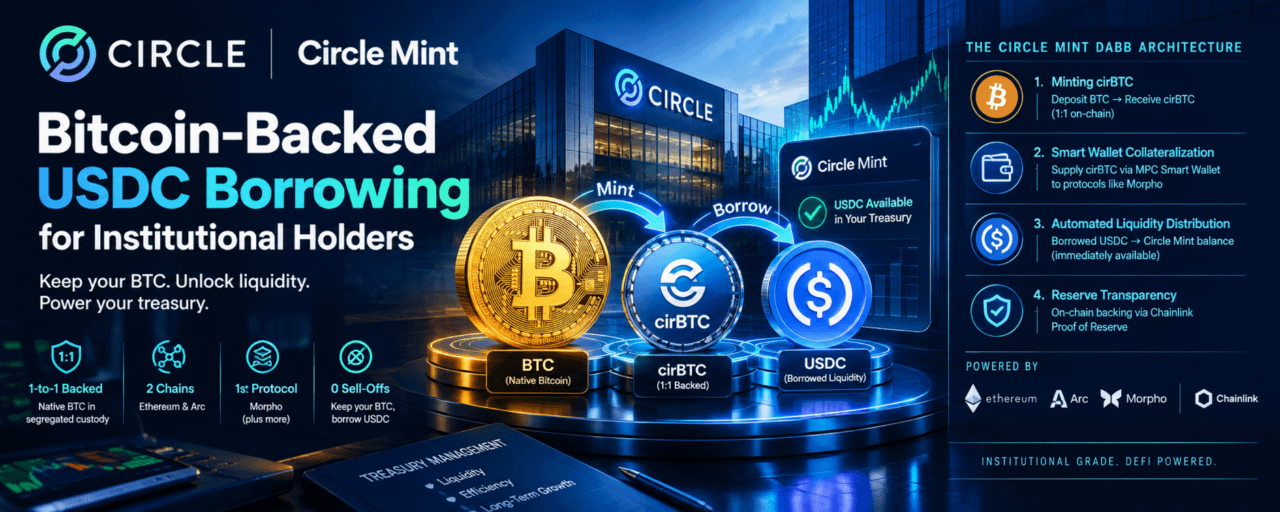
Circle Mint stellt Bitcoin-gestütztes USDC-Kreditangebot für institutionelle Inhaber vorBerechtigte institutionelle Kunden können nun geborene Bitcoin-Sicherheiten nutzen, um USDC direkt in ihre Treasury-Guthaben aufzunehmen, ohne ihre zugrunde liegenden Bestände zu verkaufen.
Die institutionelle Krypto-Marktinfrastruktur ist einen weiteren Schritt vorangekommen, da Circle ($CRCL ) die Digital Asset-Backed Borrowing (DABB) über Circle Mint einführt. Berechtigte institutionelle Konten, die Bitcoin ($BTC ) halten, können nun Circle Wrapped Bitcoin (cirBTC) prägen, es als Sicherheit in unterstützten dezentralen Kreditvergabe-Protokollen bereitstellen und $USDC direkt in ihre operativen Guthaben aufnehmen – sodass Unternehmens-Treasuries Working Capital freisetzen können, während sie gleichzeitig die langfristige Marktexponierung neben Vermögenswerten wie $ETH beibehalten.
Circle Mint stellt Bitcoin-gestütztes USDC-Kreditangebot für institutionelle Inhaber vor
Berechtigte institutionelle Kunden können nun geborene Bitcoin-Sicherheiten nutzen, um USDC direkt in ihre Treasury-Guthaben aufzunehmen, ohne ihre zugrunde liegenden Bestände zu verkaufen.
Die institutionelle Krypto-Marktinfrastruktur ist einen weiteren Schritt vorangekommen, da Circle ($CRCL ) die Digital Asset-Backed Borrowing (DABB) über Circle Mint einführt. Berechtigte institutionelle Konten, die Bitcoin ($BTC ) halten, können nun Circle Wrapped Bitcoin (cirBTC) prägen, es als Sicherheit in unterstützten dezentralen Kreditvergabe-Protokollen bereitstellen und $USDC direkt in ihre operativen Guthaben aufnehmen – sodass Unternehmens-Treasuries Working Capital freisetzen können, während sie gleichzeitig die langfristige Marktexponierung neben Vermögenswerten wie $ETH beibehalten.
Die institutionelle Krypto-Marktinfrastruktur ist einen weiteren Schritt vorangekommen, da Circle ($CRCL ) die Digital Asset-Backed Borrowing (DABB) über Circle Mint einführt. Berechtigte institutionelle Konten, die Bitcoin ($BTC ) halten, können nun Circle Wrapped Bitcoin (cirBTC) prägen, es als Sicherheit in unterstützten dezentralen Kreditvergabe-Protokollen bereitstellen und $USDC direkt in ihre operativen Guthaben aufnehmen – sodass Unternehmens-Treasuries Working Capital freisetzen können, während sie gleichzeitig die langfristige Marktexponierung neben Vermögenswerten wie $ETH beibehalten.
1
228
·
--
Artikel
Übersetzung ansehen
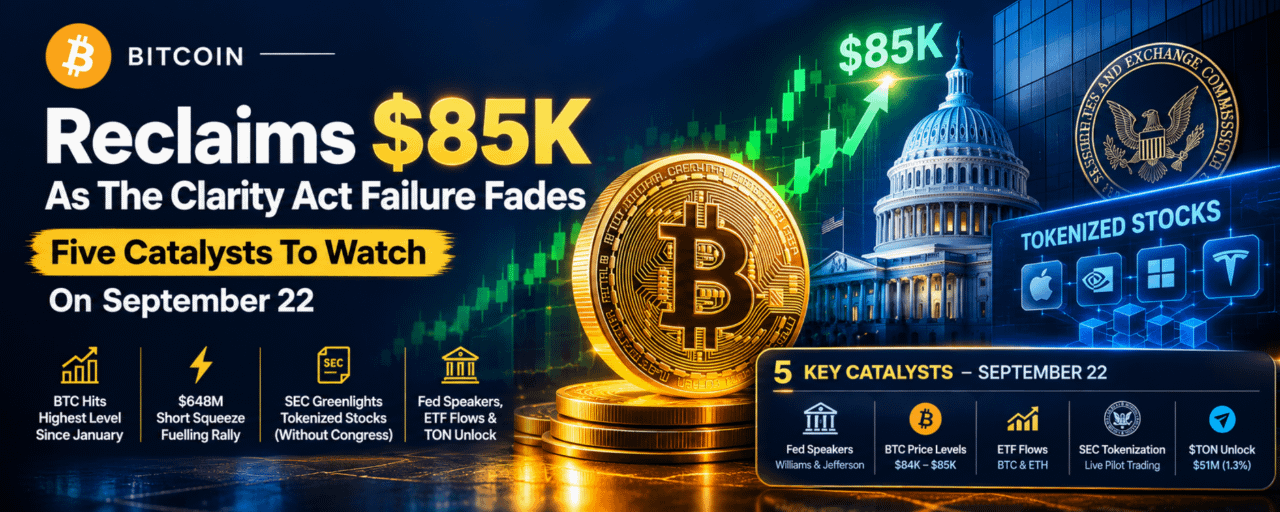
Bitcoin Reclaims $85K As The Clarity Act Failure Fades: Five Catalysts To Watch On September 22Bitcoin hit its highest level since January on a $648 million short squeeze, while the SEC moves ahead on tokenized stocks without Congress. Fed speakers, ETF flows and a $51 million $TON unlock will help decide whether the rally holds.
One week ago, $BTC traded near $75,000 after the Senate failed to advance the Clarity Act. Today it briefly topped $85,000. The bigger question for Tuesday is whether the move rests on real demand or on forced short covering, and whether an SEC workaround and the Fed's next comments change that picture. Altcoin traders also have $ETH relative strength and a TON unlock to track.
KEY FACTS
▪️ Bitcoin briefly topped $85,000 on September 21, its highest level since January, after trading near $75,000 on September 15.
▪️ CoinGlass data showed more than $750 million in crypto liquidations over 24 hours, with $648.3 million of them shorts.
▪️ The Clarity Act failed a Senate procedural vote 49 to 50 on September 15, well short of the 60 needed.
▪️ Two days later, on September 17, the SEC issued a five-year "Innovation Exemption" for tokenized U.S. stocks.
▪️ Strategy bought 950 BTC for $75.7 million at an average price of $79,670, bringing its holdings to 846,000 BTC.
WHY THE MARKET SHRUGGED OFF THE CLARITY FAILURE (ANALYSIS)
The selloff after the Senate vote reversed within days. Part of the recovery looks like squeeze-driven buying: shorts made up the bulk of liquidations, and several reports say the rally leaned heavily on forced covering. Part of it looks like genuine demand, with Strategy resuming purchases and BTC closing a weekly candle above its 50-week moving average, per one market digest. The distinction matters, because a move powered by liquidations can retrace quickly once the forced buying ends.
THE SEC WORKAROUND
The exemption lets qualifying Tokenized Securities Venues trade tokenized U.S. stocks on public blockchains through permissioned liquidity pools without registering as national exchanges. It comes with real limits:
▪️ It is temporary, lasting five years, and conditional.
▪️ Venues must be U.S. entities, and issuers can veto trading of their stocks.
▪️ It excludes synthetic products and includes volume limits.
▪️ It is not a blanket legalization of crypto assets.
CoinDesk's calendar lists September 22 as the day the window opens for pilot trading. My read: tokenization could increase demand for blockchain settlement, stablecoins and on-chain liquidity, but that is a narrative, not a guarantee for every altcoin.
SEPTEMBER 22 WATCHLIST
▪️ Fed speakers: New York Fed President John Williams speaks at 10:05 a.m. ET and Vice Chair Philip Jefferson at 10:20 a.m. ET at the Treasury Market Conference. The Fed raised rates 25 bps to 3.75%–4.00% last week, so guidance on another hike is the market-moving question.
▪️ BTC price levels: Whether it can hold the $84,000–85,000 area. Glassnode's broader resistance band extends to $86,000, and one report says Bitcoin would turn positive for the year above $87,000.
▪️ ETF flows: Spot Bitcoin ETFs took in $433 million on September 18 and Ethereum ETFs added $144 million. But the five-session week was roughly flat for Bitcoin funds, after $746 million of outflows on September 15 and 16. Monday's flow numbers are the next check.
▪️ SEC tokenization: Actual venue activity, not just headlines.
▪️ TON unlock: About $51.2 million, or 1.3% of circulating supply. Watch price, volume and exchange inflows to see whether it absorbs the supply.
BTC VS ETH
Bitcoin is leading today, gaining more than 4% since midnight UTC against roughly 2% for $ETH, per CoinDesk. But ETH is well ahead of BTC this quarter, so this isn't a simple "ETH is weak" story. If BTC keeps outperforming, the market is still trading as a BTC-led risk move rather than a broad altcoin rotation.
TWO WAYS THIS COULD GO (SCENARIOS, NOT FORECASTS)
▪️ Constructive: BTC holds the $84,000–85,000 area, ETF inflows continue, Fed speakers don't sharpen hawkish guidance, and the narrative shifts from "Clarity failed" to "regulation is advancing through agencies."
▪️ Risk: BTC loses the area, Fed comments lean toward more tightening, ETF flows reverse, and altcoins sell into the TON unlock. In that case, Monday's rally looks more like short covering than durable accumulation.
WHAT NOT TO BELIEVE
▪️ "The Clarity Act is coming back tomorrow." Nothing I found supports it.
▪️ "The SEC approved all crypto." The exemption is narrow and covers tokenized stocks only.
▪️ "Tokenized stocks are bullish for every altcoin." That does not follow from the evidence.
LATER THIS WEEK
Flash PMIs come out September 23. Jobless claims and new home sales land on September 24. Durable goods and the final Michigan sentiment reading follow on September 25, with consensus near 47.8 against 51.7 previously. A large XPL unlock, worth about $158 million and roughly 63% of circulating supply, is also due September 25.
BOTTOM LINE
The Clarity Act failure is no longer the market's dominant story. The rally is real, but part of it is forced buying, so price action, ETF flows and Fed comments matter more than the headline.
Is $85K a breakout or a squeeze that needs a retest? Share your levels below.
Sources: CoinGlass, The Block, CoinDesk, SEC-related coverage, Farside, Strategy 8-K.
Not financial advice. Always DYOR.
#bitcoin #BTC #SEC #Tokenization #ShortSqueeze
Bitcoin Reclaims $85K As The Clarity Act Failure Fades: Five Catalysts To Watch On September 22
Bitcoin hit its highest level since January on a $648 million short squeeze, while the SEC moves ahead on tokenized stocks without Congress. Fed speakers, ETF flows and a $51 million $TON unlock will help decide whether the rally holds.
One week ago, $BTC traded near $75,000 after the Senate failed to advance the Clarity Act. Today it briefly topped $85,000. The bigger question for Tuesday is whether the move rests on real demand or on forced short covering, and whether an SEC workaround and the Fed's next comments change that picture. Altcoin traders also have $ETH relative strength and a TON unlock to track.
KEY FACTS
▪️ Bitcoin briefly topped $85,000 on September 21, its highest level since January, after trading near $75,000 on September 15.
▪️ CoinGlass data showed more than $750 million in crypto liquidations over 24 hours, with $648.3 million of them shorts.
▪️ The Clarity Act failed a Senate procedural vote 49 to 50 on September 15, well short of the 60 needed.
▪️ Two days later, on September 17, the SEC issued a five-year "Innovation Exemption" for tokenized U.S. stocks.
▪️ Strategy bought 950 BTC for $75.7 million at an average price of $79,670, bringing its holdings to 846,000 BTC.
WHY THE MARKET SHRUGGED OFF THE CLARITY FAILURE (ANALYSIS)
The selloff after the Senate vote reversed within days. Part of the recovery looks like squeeze-driven buying: shorts made up the bulk of liquidations, and several reports say the rally leaned heavily on forced covering. Part of it looks like genuine demand, with Strategy resuming purchases and BTC closing a weekly candle above its 50-week moving average, per one market digest. The distinction matters, because a move powered by liquidations can retrace quickly once the forced buying ends.
THE SEC WORKAROUND
The exemption lets qualifying Tokenized Securities Venues trade tokenized U.S. stocks on public blockchains through permissioned liquidity pools without registering as national exchanges. It comes with real limits:
▪️ It is temporary, lasting five years, and conditional.
▪️ Venues must be U.S. entities, and issuers can veto trading of their stocks.
▪️ It excludes synthetic products and includes volume limits.
▪️ It is not a blanket legalization of crypto assets.
CoinDesk's calendar lists September 22 as the day the window opens for pilot trading. My read: tokenization could increase demand for blockchain settlement, stablecoins and on-chain liquidity, but that is a narrative, not a guarantee for every altcoin.
SEPTEMBER 22 WATCHLIST
▪️ Fed speakers: New York Fed President John Williams speaks at 10:05 a.m. ET and Vice Chair Philip Jefferson at 10:20 a.m. ET at the Treasury Market Conference. The Fed raised rates 25 bps to 3.75%–4.00% last week, so guidance on another hike is the market-moving question.
▪️ BTC price levels: Whether it can hold the $84,000–85,000 area. Glassnode's broader resistance band extends to $86,000, and one report says Bitcoin would turn positive for the year above $87,000.
▪️ ETF flows: Spot Bitcoin ETFs took in $433 million on September 18 and Ethereum ETFs added $144 million. But the five-session week was roughly flat for Bitcoin funds, after $746 million of outflows on September 15 and 16. Monday's flow numbers are the next check.
▪️ SEC tokenization: Actual venue activity, not just headlines.
▪️ TON unlock: About $51.2 million, or 1.3% of circulating supply. Watch price, volume and exchange inflows to see whether it absorbs the supply.
BTC VS ETH
Bitcoin is leading today, gaining more than 4% since midnight UTC against roughly 2% for $ETH , per CoinDesk. But ETH is well ahead of BTC this quarter, so this isn't a simple "ETH is weak" story. If BTC keeps outperforming, the market is still trading as a BTC-led risk move rather than a broad altcoin rotation.
TWO WAYS THIS COULD GO (SCENARIOS, NOT FORECASTS)
▪️ Constructive: BTC holds the $84,000–85,000 area, ETF inflows continue, Fed speakers don't sharpen hawkish guidance, and the narrative shifts from "Clarity failed" to "regulation is advancing through agencies."
▪️ Risk: BTC loses the area, Fed comments lean toward more tightening, ETF flows reverse, and altcoins sell into the TON unlock. In that case, Monday's rally looks more like short covering than durable accumulation.
WHAT NOT TO BELIEVE
▪️ "The Clarity Act is coming back tomorrow." Nothing I found supports it.
▪️ "The SEC approved all crypto." The exemption is narrow and covers tokenized stocks only.
▪️ "Tokenized stocks are bullish for every altcoin." That does not follow from the evidence.
LATER THIS WEEK
Flash PMIs come out September 23. Jobless claims and new home sales land on September 24. Durable goods and the final Michigan sentiment reading follow on September 25, with consensus near 47.8 against 51.7 previously. A large XPL unlock, worth about $158 million and roughly 63% of circulating supply, is also due September 25.
BOTTOM LINE
The Clarity Act failure is no longer the market's dominant story. The rally is real, but part of it is forced buying, so price action, ETF flows and Fed comments matter more than the headline.
Is $85K a breakout or a squeeze that needs a retest? Share your levels below.
Sources: CoinGlass, The Block, CoinDesk, SEC-related coverage, Farside, Strategy 8-K.
Not financial advice. Always DYOR.
#bitcoin #BTC #SEC #Tokenization #ShortSqueeze
One week ago, $BTC traded near $75,000 after the Senate failed to advance the Clarity Act. Today it briefly topped $85,000. The bigger question for Tuesday is whether the move rests on real demand or on forced short covering, and whether an SEC workaround and the Fed's next comments change that picture. Altcoin traders also have $ETH relative strength and a TON unlock to track.
KEY FACTS
▪️ Bitcoin briefly topped $85,000 on September 21, its highest level since January, after trading near $75,000 on September 15.
▪️ CoinGlass data showed more than $750 million in crypto liquidations over 24 hours, with $648.3 million of them shorts.
▪️ The Clarity Act failed a Senate procedural vote 49 to 50 on September 15, well short of the 60 needed.
▪️ Two days later, on September 17, the SEC issued a five-year "Innovation Exemption" for tokenized U.S. stocks.
▪️ Strategy bought 950 BTC for $75.7 million at an average price of $79,670, bringing its holdings to 846,000 BTC.
WHY THE MARKET SHRUGGED OFF THE CLARITY FAILURE (ANALYSIS)
The selloff after the Senate vote reversed within days. Part of the recovery looks like squeeze-driven buying: shorts made up the bulk of liquidations, and several reports say the rally leaned heavily on forced covering. Part of it looks like genuine demand, with Strategy resuming purchases and BTC closing a weekly candle above its 50-week moving average, per one market digest. The distinction matters, because a move powered by liquidations can retrace quickly once the forced buying ends.
THE SEC WORKAROUND
The exemption lets qualifying Tokenized Securities Venues trade tokenized U.S. stocks on public blockchains through permissioned liquidity pools without registering as national exchanges. It comes with real limits:
▪️ It is temporary, lasting five years, and conditional.
▪️ Venues must be U.S. entities, and issuers can veto trading of their stocks.
▪️ It excludes synthetic products and includes volume limits.
▪️ It is not a blanket legalization of crypto assets.
CoinDesk's calendar lists September 22 as the day the window opens for pilot trading. My read: tokenization could increase demand for blockchain settlement, stablecoins and on-chain liquidity, but that is a narrative, not a guarantee for every altcoin.
SEPTEMBER 22 WATCHLIST
▪️ Fed speakers: New York Fed President John Williams speaks at 10:05 a.m. ET and Vice Chair Philip Jefferson at 10:20 a.m. ET at the Treasury Market Conference. The Fed raised rates 25 bps to 3.75%–4.00% last week, so guidance on another hike is the market-moving question.
▪️ BTC price levels: Whether it can hold the $84,000–85,000 area. Glassnode's broader resistance band extends to $86,000, and one report says Bitcoin would turn positive for the year above $87,000.
▪️ ETF flows: Spot Bitcoin ETFs took in $433 million on September 18 and Ethereum ETFs added $144 million. But the five-session week was roughly flat for Bitcoin funds, after $746 million of outflows on September 15 and 16. Monday's flow numbers are the next check.
▪️ SEC tokenization: Actual venue activity, not just headlines.
▪️ TON unlock: About $51.2 million, or 1.3% of circulating supply. Watch price, volume and exchange inflows to see whether it absorbs the supply.
BTC VS ETH
Bitcoin is leading today, gaining more than 4% since midnight UTC against roughly 2% for $ETH , per CoinDesk. But ETH is well ahead of BTC this quarter, so this isn't a simple "ETH is weak" story. If BTC keeps outperforming, the market is still trading as a BTC-led risk move rather than a broad altcoin rotation.
TWO WAYS THIS COULD GO (SCENARIOS, NOT FORECASTS)
▪️ Constructive: BTC holds the $84,000–85,000 area, ETF inflows continue, Fed speakers don't sharpen hawkish guidance, and the narrative shifts from "Clarity failed" to "regulation is advancing through agencies."
▪️ Risk: BTC loses the area, Fed comments lean toward more tightening, ETF flows reverse, and altcoins sell into the TON unlock. In that case, Monday's rally looks more like short covering than durable accumulation.
WHAT NOT TO BELIEVE
▪️ "The Clarity Act is coming back tomorrow." Nothing I found supports it.
▪️ "The SEC approved all crypto." The exemption is narrow and covers tokenized stocks only.
▪️ "Tokenized stocks are bullish for every altcoin." That does not follow from the evidence.
LATER THIS WEEK
Flash PMIs come out September 23. Jobless claims and new home sales land on September 24. Durable goods and the final Michigan sentiment reading follow on September 25, with consensus near 47.8 against 51.7 previously. A large XPL unlock, worth about $158 million and roughly 63% of circulating supply, is also due September 25.
BOTTOM LINE
The Clarity Act failure is no longer the market's dominant story. The rally is real, but part of it is forced buying, so price action, ETF flows and Fed comments matter more than the headline.
Is $85K a breakout or a squeeze that needs a retest? Share your levels below.
Sources: CoinGlass, The Block, CoinDesk, SEC-related coverage, Farside, Strategy 8-K.
Not financial advice. Always DYOR.
#bitcoin #BTC #SEC #Tokenization #ShortSqueeze
59
·
--
Artikel
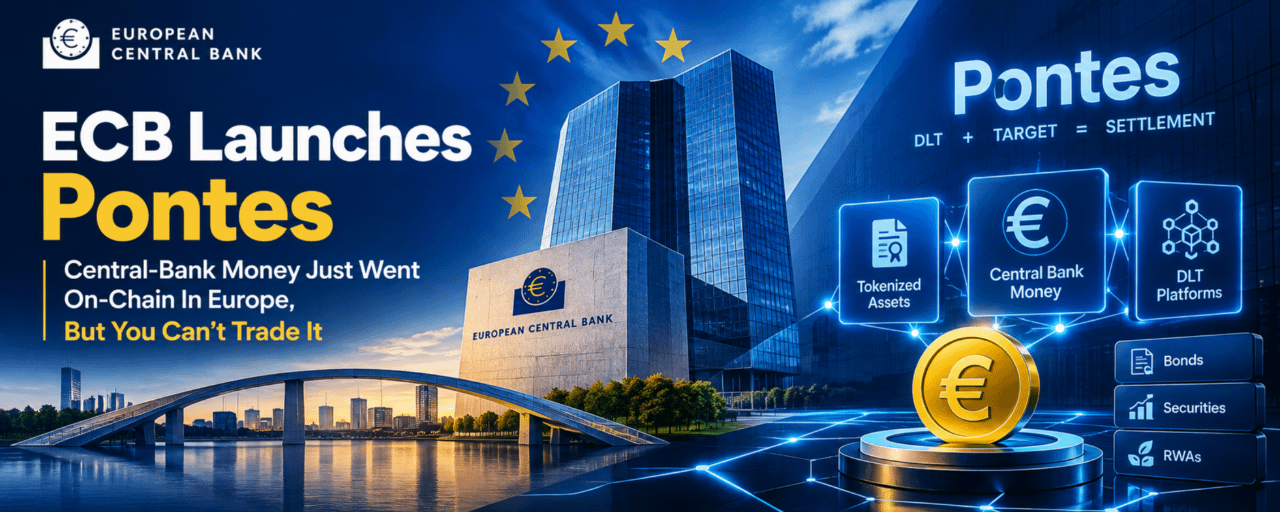
Europa startet Pontes: Zentralbankgeld wickelt jetzt tokenisierte Vermögenswerte ab – Trader sollten darauf achtenDie Europäische Zentralbank hat Pontes heute eingeschaltet und es Banken ermöglicht, tokenisierte Vermögenswerte in Zentralbank-Euros abzuwickeln. Es ist kein Token und kein direkter Auslöser für $BTC oder $ETH , aber es könnte das deutlichste Signal bisher sein, dass institutionelle Tokenisierung zu Infrastruktur wird.
Tokenisierte Anleihen und Wertpapiere konnten schon länger on-chain gehandelt werden. Was ihnen fehlte, war ein risikofreier Weg, die Cash-Seite abzuwickeln. Pontes, das am 21. September live ging, ist die Antwort der EZB – und es ist für alle relevant, die die RWA-, Stablecoin- und Tokenisierungs-Erzählungen verfolgen.
Europa startet Pontes: Zentralbankgeld wickelt jetzt tokenisierte Vermögenswerte ab – Trader sollten darauf achten
Die Europäische Zentralbank hat Pontes heute eingeschaltet und es Banken ermöglicht, tokenisierte Vermögenswerte in Zentralbank-Euros abzuwickeln. Es ist kein Token und kein direkter Auslöser für $BTC oder $ETH , aber es könnte das deutlichste Signal bisher sein, dass institutionelle Tokenisierung zu Infrastruktur wird.
Tokenisierte Anleihen und Wertpapiere konnten schon länger on-chain gehandelt werden. Was ihnen fehlte, war ein risikofreier Weg, die Cash-Seite abzuwickeln. Pontes, das am 21. September live ging, ist die Antwort der EZB – und es ist für alle relevant, die die RWA-, Stablecoin- und Tokenisierungs-Erzählungen verfolgen.
Tokenisierte Anleihen und Wertpapiere konnten schon länger on-chain gehandelt werden. Was ihnen fehlte, war ein risikofreier Weg, die Cash-Seite abzuwickeln. Pontes, das am 21. September live ging, ist die Antwort der EZB – und es ist für alle relevant, die die RWA-, Stablecoin- und Tokenisierungs-Erzählungen verfolgen.
50
·
--
Artikel
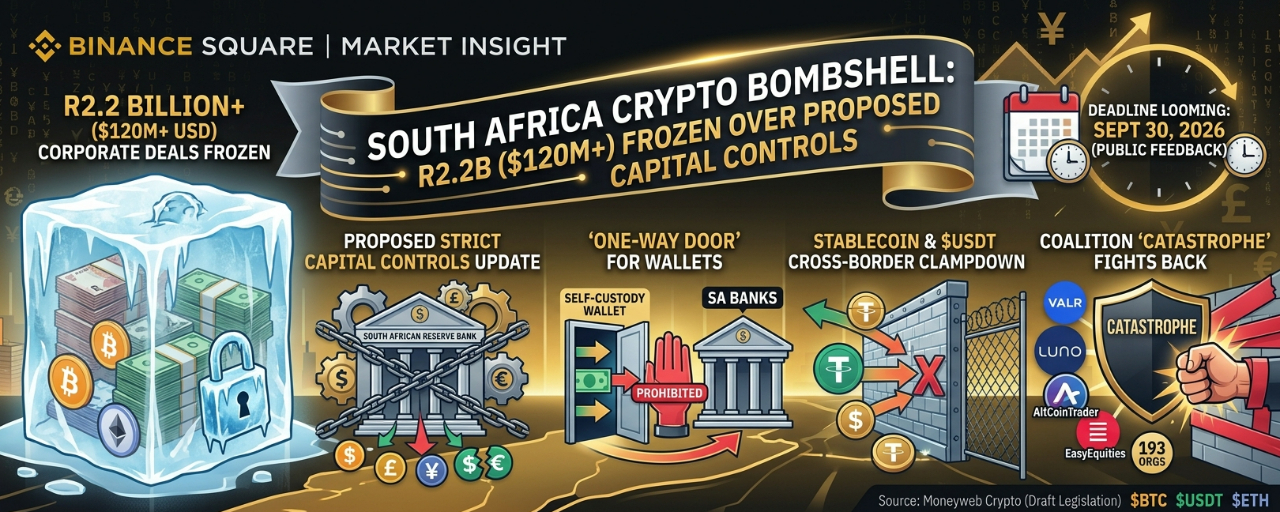
Südafrikas geplanter Krypto-Bremse friert Deals im Wert von 2,2 Milliarden Rand ein und setzt Stablecoin-Zuflüsse aufs SpielMindestens drei Krypto-Deals im Wert von R2,2 Milliarden liegen in Südafrika auf Eis, dem zweitgrößten Krypto-Markt des Kontinents. Entwürfe für Devisenkontrollregeln gefährden die grenzüberschreitende Nutzung von Stablecoins. Die öffentliche Konsultation endet am 30. September.
Digital-Asset-Unternehmen in Südafrika haben wegen vorgeschlagener Regeln, die Krypto in das Devisenkontrollsystem des Landes einordnen würden, Milliarden Rand in Transaktionen pausiert. Branchenvertreter warnen, die Regeln könnten legitime Krypto-Aktivitäten ins Ausland verlagern, und das Ergebnis ist entscheidend für $USDT - und $BTC -Händler in ganz Afrika.
Südafrikas geplanter Krypto-Bremse friert Deals im Wert von 2,2 Milliarden Rand ein und setzt Stablecoin-Zuflüsse aufs Spiel
Mindestens drei Krypto-Deals im Wert von R2,2 Milliarden liegen in Südafrika auf Eis, dem zweitgrößten Krypto-Markt des Kontinents. Entwürfe für Devisenkontrollregeln gefährden die grenzüberschreitende Nutzung von Stablecoins. Die öffentliche Konsultation endet am 30. September.
Digital-Asset-Unternehmen in Südafrika haben wegen vorgeschlagener Regeln, die Krypto in das Devisenkontrollsystem des Landes einordnen würden, Milliarden Rand in Transaktionen pausiert. Branchenvertreter warnen, die Regeln könnten legitime Krypto-Aktivitäten ins Ausland verlagern, und das Ergebnis ist entscheidend für $USDT - und $BTC -Händler in ganz Afrika.
Digital-Asset-Unternehmen in Südafrika haben wegen vorgeschlagener Regeln, die Krypto in das Devisenkontrollsystem des Landes einordnen würden, Milliarden Rand in Transaktionen pausiert. Branchenvertreter warnen, die Regeln könnten legitime Krypto-Aktivitäten ins Ausland verlagern, und das Ergebnis ist entscheidend für $USDT - und $BTC -Händler in ganz Afrika.
54
·
--
Artikel
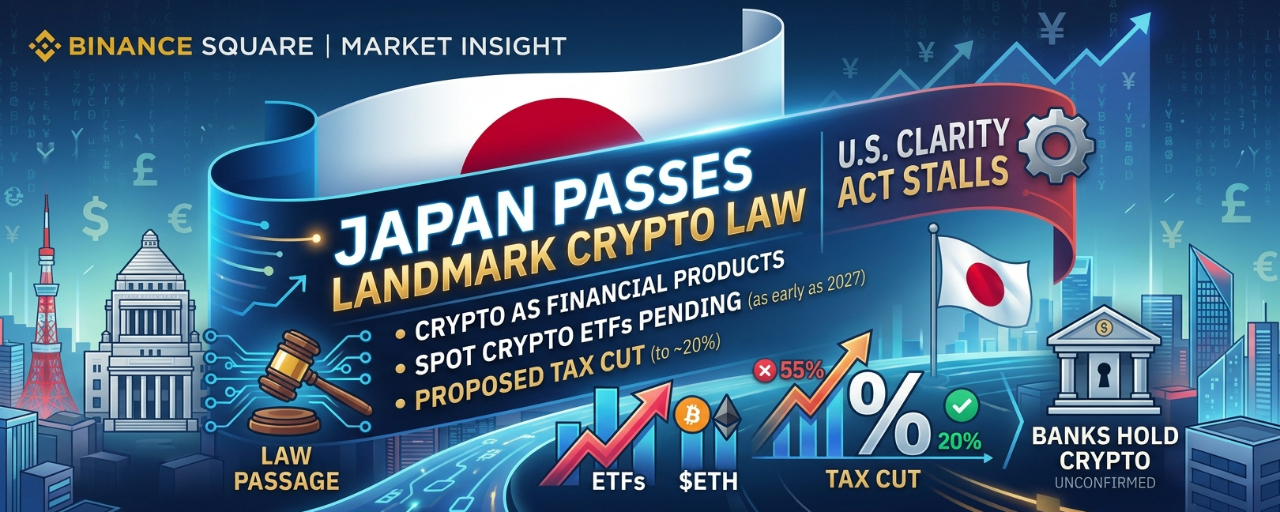
Japan Verabschiedet Meilenstein-Gesetz Für Krypto, Während Das U.S. Clarity Act HängtJapans Parlament hat Krypto als Finanzprodukte neu eingestuft und damit die Grundlage für Spot-Krypto-ETFs bereits ab 2027 geschaffen, während ein vorgeschlagener Steuerschnitt für den Spitzensteuersatz auf etwa 20 % weiterhin aussteht.
Die Reform des japanischen Krypto-Markts ist kein Entwurf mehr. Das Parlament (National Diet) hat sie am 15. Juli verabschiedet und damit $BTC <and <und $ETH < für Händler eine klarere Regelbasis geschaffen – zu einem Zeitpunkt, an dem das U.S. Clarity Act im Kongress weiterhin blockiert ist.
WICHTIGE FAKTEN
▪️ Krypto fällt nun unter das Financial Instruments and Exchange Act (FIEA) – den Rahmen, der für Aktien und Anleihen gilt – statt unter das Payment Services Act.
Japan Verabschiedet Meilenstein-Gesetz Für Krypto, Während Das U.S. Clarity Act Hängt
Japans Parlament hat Krypto als Finanzprodukte neu eingestuft und damit die Grundlage für Spot-Krypto-ETFs bereits ab 2027 geschaffen, während ein vorgeschlagener Steuerschnitt für den Spitzensteuersatz auf etwa 20 % weiterhin aussteht.
Die Reform des japanischen Krypto-Markts ist kein Entwurf mehr. Das Parlament (National Diet) hat sie am 15. Juli verabschiedet und damit $BTC <and <und $ETH < für Händler eine klarere Regelbasis geschaffen – zu einem Zeitpunkt, an dem das U.S. Clarity Act im Kongress weiterhin blockiert ist.
WICHTIGE FAKTEN
▪️ Krypto fällt nun unter das Financial Instruments and Exchange Act (FIEA) – den Rahmen, der für Aktien und Anleihen gilt – statt unter das Payment Services Act.
Die Reform des japanischen Krypto-Markts ist kein Entwurf mehr. Das Parlament (National Diet) hat sie am 15. Juli verabschiedet und damit $BTC <and <und $ETH < für Händler eine klarere Regelbasis geschaffen – zu einem Zeitpunkt, an dem das U.S. Clarity Act im Kongress weiterhin blockiert ist.
WICHTIGE FAKTEN
▪️ Krypto fällt nun unter das Financial Instruments and Exchange Act (FIEA) – den Rahmen, der für Aktien und Anleihen gilt – statt unter das Payment Services Act.
666
·
--
Übersetzung ansehen
$BTC Just Crossed 85K and its soon going to Hit 100K.
Kevin O'Leary Says: Bitcoin "WILL" Hit $1 Million, With One Big Condition
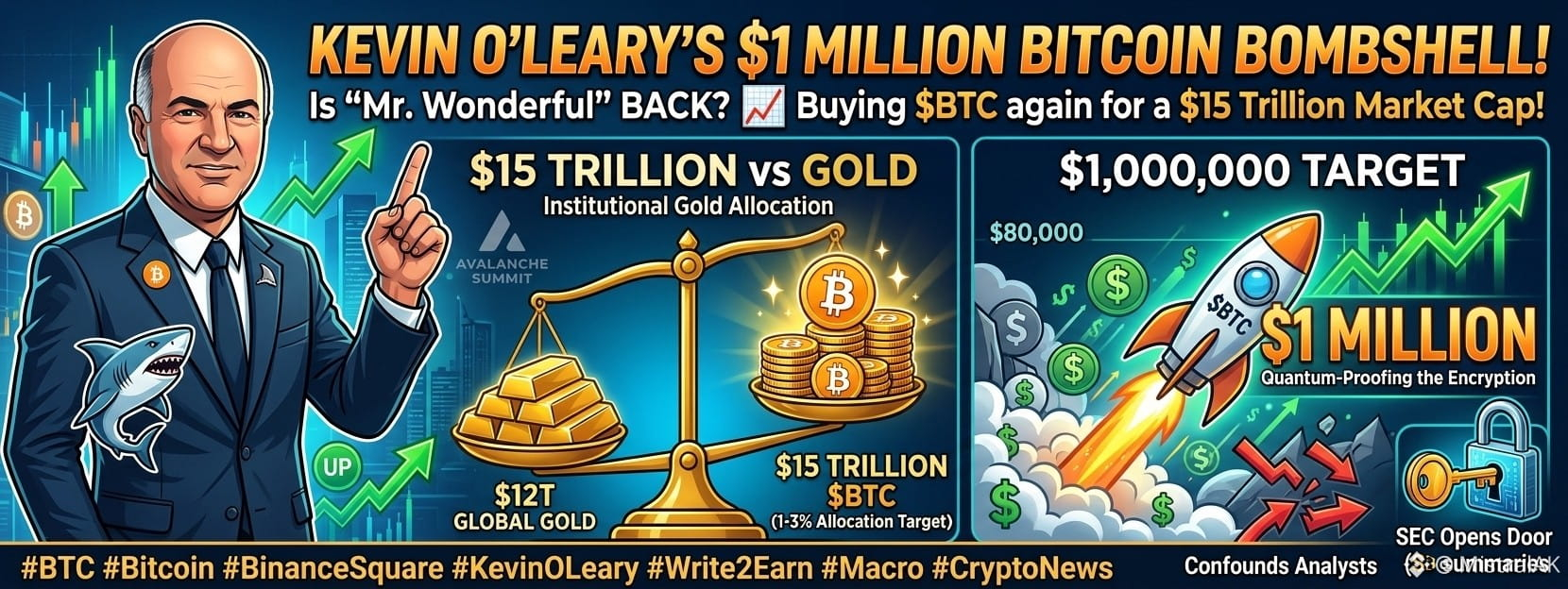
Kevin O'Leary's Bitcoin price prediction just got bigger. The Shark Tank investor says he's back buying $BTC for this cycle, and his target is now $1M. Bitcoin is holding near $80K after the Fed's first hike since 2023. Key points 👇
📌 THE THESIS
▪️ O'Leary called crypto "garbage" in 2019. Now he's buying new positions.
▪️ He expects Bitcoin to capture 1%–3% of alternative-asset allocations, like institutional gold holdings.
▪️ That implies ~$253K–$760K per BTC (up to a $15T market cap).
▪️ His new $1M target (~$20T) depends on one thing: quantum risk.
⚛️ WHY QUANTUM MATTERS
"Q-Day" is when a powerful quantum computer could break the encryption securing BTC and $ETH . A March Google paper estimated it would take under 500,000 physical qubits, ~20x fewer than earlier estimates. O'Leary says traders are already hedging with quantum-software stocks.
🏛️ TOKENIZED STOCKS
He called exchange adoption of tokenized assets a "watershed moment." This week the SEC created a regulatory path for certain venues to issue tokenized US stocks, right after the Clarity Act failed.
🧠 REALITY CHECK
▪️ $1M from ~$80K is a ~12x move.
▪️ Predictions aren't forecasts, though O'Leary is buying.
▪️ Quantum is HIS caveat, so don't skip it.
▪️ BTC has absorbed a rate hike, $100+ oil and a stalled Clarity Act and still holds up. Analysts say further upside depends on relief in oil, rates or the dollar.
Is $1M realistic this cycle, or will quantum risk be the roadblock? Drop your target 👇
Source: Forbes. Not financial advice. DYOR.
{future}(BTCUSDT)
#Bitcoin #BTC #KevinOLeary #BitcoinHits$85K #CryptoNews
$BTC Just Crossed 85K and its soon going to Hit 100K.
Kevin O'Leary Says: Bitcoin "WILL" Hit $1 Million, With One Big Condition
Kevin O'Leary's Bitcoin price prediction just got bigger. The Shark Tank investor says he's back buying $BTC for this cycle, and his target is now $1M. Bitcoin is holding near $80K after the Fed's first hike since 2023. Key points 👇
📌 THE THESIS
▪️ O'Leary called crypto "garbage" in 2019. Now he's buying new positions.
▪️ He expects Bitcoin to capture 1%–3% of alternative-asset allocations, like institutional gold holdings.
▪️ That implies ~$253K–$760K per BTC (up to a $15T market cap).
▪️ His new $1M target (~$20T) depends on one thing: quantum risk.
⚛️ WHY QUANTUM MATTERS
"Q-Day" is when a powerful quantum computer could break the encryption securing BTC and $ETH . A March Google paper estimated it would take under 500,000 physical qubits, ~20x fewer than earlier estimates. O'Leary says traders are already hedging with quantum-software stocks.
🏛️ TOKENIZED STOCKS
He called exchange adoption of tokenized assets a "watershed moment." This week the SEC created a regulatory path for certain venues to issue tokenized US stocks, right after the Clarity Act failed.
🧠 REALITY CHECK
▪️ $1M from ~$80K is a ~12x move.
▪️ Predictions aren't forecasts, though O'Leary is buying.
▪️ Quantum is HIS caveat, so don't skip it.
▪️ BTC has absorbed a rate hike, $100+ oil and a stalled Clarity Act and still holds up. Analysts say further upside depends on relief in oil, rates or the dollar.
Is $1M realistic this cycle, or will quantum risk be the roadblock? Drop your target 👇
Source: Forbes. Not financial advice. DYOR.
#Bitcoin #BTC #KevinOLeary #BitcoinHits$85K #CryptoNews
Kevin O'Leary Says: Bitcoin "WILL" Hit $1 Million, With One Big Condition
Kevin O'Leary's Bitcoin price prediction just got bigger. The Shark Tank investor says he's back buying $BTC for this cycle, and his target is now $1M. Bitcoin is holding near $80K after the Fed's first hike since 2023. Key points 👇
📌 THE THESIS
▪️ O'Leary called crypto "garbage" in 2019. Now he's buying new positions.
▪️ He expects Bitcoin to capture 1%–3% of alternative-asset allocations, like institutional gold holdings.
▪️ That implies ~$253K–$760K per BTC (up to a $15T market cap).
▪️ His new $1M target (~$20T) depends on one thing: quantum risk.
⚛️ WHY QUANTUM MATTERS
"Q-Day" is when a powerful quantum computer could break the encryption securing BTC and $ETH . A March Google paper estimated it would take under 500,000 physical qubits, ~20x fewer than earlier estimates. O'Leary says traders are already hedging with quantum-software stocks.
🏛️ TOKENIZED STOCKS
He called exchange adoption of tokenized assets a "watershed moment." This week the SEC created a regulatory path for certain venues to issue tokenized US stocks, right after the Clarity Act failed.
🧠 REALITY CHECK
▪️ $1M from ~$80K is a ~12x move.
▪️ Predictions aren't forecasts, though O'Leary is buying.
▪️ Quantum is HIS caveat, so don't skip it.
▪️ BTC has absorbed a rate hike, $100+ oil and a stalled Clarity Act and still holds up. Analysts say further upside depends on relief in oil, rates or the dollar.
Is $1M realistic this cycle, or will quantum risk be the roadblock? Drop your target 👇
Source: Forbes. Not financial advice. DYOR.
#Bitcoin #BTC #KevinOLeary #BitcoinHits$85K #CryptoNews
1
143
·
--
Übersetzung ansehen
Fed hiked. BOJ hiked. And now the yen is the wildcard for $BTC 🚨
Binance News flagged it: the yen is near 156.9 after its worst week in almost a year, and Japan is closed until Wednesday. Here's my take 👇
1️⃣ Japan hiked, but the market wanted a roadmap
Two board members dissented, and Ueda gave no end point or pace for future hikes. Traders heard "slower tightening" and sold the yen anyway.
2️⃣ Thin liquidity means amplified moves
The BOJ has already done a rate check, which often comes before intervention. With Japan on holiday, any move could hit a thin market and overshoot. Golden Week played out the same way when the yen broke 160.
3️⃣ Why crypto traders should care: the carry trade
Cheap yen funding has helped fuel leveraged risk-taking globally. A sharp yen rebound can force those trades to unwind, and Aug 2024 showed how that can hit $BTC. Bitcoin just squeezed above $80K, and crypto trades 24/7 while Tokyo is closed.
⚠️ My read: two-way risk
▪️ Yen keeps sliding: intervention odds rise
▪️ Intervention lands: a fast yen spike and a volatility shock
▪️ Either way, over-leveraged longs are the ones exposed
Is the yen the hidden risk for $BTC this week, or is the market shrugging it off? 👇
Not financial advice. Leverage can liquidate you fast. Always DYOR.
#BOJ #Yen #Bitcoin #CarryTrade #CryptoNews
Fed hiked. BOJ hiked. And now the yen is the wildcard for $BTC 🚨
Binance News flagged it: the yen is near 156.9 after its worst week in almost a year, and Japan is closed until Wednesday. Here's my take 👇
1️⃣ Japan hiked, but the market wanted a roadmap
Two board members dissented, and Ueda gave no end point or pace for future hikes. Traders heard "slower tightening" and sold the yen anyway.
2️⃣ Thin liquidity means amplified moves
The BOJ has already done a rate check, which often comes before intervention. With Japan on holiday, any move could hit a thin market and overshoot. Golden Week played out the same way when the yen broke 160.
3️⃣ Why crypto traders should care: the carry trade
Cheap yen funding has helped fuel leveraged risk-taking globally. A sharp yen rebound can force those trades to unwind, and Aug 2024 showed how that can hit $BTC. Bitcoin just squeezed above $80K, and crypto trades 24/7 while Tokyo is closed.
⚠️ My read: two-way risk
▪️ Yen keeps sliding: intervention odds rise
▪️ Intervention lands: a fast yen spike and a volatility shock
▪️ Either way, over-leveraged longs are the ones exposed
Is the yen the hidden risk for $BTC this week, or is the market shrugging it off? 👇
Not financial advice. Leverage can liquidate you fast. Always DYOR.
#BOJ #Yen #Bitcoin #CarryTrade #CryptoNews
Binance News flagged it: the yen is near 156.9 after its worst week in almost a year, and Japan is closed until Wednesday. Here's my take 👇
1️⃣ Japan hiked, but the market wanted a roadmap
Two board members dissented, and Ueda gave no end point or pace for future hikes. Traders heard "slower tightening" and sold the yen anyway.
2️⃣ Thin liquidity means amplified moves
The BOJ has already done a rate check, which often comes before intervention. With Japan on holiday, any move could hit a thin market and overshoot. Golden Week played out the same way when the yen broke 160.
3️⃣ Why crypto traders should care: the carry trade
Cheap yen funding has helped fuel leveraged risk-taking globally. A sharp yen rebound can force those trades to unwind, and Aug 2024 showed how that can hit $BTC. Bitcoin just squeezed above $80K, and crypto trades 24/7 while Tokyo is closed.
⚠️ My read: two-way risk
▪️ Yen keeps sliding: intervention odds rise
▪️ Intervention lands: a fast yen spike and a volatility shock
▪️ Either way, over-leveraged longs are the ones exposed
Is the yen the hidden risk for $BTC this week, or is the market shrugging it off? 👇
Not financial advice. Leverage can liquidate you fast. Always DYOR.
#BOJ #Yen #Bitcoin #CarryTrade #CryptoNews


Binance News
·
--
Japans Politiksignal enttäuscht: Feiertage dünnen die Liquidität aus und erhöhen das Risiko für Yen-Abwärtsbewegungen
Der Yen dürfte in den kommenden Tagen voraussichtlich kräftig schwanken und weiter nachgeben. Laut Sina Finance geht Japan in eine dreitägige Feiertagswoche, was die Liquidität an den Märkten verringern wird. Gleichzeitig gab die Bank of Japan keine klarere Orientierung zum Tempo künftiger Zinserhöhungen, was Anleger enttäuschte.
Am Montag stabilisierte sich der Yen nahe 156,86 Yen je US-Dollar. Am Freitag war er zeitweise um bis zu 1,3% gefallen, nachdem zwei Mitglieder des Notenbankrats der Bank of Japan gegen eine Zinserhöhung gestimmt hatten. Ein späterer Bericht, wonach Beamte Marktteilnehmer zu einer Währungsprüfung aufgefordert hätten, verengte den Rückgang nur leicht.
Am Montag stabilisierte sich der Yen nahe 156,86 Yen je US-Dollar. Am Freitag war er zeitweise um bis zu 1,3% gefallen, nachdem zwei Mitglieder des Notenbankrats der Bank of Japan gegen eine Zinserhöhung gestimmt hatten. Ein späterer Bericht, wonach Beamte Marktteilnehmer zu einer Währungsprüfung aufgefordert hätten, verengte den Rückgang nur leicht.
21
·
--
Übersetzung ansehen
WHY DID CRYPTO PUMP ON A FED RATE HIKE ? CONFUSED !
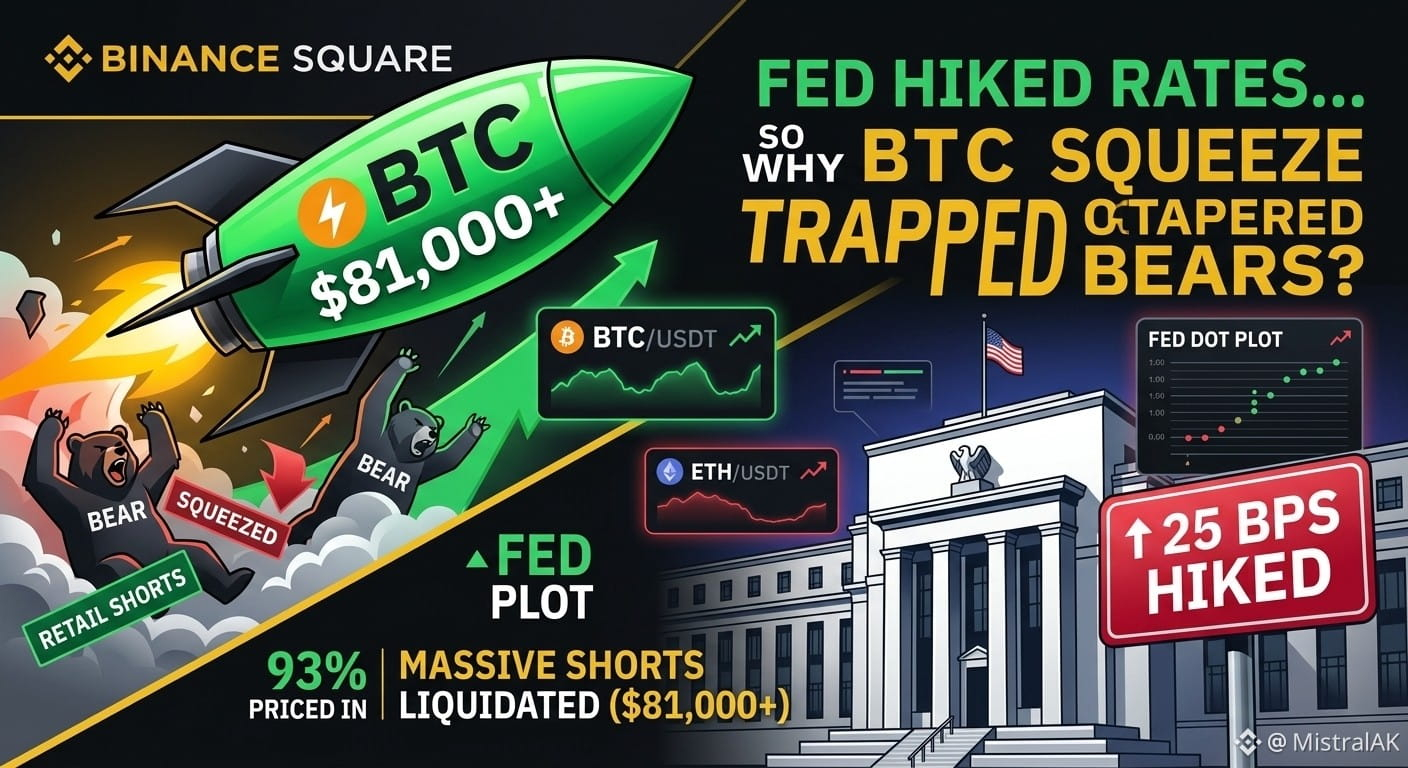
Everyone said "rate hike = bearish." Then $BTC went from ~$75K to above $81K and $450M+ in shorts got wiped out. Here's the real story:
1️⃣ The hike was already in the price:
The Fed raised rates 25 bps to 3.75%–4.00%, its first hike since 2023 and a unanimous vote. CME futures had it at roughly 92% before the meeting. No surprise means the uncertainty premium disappears. Classic "buy the news."
2️⃣ The market was positioned for a crash:
#BTC had just slid toward $75K after the CLARITY Act stalled in the Senate, and shorts piled in. When Bitcoin refused to break down, forced buying kicked in. It was a textbook short squeeze that dragged $ETH , $BNB and $SOL higher.
3️⃣ Hawkish did not mean worse than feared:
Chair Warsh sounded tough, and 16 of 18 officials see another hike this year. But the projections showed no sustained tightening cycle into 2027, and the 10-year yield backed off from 5%. Markets trade expectations vs. reality, not tone.
⚠️ What I'm watching now:
▪️ $80K: hold it and the squeeze has legs, lose it and the move may be spent
▪️ $81K–$83K: the supply zone bulls still need to clear
▪️ Leverage: after this much liquidation, funding and open interest reset fast
Did you buy the breakout, or are you waiting for a retest of $80K? Drop your level below 👇
Not financial advice. Leverage can liquidate you fast. Always DYOR.
#bitcoin #BTC #fomc #ShortSqueeze #CryptoNews
WHY DID CRYPTO PUMP ON A FED RATE HIKE ? CONFUSED !
Everyone said "rate hike = bearish." Then $BTC went from ~$75K to above $81K and $450M+ in shorts got wiped out. Here's the real story:
1️⃣ The hike was already in the price:
The Fed raised rates 25 bps to 3.75%–4.00%, its first hike since 2023 and a unanimous vote. CME futures had it at roughly 92% before the meeting. No surprise means the uncertainty premium disappears. Classic "buy the news."
2️⃣ The market was positioned for a crash:
#BTC had just slid toward $75K after the CLARITY Act stalled in the Senate, and shorts piled in. When Bitcoin refused to break down, forced buying kicked in. It was a textbook short squeeze that dragged $ETH , $BNB and $SOL higher.
3️⃣ Hawkish did not mean worse than feared:
Chair Warsh sounded tough, and 16 of 18 officials see another hike this year. But the projections showed no sustained tightening cycle into 2027, and the 10-year yield backed off from 5%. Markets trade expectations vs. reality, not tone.
⚠️ What I'm watching now:
▪️ $80K: hold it and the squeeze has legs, lose it and the move may be spent
▪️ $81K–$83K: the supply zone bulls still need to clear
▪️ Leverage: after this much liquidation, funding and open interest reset fast
Did you buy the breakout, or are you waiting for a retest of $80K? Drop your level below 👇
Not financial advice. Leverage can liquidate you fast. Always DYOR.
#bitcoin #BTC #fomc #ShortSqueeze #CryptoNews
Everyone said "rate hike = bearish." Then $BTC went from ~$75K to above $81K and $450M+ in shorts got wiped out. Here's the real story:
1️⃣ The hike was already in the price:
The Fed raised rates 25 bps to 3.75%–4.00%, its first hike since 2023 and a unanimous vote. CME futures had it at roughly 92% before the meeting. No surprise means the uncertainty premium disappears. Classic "buy the news."
2️⃣ The market was positioned for a crash:
#BTC had just slid toward $75K after the CLARITY Act stalled in the Senate, and shorts piled in. When Bitcoin refused to break down, forced buying kicked in. It was a textbook short squeeze that dragged $ETH , $BNB and $SOL higher.
3️⃣ Hawkish did not mean worse than feared:
Chair Warsh sounded tough, and 16 of 18 officials see another hike this year. But the projections showed no sustained tightening cycle into 2027, and the 10-year yield backed off from 5%. Markets trade expectations vs. reality, not tone.
⚠️ What I'm watching now:
▪️ $80K: hold it and the squeeze has legs, lose it and the move may be spent
▪️ $81K–$83K: the supply zone bulls still need to clear
▪️ Leverage: after this much liquidation, funding and open interest reset fast
Did you buy the breakout, or are you waiting for a retest of $80K? Drop your level below 👇
Not financial advice. Leverage can liquidate you fast. Always DYOR.
#bitcoin #BTC #fomc #ShortSqueeze #CryptoNews
68
·
--
🚨 WASSER/DERIVAT-ALPHA
• Optionen: 2X Marktanteils-Verschiebung.
• BTC: -5,7k ETF-Leck vs. starke Zuflüsse; Reload aktiv. Ziel: 100K$/4K.
• XRP: V1.1-Upgrade >85%. Ziele: 1.6992$/1.8815$.
• SOL: 750M$ Mint-Claim scheitert im Onchain-Audit.
• INJ: Trade-Finance-Pilot live (POSCO/LG CNS).
• BNB: >100B$ Anchor intakt.
• Makro: Trump/Iran „große Dinge kommen“ ⚠️.
Trimmen oder stacken? Bag #1 👇
$BTC $ETH $XRP $SOL $INJ $BNB
#BinanceSquare #Crypto #Trading #trending #SaylorHintsStrategyBitcoinBuy
🚨 WASSER/DERIVAT-ALPHA
• Optionen: 2X Marktanteils-Verschiebung.
• BTC: -5,7k ETF-Leck vs. starke Zuflüsse; Reload aktiv. Ziel: 100K$/4K.
• XRP: V1.1-Upgrade >85%. Ziele: 1.6992$/1.8815$.
• SOL: 750M$ Mint-Claim scheitert im Onchain-Audit.
• INJ: Trade-Finance-Pilot live (POSCO/LG CNS).
• BNB: >100B$ Anchor intakt.
• Makro: Trump/Iran „große Dinge kommen“ ⚠️.
Trimmen oder stacken? Bag #1 👇
$BTC $ETH $XRP $SOL $INJ $BNB
#BinanceSquare #Crypto #Trading #trending #SaylorHintsStrategyBitcoinBuy
• Optionen: 2X Marktanteils-Verschiebung.
• BTC: -5,7k ETF-Leck vs. starke Zuflüsse; Reload aktiv. Ziel: 100K$/4K.
• XRP: V1.1-Upgrade >85%. Ziele: 1.6992$/1.8815$.
• SOL: 750M$ Mint-Claim scheitert im Onchain-Audit.
• INJ: Trade-Finance-Pilot live (POSCO/LG CNS).
• BNB: >100B$ Anchor intakt.
• Makro: Trump/Iran „große Dinge kommen“ ⚠️.
Trimmen oder stacken? Bag #1 👇
$BTC $ETH $XRP $SOL $INJ $BNB
#BinanceSquare #Crypto #Trading #trending #SaylorHintsStrategyBitcoinBuy
261
·
--
Bullisch
Übersetzung ansehen
🚀 I'm joining the Referral Summer Finale! Invite friends, earn Referral Points, and compete for up to 8,000 USDC. [Join Me !](https://www.binance.com/activity/trading-competition/ref-tournament-aug?ref=41198913)
🚀 I'm joining the Referral Summer Finale! Invite friends, earn Referral Points, and compete for up to 8,000 USDC. Join Me !
Anmelden und weiter Inhalte entdecken
Krypto-Nutzer weltweit auf Binance Square kennenlernen
⚡️ Bleib in Sachen Krypto stets am Puls.
💬 Die weltgrößte Kryptobörse vertraut darauf.
👍 Erhalte verlässliche Einblicke von verifizierten Creators.
E-Mail-Adresse/Telefonnummer
Trendthemen
NEARRisesNearly80%InAWeek
32,510 Aufrufe
791 Kommentare
#nearrisesnearly80%inaweek
NEAR-Protokoll in absoluter Hochstimmung diese Woche – hier ist, was den Anstieg antreibt 🔥
Was für eine Woche für NEAR! 🚀 Gewinne von fast 80 % in nur 7 Tagen sind kein reiner Zufall; das deutet auf einen großen Momentum hin, der sich um NEARs Vision formt: die Kette zu entkoppeln und KI-Integration. Wenn technische Effizienz auf die Markthoffnung der Trader trifft, bekommen wir genau diese Art von Kursbewegung.
Hältst du NEAR langfristig, oder nimmst du Gewinne in diesem Bereich mit? Nenne deine Strategie unten! 👇
Bitte folgen Sie
$NEAR
#BitcoinHits$85K #Near #SolanaCutsTargetSlotTimeTo250ms
Shamika Metting
·3 Likes
·1.8k Aufrufe
MultiversXPlansHardForkRecovery
28,555 Aufrufe
604 Kommentare
CircleLaunchesInstitutionalBTCBackedBorrowing
27,878 Aufrufe
711 Kommentare