
Haseeb Ghiffari
1.3k Beiträge
Haseeb Ghiffari
Melden
Nutzer blockieren
98 Following
16.8K+ Follower
1.5K+ Like gegeben
Beiträge
Alle
Zitierungen
Live
PINNED
·
--
Bullisch
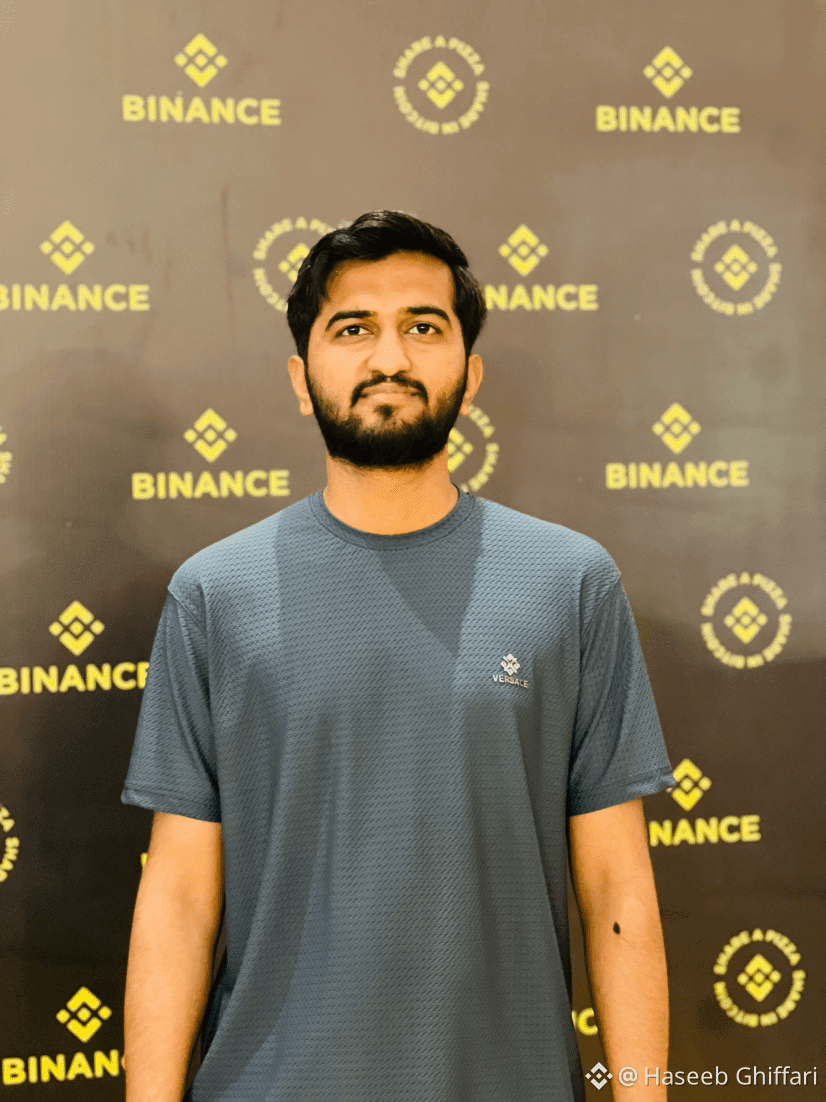
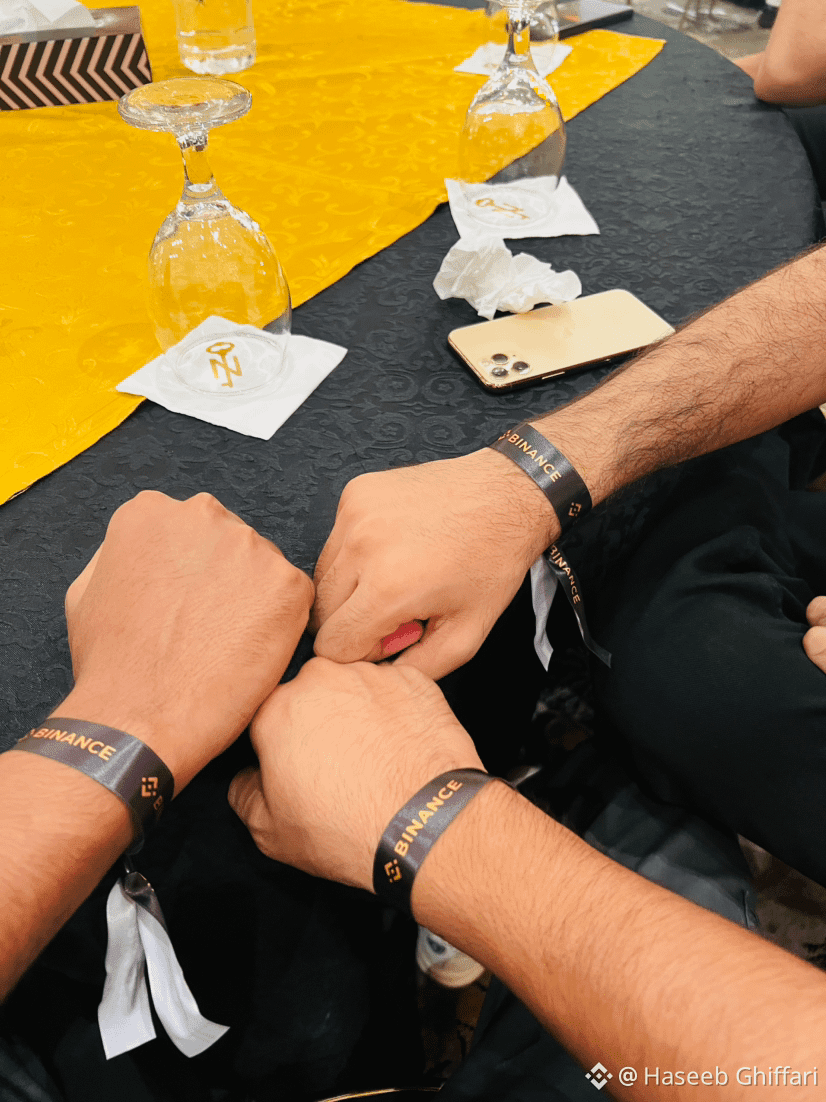
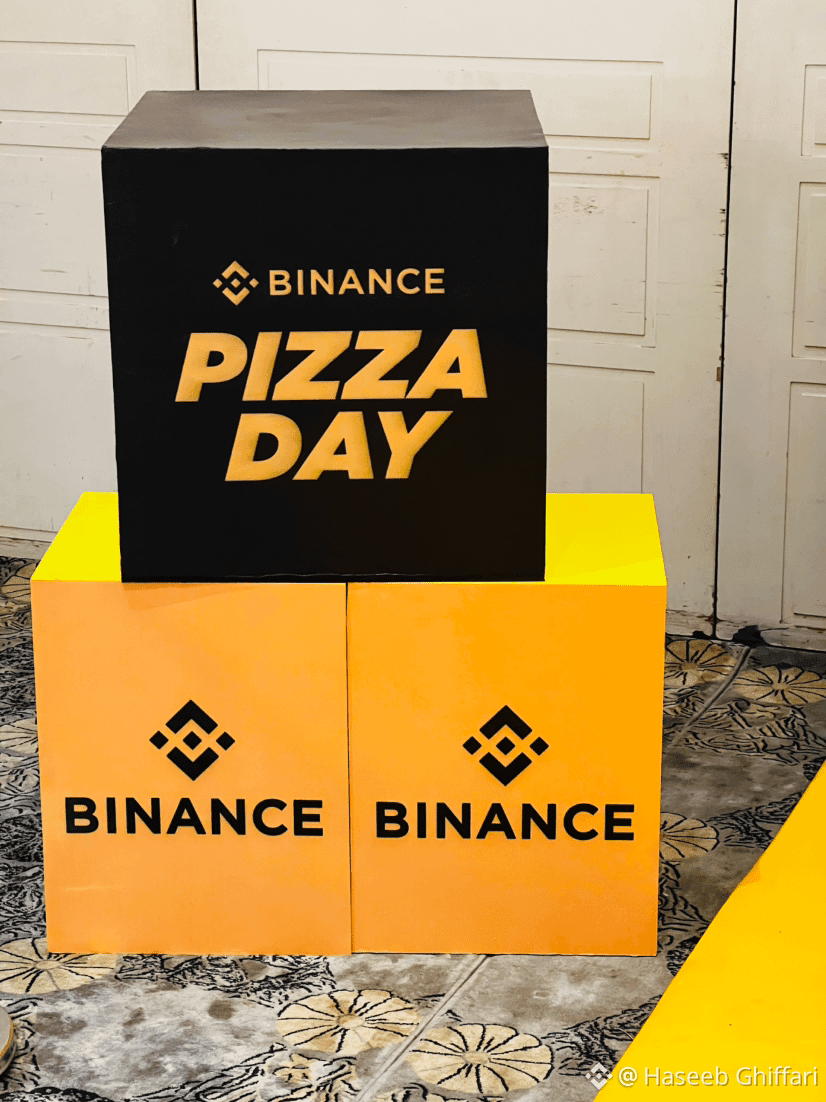
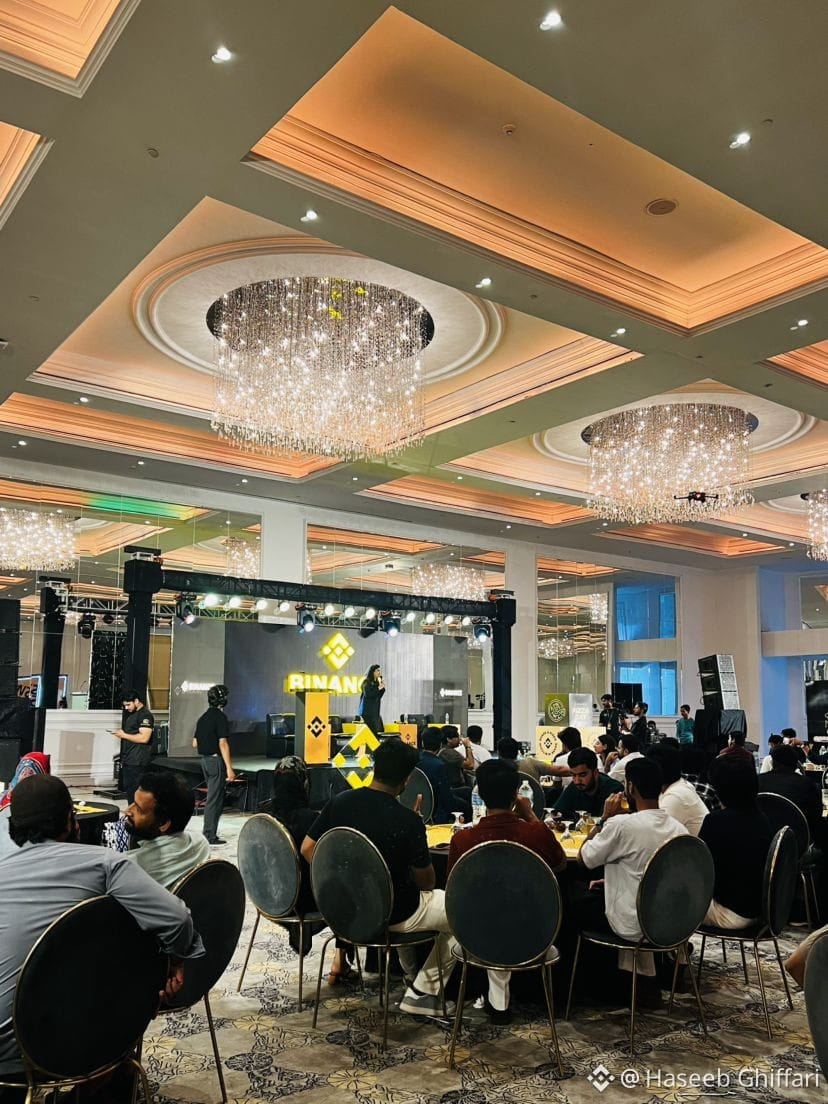
Binance Pizza Tag in Lahore und ich war dabei 🇵🇰
Habe die Community getroffen, die Geschichten gehört, die Überzeugung gespürt. Deshalb bleiben wir.
Vor 16 Jahren hat ein Mann 10.000 $BTC für Pizza bezahlt. Heute feiern wir ihn wie eine Legende. Zu Recht.
Immer noch hier. Immer noch am Bauen. Immer noch am Glauben. 🧡
#BinancePizzaDay #BinancePizza #Binancepakistan #communitymeetup
Binance Pizza Tag in Lahore und ich war dabei 🇵🇰
Habe die Community getroffen, die Geschichten gehört, die Überzeugung gespürt. Deshalb bleiben wir.
Vor 16 Jahren hat ein Mann 10.000 $BTC für Pizza bezahlt. Heute feiern wir ihn wie eine Legende. Zu Recht.
Immer noch hier. Immer noch am Bauen. Immer noch am Glauben. 🧡
#BinancePizzaDay #BinancePizza #Binancepakistan #communitymeetup
Habe die Community getroffen, die Geschichten gehört, die Überzeugung gespürt. Deshalb bleiben wir.
Vor 16 Jahren hat ein Mann 10.000 $BTC für Pizza bezahlt. Heute feiern wir ihn wie eine Legende. Zu Recht.
Immer noch hier. Immer noch am Bauen. Immer noch am Glauben. 🧡
#BinancePizzaDay #BinancePizza #Binancepakistan #communitymeetup
8
12
187
·
--
Bullisch
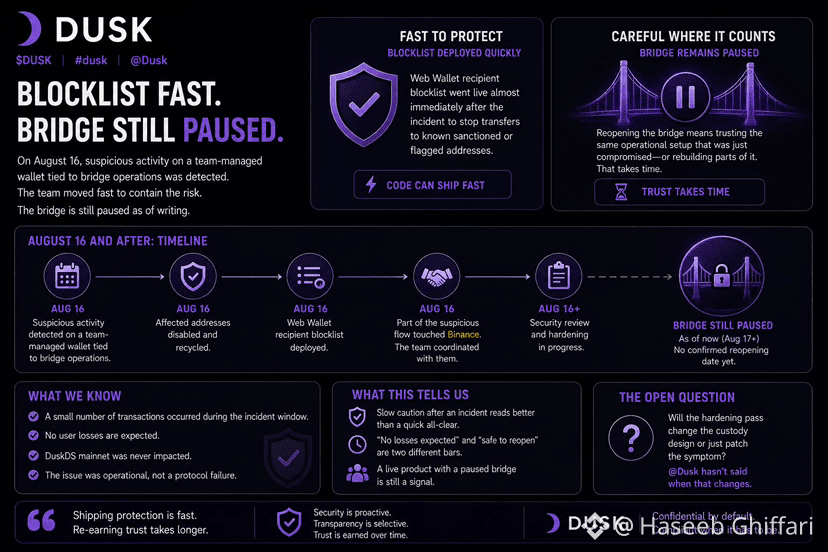
Mir ist etwas Merkwürdiges aufgefallen in Dusk' jüngster Aktivität: Die Web-Wallet-Empfänger-Blockliste ging fast unmittelbar nach dem Vorfall am 16. August online, aber die Brücke selbst liegt noch immer pausiert – eineinhalb Wochen später. Diese Lücke ist das, worüber ich immer wieder nachgedacht habe.
Eine Blockliste auszurollen geht schnell – es ist Code. Eine Brücke wieder zu öffnen bedeutet, darauf zu vertrauen, dass die gleiche operative Einrichtung, die gerade kompromittiert wurde, weiterhin funktioniert, oder Teile davon neu aufzubauen – und das dauert länger als ein Patch-Note. Das Team $DUSK hat während des Zeitfensters des Vorfalls eine kleine Zahl von Transaktionen markiert und gesagt, dass keine Nutzerverluste erwartet werden, was ich glaube. Aber „keine Verluste erwartet“ und „sicher, wieder zu öffnen“ sind intern eindeutig zwei unterschiedliche Maßstäbe.
Es ist zwar nur eine Kleinigkeit, aber es hat mich mit dem Prozess #dusk mehr beruhigt, als ich erwartet hatte. Langsame Vorsicht nach einem Vorfall klingt für mich besser als ein schneller Entwarnung.
Trotzdem ist ein Live-Produkt mit einer Brücke, die seit über einer Woche nicht läuft, an sich schon eine Art Signal. @Dusk_Foundation hat noch nicht gesagt, wann sich daran etwas ändert.
Mir ist etwas Merkwürdiges aufgefallen in Dusk' jüngster Aktivität: Die Web-Wallet-Empfänger-Blockliste ging fast unmittelbar nach dem Vorfall am 16. August online, aber die Brücke selbst liegt noch immer pausiert – eineinhalb Wochen später. Diese Lücke ist das, worüber ich immer wieder nachgedacht habe.
Eine Blockliste auszurollen geht schnell – es ist Code. Eine Brücke wieder zu öffnen bedeutet, darauf zu vertrauen, dass die gleiche operative Einrichtung, die gerade kompromittiert wurde, weiterhin funktioniert, oder Teile davon neu aufzubauen – und das dauert länger als ein Patch-Note. Das Team $DUSK hat während des Zeitfensters des Vorfalls eine kleine Zahl von Transaktionen markiert und gesagt, dass keine Nutzerverluste erwartet werden, was ich glaube. Aber „keine Verluste erwartet“ und „sicher, wieder zu öffnen“ sind intern eindeutig zwei unterschiedliche Maßstäbe.
Es ist zwar nur eine Kleinigkeit, aber es hat mich mit dem Prozess #dusk mehr beruhigt, als ich erwartet hatte. Langsame Vorsicht nach einem Vorfall klingt für mich besser als ein schneller Entwarnung.
Trotzdem ist ein Live-Produkt mit einer Brücke, die seit über einer Woche nicht läuft, an sich schon eine Art Signal. @Dusk hat noch nicht gesagt, wann sich daran etwas ändert.
Eine Blockliste auszurollen geht schnell – es ist Code. Eine Brücke wieder zu öffnen bedeutet, darauf zu vertrauen, dass die gleiche operative Einrichtung, die gerade kompromittiert wurde, weiterhin funktioniert, oder Teile davon neu aufzubauen – und das dauert länger als ein Patch-Note. Das Team $DUSK hat während des Zeitfensters des Vorfalls eine kleine Zahl von Transaktionen markiert und gesagt, dass keine Nutzerverluste erwartet werden, was ich glaube. Aber „keine Verluste erwartet“ und „sicher, wieder zu öffnen“ sind intern eindeutig zwei unterschiedliche Maßstäbe.
Es ist zwar nur eine Kleinigkeit, aber es hat mich mit dem Prozess #dusk mehr beruhigt, als ich erwartet hatte. Langsame Vorsicht nach einem Vorfall klingt für mich besser als ein schneller Entwarnung.
Trotzdem ist ein Live-Produkt mit einer Brücke, die seit über einer Woche nicht läuft, an sich schon eine Art Signal. @Dusk hat noch nicht gesagt, wann sich daran etwas ändert.
4
94
·
--
Bullisch
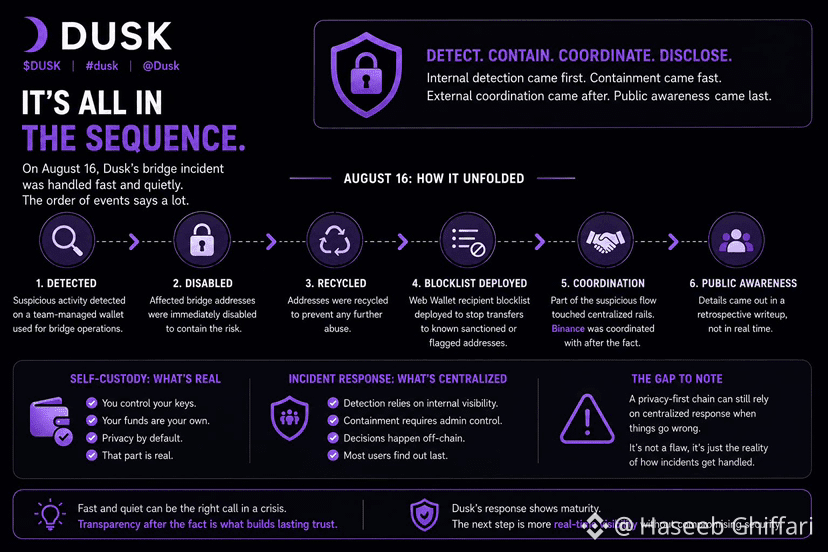
Ich habe etwas Zeit an einer Dusk-Aufgabe für CreatorPad verbracht, und das, woran ich danach weiter herumkauen musste, war nicht die Technik, sondern die Abfolge. Am 16. August wurden Bridge-Adressen markiert, deaktiviert und recycelt, bevor die meisten Nutzer überhaupt bemerkten, dass etwas nicht stimmte. Es wurde eine Blockliste erstellt. Binance wurde erst eingebunden, nachdem ein Teil des verdächtigen Ablaufs ihre Plattform berührt hatte.
Also war die Reihenfolge: interne Erkennung, interne Eindämmung, dann externe Abstimmung. Normale Nutzer erfuhren es zuletzt – wenn überhaupt.
Das ist nicht unbedingt schlecht: Man will natürlich keinen Bridge-Vorfall, der im Trend auftaucht, bevor er eingedämmt ist. Aber es hat meine Sicht darauf verändert, wie „Self-Custody“-Behauptungen rund um $DUSK funktionieren. Self-Custody ist für dein Geld tatsächlich real, klar – aber die Reaktion auf eine Bedrohung ist in der Praxis trotzdem sehr zentralisiert. Jemand mit Admin-Einsicht hat das gesehen, bevor es irgendwer on-chain bemerkt hat.
Nicht als Kritik gemeint. Eher nur eine Feststellung zur Lücke zwischen dem Privacy-Pitch und dem, wie Incident Response tatsächlich abläuft.
#dusk @Dusk_Foundation
Ich habe etwas Zeit an einer Dusk-Aufgabe für CreatorPad verbracht, und das, woran ich danach weiter herumkauen musste, war nicht die Technik, sondern die Abfolge. Am 16. August wurden Bridge-Adressen markiert, deaktiviert und recycelt, bevor die meisten Nutzer überhaupt bemerkten, dass etwas nicht stimmte. Es wurde eine Blockliste erstellt. Binance wurde erst eingebunden, nachdem ein Teil des verdächtigen Ablaufs ihre Plattform berührt hatte.
Also war die Reihenfolge: interne Erkennung, interne Eindämmung, dann externe Abstimmung. Normale Nutzer erfuhren es zuletzt – wenn überhaupt.
Das ist nicht unbedingt schlecht: Man will natürlich keinen Bridge-Vorfall, der im Trend auftaucht, bevor er eingedämmt ist. Aber es hat meine Sicht darauf verändert, wie „Self-Custody“-Behauptungen rund um $DUSK funktionieren. Self-Custody ist für dein Geld tatsächlich real, klar – aber die Reaktion auf eine Bedrohung ist in der Praxis trotzdem sehr zentralisiert. Jemand mit Admin-Einsicht hat das gesehen, bevor es irgendwer on-chain bemerkt hat.
Nicht als Kritik gemeint. Eher nur eine Feststellung zur Lücke zwischen dem Privacy-Pitch und dem, wie Incident Response tatsächlich abläuft.
#dusk @Dusk
Also war die Reihenfolge: interne Erkennung, interne Eindämmung, dann externe Abstimmung. Normale Nutzer erfuhren es zuletzt – wenn überhaupt.
Das ist nicht unbedingt schlecht: Man will natürlich keinen Bridge-Vorfall, der im Trend auftaucht, bevor er eingedämmt ist. Aber es hat meine Sicht darauf verändert, wie „Self-Custody“-Behauptungen rund um $DUSK funktionieren. Self-Custody ist für dein Geld tatsächlich real, klar – aber die Reaktion auf eine Bedrohung ist in der Praxis trotzdem sehr zentralisiert. Jemand mit Admin-Einsicht hat das gesehen, bevor es irgendwer on-chain bemerkt hat.
Nicht als Kritik gemeint. Eher nur eine Feststellung zur Lücke zwischen dem Privacy-Pitch und dem, wie Incident Response tatsächlich abläuft.
#dusk @Dusk
4
115
·
--
Bullisch
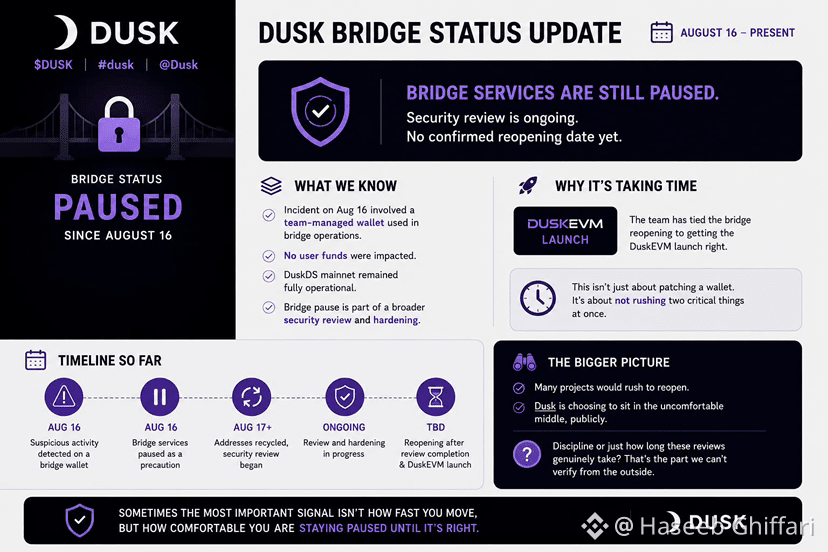
Ich habe diese Woche erneut den Status von @Dusk_Foundation s Brücke überprüft, und sie ist immer noch geschlossen. Gleiche Nachricht wie zuvor: Sicherheitsprüfung läuft noch, kein bestätigtes Wiedereröffnungsdatum bisher. An diesem Punkt ist das eigentlich die aufschlussreichere Information als der Vorfall selbst.
Der Kern der Chain von $DUSK lief nie wirklich an, das war früh klar. Weniger klar ist jedoch, wie „temporär“ eine Pause wie diese tatsächlich ist, wenn sie an einen größeren Launch gekoppelt ist, in diesem Fall DuskEVM. Das Team hat die Wiedereröffnung der Brücke ausdrücklich damit verknüpft, dass auch dieser Launch gelingt. Die Zeitleiste geht also nicht nur darum, eine Wallet zu patchen, sondern auch darum, nicht zwei Dinge gleichzeitig zu überstürzen.
Ich bin mit der Erwartung reingegangen, dass es eine schnelle Patch-und-Wiedereröffnen-Geschichte wird. Stattdessen sehe ich, wie ein Team öffentlich länger in der unbequemen Zwischenphase bleibt, als die meisten Projekte das tolerieren würden.
Ich bin mir noch nicht sicher, ob das Disziplin ist oder einfach nur, wie lange diese Reviews wirklich dauern. Vermutlich ist das der Punkt, den man von außen nicht verifizieren kann.
#dusk
Ich habe diese Woche erneut den Status von @Dusk s Brücke überprüft, und sie ist immer noch geschlossen. Gleiche Nachricht wie zuvor: Sicherheitsprüfung läuft noch, kein bestätigtes Wiedereröffnungsdatum bisher. An diesem Punkt ist das eigentlich die aufschlussreichere Information als der Vorfall selbst.
Der Kern der Chain von $DUSK lief nie wirklich an, das war früh klar. Weniger klar ist jedoch, wie „temporär“ eine Pause wie diese tatsächlich ist, wenn sie an einen größeren Launch gekoppelt ist, in diesem Fall DuskEVM. Das Team hat die Wiedereröffnung der Brücke ausdrücklich damit verknüpft, dass auch dieser Launch gelingt. Die Zeitleiste geht also nicht nur darum, eine Wallet zu patchen, sondern auch darum, nicht zwei Dinge gleichzeitig zu überstürzen.
Ich bin mit der Erwartung reingegangen, dass es eine schnelle Patch-und-Wiedereröffnen-Geschichte wird. Stattdessen sehe ich, wie ein Team öffentlich länger in der unbequemen Zwischenphase bleibt, als die meisten Projekte das tolerieren würden.
Ich bin mir noch nicht sicher, ob das Disziplin ist oder einfach nur, wie lange diese Reviews wirklich dauern. Vermutlich ist das der Punkt, den man von außen nicht verifizieren kann.
#dusk
Der Kern der Chain von $DUSK lief nie wirklich an, das war früh klar. Weniger klar ist jedoch, wie „temporär“ eine Pause wie diese tatsächlich ist, wenn sie an einen größeren Launch gekoppelt ist, in diesem Fall DuskEVM. Das Team hat die Wiedereröffnung der Brücke ausdrücklich damit verknüpft, dass auch dieser Launch gelingt. Die Zeitleiste geht also nicht nur darum, eine Wallet zu patchen, sondern auch darum, nicht zwei Dinge gleichzeitig zu überstürzen.
Ich bin mit der Erwartung reingegangen, dass es eine schnelle Patch-und-Wiedereröffnen-Geschichte wird. Stattdessen sehe ich, wie ein Team öffentlich länger in der unbequemen Zwischenphase bleibt, als die meisten Projekte das tolerieren würden.
Ich bin mir noch nicht sicher, ob das Disziplin ist oder einfach nur, wie lange diese Reviews wirklich dauern. Vermutlich ist das der Punkt, den man von außen nicht verifizieren kann.
#dusk
4
87
·
--
Bullisch
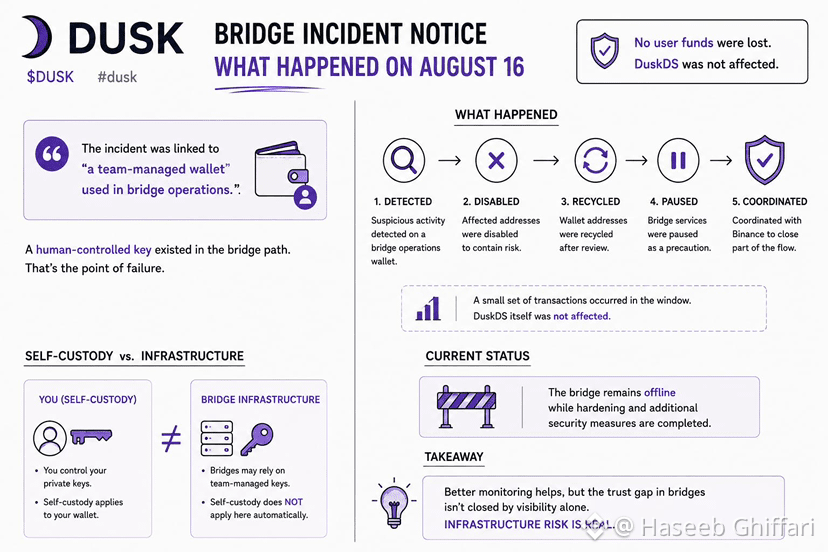
Auf der Suche nach etwas, worüber ich für CreatorPad schreiben kann, bin ich bei $DUSK gelandet – und zwar auf eine Incident-Notice vom 16. August (@Dusk_Foundation ) statt auf die Roadmap-Seiten. Der Satz, der mich dabei getroffen hat: „a team-managed wallet used in bridge operations.“ Für ein Projekt, das so stark auf dezentrale, konforme, self-custodial Messaging setzt, ist das ein ziemlich nüchternes Eingeständnis, dass irgendwo im Bridge-Pfad ein menschlich kontrollierter Schlüssel sitzt.
Nichts Katastrophales ist passiert, zumindest nach deren eigener Darstellung. Adressen wurden deaktiviert und recycelt, die Bridge-Dienste pausiert, in dem Zeitfenster fanden eine kleine Anzahl von Transaktionen statt, und die Abstimmung mit Binance hat einen Teil des Ablaufs beendet. DuskDS selbst wurde nicht angefasst.
Was sich für mich geändert hat, war nicht die Schwere, sondern die Einordnung. Ich habe „Self-Custody“ bisher so verstanden, dass es überall im Stack gilt. Es gilt für die Wallet des Nutzers. Es gilt nicht automatisch für die Infrastruktur, die die Assets in dessen Auftrag zwischen Chains bewegt – und diese Unterscheidung wird von den meisten Nutzern, einschließlich mir, übersehen.
Die Bridge ist immer noch offline, während sie sie weiter härten. Nicht sicher, ob diese Lücke allein durch besseres Monitoring geschlossen wird.
#dusk @Dusk_Foundation
Auf der Suche nach etwas, worüber ich für CreatorPad schreiben kann, bin ich bei $DUSK gelandet – und zwar auf eine Incident-Notice vom 16. August (@Dusk ) statt auf die Roadmap-Seiten. Der Satz, der mich dabei getroffen hat: „a team-managed wallet used in bridge operations.“ Für ein Projekt, das so stark auf dezentrale, konforme, self-custodial Messaging setzt, ist das ein ziemlich nüchternes Eingeständnis, dass irgendwo im Bridge-Pfad ein menschlich kontrollierter Schlüssel sitzt.
Nichts Katastrophales ist passiert, zumindest nach deren eigener Darstellung. Adressen wurden deaktiviert und recycelt, die Bridge-Dienste pausiert, in dem Zeitfenster fanden eine kleine Anzahl von Transaktionen statt, und die Abstimmung mit Binance hat einen Teil des Ablaufs beendet. DuskDS selbst wurde nicht angefasst.
Was sich für mich geändert hat, war nicht die Schwere, sondern die Einordnung. Ich habe „Self-Custody“ bisher so verstanden, dass es überall im Stack gilt. Es gilt für die Wallet des Nutzers. Es gilt nicht automatisch für die Infrastruktur, die die Assets in dessen Auftrag zwischen Chains bewegt – und diese Unterscheidung wird von den meisten Nutzern, einschließlich mir, übersehen.
Die Bridge ist immer noch offline, während sie sie weiter härten. Nicht sicher, ob diese Lücke allein durch besseres Monitoring geschlossen wird.
#dusk @Dusk
Nichts Katastrophales ist passiert, zumindest nach deren eigener Darstellung. Adressen wurden deaktiviert und recycelt, die Bridge-Dienste pausiert, in dem Zeitfenster fanden eine kleine Anzahl von Transaktionen statt, und die Abstimmung mit Binance hat einen Teil des Ablaufs beendet. DuskDS selbst wurde nicht angefasst.
Was sich für mich geändert hat, war nicht die Schwere, sondern die Einordnung. Ich habe „Self-Custody“ bisher so verstanden, dass es überall im Stack gilt. Es gilt für die Wallet des Nutzers. Es gilt nicht automatisch für die Infrastruktur, die die Assets in dessen Auftrag zwischen Chains bewegt – und diese Unterscheidung wird von den meisten Nutzern, einschließlich mir, übersehen.
Die Bridge ist immer noch offline, während sie sie weiter härten. Nicht sicher, ob diese Lücke allein durch besseres Monitoring geschlossen wird.
#dusk @Dusk
5
120
·
--
Bullisch
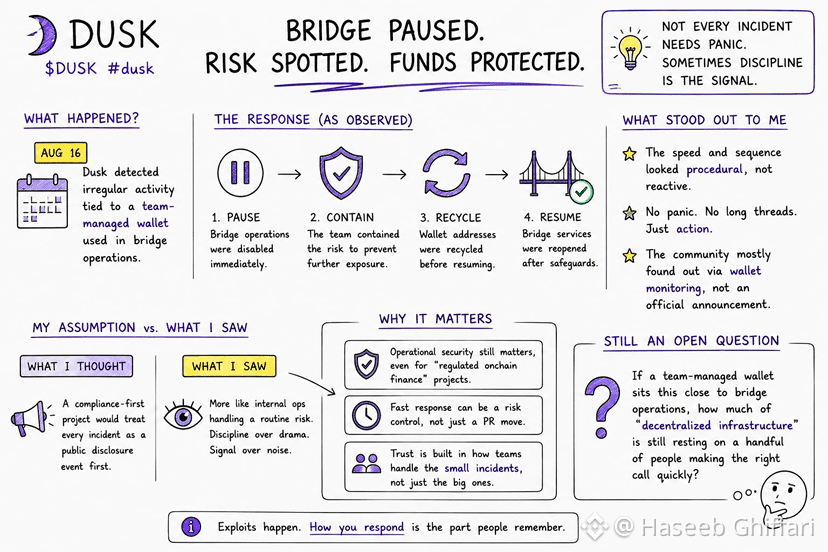
Ich habe bemerkt, dass meine Bridge-Überweisung nicht bestätigt wurde, und bin auf die Suche gegangen. Das Dusk-Team hatte am 16. August die Bridge-Operationen deaktiviert, nachdem es unregelmäßige Aktivitäten in Verbindung mit einer Wallet festgestellt hatte, die sie kontrollieren, und die Adressen anschließend recycelt, bevor sie wieder geöffnet haben. $DUSK #dusk @Dusk_Foundation
Was mich zum Nachdenken gebracht hat, war nicht der Exploit-Versuch – sowas passiert überall –, sondern wie schnell die Reaktion von außen wirkte. Pausieren, Eindämmen, Recyceln, Fortsetzen. Kein Alarm, kein langwieriger Post-Mortem-Thread. Fast schon prozedural.
Ich hatte angenommen, dass ein Projekt, das so stark auf Compliance ausgerichtet ist, jeden Vorfall zuerst als Offenlegungsereignis behandeln würde. Stattdessen klang es mehr nach internen Abläufen beim Umgang mit einem routinemäßigen Risiko – und die Community erfuhr größtenteils erst im Nachhinein davon, und zwar durch Wallet-Monitoring statt durch eine Ankündigung.
Ich weiß nicht, ob das Disziplin ist oder einfach ein kleiner genug Vorfall, der keine größere Reaktion brauchte. Wie auch immer: Es ist ein anderes Tempo, als ich es von einem Projekt erwartet hätte, das „regulierte Onchain-Finanzierung“ in den Mittelpunkt stellt.
Ich habe bemerkt, dass meine Bridge-Überweisung nicht bestätigt wurde, und bin auf die Suche gegangen. Das Dusk-Team hatte am 16. August die Bridge-Operationen deaktiviert, nachdem es unregelmäßige Aktivitäten in Verbindung mit einer Wallet festgestellt hatte, die sie kontrollieren, und die Adressen anschließend recycelt, bevor sie wieder geöffnet haben. $DUSK #dusk @Dusk
Was mich zum Nachdenken gebracht hat, war nicht der Exploit-Versuch – sowas passiert überall –, sondern wie schnell die Reaktion von außen wirkte. Pausieren, Eindämmen, Recyceln, Fortsetzen. Kein Alarm, kein langwieriger Post-Mortem-Thread. Fast schon prozedural.
Ich hatte angenommen, dass ein Projekt, das so stark auf Compliance ausgerichtet ist, jeden Vorfall zuerst als Offenlegungsereignis behandeln würde. Stattdessen klang es mehr nach internen Abläufen beim Umgang mit einem routinemäßigen Risiko – und die Community erfuhr größtenteils erst im Nachhinein davon, und zwar durch Wallet-Monitoring statt durch eine Ankündigung.
Ich weiß nicht, ob das Disziplin ist oder einfach ein kleiner genug Vorfall, der keine größere Reaktion brauchte. Wie auch immer: Es ist ein anderes Tempo, als ich es von einem Projekt erwartet hätte, das „regulierte Onchain-Finanzierung“ in den Mittelpunkt stellt.
Was mich zum Nachdenken gebracht hat, war nicht der Exploit-Versuch – sowas passiert überall –, sondern wie schnell die Reaktion von außen wirkte. Pausieren, Eindämmen, Recyceln, Fortsetzen. Kein Alarm, kein langwieriger Post-Mortem-Thread. Fast schon prozedural.
Ich hatte angenommen, dass ein Projekt, das so stark auf Compliance ausgerichtet ist, jeden Vorfall zuerst als Offenlegungsereignis behandeln würde. Stattdessen klang es mehr nach internen Abläufen beim Umgang mit einem routinemäßigen Risiko – und die Community erfuhr größtenteils erst im Nachhinein davon, und zwar durch Wallet-Monitoring statt durch eine Ankündigung.
Ich weiß nicht, ob das Disziplin ist oder einfach ein kleiner genug Vorfall, der keine größere Reaktion brauchte. Wie auch immer: Es ist ein anderes Tempo, als ich es von einem Projekt erwartet hätte, das „regulierte Onchain-Finanzierung“ in den Mittelpunkt stellt.
3
5
213
·
--
Bullisch
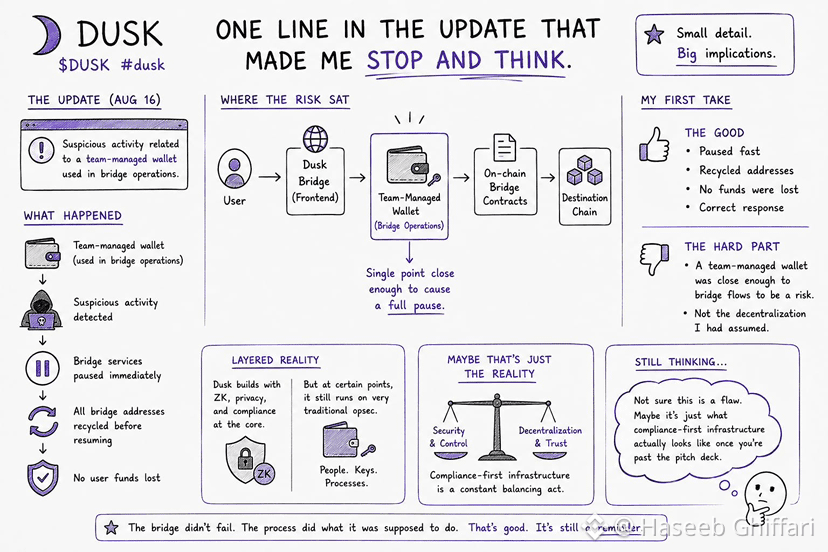
Ich bin durch eine CreatorPad-Aufgabe mit $DUSK gegangen und bin dann an etwas Kleinem hängen geblieben. @Dusk_Foundation hat am eigenen Update zum 16. August auf die Brückenpause hingewiesen: Die verdächtige Aktivität sei mit einer „teamverwalteten Wallet, die in Brückenoperationen verwendet wird“, verbunden gewesen. #dusk
Ich hatte angenommen, dass die Brücke – angesichts dessen, wie viel Dusk über Compliance und institutionenfähige Infrastruktur spricht – weiter von jedem einzelnen Punkt potenziellen Versagens entfernt sein würde. War sie nicht. Eine Wallet, die vom Team kontrolliert wird, lag nah genug an den Bridge-Flows, dass schon der Versuch, sie zu kompromittieren, ausgereicht hat, um eine vollständige Pause zu erzwingen.
Meine Reaktion war gemischt. Einerseits ist das schnelle Pausieren und das Recyceln der Adressen die richtige Maßnahme, und es gingen keine Gelder verloren. Andererseits ist es eine Erinnerung daran, dass „regulierte Onchain-Finanzierung“ an bestimmten Stellen trotzdem noch durch sehr traditionelle operative Sicherheitsmaßnahmen läuft – egal wie viel ZK-Technik darunter steckt.
Nicht sicher, ob das genau ein Fehler ist. Vielleicht ist es einfach das, was Compliance-first-Infrastruktur tatsächlich aussieht, sobald man über das Pitch-Deck hinaus ist. Ich wälze das jedenfalls noch.
Ich bin durch eine CreatorPad-Aufgabe mit $DUSK gegangen und bin dann an etwas Kleinem hängen geblieben. @Dusk hat am eigenen Update zum 16. August auf die Brückenpause hingewiesen: Die verdächtige Aktivität sei mit einer „teamverwalteten Wallet, die in Brückenoperationen verwendet wird“, verbunden gewesen. #dusk
Ich hatte angenommen, dass die Brücke – angesichts dessen, wie viel Dusk über Compliance und institutionenfähige Infrastruktur spricht – weiter von jedem einzelnen Punkt potenziellen Versagens entfernt sein würde. War sie nicht. Eine Wallet, die vom Team kontrolliert wird, lag nah genug an den Bridge-Flows, dass schon der Versuch, sie zu kompromittieren, ausgereicht hat, um eine vollständige Pause zu erzwingen.
Meine Reaktion war gemischt. Einerseits ist das schnelle Pausieren und das Recyceln der Adressen die richtige Maßnahme, und es gingen keine Gelder verloren. Andererseits ist es eine Erinnerung daran, dass „regulierte Onchain-Finanzierung“ an bestimmten Stellen trotzdem noch durch sehr traditionelle operative Sicherheitsmaßnahmen läuft – egal wie viel ZK-Technik darunter steckt.
Nicht sicher, ob das genau ein Fehler ist. Vielleicht ist es einfach das, was Compliance-first-Infrastruktur tatsächlich aussieht, sobald man über das Pitch-Deck hinaus ist. Ich wälze das jedenfalls noch.
Ich hatte angenommen, dass die Brücke – angesichts dessen, wie viel Dusk über Compliance und institutionenfähige Infrastruktur spricht – weiter von jedem einzelnen Punkt potenziellen Versagens entfernt sein würde. War sie nicht. Eine Wallet, die vom Team kontrolliert wird, lag nah genug an den Bridge-Flows, dass schon der Versuch, sie zu kompromittieren, ausgereicht hat, um eine vollständige Pause zu erzwingen.
Meine Reaktion war gemischt. Einerseits ist das schnelle Pausieren und das Recyceln der Adressen die richtige Maßnahme, und es gingen keine Gelder verloren. Andererseits ist es eine Erinnerung daran, dass „regulierte Onchain-Finanzierung“ an bestimmten Stellen trotzdem noch durch sehr traditionelle operative Sicherheitsmaßnahmen läuft – egal wie viel ZK-Technik darunter steckt.
Nicht sicher, ob das genau ein Fehler ist. Vielleicht ist es einfach das, was Compliance-first-Infrastruktur tatsächlich aussieht, sobald man über das Pitch-Deck hinaus ist. Ich wälze das jedenfalls noch.
4
157
·
--
Bullisch
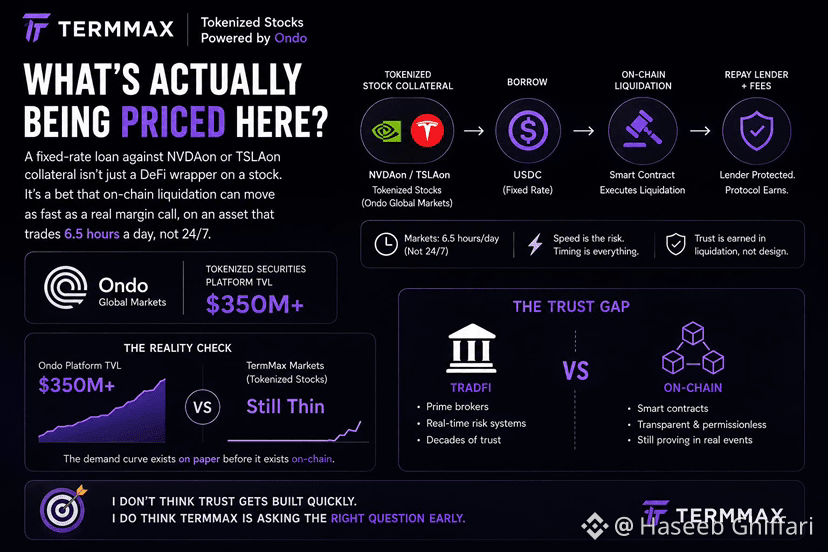
Ich bin zurück zur tokenisierten-Asset-Integration von TermMax mit Ondo Global Markets gegangen und habe mir dieses Mal eine schwierigere Frage gestellt: Was wird hier eigentlich bepreist?
Ein Festzinsdarlehen gegen NVDAon- oder TSLAon-Sicherheiten ist nicht nur ein DeFi-Wrapper auf eine Aktie. Es ist eine Wette darauf, dass die On-Chain-Liquidation sich genauso schnell bewegen kann wie ein echter Margin Call – bei einem Asset, das sechs und eine halbe Stunde am Tag handelt, nicht 24/7.
Ondos Plattform für tokenisierte Wertpapiere hat über 350 Mio. USD an TVL, was beachtlich klingt, bis man merkt, dass die Nutzung in TermMax' eigenen Märkten immer noch dünn ist im Vergleich zur zentralen USDC-Schleife.
Diese Lücke sagt mir: Die Nachfragekurve existiert auf dem Papier, bevor sie on-chain existiert. Institutionen wollen die Zinssicherheit. Sie sind nur noch nicht vollständig überzeugt, dass ein Smart Contract eine Aktienliquidation so zuverlässig abbildet wie ein Prime Broker.
Ich glaube nicht, dass dieses Vertrauen sich schnell aufbaut. Ich glaube aber, dass TermMax die richtige Frage früh stellt.
#TermMax @termmax
Ich bin zurück zur tokenisierten-Asset-Integration von TermMax mit Ondo Global Markets gegangen und habe mir dieses Mal eine schwierigere Frage gestellt: Was wird hier eigentlich bepreist?
Ein Festzinsdarlehen gegen NVDAon- oder TSLAon-Sicherheiten ist nicht nur ein DeFi-Wrapper auf eine Aktie. Es ist eine Wette darauf, dass die On-Chain-Liquidation sich genauso schnell bewegen kann wie ein echter Margin Call – bei einem Asset, das sechs und eine halbe Stunde am Tag handelt, nicht 24/7.
Ondos Plattform für tokenisierte Wertpapiere hat über 350 Mio. USD an TVL, was beachtlich klingt, bis man merkt, dass die Nutzung in TermMax' eigenen Märkten immer noch dünn ist im Vergleich zur zentralen USDC-Schleife.
Diese Lücke sagt mir: Die Nachfragekurve existiert auf dem Papier, bevor sie on-chain existiert. Institutionen wollen die Zinssicherheit. Sie sind nur noch nicht vollständig überzeugt, dass ein Smart Contract eine Aktienliquidation so zuverlässig abbildet wie ein Prime Broker.
Ich glaube nicht, dass dieses Vertrauen sich schnell aufbaut. Ich glaube aber, dass TermMax die richtige Frage früh stellt.
#TermMax @TermMax
Ein Festzinsdarlehen gegen NVDAon- oder TSLAon-Sicherheiten ist nicht nur ein DeFi-Wrapper auf eine Aktie. Es ist eine Wette darauf, dass die On-Chain-Liquidation sich genauso schnell bewegen kann wie ein echter Margin Call – bei einem Asset, das sechs und eine halbe Stunde am Tag handelt, nicht 24/7.
Ondos Plattform für tokenisierte Wertpapiere hat über 350 Mio. USD an TVL, was beachtlich klingt, bis man merkt, dass die Nutzung in TermMax' eigenen Märkten immer noch dünn ist im Vergleich zur zentralen USDC-Schleife.
Diese Lücke sagt mir: Die Nachfragekurve existiert auf dem Papier, bevor sie on-chain existiert. Institutionen wollen die Zinssicherheit. Sie sind nur noch nicht vollständig überzeugt, dass ein Smart Contract eine Aktienliquidation so zuverlässig abbildet wie ein Prime Broker.
Ich glaube nicht, dass dieses Vertrauen sich schnell aufbaut. Ich glaube aber, dass TermMax die richtige Frage früh stellt.
#TermMax @TermMax
5
253
·
--
Bullisch
#dusk $DUSK @Dusk_Foundation
Ich bin schon immer ein bisschen misstrauisch gegenüber Projekten gewesen, die mit „regulierungsfreundlich“ als Verkaufsargument starten. Das heißt meistens langsamere Lieferzeiten und weniger Dezentralisierung.
Dusk bringt mich dazu, diese Annahme zu überdenken.
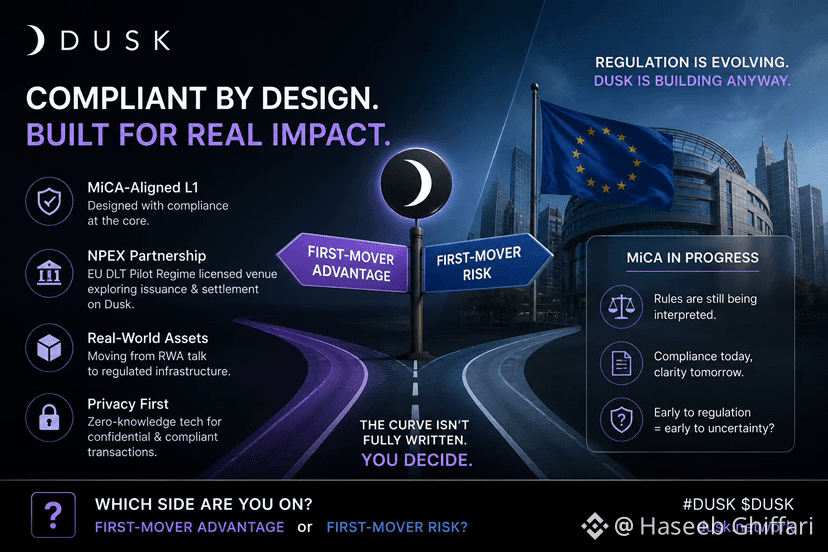
Als MiCA-konformes L1 markiert zu werden ist nicht nur ein Compliance-Häkchen. Es verbindet sich direkt mit Dingen wie der NPEX-Beziehung: ein von der EU DLT Pilot Regime lizenziertes Umfeld, das tatsächlich die Emission und Abwicklung auf Dusk-Infrastruktur untersucht. Das ist kein hypothetisches RWA-Gerede – das ist ein regulierter Markt, der echte Schienen testet.
Mit einem Punkt ringe ich jedoch immer wieder: Frühzeitig an Regulierung zu gehen bedeutet, für Regeln zu bauen, die noch halbgeschrieben sind. MiCA selbst wird in der EU weiterhin Fall für Fall ausgelegt.
Ist Dusk also voraus auf der Kurve, oder ist es nur der erste, der sichtbar wird, falls sich die Kurve anders biegt, als erwartet.
Ganz ehrlich: Ich bin unsicher. Aber zum ersten Mal hat mich „konform by design“ neugierig gemacht – statt mir von vornherein skeptisch zu sein.
Auf welcher Seite stehst du: Vorteil des First-Movers oder Risiko des First-Movers?
#dusk $DUSK @Dusk
Ich bin schon immer ein bisschen misstrauisch gegenüber Projekten gewesen, die mit „regulierungsfreundlich“ als Verkaufsargument starten. Das heißt meistens langsamere Lieferzeiten und weniger Dezentralisierung.
Dusk bringt mich dazu, diese Annahme zu überdenken.
Als MiCA-konformes L1 markiert zu werden ist nicht nur ein Compliance-Häkchen. Es verbindet sich direkt mit Dingen wie der NPEX-Beziehung: ein von der EU DLT Pilot Regime lizenziertes Umfeld, das tatsächlich die Emission und Abwicklung auf Dusk-Infrastruktur untersucht. Das ist kein hypothetisches RWA-Gerede – das ist ein regulierter Markt, der echte Schienen testet.
Mit einem Punkt ringe ich jedoch immer wieder: Frühzeitig an Regulierung zu gehen bedeutet, für Regeln zu bauen, die noch halbgeschrieben sind. MiCA selbst wird in der EU weiterhin Fall für Fall ausgelegt.
Ist Dusk also voraus auf der Kurve, oder ist es nur der erste, der sichtbar wird, falls sich die Kurve anders biegt, als erwartet.
Ganz ehrlich: Ich bin unsicher. Aber zum ersten Mal hat mich „konform by design“ neugierig gemacht – statt mir von vornherein skeptisch zu sein.
Auf welcher Seite stehst du: Vorteil des First-Movers oder Risiko des First-Movers?
Ich bin schon immer ein bisschen misstrauisch gegenüber Projekten gewesen, die mit „regulierungsfreundlich“ als Verkaufsargument starten. Das heißt meistens langsamere Lieferzeiten und weniger Dezentralisierung.
Dusk bringt mich dazu, diese Annahme zu überdenken.
Als MiCA-konformes L1 markiert zu werden ist nicht nur ein Compliance-Häkchen. Es verbindet sich direkt mit Dingen wie der NPEX-Beziehung: ein von der EU DLT Pilot Regime lizenziertes Umfeld, das tatsächlich die Emission und Abwicklung auf Dusk-Infrastruktur untersucht. Das ist kein hypothetisches RWA-Gerede – das ist ein regulierter Markt, der echte Schienen testet.
Mit einem Punkt ringe ich jedoch immer wieder: Frühzeitig an Regulierung zu gehen bedeutet, für Regeln zu bauen, die noch halbgeschrieben sind. MiCA selbst wird in der EU weiterhin Fall für Fall ausgelegt.
Ist Dusk also voraus auf der Kurve, oder ist es nur der erste, der sichtbar wird, falls sich die Kurve anders biegt, als erwartet.
Ganz ehrlich: Ich bin unsicher. Aber zum ersten Mal hat mich „konform by design“ neugierig gemacht – statt mir von vornherein skeptisch zu sein.
Auf welcher Seite stehst du: Vorteil des First-Movers oder Risiko des First-Movers?
3
4
151
·
--
Bullisch
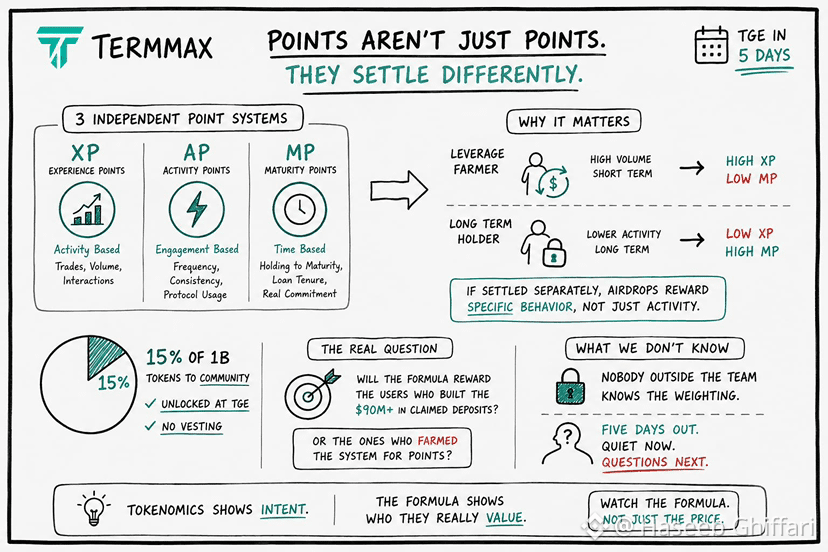
Zuerst nahm ich an, das Punktesystem sei nur Gamification—eine weitere Bestenliste, um Wallets vor dem TGE am Einloggen zu halten. Dann habe ich mir angesehen, wie XP, AP und MP so strukturiert sind, dass sie unabhängig voneinander ausgezahlt/abgerechnet werden, statt zu einem einzigen Score zusammengeführt zu werden.
Das verändert die Anreize komplett. Ein Wallet, das über Leverage-Loops „Farmen“ betreibt, sammelt anders an als eines, das eine Position bis zur Fälligkeit hält. Wenn diese „Spuren“ separat freigegeben werden, belohnt das Airdrop nicht einfach Aktivität, sondern eine bestimmte Art von Aktivität—und die meisten Farmer werden nicht wissen, welche Art das ist, bevor die Zuteilungen nach Bekanntwerden veröffentlicht werden.
15 % von 1B Tokens gehen an die Community, werden sofort freigeschaltet, ohne Vesting. Das klingt auf dem Papier großzügig. Aber großzügig ist nur dann relevant, wenn die Formel die Nutzer belohnt, die tatsächlich die beanspruchten $90M an Einzahlungen aufgebaut haben—und nicht diejenigen, die das Protokoll nur einmal für ein Abzeichen berührt haben.
Fünf Tage vorher weiß niemand außerhalb des Teams, wie die Gewichtung ist. Das ist normalerweise der Zeitpunkt, an dem das echte Signal sichtbar wird—nicht in der Tokenomics-Folie, sondern darin, wer still bleibt und wer beginnt Fragen zu stellen.
#termmax @termmax
Zuerst nahm ich an, das Punktesystem sei nur Gamification—eine weitere Bestenliste, um Wallets vor dem TGE am Einloggen zu halten. Dann habe ich mir angesehen, wie XP, AP und MP so strukturiert sind, dass sie unabhängig voneinander ausgezahlt/abgerechnet werden, statt zu einem einzigen Score zusammengeführt zu werden.
Das verändert die Anreize komplett. Ein Wallet, das über Leverage-Loops „Farmen“ betreibt, sammelt anders an als eines, das eine Position bis zur Fälligkeit hält. Wenn diese „Spuren“ separat freigegeben werden, belohnt das Airdrop nicht einfach Aktivität, sondern eine bestimmte Art von Aktivität—und die meisten Farmer werden nicht wissen, welche Art das ist, bevor die Zuteilungen nach Bekanntwerden veröffentlicht werden.
15 % von 1B Tokens gehen an die Community, werden sofort freigeschaltet, ohne Vesting. Das klingt auf dem Papier großzügig. Aber großzügig ist nur dann relevant, wenn die Formel die Nutzer belohnt, die tatsächlich die beanspruchten $90M an Einzahlungen aufgebaut haben—und nicht diejenigen, die das Protokoll nur einmal für ein Abzeichen berührt haben.
Fünf Tage vorher weiß niemand außerhalb des Teams, wie die Gewichtung ist. Das ist normalerweise der Zeitpunkt, an dem das echte Signal sichtbar wird—nicht in der Tokenomics-Folie, sondern darin, wer still bleibt und wer beginnt Fragen zu stellen.
#termmax @TermMax
Das verändert die Anreize komplett. Ein Wallet, das über Leverage-Loops „Farmen“ betreibt, sammelt anders an als eines, das eine Position bis zur Fälligkeit hält. Wenn diese „Spuren“ separat freigegeben werden, belohnt das Airdrop nicht einfach Aktivität, sondern eine bestimmte Art von Aktivität—und die meisten Farmer werden nicht wissen, welche Art das ist, bevor die Zuteilungen nach Bekanntwerden veröffentlicht werden.
15 % von 1B Tokens gehen an die Community, werden sofort freigeschaltet, ohne Vesting. Das klingt auf dem Papier großzügig. Aber großzügig ist nur dann relevant, wenn die Formel die Nutzer belohnt, die tatsächlich die beanspruchten $90M an Einzahlungen aufgebaut haben—und nicht diejenigen, die das Protokoll nur einmal für ein Abzeichen berührt haben.
Fünf Tage vorher weiß niemand außerhalb des Teams, wie die Gewichtung ist. Das ist normalerweise der Zeitpunkt, an dem das echte Signal sichtbar wird—nicht in der Tokenomics-Folie, sondern darin, wer still bleibt und wer beginnt Fragen zu stellen.
#termmax @TermMax
4
106
·
--
Bullisch
#dusk $DUSK @Dusk_Foundation
Datenschutz und EVM passen normalerweise nicht in denselben Satz. Die meisten Privacy-Chains verlangen, dass du Ehiereums Tools komplett hinter dir lässt – genau deshalb hat mich Hedger Alpha dazu gebracht, die Doku zweimal zu lesen.
Es kombiniert Homomorphic Encryption mit Zero-Knowledge-Proofs, nicht nur ZK allein, worauf die meisten DeFi-Privacy-Systeme setzen. HE ermöglicht, dass Berechnungen direkt mit verschlüsselten Werten stattfinden. ZK beweist, dass die Berechnung korrekt ausgeführt wurde. Zusammen bleiben Salden und Beträge verborgen, aber die Transaktion ist dennoch verifizierbar.
Was ich immer wieder aufgreife, ist das „Alpha“-Label. Das ist jetzt auf dem DuskEVM-Testnet live, heißt: testbar, nicht nur theoretisch. Für eine Chain, die um reguliertes Finance herum gebaut ist, ist diese Unterscheidung zwischen privat und verborgen wichtiger, als es klingt.
Noch ganz am Anfang. Noch Testnet. Aber Confidential Transactions auf einer EVM-kompatiblen Ebene – damit hatte ich nicht so schnell gerechnet.
Mal sehen, wie das abschneidet, sobald echte Transaktionsvolumen darauf treffen
#dusk $DUSK @Dusk
Datenschutz und EVM passen normalerweise nicht in denselben Satz. Die meisten Privacy-Chains verlangen, dass du Ehiereums Tools komplett hinter dir lässt – genau deshalb hat mich Hedger Alpha dazu gebracht, die Doku zweimal zu lesen.
Es kombiniert Homomorphic Encryption mit Zero-Knowledge-Proofs, nicht nur ZK allein, worauf die meisten DeFi-Privacy-Systeme setzen. HE ermöglicht, dass Berechnungen direkt mit verschlüsselten Werten stattfinden. ZK beweist, dass die Berechnung korrekt ausgeführt wurde. Zusammen bleiben Salden und Beträge verborgen, aber die Transaktion ist dennoch verifizierbar.
Was ich immer wieder aufgreife, ist das „Alpha“-Label. Das ist jetzt auf dem DuskEVM-Testnet live, heißt: testbar, nicht nur theoretisch. Für eine Chain, die um reguliertes Finance herum gebaut ist, ist diese Unterscheidung zwischen privat und verborgen wichtiger, als es klingt.
Noch ganz am Anfang. Noch Testnet. Aber Confidential Transactions auf einer EVM-kompatiblen Ebene – damit hatte ich nicht so schnell gerechnet.
Mal sehen, wie das abschneidet, sobald echte Transaktionsvolumen darauf treffen
Datenschutz und EVM passen normalerweise nicht in denselben Satz. Die meisten Privacy-Chains verlangen, dass du Ehiereums Tools komplett hinter dir lässt – genau deshalb hat mich Hedger Alpha dazu gebracht, die Doku zweimal zu lesen.
Es kombiniert Homomorphic Encryption mit Zero-Knowledge-Proofs, nicht nur ZK allein, worauf die meisten DeFi-Privacy-Systeme setzen. HE ermöglicht, dass Berechnungen direkt mit verschlüsselten Werten stattfinden. ZK beweist, dass die Berechnung korrekt ausgeführt wurde. Zusammen bleiben Salden und Beträge verborgen, aber die Transaktion ist dennoch verifizierbar.
Was ich immer wieder aufgreife, ist das „Alpha“-Label. Das ist jetzt auf dem DuskEVM-Testnet live, heißt: testbar, nicht nur theoretisch. Für eine Chain, die um reguliertes Finance herum gebaut ist, ist diese Unterscheidung zwischen privat und verborgen wichtiger, als es klingt.
Noch ganz am Anfang. Noch Testnet. Aber Confidential Transactions auf einer EVM-kompatiblen Ebene – damit hatte ich nicht so schnell gerechnet.
Mal sehen, wie das abschneidet, sobald echte Transaktionsvolumen darauf treffen
Solid approach
0%
Too early to tell
50%
Overengineered
50%
2 Stimmen • Abstimmung beendet
2
4
100
·
--
Bullisch
Witziger Timing-Ausrutscher bei @termmax . Das TGE-Whitepaper fällt, und in derselben Zeitspanne ist die TVL um etwa 7% über 30 Tage gesunken, auf ungefähr 31 Mio. US-Dollar.
Normalerweise versuchen Protokolle, in ein TGE hineinzusteuern, mit Wachstumszahlen, die nach oben zeigen. Dieses startet Token-Ökonomik, während sich die zugrunde liegende Nutzungs-Kurve in die andere Richtung biegt.
Das ist nicht automatisch bärisch. Lending mit Fixzins ist kein Momentum-Produkt; die TVL atmet natürlich mit auslaufenden Fälligkeiten und verschobenen Rate-Spreads. Ein Rückgang während einer volatilen Phase im Makro-Umfeld ist nicht dasselbe wie Nutzer, die an Überzeugung verlieren.
Trotzdem zählen die Signale für einen Token-Launch. Der Pitch lautet: „Infrastruktur für Fixed-Income-DeFi.“ Infrastruktur braucht dauerhaft gebundenes Kapital – nicht Kapital, das direkt wieder rotiert, bevor die Anreizschicht live geht.
Ich möchte die nächsten 30 Tage der TVL sehen, bevor ich irgendetwas aus den Whitepaper-Zahlen herauslese.
#termmax
Was erklärt den TVL-Rückgang?
Witziger Timing-Ausrutscher bei @TermMax . Das TGE-Whitepaper fällt, und in derselben Zeitspanne ist die TVL um etwa 7% über 30 Tage gesunken, auf ungefähr 31 Mio. US-Dollar.
Normalerweise versuchen Protokolle, in ein TGE hineinzusteuern, mit Wachstumszahlen, die nach oben zeigen. Dieses startet Token-Ökonomik, während sich die zugrunde liegende Nutzungs-Kurve in die andere Richtung biegt.
Das ist nicht automatisch bärisch. Lending mit Fixzins ist kein Momentum-Produkt; die TVL atmet natürlich mit auslaufenden Fälligkeiten und verschobenen Rate-Spreads. Ein Rückgang während einer volatilen Phase im Makro-Umfeld ist nicht dasselbe wie Nutzer, die an Überzeugung verlieren.
Trotzdem zählen die Signale für einen Token-Launch. Der Pitch lautet: „Infrastruktur für Fixed-Income-DeFi.“ Infrastruktur braucht dauerhaft gebundenes Kapital – nicht Kapital, das direkt wieder rotiert, bevor die Anreizschicht live geht.
Ich möchte die nächsten 30 Tage der TVL sehen, bevor ich irgendetwas aus den Whitepaper-Zahlen herauslese.
#termmax
Was erklärt den TVL-Rückgang?
Normalerweise versuchen Protokolle, in ein TGE hineinzusteuern, mit Wachstumszahlen, die nach oben zeigen. Dieses startet Token-Ökonomik, während sich die zugrunde liegende Nutzungs-Kurve in die andere Richtung biegt.
Das ist nicht automatisch bärisch. Lending mit Fixzins ist kein Momentum-Produkt; die TVL atmet natürlich mit auslaufenden Fälligkeiten und verschobenen Rate-Spreads. Ein Rückgang während einer volatilen Phase im Makro-Umfeld ist nicht dasselbe wie Nutzer, die an Überzeugung verlieren.
Trotzdem zählen die Signale für einen Token-Launch. Der Pitch lautet: „Infrastruktur für Fixed-Income-DeFi.“ Infrastruktur braucht dauerhaft gebundenes Kapital – nicht Kapital, das direkt wieder rotiert, bevor die Anreizschicht live geht.
Ich möchte die nächsten 30 Tage der TVL sehen, bevor ich irgendetwas aus den Whitepaper-Zahlen herauslese.
#termmax
Was erklärt den TVL-Rückgang?
Normal maturity cycle
50%
Users derisking early
50%
Just macro conditions
0%
2 Stimmen • Abstimmung beendet
2
6
97
·
--
Bullisch
#dusk $DUSK @Dusk_Foundation fast an Hedger in der DuskEVM-Übersicht vorbeigelesen, dann bin ich zurückgegangen und hab es zweimal nochmal gelesen.
aus irgendeinem Grund nennen alle das „privacy-preserving EVM“, aber Hedger ist der eigentliche Privacy-Teil: Homomorphe Verschlüsselung plus ZK-Beweise, die auf DuskEVM aufgesetzt sind, nicht im EVM selbst eingebaut.
-das ist eine deutlich andere Behauptung. die EVM-Ebene ist nur Solidity-Tooling. Privacy wird separat angeflanscht.
das lässt mich fragen, ob „privacy-preserving“ hier mehr Branding- als Architekturarbeit leistet. ich sage nicht, dass es falsch ist – eher, dass ein geschichtetes System so tut, als wäre es eine Sache.
für Builder, die eine vertrauliche Ausführung brauchen, ist das ein zusätzlicher Integrationsschritt, nicht etwas von Haus aus. gut zu wissen, bevor man annimmt, dass das out-of-the-box wie eine Privacy-native Chain funktioniert.
ich bilde mir immer noch eine Meinung dazu, ob das eine kluge modulare Entscheidung ist oder zusätzlicher Reibungsaufwand, der als Flexibilität verkleidet ist.
#dusk $DUSK @Dusk fast an Hedger in der DuskEVM-Übersicht vorbeigelesen, dann bin ich zurückgegangen und hab es zweimal nochmal gelesen.
aus irgendeinem Grund nennen alle das „privacy-preserving EVM“, aber Hedger ist der eigentliche Privacy-Teil: Homomorphe Verschlüsselung plus ZK-Beweise, die auf DuskEVM aufgesetzt sind, nicht im EVM selbst eingebaut.
-das ist eine deutlich andere Behauptung. die EVM-Ebene ist nur Solidity-Tooling. Privacy wird separat angeflanscht.
das lässt mich fragen, ob „privacy-preserving“ hier mehr Branding- als Architekturarbeit leistet. ich sage nicht, dass es falsch ist – eher, dass ein geschichtetes System so tut, als wäre es eine Sache.
für Builder, die eine vertrauliche Ausführung brauchen, ist das ein zusätzlicher Integrationsschritt, nicht etwas von Haus aus. gut zu wissen, bevor man annimmt, dass das out-of-the-box wie eine Privacy-native Chain funktioniert.
ich bilde mir immer noch eine Meinung dazu, ob das eine kluge modulare Entscheidung ist oder zusätzlicher Reibungsaufwand, der als Flexibilität verkleidet ist.
aus irgendeinem Grund nennen alle das „privacy-preserving EVM“, aber Hedger ist der eigentliche Privacy-Teil: Homomorphe Verschlüsselung plus ZK-Beweise, die auf DuskEVM aufgesetzt sind, nicht im EVM selbst eingebaut.
-das ist eine deutlich andere Behauptung. die EVM-Ebene ist nur Solidity-Tooling. Privacy wird separat angeflanscht.
das lässt mich fragen, ob „privacy-preserving“ hier mehr Branding- als Architekturarbeit leistet. ich sage nicht, dass es falsch ist – eher, dass ein geschichtetes System so tut, als wäre es eine Sache.
für Builder, die eine vertrauliche Ausführung brauchen, ist das ein zusätzlicher Integrationsschritt, nicht etwas von Haus aus. gut zu wissen, bevor man annimmt, dass das out-of-the-box wie eine Privacy-native Chain funktioniert.
ich bilde mir immer noch eine Meinung dazu, ob das eine kluge modulare Entscheidung ist oder zusätzlicher Reibungsaufwand, der als Flexibilität verkleidet ist.
Modular privacy is smarter
100%
Bolted-on privacy add friction
0%
Need to see it live first
0%
1 Stimmen • Abstimmung beendet
1
4
160
·
--
Bullisch
Jeder Zyklus produziert hundert Protokolle, die Probleme lösen, von denen niemand wusste, dass sie existieren. TermMax zu starten fühlt sich anders an – und ich sage das widerwillig, weil ich mit „anders“ schon einmal falsch lag.
Variable Zinssätze sind kein Bug, mit dem Menschen gelernt haben zu leben – sie sind eine Wunde, die der Markt in jedem einzelnen Zyklus wieder aufreißt. Kreditgeber werden von unvorhersehbaren Renditen verbrannt. Kreditnehmer werden von unvorhersehbaren Kosten verbrannt. Das zu beheben ist keine clevere Ingenieursleistung um ihrer selbst willen.
Es geht darum, etwas anzugehen, in das der Markt immer wieder hineinläuft – nicht etwas, das der Markt erfunden hat, um einen Token zu rechtfertigen. Was jedoch wirklich meine Aufmerksamkeit geweckt hat, war der Ansatz der Reservenbelege. Nach FTX zeigte jeder auf Wallet-Adressen als Beweis für die Zahlungsfähigkeit – was ungefähr so ist, als würde man seine finanzielle Stabilität beweisen, indem man jemandem ein Foto von seiner Bankkarte zeigt.
ZK-Beweise funktionieren anders: Sie prüfen, ob die zugrunde liegende Mathematik stimmig ist, ohne eine einzelne Position offenzulegen. Das ist echter Beweis, nicht Leistung. Nichts davon garantiert, dass die Einführung den Lärm eines Token-Launchs überlebt. Mainnet-Bestätigung ist ein Meilenstein, kein Siegeszug. Ich bin interessiert. Noch bin ich nicht überzeugt.
#TermMax @termmax
Jeder Zyklus produziert hundert Protokolle, die Probleme lösen, von denen niemand wusste, dass sie existieren. TermMax zu starten fühlt sich anders an – und ich sage das widerwillig, weil ich mit „anders“ schon einmal falsch lag.
Variable Zinssätze sind kein Bug, mit dem Menschen gelernt haben zu leben – sie sind eine Wunde, die der Markt in jedem einzelnen Zyklus wieder aufreißt. Kreditgeber werden von unvorhersehbaren Renditen verbrannt. Kreditnehmer werden von unvorhersehbaren Kosten verbrannt. Das zu beheben ist keine clevere Ingenieursleistung um ihrer selbst willen.
Es geht darum, etwas anzugehen, in das der Markt immer wieder hineinläuft – nicht etwas, das der Markt erfunden hat, um einen Token zu rechtfertigen. Was jedoch wirklich meine Aufmerksamkeit geweckt hat, war der Ansatz der Reservenbelege. Nach FTX zeigte jeder auf Wallet-Adressen als Beweis für die Zahlungsfähigkeit – was ungefähr so ist, als würde man seine finanzielle Stabilität beweisen, indem man jemandem ein Foto von seiner Bankkarte zeigt.
ZK-Beweise funktionieren anders: Sie prüfen, ob die zugrunde liegende Mathematik stimmig ist, ohne eine einzelne Position offenzulegen. Das ist echter Beweis, nicht Leistung. Nichts davon garantiert, dass die Einführung den Lärm eines Token-Launchs überlebt. Mainnet-Bestätigung ist ein Meilenstein, kein Siegeszug. Ich bin interessiert. Noch bin ich nicht überzeugt.
#TermMax @TermMax
Variable Zinssätze sind kein Bug, mit dem Menschen gelernt haben zu leben – sie sind eine Wunde, die der Markt in jedem einzelnen Zyklus wieder aufreißt. Kreditgeber werden von unvorhersehbaren Renditen verbrannt. Kreditnehmer werden von unvorhersehbaren Kosten verbrannt. Das zu beheben ist keine clevere Ingenieursleistung um ihrer selbst willen.
Es geht darum, etwas anzugehen, in das der Markt immer wieder hineinläuft – nicht etwas, das der Markt erfunden hat, um einen Token zu rechtfertigen. Was jedoch wirklich meine Aufmerksamkeit geweckt hat, war der Ansatz der Reservenbelege. Nach FTX zeigte jeder auf Wallet-Adressen als Beweis für die Zahlungsfähigkeit – was ungefähr so ist, als würde man seine finanzielle Stabilität beweisen, indem man jemandem ein Foto von seiner Bankkarte zeigt.
ZK-Beweise funktionieren anders: Sie prüfen, ob die zugrunde liegende Mathematik stimmig ist, ohne eine einzelne Position offenzulegen. Das ist echter Beweis, nicht Leistung. Nichts davon garantiert, dass die Einführung den Lärm eines Token-Launchs überlebt. Mainnet-Bestätigung ist ein Meilenstein, kein Siegeszug. Ich bin interessiert. Noch bin ich nicht überzeugt.
#TermMax @TermMax
Real fix, not hype
0%
Adoption is the real test
0%
ZK proof earns my trust
100%
2 Stimmen • Abstimmung beendet
1
5
115
·
--
Bullisch
#dusk $DUSK @Dusk_Foundation
Ich nahm immer an, dass vertrauliche Transaktionen und EVM-Kompatibilität Gegensätze sind. Entweder die Daten verbergen oder sie programmierbar machen – such dir eines aus.
Dass Hedger Alpha live auf dem DuskEVM-Testnet geht, hat mich daran zweifeln lassen. Es nutzt homomorphe Verschlüsselung zusammen mit Zero-Knowledge-Proofs, um Salden und Überweisungsbeträge verborgen zu halten, während die Transaktionslogik selbst vollständig EVM-kompatibel bleibt.
Interessant ist nicht, dass die Beträge verborgen sind. Das machen viele Privacy-Chains. Sondern: Die Berechnung findet in einer Umgebung statt, die Entwickler bereits kennen, in die sie bereits gewohnt sind zu bauen – ohne dass sie ein neues kryptografisches Paradigma lernen müssen, um etwas auszuliefern.
Ich bin hier aber weiterhin vorsichtig. Alpha-Software auf einem Testnet ist nicht dasselbe wie eine production-taugliche vertrauliche DeFi-Lösung, die echte Werte verwaltet. Homomorphe Verschlüsselung ist rechnerisch teuer, und noch hat niemand bewiesen, dass das unter realer Last skaliert.
Würdest du versteckte Salden auf einer neuen EVM-Kette vertrauen?
#dusk $DUSK @Dusk
Ich nahm immer an, dass vertrauliche Transaktionen und EVM-Kompatibilität Gegensätze sind. Entweder die Daten verbergen oder sie programmierbar machen – such dir eines aus.
Dass Hedger Alpha live auf dem DuskEVM-Testnet geht, hat mich daran zweifeln lassen. Es nutzt homomorphe Verschlüsselung zusammen mit Zero-Knowledge-Proofs, um Salden und Überweisungsbeträge verborgen zu halten, während die Transaktionslogik selbst vollständig EVM-kompatibel bleibt.
Interessant ist nicht, dass die Beträge verborgen sind. Das machen viele Privacy-Chains. Sondern: Die Berechnung findet in einer Umgebung statt, die Entwickler bereits kennen, in die sie bereits gewohnt sind zu bauen – ohne dass sie ein neues kryptografisches Paradigma lernen müssen, um etwas auszuliefern.
Ich bin hier aber weiterhin vorsichtig. Alpha-Software auf einem Testnet ist nicht dasselbe wie eine production-taugliche vertrauliche DeFi-Lösung, die echte Werte verwaltet. Homomorphe Verschlüsselung ist rechnerisch teuer, und noch hat niemand bewiesen, dass das unter realer Last skaliert.
Würdest du versteckte Salden auf einer neuen EVM-Kette vertrauen?
Ich nahm immer an, dass vertrauliche Transaktionen und EVM-Kompatibilität Gegensätze sind. Entweder die Daten verbergen oder sie programmierbar machen – such dir eines aus.
Dass Hedger Alpha live auf dem DuskEVM-Testnet geht, hat mich daran zweifeln lassen. Es nutzt homomorphe Verschlüsselung zusammen mit Zero-Knowledge-Proofs, um Salden und Überweisungsbeträge verborgen zu halten, während die Transaktionslogik selbst vollständig EVM-kompatibel bleibt.
Interessant ist nicht, dass die Beträge verborgen sind. Das machen viele Privacy-Chains. Sondern: Die Berechnung findet in einer Umgebung statt, die Entwickler bereits kennen, in die sie bereits gewohnt sind zu bauen – ohne dass sie ein neues kryptografisches Paradigma lernen müssen, um etwas auszuliefern.
Ich bin hier aber weiterhin vorsichtig. Alpha-Software auf einem Testnet ist nicht dasselbe wie eine production-taugliche vertrauliche DeFi-Lösung, die echte Werte verwaltet. Homomorphe Verschlüsselung ist rechnerisch teuer, und noch hat niemand bewiesen, dass das unter realer Last skaliert.
Würdest du versteckte Salden auf einer neuen EVM-Kette vertrauen?
Yes, if audited well
50%
No, too early to trust
50%
2 Stimmen • Abstimmung beendet
2
4
138
·
--
Bullisch
Jeder Zyklus bringt ein Dutzend Protokolle hervor, die Probleme lösen, die der Markt für sie erfunden hat. TermMax macht das nicht – und genau deshalb habe ich nach der Mainnet-Ankündigung weitergelesen.
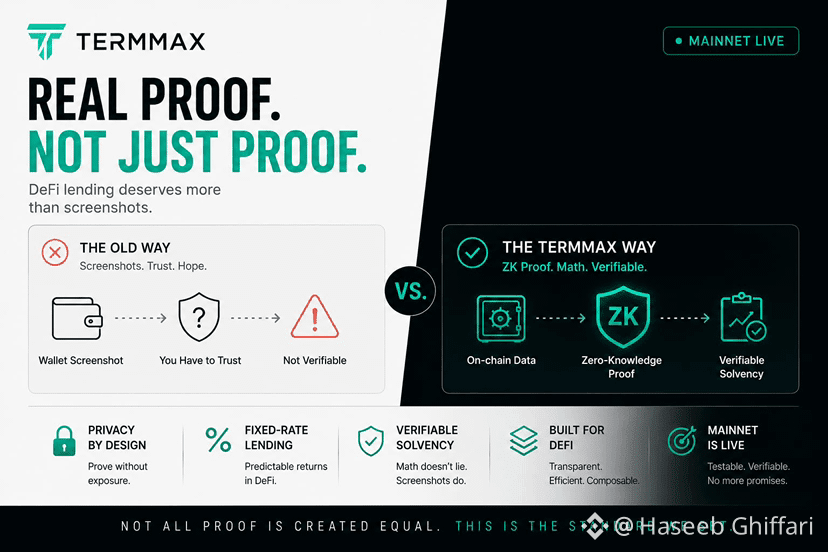
Das Problem, das es tatsächlich verfolgt, ist alt und langweilig: Niemand im DeFi-Lending kann Zahlungsfähigkeit beweisen, ohne dich um Vertrauen zu bitten – etwa durch einen Screenshot. Nach FTX wurde „Proof of Reserves“ zu einer Wallet-Adresse und einem Gebet: die Krypto-Version davon, jemandem ein Foto deines Bankguthabens zu zeigen, statt den Kontoauszug.
Der ZK-Ansatz von TermMax beweist, dass die zugrunde liegende Mathematik stimmt, ohne dabei das Konto selbst offenzulegen. Das ist eine echte Lösung, kein Rebranding. Ich habe bereits gesehen, wie Protokolle für Festzins-Kredite Stabilität versprachen – und beim ersten Auftreten echter Volatilität einknickten.
Nichts hier garantiert, dass es diesmal anders ist. Das Mainnet ist live, die Behauptungen sind jetzt überprüfbar, und überprüfbar ist mehr, als die meisten Projekte anbieten. Ich möchte glauben, dass das wiederkehrende Scheitern endlich eine Antwort hat. Ich bin noch nicht da.
#TermMax @termmax
Jeder Zyklus bringt ein Dutzend Protokolle hervor, die Probleme lösen, die der Markt für sie erfunden hat. TermMax macht das nicht – und genau deshalb habe ich nach der Mainnet-Ankündigung weitergelesen.
Das Problem, das es tatsächlich verfolgt, ist alt und langweilig: Niemand im DeFi-Lending kann Zahlungsfähigkeit beweisen, ohne dich um Vertrauen zu bitten – etwa durch einen Screenshot. Nach FTX wurde „Proof of Reserves“ zu einer Wallet-Adresse und einem Gebet: die Krypto-Version davon, jemandem ein Foto deines Bankguthabens zu zeigen, statt den Kontoauszug.
Der ZK-Ansatz von TermMax beweist, dass die zugrunde liegende Mathematik stimmt, ohne dabei das Konto selbst offenzulegen. Das ist eine echte Lösung, kein Rebranding. Ich habe bereits gesehen, wie Protokolle für Festzins-Kredite Stabilität versprachen – und beim ersten Auftreten echter Volatilität einknickten.
Nichts hier garantiert, dass es diesmal anders ist. Das Mainnet ist live, die Behauptungen sind jetzt überprüfbar, und überprüfbar ist mehr, als die meisten Projekte anbieten. Ich möchte glauben, dass das wiederkehrende Scheitern endlich eine Antwort hat. Ich bin noch nicht da.
#TermMax @TermMax
Das Problem, das es tatsächlich verfolgt, ist alt und langweilig: Niemand im DeFi-Lending kann Zahlungsfähigkeit beweisen, ohne dich um Vertrauen zu bitten – etwa durch einen Screenshot. Nach FTX wurde „Proof of Reserves“ zu einer Wallet-Adresse und einem Gebet: die Krypto-Version davon, jemandem ein Foto deines Bankguthabens zu zeigen, statt den Kontoauszug.
Der ZK-Ansatz von TermMax beweist, dass die zugrunde liegende Mathematik stimmt, ohne dabei das Konto selbst offenzulegen. Das ist eine echte Lösung, kein Rebranding. Ich habe bereits gesehen, wie Protokolle für Festzins-Kredite Stabilität versprachen – und beim ersten Auftreten echter Volatilität einknickten.
Nichts hier garantiert, dass es diesmal anders ist. Das Mainnet ist live, die Behauptungen sind jetzt überprüfbar, und überprüfbar ist mehr, als die meisten Projekte anbieten. Ich möchte glauben, dass das wiederkehrende Scheitern endlich eine Antwort hat. Ich bin noch nicht da.
#TermMax @TermMax
4
83
·
--
Bullisch
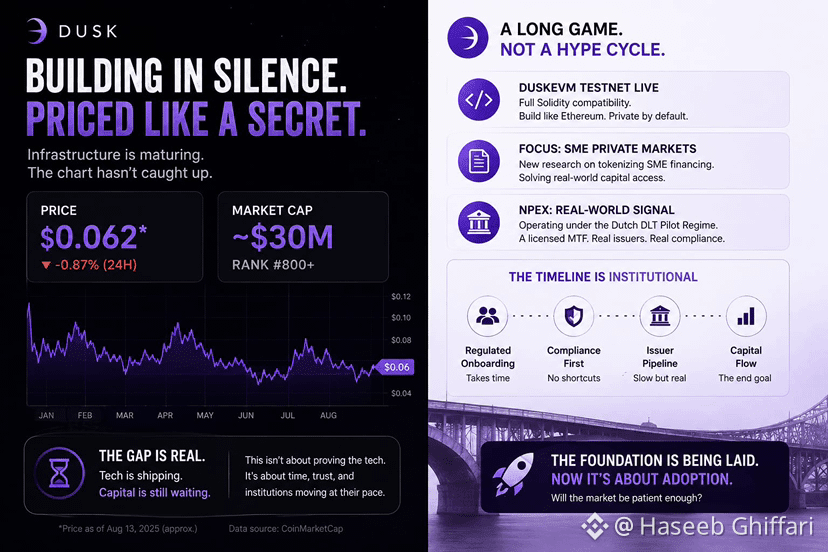
DUSK habe ich nach einer Weile nochmal gecheckt, und die Zahl war nicht so stark gestiegen, wie ich es angesichts dessen erwartet hätte, was im Hintergrund alles angelaufen ist. Sie lag weiterhin bei rund sechs Cent, während die Marktkapitalisierung nahe bei dreißig Millionen pendelte. DuskEVM ist inzwischen im Testnet live, die Solidity-Kompatibilität ist im Grunde da, und Dusk hat gerade einen neuen Beitrag veröffentlicht – über das Tokenisieren privater Märkte für SME, die an die NPEX-Arbeit gekoppelt sind.
All das taucht im Chart nicht auf. Genau damit ringe ich immer wieder. Die Lücke zwischen „die Infrastruktur reift“ und „das Kapital fließt tatsächlich durch sie hindurch“ hat sich in diesem Jahr kaum geschlossen. NPEX ist nach wie vor das stärkste reale Signal, das sie haben – und es ist eine bewusst langsam voranschreitende, regulierte Pipeline. MTFs nehmen Emittenten nicht über Nacht auf.
Die Frage ist also nicht wirklich, ob die Technik inzwischen funktioniert. Sondern ob der Markt bereit ist, eine tatsächlich institutionelle Zeitschiene abzuwarten, oder ob er DUSK weiterhin so bewertet wie eine Kette, die ihr Zeitfenster schon verpasst hat. Ich glaube nicht, dass das bereits geklärt ist, und ich bin mir auch nicht sicher, ob sechs Monate Entwicklung die Antwort in die eine oder andere Richtung verändern.
#dusk $DUSK @Dusk_Foundation
DUSK habe ich nach einer Weile nochmal gecheckt, und die Zahl war nicht so stark gestiegen, wie ich es angesichts dessen erwartet hätte, was im Hintergrund alles angelaufen ist. Sie lag weiterhin bei rund sechs Cent, während die Marktkapitalisierung nahe bei dreißig Millionen pendelte. DuskEVM ist inzwischen im Testnet live, die Solidity-Kompatibilität ist im Grunde da, und Dusk hat gerade einen neuen Beitrag veröffentlicht – über das Tokenisieren privater Märkte für SME, die an die NPEX-Arbeit gekoppelt sind.
All das taucht im Chart nicht auf. Genau damit ringe ich immer wieder. Die Lücke zwischen „die Infrastruktur reift“ und „das Kapital fließt tatsächlich durch sie hindurch“ hat sich in diesem Jahr kaum geschlossen. NPEX ist nach wie vor das stärkste reale Signal, das sie haben – und es ist eine bewusst langsam voranschreitende, regulierte Pipeline. MTFs nehmen Emittenten nicht über Nacht auf.
Die Frage ist also nicht wirklich, ob die Technik inzwischen funktioniert. Sondern ob der Markt bereit ist, eine tatsächlich institutionelle Zeitschiene abzuwarten, oder ob er DUSK weiterhin so bewertet wie eine Kette, die ihr Zeitfenster schon verpasst hat. Ich glaube nicht, dass das bereits geklärt ist, und ich bin mir auch nicht sicher, ob sechs Monate Entwicklung die Antwort in die eine oder andere Richtung verändern.
#dusk $DUSK @Dusk
All das taucht im Chart nicht auf. Genau damit ringe ich immer wieder. Die Lücke zwischen „die Infrastruktur reift“ und „das Kapital fließt tatsächlich durch sie hindurch“ hat sich in diesem Jahr kaum geschlossen. NPEX ist nach wie vor das stärkste reale Signal, das sie haben – und es ist eine bewusst langsam voranschreitende, regulierte Pipeline. MTFs nehmen Emittenten nicht über Nacht auf.
Die Frage ist also nicht wirklich, ob die Technik inzwischen funktioniert. Sondern ob der Markt bereit ist, eine tatsächlich institutionelle Zeitschiene abzuwarten, oder ob er DUSK weiterhin so bewertet wie eine Kette, die ihr Zeitfenster schon verpasst hat. Ich glaube nicht, dass das bereits geklärt ist, und ich bin mir auch nicht sicher, ob sechs Monate Entwicklung die Antwort in die eine oder andere Richtung verändern.
#dusk $DUSK @Dusk
4
5
106
·
--
Bullisch
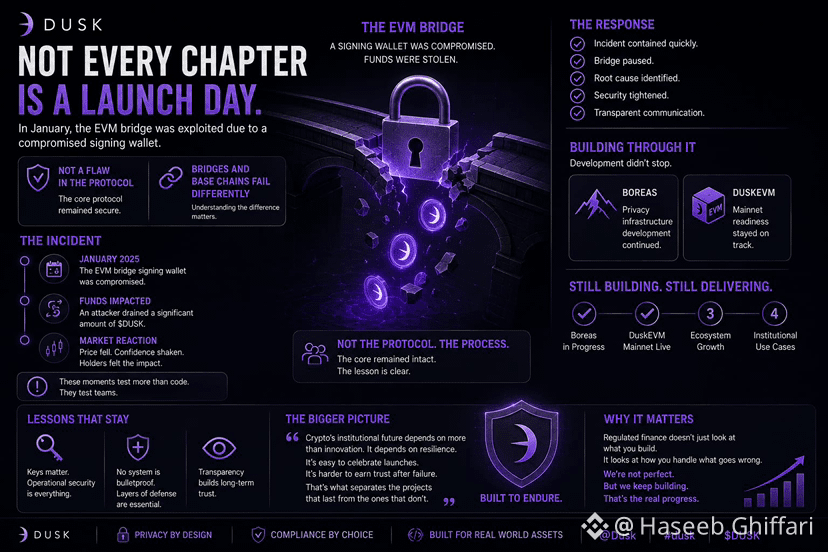
Nicht jeder Dusk-Post in diesem Jahr muss sich um Mainnet-Launches drehen. Im Januar wurde die EVM-Bridge angegriffen: Ein kompromittiertes Signing-Wallet ermöglichte es jemandem, einen bedeutenden Teil von DUSK mitzunehmen.
Es war kein Fehler im Kernprotokoll, und ich denke, diese Unterscheidung ist tatsächlich wichtig, denn Bridges und Base-Chains scheitern aus sehr unterschiedlichen Gründen. Solche Unterschiede werden jedoch selten so kommuniziert, wie sie es sollten – während Halter dabei zusehen, wie sich der Kurs in die falsche Richtung bewegt.
Was bei mir hängen blieb, ist, wie viel von der institutionellen Argumentation im Krypto-Bereich genau auf so ein Ereignis zuläuft. Man kann Zero-Knowledge-Proofs und selektive Offenlegung aufbauen – und trotzdem Gelder verlieren, etwas so Profanes wie einen falsch verwalteten Schlüssel. Dusk baute weiter daran, Boreas und die Bereitschaft von DuskEVM wurden dadurch nicht gestoppt.
Aber jede Erzählung rund um regulierte Finanzen muss auch ihre hässlichen Momente überstehen – nicht nur ihre Launch-Tage. Mich interessiert mehr, wie sie auf ein Scheitern reagieren, als wie sie ihren Erfolg ankündigen.
@Dusk_Foundation #dusk $DUSK
Nicht jeder Dusk-Post in diesem Jahr muss sich um Mainnet-Launches drehen. Im Januar wurde die EVM-Bridge angegriffen: Ein kompromittiertes Signing-Wallet ermöglichte es jemandem, einen bedeutenden Teil von DUSK mitzunehmen.
Es war kein Fehler im Kernprotokoll, und ich denke, diese Unterscheidung ist tatsächlich wichtig, denn Bridges und Base-Chains scheitern aus sehr unterschiedlichen Gründen. Solche Unterschiede werden jedoch selten so kommuniziert, wie sie es sollten – während Halter dabei zusehen, wie sich der Kurs in die falsche Richtung bewegt.
Was bei mir hängen blieb, ist, wie viel von der institutionellen Argumentation im Krypto-Bereich genau auf so ein Ereignis zuläuft. Man kann Zero-Knowledge-Proofs und selektive Offenlegung aufbauen – und trotzdem Gelder verlieren, etwas so Profanes wie einen falsch verwalteten Schlüssel. Dusk baute weiter daran, Boreas und die Bereitschaft von DuskEVM wurden dadurch nicht gestoppt.
Aber jede Erzählung rund um regulierte Finanzen muss auch ihre hässlichen Momente überstehen – nicht nur ihre Launch-Tage. Mich interessiert mehr, wie sie auf ein Scheitern reagieren, als wie sie ihren Erfolg ankündigen.
@Dusk #dusk $DUSK
Es war kein Fehler im Kernprotokoll, und ich denke, diese Unterscheidung ist tatsächlich wichtig, denn Bridges und Base-Chains scheitern aus sehr unterschiedlichen Gründen. Solche Unterschiede werden jedoch selten so kommuniziert, wie sie es sollten – während Halter dabei zusehen, wie sich der Kurs in die falsche Richtung bewegt.
Was bei mir hängen blieb, ist, wie viel von der institutionellen Argumentation im Krypto-Bereich genau auf so ein Ereignis zuläuft. Man kann Zero-Knowledge-Proofs und selektive Offenlegung aufbauen – und trotzdem Gelder verlieren, etwas so Profanes wie einen falsch verwalteten Schlüssel. Dusk baute weiter daran, Boreas und die Bereitschaft von DuskEVM wurden dadurch nicht gestoppt.
Aber jede Erzählung rund um regulierte Finanzen muss auch ihre hässlichen Momente überstehen – nicht nur ihre Launch-Tage. Mich interessiert mehr, wie sie auf ein Scheitern reagieren, als wie sie ihren Erfolg ankündigen.
@Dusk #dusk $DUSK
4
4
185
·
--
Bullisch
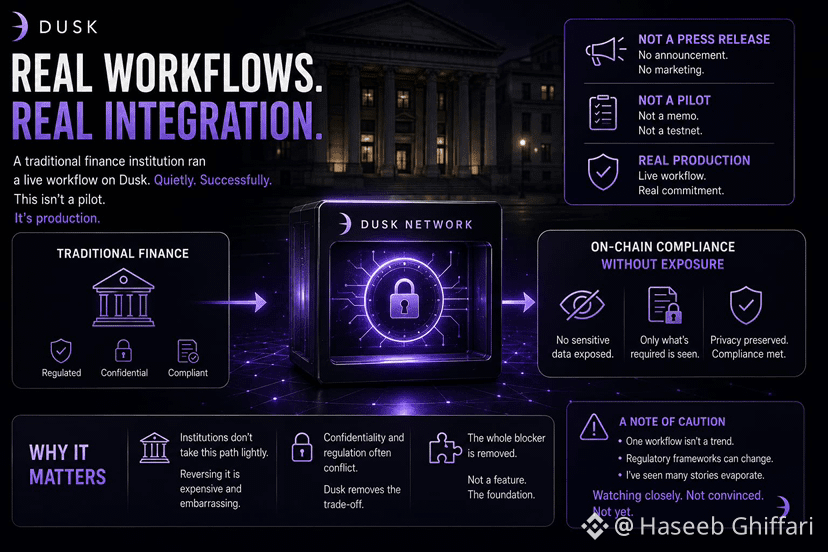
Eine traditionelle Finanzinstitution hat gerade einen Live-Workflow auf Dusk ausgeführt. Keine Pilotankündigung. Keine Mitteilung. Ein echter Produktionsprozess, der still auf der Kette weiterlief. Dieser Unterschied ist wichtiger, als er klingt.
Pressemitteilungen sind Marketing; Produktions-Workflows sind Verpflichtungen – solche, die Institutionen nicht leichtfertig eingehen, weil das Rückgängigmachen teuer und peinlich ist. Dusk’ zentrales Prinzip hier ist On-Chain-Compliance ohne Exposition. Das lässt sich einfacher erklären als die meisten Krypto-Jargons: Es ist wie die Abfertigung am Flughafen-Sicherheitscheck, ohne den eigenen Beutel auf das Laufband für Fremde zu kippen, die ihn inspizieren.
Die Autorität verifiziert, was verifiziert werden muss. Niemand sonst sieht etwas. Für Institutionen, die zugleich an Regulierungen und Vertraulichkeitsverpflichtungen gebunden sind, ist das kein „nice-to-have“, sondern der gesamte Blocker, der damit aus dem Weg geräumt wird.
Ich habe schon zu viele Geschichten über „institutionelle Akzeptanz“ gesehen, die sich allein durch eine Headline in Luft aufgelöst haben. Das war keine Headline. Dennoch: Ein einzelner Workflow ist kein Trend, und regulatorische Rahmenwerke können sich über Nacht unter einem Projekt verschieben. Ich achte jetzt widerwillig darauf. Ob diese Aufmerksamkeit gerechtfertigt ist, weiß ich ehrlich gesagt noch nicht.
@Dusk_Foundation $DUSK #dusk
Eine traditionelle Finanzinstitution hat gerade einen Live-Workflow auf Dusk ausgeführt. Keine Pilotankündigung. Keine Mitteilung. Ein echter Produktionsprozess, der still auf der Kette weiterlief. Dieser Unterschied ist wichtiger, als er klingt.
Pressemitteilungen sind Marketing; Produktions-Workflows sind Verpflichtungen – solche, die Institutionen nicht leichtfertig eingehen, weil das Rückgängigmachen teuer und peinlich ist. Dusk’ zentrales Prinzip hier ist On-Chain-Compliance ohne Exposition. Das lässt sich einfacher erklären als die meisten Krypto-Jargons: Es ist wie die Abfertigung am Flughafen-Sicherheitscheck, ohne den eigenen Beutel auf das Laufband für Fremde zu kippen, die ihn inspizieren.
Die Autorität verifiziert, was verifiziert werden muss. Niemand sonst sieht etwas. Für Institutionen, die zugleich an Regulierungen und Vertraulichkeitsverpflichtungen gebunden sind, ist das kein „nice-to-have“, sondern der gesamte Blocker, der damit aus dem Weg geräumt wird.
Ich habe schon zu viele Geschichten über „institutionelle Akzeptanz“ gesehen, die sich allein durch eine Headline in Luft aufgelöst haben. Das war keine Headline. Dennoch: Ein einzelner Workflow ist kein Trend, und regulatorische Rahmenwerke können sich über Nacht unter einem Projekt verschieben. Ich achte jetzt widerwillig darauf. Ob diese Aufmerksamkeit gerechtfertigt ist, weiß ich ehrlich gesagt noch nicht.
@Dusk $DUSK #dusk
Pressemitteilungen sind Marketing; Produktions-Workflows sind Verpflichtungen – solche, die Institutionen nicht leichtfertig eingehen, weil das Rückgängigmachen teuer und peinlich ist. Dusk’ zentrales Prinzip hier ist On-Chain-Compliance ohne Exposition. Das lässt sich einfacher erklären als die meisten Krypto-Jargons: Es ist wie die Abfertigung am Flughafen-Sicherheitscheck, ohne den eigenen Beutel auf das Laufband für Fremde zu kippen, die ihn inspizieren.
Die Autorität verifiziert, was verifiziert werden muss. Niemand sonst sieht etwas. Für Institutionen, die zugleich an Regulierungen und Vertraulichkeitsverpflichtungen gebunden sind, ist das kein „nice-to-have“, sondern der gesamte Blocker, der damit aus dem Weg geräumt wird.
Ich habe schon zu viele Geschichten über „institutionelle Akzeptanz“ gesehen, die sich allein durch eine Headline in Luft aufgelöst haben. Das war keine Headline. Dennoch: Ein einzelner Workflow ist kein Trend, und regulatorische Rahmenwerke können sich über Nacht unter einem Projekt verschieben. Ich achte jetzt widerwillig darauf. Ob diese Aufmerksamkeit gerechtfertigt ist, weiß ich ehrlich gesagt noch nicht.
@Dusk $DUSK #dusk
2
4
211
·
--
Bullisch
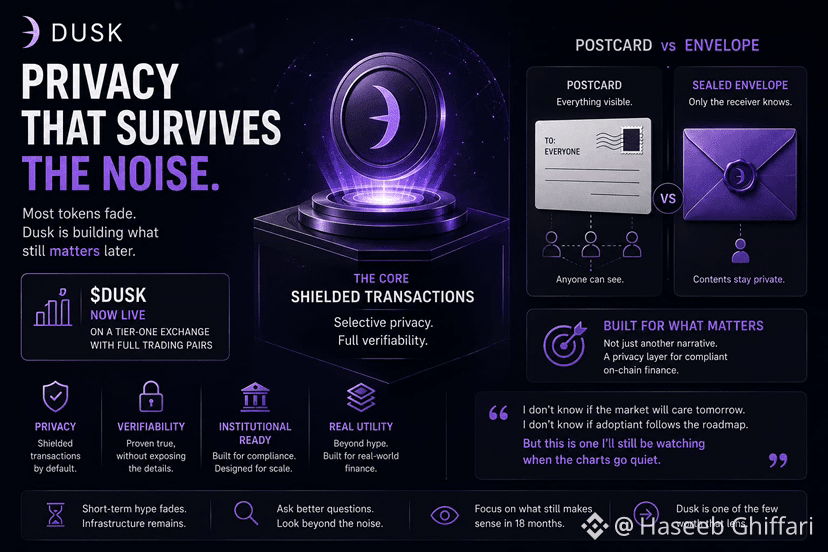
Ich bin müde von Privacy-Coins, die Diskretion versprechen und am Ende nichts liefern, was Regulierer nicht doch anfassen. Also hätte sich das Tier-1-Listing für $DUSK, mit allen vollen Paaren, wie einfach nur noch mehr Lärm anfühlen müssen – in einem Markt, der Lärm belohnt.
Tja, nicht ganz. Die zentrale Idee der Dusk Foundation sind abgeschirmte Transaktionen. Und am einfachsten kann ich es so ausdrücken: Eine Postkarte und ein versiegelter Umschlag werden beide zugestellt, aber nur der Umschlag bewahrt den Inhalt davor, den alle zu sehen bekommen, die ihn auf dem Weg dazwischen anfassen.
Diese Lücke schließen die meisten Blockchains nie. Öffentliche Ledger sind Postkarten – per Design. Dusk versucht, den Umschlag zu bauen, ohne das Zustellsystem zu zerstören. Das ist ein härteres Problem, als es klingt – und an dem sind zahlreiche Teams gescheitert, oft leise.
Ich bin nicht überzeugt, dass das den Kontakt mit echter regulatorischer Reibung überlebt. Und ich bin nicht überzeugt, dass der Markt Infrastruktur gegenüber Narrative belohnt; historisch hat er das nicht. Aber die Überlegung hinter diesem Ansatz hält länger durch als die meisten Überlegungen unter Druck. Das ist selten genug, um weiter zuzusehen.
@Dusk_Foundation $DUSK #dusk
Ich bin müde von Privacy-Coins, die Diskretion versprechen und am Ende nichts liefern, was Regulierer nicht doch anfassen. Also hätte sich das Tier-1-Listing für $DUSK , mit allen vollen Paaren, wie einfach nur noch mehr Lärm anfühlen müssen – in einem Markt, der Lärm belohnt.
Tja, nicht ganz. Die zentrale Idee der Dusk Foundation sind abgeschirmte Transaktionen. Und am einfachsten kann ich es so ausdrücken: Eine Postkarte und ein versiegelter Umschlag werden beide zugestellt, aber nur der Umschlag bewahrt den Inhalt davor, den alle zu sehen bekommen, die ihn auf dem Weg dazwischen anfassen.
Diese Lücke schließen die meisten Blockchains nie. Öffentliche Ledger sind Postkarten – per Design. Dusk versucht, den Umschlag zu bauen, ohne das Zustellsystem zu zerstören. Das ist ein härteres Problem, als es klingt – und an dem sind zahlreiche Teams gescheitert, oft leise.
Ich bin nicht überzeugt, dass das den Kontakt mit echter regulatorischer Reibung überlebt. Und ich bin nicht überzeugt, dass der Markt Infrastruktur gegenüber Narrative belohnt; historisch hat er das nicht. Aber die Überlegung hinter diesem Ansatz hält länger durch als die meisten Überlegungen unter Druck. Das ist selten genug, um weiter zuzusehen.
@Dusk $DUSK #dusk
Tja, nicht ganz. Die zentrale Idee der Dusk Foundation sind abgeschirmte Transaktionen. Und am einfachsten kann ich es so ausdrücken: Eine Postkarte und ein versiegelter Umschlag werden beide zugestellt, aber nur der Umschlag bewahrt den Inhalt davor, den alle zu sehen bekommen, die ihn auf dem Weg dazwischen anfassen.
Diese Lücke schließen die meisten Blockchains nie. Öffentliche Ledger sind Postkarten – per Design. Dusk versucht, den Umschlag zu bauen, ohne das Zustellsystem zu zerstören. Das ist ein härteres Problem, als es klingt – und an dem sind zahlreiche Teams gescheitert, oft leise.
Ich bin nicht überzeugt, dass das den Kontakt mit echter regulatorischer Reibung überlebt. Und ich bin nicht überzeugt, dass der Markt Infrastruktur gegenüber Narrative belohnt; historisch hat er das nicht. Aber die Überlegung hinter diesem Ansatz hält länger durch als die meisten Überlegungen unter Druck. Das ist selten genug, um weiter zuzusehen.
@Dusk $DUSK #dusk
3
4
84
Anmelden und weiter Inhalte entdecken
Krypto-Nutzer weltweit auf Binance Square kennenlernen
⚡️ Bleib in Sachen Krypto stets am Puls.
💬 Die weltgrößte Kryptobörse vertraut darauf.
👍 Erhalte verlässliche Einblicke von verifizierten Creators.
E-Mail-Adresse/Telefonnummer
Trendthemen
FedRateWatch
798,004 Aufrufe
3,763 Kommentare
Teile & gewinne Traffic-Belohnungen in unserer Kampagne mit angesagtem Hashtag
✨Thema: FOMC September, Was ist der nächste Schritt der Fed?
👉So nimmst du teil:
Veröffentliche einen kurzen Beitrag oder Artikel mit dem Hashtag #FedRateWatch
Erstelle Inhalte basierend auf den folgenden Blickwinkeln:
- Der August-Core-CPI stieg um 0,3% im Monatsvergleich, und die Wahrscheinlichkeit für eine 25bp-Erhöhung diese Woche liegt nun bei fast 90%. Erwartest du diese Woche eine Zinserhöhung? Handelt es sich um einen einmaligen Schritt oder den Beginn eines längeren Zinserhöhungszyklus?
- Wenn die Erhöhung erfolgt: Wie entwickelt sich das für BTC, Tech-Aktien und Gold? Aufwärts- oder abwärtsgerichtet?
- Wie planst du als Nächstes zu handeln? Teile deinen BTC-, Aktien- oder Gold-Trade/Bestände mit unserem Trade-Sharing-Widget.
⏰Kampagnenzeitraum:
- 2026-09-15 11:00 - 2026-09-17 3:00 UTC
🎁Belohnung:
- Qualifizierte Beiträge, die die oben genannten Richtlinien erfüllen und mehr als 100 Wörter enthalten, werden überprüft und erhalten möglicherweise einen zufälligen Traffic-Boost von 500 bis 3.000 Aufrufen. Du erhältst eine Benachrichtigung von deiner Feed-Secretary, wenn dein Beitrag ausgewählt wird.
- Erhalte die Chance, dass dein Artikel auf Binance Square Official vorgestellt wird
Du brauchst Ideen für deinen Beitrag? Besuche die Themenseite #FedRateWatch oder die Square Guide on How to Post for Better Reach.
Binance Square Official
·487 Likes
·1.1M Aufrufe
BitcoinFalls4%
619 Aufrufe
65 Kommentare
OpenAIDiscussesNewFundingAt$1.2TValuation
0 Aufrufe
6 Kommentare