Binance Square

Lishay_Era

Clean Signals. Calm Mindset. New Era.
Trade eröffnen
Hochfrequenz-Trader
1.7 Jahre
47 Following
11.4K+ Follower
34.4K+ Like gegeben
6.0K+ Geteilt
Beiträge
Portfolio
·
--
#walrus $WAL @WalrusProtocol : Making Data Permanent in Web3 Walrus Protocol is rethinking how data lives on the internet. Instead of treating information as temporary files stored in centralized clouds, Walrus turns data into a durable, verifiable, and economically secured asset for Web3 and AI. At the heart of Walrus are “blobs” — large, decentralized data objects stored using advanced Red Stuff coding. This method ensures that data remains available even if many nodes go offline, making the network resilient, censorship-resistant, and reliable for long-term storage. What makes Walrus truly unique is its deep integration with the Sui blockchain. Every stored blob becomes a first-class on-chain object with clear ownership and provenance. This means data is not just stored — it becomes programmable and usable by dApps, creators, and AI agents. The network runs on a delegated Proof-of-Stake model where validators are rewarded for storing and serving data, while users pay predictable fees. This creates a sustainable system where no single party controls information. For AI applications, Walrus is especially important. AI systems need trustworthy, structured, and tamper-resistant datasets — exactly what Walrus provides. This positions Walrus as a foundational layer for the future of AI-driven Web3 economies. In simple terms, Walrus is building the memory layer of the decentralized internet — where data lasts forever, stays trustworthy, and carries real economic value.
#walrus $WAL
@Walrus 🦭/acc : Making Data Permanent in Web3
Walrus Protocol is rethinking how data lives on the internet. Instead of treating information as temporary files stored in centralized clouds, Walrus turns data into a durable, verifiable, and economically secured asset for Web3 and AI.
At the heart of Walrus are “blobs” — large, decentralized data objects stored using advanced Red Stuff coding. This method ensures that data remains available even if many nodes go offline, making the network resilient, censorship-resistant, and reliable for long-term storage.
What makes Walrus truly unique is its deep integration with the Sui blockchain. Every stored blob becomes a first-class on-chain object with clear ownership and provenance. This means data is not just stored — it becomes programmable and usable by dApps, creators, and AI agents.
The network runs on a delegated Proof-of-Stake model where validators are rewarded for storing and serving data, while users pay predictable fees. This creates a sustainable system where no single party controls information.
For AI applications, Walrus is especially important. AI systems need trustworthy, structured, and tamper-resistant datasets — exactly what Walrus provides. This positions Walrus as a foundational layer for the future of AI-driven Web3 economies.
In simple terms, Walrus is building the memory layer of the decentralized internet — where data lasts forever, stays trustworthy, and carries real economic value.
Plasma : Deterministisches Geld für eine KI-gesteuerte Wirtschaft@Plasma #Plasma $XPL Ich komme immer wieder zu einer unbequemen Wahrheit zurück: Das heutige Geld ist für Menschen und nicht für Maschinen gemacht. Märkte bewegen sich in Stößen, Liquidität erscheint und verschwindet, und Stabilität ist oft mehr Erzählung als Mathematik. Als ich begann, Plasma zu studieren, hatte ich das Gefühl, ein finanzielles System zu betrachten, das von Grund auf neu gestaltet wurde – eines, das Wert nicht nur als soziale Vereinbarung, sondern als programmierbares, verifizierbares und maschinenlesbares Invariant betrachtet. Dieser Perspektivwechsel verändert alles.

Plasma : Deterministisches Geld für eine KI-gesteuerte Wirtschaft

@Plasma #Plasma $XPL
Ich komme immer wieder zu einer unbequemen Wahrheit zurück: Das heutige Geld ist für Menschen und nicht für Maschinen gemacht. Märkte bewegen sich in Stößen, Liquidität erscheint und verschwindet, und Stabilität ist oft mehr Erzählung als Mathematik. Als ich begann, Plasma zu studieren, hatte ich das Gefühl, ein finanzielles System zu betrachten, das von Grund auf neu gestaltet wurde – eines, das Wert nicht nur als soziale Vereinbarung, sondern als programmierbares, verifizierbares und maschinenlesbares Invariant betrachtet. Dieser Perspektivwechsel verändert alles.
When Privacy Becomes Infrastructure — My Journey into Dusk Foundation@Dusk_Foundation #Dusk $DUSK When I first encountered Dusk Foundation, I didn’t just see another blockchain — I saw a challenge to how the entire financial internet is structured. Most people in Web3 talk about decentralization, but very few projects confront the uncomfortable reality that radical transparency can actually be harmful. Watching every transaction, balance, and interaction in real time might feel “trustless,” but in practice it creates surveillance economies, competitive vulnerabilities, and chilling effects on real institutional participation. That tension is what pulled me toward Dusk: a network that asks a simple but powerful question — what if decentralization included the right to privacy? As I dug deeper, I realized that Dusk is not trying to hide activity from the world; it is trying to redefine how trust works in a digital financial system. Traditional public chains replace banks with open ledgers, but they inadvertently expose far more information than legacy systems ever did. In contrast, Dusk replaces trust in intermediaries with trust in mathematics — specifically, zero-knowledge cryptography — allowing verification without visibility. That distinction is subtle, but revolutionary. Many blockchain ecosystems treat privacy as an afterthought, bolted on through mixers or optional shielding layers. Dusk does the opposite: privacy is the base layer. Every smart contract, every settlement, every proof is designed around confidentiality by default. To me, this feels like the difference between installing a lock on a glass house versus building a private home from the ground up. Technically, Dusk is built around zk-STARK rollups, which allow massive batches of transactions to be validated with a single cryptographic proof. This means scalability does not come at the cost of privacy. Where many chains force a tradeoff — either fast and public or private and slow — Dusk refuses that compromise. It delivers performance and confidentiality together, which is rare in Web3 infrastructure. What fascinates me most is how this design maps onto real institutional needs. Banks, asset managers, and regulated firms do not want the world to see their trading strategies, liquidity positions, or client relationships on a transparent ledger. Yet they increasingly want blockchain settlement efficiency. Dusk creates a bridge: onchain trust with offchain-like confidentiality, making decentralized finance usable for serious financial players. The DUSK token plays a central role in this system. It is not merely a speculative asset — it is the engine of security, governance, and economic coordination. Validators stake DUSK to participate in consensus, aligning their incentives with network reliability. If they act dishonestly or go offline, they risk penalties. This staking model transforms privacy from a privilege into a collectively secured public good. Another layer that often gets overlooked is Dusk’s approach to compliance-aware privacy. Critics of private blockchains worry about illicit use, but Dusk does not advocate absolute opacity. Instead, it supports selective disclosure mechanisms — meaning users can reveal transaction details to regulators or auditors when legally required while keeping them hidden from the broader public. This is privacy with responsibility, not chaos. From a user’s perspective, this changes how you experience DeFi. On most chains, your wallet history is permanently public, searchable, and analyzable by anyone. On Dusk, you regain control over what others can see. That shift feels deeply empowering — like moving from a glass bank to a secure vault where you decide who gets access. One of the most powerful applications of Dusk is in confidential DeFi markets. Imagine trading in an order book where your bids, sizes, and strategies are hidden from front-running bots and competitors. Liquidity becomes fairer, manipulation becomes harder, and markets function more like traditional finance — but without centralized gatekeepers. Beyond trading, Dusk enables private lending, shielded vaults, and confidential staking, where your financial behavior is not laid bare to the world. This is not about secrecy for wrongdoing; it is about protecting competitive, personal, and strategic information in a hyper-connected digital economy. I also see Dusk as an answer to one of Web3’s biggest philosophical contradictions: how can a system be both decentralized and respectful of personal rights? Pure transparency often feels like a digital panopticon, while pure secrecy undermines trust. Dusk navigates this middle path by ensuring verifiability without exposure — trust without surveillance. The developer ecosystem around Dusk is equally important. Through privacy SDKs, documentation, and tooling, the foundation is lowering the barrier to building confidential applications. Instead of privacy being reserved for cryptographers, it becomes accessible to ordinary Web3 builders who want to create safer, more user-respecting products. Another dimension that excites me is how Dusk interacts with tokenized real-world assets (RWA). Enterprises issuing bonds, equities, or structured products onchain need confidentiality around holdings and transfers. Dusk gives them a native settlement layer that aligns with both regulatory expectations and blockchain efficiency. Looking at the broader Web3 landscape, many chains chase throughput, TVL, or narrative dominance. Dusk is chasing something deeper: financial dignity in a decentralized world. That might sound abstract, but it matters. People and institutions behave differently when they feel safe rather than exposed. Of course, privacy is not just a technical problem — it is a political and cultural one. Governments, regulators, and platforms are still grappling with how much financial privacy citizens should have in digital systems. Dusk positions itself not as a rebel network, but as a responsible privacy layer that can coexist with legal frameworks while protecting individual rights. From a strategic standpoint, I see Dusk as essential infrastructure for the next phase of DeFi. As decentralized markets mature, participants will demand confidentiality to avoid predatory behavior, front-running, and data exploitation. Dusk is built for that future. Personally, what keeps me invested in this ecosystem is the realization that privacy is not anti-transparency — it is a higher form of transparency, where truth is proven mathematically instead of broadcast socially. That shift changes how we think about trust itself. In the long run, I believe Dusk will be remembered not just as a privacy chain, but as the network that helped normalize confidential smart contracts across Web3. When privacy becomes infrastructure, entire categories of applications suddenly become possible. Ultimately, Dusk Foundation is not just building technology — it is building a framework for financial sovereignty in the age of digital surveillance. In a world where every click, trade, and transfer can be tracked, having a system that respects your right to privacy is no longer optional — it is essential. And that is why, for me, Dusk is not just another protocol. It is a statement: that decentralization should empower people, not expose them.

When Privacy Becomes Infrastructure — My Journey into Dusk Foundation

@Dusk #Dusk $DUSK
When I first encountered Dusk Foundation, I didn’t just see another blockchain — I saw a challenge to how the entire financial internet is structured. Most people in Web3 talk about decentralization, but very few projects confront the uncomfortable reality that radical transparency can actually be harmful. Watching every transaction, balance, and interaction in real time might feel “trustless,” but in practice it creates surveillance economies, competitive vulnerabilities, and chilling effects on real institutional participation. That tension is what pulled me toward Dusk: a network that asks a simple but powerful question — what if decentralization included the right to privacy?
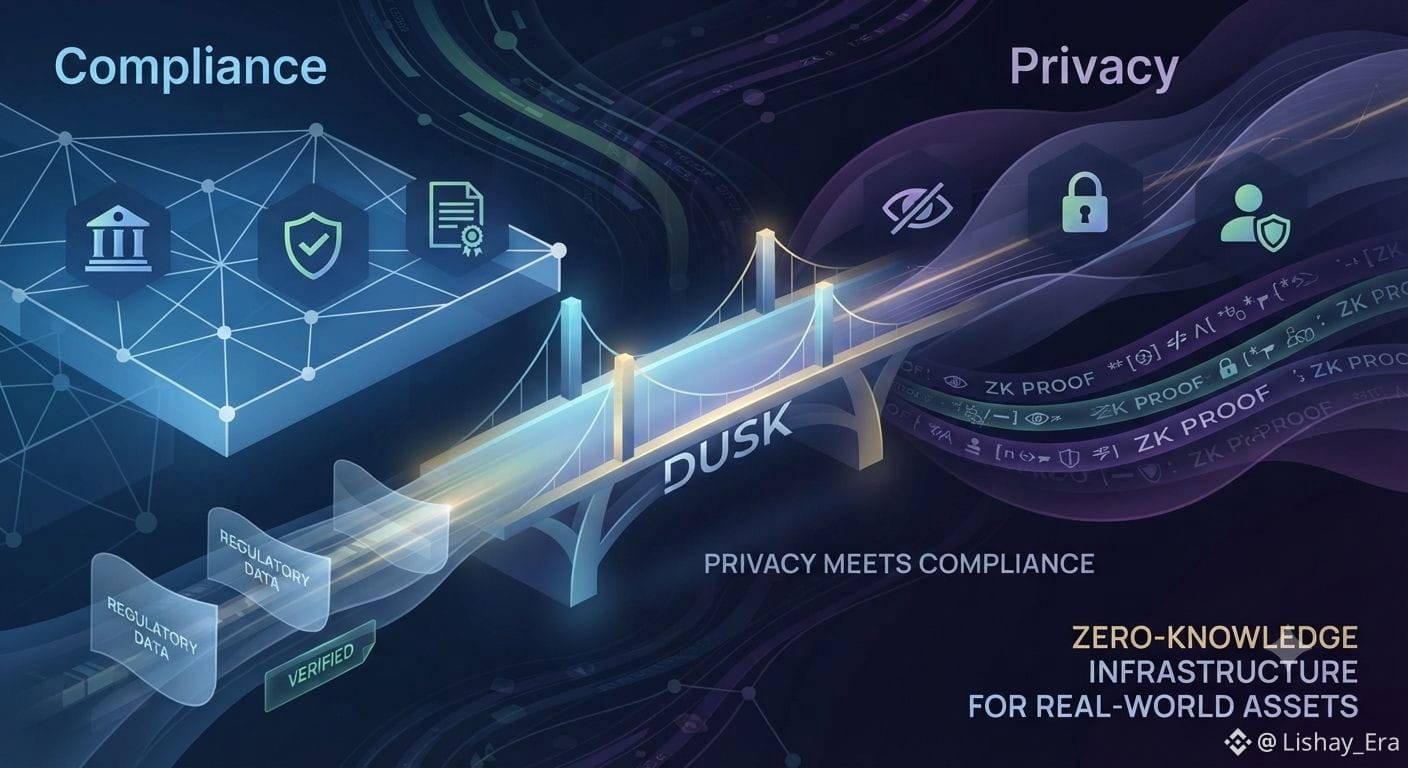
As I dug deeper, I realized that Dusk is not trying to hide activity from the world; it is trying to redefine how trust works in a digital financial system. Traditional public chains replace banks with open ledgers, but they inadvertently expose far more information than legacy systems ever did. In contrast, Dusk replaces trust in intermediaries with trust in mathematics — specifically, zero-knowledge cryptography — allowing verification without visibility. That distinction is subtle, but revolutionary.
Many blockchain ecosystems treat privacy as an afterthought, bolted on through mixers or optional shielding layers. Dusk does the opposite: privacy is the base layer. Every smart contract, every settlement, every proof is designed around confidentiality by default. To me, this feels like the difference between installing a lock on a glass house versus building a private home from the ground up.
Technically, Dusk is built around zk-STARK rollups, which allow massive batches of transactions to be validated with a single cryptographic proof. This means scalability does not come at the cost of privacy. Where many chains force a tradeoff — either fast and public or private and slow — Dusk refuses that compromise. It delivers performance and confidentiality together, which is rare in Web3 infrastructure.
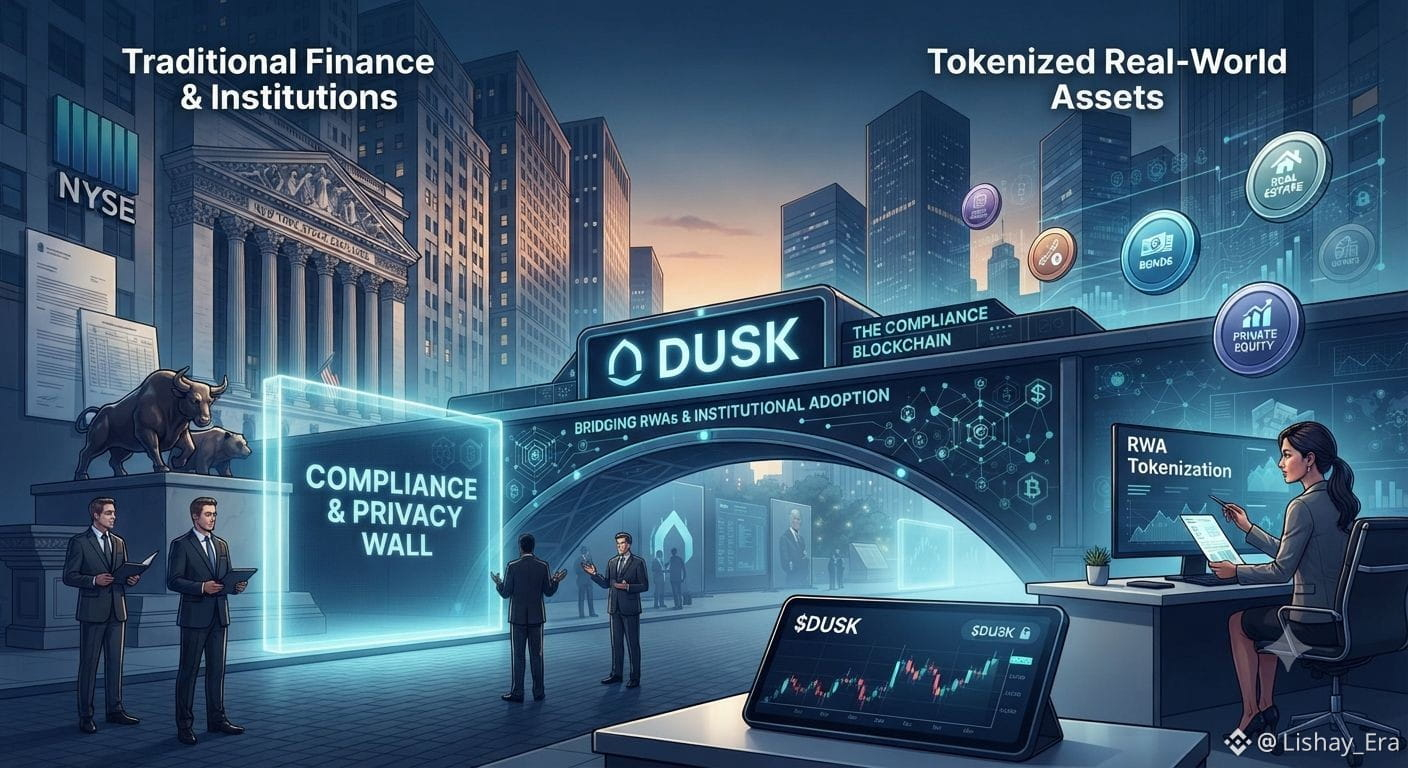
What fascinates me most is how this design maps onto real institutional needs. Banks, asset managers, and regulated firms do not want the world to see their trading strategies, liquidity positions, or client relationships on a transparent ledger. Yet they increasingly want blockchain settlement efficiency. Dusk creates a bridge: onchain trust with offchain-like confidentiality, making decentralized finance usable for serious financial players.
The DUSK token plays a central role in this system. It is not merely a speculative asset — it is the engine of security, governance, and economic coordination. Validators stake DUSK to participate in consensus, aligning their incentives with network reliability. If they act dishonestly or go offline, they risk penalties. This staking model transforms privacy from a privilege into a collectively secured public good.
Another layer that often gets overlooked is Dusk’s approach to compliance-aware privacy. Critics of private blockchains worry about illicit use, but Dusk does not advocate absolute opacity. Instead, it supports selective disclosure mechanisms — meaning users can reveal transaction details to regulators or auditors when legally required while keeping them hidden from the broader public. This is privacy with responsibility, not chaos.
From a user’s perspective, this changes how you experience DeFi. On most chains, your wallet history is permanently public, searchable, and analyzable by anyone. On Dusk, you regain control over what others can see. That shift feels deeply empowering — like moving from a glass bank to a secure vault where you decide who gets access.
One of the most powerful applications of Dusk is in confidential DeFi markets. Imagine trading in an order book where your bids, sizes, and strategies are hidden from front-running bots and competitors. Liquidity becomes fairer, manipulation becomes harder, and markets function more like traditional finance — but without centralized gatekeepers.
Beyond trading, Dusk enables private lending, shielded vaults, and confidential staking, where your financial behavior is not laid bare to the world. This is not about secrecy for wrongdoing; it is about protecting competitive, personal, and strategic information in a hyper-connected digital economy.
I also see Dusk as an answer to one of Web3’s biggest philosophical contradictions: how can a system be both decentralized and respectful of personal rights? Pure transparency often feels like a digital panopticon, while pure secrecy undermines trust. Dusk navigates this middle path by ensuring verifiability without exposure — trust without surveillance.
The developer ecosystem around Dusk is equally important. Through privacy SDKs, documentation, and tooling, the foundation is lowering the barrier to building confidential applications. Instead of privacy being reserved for cryptographers, it becomes accessible to ordinary Web3 builders who want to create safer, more user-respecting products.
Another dimension that excites me is how Dusk interacts with tokenized real-world assets (RWA). Enterprises issuing bonds, equities, or structured products onchain need confidentiality around holdings and transfers. Dusk gives them a native settlement layer that aligns with both regulatory expectations and blockchain efficiency.
Looking at the broader Web3 landscape, many chains chase throughput, TVL, or narrative dominance. Dusk is chasing something deeper: financial dignity in a decentralized world. That might sound abstract, but it matters. People and institutions behave differently when they feel safe rather than exposed.
Of course, privacy is not just a technical problem — it is a political and cultural one. Governments, regulators, and platforms are still grappling with how much financial privacy citizens should have in digital systems. Dusk positions itself not as a rebel network, but as a responsible privacy layer that can coexist with legal frameworks while protecting individual rights.
From a strategic standpoint, I see Dusk as essential infrastructure for the next phase of DeFi. As decentralized markets mature, participants will demand confidentiality to avoid predatory behavior, front-running, and data exploitation. Dusk is built for that future.
Personally, what keeps me invested in this ecosystem is the realization that privacy is not anti-transparency — it is a higher form of transparency, where truth is proven mathematically instead of broadcast socially. That shift changes how we think about trust itself.
In the long run, I believe Dusk will be remembered not just as a privacy chain, but as the network that helped normalize confidential smart contracts across Web3. When privacy becomes infrastructure, entire categories of applications suddenly become possible.
Ultimately, Dusk Foundation is not just building technology — it is building a framework for financial sovereignty in the age of digital surveillance. In a world where every click, trade, and transfer can be tracked, having a system that respects your right to privacy is no longer optional — it is essential.
And that is why, for me, Dusk is not just another protocol. It is a statement: that decentralization should empower people, not expose them.
World Where Data Is Owned, Not Rented — Why Walrus Protocol Feels Like Web3’s Memory Layer@WalrusProtocol #Walrus $WAL The more time I spend in Web3, the more I realize that we don’t actually “own” much of what we think we own. We hold wallets, NFTs, tokens, and credentials, yet most of the data behind them still lives in centralized servers. That contradiction bothered me for a long time, and it’s exactly what led me to Walrus Protocol. When I first looked at it, I didn’t see just another storage network — I saw a movement toward true digital sovereignty, where data stops being something we rent from Big Tech and becomes something we genuinely control onchain. What struck me most is that Walrus doesn’t market itself as “cheap storage.” Instead, it frames storage as a trust problem, not a cost problem. In today’s internet, we don’t pay much for cloud storage, but we pay with surveillance, censorship risk, platform dependency, and data extraction. Walrus flips that dynamic: you may pay in $WAL, but in return, you get guaranteed availability, verifiable persistence, and cryptographic ownership — something no centralized provider can ever truly offer. At a technical level, Walrus introduces the idea of blobs — large, structured pieces of data that exist as first-class citizens in the Sui ecosystem. Unlike typical blockchains that are optimized for tiny transactions, Walrus is designed for videos, datasets, images, archives, and machine-readable files that modern AI systems actually need. To me, this makes Walrus feel less like a “blockchain add-on” and more like Web3’s long-term memory layer. Instead of storing full replicas everywhere, Walrus uses advanced erasure coding (often referred to as Red Stuff coding). This means data is mathematically fragmented and distributed across many nodes, yet can be reconstructed even if many nodes disappear. When I learned this, I realized how elegant the design is — decentralization without waste, resilience without absurd redundancy, and durability without massive overhead. This is where the concept of data rental vs data ownership becomes crystal clear. In Web2, you rent storage from Google, Amazon, or Microsoft. They technically “hold” your data, but they also have power over it. With Walrus, you lock data into a decentralized network where no single entity can delete, alter, or restrict it. That shift — from permissioned access to cryptographic guarantees — is revolutionary. Economically, this is powered by the $WAL token, which functions as both payment and security. Users prepay for storage using WAL, while node operators stake WAL to prove reliability. If they fail to store or serve data properly, they can be penalized. This aligns incentives perfectly: users get reliable storage, and operators get rewarded for honest behavior. What I find especially compelling is that Walrus isn’t chasing hype. It is built natively on Sui, which already prioritizes speed, object ownership, and programmability. That means every stored blob can interact with smart contracts, NFTs, DeFi apps, and AI agents in a seamless way. Storage is no longer a passive layer — it becomes programmable infrastructure. From a creator’s perspective, this changes everything. Imagine minting an NFT where the artwork, metadata, and provenance are permanently secured on Walrus rather than pinned to a fragile IPFS link. That’s not just better storage — that’s better digital ownership. Your art truly lives onchain, not in a centralized bucket. For AI developers, Walrus opens another frontier. Training datasets, model outputs, and agent memories can be stored in a way that is tamper-resistant and verifiable. Instead of AI systems relying on opaque cloud databases, they can reference decentralized, auditable data objects — a critical step toward trust in AI systems. I also see Walrus as a solution to one of Web3’s biggest weaknesses: broken links. How many times have you seen NFTs or dApps lose their images because hosting disappeared? Walrus directly addresses this by ensuring long-term availability rather than temporary hosting, making digital assets genuinely durable. Beyond technology, there’s a philosophical dimension that resonates with me. Web3 was supposed to return power to individuals, yet most data still sits in corporate silos. Walrus feels like a quiet correction — a protocol that says, “Your data is yours, forever, not just until a server shuts down.” What excites me is how this could reshape decentralized social platforms, content networks, and creator economies. Instead of platforms controlling archives, users could publish content that no company, government, or platform can erase, stored securely on Walrus and governed by cryptographic truth. The community aspect also matters. With WAL staking and governance, users are not passive consumers — they are participants in a living network. Decisions about pricing, upgrades, and incentives emerge from decentralized coordination rather than corporate boards. When I compare Walrus to traditional cloud storage, the difference feels almost ethical. Cloud is convenient but fragile in terms of ownership. Walrus is decentralized, resilient, and principled. It doesn’t ask you to trust a company — it asks you to trust math and cryptography. Looking forward, I believe Walrus will become foundational for AI-driven Web3 applications. As agents, bots, and autonomous systems grow, they will need reliable, persistent, and trustless data layers. Walrus is positioned exactly at that intersection. In the end, my takeaway is simple but powerful: if Web3 is about sovereignty, then Walrus is about sovereign memory. Tokens move value, smart contracts move logic, but Walrus moves truth — and in a data-driven world, that may be the most valuable layer of all.

World Where Data Is Owned, Not Rented — Why Walrus Protocol Feels Like Web3’s Memory Layer

@Walrus 🦭/acc #Walrus $WAL
The more time I spend in Web3, the more I realize that we don’t actually “own” much of what we think we own. We hold wallets, NFTs, tokens, and credentials, yet most of the data behind them still lives in centralized servers. That contradiction bothered me for a long time, and it’s exactly what led me to Walrus Protocol. When I first looked at it, I didn’t see just another storage network — I saw a movement toward true digital sovereignty, where data stops being something we rent from Big Tech and becomes something we genuinely control onchain.
What struck me most is that Walrus doesn’t market itself as “cheap storage.” Instead, it frames storage as a trust problem, not a cost problem. In today’s internet, we don’t pay much for cloud storage, but we pay with surveillance, censorship risk, platform dependency, and data extraction. Walrus flips that dynamic: you may pay in $WAL , but in return, you get guaranteed availability, verifiable persistence, and cryptographic ownership — something no centralized provider can ever truly offer.
At a technical level, Walrus introduces the idea of blobs — large, structured pieces of data that exist as first-class citizens in the Sui ecosystem. Unlike typical blockchains that are optimized for tiny transactions, Walrus is designed for videos, datasets, images, archives, and machine-readable files that modern AI systems actually need. To me, this makes Walrus feel less like a “blockchain add-on” and more like Web3’s long-term memory layer.
Instead of storing full replicas everywhere, Walrus uses advanced erasure coding (often referred to as Red Stuff coding). This means data is mathematically fragmented and distributed across many nodes, yet can be reconstructed even if many nodes disappear. When I learned this, I realized how elegant the design is — decentralization without waste, resilience without absurd redundancy, and durability without massive overhead.
This is where the concept of data rental vs data ownership becomes crystal clear. In Web2, you rent storage from Google, Amazon, or Microsoft. They technically “hold” your data, but they also have power over it. With Walrus, you lock data into a decentralized network where no single entity can delete, alter, or restrict it. That shift — from permissioned access to cryptographic guarantees — is revolutionary.
Economically, this is powered by the $WAL token, which functions as both payment and security. Users prepay for storage using WAL, while node operators stake WAL to prove reliability. If they fail to store or serve data properly, they can be penalized. This aligns incentives perfectly: users get reliable storage, and operators get rewarded for honest behavior.
What I find especially compelling is that Walrus isn’t chasing hype. It is built natively on Sui, which already prioritizes speed, object ownership, and programmability. That means every stored blob can interact with smart contracts, NFTs, DeFi apps, and AI agents in a seamless way. Storage is no longer a passive layer — it becomes programmable infrastructure.
From a creator’s perspective, this changes everything. Imagine minting an NFT where the artwork, metadata, and provenance are permanently secured on Walrus rather than pinned to a fragile IPFS link. That’s not just better storage — that’s better digital ownership. Your art truly lives onchain, not in a centralized bucket.
For AI developers, Walrus opens another frontier. Training datasets, model outputs, and agent memories can be stored in a way that is tamper-resistant and verifiable. Instead of AI systems relying on opaque cloud databases, they can reference decentralized, auditable data objects — a critical step toward trust in AI systems.
I also see Walrus as a solution to one of Web3’s biggest weaknesses: broken links. How many times have you seen NFTs or dApps lose their images because hosting disappeared? Walrus directly addresses this by ensuring long-term availability rather than temporary hosting, making digital assets genuinely durable.
Beyond technology, there’s a philosophical dimension that resonates with me. Web3 was supposed to return power to individuals, yet most data still sits in corporate silos. Walrus feels like a quiet correction — a protocol that says, “Your data is yours, forever, not just until a server shuts down.”
What excites me is how this could reshape decentralized social platforms, content networks, and creator economies. Instead of platforms controlling archives, users could publish content that no company, government, or platform can erase, stored securely on Walrus and governed by cryptographic truth.
The community aspect also matters. With WAL staking and governance, users are not passive consumers — they are participants in a living network. Decisions about pricing, upgrades, and incentives emerge from decentralized coordination rather than corporate boards.
When I compare Walrus to traditional cloud storage, the difference feels almost ethical. Cloud is convenient but fragile in terms of ownership. Walrus is decentralized, resilient, and principled. It doesn’t ask you to trust a company — it asks you to trust math and cryptography.
Looking forward, I believe Walrus will become foundational for AI-driven Web3 applications. As agents, bots, and autonomous systems grow, they will need reliable, persistent, and trustless data layers. Walrus is positioned exactly at that intersection.
In the end, my takeaway is simple but powerful: if Web3 is about sovereignty, then Walrus is about sovereign memory. Tokens move value, smart contracts move logic, but Walrus moves truth — and in a data-driven world, that may be the most valuable layer of all.
How Vanar Chain Is Rewriting Web3@Vanar #Vanar $VANRY I’ll be honest — when I first started exploring what Vanar Chain really is, I was struck not just by the buzzwords, but by how fundamentally different its architecture feels from most other Layer-1 blockchains. Many chains talk about speed and low costs; Vanar actually embeds intelligence into the network itself — and that aligns deeply with my own thinking about data ownership vs data rental, agent-driven systems, and why infrastructure really matters for the next generation of decentralized apps. Vanar isn’t just another EVM chain — it’s trying to be AI-native, meaning it treats data and reasoning as first-class citizens of the blockchain protocol rather than as an add-on. Let me start with some hard numbers that show why this isn’t hype. Vanar Chain’s native token, $VANRY, is currently trading around $0.0064 USD, with a circulating supply of roughly 2.25 billion tokens and a market cap in the low-teens of millions — an important context, because it signals both growth potential and where the ecosystem maturity sits right now. It’s traded on multiple exchanges and has a 24-hour volume in the multi-millions, meaning there’s real liquidity and engagement with the market right now. But what makes me want to write a deep, educational article — not just another token narrative — is how Vanar positions itself as a data and intelligence infrastructure layer. Traditional blockchains are optimized for transactions — they confirm transfers, record state changes, and do it with varying tradeoffs in speed and fees. Vanar aims to go beyond that: it embeds mechanisms like Neutron for on-chain data compression and Kayon for decentralized AI reasoning so that applications can natively reason about data onchain, not just execute smart contracts over pre-processed offchain data. That’s a really big conceptual leap for Web3. In my view, this shift — from storing transactional history to storing memory and context — is a watershed. If you think of ownership of data as the ultimate endgame of Web3, many current architectures leave that data fragmented or reliant on oracles and cloud layers. Vanar suggests a world where reasoning — the ability to make decisions based on evolving data — is part of the blockchain protocol, not left outside. That’s what I mean when I contrast data ownership with data rental. On most networks, your app rents secure storage and orchestration services from off-chain systems. On Vanar, data — and the logic over that data — resides onchain, giving truly decentralized AI agents the substrate they need to operate trustlessly. The practical implications are huge. For example, AI-driven PayFi (payment finance) systems could settle directly on the blockchain with AI making real-time pricing decisions without cloud oracles. Real-World Assets (RWA) can be tokenized with transparent reasoning about compliance and asset state. That’s not a minor utility play — that’s what I’d call infrastructure utility. And for developers who’ve been frustrated by sharding timelines and rollups, having native reasoning layers might be a killer app infrastructure story all on its own. That said, I also want to keep it real about where Vanar sits today versus where it wants to go. The ecosystem is still in its early stages — market cap is modest, price is well below historical highs, and the real world use cases are still growing. But the direction is clear: providing tools — and courses through Vanar Academy — that help you understand how to build intelligent Web3 apps. That matters in a learning economy where curiosity and skill development underpins real adoption. From a developer perspective — something that’s near and dear to me — Vanar’s EVM compatibility and fork of GETH means you can migrate or build with familiar tooling while benefiting from Vanar’s custom architecture. The network’s emphasis on scalability, security, and decentralization helps address core blockchain pain points, and its commitment to sustainability — even carbon-neutral operations — aligns with long-term ecosystem health. I want to talk about this data ownership vs data rental theme a bit more, because it’s foundational. In the current Web3 landscape, the data most applications work with is offchain, stored in IPFS, centralized APIs, oracles, or cloud systems. That means real intelligence about user behavior, historical context, preferences, and state lives outside the chain. A developer might pay for that as a service, but fundamentally renting that data means the blockchain is never the source of truth. Vanar’s approach — compressing, storing, and reasoning onchain — shifts that paradigm. This means apps can self-validate, optimize, and evolve without relying on external computation layers, which in my mind is a big step toward true decentralized intelligence. Let’s not ignore the macro picture too. As the industry moves toward AI and blockchain convergence, many chains will claim “AI integration.” Vanar’s thesis, though, is deeper: intelligence is not a feature module — it’s the substrate. Whether it’s real-time semantic search onchain, AI reasoning over tokenized datasets, or dynamic agent workflows that interact trustlessly with smart contracts — this is the kind of integrated vision that historically has led to paradigm shifts in tech stacks. I also have to stress the importance of community and participation in the governance of this system. Vanar holders aren’t just users — they influence how the protocol evolves. Voting, staking, and protocol parameter changes are part of the story, and this aligns with the ethos of shared prosperity in decentralized ecosystems. When token holders have a voice, we all move toward networks that reflect community priorities instead of centralized roadmaps. From my perspective, the real utility of Vanar isn’t measured by its price alone — it’s in the capabilities it unlocks. Microtransactions become seamless and cheap; AI-driven agents can autonomously interact with smart contracts; data becomes an asset not just of storage but of computation and reasoning. These are not future-back visions — these are logical next steps if we believe Web3 is about moving beyond digital scarcity into digital intelligence ownership. I’ve watched many ecosystems evolve, from early smart contract platforms to current modular rollups. But when I look at Vanar Chain, I see a design that acknowledges where blockchain needs to go: toward intelligent infrastructure that doesn’t rely on rented compute or storage. That’s a shift that could redefine how DAOs, DeFi protocols, metaverses, autonomous agents, and even real-world asset systems are built. So if you’re reading this and wondering what to do next within this ecosystem, here’s my honest and personal advice: start with understanding the intelligence layer as not just a part of your stack, but as the backbone of your app’s logic. Dive into Vanar Academy, experiment with Neutron and Kayon, and think beyond gas fees — think about how your application reasons. Your architecture will thank you later. To wrap up, Vanar Chain represents one of the most thoughtful attempts I’ve seen to move beyond transaction-centric blockchains toward reasoning-centric ecosystems. The intersection of AI and blockchain isn’t just a marketing slogan here — it’s baked into the protocol, the tooling, and the vision for a future Web3 where data ownership includes computational sovereignty as well. And that’s why I’m personally excited to be watching — and building — in this space alongside you.

How Vanar Chain Is Rewriting Web3

@Vanarchain #Vanar $VANRY
I’ll be honest — when I first started exploring what Vanar Chain really is, I was struck not just by the buzzwords, but by how fundamentally different its architecture feels from most other Layer-1 blockchains. Many chains talk about speed and low costs; Vanar actually embeds intelligence into the network itself — and that aligns deeply with my own thinking about data ownership vs data rental, agent-driven systems, and why infrastructure really matters for the next generation of decentralized apps. Vanar isn’t just another EVM chain — it’s trying to be AI-native, meaning it treats data and reasoning as first-class citizens of the blockchain protocol rather than as an add-on.
Let me start with some hard numbers that show why this isn’t hype. Vanar Chain’s native token, $VANRY , is currently trading around $0.0064 USD, with a circulating supply of roughly 2.25 billion tokens and a market cap in the low-teens of millions — an important context, because it signals both growth potential and where the ecosystem maturity sits right now. It’s traded on multiple exchanges and has a 24-hour volume in the multi-millions, meaning there’s real liquidity and engagement with the market right now.
But what makes me want to write a deep, educational article — not just another token narrative — is how Vanar positions itself as a data and intelligence infrastructure layer. Traditional blockchains are optimized for transactions — they confirm transfers, record state changes, and do it with varying tradeoffs in speed and fees. Vanar aims to go beyond that: it embeds mechanisms like Neutron for on-chain data compression and Kayon for decentralized AI reasoning so that applications can natively reason about data onchain, not just execute smart contracts over pre-processed offchain data. That’s a really big conceptual leap for Web3.
In my view, this shift — from storing transactional history to storing memory and context — is a watershed. If you think of ownership of data as the ultimate endgame of Web3, many current architectures leave that data fragmented or reliant on oracles and cloud layers. Vanar suggests a world where reasoning — the ability to make decisions based on evolving data — is part of the blockchain protocol, not left outside. That’s what I mean when I contrast data ownership with data rental. On most networks, your app rents secure storage and orchestration services from off-chain systems. On Vanar, data — and the logic over that data — resides onchain, giving truly decentralized AI agents the substrate they need to operate trustlessly.
The practical implications are huge. For example, AI-driven PayFi (payment finance) systems could settle directly on the blockchain with AI making real-time pricing decisions without cloud oracles. Real-World Assets (RWA) can be tokenized with transparent reasoning about compliance and asset state. That’s not a minor utility play — that’s what I’d call infrastructure utility. And for developers who’ve been frustrated by sharding timelines and rollups, having native reasoning layers might be a killer app infrastructure story all on its own.
That said, I also want to keep it real about where Vanar sits today versus where it wants to go. The ecosystem is still in its early stages — market cap is modest, price is well below historical highs, and the real world use cases are still growing. But the direction is clear: providing tools — and courses through Vanar Academy — that help you understand how to build intelligent Web3 apps. That matters in a learning economy where curiosity and skill development underpins real adoption.
From a developer perspective — something that’s near and dear to me — Vanar’s EVM compatibility and fork of GETH means you can migrate or build with familiar tooling while benefiting from Vanar’s custom architecture. The network’s emphasis on scalability, security, and decentralization helps address core blockchain pain points, and its commitment to sustainability — even carbon-neutral operations — aligns with long-term ecosystem health.
I want to talk about this data ownership vs data rental theme a bit more, because it’s foundational. In the current Web3 landscape, the data most applications work with is offchain, stored in IPFS, centralized APIs, oracles, or cloud systems. That means real intelligence about user behavior, historical context, preferences, and state lives outside the chain. A developer might pay for that as a service, but fundamentally renting that data means the blockchain is never the source of truth. Vanar’s approach — compressing, storing, and reasoning onchain — shifts that paradigm. This means apps can self-validate, optimize, and evolve without relying on external computation layers, which in my mind is a big step toward true decentralized intelligence.
Let’s not ignore the macro picture too. As the industry moves toward AI and blockchain convergence, many chains will claim “AI integration.” Vanar’s thesis, though, is deeper: intelligence is not a feature module — it’s the substrate. Whether it’s real-time semantic search onchain, AI reasoning over tokenized datasets, or dynamic agent workflows that interact trustlessly with smart contracts — this is the kind of integrated vision that historically has led to paradigm shifts in tech stacks.
I also have to stress the importance of community and participation in the governance of this system. Vanar holders aren’t just users — they influence how the protocol evolves. Voting, staking, and protocol parameter changes are part of the story, and this aligns with the ethos of shared prosperity in decentralized ecosystems. When token holders have a voice, we all move toward networks that reflect community priorities instead of centralized roadmaps.
From my perspective, the real utility of Vanar isn’t measured by its price alone — it’s in the capabilities it unlocks. Microtransactions become seamless and cheap; AI-driven agents can autonomously interact with smart contracts; data becomes an asset not just of storage but of computation and reasoning. These are not future-back visions — these are logical next steps if we believe Web3 is about moving beyond digital scarcity into digital intelligence ownership.
I’ve watched many ecosystems evolve, from early smart contract platforms to current modular rollups. But when I look at Vanar Chain, I see a design that acknowledges where blockchain needs to go: toward intelligent infrastructure that doesn’t rely on rented compute or storage. That’s a shift that could redefine how DAOs, DeFi protocols, metaverses, autonomous agents, and even real-world asset systems are built.
So if you’re reading this and wondering what to do next within this ecosystem, here’s my honest and personal advice: start with understanding the intelligence layer as not just a part of your stack, but as the backbone of your app’s logic. Dive into Vanar Academy, experiment with Neutron and Kayon, and think beyond gas fees — think about how your application reasons. Your architecture will thank you later.
To wrap up, Vanar Chain represents one of the most thoughtful attempts I’ve seen to move beyond transaction-centric blockchains toward reasoning-centric ecosystems. The intersection of AI and blockchain isn’t just a marketing slogan here — it’s baked into the protocol, the tooling, and the vision for a future Web3 where data ownership includes computational sovereignty as well. And that’s why I’m personally excited to be watching — and building — in this space alongside you.
#vanar $VANRY @Vanar : Powering Creator-Owned Digital Worlds Vanar Chain is a creator-first blockchain built for AI-driven digital worlds, immersive economies, and true digital ownership. Unlike traditional platforms where creators rent their audiences, Vanar enables artists, brands, and builders to own, monetize, and scale their digital assets directly on-chain. What makes Vanar stand out is its integration of AI with blockchain. Creators can generate and evolve digital assets while securing provenance and ownership through verifiable records on Vanar. Every avatar, NFT, or virtual asset becomes a programmable, tradable piece of the digital economy. For brands, Vanar provides a secure environment to tokenize intellectual property, build interactive experiences, and reward communities with real digital value. For builders, it offers composable tools to create virtual worlds, marketplaces, and decentralized applications with lower friction and stronger security. In essence, Vanar is shaping an Internet where creativity equals ownership, participation equals value, and the digital world truly belongs to its creators.
#vanar $VANRY
@Vanarchain : Powering Creator-Owned Digital Worlds
Vanar Chain is a creator-first blockchain built for AI-driven digital worlds, immersive economies, and true digital ownership. Unlike traditional platforms where creators rent their audiences, Vanar enables artists, brands, and builders to own, monetize, and scale their digital assets directly on-chain.
What makes Vanar stand out is its integration of AI with blockchain. Creators can generate and evolve digital assets while securing provenance and ownership through verifiable records on Vanar. Every avatar, NFT, or virtual asset becomes a programmable, tradable piece of the digital economy.
For brands, Vanar provides a secure environment to tokenize intellectual property, build interactive experiences, and reward communities with real digital value. For builders, it offers composable tools to create virtual worlds, marketplaces, and decentralized applications with lower friction and stronger security.
In essence, Vanar is shaping an Internet where creativity equals ownership, participation equals value, and the digital world truly belongs to its creators.
#plasma $XPL @Plasma : Programmable Stability for Autonomous Economies Plasma is building a new kind of money designed for a world where value moves at machine speed. Instead of relying on centralized stablecoins or human-driven governance, Plasma introduces $XPL — a deterministic, rules-based stable asset secured by an on-chain treasury. Unlike traditional stablecoins that depend on banks or opaque reserves, XPL is backed by transparent, over-collateralized assets and managed by an automated risk engine. When demand for XPL increases, the protocol mints new supply; when demand falls, excess is burned — keeping stability tight without manual intervention. What truly sets Plasma apart is its focus on AI-native finance. AI agents, smart contracts, and autonomous systems need money they can verify and trust programmatically. $XPL is built exactly for that: predictable, composable, and fully on-chain. For builders, Plasma unlocks machine-to-machine payments, decentralized marketplaces, and automated DeFi systems that don’t depend on centralized issuers. For users, it offers stability with transparency and decentralization. In essence, Plasma is not just another stablecoin — it is programmable, deterministic money built for an intelligent, automated future.
#plasma $XPL
@Plasma : Programmable Stability for Autonomous Economies
Plasma is building a new kind of money designed for a world where value moves at machine speed. Instead of relying on centralized stablecoins or human-driven governance, Plasma introduces $XPL — a deterministic, rules-based stable asset secured by an on-chain treasury.
Unlike traditional stablecoins that depend on banks or opaque reserves, XPL is backed by transparent, over-collateralized assets and managed by an automated risk engine. When demand for XPL increases, the protocol mints new supply; when demand falls, excess is burned — keeping stability tight without manual intervention.
What truly sets Plasma apart is its focus on AI-native finance. AI agents, smart contracts, and autonomous systems need money they can verify and trust programmatically. $XPL is built exactly for that: predictable, composable, and fully on-chain.
For builders, Plasma unlocks machine-to-machine payments, decentralized marketplaces, and automated DeFi systems that don’t depend on centralized issuers. For users, it offers stability with transparency and decentralization.
In essence, Plasma is not just another stablecoin — it is programmable, deterministic money built for an intelligent, automated future.
#dusk $DUSK @Dusk_Foundation : Vertrauliche Finanzen für eine regulierte Welt Die Dusk-Stiftung entwickelt eine datenschutzorientierte Blockchain, die für institutionelle Finanzen und regulierte Märkte konzipiert ist. Im Gegensatz zu transparenten Blockchains ermöglicht Dusk selektive Offenlegung – was bedeutet, dass Transaktionen privat bleiben können, während sie dennoch von Aufsichtsbehörden überprüfbar sind. Angetrieben von Zero-Knowledge-Beweisen und dem SBA (Secure Byzantine Agreement) Konsens bietet Dusk schnelle Endgültigkeit, Skalierbarkeit und compliance-fähige Vertraulichkeit. Dies macht es ideal für tokenisierte Wertpapiere, reale Vermögenswerte und regulierte DeFi-Anwendungen. In einer Welt, die sich auf strengere Vorschriften zubewegt, widersteht Dusk nicht der Einhaltung – es integriert sie. Es bietet die fehlende Datenschicht für institutionelles Web3. Dusk ist nicht nur eine weitere Blockchain – es ist die vertrauliche Abrechnungsinfrastruktur für die Zukunft der Finanzen.
#dusk $DUSK
@Dusk : Vertrauliche Finanzen für eine regulierte Welt
Die Dusk-Stiftung entwickelt eine datenschutzorientierte Blockchain, die für institutionelle Finanzen und regulierte Märkte konzipiert ist. Im Gegensatz zu transparenten Blockchains ermöglicht Dusk selektive Offenlegung – was bedeutet, dass Transaktionen privat bleiben können, während sie dennoch von Aufsichtsbehörden überprüfbar sind.
Angetrieben von Zero-Knowledge-Beweisen und dem SBA (Secure Byzantine Agreement) Konsens bietet Dusk schnelle Endgültigkeit, Skalierbarkeit und compliance-fähige Vertraulichkeit. Dies macht es ideal für tokenisierte Wertpapiere, reale Vermögenswerte und regulierte DeFi-Anwendungen.
In einer Welt, die sich auf strengere Vorschriften zubewegt, widersteht Dusk nicht der Einhaltung – es integriert sie. Es bietet die fehlende Datenschicht für institutionelles Web3.
Dusk ist nicht nur eine weitere Blockchain – es ist die vertrauliche Abrechnungsinfrastruktur für die Zukunft der Finanzen.
#walrus $WAL @WalrusProtocol : Redefining Decentralized Data for the AI Era Walrus Protocol is not just another storage network — it is a data-native infrastructure layer built for a decentralized, AI-driven internet. Instead of treating data as disposable, Walrus makes it durable, verifiable, and economically secured. At its core are “blobs” — large, erasure-coded data objects stored permanently on-chain. Using Red Stuff coding, Walrus ensures data remains available even if many nodes go offline, making it far more resilient than traditional or fragmented storage systems. Its deep integration with Sui’s object model turns every stored file into a first-class on-chain object with ownership, provenance, and programmability. This makes Walrus not just storage, but a programmable data layer for dApps, AI agents, and creators. Through delegated Proof-of-Stake, validators are rewarded for storing and serving data while users pay predictable fees — creating a sustainable, decentralized storage economy. For AI, Walrus provides reliable, tamper-proof datasets for training and inference. For creators, it offers permanent, censorship-resistant storage for media, research, NFTs, and digital content. Simply put: Sui provides fast execution, and Walrus provides durable memory. Together, they form a full-stack decentralized infrastructure for the AI era.
#walrus $WAL
@Walrus 🦭/acc : Redefining Decentralized Data for the AI Era
Walrus Protocol is not just another storage network — it is a data-native infrastructure layer built for a decentralized, AI-driven internet. Instead of treating data as disposable, Walrus makes it durable, verifiable, and economically secured.
At its core are “blobs” — large, erasure-coded data objects stored permanently on-chain. Using Red Stuff coding, Walrus ensures data remains available even if many nodes go offline, making it far more resilient than traditional or fragmented storage systems.
Its deep integration with Sui’s object model turns every stored file into a first-class on-chain object with ownership, provenance, and programmability. This makes Walrus not just storage, but a programmable data layer for dApps, AI agents, and creators.
Through delegated Proof-of-Stake, validators are rewarded for storing and serving data while users pay predictable fees — creating a sustainable, decentralized storage economy.
For AI, Walrus provides reliable, tamper-proof datasets for training and inference. For creators, it offers permanent, censorship-resistant storage for media, research, NFTs, and digital content.
Simply put: Sui provides fast execution, and Walrus provides durable memory. Together, they form a full-stack decentralized infrastructure for the AI era.
Vanar Chain: Where Digital Worlds Become Real Economies@Vanar #Vanar $VANRY When I first started looking beyond speculative blockchains, I kept asking the same question: what makes a network actually useful beyond trading tokens? That question eventually pulled me toward Vanar Chain. The deeper I went, the clearer it became that Vanar is not just another layer-1 — it is a framework for how creators, brands, and AI agents might organize value in the next phase of the internet. Vanar positions itself as a creator-centric digital infrastructure rather than a generic smart-contract chain. That distinction matters. Most blockchains optimize for DeFi liquidity or developer throughput, but Vanar optimizes for intellectual property, digital identity, and AI-driven asset economies. In my view, this makes it fundamentally different from traditional Web3 networks that treat digital content as secondary to finance. At the core of Vanar is a belief that digital assets should behave more like real economic property. Instead of static NFTs or isolated metaverse items, Vanar structures assets so they can be programmed, traded, upgraded, licensed, and integrated into AI systems. This means a digital character, a brand mascot, or a virtual product is not just an image — it is an economic primitive. What fascinates me most is how Vanar bridges creators with programmable infrastructure. Traditional platforms extract value from creators through algorithms, ad revenue models, and centralized control. Vanar flips that dynamic. Creators mint assets directly on-chain, retain ownership, and can build entire digital businesses around them without intermediaries deciding their fate. Technically, Vanar is designed to support composable digital worlds. Assets are not locked inside single applications. A digital item created in one environment can move into another, interact with AI systems, or be used in virtual commerce. This interoperability is what makes Vanar feel like a foundation rather than a silo. Another layer that makes Vanar compelling is its relationship with AI. We are moving toward an era where autonomous agents will generate, trade, and manage digital content. Vanar provides a settlement and ownership layer for that activity. Instead of AI creating content in centralized clouds, it can operate within a verifiable economic system. From a creator’s perspective, this is powerful. Imagine artists minting assets that AI agents can license automatically, with royalties enforced on-chain. Vanar makes this kind of machine-to-machine economy structurally possible rather than theoretical. I also see Vanar as a response to the fragmentation of digital identity. Today, we exist across social media, gaming worlds, and creative platforms with no unified ownership model. Vanar hints at a future where identity, reputation, and digital property are portable across ecosystems. Economically, Vanar aligns incentives around participation rather than extraction. Validators, creators, brands, and developers all benefit when digital worlds grow. This contrasts with many blockchains that primarily reward capital rather than creativity. What excites me is how this could reshape industries beyond crypto. Gaming studios could issue interoperable assets rather than locked ecosystems. Brands could build persistent digital representations of their IP. Creators could run micro-economies around their work without relying on advertising platforms. Vanar also feels aligned with the broader macro trend toward digital sovereignty. As AI increasingly shapes culture and commerce, control over digital assets becomes a geopolitical and economic issue. Vanar provides a neutral, programmable layer where ownership is mathematically enforced rather than politically granted. From a user standpoint, interacting with Vanar is less about speculation and more about participation in digital creation. It feels closer to building a digital society than trading tokens. However, the real test for Vanar will be adoption. Technology alone does not guarantee success. What matters is whether creators, brands, and developers choose to build here instead of Web2 platforms. I believe Vanar’s differentiation gives it a real chance. By centering creators rather than traders, it speaks to a much larger audience than typical crypto networks. In many ways, Vanar feels like infrastructure for the next internet — one where value, identity, and creativity are intertwined. It is not trying to replace finance; it is trying to define how digital culture itself is organized. When I think about the future, I imagine AI agents negotiating licenses for digital assets, virtual brands collaborating across metaverses, and creators earning value directly from their work. Vanar is one of the few chains genuinely structured for that reality. For me, Vanar represents a shift from “blockchain for money” to “blockchain for culture.” That is a profound evolution. As Web3 matures, the winners will not just be faster chains — they will be the ones that enable new economic behaviors. Vanar is positioning itself exactly there. If digital worlds are going to become real economies, they need governance, ownership, and programmability. Vanar provides all three in a cohesive model. I see Vanar not as a destination, but as a layer where countless digital societies could emerge. That is what makes it truly interesting. In the end, Vanar is not just building technology. It is sketching the blueprint for how humans and AI might co-create, trade, and govern value in digital reality. And that, more than anything, is why I keep watching it closely.

Vanar Chain: Where Digital Worlds Become Real Economies

@Vanarchain #Vanar $VANRY
When I first started looking beyond speculative blockchains, I kept asking the same question: what makes a network actually useful beyond trading tokens? That question eventually pulled me toward Vanar Chain. The deeper I went, the clearer it became that Vanar is not just another layer-1 — it is a framework for how creators, brands, and AI agents might organize value in the next phase of the internet.
Vanar positions itself as a creator-centric digital infrastructure rather than a generic smart-contract chain. That distinction matters. Most blockchains optimize for DeFi liquidity or developer throughput, but Vanar optimizes for intellectual property, digital identity, and AI-driven asset economies. In my view, this makes it fundamentally different from traditional Web3 networks that treat digital content as secondary to finance.
At the core of Vanar is a belief that digital assets should behave more like real economic property. Instead of static NFTs or isolated metaverse items, Vanar structures assets so they can be programmed, traded, upgraded, licensed, and integrated into AI systems. This means a digital character, a brand mascot, or a virtual product is not just an image — it is an economic primitive.
What fascinates me most is how Vanar bridges creators with programmable infrastructure. Traditional platforms extract value from creators through algorithms, ad revenue models, and centralized control. Vanar flips that dynamic. Creators mint assets directly on-chain, retain ownership, and can build entire digital businesses around them without intermediaries deciding their fate.
Technically, Vanar is designed to support composable digital worlds. Assets are not locked inside single applications. A digital item created in one environment can move into another, interact with AI systems, or be used in virtual commerce. This interoperability is what makes Vanar feel like a foundation rather than a silo.
Another layer that makes Vanar compelling is its relationship with AI. We are moving toward an era where autonomous agents will generate, trade, and manage digital content. Vanar provides a settlement and ownership layer for that activity. Instead of AI creating content in centralized clouds, it can operate within a verifiable economic system.
From a creator’s perspective, this is powerful. Imagine artists minting assets that AI agents can license automatically, with royalties enforced on-chain. Vanar makes this kind of machine-to-machine economy structurally possible rather than theoretical.
I also see Vanar as a response to the fragmentation of digital identity. Today, we exist across social media, gaming worlds, and creative platforms with no unified ownership model. Vanar hints at a future where identity, reputation, and digital property are portable across ecosystems.
Economically, Vanar aligns incentives around participation rather than extraction. Validators, creators, brands, and developers all benefit when digital worlds grow. This contrasts with many blockchains that primarily reward capital rather than creativity.
What excites me is how this could reshape industries beyond crypto. Gaming studios could issue interoperable assets rather than locked ecosystems. Brands could build persistent digital representations of their IP. Creators could run micro-economies around their work without relying on advertising platforms.
Vanar also feels aligned with the broader macro trend toward digital sovereignty. As AI increasingly shapes culture and commerce, control over digital assets becomes a geopolitical and economic issue. Vanar provides a neutral, programmable layer where ownership is mathematically enforced rather than politically granted.
From a user standpoint, interacting with Vanar is less about speculation and more about participation in digital creation. It feels closer to building a digital society than trading tokens.
However, the real test for Vanar will be adoption. Technology alone does not guarantee success. What matters is whether creators, brands, and developers choose to build here instead of Web2 platforms.
I believe Vanar’s differentiation gives it a real chance. By centering creators rather than traders, it speaks to a much larger audience than typical crypto networks.
In many ways, Vanar feels like infrastructure for the next internet — one where value, identity, and creativity are intertwined. It is not trying to replace finance; it is trying to define how digital culture itself is organized.
When I think about the future, I imagine AI agents negotiating licenses for digital assets, virtual brands collaborating across metaverses, and creators earning value directly from their work. Vanar is one of the few chains genuinely structured for that reality.
For me, Vanar represents a shift from “blockchain for money” to “blockchain for culture.” That is a profound evolution.
As Web3 matures, the winners will not just be faster chains — they will be the ones that enable new economic behaviors. Vanar is positioning itself exactly there.
If digital worlds are going to become real economies, they need governance, ownership, and programmability. Vanar provides all three in a cohesive model.
I see Vanar not as a destination, but as a layer where countless digital societies could emerge. That is what makes it truly interesting.
In the end, Vanar is not just building technology. It is sketching the blueprint for how humans and AI might co-create, trade, and govern value in digital reality. And that, more than anything, is why I keep watching it closely.
When Money Learns to Behave — Why Plasma Redefines Economic Coordination@Plasma #Plasma $XPL Markets are messy by nature. They move too fast, react too emotionally, and break too often under stress. Traditional finance tries to manage this with layers of intermediaries — banks, clearinghouses, custodians, risk desks, and human decision-makers. Web3 tried to remove intermediaries but ended up replacing them with fragile algorithms or opaque governance. Plasma enters this conversation with a radically different premise: what if the system itself could behave rationally, predictably, and consistently — regardless of human psychology? Plasma is not just another stable asset. It is better understood as a self-governing collateral architecture that teaches value how to move, settle, and stabilize without relying on discretionary human control. Instead of asking “who do we trust,” Plasma asks “how do we design trust into the system?” At the center of this design is $XPL, but its role is more subtle than typical stablecoins. $XPL is not merely pegged to a reference price; it is embedded in a broader web of on-chain economic invariants — mathematical rules that define how collateral behaves, how risk is absorbed, and how stability is preserved. These rules act like economic physics rather than governance opinions. Most stable systems fail not because they lack collateral, but because they lack coordination. In crises, participants act in their own interest, creating cascades of liquidations and panic. Plasma tackles this by structuring incentives so that individual actions align with collective stability. When users mint, redeem, or move $XPL, they are not just transacting — they are participating in a shared risk-balancing mechanism. This makes Plasma fundamentally different from traditional collateralized stablecoins. Instead of a passive backing model, Plasma operates as an active risk engine that continuously monitors and adjusts the system’s health. Collateral is not static; it is dynamically managed according to transparent parameters that anyone can verify on-chain. Another overlooked aspect is Plasma’s relationship with automation. As AI agents, trading bots, and algorithmic marketplaces grow, money must be legible to machines. Plasma is built for that reality. Its rules are deterministic, predictable, and machine-readable, meaning autonomous systems can reason about risk, liquidity, and value without human interpretation. In this sense, Plasma feels less like “crypto money” and more like programmable macroeconomics. It encodes principles such as risk distribution, shock absorption, and systemic resilience directly into the protocol rather than relying on after-the-fact interventions. Plasma also reframes what collateral means. Instead of treating collateral as a pile of assets sitting in a vault, it treats it as a living system that reacts to market conditions. If volatility rises, safeguards tighten. If markets stabilize, liquidity loosens. This adaptive behavior is closer to how central banks operate than how most DeFi protocols function. For developers, this opens a new frontier. You are not just building applications on top of a stable token — you are building on top of a predictable economic substrate. Decentralized exchanges, lending platforms, and AI marketplaces can rely on $XPL not just as a unit of account, but as a risk-aware settlement layer. From a philosophical angle, Plasma challenges the idea that markets must be chaotic. It suggests that with the right design, economic systems can be calm by default rather than crisis-prone. Stability becomes a property of the protocol, not a lucky outcome. There is also a governance implication here. Because Plasma’s core rules are encoded rather than politically debated, the system reduces the influence of power structures that often distort monetary systems. No single entity can arbitrarily change how value behaves. Trust shifts from people to code. Plasma’s architecture also addresses a deeper problem in crypto: fragmentation. Many stable assets exist, but they behave inconsistently across chains and applications. Plasma aspires to be a coherent cross-environment monetary layer, allowing different ecosystems to coordinate around a shared, reliable unit of value. For AI-driven economies, this is crucial. Autonomous agents need money that behaves the same way everywhere — no surprises, no hidden governance, no sudden policy shifts. Plasma offers that consistency. Looking forward, the real test of any monetary system is how it performs under stress. Plasma is explicitly designed with stress in mind, prioritizing resilience over short-term yield or speculative growth. This makes it quietly conservative in a space obsessed with risk-taking. Ultimately, Plasma is not trying to replace banks, nor is it chasing DeFi hype. It is building the plumbing of a future economy where humans and machines transact side by side. In that world, money must be rational, programmable, and dependable. In simple terms, Plasma is teaching money how to behave — so markets don’t have to panic. Plasma is not just a stable asset; it is a system that thinks like an economy.

When Money Learns to Behave — Why Plasma Redefines Economic Coordination

@Plasma #Plasma $XPL
Markets are messy by nature. They move too fast, react too emotionally, and break too often under stress. Traditional finance tries to manage this with layers of intermediaries — banks, clearinghouses, custodians, risk desks, and human decision-makers. Web3 tried to remove intermediaries but ended up replacing them with fragile algorithms or opaque governance. Plasma enters this conversation with a radically different premise: what if the system itself could behave rationally, predictably, and consistently — regardless of human psychology?
Plasma is not just another stable asset. It is better understood as a self-governing collateral architecture that teaches value how to move, settle, and stabilize without relying on discretionary human control. Instead of asking “who do we trust,” Plasma asks “how do we design trust into the system?”
At the center of this design is $XPL , but its role is more subtle than typical stablecoins. $XPL is not merely pegged to a reference price; it is embedded in a broader web of on-chain economic invariants — mathematical rules that define how collateral behaves, how risk is absorbed, and how stability is preserved. These rules act like economic physics rather than governance opinions.
Most stable systems fail not because they lack collateral, but because they lack coordination. In crises, participants act in their own interest, creating cascades of liquidations and panic. Plasma tackles this by structuring incentives so that individual actions align with collective stability. When users mint, redeem, or move $XPL , they are not just transacting — they are participating in a shared risk-balancing mechanism.
This makes Plasma fundamentally different from traditional collateralized stablecoins. Instead of a passive backing model, Plasma operates as an active risk engine that continuously monitors and adjusts the system’s health. Collateral is not static; it is dynamically managed according to transparent parameters that anyone can verify on-chain.
Another overlooked aspect is Plasma’s relationship with automation. As AI agents, trading bots, and algorithmic marketplaces grow, money must be legible to machines. Plasma is built for that reality. Its rules are deterministic, predictable, and machine-readable, meaning autonomous systems can reason about risk, liquidity, and value without human interpretation.
In this sense, Plasma feels less like “crypto money” and more like programmable macroeconomics. It encodes principles such as risk distribution, shock absorption, and systemic resilience directly into the protocol rather than relying on after-the-fact interventions.
Plasma also reframes what collateral means. Instead of treating collateral as a pile of assets sitting in a vault, it treats it as a living system that reacts to market conditions. If volatility rises, safeguards tighten. If markets stabilize, liquidity loosens. This adaptive behavior is closer to how central banks operate than how most DeFi protocols function.
For developers, this opens a new frontier. You are not just building applications on top of a stable token — you are building on top of a predictable economic substrate. Decentralized exchanges, lending platforms, and AI marketplaces can rely on $XPL not just as a unit of account, but as a risk-aware settlement layer.
From a philosophical angle, Plasma challenges the idea that markets must be chaotic. It suggests that with the right design, economic systems can be calm by default rather than crisis-prone. Stability becomes a property of the protocol, not a lucky outcome.
There is also a governance implication here. Because Plasma’s core rules are encoded rather than politically debated, the system reduces the influence of power structures that often distort monetary systems. No single entity can arbitrarily change how value behaves. Trust shifts from people to code.
Plasma’s architecture also addresses a deeper problem in crypto: fragmentation. Many stable assets exist, but they behave inconsistently across chains and applications. Plasma aspires to be a coherent cross-environment monetary layer, allowing different ecosystems to coordinate around a shared, reliable unit of value.
For AI-driven economies, this is crucial. Autonomous agents need money that behaves the same way everywhere — no surprises, no hidden governance, no sudden policy shifts. Plasma offers that consistency.
Looking forward, the real test of any monetary system is how it performs under stress. Plasma is explicitly designed with stress in mind, prioritizing resilience over short-term yield or speculative growth. This makes it quietly conservative in a space obsessed with risk-taking.
Ultimately, Plasma is not trying to replace banks, nor is it chasing DeFi hype. It is building the plumbing of a future economy where humans and machines transact side by side. In that world, money must be rational, programmable, and dependable.
In simple terms, Plasma is teaching money how to behave — so markets don’t have to panic.
Plasma is not just a stable asset; it is a system that thinks like an economy.
Zwischen Vertrauen und Transparenz – Warum die Dusk Foundation wichtiger ist, als Sie denken@Dusk_Foundation #Dusk $DUSK Wir leben in einem seltsamen Paradox. Finanzinstitute wollen die Effizienz der Blockchain, fürchten aber die Exposition gegenüber der Blockchain. Nutzer wollen Privatsphäre, aber Regulierungsbehörden verlangen Rechenschaftspflicht. Märkte wollen Geschwindigkeit, aber Risikosysteme verlangen Sicherheit. Die meisten Netzwerke wählen eine Seite dieses Dreiecks und ignorieren die anderen. Die Dusk Foundation lehnt diesen Kompromiss ab. Sie befindet sich genau in der Spannung zwischen Vertrauen, Privatsphäre und Regulierung – und das macht sie strategisch wichtig für die Zukunft der digitalen Finanzen.

Zwischen Vertrauen und Transparenz – Warum die Dusk Foundation wichtiger ist, als Sie denken

@Dusk #Dusk $DUSK
Wir leben in einem seltsamen Paradox. Finanzinstitute wollen die Effizienz der Blockchain, fürchten aber die Exposition gegenüber der Blockchain. Nutzer wollen Privatsphäre, aber Regulierungsbehörden verlangen Rechenschaftspflicht. Märkte wollen Geschwindigkeit, aber Risikosysteme verlangen Sicherheit. Die meisten Netzwerke wählen eine Seite dieses Dreiecks und ignorieren die anderen. Die Dusk Foundation lehnt diesen Kompromiss ab. Sie befindet sich genau in der Spannung zwischen Vertrauen, Privatsphäre und Regulierung – und das macht sie strategisch wichtig für die Zukunft der digitalen Finanzen.
Walrus Protocol: Reclaiming Data Sovereignty in the Age of AI@WalrusProtocol #Walrus $WAL For years, we have treated data like exhaust — something created incidentally while using apps, platforms, and networks. Yet in today’s world, data is not exhaust; it is fuel. It trains AI models, powers recommendations, shapes markets, and increasingly governs economic outcomes. The paradox is that while data has become more valuable than oil, individuals and communities still own almost none of it. This is where Walrus Protocol enters the picture, not just as a storage layer, but as a political, economic, and technological reset for data ownership. Centralized platforms currently extract enormous value from user data while offering little control or compensation in return. Every video, message, dataset, or creative work can be removed, altered, or monetized without its creator’s consent. Walrus flips this model. By building a decentralized, programmable, and permanent data layer, it gives creators, developers, and organizations true sovereignty over their digital assets. In this sense, Walrus is less a technical protocol and more a movement toward digital self-determination. What makes Walrus unique is that it does not simply “store files.” It elevates data into a first-class economic object. Data stored on Walrus is not just retrievable; it is verifiable, addressable, and composable with on-chain logic through Sui’s object model. This means data can participate in smart contracts, licensing agreements, revenue splits, and automated governance systems. Your dataset is no longer a static file — it becomes an active participant in the digital economy. As AI systems scale, the question of where training data lives becomes critical. Today, AI labs hoard massive proprietary datasets behind closed walls. Walrus opens a different path: a decentralized commons where high-quality datasets can be stored securely, accessed fairly, and monetized transparently. Imagine researchers contributing to shared AI datasets while receiving continuous rewards based on usage — that is the kind of economy Walrus makes possible. The protocol’s use of erasure coding is not just a performance trick; it is an economic design choice. By distributing fragments of data across many nodes rather than forcing full replication, Walrus reduces storage costs while preserving security. This efficiency makes large-scale data infrastructures feasible without centralized gatekeepers. In practice, this lowers the barrier for independent creators, startups, and communities to participate in the data economy. Walrus also introduces a new relationship between data and incentives. Storage nodes stake WAL tokens and must prove data availability across epochs. This transforms storage from a passive service into an active economic role. Nodes are not just hosting files; they are participating in a global commitment to preserve knowledge, culture, and digital memory. In many ways, Walrus is building a decentralized library of the internet that cannot be erased by corporate decisions or political pressure. For creators, this is revolutionary. Artists, journalists, researchers, and developers can publish content knowing it will persist beyond platform policies. A documentary stored on Walrus is not dependent on YouTube’s algorithms or moderation rules. A research paper stored on Walrus cannot be silently removed by a centralized server. This permanence shifts power back toward individuals rather than institutions. In the context of Web3, Walrus acts as a missing layer between blockchain and real-world data. Blockchains excel at storing small, structured information like balances and contracts, but they struggle with videos, images, or AI datasets. Walrus bridges that gap, allowing decentralized applications to reference rich media and large datasets without sacrificing security or decentralization. Economically, Walrus could reshape how value flows in digital networks. Instead of platforms capturing most of the profit, value can be redistributed to those who actually produce and maintain data. Storage providers earn rewards, creators earn royalties, and developers build on a reliable foundation. This aligns incentives across the ecosystem rather than concentrating them at the top. From a philosophical perspective, Walrus challenges our assumptions about digital existence. If data is memory, then controlling data means controlling history. Centralized systems can rewrite, delete, or manipulate records. Walrus offers an alternative: a collective, tamper-resistant archive that belongs to the community rather than a corporation. Looking ahead, the convergence of AI, blockchain, and decentralized storage will define the next decade of the internet. Networks that combine intelligence, ownership, and permanence will shape how knowledge is created and preserved. Walrus positions itself at the center of this transition — not as a utility layer, but as a sovereignty layer for the data age. In simple terms, Walrus is not just about where data lives; it is about who controls it. It is about building an internet where creators are empowered, institutions are accountable, and information belongs to the people who generate it.

Walrus Protocol: Reclaiming Data Sovereignty in the Age of AI

@Walrus 🦭/acc #Walrus $WAL
For years, we have treated data like exhaust — something created incidentally while using apps, platforms, and networks. Yet in today’s world, data is not exhaust; it is fuel. It trains AI models, powers recommendations, shapes markets, and increasingly governs economic outcomes. The paradox is that while data has become more valuable than oil, individuals and communities still own almost none of it. This is where Walrus Protocol enters the picture, not just as a storage layer, but as a political, economic, and technological reset for data ownership.
Centralized platforms currently extract enormous value from user data while offering little control or compensation in return. Every video, message, dataset, or creative work can be removed, altered, or monetized without its creator’s consent. Walrus flips this model. By building a decentralized, programmable, and permanent data layer, it gives creators, developers, and organizations true sovereignty over their digital assets. In this sense, Walrus is less a technical protocol and more a movement toward digital self-determination.
What makes Walrus unique is that it does not simply “store files.” It elevates data into a first-class economic object. Data stored on Walrus is not just retrievable; it is verifiable, addressable, and composable with on-chain logic through Sui’s object model. This means data can participate in smart contracts, licensing agreements, revenue splits, and automated governance systems. Your dataset is no longer a static file — it becomes an active participant in the digital economy.
As AI systems scale, the question of where training data lives becomes critical. Today, AI labs hoard massive proprietary datasets behind closed walls. Walrus opens a different path: a decentralized commons where high-quality datasets can be stored securely, accessed fairly, and monetized transparently. Imagine researchers contributing to shared AI datasets while receiving continuous rewards based on usage — that is the kind of economy Walrus makes possible.
The protocol’s use of erasure coding is not just a performance trick; it is an economic design choice. By distributing fragments of data across many nodes rather than forcing full replication, Walrus reduces storage costs while preserving security. This efficiency makes large-scale data infrastructures feasible without centralized gatekeepers. In practice, this lowers the barrier for independent creators, startups, and communities to participate in the data economy.
Walrus also introduces a new relationship between data and incentives. Storage nodes stake WAL tokens and must prove data availability across epochs. This transforms storage from a passive service into an active economic role. Nodes are not just hosting files; they are participating in a global commitment to preserve knowledge, culture, and digital memory. In many ways, Walrus is building a decentralized library of the internet that cannot be erased by corporate decisions or political pressure.
For creators, this is revolutionary. Artists, journalists, researchers, and developers can publish content knowing it will persist beyond platform policies. A documentary stored on Walrus is not dependent on YouTube’s algorithms or moderation rules. A research paper stored on Walrus cannot be silently removed by a centralized server. This permanence shifts power back toward individuals rather than institutions.
In the context of Web3, Walrus acts as a missing layer between blockchain and real-world data. Blockchains excel at storing small, structured information like balances and contracts, but they struggle with videos, images, or AI datasets. Walrus bridges that gap, allowing decentralized applications to reference rich media and large datasets without sacrificing security or decentralization.
Economically, Walrus could reshape how value flows in digital networks. Instead of platforms capturing most of the profit, value can be redistributed to those who actually produce and maintain data. Storage providers earn rewards, creators earn royalties, and developers build on a reliable foundation. This aligns incentives across the ecosystem rather than concentrating them at the top.
From a philosophical perspective, Walrus challenges our assumptions about digital existence. If data is memory, then controlling data means controlling history. Centralized systems can rewrite, delete, or manipulate records. Walrus offers an alternative: a collective, tamper-resistant archive that belongs to the community rather than a corporation.
Looking ahead, the convergence of AI, blockchain, and decentralized storage will define the next decade of the internet. Networks that combine intelligence, ownership, and permanence will shape how knowledge is created and preserved. Walrus positions itself at the center of this transition — not as a utility layer, but as a sovereignty layer for the data age.
In simple terms, Walrus is not just about where data lives; it is about who controls it. It is about building an internet where creators are empowered, institutions are accountable, and information belongs to the people who generate it.
#vanar $VANRY @Vanar : Powering Creator-Centric Digital Economies Vanar Chain is built as a creator-first blockchain that blends AI, IP, and digital assets into a unified ecosystem. Instead of treating content as disposable data, Vanar turns creativity into programmable, tradable, and monetizable digital property. At its core, Vanar provides tools for AI-generated assets, brand IP licensing, and decentralized ownership, allowing creators, studios, and communities to co-create and share value transparently. Smart contracts manage royalties, attribution, and permissions automatically. Unlike traditional platforms that lock creators into centralized systems, Vanar enables true digital sovereignty — creators control their work while still participating in a scalable, interoperable economy. For brands and artists, this means seamless collaboration, verifiable ownership, and fair revenue distribution. For developers, it means building immersive digital worlds, AI-native experiences, and next-generation creative marketplaces. In simple terms: Vanar transforms creativity into programmable digital capital.
#vanar $VANRY
@Vanarchain : Powering Creator-Centric Digital Economies
Vanar Chain is built as a creator-first blockchain that blends AI, IP, and digital assets into a unified ecosystem. Instead of treating content as disposable data, Vanar turns creativity into programmable, tradable, and monetizable digital property.
At its core, Vanar provides tools for AI-generated assets, brand IP licensing, and decentralized ownership, allowing creators, studios, and communities to co-create and share value transparently. Smart contracts manage royalties, attribution, and permissions automatically.
Unlike traditional platforms that lock creators into centralized systems, Vanar enables true digital sovereignty — creators control their work while still participating in a scalable, interoperable economy.
For brands and artists, this means seamless collaboration, verifiable ownership, and fair revenue distribution. For developers, it means building immersive digital worlds, AI-native experiences, and next-generation creative marketplaces.
In simple terms: Vanar transforms creativity into programmable digital capital.
#plasma $XPL @Plasma : Die Liquiditätsmaschine für maschinen-native Finanzen Plasma ist mehr als ein Stablecoin — es ist eine Liquiditätsschicht, die für KI-Agenten, automatisierte Systeme und programmierbare Märkte entwickelt wurde. Anstatt auf menschliche Entscheidungen angewiesen zu sein, läuft Plasma auf On-Chain-Wirtschaftsregeln, die die Liquidität reibungslos und vorhersehbar fließen lassen. Im Kern steht $XPL, ein vollständig besichertes Asset, das von protokollseitigen Invarianzen anstelle zentraler Kontrolle gesteuert wird. Dies reduziert das Gegenparteirisiko und macht das System transparent, widerstandsfähig und maschinenlesbar. Im Gegensatz zu traditionellen Stablecoins, die über Ketten fragmentiert werden, ist Plasma als universelles Liquiditätsprimitive für DeFi, KI-Marktplätze und autonome Zahlungen konzipiert. Kapital kann automatisch ohne manuelles Eingreifen bewegt, abgerechnet und umgeschichtet werden. Risikomanagement ist in das System integriert durch Sicherheitenpuffer und automatisierte Liquidationen, die verhindern, dass Instabilität sich im Ökosystem ausbreitet. Für KI-Agenten fungiert Plasma als zuverlässiges „Maschinen Geld“ — konsistent, programmierbar und neutral. Einfach ausgedrückt: Plasma verwandelt Stabilität in kontinuierliche, automatisierte Liquidität für eine maschinengesteuerte Wirtschaft.
#plasma $XPL
@Plasma : Die Liquiditätsmaschine für maschinen-native Finanzen
Plasma ist mehr als ein Stablecoin — es ist eine Liquiditätsschicht, die für KI-Agenten, automatisierte Systeme und programmierbare Märkte entwickelt wurde. Anstatt auf menschliche Entscheidungen angewiesen zu sein, läuft Plasma auf On-Chain-Wirtschaftsregeln, die die Liquidität reibungslos und vorhersehbar fließen lassen.
Im Kern steht $XPL , ein vollständig besichertes Asset, das von protokollseitigen Invarianzen anstelle zentraler Kontrolle gesteuert wird. Dies reduziert das Gegenparteirisiko und macht das System transparent, widerstandsfähig und maschinenlesbar.
Im Gegensatz zu traditionellen Stablecoins, die über Ketten fragmentiert werden, ist Plasma als universelles Liquiditätsprimitive für DeFi, KI-Marktplätze und autonome Zahlungen konzipiert. Kapital kann automatisch ohne manuelles Eingreifen bewegt, abgerechnet und umgeschichtet werden.
Risikomanagement ist in das System integriert durch Sicherheitenpuffer und automatisierte Liquidationen, die verhindern, dass Instabilität sich im Ökosystem ausbreitet.
Für KI-Agenten fungiert Plasma als zuverlässiges „Maschinen Geld“ — konsistent, programmierbar und neutral.
Einfach ausgedrückt: Plasma verwandelt Stabilität in kontinuierliche, automatisierte Liquidität für eine maschinengesteuerte Wirtschaft.
#dusk $DUSK @Dusk_Foundation : Building Confidential Settlement Rails for the Regulated Web3 Economy Dusk Foundation is not just another blockchain — it is a purpose-built confidential smart contract platform designed for institutional finance, regulated markets, and privacy-first digital assets. While most blockchains prioritize transparency, Dusk takes a different path: verifiable privacy with selective disclosure, making it ideal for real-world financial use cases. At the core of Dusk is its Zero-Knowledge (ZK) architecture, which allows transactions to be validated without revealing sensitive data. This means institutions can operate on-chain while keeping commercial information, identities, and transaction details private — a critical requirement for banks, asset managers, and compliance-driven enterprises. Dusk’s consensus mechanism, SBA (Synchronous Byzantine Agreement), ensures fast finality, strong security, and deterministic settlement. Unlike probabilistic blockchains, Dusk provides reliable transaction ordering and reduced risk of reorgs, which is essential for tokenized securities and regulated DeFi. A major differentiator is Dusk’s focus on tokenized securities and digital assets. The network is built to support compliant instruments such as bonds, shares, funds, and real estate tokens, bridging traditional finance with blockchain efficiency. Developers can deploy confidential smart contracts that support privacy-preserving asset issuance, trading, and settlement — all while remaining auditable by regulators through controlled disclosure mechanisms. In simple terms: Dusk enables institutions to use blockchain without sacrificing confidentiality or compliance. As capital markets move toward tokenization, Dusk positions itself as a trusted infrastructure layer for regulated digital finance. Dusk is not just privacy — it is confidential finance at scale.
#dusk $DUSK
@Dusk : Building Confidential Settlement Rails for the Regulated Web3 Economy

Dusk Foundation is not just another blockchain — it is a purpose-built confidential smart contract platform designed for institutional finance, regulated markets, and privacy-first digital assets. While most blockchains prioritize transparency, Dusk takes a different path: verifiable privacy with selective disclosure, making it ideal for real-world financial use cases.
At the core of Dusk is its Zero-Knowledge (ZK) architecture, which allows transactions to be validated without revealing sensitive data. This means institutions can operate on-chain while keeping commercial information, identities, and transaction details private — a critical requirement for banks, asset managers, and compliance-driven enterprises.
Dusk’s consensus mechanism, SBA (Synchronous Byzantine Agreement), ensures fast finality, strong security, and deterministic settlement. Unlike probabilistic blockchains, Dusk provides reliable transaction ordering and reduced risk of reorgs, which is essential for tokenized securities and regulated DeFi.
A major differentiator is Dusk’s focus on tokenized securities and digital assets. The network is built to support compliant instruments such as bonds, shares, funds, and real estate tokens, bridging traditional finance with blockchain efficiency.
Developers can deploy confidential smart contracts that support privacy-preserving asset issuance, trading, and settlement — all while remaining auditable by regulators through controlled disclosure mechanisms.
In simple terms:
Dusk enables institutions to use blockchain without sacrificing confidentiality or compliance.
As capital markets move toward tokenization, Dusk positions itself as a trusted infrastructure layer for regulated digital finance.
Dusk is not just privacy — it is confidential finance at scale.
#walrus $WAL @WalrusProtocol : Making Decentralized Storage Truly Programmable Walrus is not just another storage network — it is a programmable decentralized storage layer designed for the next generation of Web3 and AI applications. Instead of forcing blockchains to store massive files on-chain, Walrus separates data from computation while keeping it cryptographically secure, verifiable, and economically guaranteed. At its core, Walrus uses erasure coding (Red Stuff coding) to break large files (“blobs”) into fragments, distribute them across a globally decentralized node network, and ensure availability without full replication. This makes storage faster, cheaper, and more scalable than traditional decentralized systems like IPFS while remaining censorship-resistant. What makes Walrus powerful is its tight integration with Sui’s object model. Developers can store data as programmable objects, attach logic to it, and build composable applications — from decentralized media to AI datasets, gaming assets, and permanent web hosting. Security is enforced through delegated Proof-of-Stake, where storage nodes must stake WAL tokens and produce epoch proofs to guarantee data availability. If they fail, they lose rewards — aligning incentives with reliability. In simple terms: Walrus turns data into a first-class digital asset — verifiable, programmable, and permanently available. As AI, creators, and decentralized apps scale, Walrus becomes critical infrastructure for a data-driven Web3 economy. Walrus is not just storage — it is the foundation for sovereign, programmable data.
#walrus $WAL
@Walrus 🦭/acc : Making Decentralized Storage Truly Programmable
Walrus is not just another storage network — it is a programmable decentralized storage layer designed for the next generation of Web3 and AI applications. Instead of forcing blockchains to store massive files on-chain, Walrus separates data from computation while keeping it cryptographically secure, verifiable, and economically guaranteed.
At its core, Walrus uses erasure coding (Red Stuff coding) to break large files (“blobs”) into fragments, distribute them across a globally decentralized node network, and ensure availability without full replication. This makes storage faster, cheaper, and more scalable than traditional decentralized systems like IPFS while remaining censorship-resistant.
What makes Walrus powerful is its tight integration with Sui’s object model. Developers can store data as programmable objects, attach logic to it, and build composable applications — from decentralized media to AI datasets, gaming assets, and permanent web hosting.
Security is enforced through delegated Proof-of-Stake, where storage nodes must stake WAL tokens and produce epoch proofs to guarantee data availability. If they fail, they lose rewards — aligning incentives with reliability.
In simple terms:
Walrus turns data into a first-class digital asset — verifiable, programmable, and permanently available.
As AI, creators, and decentralized apps scale, Walrus becomes critical infrastructure for a data-driven Web3 economy.
Walrus is not just storage — it is the foundation for sovereign, programmable data.
Vanar Chain: The AI-Native Layer-1 Powering the Next Web3 Era@Vanar #Vanar $VANRY In the global evolution of blockchain technology, few projects aim as ambitiously at marrying artificial intelligence, real-world adoption, and scalable decentralized infrastructure as Vanar Chain. Far from being just another Layer-1 network, Vanar is engineered to transcend traditional blockchain limitations — blending high-speed settlement, low-cost computation, embedded intelligence, and practical utility for brands, developers, and everyday users alike. A New Paradigm: Intelligence Built Into the Chain Unlike traditional L1 blockchains that simply provide a decentralized ledger, Vanar Chain is purpose-built to support on-chain AI workflows and intelligent applications from day one. Its design philosophy starts with the premise that future digital systems — from PayFi infrastructure to autonomous agents and real-world asset services — will need predictive, data-aware, and adaptive capabilities, not just programmable tokens. According to official documentation and ecosystem sources, Vanar embeds intelligence into the core of its stack, enabling: On-chain reasoning and semantic data storageIntegration of machine learning primitives without external oracles Real-time automated logic and inference that serve real apps rather than just dumb contracts. This fusion of blockchain and programmable intelligence positions Vanar not merely as a settlement layer, but as an operational substrate for next-generation digital economies. Technical Architecture: What Makes Vanar Different At its core, Vanar Chain is an EVM-compatible Layer-1 blockchain — meaning it supports the entire Solidity ecosystem and developer tooling familiar to Ethereum programmers — but with custom enhancements aimed at real-world scale and performance. Here are its key architectural pillars: 1. EVM Compatibility & Developer Accessibility Vanar retains full compatibility with the Ethereum Virtual Machine (EVM). This design choice lowers the barrier for existing Web3 developers to build decentralized applications (dApps) on Vanar without learning new smart contract languages or toolchains. 2. High Throughput, Low Cost Vanar offers high-speed transactions with fixed, predictable fees, significantly reducing uncertainty for developers and end users. Unlike blockchains where gas fees fluctuate with congestion, Vanar’s fee structure enables predictable budgeting for applications and services. 3. Sustainability at the Core Environmental impact has become a critical vector for blockchain adoption. Vanar integrates carbon-neutral infrastructure (including partnerships leveraging renewable energy) to ensure that its network remains robust without high ecological cost. 4. Consensus Innovation While many networks rely solely on Proof of Work (PoW) or Proof of Stake (PoS), Vanar enhances security and decentralization with approaches that factor in reputation-based elements and validator credibility, making its consensus process more inclusive and aligned with its use-case goals. The VANRY Token: Utility and Ecosystem Fuel At the heart of Vanar Chain’s economy is the $VANRY token, a utility asset that underpins network activity, governance, and value exchange across services. It serves multiple critical functions: Transaction settlement — powering transfers and smart contract executionStaking and governance — aligning validator incentives and decentralized decision-makingEcosystem rewards — encouraging participation from builders and users alike The current supply structure, circulating volume, and live pricing reflect Vanar’s ongoing market dynamics and adoption trajectory, though broad volatility is typical for nascent chains. Ecosystem Focus: Real Adoption, Not Hype Unlike many blockchain projects that center primarily on DeFi yield or speculative narratives, Vanar Chain’s roadmap emphasizes practical real-world applications, including: PayFi & Financial Utilities Vanar supports seamless payment rails that blend decentralized settlement with real-world currency utility — a critical step toward blockchain that people actually use for everyday commerce. Gaming & Virtual-Entertainment Integration With microtransaction support and tools tailored for immersive gaming ecosystems, Vanar aims to power the next generation of Web3-first entertainment platforms. Its low fees and fast finality make it suitable for games, collectibles, and interactive experiences that demand real-time responsiveness. Brand Solutions & Enterprise Offerings Vanar Chain explicitly courts global brands looking to integrate Web3 features — from loyalty systems to tokenized assets — with minimal friction. Predictable fees and straightforward developer experiences reduce the adoption barriers that have long hindered enterprise traction in blockchain. AI-Driven Infrastructure Perhaps Vanar’s most profound differentiator is its approach to embedding intelligence directly into on-chain logic. With tools that support semantic data compression, reasoning engines, and machine-readable storage, Vanar is seeking to be not only a ledger but a platform for computationally aware contracts and services. Interoperability, Accessibility, and On-Ramps Practical blockchain adoption depends on interoperability and user accessibility. Vanar supports connections with familiar wallets such as MetaMask, Coinbase Wallet, and WalletConnect-enabled apps, making onboarding simpler for both newcomers and experienced users. On the interoperability front, Vanar’s EVM base allows integration with existing DeFi primitives and cross-chain bridges, broadening the utility of VANRY across markets and applications. Challenges and Strategic Positioning No blockchain project exists in a vacuum. Vanar faces stiff competition from robust ecosystems like Ethereum, BNB Chain, and emerging AI/web-scale platforms. Its success hinges on several factors: Developer traction — the extent to which builders choose Vanar for serious appsReal-world utility — actual adoption in payments, gaming, and other sectorsEcosystem growth — partnerships and integrations that bring external users into the VANAR economy Yet its focus on sustainability, AI integration, and predictable economics distinguishes it from typical Layer-1 narratives. As blockchain evolves beyond mere settlement and speculation, Vanar is positioning itself as a bridge toward genuinely intelligent decentralized systems. Conclusion: Vanar Chain as a Strategic Blockchain Inflection Point Vanar Chain represents a deliberate rethinking of blockchain’s role in a digital society increasingly shaped by data, AI, and real transactions. By integrating intelligence into the chain, providing predictable costs, and emphasizing real-world utility, it extends the purpose of decentralized networks beyond decentralization alone — toward adaptive, efficient, and scalable platforms for the next generation of digital infrastructure. Whether Vanar ultimately becomes a dominant platform or a meaningful niche ecosystem, its architectural choices and practical focus offer a blueprint for how blockchain might evolve to support the real economic and computational demands of the future

Vanar Chain: The AI-Native Layer-1 Powering the Next Web3 Era

@Vanarchain #Vanar $VANRY
In the global evolution of blockchain technology, few projects aim as ambitiously at marrying artificial intelligence, real-world adoption, and scalable decentralized infrastructure as Vanar Chain. Far from being just another Layer-1 network, Vanar is engineered to transcend traditional blockchain limitations — blending high-speed settlement, low-cost computation, embedded intelligence, and practical utility for brands, developers, and everyday users alike.
A New Paradigm: Intelligence Built Into the Chain
Unlike traditional L1 blockchains that simply provide a decentralized ledger, Vanar Chain is purpose-built to support on-chain AI workflows and intelligent applications from day one. Its design philosophy starts with the premise that future digital systems — from PayFi infrastructure to autonomous agents and real-world asset services — will need predictive, data-aware, and adaptive capabilities, not just programmable tokens.
According to official documentation and ecosystem sources, Vanar embeds intelligence into the core of its stack, enabling:
On-chain reasoning and semantic data storageIntegration of machine learning primitives without external oracles
Real-time automated logic and inference that serve real apps rather than just dumb contracts.
This fusion of blockchain and programmable intelligence positions Vanar not merely as a settlement layer, but as an operational substrate for next-generation digital economies.
Technical Architecture: What Makes Vanar Different
At its core, Vanar Chain is an EVM-compatible Layer-1 blockchain — meaning it supports the entire Solidity ecosystem and developer tooling familiar to Ethereum programmers — but with custom enhancements aimed at real-world scale and performance. Here are its key architectural pillars:
1. EVM Compatibility & Developer Accessibility
Vanar retains full compatibility with the Ethereum Virtual Machine (EVM). This design choice lowers the barrier for existing Web3 developers to build decentralized applications (dApps) on Vanar without learning new smart contract languages or toolchains.
2. High Throughput, Low Cost
Vanar offers high-speed transactions with fixed, predictable fees, significantly reducing uncertainty for developers and end users. Unlike blockchains where gas fees fluctuate with congestion, Vanar’s fee structure enables predictable budgeting for applications and services.
3. Sustainability at the Core
Environmental impact has become a critical vector for blockchain adoption. Vanar integrates carbon-neutral infrastructure (including partnerships leveraging renewable energy) to ensure that its network remains robust without high ecological cost.
4. Consensus Innovation
While many networks rely solely on Proof of Work (PoW) or Proof of Stake (PoS), Vanar enhances security and decentralization with approaches that factor in reputation-based elements and validator credibility, making its consensus process more inclusive and aligned with its use-case goals.
The VANRY Token: Utility and Ecosystem Fuel
At the heart of Vanar Chain’s economy is the $VANRY token, a utility asset that underpins network activity, governance, and value exchange across services. It serves multiple critical functions:
Transaction settlement — powering transfers and smart contract executionStaking and governance — aligning validator incentives and decentralized decision-makingEcosystem rewards — encouraging participation from builders and users alike
The current supply structure, circulating volume, and live pricing reflect Vanar’s ongoing market dynamics and adoption trajectory, though broad volatility is typical for nascent chains.
Ecosystem Focus: Real Adoption, Not Hype
Unlike many blockchain projects that center primarily on DeFi yield or speculative narratives, Vanar Chain’s roadmap emphasizes practical real-world applications, including:
PayFi & Financial Utilities
Vanar supports seamless payment rails that blend decentralized settlement with real-world currency utility — a critical step toward blockchain that people actually use for everyday commerce.
Gaming & Virtual-Entertainment Integration
With microtransaction support and tools tailored for immersive gaming ecosystems, Vanar aims to power the next generation of Web3-first entertainment platforms. Its low fees and fast finality make it suitable for games, collectibles, and interactive experiences that demand real-time responsiveness.
Brand Solutions & Enterprise Offerings
Vanar Chain explicitly courts global brands looking to integrate Web3 features — from loyalty systems to tokenized assets — with minimal friction. Predictable fees and straightforward developer experiences reduce the adoption barriers that have long hindered enterprise traction in blockchain.
AI-Driven Infrastructure
Perhaps Vanar’s most profound differentiator is its approach to embedding intelligence directly into on-chain logic. With tools that support semantic data compression, reasoning engines, and machine-readable storage, Vanar is seeking to be not only a ledger but a platform for computationally aware contracts and services.
Interoperability, Accessibility, and On-Ramps
Practical blockchain adoption depends on interoperability and user accessibility. Vanar supports connections with familiar wallets such as MetaMask, Coinbase Wallet, and WalletConnect-enabled apps, making onboarding simpler for both newcomers and experienced users.
On the interoperability front, Vanar’s EVM base allows integration with existing DeFi primitives and cross-chain bridges, broadening the utility of VANRY across markets and applications.
Challenges and Strategic Positioning
No blockchain project exists in a vacuum. Vanar faces stiff competition from robust ecosystems like Ethereum, BNB Chain, and emerging AI/web-scale platforms. Its success hinges on several factors:
Developer traction — the extent to which builders choose Vanar for serious appsReal-world utility — actual adoption in payments, gaming, and other sectorsEcosystem growth — partnerships and integrations that bring external users into the VANAR economy
Yet its focus on sustainability, AI integration, and predictable economics distinguishes it from typical Layer-1 narratives. As blockchain evolves beyond mere settlement and speculation, Vanar is positioning itself as a bridge toward genuinely intelligent decentralized systems.
Conclusion: Vanar Chain as a Strategic Blockchain Inflection Point
Vanar Chain represents a deliberate rethinking of blockchain’s role in a digital society increasingly shaped by data, AI, and real transactions. By integrating intelligence into the chain, providing predictable costs, and emphasizing real-world utility, it extends the purpose of decentralized networks beyond decentralization alone — toward adaptive, efficient, and scalable platforms for the next generation of digital infrastructure.
Whether Vanar ultimately becomes a dominant platform or a meaningful niche ecosystem, its architectural choices and practical focus offer a blueprint for how blockchain might evolve to support the real economic and computational demands of the future
Plasma and the Architecture of Deterministic Money@Plasma #Plasma $XPL In the rapidly evolving landscape of Web3, most blockchain innovations still orbit around scalability, speed, or interoperability. Plasma takes a fundamentally different stance. Instead of chasing raw throughput or flashy narratives, it builds something far more structural: a deterministic monetary infrastructure designed for both humans and autonomous systems. At its core, Plasma is not merely another blockchain or stablecoin project; it is an economic protocol that treats value as programmable logic rather than speculative abstraction. This shift is subtle, but its implications are profound. Traditional stablecoins operate largely on reactive mechanisms. They respond to market conditions through collateral adjustments, liquidation events, or algorithmic rebalancing. Plasma inverts this logic. It starts with clearly defined economic invariants — rules that remain constant regardless of market noise — and builds its entire system around them. The $XPL stablecoin is therefore not just pegged to a value; it is governed by mathematically predictable behaviors that make it suitable for AI agents, automated markets, and machine-to-machine economies. In a world increasingly driven by autonomous systems, this kind of determinism is not a luxury, but a necessity. What makes Plasma particularly compelling is its approach to collateralization. Rather than relying on fragile over-collateralization alone, it introduces a layered risk model that integrates on-chain assets, smart contract logic, and probabilistic stability mechanisms. This ensures that value does not float aimlessly but is anchored to transparent, verifiable rules. Every minting event, every redemption cycle, and every liquidation pathway is designed to minimize systemic fragility while preserving decentralization. Beyond technical design, Plasma represents a philosophical evolution in how we think about money in digital economies. For decades, money has been a social construct mediated by institutions. In Web3, it becomes a programmable construct mediated by code. Plasma pushes this idea further by making money legible to machines. AI agents can reason about XPL not just as a token, but as a predictable unit of economic computation. This is where Plasma’s true differentiation lies. The protocol’s architecture is deeply modular. Settlement layers, collateral vaults, oracle feeds, and governance mechanisms all operate as interconnected but independent components. This modularity makes Plasma adaptable across different ecosystems — DeFi platforms, institutional rails, or even AI-driven marketplaces. Instead of forcing developers into rigid frameworks, Plasma offers a composable monetary substrate that other protocols can build upon. One of the most critical aspects of Plasma is its focus on stability without stagnation. Many stable systems become brittle because they resist change too strongly. Plasma strikes a balance by embedding controlled adaptability into its economic design. Market conditions may fluctuate, but the underlying logic of value creation and preservation remains consistent. This dynamic stability is what positions $XPL as more than just a trading instrument. From a governance perspective, Plasma avoids centralized intervention while still maintaining system integrity. Decisions are not made arbitrarily by a core team; they emerge from protocol rules, validator incentives, and community-aligned mechanisms. This creates a system that is resilient not only to market volatility but also to political capture — a rare achievement in the crypto space. For DeFi users, Plasma offers something refreshing: clarity. Instead of opaque mechanisms or hidden risks, the protocol prioritizes transparency. Users can trace how value flows, how collateral behaves, and how risk is managed. This transparency builds trust, which is often more valuable than yield in long-term adoption. Institutionally, Plasma has the potential to bridge the gap between traditional finance and decentralized systems. Its deterministic framework aligns well with regulatory expectations, risk assessment models, and compliance requirements. Unlike many crypto-native experiments, Plasma speaks a language that both engineers and financial analysts can understand. Perhaps most importantly, Plasma anticipates a future where AI agents actively participate in economic systems. In such a world, traditional money fails because it is too ambiguous, too policy-driven, and too human-centered. XPL, by contrast, is built for algorithmic participants who require precision, consistency, and machine-verifiable rules. As we move toward an era of decentralized data markets, autonomous trading systems, and AI-driven financial infrastructure, Plasma emerges not as a trend but as foundational infrastructure. It does not seek attention through hype; it earns relevance through architectural depth. In many ways, Plasma feels less like a crypto project and more like a monetary protocol for the next phase of the internet. It treats value as infrastructure, not speculation. It treats stability as design, not reaction. And it treats money as computation, not myth. Whether you view it as a stablecoin, a protocol, or an economic system, Plasma challenges conventional thinking. It invites builders, researchers, and investors to reconsider what money should be in a programmable world. If Web3 is truly about building a new financial paradigm, Plasma may be one of its quiet but most essential pillars.

Plasma and the Architecture of Deterministic Money

@Plasma #Plasma $XPL
In the rapidly evolving landscape of Web3, most blockchain innovations still orbit around scalability, speed, or interoperability. Plasma takes a fundamentally different stance. Instead of chasing raw throughput or flashy narratives, it builds something far more structural: a deterministic monetary infrastructure designed for both humans and autonomous systems. At its core, Plasma is not merely another blockchain or stablecoin project; it is an economic protocol that treats value as programmable logic rather than speculative abstraction. This shift is subtle, but its implications are profound.
Traditional stablecoins operate largely on reactive mechanisms. They respond to market conditions through collateral adjustments, liquidation events, or algorithmic rebalancing. Plasma inverts this logic. It starts with clearly defined economic invariants — rules that remain constant regardless of market noise — and builds its entire system around them. The $XPL stablecoin is therefore not just pegged to a value; it is governed by mathematically predictable behaviors that make it suitable for AI agents, automated markets, and machine-to-machine economies. In a world increasingly driven by autonomous systems, this kind of determinism is not a luxury, but a necessity.
What makes Plasma particularly compelling is its approach to collateralization. Rather than relying on fragile over-collateralization alone, it introduces a layered risk model that integrates on-chain assets, smart contract logic, and probabilistic stability mechanisms. This ensures that value does not float aimlessly but is anchored to transparent, verifiable rules. Every minting event, every redemption cycle, and every liquidation pathway is designed to minimize systemic fragility while preserving decentralization.
Beyond technical design, Plasma represents a philosophical evolution in how we think about money in digital economies. For decades, money has been a social construct mediated by institutions. In Web3, it becomes a programmable construct mediated by code. Plasma pushes this idea further by making money legible to machines. AI agents can reason about XPL not just as a token, but as a predictable unit of economic computation. This is where Plasma’s true differentiation lies.
The protocol’s architecture is deeply modular. Settlement layers, collateral vaults, oracle feeds, and governance mechanisms all operate as interconnected but independent components. This modularity makes Plasma adaptable across different ecosystems — DeFi platforms, institutional rails, or even AI-driven marketplaces. Instead of forcing developers into rigid frameworks, Plasma offers a composable monetary substrate that other protocols can build upon.
One of the most critical aspects of Plasma is its focus on stability without stagnation. Many stable systems become brittle because they resist change too strongly. Plasma strikes a balance by embedding controlled adaptability into its economic design. Market conditions may fluctuate, but the underlying logic of value creation and preservation remains consistent. This dynamic stability is what positions $XPL as more than just a trading instrument.
From a governance perspective, Plasma avoids centralized intervention while still maintaining system integrity. Decisions are not made arbitrarily by a core team; they emerge from protocol rules, validator incentives, and community-aligned mechanisms. This creates a system that is resilient not only to market volatility but also to political capture — a rare achievement in the crypto space.
For DeFi users, Plasma offers something refreshing: clarity. Instead of opaque mechanisms or hidden risks, the protocol prioritizes transparency. Users can trace how value flows, how collateral behaves, and how risk is managed. This transparency builds trust, which is often more valuable than yield in long-term adoption.
Institutionally, Plasma has the potential to bridge the gap between traditional finance and decentralized systems. Its deterministic framework aligns well with regulatory expectations, risk assessment models, and compliance requirements. Unlike many crypto-native experiments, Plasma speaks a language that both engineers and financial analysts can understand.
Perhaps most importantly, Plasma anticipates a future where AI agents actively participate in economic systems. In such a world, traditional money fails because it is too ambiguous, too policy-driven, and too human-centered. XPL, by contrast, is built for algorithmic participants who require precision, consistency, and machine-verifiable rules.
As we move toward an era of decentralized data markets, autonomous trading systems, and AI-driven financial infrastructure, Plasma emerges not as a trend but as foundational infrastructure. It does not seek attention through hype; it earns relevance through architectural depth.
In many ways, Plasma feels less like a crypto project and more like a monetary protocol for the next phase of the internet. It treats value as infrastructure, not speculation. It treats stability as design, not reaction. And it treats money as computation, not myth.
Whether you view it as a stablecoin, a protocol, or an economic system, Plasma challenges conventional thinking. It invites builders, researchers, and investors to reconsider what money should be in a programmable world.
If Web3 is truly about building a new financial paradigm, Plasma may be one of its quiet but most essential pillars.
Settlement Layer That Tries to Make “Compliance” a Feature, Not a Compromise@Dusk_Foundation #Dusk $DUSK When I first started digging into Dusk Foundation, I expected the usual “privacy chain” pitch: shielded transfers, vague promises, and a lot of marketing fog. But the deeper I went, the more it felt like Dusk is actually aiming at a very specific target: regulated finance that still needs confidentiality. Not “hide everything,” not “fully public everything,” but the uncomfortable middle ground where institutions need privacy for counterparties and balances while regulators still need auditability and rule enforcement. That’s a harder problem than building another general-purpose L1, and it explains why Dusk’s design choices look different from the typical DeFi-first stack. The core framing that made Dusk click for me is this: in capital markets, privacy is not optional, but opacity is not allowed. A public chain can broadcast too much sensitive information, while a purely private system can fail basic accountability. Dusk tries to treat confidentiality like a programmable primitive—something you can selectively reveal, prove, or restrict—rather than an all-or-nothing toggle. Their whitepaper explicitly positions the network around strong finality and native support for zero-knowledge-related primitives at the compute layer, which is basically the technical way of saying “privacy needs to be a first-class citizen, not a bolt-on.” Under the hood, Dusk’s architecture in the whitepaper is conceptually split into two layers: the native protocol asset layer (DUSK) and a general compute layer that shares the same state space. That matters because DUSK isn’t just “the token,” it’s privileged in protocol logic: it’s used for staking and for paying computation costs, and it acts as the entry point for certain state transitions. In plain terms: instead of token utility being an afterthought, it is structurally tied to how the chain secures itself and how transactions pay for execution. Consensus is where Dusk really separates itself. The whitepaper describes a permissionless Proof-of-Stake consensus called Segregated Byzantine Agreement (SBA), designed to provide near-instant finality with a negligible fork probability, and it leans on a privacy-preserving leader selection mechanism called Proof-of-Blind Bid. If you’ve lived through chain reorganizations, probabilistic finality, or the “wait 12 confirmations” era, you’ll understand why this is a big deal for institutional settlement. Markets don’t want “probably final,” they want final—because once you settle a security transfer, you can’t casually rewind it without creating legal chaos. I like to think of SBA as Dusk trying to capture the “BFT-grade settlement feel” without giving up permissionless participation. Classic BFT systems can be final and fast, but often assume known validator sets. Dusk’s approach (as described in the whitepaper) is committee-based Proof-of-Stake with a leader extraction procedure that’s designed to be privacy-preserving. The “blind bid” concept is essentially about preventing predictable leader selection dynamics that can be exploited—because in adversarial finance, predictability is attack surface. Whether you’re worried about censorship, targeted DoS, or coordination games around leadership, Dusk treats leader selection as a security-critical primitive, not a convenience. Now let’s talk about the part most people skip: what Dusk actually believes finance needs at the transaction-model level. The whitepaper introduces multiple models, including Phoenix (a UTXO-based privacy-preserving transaction model) and Zedger (a hybrid model built to comply with requirements around security tokenization and lifecycle management). The key point here is not the names; it’s the direction: Dusk is explicitly designing for a world where “financial assets” are not just tokens you swap, but regulated instruments with reporting, lifecycle events, and rule-bound transfers. That kind of asset logic doesn’t sit comfortably inside the typical account-only DeFi paradigm. Zedger is especially telling because Dusk documentation describes it as a hybrid transaction model combining UTXO and account-based benefits, built to support Confidential Security Contract functionality for securities use cases and “full regulatory compliance.” In other words: the chain is not only about private payments; it’s about compliant issuance and management of assets that have real legal meaning. If you want tokenization to become normal financial infrastructure rather than a speculative niche, you need systems that can represent “who is allowed to hold this,” “what disclosures are required,” and “what is provably true without leaking everything.” Dusk is building straight into that arena. The “mainnet reality check” matters too, because lots of networks have nice papers and no serious execution. Dusk published a detailed mainnet rollout announcement on December 20, 2024, describing the activation of a Mainnet Onramp contract, the on-ramping of early stakes into Genesis on December 29, and a mainnet cluster scheduled to produce its first immutable block on January 7. That’s not vague roadmap language; that’s an operational timeline. Whether you’re a builder or an investor, these kinds of specifics are what separate “we’re building” from “it’s shipping.” And then the follow-through: Dusk also published “Mainnet is Live,” framing the launch as more than a technical milestone and positioning it as infrastructure aimed at lowering barriers to access and giving individuals and institutions more control over assets and transactions. You can read that as branding if you want, but from my perspective the more important subtext is: the chain is expected to be used, and used by actors who care about privacy and compliance for practical reasons, not ideological ones. That is a different adoption curve than meme-driven ecosystems. Tokenomics on Dusk is unusually explicit in their official docs, and I appreciate that because it lets you reason about long-run security economics. The Dusk documentation states an initial supply of 500,000,000 DUSK (originally represented as ERC20/BEP20) and an additional 500,000,000 DUSK emitted over 36 years for staking rewards—giving a maximum supply of 1,000,000,000 DUSK. They also describe a geometric decay style schedule where emissions reduce every 4 years across nine 4-year periods, intended to balance early security incentives with long-term inflation control. That’s the kind of emission design that tries to avoid the “security cliff” problem where rewards drop too fast before fees can take over. From the same documentation, staking details are concrete: minimum staking amount is 1000 DUSK; stake maturity is 2 epochs (4320 blocks); and unstaking is described as having no penalties or waiting period. They also describe gas pricing in a unit called LUX, where 1 LUX = 10⁻⁹ DUSK, and transaction fee logic is straightforward: gas_used × gas_price. This is all “plumbing,” but plumbing matters—especially if your goal is to attract serious validators and serious applications rather than short-term farming behavior. Interoperability is another place where Dusk looks practical rather than maximalist. In May 2025, Dusk announced a two-way bridge enabling users to move native DUSK from mainnet to BEP20 DUSK on BSC and back, via the Dusk Web Wallet, with a lock-and-mint style flow described in their announcement. Bridges are never “sexy,” but they are how ecosystems become usable. If your chain is trying to serve finance, it can’t be an island. You need controlled paths to liquidity and user access while keeping security boundaries clear. What convinced me that Dusk is serious about ecosystem building—not just core protocol shipping—is the Dusk Development Fund announcement. They committed 15 million DUSK to support teams building on the network, and they were specific about early priorities like archiver/prover infrastructure, a two-way bridge, and a DEX. That priority list is revealing: it’s not just “build random dApps,” it’s “build the components that make the chain operationally resilient and economically complete.” Especially for privacy + compliance chains, infrastructure is the product. Finally, if you want a crisp example of Dusk’s “regulated finance meets privacy” thesis in the real world, look at the partnership announcement involving Quantoz Payments and NPEX to bring EURQ to Dusk. Dusk describes EURQ as a digital euro designed to comply with MiCA and classifies it as an Electronic Money Token (EMT). They also connect that integration to ambitions like an on-chain stock exchange and Dusk Pay—positioning EURQ not as just another stablecoin, but as regulated money infrastructure that can actually be used in compliant flows. Whether every part lands exactly as described is something the market will judge, but the strategic direction is clear: Dusk wants credible rails for regulated assets, not only crypto-native games. So when I summarize Dusk in my own head, I don’t file it under “privacy coin.” I file it under “confidential settlement infrastructure.” The design choices—SBA consensus with Proof-of-Blind Bid, hybrid transaction models aimed at securities lifecycles, long-horizon emissions tied to staking security, bridges for accessibility, and partnerships that explicitly reference MiCA-grade money—are all consistent with that one goal: make on-chain finance look like something institutions can actually use without violating confidentiality or compliance requirements. If Dusk succeeds, it won’t be because it out-memed the market; it’ll be because it delivered a new default for how regulated assets move: privately, finally, and verifiably.

Settlement Layer That Tries to Make “Compliance” a Feature, Not a Compromise

@Dusk #Dusk $DUSK
When I first started digging into Dusk Foundation, I expected the usual “privacy chain” pitch: shielded transfers, vague promises, and a lot of marketing fog. But the deeper I went, the more it felt like Dusk is actually aiming at a very specific target: regulated finance that still needs confidentiality. Not “hide everything,” not “fully public everything,” but the uncomfortable middle ground where institutions need privacy for counterparties and balances while regulators still need auditability and rule enforcement. That’s a harder problem than building another general-purpose L1, and it explains why Dusk’s design choices look different from the typical DeFi-first stack.
The core framing that made Dusk click for me is this: in capital markets, privacy is not optional, but opacity is not allowed. A public chain can broadcast too much sensitive information, while a purely private system can fail basic accountability. Dusk tries to treat confidentiality like a programmable primitive—something you can selectively reveal, prove, or restrict—rather than an all-or-nothing toggle. Their whitepaper explicitly positions the network around strong finality and native support for zero-knowledge-related primitives at the compute layer, which is basically the technical way of saying “privacy needs to be a first-class citizen, not a bolt-on.”
Under the hood, Dusk’s architecture in the whitepaper is conceptually split into two layers: the native protocol asset layer (DUSK) and a general compute layer that shares the same state space. That matters because DUSK isn’t just “the token,” it’s privileged in protocol logic: it’s used for staking and for paying computation costs, and it acts as the entry point for certain state transitions. In plain terms: instead of token utility being an afterthought, it is structurally tied to how the chain secures itself and how transactions pay for execution.
Consensus is where Dusk really separates itself. The whitepaper describes a permissionless Proof-of-Stake consensus called Segregated Byzantine Agreement (SBA), designed to provide near-instant finality with a negligible fork probability, and it leans on a privacy-preserving leader selection mechanism called Proof-of-Blind Bid. If you’ve lived through chain reorganizations, probabilistic finality, or the “wait 12 confirmations” era, you’ll understand why this is a big deal for institutional settlement. Markets don’t want “probably final,” they want final—because once you settle a security transfer, you can’t casually rewind it without creating legal chaos.
I like to think of SBA as Dusk trying to capture the “BFT-grade settlement feel” without giving up permissionless participation. Classic BFT systems can be final and fast, but often assume known validator sets. Dusk’s approach (as described in the whitepaper) is committee-based Proof-of-Stake with a leader extraction procedure that’s designed to be privacy-preserving. The “blind bid” concept is essentially about preventing predictable leader selection dynamics that can be exploited—because in adversarial finance, predictability is attack surface. Whether you’re worried about censorship, targeted DoS, or coordination games around leadership, Dusk treats leader selection as a security-critical primitive, not a convenience.
Now let’s talk about the part most people skip: what Dusk actually believes finance needs at the transaction-model level. The whitepaper introduces multiple models, including Phoenix (a UTXO-based privacy-preserving transaction model) and Zedger (a hybrid model built to comply with requirements around security tokenization and lifecycle management). The key point here is not the names; it’s the direction: Dusk is explicitly designing for a world where “financial assets” are not just tokens you swap, but regulated instruments with reporting, lifecycle events, and rule-bound transfers. That kind of asset logic doesn’t sit comfortably inside the typical account-only DeFi paradigm.
Zedger is especially telling because Dusk documentation describes it as a hybrid transaction model combining UTXO and account-based benefits, built to support Confidential Security Contract functionality for securities use cases and “full regulatory compliance.” In other words: the chain is not only about private payments; it’s about compliant issuance and management of assets that have real legal meaning. If you want tokenization to become normal financial infrastructure rather than a speculative niche, you need systems that can represent “who is allowed to hold this,” “what disclosures are required,” and “what is provably true without leaking everything.” Dusk is building straight into that arena.
The “mainnet reality check” matters too, because lots of networks have nice papers and no serious execution. Dusk published a detailed mainnet rollout announcement on December 20, 2024, describing the activation of a Mainnet Onramp contract, the on-ramping of early stakes into Genesis on December 29, and a mainnet cluster scheduled to produce its first immutable block on January 7. That’s not vague roadmap language; that’s an operational timeline. Whether you’re a builder or an investor, these kinds of specifics are what separate “we’re building” from “it’s shipping.”
And then the follow-through: Dusk also published “Mainnet is Live,” framing the launch as more than a technical milestone and positioning it as infrastructure aimed at lowering barriers to access and giving individuals and institutions more control over assets and transactions. You can read that as branding if you want, but from my perspective the more important subtext is: the chain is expected to be used, and used by actors who care about privacy and compliance for practical reasons, not ideological ones. That is a different adoption curve than meme-driven ecosystems.
Tokenomics on Dusk is unusually explicit in their official docs, and I appreciate that because it lets you reason about long-run security economics. The Dusk documentation states an initial supply of 500,000,000 DUSK (originally represented as ERC20/BEP20) and an additional 500,000,000 DUSK emitted over 36 years for staking rewards—giving a maximum supply of 1,000,000,000 DUSK. They also describe a geometric decay style schedule where emissions reduce every 4 years across nine 4-year periods, intended to balance early security incentives with long-term inflation control. That’s the kind of emission design that tries to avoid the “security cliff” problem where rewards drop too fast before fees can take over.
From the same documentation, staking details are concrete: minimum staking amount is 1000 DUSK; stake maturity is 2 epochs (4320 blocks); and unstaking is described as having no penalties or waiting period. They also describe gas pricing in a unit called LUX, where 1 LUX = 10⁻⁹ DUSK, and transaction fee logic is straightforward: gas_used × gas_price. This is all “plumbing,” but plumbing matters—especially if your goal is to attract serious validators and serious applications rather than short-term farming behavior.
Interoperability is another place where Dusk looks practical rather than maximalist. In May 2025, Dusk announced a two-way bridge enabling users to move native DUSK from mainnet to BEP20 DUSK on BSC and back, via the Dusk Web Wallet, with a lock-and-mint style flow described in their announcement. Bridges are never “sexy,” but they are how ecosystems become usable. If your chain is trying to serve finance, it can’t be an island. You need controlled paths to liquidity and user access while keeping security boundaries clear.
What convinced me that Dusk is serious about ecosystem building—not just core protocol shipping—is the Dusk Development Fund announcement. They committed 15 million DUSK to support teams building on the network, and they were specific about early priorities like archiver/prover infrastructure, a two-way bridge, and a DEX. That priority list is revealing: it’s not just “build random dApps,” it’s “build the components that make the chain operationally resilient and economically complete.” Especially for privacy + compliance chains, infrastructure is the product.
Finally, if you want a crisp example of Dusk’s “regulated finance meets privacy” thesis in the real world, look at the partnership announcement involving Quantoz Payments and NPEX to bring EURQ to Dusk. Dusk describes EURQ as a digital euro designed to comply with MiCA and classifies it as an Electronic Money Token (EMT). They also connect that integration to ambitions like an on-chain stock exchange and Dusk Pay—positioning EURQ not as just another stablecoin, but as regulated money infrastructure that can actually be used in compliant flows. Whether every part lands exactly as described is something the market will judge, but the strategic direction is clear: Dusk wants credible rails for regulated assets, not only crypto-native games.
So when I summarize Dusk in my own head, I don’t file it under “privacy coin.” I file it under “confidential settlement infrastructure.” The design choices—SBA consensus with Proof-of-Blind Bid, hybrid transaction models aimed at securities lifecycles, long-horizon emissions tied to staking security, bridges for accessibility, and partnerships that explicitly reference MiCA-grade money—are all consistent with that one goal: make on-chain finance look like something institutions can actually use without violating confidentiality or compliance requirements. If Dusk succeeds, it won’t be because it out-memed the market; it’ll be because it delivered a new default for how regulated assets move: privately, finally, and verifiably.
Melde dich an, um weitere Inhalte zu entdecken
Bleib immer am Ball mit den neuesten Nachrichten aus der Kryptowelt
⚡️ Beteilige dich an aktuellen Diskussionen rund um Kryptothemen
💬 Interagiere mit deinen bevorzugten Content-Erstellern
👍 Entdecke für dich interessante Inhalte
E-Mail-Adresse/Telefonnummer
Sitemap
Cookie-Präferenzen
Nutzungsbedingungen der Plattform