
L I S A
3.1k Beiträge

L I S A
Trade eröffnen

LINEA Halter
Regelmäßiger Trader
1.3 Jahre
114 Following
5.9K+ Follower
29.3K+ Like gegeben
Beiträge
Portfolio
Alle
Zitierungen
Live
Übersetzung ansehen
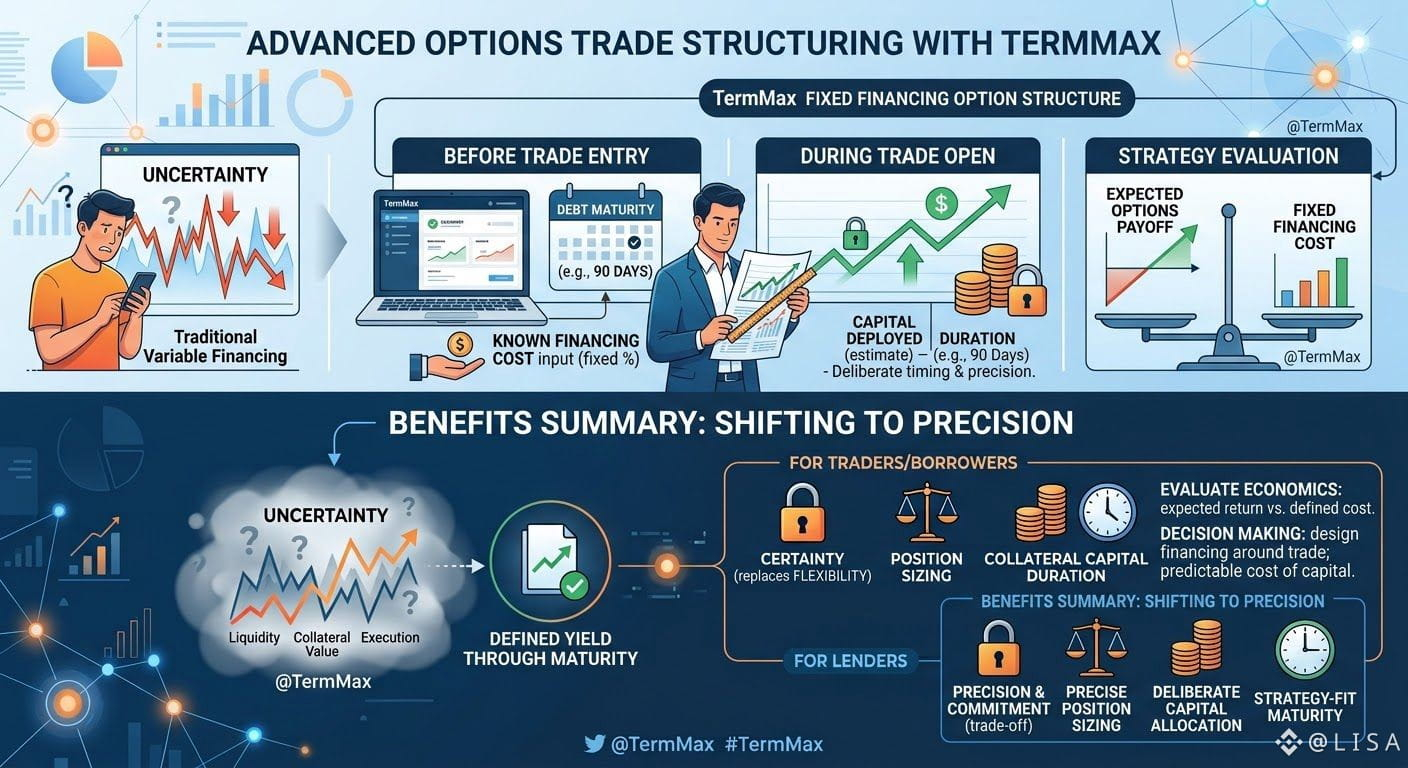
The part of TermMax I find most interesting is how fixed term financing changes the way I can structure an options trade. I usually think about an options position through entry, payoff, and risk, but financing can quietly alter the result while the trade is still open. With @TermMax , a fixed borrowing cost gives me a known financing input through maturity. That means I can estimate the cost of carry before entering instead of treating future interest expense as an unknown. #TermMax
The trade off is that precision comes with commitment. A fixed term means I need to choose a maturity that actually fits the strategy, rather than keeping capital completely flexible. But when the timing is deliberate, that constraint can be useful. I can compare the expected options payoff against a financing cost that stays defined, making the economics easier to evaluate before I commit capital. I see this as a subtle shift from simply borrowing to designing the financing around the trade itself. If options already require careful assumptions about timing and payoff, why should the cost of capital remain unpredictable?
The trade off is that precision comes with commitment. A fixed term means I need to choose a maturity that actually fits the strategy, rather than keeping capital completely flexible. But when the timing is deliberate, that constraint can be useful. I can compare the expected options payoff against a financing cost that stays defined, making the economics easier to evaluate before I commit capital. I see this as a subtle shift from simply borrowing to designing the financing around the trade itself. If options already require careful assumptions about timing and payoff, why should the cost of capital remain unpredictable?
Übersetzung ansehen
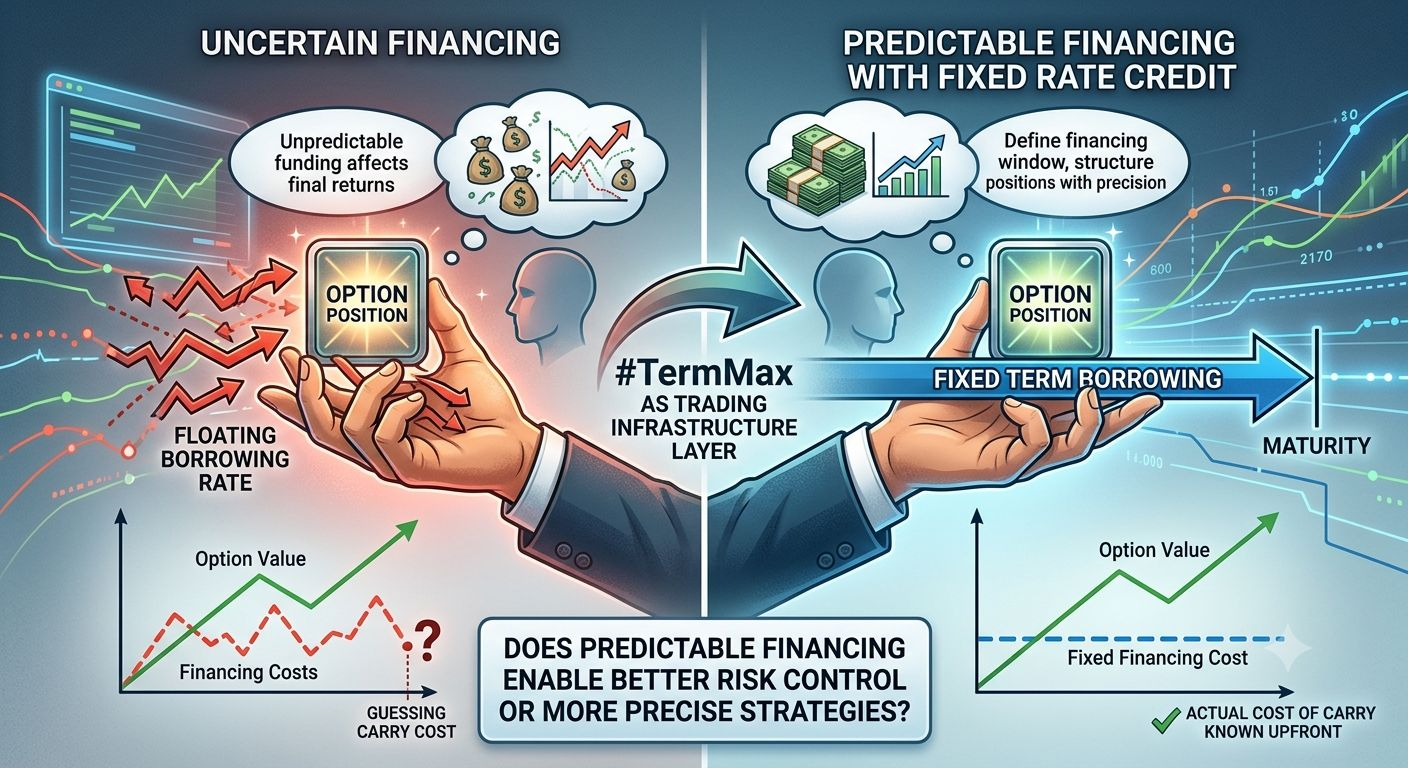
My biggest interest in @TermMax is not simply that it offers fixed rate borrowing. It is what happens when that fixed cost sits beside options execution. I can think about a trade in terms of actual cost of carry instead of guessing where a floating borrowing rate might drift before maturity. In DeFi, that distinction matters because an options position can look attractive at entry and become much less compelling when financing costs change underneath it. With a fixed term, I know the borrowing cost upfront, which gives me a cleaner base for judging whether an options strategy still makes sense. #TermMax
The trade off is liquidity versus predictability. A fixed term can limit flexibility compared with constantly rolling capital through variable rate markets, but I would rather accept that constraint when I need a clearly defined financing window. For me, this makes TermMax interesting as a trading infrastructure layer rather than just another lending venue. The combination of fixed rate credit and options execution could let traders structure positions around maturity, financing cost, and expected payoff with much clearer assumptions. The real question I keep coming back to is this: when financing becomes predictable, does the bigger advantage come from better risk control, or from being able to design more precise strategies?
#termmax @TermMax
The trade off is liquidity versus predictability. A fixed term can limit flexibility compared with constantly rolling capital through variable rate markets, but I would rather accept that constraint when I need a clearly defined financing window. For me, this makes TermMax interesting as a trading infrastructure layer rather than just another lending venue. The combination of fixed rate credit and options execution could let traders structure positions around maturity, financing cost, and expected payoff with much clearer assumptions. The real question I keep coming back to is this: when financing becomes predictable, does the bigger advantage come from better risk control, or from being able to design more precise strategies?
#termmax @TermMax
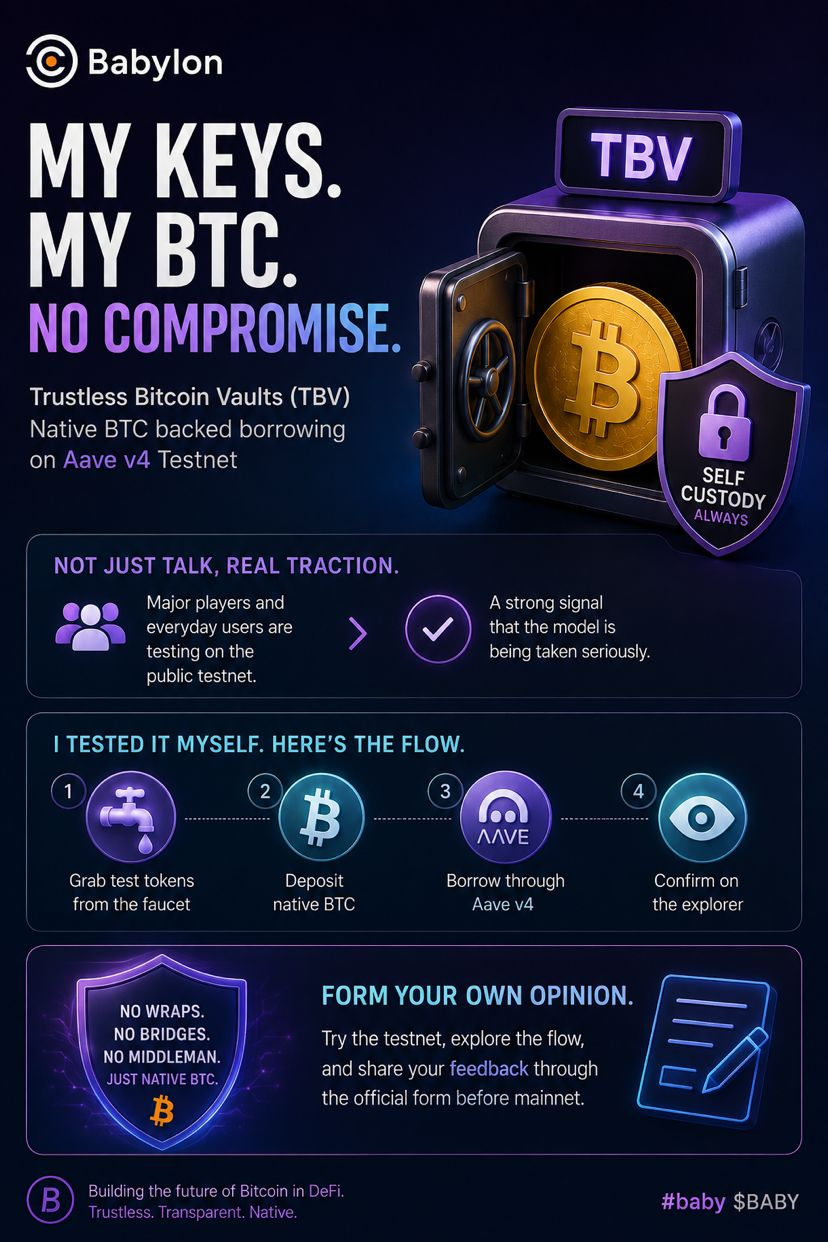
Selbstverwahrung ist das eine, bei dem ich niemals Kompromisse eingehe. Daher verlieren die meisten Bitcoin-Kreditprodukte für mich sofort an Interesse, sobald sie von mir verlangen, BTC zu wrappen oder zu bridgen. Trustless Bitcoin Vaults (TBV) von @BabylonLabs_io sind anders – und deshalb habe ich beschlossen, darüber zu schreiben.
Was meine Aufmerksamkeit geweckt hat: Das öffentliche Testnet für native Bitcoin-gestützte Kredite über Aave v4 hat bereits mehrere große Namen im Testbetrieb – neben regulären Nutzerinnen und Nutzern. Das ist bei nicht jedem frühen Testnet zu sehen. Das signalisiert, dass das Modell ernsthaft verfolgt wird, nicht nur „für den Retail-Bereich“.
Ich habe es getestet, genauso wie es jeder andere auch kann. Ich habe Test-Tokens aus dem Faucet geholt, natives BTC hinterlegt, über Aave v4 Kredite aufgenommen und anschließend alles im Explorer bestätigt. Meine Schlüssel haben meinen Einflussbereich zu keinem Zeitpunkt verlassen. Wenn du dir stattdessen deine eigene Meinung bilden möchtest, statt meine zu übernehmen: Teile dein Feedback über das offizielle Formular, bevor das Mainnet startet.
#baby $BABY
Was meine Aufmerksamkeit geweckt hat: Das öffentliche Testnet für native Bitcoin-gestützte Kredite über Aave v4 hat bereits mehrere große Namen im Testbetrieb – neben regulären Nutzerinnen und Nutzern. Das ist bei nicht jedem frühen Testnet zu sehen. Das signalisiert, dass das Modell ernsthaft verfolgt wird, nicht nur „für den Retail-Bereich“.
Ich habe es getestet, genauso wie es jeder andere auch kann. Ich habe Test-Tokens aus dem Faucet geholt, natives BTC hinterlegt, über Aave v4 Kredite aufgenommen und anschließend alles im Explorer bestätigt. Meine Schlüssel haben meinen Einflussbereich zu keinem Zeitpunkt verlassen. Wenn du dir stattdessen deine eigene Meinung bilden möchtest, statt meine zu übernehmen: Teile dein Feedback über das offizielle Formular, bevor das Mainnet startet.
#baby $BABY
Übersetzung ansehen
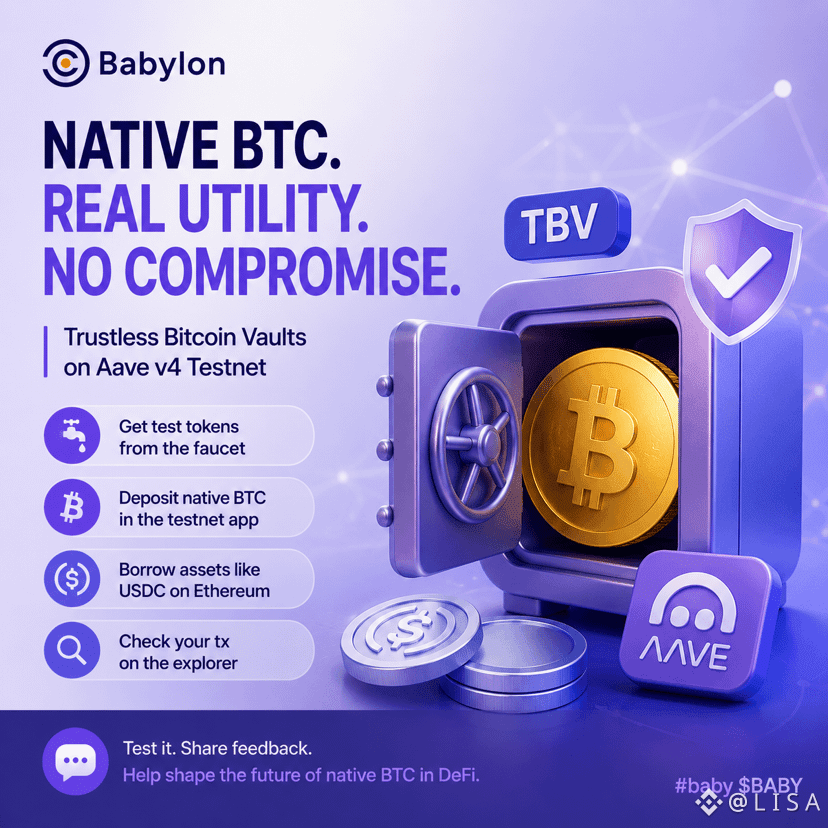
Babylon built the Bitcoin Staking Protocol, which grew into the largest Bitcoin based project in crypto by total value locked. Now @BabylonLabs_io is extending that native BTC into DeFi through Trustless Bitcoin Vaults (TBV), a way to use Bitcoin as collateral without wrapping, bridging, or trusting a middleman.
TBV currently powers native Bitcoin backed borrowing on Aave v4, live on public testnet. The flow is simple. Claim test tokens from the faucet, deposit native BTC in the testnet app, borrow assets like USDC on Ethereum, then check the transaction on the explorer.
What makes this worth trying is how little trust it asks for. Your Bitcoin stays native the whole time, and you never give up custody to complete the borrow. Test it yourself and send feedback through the official form before mainnet.
#baby $BABY
TBV currently powers native Bitcoin backed borrowing on Aave v4, live on public testnet. The flow is simple. Claim test tokens from the faucet, deposit native BTC in the testnet app, borrow assets like USDC on Ethereum, then check the transaction on the explorer.
What makes this worth trying is how little trust it asks for. Your Bitcoin stays native the whole time, and you never give up custody to complete the borrow. Test it yourself and send feedback through the official form before mainnet.
#baby $BABY
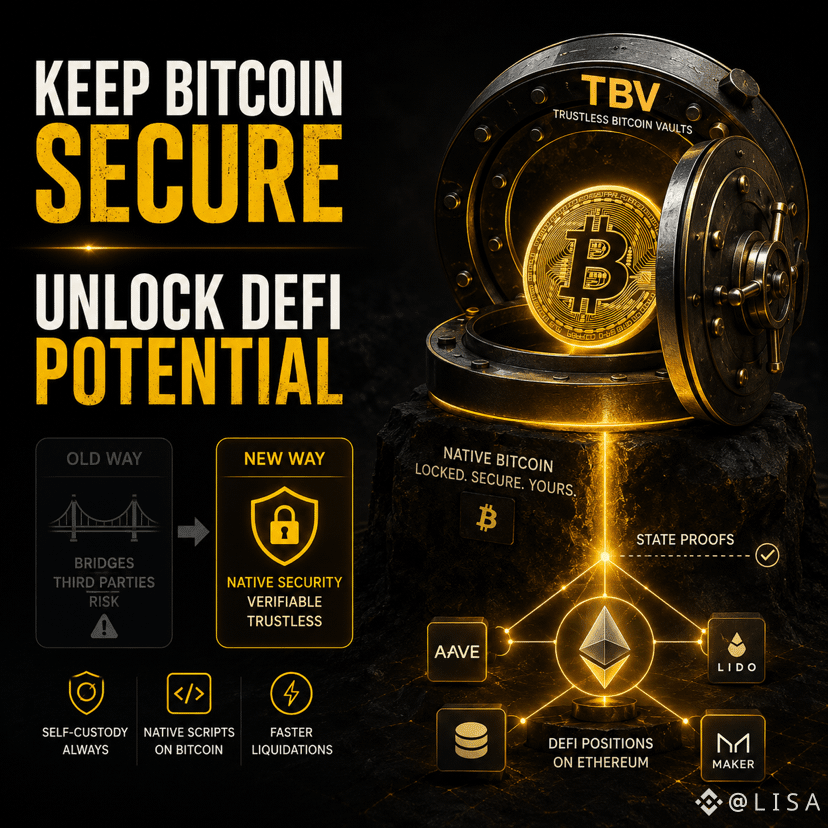
Die meisten Trader haben eine mentale Hierarchie für Vermögenswerte, und ganz oben steht Bitcoin in Selbstverwahrung. Alles andere wird in der Regel als Abwägung betrachtet: Entweder opferst du diese Sicherheit für DeFi-Renditen, oder du hältst Spot-Bestände und ignorierst das Potenzial für Kapitaleffizienz.
Trustless Bitcoin Vaults (TBV) zwingen dieses binäre Modell endlich zur Weiterentwicklung. Anstatt sich zwischen dem Halten von Assets und deren Einsatz zu entscheiden, ermöglicht dir die TBV-Architektur, die Verwahrung auf der Basisschicht beizubehalten und gleichzeitig DeFi-Positionen auf Ethereum abzusichern.
Wenn ich mir den Ausführungsablauf beim Ausleihen gegen nativem Bitcoin anschaue, ist der Unterschied im Risikoprofil Tag und Nacht im Vergleich zu Varianten mit verpackten Tokens. Da das tatsächliche Sicherungsvermögen in Bitcoin-Taproot-Skripten gesperrt bleibt und nur Statusnachweise ausgibt, verdampft die gesamte Abhängigkeit von Drittanbieter-Bridge-Operatoren effektiv.
So wird das Ausleihen von einer Vertrauensfrage zu einer Frage der Überprüfung der Skriptausführung onchain. Ich habe mir Zeit genommen zu untersuchen, wie diese Tresore Liquidationsttrigger während Testnet-Simulationen handhaben, und die Geschwindigkeit der kryptografischen Durchsetzung ist eine massive Verbesserung gegenüber herkömmlichen oraclebasierten Bridge-Updates.
Für alle, die aufgrund von Bridge-bedingter Unsicherheit bisher von Lending-Protokollen Abstand genommen haben, ist das die erste echte Verschiebung auf dem Markt. Verändert der Übergang zu nativer kryptografischer Durchsetzung deine langfristige Einschätzung zum Lending?
@BabylonLabs_io $BABY #baby
Trustless Bitcoin Vaults (TBV) zwingen dieses binäre Modell endlich zur Weiterentwicklung. Anstatt sich zwischen dem Halten von Assets und deren Einsatz zu entscheiden, ermöglicht dir die TBV-Architektur, die Verwahrung auf der Basisschicht beizubehalten und gleichzeitig DeFi-Positionen auf Ethereum abzusichern.
Wenn ich mir den Ausführungsablauf beim Ausleihen gegen nativem Bitcoin anschaue, ist der Unterschied im Risikoprofil Tag und Nacht im Vergleich zu Varianten mit verpackten Tokens. Da das tatsächliche Sicherungsvermögen in Bitcoin-Taproot-Skripten gesperrt bleibt und nur Statusnachweise ausgibt, verdampft die gesamte Abhängigkeit von Drittanbieter-Bridge-Operatoren effektiv.
So wird das Ausleihen von einer Vertrauensfrage zu einer Frage der Überprüfung der Skriptausführung onchain. Ich habe mir Zeit genommen zu untersuchen, wie diese Tresore Liquidationsttrigger während Testnet-Simulationen handhaben, und die Geschwindigkeit der kryptografischen Durchsetzung ist eine massive Verbesserung gegenüber herkömmlichen oraclebasierten Bridge-Updates.
Für alle, die aufgrund von Bridge-bedingter Unsicherheit bisher von Lending-Protokollen Abstand genommen haben, ist das die erste echte Verschiebung auf dem Markt. Verändert der Übergang zu nativer kryptografischer Durchsetzung deine langfristige Einschätzung zum Lending?
@BabylonLabs_io $BABY #baby
Übersetzung ansehen
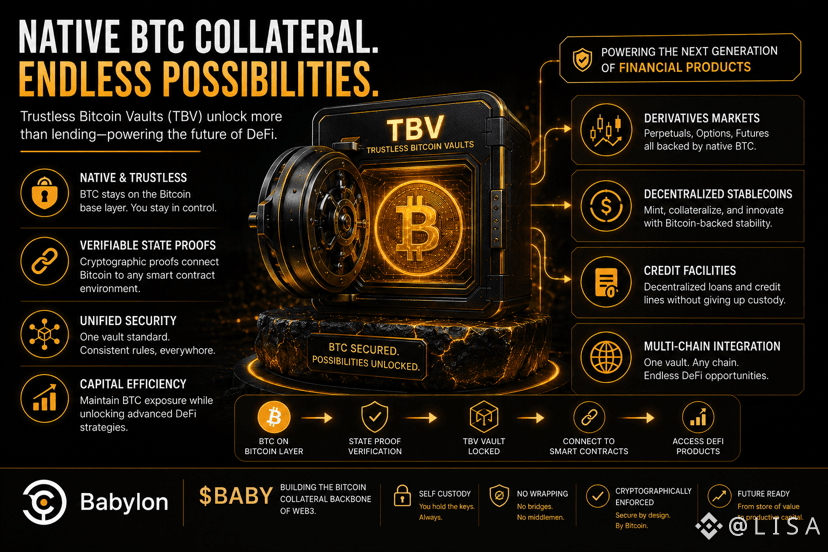
When evaluating capital efficiency across decentralized finance, borrowing against spot assets is often just the initial step in a broader ecosystem shift.
The release of Trustless Bitcoin Vaults (TBV) opens the door for native Bitcoin collateral to power a vast range of financial instruments beyond simple lending pools. By enabling verifiable Bitcoin state proofs across external smart contract layers, TBV allows developers to build derivative markets, decentralized stablecoins, and credit facilities directly backed by unbridged BTC.
This means traders can maintain long term spot exposure while deploying their underlying wealth into structured yield strategies or hedging positions without counterparty friction.
What excites me most about expanding TBV into multi chain financial products is how it standardizes security across diverse DeFi applications. Rather than creating isolated wrapped tokens for every single protocol, a unified vault mechanism ensures that collateral rules and liquidation logic remain cryptographically consistent.
Whether you are backing synthetic assets on Ethereum or accessing automated credit lines, your primary Bitcoin stays securely anchored on its native chain.
As more decentralized protocols adopt TBV infrastructure, native Bitcoin will transform from a passive store of value into the primary collateral backbone for web3.
Have you considered using native $BTC to back non lending DeFi positions?
@BabylonLabs_io $BABY #baby
The release of Trustless Bitcoin Vaults (TBV) opens the door for native Bitcoin collateral to power a vast range of financial instruments beyond simple lending pools. By enabling verifiable Bitcoin state proofs across external smart contract layers, TBV allows developers to build derivative markets, decentralized stablecoins, and credit facilities directly backed by unbridged BTC.
This means traders can maintain long term spot exposure while deploying their underlying wealth into structured yield strategies or hedging positions without counterparty friction.
What excites me most about expanding TBV into multi chain financial products is how it standardizes security across diverse DeFi applications. Rather than creating isolated wrapped tokens for every single protocol, a unified vault mechanism ensures that collateral rules and liquidation logic remain cryptographically consistent.
Whether you are backing synthetic assets on Ethereum or accessing automated credit lines, your primary Bitcoin stays securely anchored on its native chain.
As more decentralized protocols adopt TBV infrastructure, native Bitcoin will transform from a passive store of value into the primary collateral backbone for web3.
Have you considered using native $BTC to back non lending DeFi positions?
@BabylonLabs_io $BABY #baby
Übersetzung ansehen
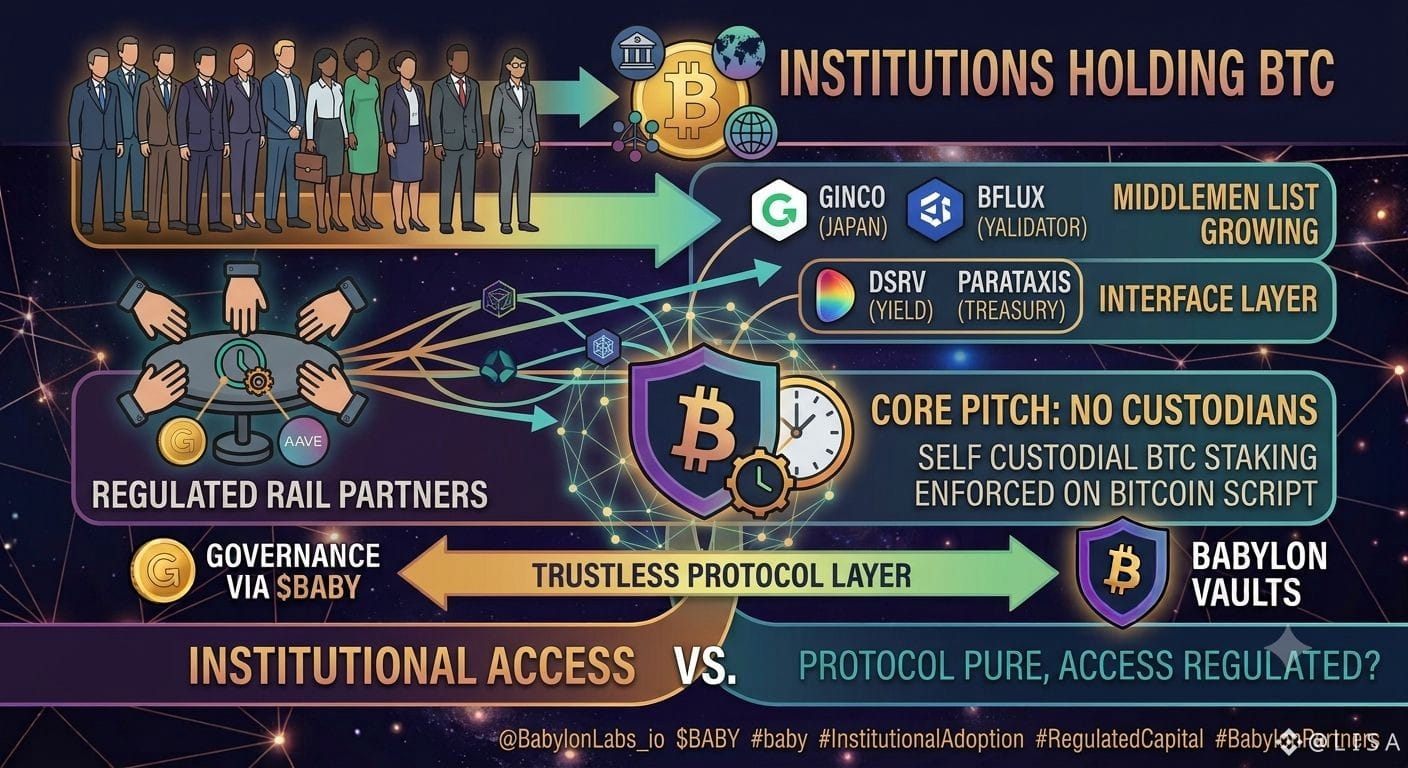
Babylon needed a growing list of institutional middlemen to sell a message about removing middlemen
I went through the recent partnership list and it kept growing. Ginco in Japan, Bflux for institutional yield, DSRV as validator infrastructure, Parataxis for treasury strategy. All of them sit between Babylon's protocol and the institutions actually holding the Bitcoin.
That struck me as worth sitting with. The core pitch is no custodians, no intermediaries, pure self custodial staking enforced on Bitcoin itself. Yet reaching institutions apparently requires enterprise wallet providers, custody specialists, and regional partners acting as the interface layer between cold $BTC reserves and the protocol underneath.
I do not think that contradicts the trustless design. The BTC itself stays locked under Bitcoin script conditions regardless of which enterprise wallet initiates the transaction. But it does mean the actual experience of trustless staking, for a bank or a corporate treasury anyway, still runs through a chain of vetted partners handling compliance, custody interfaces, and onboarding. Protocol level trustlessness and institutional access are turning out to be two very different layers of the same system.
Maybe that is just what adoption looks like. Regulated capital does not move without regulated rails, no matter how clean the underlying cryptography is.
Does institutional Bitcoin ever actually touch a truly trustless protocol directly, or does it always pass through a layer of trusted partners first regardless of what the base layer promises
@BabylonLabs_io $BABY #baby
I went through the recent partnership list and it kept growing. Ginco in Japan, Bflux for institutional yield, DSRV as validator infrastructure, Parataxis for treasury strategy. All of them sit between Babylon's protocol and the institutions actually holding the Bitcoin.
That struck me as worth sitting with. The core pitch is no custodians, no intermediaries, pure self custodial staking enforced on Bitcoin itself. Yet reaching institutions apparently requires enterprise wallet providers, custody specialists, and regional partners acting as the interface layer between cold $BTC reserves and the protocol underneath.
I do not think that contradicts the trustless design. The BTC itself stays locked under Bitcoin script conditions regardless of which enterprise wallet initiates the transaction. But it does mean the actual experience of trustless staking, for a bank or a corporate treasury anyway, still runs through a chain of vetted partners handling compliance, custody interfaces, and onboarding. Protocol level trustlessness and institutional access are turning out to be two very different layers of the same system.
Maybe that is just what adoption looks like. Regulated capital does not move without regulated rails, no matter how clean the underlying cryptography is.
Does institutional Bitcoin ever actually touch a truly trustless protocol directly, or does it always pass through a layer of trusted partners first regardless of what the base layer promises
@BabylonLabs_io $BABY #baby
Übersetzung ansehen
A one line bug report shows more about a protocol than any roadmap does
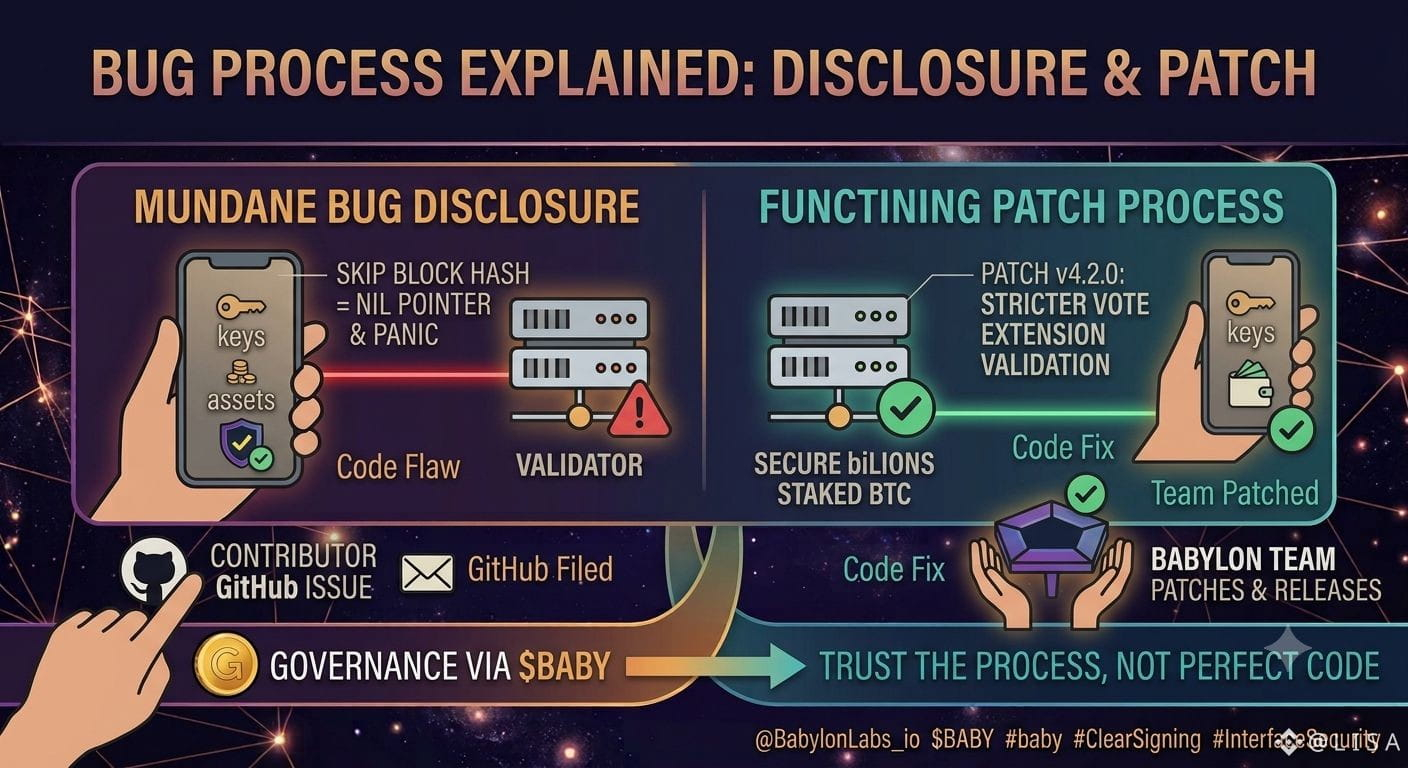
I read through the disclosure and the part that stuck with me was not the bug itself, it was how mundane it actually was. A malicious validator could skip a block hash field, protobuf allowed it because the field was optional, and Babylon's code tried to read data that was not there. Nil pointer, runtime panic, validators crashing right at epoch boundaries where consensus timing matters most.
Nothing exotic. No $BTC ever at risk, no funds touched, just a consensus layer bug that could have slowed block production if enough validators got hit at once.
What actually interests me is the disclosure path. Found by an independent pseudonymous contributor, filed publicly on GitHub, patched in version 4.2.0 with stricter validation around vote extensions. That is the boring, unglamorous reality of how security actually works in production systems securing billions in staked BTC. Not flawless code, just a functioning process for catching and fixing what slips through.
I think people conflate trustless with bug free, and those are not the same claim at all. Trustless describes who holds custody. It says nothing about whether the software underneath is perfect, because no software is.
Does a quiet, quickly patched bug make you trust the process more, or does any consensus level flaw on a Bitcoin security protocol just make you nervous regardless of how it gets resolved
@BabylonLabs_io $BABY #baby
I read through the disclosure and the part that stuck with me was not the bug itself, it was how mundane it actually was. A malicious validator could skip a block hash field, protobuf allowed it because the field was optional, and Babylon's code tried to read data that was not there. Nil pointer, runtime panic, validators crashing right at epoch boundaries where consensus timing matters most.
Nothing exotic. No $BTC ever at risk, no funds touched, just a consensus layer bug that could have slowed block production if enough validators got hit at once.
What actually interests me is the disclosure path. Found by an independent pseudonymous contributor, filed publicly on GitHub, patched in version 4.2.0 with stricter validation around vote extensions. That is the boring, unglamorous reality of how security actually works in production systems securing billions in staked BTC. Not flawless code, just a functioning process for catching and fixing what slips through.
I think people conflate trustless with bug free, and those are not the same claim at all. Trustless describes who holds custody. It says nothing about whether the software underneath is perfect, because no software is.
Does a quiet, quickly patched bug make you trust the process more, or does any consensus level flaw on a Bitcoin security protocol just make you nervous regardless of how it gets resolved
@BabylonLabs_io $BABY #baby
Übersetzung ansehen
The no wrapping promise has an asterisk exactly when things go wrong
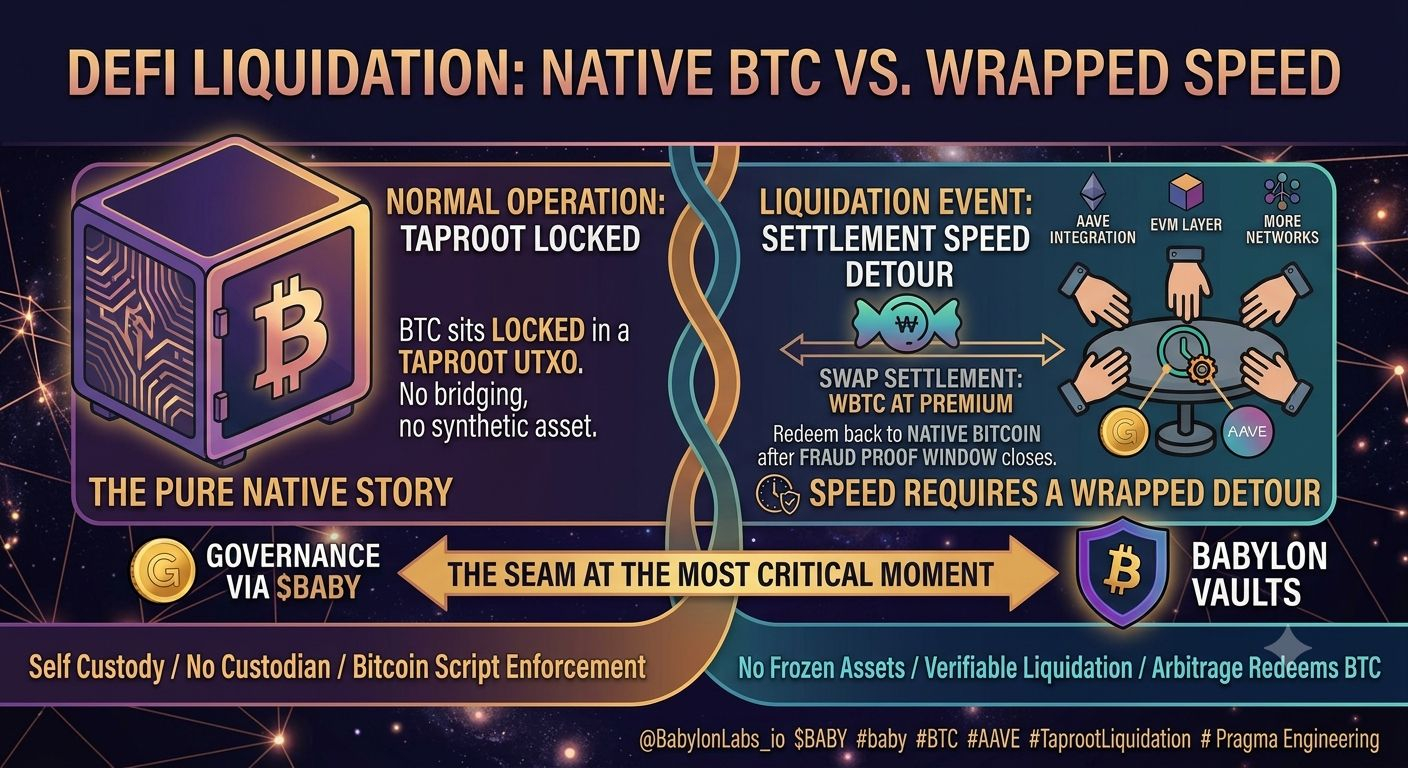
I dug into the actual liquidation mechanics of Babylon's Aave integration and found the detail nobody puts in the headline. During normal operation, $BTC sits locked in a Taproot UTXO, no wrapping, no bridge, exactly the story everyone repeats. But liquidation is a different moment entirely. When a position gets liquidated, the swap spoke settles in WBTC at a small premium, and arbitrageurs are the ones who actually buy that vaultBTC and redeem it back to native Bitcoin once the fraud proof window closes.
So the system stays fully trustless until the exact moment things break, and right there, briefly, wrapped Bitcoin reenters the picture to keep liquidations fast enough to matter. Bitcoin settlement is slow, DeFi liquidations are not patient, and something has to bridge that timing gap.
I do not think this is a flaw exactly. It might be the only realistic way to reconcile Bitcoin's settlement speed with how lending markets actually need to behave under stress. But it does mean the purity of the pitch has a seam right where risk is highest, not where marketing usually points.
Does a brief wrapped detour during liquidation undermine the trustless claim, or is that just what pragmatic engineering looks like under pressure
@BabylonLabs_io $BABY #baby
I dug into the actual liquidation mechanics of Babylon's Aave integration and found the detail nobody puts in the headline. During normal operation, $BTC sits locked in a Taproot UTXO, no wrapping, no bridge, exactly the story everyone repeats. But liquidation is a different moment entirely. When a position gets liquidated, the swap spoke settles in WBTC at a small premium, and arbitrageurs are the ones who actually buy that vaultBTC and redeem it back to native Bitcoin once the fraud proof window closes.
So the system stays fully trustless until the exact moment things break, and right there, briefly, wrapped Bitcoin reenters the picture to keep liquidations fast enough to matter. Bitcoin settlement is slow, DeFi liquidations are not patient, and something has to bridge that timing gap.
I do not think this is a flaw exactly. It might be the only realistic way to reconcile Bitcoin's settlement speed with how lending markets actually need to behave under stress. But it does mean the purity of the pitch has a seam right where risk is highest, not where marketing usually points.
Does a brief wrapped detour during liquidation undermine the trustless claim, or is that just what pragmatic engineering looks like under pressure
@BabylonLabs_io $BABY #baby
Eine Beteiligung, mehrere Netzwerke, ein schlechter Tag überall auf einmal
Darüber spricht niemand genug.
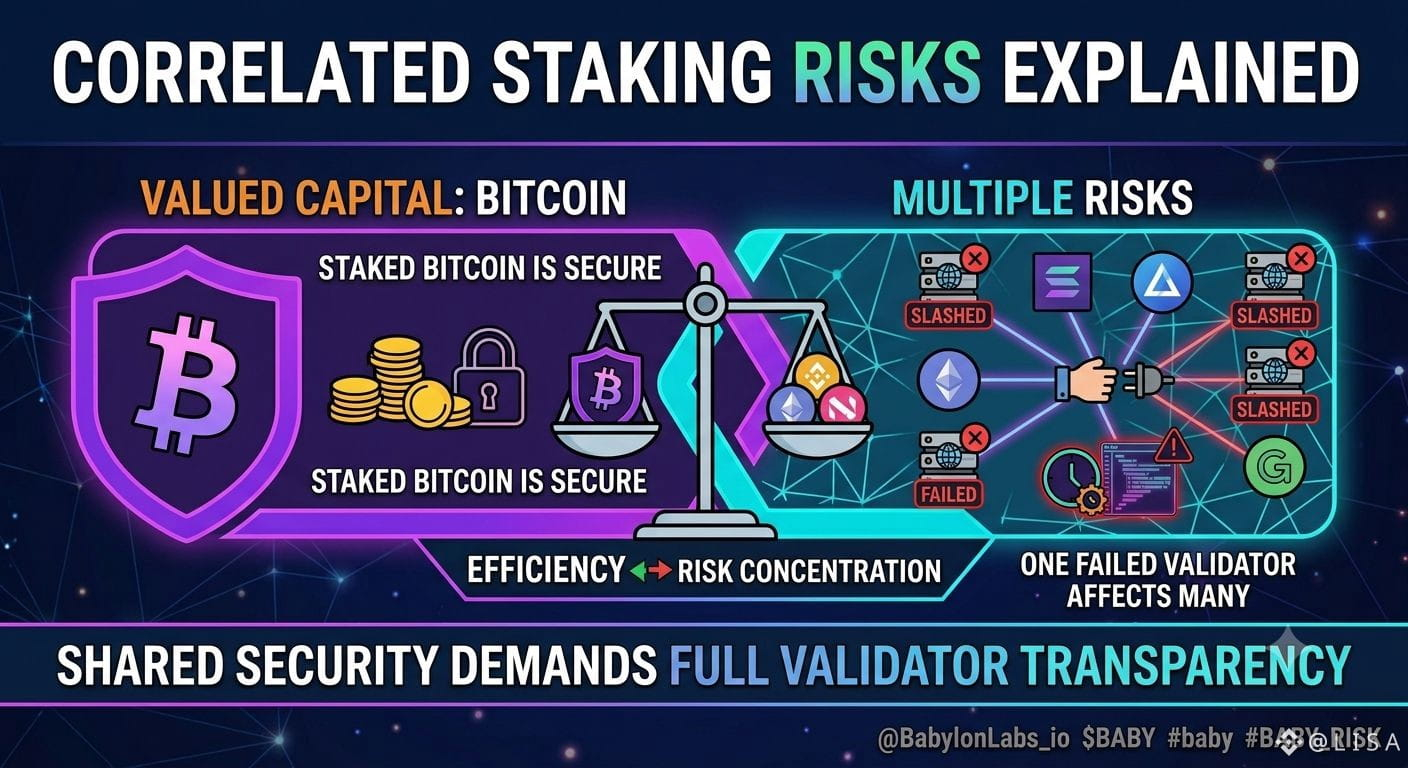
Wenn dein verpfändetes BTC gleichzeitig mehr als ein „Bitcoin Secured Network“ absichern kann, klingt das effizient. Dasselbe Kapital, mehrere Sicherheitsaufgaben. Klingt gut auf dem Papier.
Aber das korrelierte Risiko wirkt in beide Richtungen.
Ein Validator, der in mehreren Netzwerken schlecht läuft, scheitert nicht nur einmal. Er scheitert überall, wo er mitwirkt. Deine $BTC ist nicht mehr nur einer einzigen Slashing-Bedingung ausgesetzt, sondern so vielen Netzwerken, wie dieser Validator berührt.
Effizienz und Konzentration sind im Grunde dieselbe Münze, nur anders herum.
Ich sage nicht, dass das das Modell bricht. Ich sage, dass es verändert, wie Due Diligence tatsächlich aussieht, wenn jemand über Babylon staked. Du bewertest nicht mehr nur die Gesundheit eines einzelnen Netzwerks. Du bewertest das Verhalten des Validators über ein gesamtes Portfolio an Netzwerken hinweg, für das deine BTC gerade Sicherung leistet.
Die meisten, die staken, werden das nicht prüfen. Sie sehen Rendite, sehen Self-Custody und staken, ohne die Validator-Exponierung über Netzwerke hinweg zu kartieren.
Sollte gemeinsame Absicherung mit obligatorischer Transparenz über die Überschneidung von Validatoren einhergehen, oder ist das zu viel verlangt von einem System, das für den Endnutzer bewusst einfach gehalten ist?
@BabylonLabs_io $BABY #baby
Darüber spricht niemand genug.
Wenn dein verpfändetes BTC gleichzeitig mehr als ein „Bitcoin Secured Network“ absichern kann, klingt das effizient. Dasselbe Kapital, mehrere Sicherheitsaufgaben. Klingt gut auf dem Papier.
Aber das korrelierte Risiko wirkt in beide Richtungen.
Ein Validator, der in mehreren Netzwerken schlecht läuft, scheitert nicht nur einmal. Er scheitert überall, wo er mitwirkt. Deine $BTC ist nicht mehr nur einer einzigen Slashing-Bedingung ausgesetzt, sondern so vielen Netzwerken, wie dieser Validator berührt.
Effizienz und Konzentration sind im Grunde dieselbe Münze, nur anders herum.
Ich sage nicht, dass das das Modell bricht. Ich sage, dass es verändert, wie Due Diligence tatsächlich aussieht, wenn jemand über Babylon staked. Du bewertest nicht mehr nur die Gesundheit eines einzelnen Netzwerks. Du bewertest das Verhalten des Validators über ein gesamtes Portfolio an Netzwerken hinweg, für das deine BTC gerade Sicherung leistet.
Die meisten, die staken, werden das nicht prüfen. Sie sehen Rendite, sehen Self-Custody und staken, ohne die Validator-Exponierung über Netzwerke hinweg zu kartieren.
Sollte gemeinsame Absicherung mit obligatorischer Transparenz über die Überschneidung von Validatoren einhergehen, oder ist das zu viel verlangt von einem System, das für den Endnutzer bewusst einfach gehalten ist?
@BabylonLabs_io $BABY #baby
Übersetzung ansehen
Why does a Bitcoin security protocol even need its own chain
This one bugged me for a bit. If the whole pitch is trustless Bitcoin staking with everything enforced through Bitcoin script and timelocks, why introduce Babylon Genesis chain into the picture at all. Doesn't adding another chain reintroduce the exact kind of extra trust surface this protocol is supposed to be avoiding.
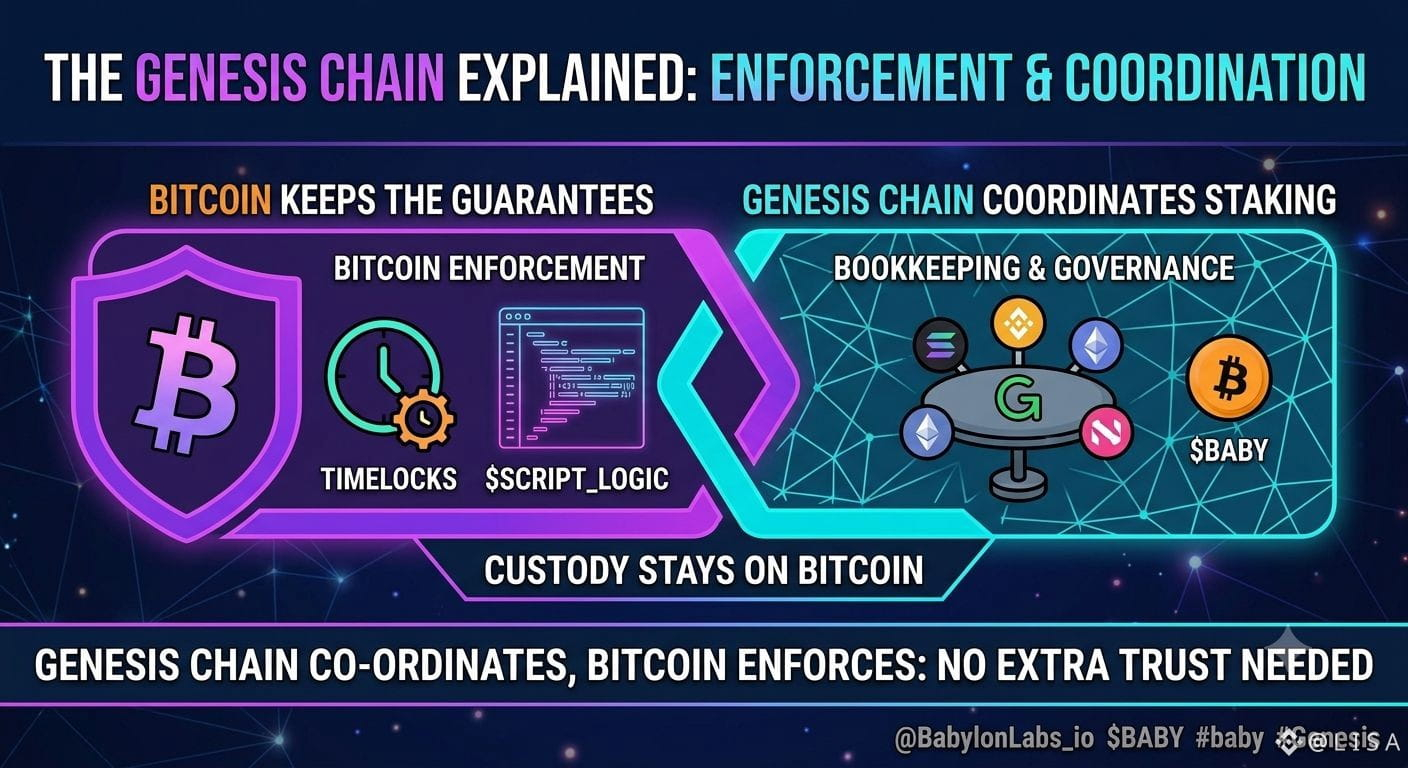
The answer I landed on is that Bitcoin itself cannot coordinate anything beyond simple locking conditions. It has no concept of validator sets, no way to track which Proof of Stake networks are being secured or how slashing gets enforced across dozens of different Bitcoin Secured Networks. Genesis chain exists to do the coordination and governance work that Bitcoin was never designed to handle, while the actual custody and staking commitment stays enforced at the Bitcoin layer itself.
So it is less about adding trust and more about separating enforcement from orchestration. Bitcoin holds the guarantees, Genesis chain handles the bookkeeping and governance through BABY. Still, any additional chain is additional infrastructure that needs its own security assumptions, even if it never touches your actual staked $BTC .
Does that separation actually hold up as more networks plug in, or does complexity creep back in through the coordination layer instead of the custody layer
@BabylonLabs_io $BABY #baby
This one bugged me for a bit. If the whole pitch is trustless Bitcoin staking with everything enforced through Bitcoin script and timelocks, why introduce Babylon Genesis chain into the picture at all. Doesn't adding another chain reintroduce the exact kind of extra trust surface this protocol is supposed to be avoiding.
The answer I landed on is that Bitcoin itself cannot coordinate anything beyond simple locking conditions. It has no concept of validator sets, no way to track which Proof of Stake networks are being secured or how slashing gets enforced across dozens of different Bitcoin Secured Networks. Genesis chain exists to do the coordination and governance work that Bitcoin was never designed to handle, while the actual custody and staking commitment stays enforced at the Bitcoin layer itself.
So it is less about adding trust and more about separating enforcement from orchestration. Bitcoin holds the guarantees, Genesis chain handles the bookkeeping and governance through BABY. Still, any additional chain is additional infrastructure that needs its own security assumptions, even if it never touches your actual staked $BTC .
Does that separation actually hold up as more networks plug in, or does complexity creep back in through the coordination layer instead of the custody layer
@BabylonLabs_io $BABY #baby
Rego-Richtlinienregeln Sind Nur So Gut Wie Jemand, Der Sie Schreibt
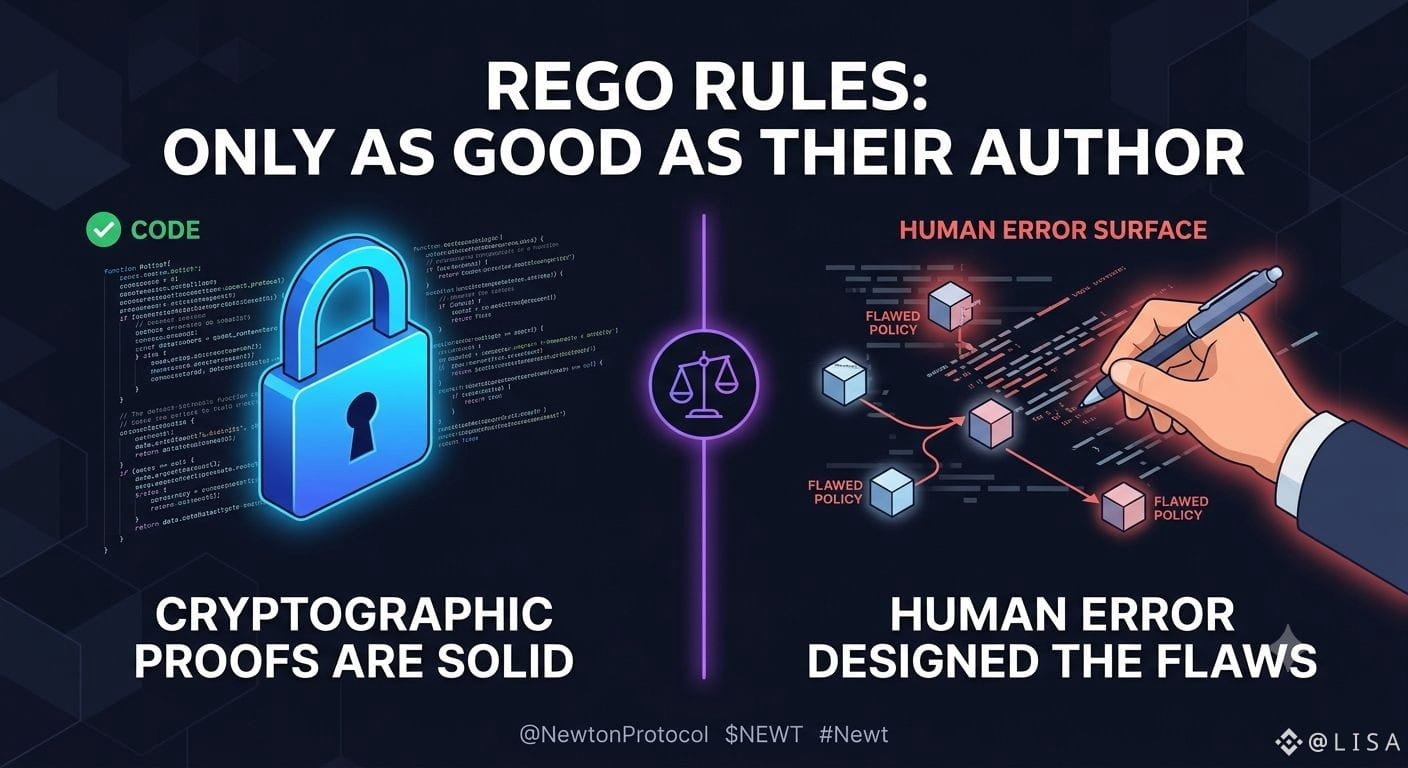
$NEWT Newton führt Evaluierungen durch Rego, eine deklarative Policiesprache, und das ist der Teil, auf den noch niemand wirklich ein Auge wirft. Jemand muss diese Regeln jedoch tatsächlich korrekt verfassen, und Rego ist notorisch einfach so zu schreiben, dass zwar technisch gültige Logik entsteht, aber nicht das bewirkt, was man annimmt. Wenn ein Vault-Curator oder ein Protokoll eine fehlerhafte Policy schreibt, wird der zk-Beweis bereitwillig bestätigen, dass diese fehlerhafte Policy perfekt befolgt wurde. Verifikation beweist, dass die Regel wie geschrieben ausgeführt wurde; sie sagt nichts darüber, ob die Regel selbst klug war. Das ist eine menschliche Fehlerquelle, die direkt unter all dieser kryptografischen Garantie sitzt.
Ich möchte Richtlinien-Audit-Tools sehen, bevor ich curator-gemachte Regeln mit echter Größenordnung vertraue. Meine Sicherheitsbedenken wachsen, sobald es einen Standard gibt, um Rego-Logik zu überprüfen, bevor sie live auf einem Vault geht. Beweise retten dich nicht vor schlechtem Policy-Design.
@NewtonProtocol $NEWT #Newt
$NEWT Newton führt Evaluierungen durch Rego, eine deklarative Policiesprache, und das ist der Teil, auf den noch niemand wirklich ein Auge wirft. Jemand muss diese Regeln jedoch tatsächlich korrekt verfassen, und Rego ist notorisch einfach so zu schreiben, dass zwar technisch gültige Logik entsteht, aber nicht das bewirkt, was man annimmt. Wenn ein Vault-Curator oder ein Protokoll eine fehlerhafte Policy schreibt, wird der zk-Beweis bereitwillig bestätigen, dass diese fehlerhafte Policy perfekt befolgt wurde. Verifikation beweist, dass die Regel wie geschrieben ausgeführt wurde; sie sagt nichts darüber, ob die Regel selbst klug war. Das ist eine menschliche Fehlerquelle, die direkt unter all dieser kryptografischen Garantie sitzt.
Ich möchte Richtlinien-Audit-Tools sehen, bevor ich curator-gemachte Regeln mit echter Größenordnung vertraue. Meine Sicherheitsbedenken wachsen, sobald es einen Standard gibt, um Rego-Logik zu überprüfen, bevor sie live auf einem Vault geht. Beweise retten dich nicht vor schlechtem Policy-Design.
@NewtonProtocol $NEWT #Newt

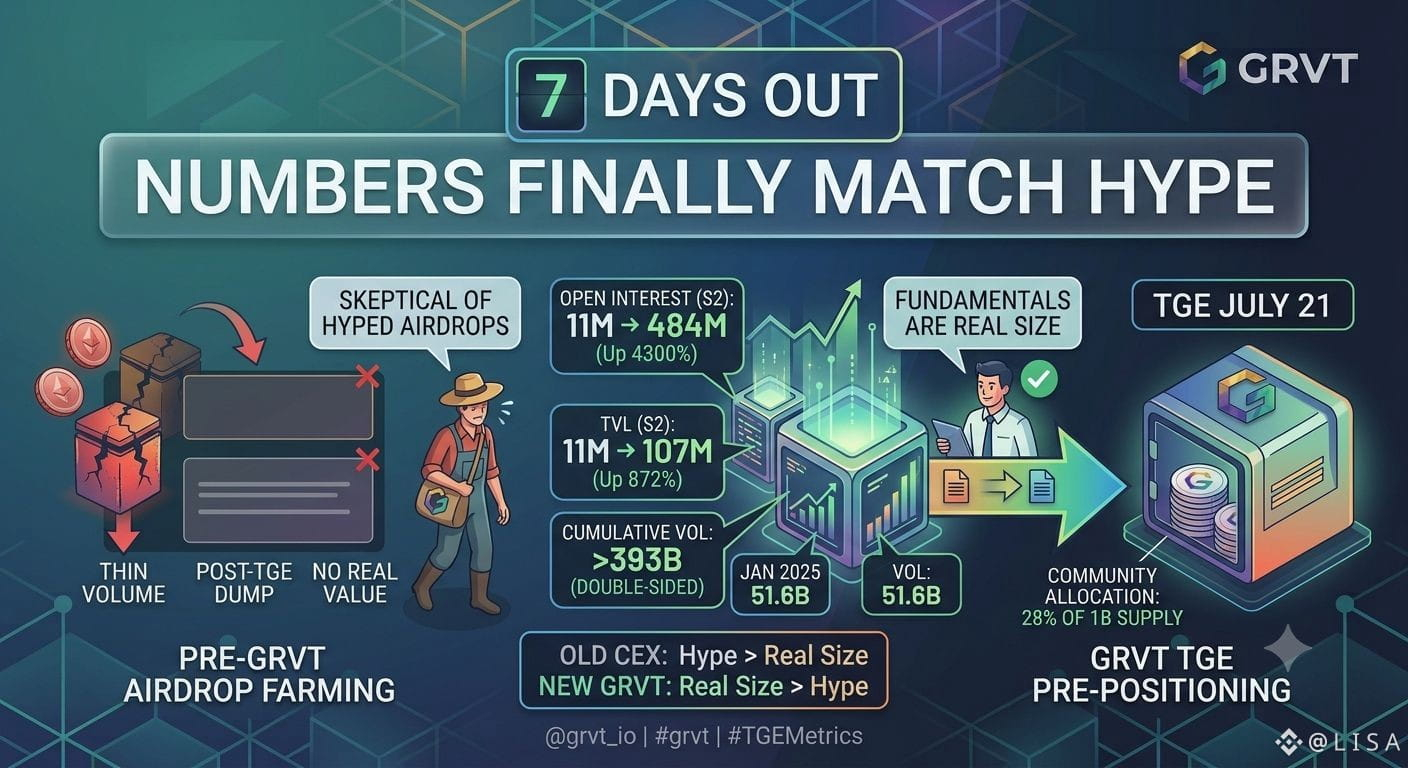
SIEBEN TAGE DAUßERHALB UND DIE ZAHLEN ENDLICH TRIFFEN DIE HYPE
Ich habe das Airdrop-Farming vor einer Weile nicht mehr ernsthaft betrieben, weil die meisten Seasons mit einem Token enden, den am Ende niemand wirklich haben will, sobald der Handel eröffnet wird. GRVT ist der erste in Monaten, bei dem ich die Kennzahlen tatsächlich schon vor dem Token-Generation-Event geprüft habe und nicht erst danach – und allein die Daten zum Open Interest haben mich aufhorchen lassen.
Das Open Interest ist in Season 2 von ungefähr 11 Millionen auf 484 Millionen gestiegen. Das ist kein organischer Hype, sondern echtes Derivate-Volumen, das die These untermauert. Die TVL ist im selben Zeitraum von etwa 11 Millionen auf über 107 Millionen geklettert. Das kumulierte Handelsvolumen hat 393 Milliarden auf der doppelten Seite überschritten, und allein im Januar wurden 51,6 Milliarden im Monatsvolumen gedruckt. Zahlen wie diese tauchen normalerweise auf, nachdem ein Token gelauncht wurde – nicht davor.
Mit dem TGE am 21. Juli und einer Community-Allokation, die jetzt bei 28 Prozent des festen 1-Milliarden-Angebots liegt, ist das einer der seltenen Fälle, in denen sich die Fundamentaldaten schon gestapelt haben, während alle anderen nur blind Punkte farmten. Ich habe schon zu viele Projekte gesehen, die einen Token mit dünnem Volumen an den Markt bringen und dann dabei zusehen müssen, wie er innerhalb weniger Tage abgeladen wird.
Dieser wird an eine Börse gelauncht, die bereits bewiesen hat, dass sie echte Größenordnungen stemmen kann. Das verändert, wie ich das Post-TGE-Positioning komplett denke.
Wenn der Handel eröffnet, die Orderbücher genau im Blick behalten.
@grvt_io #grvt
Ich habe das Airdrop-Farming vor einer Weile nicht mehr ernsthaft betrieben, weil die meisten Seasons mit einem Token enden, den am Ende niemand wirklich haben will, sobald der Handel eröffnet wird. GRVT ist der erste in Monaten, bei dem ich die Kennzahlen tatsächlich schon vor dem Token-Generation-Event geprüft habe und nicht erst danach – und allein die Daten zum Open Interest haben mich aufhorchen lassen.
Das Open Interest ist in Season 2 von ungefähr 11 Millionen auf 484 Millionen gestiegen. Das ist kein organischer Hype, sondern echtes Derivate-Volumen, das die These untermauert. Die TVL ist im selben Zeitraum von etwa 11 Millionen auf über 107 Millionen geklettert. Das kumulierte Handelsvolumen hat 393 Milliarden auf der doppelten Seite überschritten, und allein im Januar wurden 51,6 Milliarden im Monatsvolumen gedruckt. Zahlen wie diese tauchen normalerweise auf, nachdem ein Token gelauncht wurde – nicht davor.
Mit dem TGE am 21. Juli und einer Community-Allokation, die jetzt bei 28 Prozent des festen 1-Milliarden-Angebots liegt, ist das einer der seltenen Fälle, in denen sich die Fundamentaldaten schon gestapelt haben, während alle anderen nur blind Punkte farmten. Ich habe schon zu viele Projekte gesehen, die einen Token mit dünnem Volumen an den Markt bringen und dann dabei zusehen müssen, wie er innerhalb weniger Tage abgeladen wird.
Dieser wird an eine Börse gelauncht, die bereits bewiesen hat, dass sie echte Größenordnungen stemmen kann. Das verändert, wie ich das Post-TGE-Positioning komplett denke.
Wenn der Handel eröffnet, die Orderbücher genau im Blick behalten.
@grvt_io #grvt
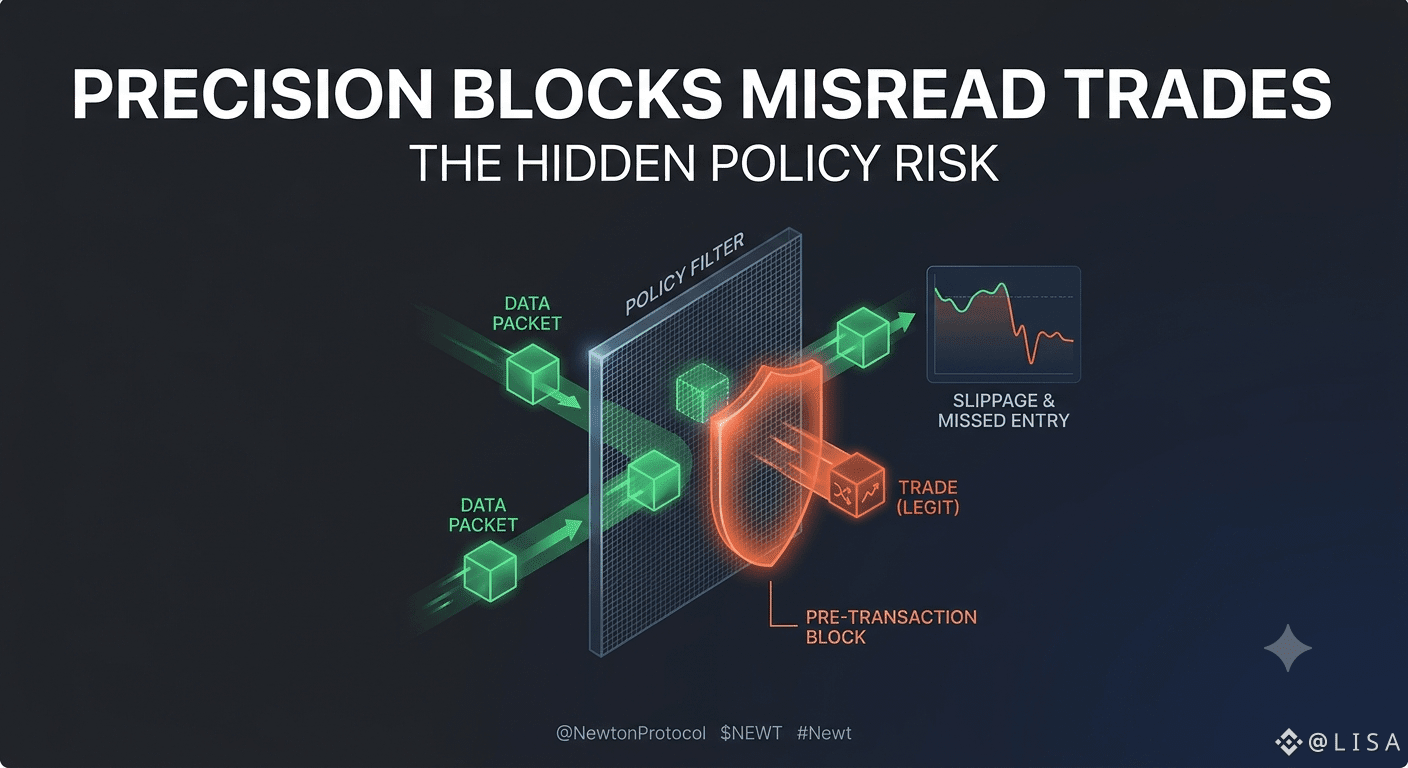
Richtlinienregeln, die legitime Trades blockieren, sind das Risiko, über das niemand spricht
Alle reden darüber, wie Newton $NEWT bösartige Abwicklungen stoppt – aber drehen wir die Logik für einen Moment um. Eine Richtlinien-Engine, die streng genug ist, um schlechte Akteure zu erwischen, ist auch streng genug, um sich bei legitimen Agentenstrategien zu verhaspeln, die auf dem Papier einfach nur ungewöhnlich aussehen. Wenn meine automatisierte Strategie fälschlicherweise markiert und blockiert wird, weil sie nicht zu irgendeinem vordefinierten Regelwerk passt, zahle ich Slippage und verpasste Einstiege, während das System mich vor einer Bedrohung schützt, die nie wirklich da war. False Positives in einer Pre-Transaction-Enforcement-Schicht sind ein echter Kostenfaktor – nicht nur ein theoretisches Problem. Noch niemand hat veröffentlichte Daten dazu, wie oft legitime Trades abgelehnt werden im Vergleich zu tatsächlich bösartigen.
Ich möchte die Rate an False Positives kennen, bevor ich das mit echtem Volumen vertraue. Meine Strategien können es sich nicht leisten, während der Ausführung wegen eines übervorsichtigen Regelsets blockiert zu werden. Präzision ist hier genauso wichtig wie Schutz.
@NewtonProtocol
$NEWT
#Newt
Alle reden darüber, wie Newton $NEWT bösartige Abwicklungen stoppt – aber drehen wir die Logik für einen Moment um. Eine Richtlinien-Engine, die streng genug ist, um schlechte Akteure zu erwischen, ist auch streng genug, um sich bei legitimen Agentenstrategien zu verhaspeln, die auf dem Papier einfach nur ungewöhnlich aussehen. Wenn meine automatisierte Strategie fälschlicherweise markiert und blockiert wird, weil sie nicht zu irgendeinem vordefinierten Regelwerk passt, zahle ich Slippage und verpasste Einstiege, während das System mich vor einer Bedrohung schützt, die nie wirklich da war. False Positives in einer Pre-Transaction-Enforcement-Schicht sind ein echter Kostenfaktor – nicht nur ein theoretisches Problem. Noch niemand hat veröffentlichte Daten dazu, wie oft legitime Trades abgelehnt werden im Vergleich zu tatsächlich bösartigen.
Ich möchte die Rate an False Positives kennen, bevor ich das mit echtem Volumen vertraue. Meine Strategien können es sich nicht leisten, während der Ausführung wegen eines übervorsichtigen Regelsets blockiert zu werden. Präzision ist hier genauso wichtig wie Schutz.
@NewtonProtocol
$NEWT
#Newt
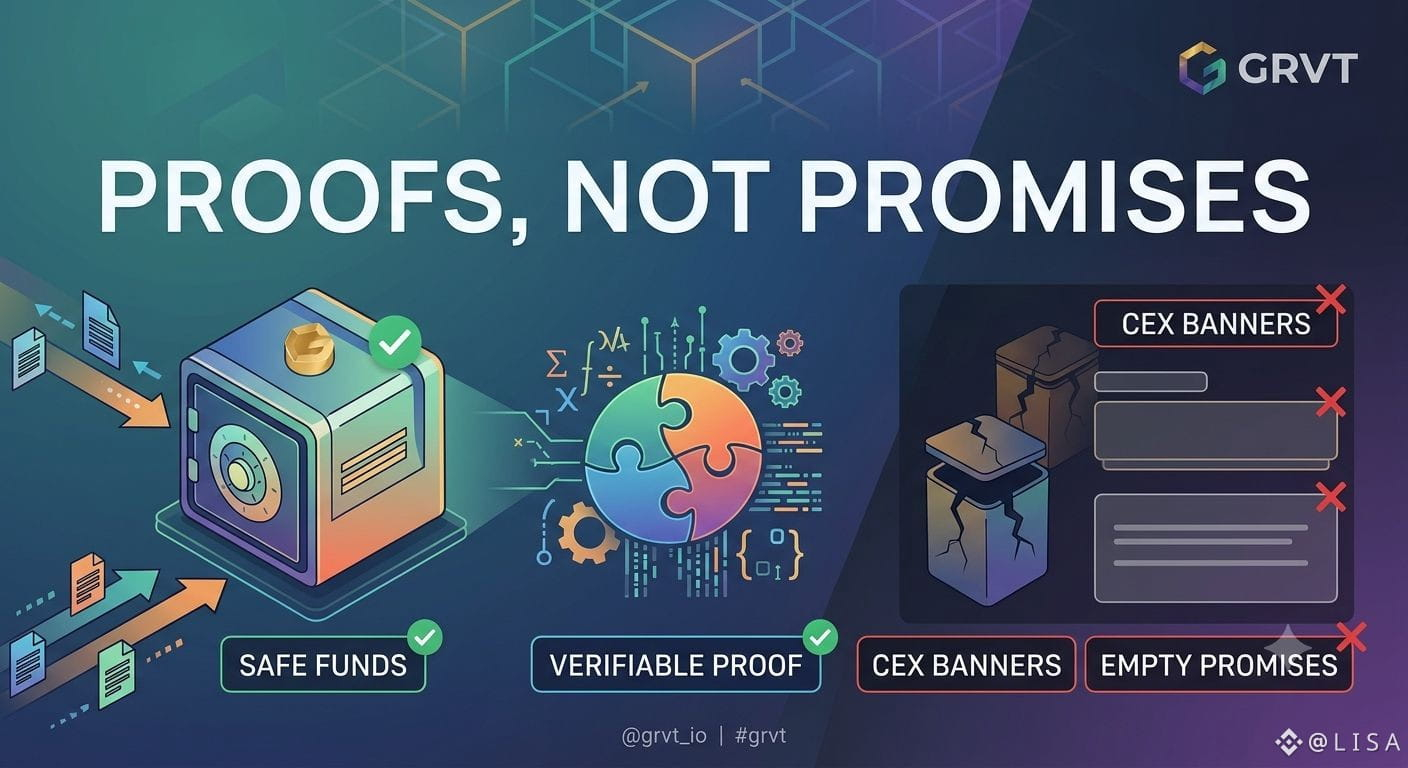
Einem CEX mit Beweisen vertrauen statt mit Versprechen
Ich habe die Anzahl der Male verloren, wie oft uns eine Börse gesagt hat, dass unsere Gelder sicher seien – direkt bevor alles zusammenbrach. Genau deshalb ist die On-Chain-ZK-Abwicklung für mich mittlerweile relevant: GRVT bittet mich nicht, einem Bilanzblatt zu vertrauen, das ich nicht einsehen kann. Die Beweise sind überprüfbar – statt nur in einem Blogbeitrag versprochen zu werden, nachdem bereits etwas kaputtgegangen ist.
Zentralisierte Börsen arbeiten historisch gesehen auf Glaubensbasis: Man geht davon aus, dass die Reserven da sind, bis eine Auszahlungs-Sperre das Gegenteil beweist. GRVT dreht das um, indem es Trades über Zero-Knowledge-Beweise On-Chain abwickelt, während die Ausführung weiterhin off-chain für die Geschwindigkeit läuft. So ist die Absicherung mathematisch – nicht reputationsbasiert.
Dieser Unterschied trifft besonders hart, nachdem man gesehen hat, wie mehrere Plattformen implodieren, bei denen Nutzer zu spät herausfanden, dass ihre Risiken in Wirklichkeit nie so abgesichert waren, wie es behauptet wurde. Hier kümmert sich die Abwicklungsschicht nicht um Vibes oder „Trust me bro“-Ankündigungen, sie verifiziert einfach.
Der lizensierte Betrieb darauf setzt noch eine weitere Ebene von blindem Vertrauen außer Kraft: Das ist kein anonymes Team, das hofft, dass Regulierungsbehörden sie niemals bemerken. Ein fester Supply-Cap von $GRVT in Höhe von 1 Milliarde gibt der Token-Seite dieser Gleichung dieselbe Art von Planbarkeit, die die Abwicklungsarchitektur bereits liefert.
Zu beobachten, wie das standhält, wenn größere Akteure anfangen, Kapital in größerem Umfang zuzuweisen.
@grvt_io #grvt
Ich habe die Anzahl der Male verloren, wie oft uns eine Börse gesagt hat, dass unsere Gelder sicher seien – direkt bevor alles zusammenbrach. Genau deshalb ist die On-Chain-ZK-Abwicklung für mich mittlerweile relevant: GRVT bittet mich nicht, einem Bilanzblatt zu vertrauen, das ich nicht einsehen kann. Die Beweise sind überprüfbar – statt nur in einem Blogbeitrag versprochen zu werden, nachdem bereits etwas kaputtgegangen ist.
Zentralisierte Börsen arbeiten historisch gesehen auf Glaubensbasis: Man geht davon aus, dass die Reserven da sind, bis eine Auszahlungs-Sperre das Gegenteil beweist. GRVT dreht das um, indem es Trades über Zero-Knowledge-Beweise On-Chain abwickelt, während die Ausführung weiterhin off-chain für die Geschwindigkeit läuft. So ist die Absicherung mathematisch – nicht reputationsbasiert.
Dieser Unterschied trifft besonders hart, nachdem man gesehen hat, wie mehrere Plattformen implodieren, bei denen Nutzer zu spät herausfanden, dass ihre Risiken in Wirklichkeit nie so abgesichert waren, wie es behauptet wurde. Hier kümmert sich die Abwicklungsschicht nicht um Vibes oder „Trust me bro“-Ankündigungen, sie verifiziert einfach.
Der lizensierte Betrieb darauf setzt noch eine weitere Ebene von blindem Vertrauen außer Kraft: Das ist kein anonymes Team, das hofft, dass Regulierungsbehörden sie niemals bemerken. Ein fester Supply-Cap von $GRVT in Höhe von 1 Milliarde gibt der Token-Seite dieser Gleichung dieselbe Art von Planbarkeit, die die Abwicklungsarchitektur bereits liefert.
Zu beobachten, wie das standhält, wenn größere Akteure anfangen, Kapital in größerem Umfang zuzuweisen.
@grvt_io #grvt
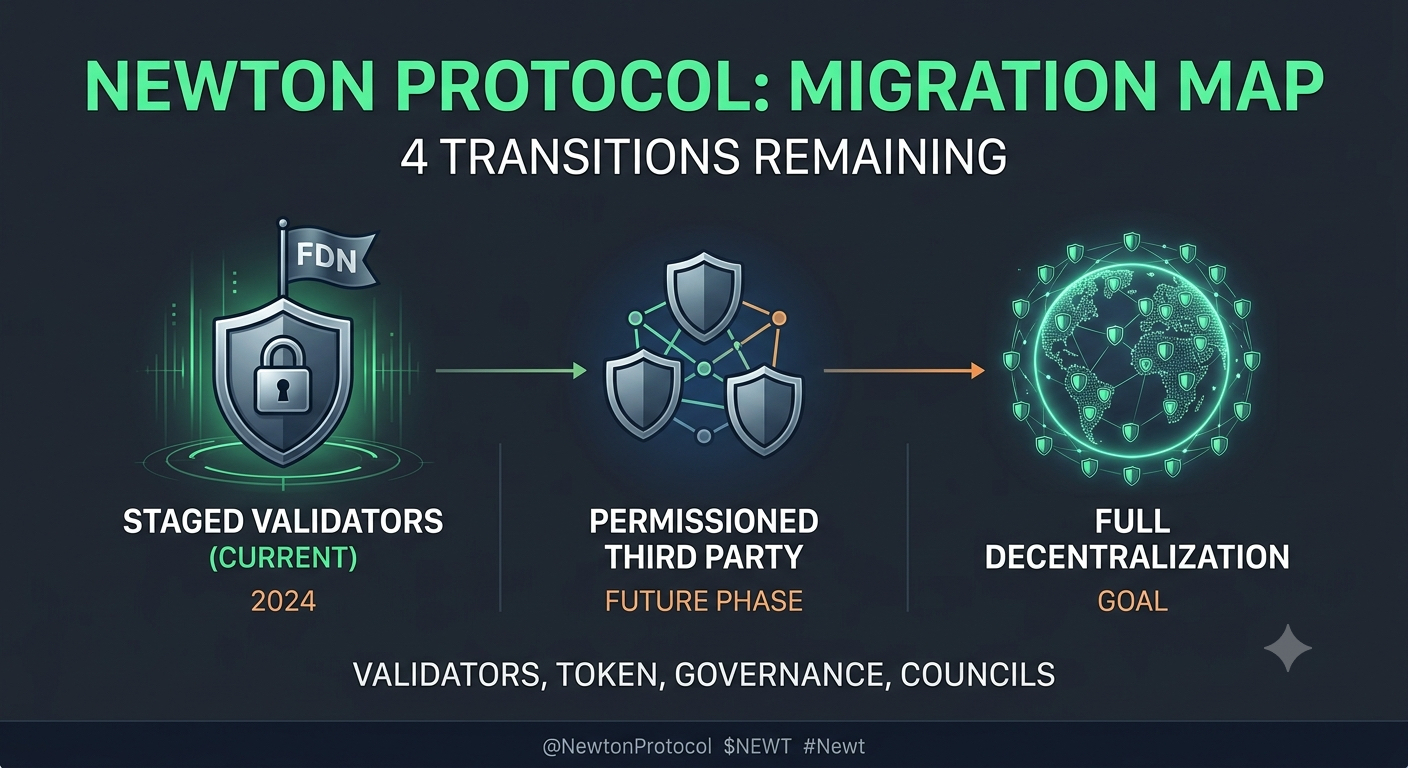
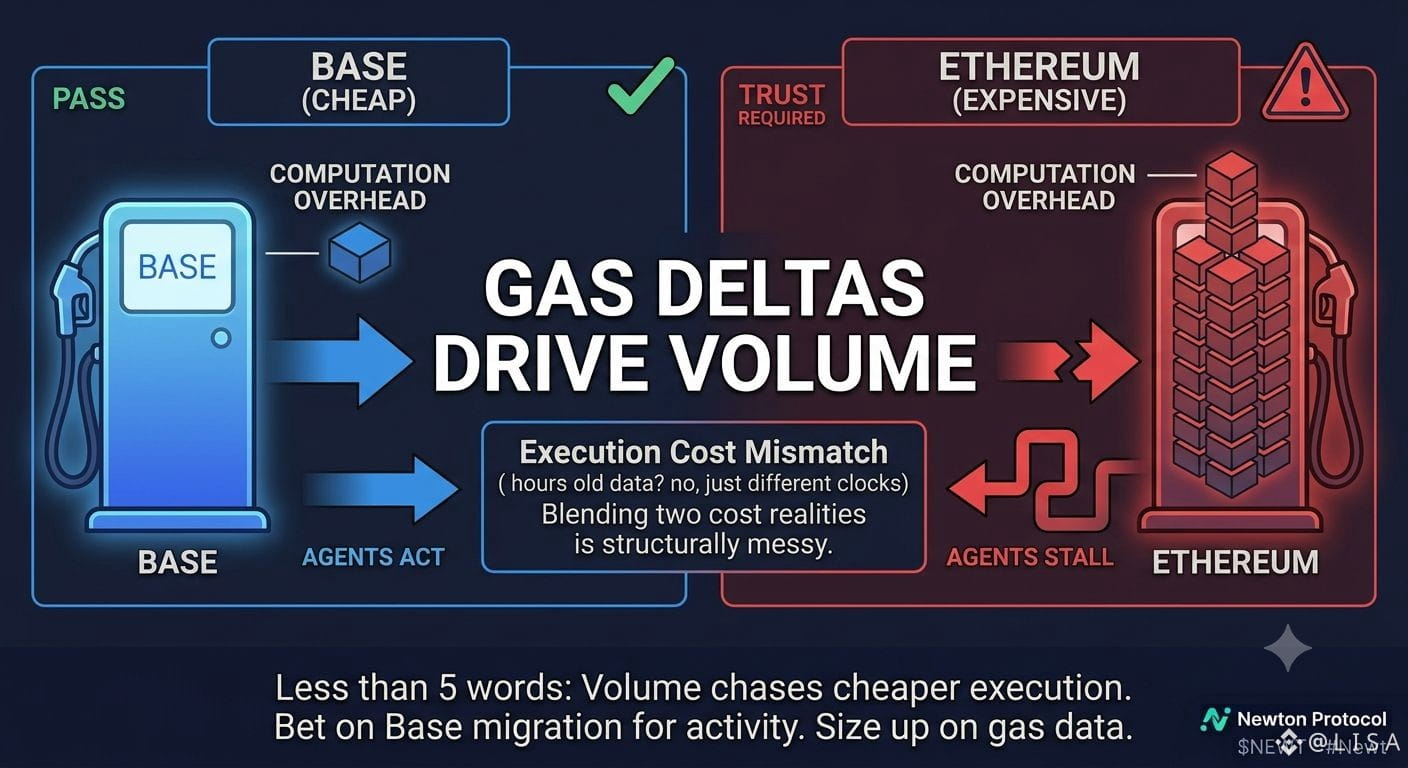
Gas-Deltas werden entscheiden, wohin das Volumen tatsächlich fließt
Newton läuft sowohl auf dem Base- als auch auf dem Ethereum-Mainnet, aber die Ausführungskosten zwischen diesen beiden Chains liegen nicht annähernd auf demselben Niveau, und dieser Unterschied verändert, wie Agents in der Praxis tatsächlich agieren. Wenn die Durchsetzung von Richtlinien zusätzlich zu einer normalen Transaktion noch weitere Berechnungen erfordert, wird dieser Overhead mit der jeweiligen Gas-Umgebung multipliziert. Auf Base ist das wahrscheinlich vernachlässigbar, aber im Ethereum-Mainnet könnte bei echter Netzüberlast dieser zusätzliche Verifizierungsschritt automatisierte Strategien schon unprofitabel machen, bevor sie überhaupt abgewickelt sind. Niemand hat veröffentlichte Zahlen, die die tatsächliche Kosten-Differenz zwischen den beiden Chains unter dieser neuen Durchsetzungsschicht vergleichen.
Ich würde wetten, dass sich die meisten ernsthaften Agent-Aktivitäten allein aus Kostengründen hin zu Base verlagern – nicht weil Ethereum $ETH weniger sicher wäre. Aber wenn das schnell passiert, könnte die Liquidität auf der Ethereum-Seite für dieses System am Ende dünn werden, während alle der günstigeren Ausführung hinterherlaufen. Ich schaue mir die Gas-Daten an, bevor ich meine Größenordnung festlege.
@NewtonProtocol $NEWT #Newt
Newton läuft sowohl auf dem Base- als auch auf dem Ethereum-Mainnet, aber die Ausführungskosten zwischen diesen beiden Chains liegen nicht annähernd auf demselben Niveau, und dieser Unterschied verändert, wie Agents in der Praxis tatsächlich agieren. Wenn die Durchsetzung von Richtlinien zusätzlich zu einer normalen Transaktion noch weitere Berechnungen erfordert, wird dieser Overhead mit der jeweiligen Gas-Umgebung multipliziert. Auf Base ist das wahrscheinlich vernachlässigbar, aber im Ethereum-Mainnet könnte bei echter Netzüberlast dieser zusätzliche Verifizierungsschritt automatisierte Strategien schon unprofitabel machen, bevor sie überhaupt abgewickelt sind. Niemand hat veröffentlichte Zahlen, die die tatsächliche Kosten-Differenz zwischen den beiden Chains unter dieser neuen Durchsetzungsschicht vergleichen.
Ich würde wetten, dass sich die meisten ernsthaften Agent-Aktivitäten allein aus Kostengründen hin zu Base verlagern – nicht weil Ethereum $ETH weniger sicher wäre. Aber wenn das schnell passiert, könnte die Liquidität auf der Ethereum-Seite für dieses System am Ende dünn werden, während alle der günstigeren Ausführung hinterherlaufen. Ich schaue mir die Gas-Daten an, bevor ich meine Größenordnung festlege.
@NewtonProtocol $NEWT #Newt
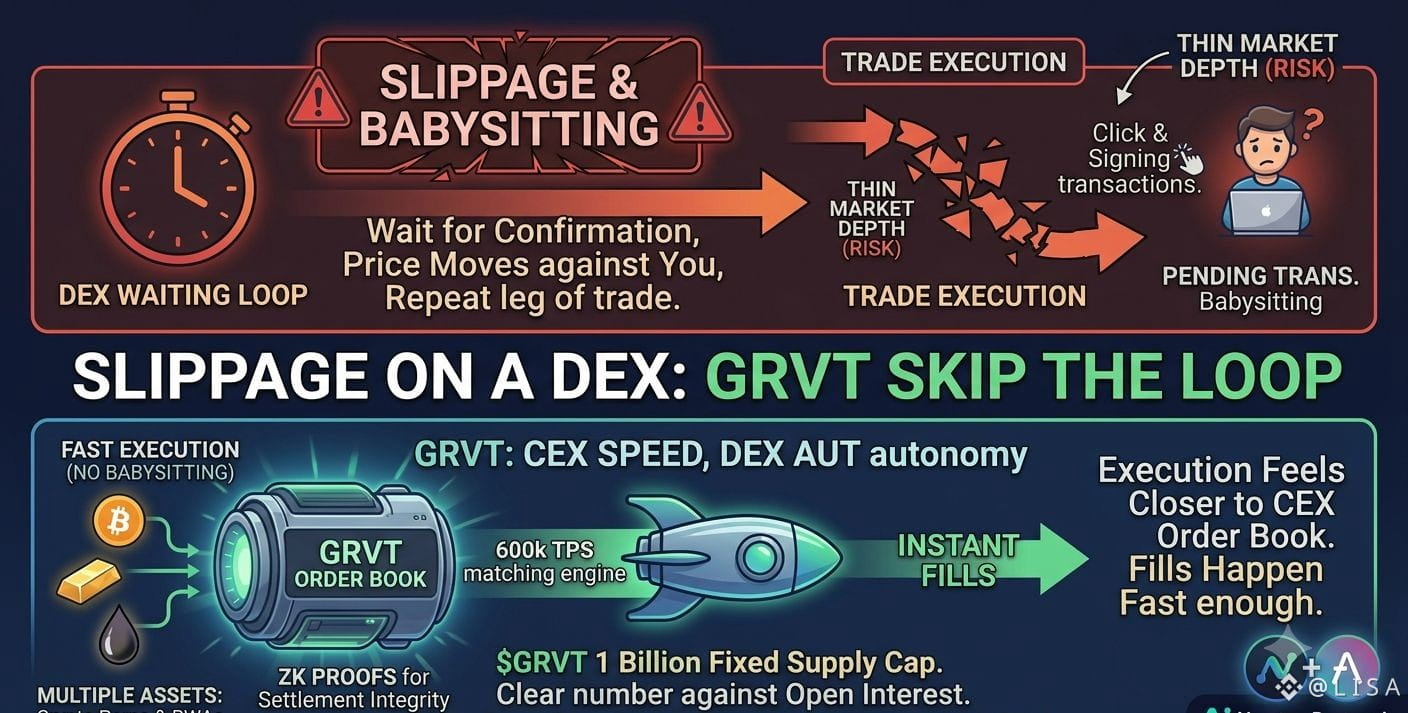
Slippage an einem DEX hat mich gelehrt, das Warten zu hassen
Wer schon einmal mit echter Größe auf einer dezentralen App gehandelt hat, kennt das Spiel: Du signierst eine Transaktion, wartest auf die Bestätigung, siehst zu, wie sich dein Kurs gegen dich bewegt, und wiederholst das für den nächsten Abschnitt des Trades. GRVT überspringt diese gesamte Schleife mit einer 600k TPS-„Matching Engine“, die sich tatsächlich wie eine zentrale Börse anfühlt, während die Abwicklung dennoch on-chain über ZK-Proofs stattfindet.
Was mich überzeugt hat, war nicht nur die Geschwindigkeit, sondern auch, dass ich zwischen Crypto-Perps und RWA-Exposure wie Gold und Öl innerhalb derselben Oberfläche rotieren kann, ohne den Handelsplatz zu wechseln oder Assets manuell zu brücken. Die Markttiefe bei herkömmlichen DEX-Setups für alles außerhalb der Majors ist meistens dünn, und Slippage frisst dir deinen Einstieg weg, bevor du dich überhaupt in der Position wohl fühlen kannst.
Hier fühlt sich die Ausführung näher an wie ein CEX-Orderbuch an: Die Fills passieren schnell genug, sodass ich keine schwebende Transaktion beaufsichtigen muss, während meine These veraltet. Genau diese Lücke zwischen DEX-Autonomie und CEX-Geschwindigkeit ist der Bereich, in dem die meisten Plattformen scheitern – sie entscheiden sich für eins und opfern das andere.
GRVT hat einen festen Supply-Cap von 1 Milliarde, was mir zumindest eine klare Zahl gibt, die ich gegen das Open Interest im Blick behalten kann, während das Thema mehr Aufmerksamkeit bekommt.
Ich schaue mir weiterhin an, wie das skaliert, sobald das Volumen anzieht.
@grvt_io #grvt
Wer schon einmal mit echter Größe auf einer dezentralen App gehandelt hat, kennt das Spiel: Du signierst eine Transaktion, wartest auf die Bestätigung, siehst zu, wie sich dein Kurs gegen dich bewegt, und wiederholst das für den nächsten Abschnitt des Trades. GRVT überspringt diese gesamte Schleife mit einer 600k TPS-„Matching Engine“, die sich tatsächlich wie eine zentrale Börse anfühlt, während die Abwicklung dennoch on-chain über ZK-Proofs stattfindet.
Was mich überzeugt hat, war nicht nur die Geschwindigkeit, sondern auch, dass ich zwischen Crypto-Perps und RWA-Exposure wie Gold und Öl innerhalb derselben Oberfläche rotieren kann, ohne den Handelsplatz zu wechseln oder Assets manuell zu brücken. Die Markttiefe bei herkömmlichen DEX-Setups für alles außerhalb der Majors ist meistens dünn, und Slippage frisst dir deinen Einstieg weg, bevor du dich überhaupt in der Position wohl fühlen kannst.
Hier fühlt sich die Ausführung näher an wie ein CEX-Orderbuch an: Die Fills passieren schnell genug, sodass ich keine schwebende Transaktion beaufsichtigen muss, während meine These veraltet. Genau diese Lücke zwischen DEX-Autonomie und CEX-Geschwindigkeit ist der Bereich, in dem die meisten Plattformen scheitern – sie entscheiden sich für eins und opfern das andere.
GRVT hat einen festen Supply-Cap von 1 Milliarde, was mir zumindest eine klare Zahl gibt, die ich gegen das Open Interest im Blick behalten kann, während das Thema mehr Aufmerksamkeit bekommt.
Ich schaue mir weiterhin an, wie das skaliert, sobald das Volumen anzieht.
@grvt_io #grvt
Anmelden und weiter Inhalte entdecken