
LearnBits
2.6k Beiträge

LearnBits
Melden
Nutzer blockieren
Learning quietly. Moving silently. Watching everything.
Trade eröffnen
Hochfrequenz-Trader
7.9 Jahre
119 Following
4.4K+ Follower
6.6K+ Like gegeben
Beiträge
Portfolio
Alle
Zitierungen
Videos
Live
·
--
🔻Rote Kerzen auf den wichtigsten Charts! Ist das ein gesunder Rücksetzer oder ein Signal, um Gewinne mitzunehmen?
Wir sehen auf dem Tages-Chart bei den großen Crypto-Giganten einen leichten Rücksetzer:
$BTC zieht sich nach dem Testen des $87,3k-Widerstands zurück!
$ETH kühlt um die $2,6k-Zone herum ab!
$BNB geht zurück, nachdem es nahe $807 gedrückt hat!
Ist das eine klassische „Kaufe den Dip“-Chance vor der nächsten Aufwärtsbewegung, oder wartest du auf niedrigere Support-Level?
{future}(BTCUSDT)
{future}(ETHUSDT)
{future}(BNBUSDT)
Was ist dein Move während dieses Marktdips?
🔻Rote Kerzen auf den wichtigsten Charts! Ist das ein gesunder Rücksetzer oder ein Signal, um Gewinne mitzunehmen?
Wir sehen auf dem Tages-Chart bei den großen Crypto-Giganten einen leichten Rücksetzer:
$BTC zieht sich nach dem Testen des $87,3k-Widerstands zurück!
$ETH kühlt um die $2,6k-Zone herum ab!
$BNB geht zurück, nachdem es nahe $807 gedrückt hat!
Ist das eine klassische „Kaufe den Dip“-Chance vor der nächsten Aufwärtsbewegung, oder wartest du auf niedrigere Support-Level?
Was ist dein Move während dieses Marktdips?
Wir sehen auf dem Tages-Chart bei den großen Crypto-Giganten einen leichten Rücksetzer:
$BTC zieht sich nach dem Testen des $87,3k-Widerstands zurück!
$ETH kühlt um die $2,6k-Zone herum ab!
$BNB geht zurück, nachdem es nahe $807 gedrückt hat!
Ist das eine klassische „Kaufe den Dip“-Chance vor der nächsten Aufwärtsbewegung, oder wartest du auf niedrigere Support-Level?
Was ist dein Move während dieses Marktdips?
Buying the Dip! 🛒
Waiting for lower levels ⏳
Taking profit / Selling 💰
HODL & Chill ☕
21 Stunde(n) übrig

Best Wishes!
Von LearnBits
5
694
·
--
Übersetzung ansehen
$SUI Network Surges 22% on High-Throughput DEX Volume and TVL Expansion ⚡
Sui (SUI) surged over 22% in 24 hours, reclaiming the $1.01 level and leading gains across major Layer-1 ecosystems. The sharp upward momentum was propelled by a rapid increase in Total Value Locked (TVL) across native decentralized exchanges and automated market maker protocols. On-chain metrics showed a noticeable spike in daily active addresses and transaction execution speeds, pointing to strong ecosystem adoption and liquidity inflows.
The rally rekindled investor interest in high-performance alternative Layer-1 networks competing for decentralized finance market share. Institutional market makers noted that sustained developer activity and growing DEX trading volumes are providing solid fundamental support for token price discovery. As capital continues rotating across major L1 assets, Sui's rapid throughput metrics keep it positioned near the forefront of recent market activity.
{future}(SUIUSDT)
$SUI Network Surges 22% on High-Throughput DEX Volume and TVL Expansion ⚡
Sui (SUI) surged over 22% in 24 hours, reclaiming the $1.01 level and leading gains across major Layer-1 ecosystems. The sharp upward momentum was propelled by a rapid increase in Total Value Locked (TVL) across native decentralized exchanges and automated market maker protocols. On-chain metrics showed a noticeable spike in daily active addresses and transaction execution speeds, pointing to strong ecosystem adoption and liquidity inflows.
The rally rekindled investor interest in high-performance alternative Layer-1 networks competing for decentralized finance market share. Institutional market makers noted that sustained developer activity and growing DEX trading volumes are providing solid fundamental support for token price discovery. As capital continues rotating across major L1 assets, Sui's rapid throughput metrics keep it positioned near the forefront of recent market activity.
Sui (SUI) surged over 22% in 24 hours, reclaiming the $1.01 level and leading gains across major Layer-1 ecosystems. The sharp upward momentum was propelled by a rapid increase in Total Value Locked (TVL) across native decentralized exchanges and automated market maker protocols. On-chain metrics showed a noticeable spike in daily active addresses and transaction execution speeds, pointing to strong ecosystem adoption and liquidity inflows.
The rally rekindled investor interest in high-performance alternative Layer-1 networks competing for decentralized finance market share. Institutional market makers noted that sustained developer activity and growing DEX trading volumes are providing solid fundamental support for token price discovery. As capital continues rotating across major L1 assets, Sui's rapid throughput metrics keep it positioned near the forefront of recent market activity.
Best Wishes!
Von LearnBits
1
5
354
·
--
Übersetzung ansehen
$FIGHT That rejection candle on #FIGHT says it all. 0.0055 smelled like a fakeout. I’m not long until 0.0041 flips back to support.
{future}(FIGHTUSDT)
$FIGHT That rejection candle on #FIGHT says it all. 0.0055 smelled like a fakeout. I’m not long until 0.0041 flips back to support.
1
511
·
--
Übersetzung ansehen
$ALLO Momentum is super hot, but I'm watching to see if 0.30 holds as new support. 🔥
{future}(ALLOUSDT)
$ALLO Momentum is super hot, but I'm watching to see if 0.30 holds as new support. 🔥
1
354
·
--
$MET Jeder ist mutig, bis die erste rote Kerze erscheint. 😁
{future}(METUSDT)
$MET Jeder ist mutig, bis die erste rote Kerze erscheint. 😁
1
382
·
--
Bullisch
Übersetzung ansehen
$TAKE up a insane +173% with a vertical candle straight to 0.168! 🚀 RSI sitting at 97 is absolutely wild, though.
What’s the play here? 👇
{future}(TAKEUSDT)
$TAKE up a insane +173% with a vertical candle straight to 0.168! 🚀 RSI sitting at 97 is absolutely wild, though.
What’s the play here? 👇
What’s the play here? 👇
FOMO long to the moon 🌕
Wait for the inevitable dump
12 Stunde(n) übrig
Best Wishes!
Von LearnBits
6
986
·
--
🚀 Überall grüne Kerzen! Welcher Ausbruch hat gerade den meisten Schwung?
Alle drei zeigen massive bullische Setups im Tageschart, aber nur EINE kann sich die Krone für die nächste große Aufwärtsbewegung sichern. 📈🔥
$UNI bricht Grenzen mit starkem Volumen! 🦄
{future}(UNIUSDT)
$NEAR mit massiven grünen Kerzen auf Pump! 🌐
{future}(NEARUSDT)
$SUI hält starken Schwung an wichtigen Levels! 💧
{future}(SUIUSDT)
Welche Coin wird diese Woche am härtesten pumpen?
🚀 Überall grüne Kerzen! Welcher Ausbruch hat gerade den meisten Schwung?
Alle drei zeigen massive bullische Setups im Tageschart, aber nur EINE kann sich die Krone für die nächste große Aufwärtsbewegung sichern. 📈🔥
$UNI bricht Grenzen mit starkem Volumen! 🦄
$NEAR mit massiven grünen Kerzen auf Pump! 🌐
$SUI hält starken Schwung an wichtigen Levels! 💧
Welche Coin wird diese Woche am härtesten pumpen?
Alle drei zeigen massive bullische Setups im Tageschart, aber nur EINE kann sich die Krone für die nächste große Aufwärtsbewegung sichern. 📈🔥
$UNI bricht Grenzen mit starkem Volumen! 🦄
$NEAR mit massiven grünen Kerzen auf Pump! 🌐
$SUI hält starken Schwung an wichtigen Levels! 💧
Welche Coin wird diese Woche am härtesten pumpen?
UNI 🦄
NEAR 🌐
SUI 💧
All 3 to the moon! 🚀
9 Stunde(n) übrig
Best Wishes!
Von LearnBits
3
1k
·
--
Übersetzung ansehen
$NIL is so overextended right now. RSI 96, price miles above the band. Late apers might get cooked here. Let it breathe first.
{future}(NILUSDT)
$NIL is so overextended right now. RSI 96, price miles above the band. Late apers might get cooked here. Let it breathe first.
2
457
·
--
Übersetzung ansehen
🚨 Binance Just Bought $100M of Circle.
The Stablecoin War Just Got Bigger.
Binance has invested $100 million in Circle, the company behind USDC, while signing a new five-year commercial agreement to expand USDC across Binance’s global platform.
The deal gives Binance an equity stake in one of the biggest players in the stablecoin market. Circle sold Binance 1.24 million Class A shares at $80.84 each in a private placement.
But the equity investment is only half the story.
Binance will push USDC adoption across its platform, with a particular focus on emerging markets, while Circle provides the infrastructure supporting USDC.
Circle will also pay Binance a monthly incentive tied to USDC held through its wallet infrastructure.
The market impact could be much bigger than the $100 million headline.
Binance is one of the world's largest crypto distribution platforms, while Circle controls a major dollar-stablecoin network. Putting those two forces closer together could accelerate USDC adoption, especially in markets where access to digital dollars is expanding rapidly.
And there's another signal here.
Binance isn't just listing or promoting USDC anymore—it now owns part of the company behind it.
The bigger takeaway: the stablecoin race is turning into a battle for distribution, infrastructure and financial networks—not just market share. 👀
So here's the real question: Does this make USDC a serious threat to the dominance of other dollar stablecoins?
$CRCLB
{spot}(CRCLBUSDT)
$USDC
{future}(USDCUSDT)
$BNB
{future}(BNBUSDT)
🚨 Binance Just Bought $100M of Circle.
The Stablecoin War Just Got Bigger.
Binance has invested $100 million in Circle, the company behind USDC, while signing a new five-year commercial agreement to expand USDC across Binance’s global platform.
The deal gives Binance an equity stake in one of the biggest players in the stablecoin market. Circle sold Binance 1.24 million Class A shares at $80.84 each in a private placement.
But the equity investment is only half the story.
Binance will push USDC adoption across its platform, with a particular focus on emerging markets, while Circle provides the infrastructure supporting USDC.
Circle will also pay Binance a monthly incentive tied to USDC held through its wallet infrastructure.
The market impact could be much bigger than the $100 million headline.
Binance is one of the world's largest crypto distribution platforms, while Circle controls a major dollar-stablecoin network. Putting those two forces closer together could accelerate USDC adoption, especially in markets where access to digital dollars is expanding rapidly.
And there's another signal here.
Binance isn't just listing or promoting USDC anymore—it now owns part of the company behind it.
The bigger takeaway: the stablecoin race is turning into a battle for distribution, infrastructure and financial networks—not just market share. 👀
So here's the real question: Does this make USDC a serious threat to the dominance of other dollar stablecoins?
$CRCLB
$USDC
$BNB
The Stablecoin War Just Got Bigger.
Binance has invested $100 million in Circle, the company behind USDC, while signing a new five-year commercial agreement to expand USDC across Binance’s global platform.
The deal gives Binance an equity stake in one of the biggest players in the stablecoin market. Circle sold Binance 1.24 million Class A shares at $80.84 each in a private placement.
But the equity investment is only half the story.
Binance will push USDC adoption across its platform, with a particular focus on emerging markets, while Circle provides the infrastructure supporting USDC.
Circle will also pay Binance a monthly incentive tied to USDC held through its wallet infrastructure.
The market impact could be much bigger than the $100 million headline.
Binance is one of the world's largest crypto distribution platforms, while Circle controls a major dollar-stablecoin network. Putting those two forces closer together could accelerate USDC adoption, especially in markets where access to digital dollars is expanding rapidly.
And there's another signal here.
Binance isn't just listing or promoting USDC anymore—it now owns part of the company behind it.
The bigger takeaway: the stablecoin race is turning into a battle for distribution, infrastructure and financial networks—not just market share. 👀
So here's the real question: Does this make USDC a serious threat to the dominance of other dollar stablecoins?
$CRCLB
$USDC
$BNB
1
259
·
--
Übersetzung ansehen
$BCH tapped 350 and got pushed back. RSI 88, way overbought. If 320 holds maybe continuation, but this feels top-heavy.
{future}(BCHUSDT)
$BCH tapped 350 and got pushed back. RSI 88, way overbought. If 320 holds maybe continuation, but this feels top-heavy.
Best Wishes!
Von LearnBits
8
415
·
--
Übersetzung ansehen
$ZEC is extended after a massive rally, but RSI isn’t extreme and no clear pullback zone exists. Chasing here offers poor risk-reward. Patience is the trade, wait for a healthy retracement or a confirmed rejection before committing capital.
{future}(ZECUSDT)
$ZEC is extended after a massive rally, but RSI isn’t extreme and no clear pullback zone exists. Chasing here offers poor risk-reward. Patience is the trade, wait for a healthy retracement or a confirmed rejection before committing capital.
Best Wishes!
Von LearnBits
6
799
·
--
$CHR Ich warte auf die erste rote Kerze, bevor ich überhaupt hinschaue.
{future}(CHRUSDT)
$CHR Ich warte auf die erste rote Kerze, bevor ich überhaupt hinschaue.
1
457
·
--
Überkauft oder nur am Aufwärmen? $ADA (RSI 84), HYPE (78), DOGE (82). Einer hat noch Luft, zwei sind heiß. Wer überlebt morgen?👇
{future}(ADAUSDT)
{future}(HYPEUSDT)
{future}(DOGEUSDT)
Überkauft oder nur am Aufwärmen? $ADA (RSI 84), HYPE (78), DOGE (82). Einer hat noch Luft, zwei sind heiß. Wer überlebt morgen?👇
ADA 🚀
41%
HYPE 🚀
43%
DOGE 🚀
16%
172 Stimmen • Abstimmung beendet
Best Wishes!
Von LearnBits
9
3.4k
·
--
Übersetzung ansehen
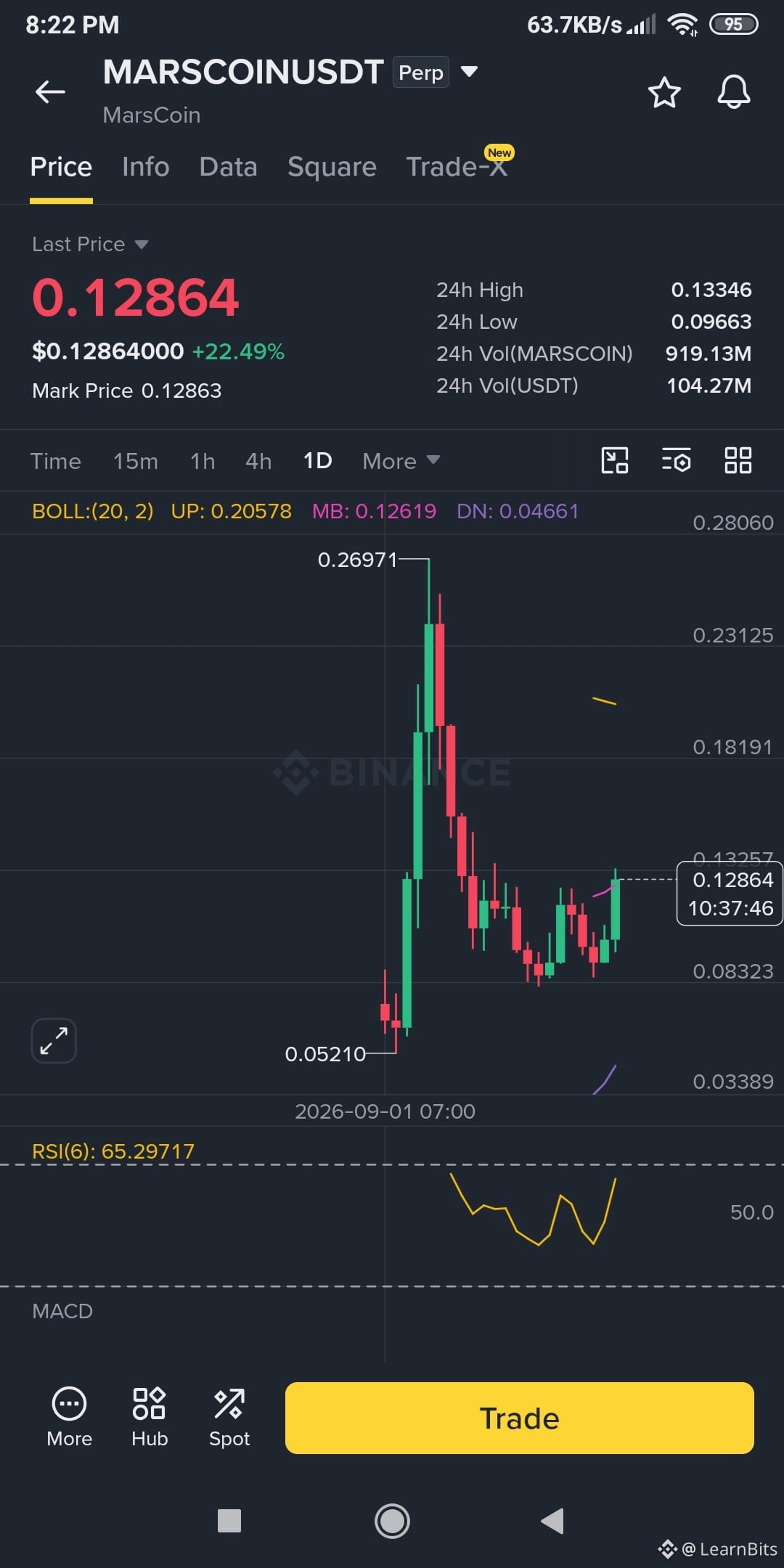
$MARSCOIN trying to heal after that 0.27 nuke. Back above mid-band but 0.13 still the gate.
{future}(MARSCOINUSDT)
$MARSCOIN trying to heal after that 0.27 nuke. Back above mid-band but 0.13 still the gate.
1
414
·
--
Übersetzung ansehen
$FORM If 0.33 flips into support I’m watching for round 2. Lose it and we retest 0.26.
{future}(FORMUSDT)
$FORM If 0.33 flips into support I’m watching for round 2. Lose it and we retest 0.26.
1
390
·
--
Das Dip-Buffet ist geöffnet! 🍽️
$AAVE , $AVAX und $龙虾 sind alle im Angebot. Aber welches ist das echte Schnäppchen?
{future}(AAVEUSDT)
{future}(AVAXUSDT)
{future}(龙虾USDT)
Wähle dein Gericht: 👇
Das Dip-Buffet ist geöffnet! 🍽️
$AAVE , $AVAX und $龙虾 sind alle im Angebot. Aber welches ist das echte Schnäppchen?
Wähle dein Gericht: 👇
$AAVE , $AVAX und $龙虾 sind alle im Angebot. Aber welches ist das echte Schnäppchen?
Wähle dein Gericht: 👇
AAVE
21%
AVAX
49%
龙虾
30%
82 Stimmen • Abstimmung beendet
Best Wishes!
Von LearnBits
3
2.3k
·
--
Übersetzung ansehen
🚨 Apple and Google Are Quietly Hiring Crypto Experts.
Apple and Google are both recruiting senior talent with experience in stablecoins, tokenized deposits and blockchain infrastructure.
Apple is hiring for an Apple Pay financial-product strategy role where knowledge of stablecoins, tokenized deposits and blockchain is listed among the preferred qualifications.
Google Cloud is taking a different route.
It is looking for a Web3 principal architect in Hong Kong to work with financial institutions, exchanges, custodians and blockchain developers across Asia-Pacific.
The role specifically covers real-world asset tokenization, stablecoin payment rails, tokenized deposits and digital-asset custody.
And this isn't just theoretical for Google.
Google Cloud already has a Universal Ledger project in private preview, designed for financial services with features including asset tokenization, programmable finance and 24/7 settlement.
Here's the market impact:
Neither Apple nor Google has announced a proprietary stablecoin or crypto product.
But when two of the world's biggest technology companies start hiring people who understand the infrastructure behind digital dollars and tokenized assets, it shows where the industry is heading.
Stablecoins may be moving from “crypto infrastructure” to “Big Tech payment infrastructure.”
The bigger question: Are Apple and Google preparing for the next financial system before most people even notice?
$AAPLB
{spot}(AAPLBUSDT)
$GOOGLB
{spot}(GOOGLBUSDT)
🚨 Apple and Google Are Quietly Hiring Crypto Experts.
Apple and Google are both recruiting senior talent with experience in stablecoins, tokenized deposits and blockchain infrastructure.
Apple is hiring for an Apple Pay financial-product strategy role where knowledge of stablecoins, tokenized deposits and blockchain is listed among the preferred qualifications.
Google Cloud is taking a different route.
It is looking for a Web3 principal architect in Hong Kong to work with financial institutions, exchanges, custodians and blockchain developers across Asia-Pacific.
The role specifically covers real-world asset tokenization, stablecoin payment rails, tokenized deposits and digital-asset custody.
And this isn't just theoretical for Google.
Google Cloud already has a Universal Ledger project in private preview, designed for financial services with features including asset tokenization, programmable finance and 24/7 settlement.
Here's the market impact:
Neither Apple nor Google has announced a proprietary stablecoin or crypto product.
But when two of the world's biggest technology companies start hiring people who understand the infrastructure behind digital dollars and tokenized assets, it shows where the industry is heading.
Stablecoins may be moving from “crypto infrastructure” to “Big Tech payment infrastructure.”
The bigger question: Are Apple and Google preparing for the next financial system before most people even notice?
$AAPLB
$GOOGLB
Apple and Google are both recruiting senior talent with experience in stablecoins, tokenized deposits and blockchain infrastructure.
Apple is hiring for an Apple Pay financial-product strategy role where knowledge of stablecoins, tokenized deposits and blockchain is listed among the preferred qualifications.
Google Cloud is taking a different route.
It is looking for a Web3 principal architect in Hong Kong to work with financial institutions, exchanges, custodians and blockchain developers across Asia-Pacific.
The role specifically covers real-world asset tokenization, stablecoin payment rails, tokenized deposits and digital-asset custody.
And this isn't just theoretical for Google.
Google Cloud already has a Universal Ledger project in private preview, designed for financial services with features including asset tokenization, programmable finance and 24/7 settlement.
Here's the market impact:
Neither Apple nor Google has announced a proprietary stablecoin or crypto product.
But when two of the world's biggest technology companies start hiring people who understand the infrastructure behind digital dollars and tokenized assets, it shows where the industry is heading.
Stablecoins may be moving from “crypto infrastructure” to “Big Tech payment infrastructure.”
The bigger question: Are Apple and Google preparing for the next financial system before most people even notice?
$AAPLB
$GOOGLB
1
267
·
--
Übersetzung ansehen
$COOKIE daily breakout is nice but that wick at 0.0142 says sellers are lurking.
{future}(COOKIEUSDT)
$COOKIE daily breakout is nice but that wick at 0.0142 says sellers are lurking.
1
387
·
--
Übersetzung ansehen
$AGT Rejection at 0.0275 shows sellers were waiting, so I’m watching for a retest before making any moves.
{future}(AGTUSDT)
$AGT Rejection at 0.0275 shows sellers were waiting, so I’m watching for a retest before making any moves.
1
364
·
--
Übersetzung ansehen
$KERNEL 0.071 rejection + RSI 91. Feels like FOMO trap szn. Let it cool first.
{future}(KERNELUSDT)
$KERNEL 0.071 rejection + RSI 91. Feels like FOMO trap szn. Let it cool first.
1
386
Anmelden und weiter Inhalte entdecken
Krypto-Nutzer weltweit auf Binance Square kennenlernen
⚡️ Bleib in Sachen Krypto stets am Puls.
💬 Die weltgrößte Kryptobörse vertraut darauf.
👍 Erhalte verlässliche Einblicke von verifizierten Creators.
E-Mail-Adresse/Telefonnummer
Trendthemen
AIStocksWhatNext
862,013 Aufrufe
6,529 Kommentare
Teile & gewinne Traffic-Rewards in unserer angesagten Hashtag-Kampagne
✨Thema: Welche anderen Investitionsmöglichkeiten gibt es noch, während KI-Aktien weiter steigen?
👉So machst du mit:
Veröffentliche einen kurzen Beitrag oder Artikel mit dem Hashtag #AIStocksWhatNext
Teile, ob du bullisch oder bärisch bist, und poste deine KI-Aktienbestände oder Trades – die Nutzung des Trade-Widgets kann deine Berechtigung verbessern.
Du kannst deinen Beitrag auch stärken, indem du Daten oder Diagramme teilst und KI-generierte Bilder vermeidest.
✍️Erstelle Inhalte basierend auf den folgenden Blickwinkeln:
- Nvidia sagt, dass sich der Chip-Umsatz im nächsten Jahr verdoppeln wird, und die führenden KI-Unternehmen erreichen weiterhin Rekordumsätze – der Rechenaufwand dahinter ist ebenso beeindruckend. Verläuft die Nachfrage nach KI wirklich gerade erst so richtig, oder geht es nur noch eine Weile weiter? KI-Aktien steigen derzeit branchenweit. Ist das ein echter Ausbruch oder nur ein kurzfristiger Rückprall?
- Branchenführer fordern dazu auf, die Entwicklung von KI zu verlangsamen, während Trump plant, eine „AI Force“ aufzubauen, und behauptet, KI könne in der Zukunft 25% des US-BIP ausmachen. Auf welcher Seite stehst du? Wird staatliche Unterstützung ein langfristiger Gewinn für KI-Aktien sein?
- Kaufst du KI-Aktien? Teile deinen KI-bezogenen Trade/deine Bestände mit unserem Trade-Sharing-Widget.
⏰Kampagnenzeitraum:
- 2026-09-22 7:00 - 2026-09-24 4:00 UTC
🎁Belohnung:
- Qualifizierte Beiträge, die die oben genannten Richtlinien einhalten und mehr als 100 Wörter enthalten, werden überprüft und können möglicherweise einen zufälligen Traffic-Boost von 500 bis 3.000 Views erhalten. Du erhältst eine Benachrichtigung von deiner Feed-Sekretärin, wenn dein Beitrag ausgewählt wurde.
- Erhalte die Chance, dass dein Artikel auf Binance Square Official vorgestellt wird
Brauchst du Ideen für deinen Beitrag? Besuche die Thema-Seite #AIStocksWhatNext oder die Square Guide on How to Post for Better Reach.
Binance Square Official
·578 Likes
·1.7M Aufrufe
BitcoinRejectedAt$87,300Twice
0 Aufrufe
0 Kommentare
BCHJumps28%OnCMEFuturesListing
8,818 Aufrufe
466 Kommentare