

ifreqs
2 Beiträge

ifreqs
Melden
Nutzer blockieren
8 Following
5.4K+ Follower
647 Like gegeben
Beiträge
·
--
Übersetzung ansehen
SoFi just gave consumers a tokenized deposit: 4.40% APY, FDIC-insured, convertible 1:1 into its stablecoin. Banks are shipping this RWA lane now. $QNT is the token crypto traders tie to it, and it is up ~15% in 24h.
★ What SoFi launched (Oct 22)
→ Each SoFi Earn (SOFIE) token is one dollar on deposit at SoFi Bank.
→ It converts 1:1 into SoFiUSD to buy crypto or move funds onchain 24/7. The stablecoin itself pays nothing.
→ SoFi's pitch: Fed research puts ~$64B, or 21.2% of stablecoins, idle in inactive wallets.
★ The bank pipeline
→ The Clearing House picked Quant on Sep 24 to power the interoperability layer of its tokenized deposit network, linked to the RTP and CHIPS rails. TCH clears $2T+ a day. Launch is set for H1 2027.
→ JPMorgan's deposit token has run on Base since Nov 2025.
→ Five regional banks, including Huntington, M&T and KeyBank, chose ZKsync for the Cari network.
★ The token (CoinGecko, CoinGlass)
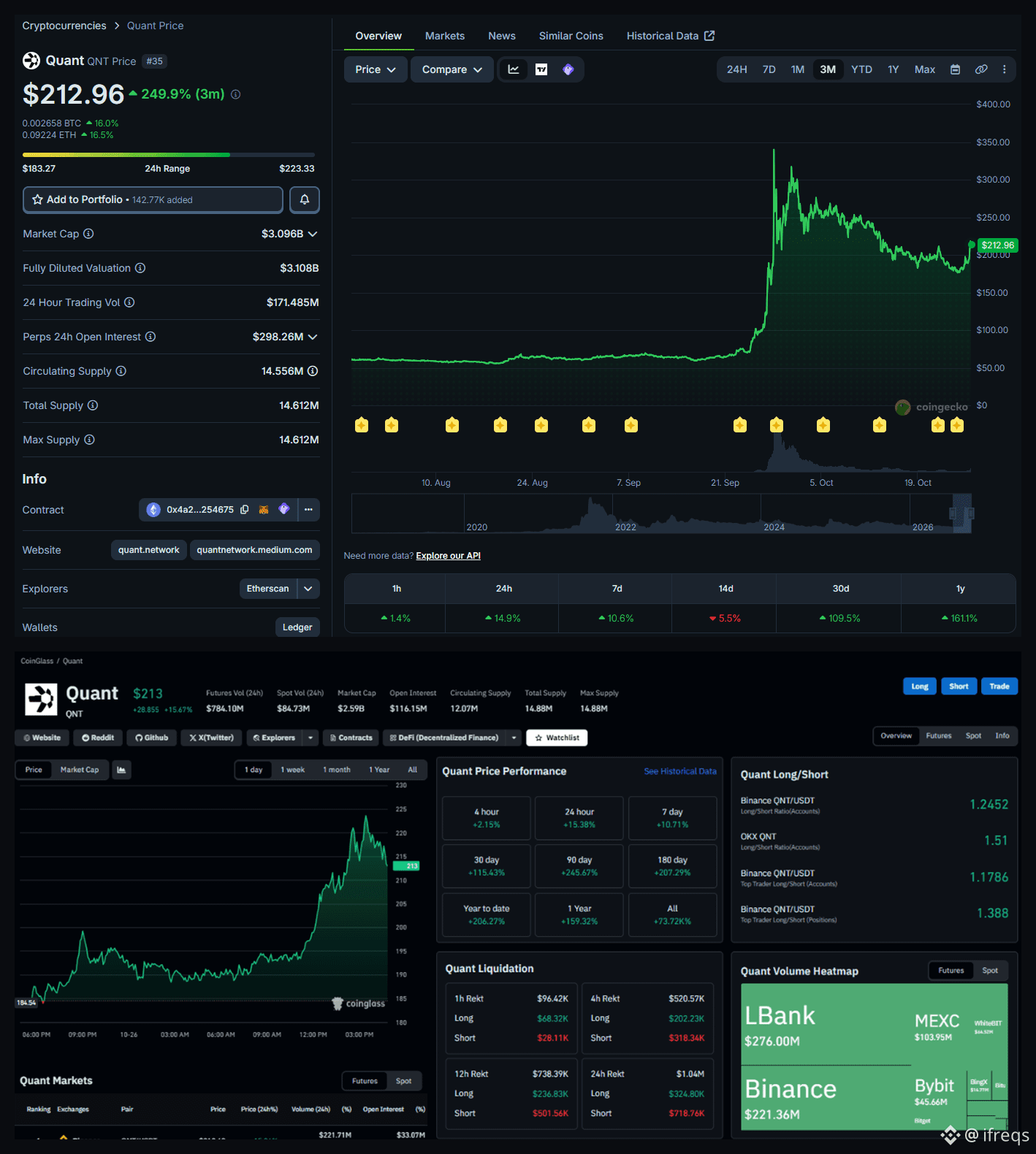
→ ~$213 now, ~+250% in 3 months: a $55.9 close on Aug 18, a $373 high on Sep 27, a $179 close on Oct 24.
→ Today's move is futures-led: $784M futures volume vs $85M spot in 24h. OI +22% on Binance and +38% on Bybit.
→ Liquidations were small ($1.04M, $719K of it shorts) and funding is flat. That's new positions, not a squeeze.
→ Binance long/short accounts went from 0.93 on Saturday to over 1.2.
→ Caveat: SoFi's release doesn't name Quant, and TCH's never mentions the QNT token. Nothing ties network fees to it. Trackers also disagree on supply: CoinGecko counts 14.56M circulating ($3.10B), CoinGlass 12.07M ($2.59B).
Tokenized deposits are clearly coming. Do they need QNT, or just Quant the company?
254
·
--
Die Bitcoin-Dominanz hält sich bei ~60,6 %, einem Niveau, das zuletzt Ende Mai erreicht wurde. Doch $BTC liegt über 30 Tage 5 % im Minus. Der Anteil stieg, weil alles andere stärker fiel.
★ Der Chart (TradingView, BTC.D)
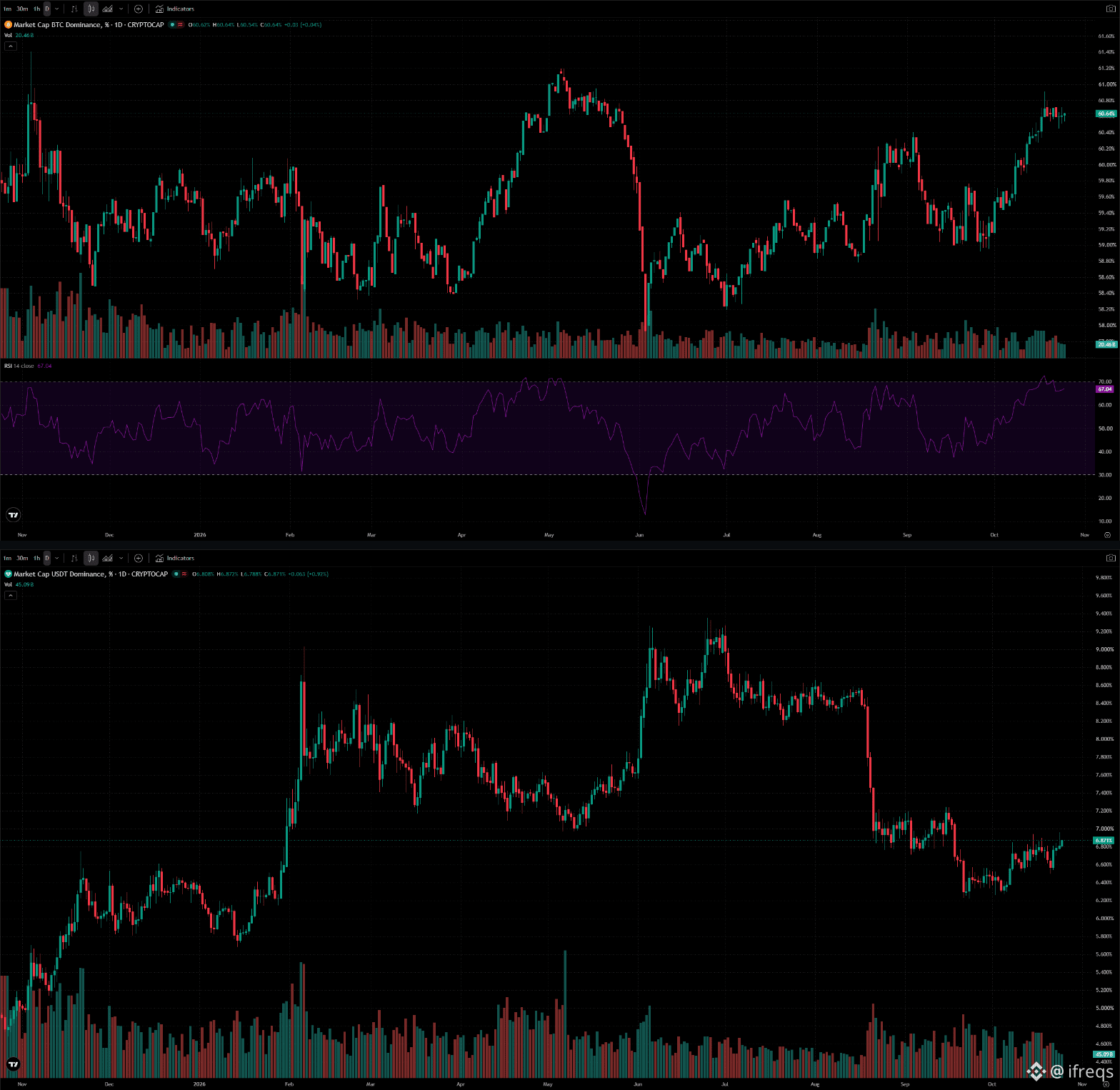
→ Jetzt bei 60,6 %, gegenüber 59,4 % am 24. Sep.
→ Über dem 50-Tage- (59,8 %) und dem 200-Tage-Durchschnitt (59,6 %). Der RSI liegt bei 67, nahe der 70er-Marke.
→ Die 1-Jahres-Obergrenze liegt bei ~61 %: ein Docht bei 61,4 % am 4. Nov. 2025 und ein Schlusskurs von 61,1 % am 5. Mai 2026.
★ Woher der Anteil kam (letzte 30 Tage)
→ BTC −5,0 %. Gesamte Kryptomarktkapitalisierung −7,0 %. Alles außer BTC −9,8 %.
→ ETH/BTC −8,9 % auf 0,0290, RSI 25. Die Dominanz von $ETH ist auf 10,7 % gesunken.
→ USDT-Dominanz +6,7 % auf 6,87 %. Stablecoins fallen bei einem Ausverkauf nicht, daher steigt ihr Anteil automatisch.
★ Die letzten beiden Male, als BTC.D ~61 % erreichte
→ Nov. 2025: BTC.D fiel bis zum 21. Nov. von 60,8 % auf 59,1 %, während BTC 16 % verlor. Die Dominanz von USDT + USDC stieg um 1,2 Pp. ETH/BTC blieb unverändert.
→ Mai 2026: BTC.D fiel bis zum 3. Jun. von 61,1 % auf 57,9 %, während BTC 21 % verlor. USDT + USDC stiegen um 1,8 Pp. ETH/BTC −3 %.
→ Beide Male entfielen mehr als die Hälfte des von BTC verlorenen Anteils auf Stablecoins, und auch der Anteil von ETH sank.
→ Hinweis: TradingView berücksichtigt Stablecoins in der Gesamtsumme. Ohne USDT und USDC liegt der BTC-Anteil bei ~67 %. CoinGecko weist 60,1 % aus, da dort eine andere Auswahl an Coins erfasst wird. Und zwei Höchststände ergeben noch kein Muster.
BTC.D ist wieder an der Obergrenze, der RSI liegt nahe 70. Wenn die Dominanz erneut nachgibt: Ist das der Beginn einer Altcoin-Saison oder eine weitere Umschichtung in Stablecoins?
150
Anmelden und weiter Inhalte entdecken
Krypto-Nutzer weltweit auf Binance Square kennenlernen
⚡️ Bleib in Sachen Krypto stets am Puls.
💬 Die weltgrößte Kryptobörse vertraut darauf.
👍 Erhalte verlässliche Einblicke von verifizierten Creators.
E-Mail-Adresse/Telefonnummer