

赫拉迪耶什
15.1k Beiträge

赫拉迪耶什
Melden
Nutzer blockieren
Trade eröffnen
Regelmäßiger Trader
4.6 Jahre
8.6K+ Following
4.4K+ Follower
3.8K+ Like gegeben
Beiträge
Portfolio
Alle
Zitierungen
Videos
Live
·
--
#newt $NEWT
Ich habe bemerkt, dass die meisten DeFi-Prozesse immer noch auf einer seltsamen Annahme beruhen
Wenn du es unterschrieben hast, hast du es verstanden
Das bricht häufiger, als die Leute zugeben
Beim Lesen des Newton Protocol Whitepapers und beim Erkunden der Mainnet-Beta fühlt sich der Fokus anders an
Hier geht es nicht darum, Geschwindigkeit oder bessere Dashboards zu jagen
Es geht darum, den Teil zu reparieren, über den niemand gerne spricht
Was tatsächlich passiert, bevor Geld in Bewegung gerät
von manuellen Transaktionen zu kontrollierter Ausführung
Newton positioniert sich nicht einfach blind als Genehmiger von Aktionen
Es prüft die Absicht, bevor es ausführt
Es kann riskantes Verhalten blockieren, Limits durchsetzen und Aktionen innerhalb festgelegter Regeln halten
Das klingt langweilig, aber genau das sollte diese Schicht sein
Die meisten Systeme erklären Probleme erst, nachdem sie passiert sind
Newton untersucht, ob diese Ausfälle überhaupt verhindert werden können
Weniger Reaktion, mehr Kontrolle
Die Herausforderung besteht darin, das zu tun, ohne Macht zu zentralisieren
Regeln, Beweise und Privatsphäre müssen koexistieren
Das ist nicht einfach, aber es ist ein echtes Problem, das man lösen sollte
Ich habe in letzter Zeit mehr über Newton gesehen, und die Mainnet-Beta fühlt sich wie ein stabiler Schritt nach vorn an
Wenn Automatisierung sicherer zu nutzen wird, verändert das, wer tatsächlich teilnehmen kann
fast Tage, aber die Richtung ist klar
@NewtonProtocol #Newt $NEWT
{future}(NEWTUSDT)
⚠️Dieser Inhalt ist eine bezahlte Partnerschaft
Umfrage
Was ist in Zukunft wichtiger?:-
#newt $NEWT
Ich habe bemerkt, dass die meisten DeFi-Prozesse immer noch auf einer seltsamen Annahme beruhen
Wenn du es unterschrieben hast, hast du es verstanden
Das bricht häufiger, als die Leute zugeben
Beim Lesen des Newton Protocol Whitepapers und beim Erkunden der Mainnet-Beta fühlt sich der Fokus anders an
Hier geht es nicht darum, Geschwindigkeit oder bessere Dashboards zu jagen
Es geht darum, den Teil zu reparieren, über den niemand gerne spricht
Was tatsächlich passiert, bevor Geld in Bewegung gerät
von manuellen Transaktionen zu kontrollierter Ausführung
Newton positioniert sich nicht einfach blind als Genehmiger von Aktionen
Es prüft die Absicht, bevor es ausführt
Es kann riskantes Verhalten blockieren, Limits durchsetzen und Aktionen innerhalb festgelegter Regeln halten
Das klingt langweilig, aber genau das sollte diese Schicht sein
Die meisten Systeme erklären Probleme erst, nachdem sie passiert sind
Newton untersucht, ob diese Ausfälle überhaupt verhindert werden können
Weniger Reaktion, mehr Kontrolle
Die Herausforderung besteht darin, das zu tun, ohne Macht zu zentralisieren
Regeln, Beweise und Privatsphäre müssen koexistieren
Das ist nicht einfach, aber es ist ein echtes Problem, das man lösen sollte
Ich habe in letzter Zeit mehr über Newton gesehen, und die Mainnet-Beta fühlt sich wie ein stabiler Schritt nach vorn an
Wenn Automatisierung sicherer zu nutzen wird, verändert das, wer tatsächlich teilnehmen kann
fast Tage, aber die Richtung ist klar
@NewtonProtocol #Newt $NEWT
⚠️Dieser Inhalt ist eine bezahlte Partnerschaft
Umfrage
Was ist in Zukunft wichtiger?:-
Ich habe bemerkt, dass die meisten DeFi-Prozesse immer noch auf einer seltsamen Annahme beruhen
Wenn du es unterschrieben hast, hast du es verstanden
Das bricht häufiger, als die Leute zugeben
Beim Lesen des Newton Protocol Whitepapers und beim Erkunden der Mainnet-Beta fühlt sich der Fokus anders an
Hier geht es nicht darum, Geschwindigkeit oder bessere Dashboards zu jagen
Es geht darum, den Teil zu reparieren, über den niemand gerne spricht
Was tatsächlich passiert, bevor Geld in Bewegung gerät
von manuellen Transaktionen zu kontrollierter Ausführung
Newton positioniert sich nicht einfach blind als Genehmiger von Aktionen
Es prüft die Absicht, bevor es ausführt
Es kann riskantes Verhalten blockieren, Limits durchsetzen und Aktionen innerhalb festgelegter Regeln halten
Das klingt langweilig, aber genau das sollte diese Schicht sein
Die meisten Systeme erklären Probleme erst, nachdem sie passiert sind
Newton untersucht, ob diese Ausfälle überhaupt verhindert werden können
Weniger Reaktion, mehr Kontrolle
Die Herausforderung besteht darin, das zu tun, ohne Macht zu zentralisieren
Regeln, Beweise und Privatsphäre müssen koexistieren
Das ist nicht einfach, aber es ist ein echtes Problem, das man lösen sollte
Ich habe in letzter Zeit mehr über Newton gesehen, und die Mainnet-Beta fühlt sich wie ein stabiler Schritt nach vorn an
Wenn Automatisierung sicherer zu nutzen wird, verändert das, wer tatsächlich teilnehmen kann
fast Tage, aber die Richtung ist klar
@NewtonProtocol #Newt $NEWT
⚠️Dieser Inhalt ist eine bezahlte Partnerschaft
Umfrage
Was ist in Zukunft wichtiger?:-
speed
50%
usability
0%
automation
0%
pre execution control
50%
2 Stimmen • Abstimmung beendet
3
5
83
·
--
Artikel
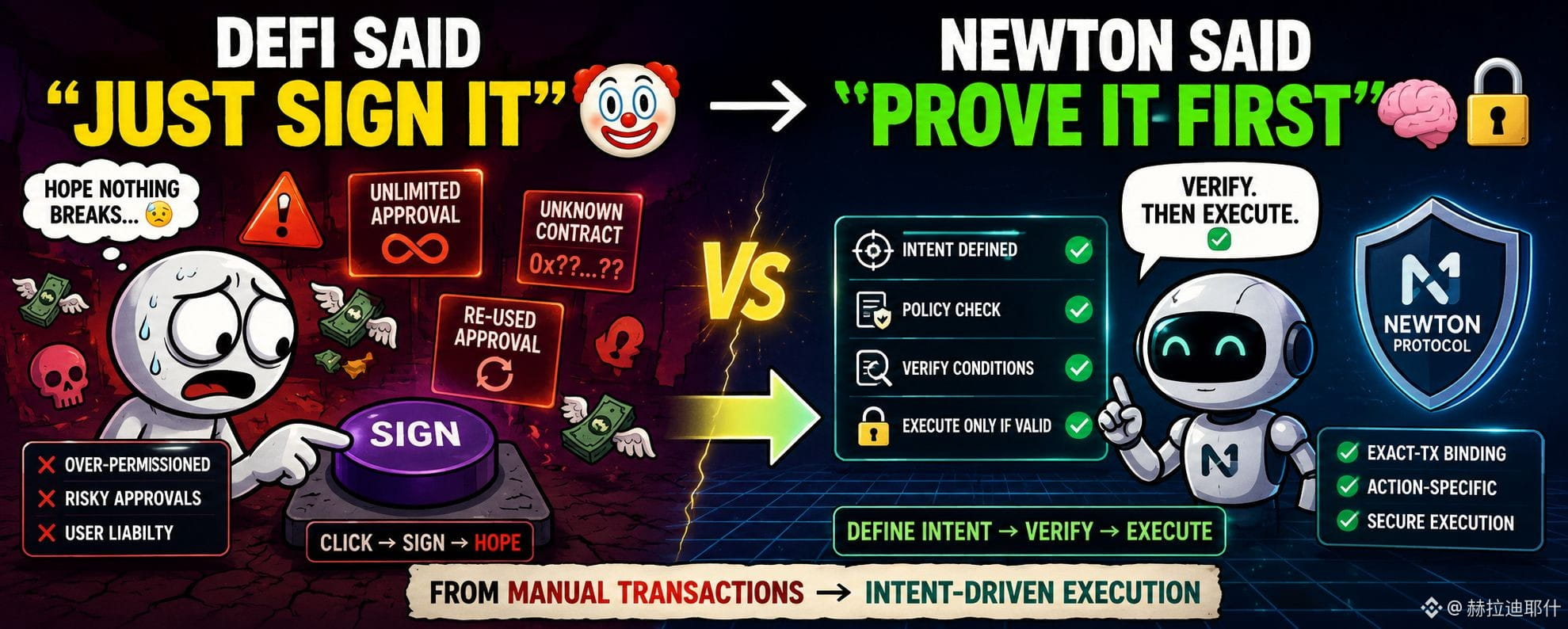
DeFi sagte „Nur unterschreiben“ 🤡 → Newton sagte „Beweise es zuerst“ 🧠🔐Das größte Risiko in DeFi sind nicht Hacker. Es sind Genehmigungen, die still und leise mehr tun, als du denkst.
Diese Erkenntnis hat verändert, wie ich Newton Protocol lese.
Weil die meisten Systeme nicht laut scheitern. Sie scheitern richtig… nur nicht auf die Art, die du erwartet hast 😅
Die Mainnet Beta fühlt sich nicht wie ein Experiment an. Sie fühlt sich an wie ein Einschränkungssystem, das öffentlich getestet wird.
Momentan ist der Ablauf einfach. Klicken. Signieren. Ausführen.
Wir vertrauen dem Ergebnis, weil wir die Aktion genehmigt haben.
Newton bricht diese Annahme.
Definiere die Absicht. Binde die Richtlinie. Überprüfe die Bedingungen. Führe nur aus, wenn alles übereinstimmt 🧠
DeFi sagte „Nur unterschreiben“ 🤡 → Newton sagte „Beweise es zuerst“ 🧠🔐
Das größte Risiko in DeFi sind nicht Hacker. Es sind Genehmigungen, die still und leise mehr tun, als du denkst.
Diese Erkenntnis hat verändert, wie ich Newton Protocol lese.
Weil die meisten Systeme nicht laut scheitern. Sie scheitern richtig… nur nicht auf die Art, die du erwartet hast 😅
Die Mainnet Beta fühlt sich nicht wie ein Experiment an. Sie fühlt sich an wie ein Einschränkungssystem, das öffentlich getestet wird.
Momentan ist der Ablauf einfach. Klicken. Signieren. Ausführen.
Wir vertrauen dem Ergebnis, weil wir die Aktion genehmigt haben.
Newton bricht diese Annahme.
Definiere die Absicht. Binde die Richtlinie. Überprüfe die Bedingungen. Führe nur aus, wenn alles übereinstimmt 🧠
Diese Erkenntnis hat verändert, wie ich Newton Protocol lese.
Weil die meisten Systeme nicht laut scheitern. Sie scheitern richtig… nur nicht auf die Art, die du erwartet hast 😅
Die Mainnet Beta fühlt sich nicht wie ein Experiment an. Sie fühlt sich an wie ein Einschränkungssystem, das öffentlich getestet wird.
Momentan ist der Ablauf einfach. Klicken. Signieren. Ausführen.
Wir vertrauen dem Ergebnis, weil wir die Aktion genehmigt haben.
Newton bricht diese Annahme.
Definiere die Absicht. Binde die Richtlinie. Überprüfe die Bedingungen. Führe nur aus, wenn alles übereinstimmt 🧠
15
14
96
·
--
#newt $NEWT
Ich bin heute früh aufgewacht und irgendwie war Newton Protocol wieder überall. Kein Hype, nur… wiederholte Signale. Die Mainnet Beta fühlt sich an wie ein echter Schritt an – kein Rauschen.
Der Großteil von DeFi funktioniert immer noch so:
klick → signieren → hoffen, dass nichts kaputtgeht 😅
Newton versucht etwas anderes:
Intent definieren → Policy verifizieren → nur ausführen, wenn es gültig ist 🧠
Das klingt nach wenig, bis man darüber nachdenkt.
Stell dir vor, du sendest einen Stablecoin.
Wenn die Policy eine Genehmigung für genau einen Signer, ein Ziel, einen Wert, eine Funktion… erteilt, dann sollte diese Genehmigung an genau diese Aktion gebunden bleiben.
Wie ein Zustell-OTP 📦
Ein Code. Ein Paket. Eine Adresse.
Du kannst ihn nicht später für etwas anderes wiederverwenden.
So fühlt sich Exact-Tx Attestation Binding an:
Die Genehmigung wird aktion-spezifisch, nicht endlos offen 🔐
Von manuellen Transaktionen → intent-gesteuerte Ausführung
die Richtung ist klar.
Wenn das wirklich im großen Maßstab funktioniert, verändert es das Vertrauen der Nutzer in die Ausführung – nicht nur die Geschwindigkeit.
@NewtonProtocol
#Newt
$NEWT
{future}(NEWTUSDT)
⚠️Dieser Inhalt ist eine bezahlte Partnerschaft
🗳️ Umfrage:
Was ist wichtiger für die On-Chain-UX?
#newt $NEWT
Ich bin heute früh aufgewacht und irgendwie war Newton Protocol wieder überall. Kein Hype, nur… wiederholte Signale. Die Mainnet Beta fühlt sich an wie ein echter Schritt an – kein Rauschen.
Der Großteil von DeFi funktioniert immer noch so:
klick → signieren → hoffen, dass nichts kaputtgeht 😅
Newton versucht etwas anderes:
Intent definieren → Policy verifizieren → nur ausführen, wenn es gültig ist 🧠
Das klingt nach wenig, bis man darüber nachdenkt.
Stell dir vor, du sendest einen Stablecoin.
Wenn die Policy eine Genehmigung für genau einen Signer, ein Ziel, einen Wert, eine Funktion… erteilt, dann sollte diese Genehmigung an genau diese Aktion gebunden bleiben.
Wie ein Zustell-OTP 📦
Ein Code. Ein Paket. Eine Adresse.
Du kannst ihn nicht später für etwas anderes wiederverwenden.
So fühlt sich Exact-Tx Attestation Binding an:
Die Genehmigung wird aktion-spezifisch, nicht endlos offen 🔐
Von manuellen Transaktionen → intent-gesteuerte Ausführung
die Richtung ist klar.
Wenn das wirklich im großen Maßstab funktioniert, verändert es das Vertrauen der Nutzer in die Ausführung – nicht nur die Geschwindigkeit.
@NewtonProtocol
#Newt
$NEWT
⚠️Dieser Inhalt ist eine bezahlte Partnerschaft
🗳️ Umfrage:
Was ist wichtiger für die On-Chain-UX?
Ich bin heute früh aufgewacht und irgendwie war Newton Protocol wieder überall. Kein Hype, nur… wiederholte Signale. Die Mainnet Beta fühlt sich an wie ein echter Schritt an – kein Rauschen.
Der Großteil von DeFi funktioniert immer noch so:
klick → signieren → hoffen, dass nichts kaputtgeht 😅
Newton versucht etwas anderes:
Intent definieren → Policy verifizieren → nur ausführen, wenn es gültig ist 🧠
Das klingt nach wenig, bis man darüber nachdenkt.
Stell dir vor, du sendest einen Stablecoin.
Wenn die Policy eine Genehmigung für genau einen Signer, ein Ziel, einen Wert, eine Funktion… erteilt, dann sollte diese Genehmigung an genau diese Aktion gebunden bleiben.
Wie ein Zustell-OTP 📦
Ein Code. Ein Paket. Eine Adresse.
Du kannst ihn nicht später für etwas anderes wiederverwenden.
So fühlt sich Exact-Tx Attestation Binding an:
Die Genehmigung wird aktion-spezifisch, nicht endlos offen 🔐
Von manuellen Transaktionen → intent-gesteuerte Ausführung
die Richtung ist klar.
Wenn das wirklich im großen Maßstab funktioniert, verändert es das Vertrauen der Nutzer in die Ausführung – nicht nur die Geschwindigkeit.
@NewtonProtocol
#Newt
$NEWT
⚠️Dieser Inhalt ist eine bezahlte Partnerschaft
🗳️ Umfrage:
Was ist wichtiger für die On-Chain-UX?
Faster transactions ⚡
0%
Lower fees 💸
0%
Safer execution 🔐
0%
Full automation 🤖
0%
0 Stimmen • Abstimmung beendet
27
18
131
·
--
Artikel
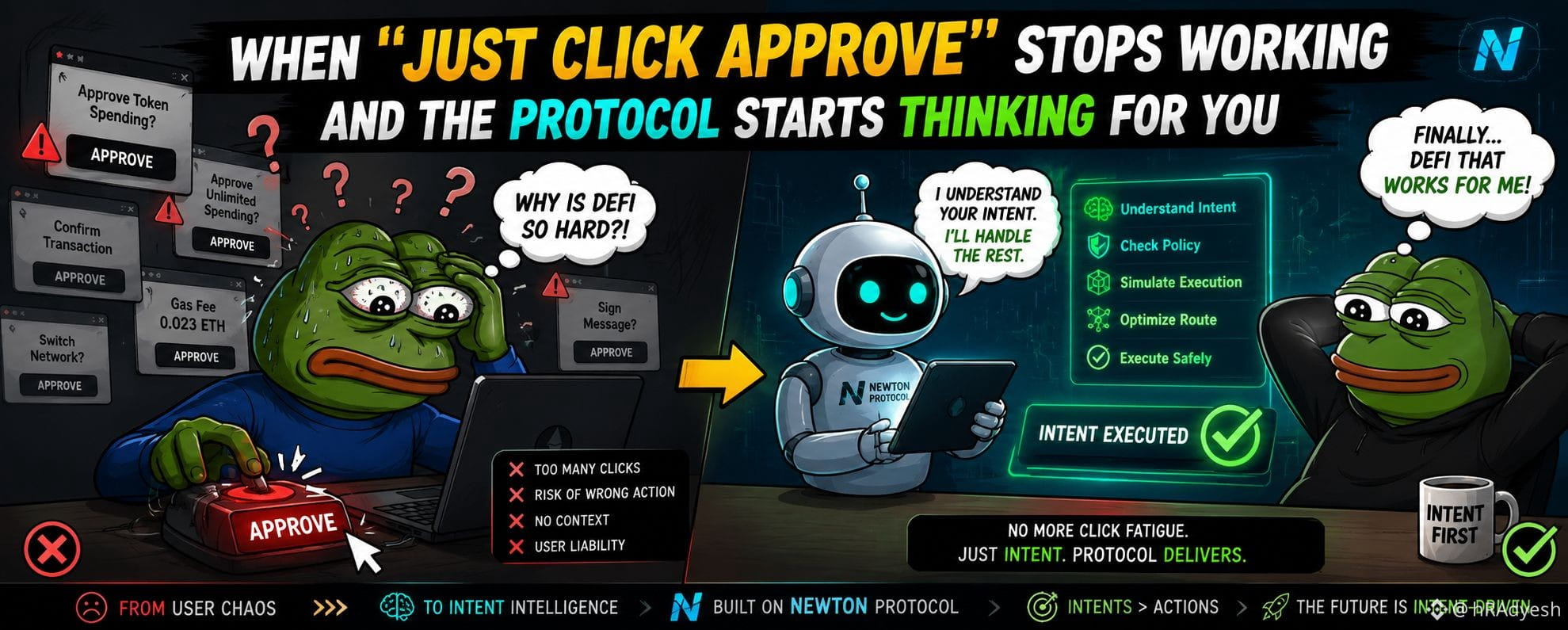
Wenn „Just Click Approve“ nicht mehr funktioniert – und das Protokoll anfängt, für dich mitzudenkenFrüher dachte ich, Beta bedeutet unfertig. Etwas Rohes. Etwas, das noch nicht bereit ist. Etwas, das man einmal ausprobiert und dann auf die echte Version wartet.
Diese Annahme stimmt nicht mehr so gut.
Mir ist aufgefallen, wie normal es geworden ist, in DeFi einfach auf „Approve“ zu klicken, ohne darüber nachzudenken, was tatsächlich ausgeführt wird. Es fühlt sich effizient an. Es fühlt sich routiniert an. Bis es nicht mehr so ist. Eine falsche Freigabe, und das System macht immer noch genau das, was du ihm gesagt hast.
Das ist kein Bug. So funktioniert das Design.
Durchlesen des Newton Protocol-Whitepapers und die Zeit mit der Newton Mainnet Beta haben ein Gefühl vermittelt, das ruhig wirkt, aber strukturell ist. Es geht nicht darum, Transaktionen schneller zu machen. Es soll die Notwendigkeit beseitigen, dass Nutzer sie überhaupt erst manuell konstruieren müssen.
Wenn „Just Click Approve“ nicht mehr funktioniert – und das Protokoll anfängt, für dich mitzudenken
Früher dachte ich, Beta bedeutet unfertig. Etwas Rohes. Etwas, das noch nicht bereit ist. Etwas, das man einmal ausprobiert und dann auf die echte Version wartet.
Diese Annahme stimmt nicht mehr so gut.
Mir ist aufgefallen, wie normal es geworden ist, in DeFi einfach auf „Approve“ zu klicken, ohne darüber nachzudenken, was tatsächlich ausgeführt wird. Es fühlt sich effizient an. Es fühlt sich routiniert an. Bis es nicht mehr so ist. Eine falsche Freigabe, und das System macht immer noch genau das, was du ihm gesagt hast.
Das ist kein Bug. So funktioniert das Design.
Durchlesen des Newton Protocol-Whitepapers und die Zeit mit der Newton Mainnet Beta haben ein Gefühl vermittelt, das ruhig wirkt, aber strukturell ist. Es geht nicht darum, Transaktionen schneller zu machen. Es soll die Notwendigkeit beseitigen, dass Nutzer sie überhaupt erst manuell konstruieren müssen.
Diese Annahme stimmt nicht mehr so gut.
Mir ist aufgefallen, wie normal es geworden ist, in DeFi einfach auf „Approve“ zu klicken, ohne darüber nachzudenken, was tatsächlich ausgeführt wird. Es fühlt sich effizient an. Es fühlt sich routiniert an. Bis es nicht mehr so ist. Eine falsche Freigabe, und das System macht immer noch genau das, was du ihm gesagt hast.
Das ist kein Bug. So funktioniert das Design.
Durchlesen des Newton Protocol-Whitepapers und die Zeit mit der Newton Mainnet Beta haben ein Gefühl vermittelt, das ruhig wirkt, aber strukturell ist. Es geht nicht darum, Transaktionen schneller zu machen. Es soll die Notwendigkeit beseitigen, dass Nutzer sie überhaupt erst manuell konstruieren müssen.
17
15
105
·
--
#newt $NEWT habe bemerkt, wie normal es geworden ist, einfach „Approve“ in DeFi zu klicken, ohne groß nachzudenken, was eigentlich ausgeführt wird
dieses Muster fühlt sich in Ordnung an, bis es nicht mehr so ist
beim Lesen des Newton-Protocol-Whitepapers und beim Ausprobieren der Mainnet-Beta fühlt sich die Veränderung subtil an, aber wichtig
es geht nicht darum, Transaktionen schneller zu machen
es geht darum, die Notwendigkeit zu entfernen, sie überhaupt erst manuell zusammenzustellen
von manuellen Transaktionen → zustands-/zielorientierte Ausführung
anstatt der Kette exakt zu sagen, was sie Schritt für Schritt tun soll, definierst du das Ergebnis
das System übernimmt die Ausführung innerhalb vordefinierter Richtlinien
das verändert, wo das Risiko „lebt“
aktuell erklärt die Web3-Sicherheit größtenteils vor allem, was im Nachhinein schiefgelaufen ist
Newton untersucht etwas anderes
risikoreiche Aktionen filtern, bevor sie überhaupt ausgeführt werden
weniger Reaktion, mehr Vorbeugung
wenn das wie geplant funktioniert, hört die Oberfläche auf, die wichtigste Vertrauensebene zu sein
das Protokoll wird zum Türsteher
die ersten Tage sind noch her, aber die Richtung ist klar
On-Chain-Finance könnte sich in Richtung von Systemen bewegen, die entscheiden, was nicht passieren sollte – nicht nur, was möglich ist
habe in letzter Zeit mehr über Newton gesehen, und die Mainnet-Beta fühlt sich wie ein solider Schritt nach vorn an
wenn sie die Automatisierung tatsächlich vereinfachen, könnte das sehr viel öffnen
@NewtonProtocol
$NEWT
{future}(NEWTUSDT)
#Newt
⚠️dieser Inhalt ist eine bezahlte Partnerschaft
Umfrage:
Was ist in DeFis nächster Phase wichtiger?
#newt $NEWT habe bemerkt, wie normal es geworden ist, einfach „Approve“ in DeFi zu klicken, ohne groß nachzudenken, was eigentlich ausgeführt wird
dieses Muster fühlt sich in Ordnung an, bis es nicht mehr so ist
beim Lesen des Newton-Protocol-Whitepapers und beim Ausprobieren der Mainnet-Beta fühlt sich die Veränderung subtil an, aber wichtig
es geht nicht darum, Transaktionen schneller zu machen
es geht darum, die Notwendigkeit zu entfernen, sie überhaupt erst manuell zusammenzustellen
von manuellen Transaktionen → zustands-/zielorientierte Ausführung
anstatt der Kette exakt zu sagen, was sie Schritt für Schritt tun soll, definierst du das Ergebnis
das System übernimmt die Ausführung innerhalb vordefinierter Richtlinien
das verändert, wo das Risiko „lebt“
aktuell erklärt die Web3-Sicherheit größtenteils vor allem, was im Nachhinein schiefgelaufen ist
Newton untersucht etwas anderes
risikoreiche Aktionen filtern, bevor sie überhaupt ausgeführt werden
weniger Reaktion, mehr Vorbeugung
wenn das wie geplant funktioniert, hört die Oberfläche auf, die wichtigste Vertrauensebene zu sein
das Protokoll wird zum Türsteher
die ersten Tage sind noch her, aber die Richtung ist klar
On-Chain-Finance könnte sich in Richtung von Systemen bewegen, die entscheiden, was nicht passieren sollte – nicht nur, was möglich ist
habe in letzter Zeit mehr über Newton gesehen, und die Mainnet-Beta fühlt sich wie ein solider Schritt nach vorn an
wenn sie die Automatisierung tatsächlich vereinfachen, könnte das sehr viel öffnen
@NewtonProtocol
$NEWT
#Newt
⚠️dieser Inhalt ist eine bezahlte Partnerschaft
Umfrage:
Was ist in DeFis nächster Phase wichtiger?
dieses Muster fühlt sich in Ordnung an, bis es nicht mehr so ist
beim Lesen des Newton-Protocol-Whitepapers und beim Ausprobieren der Mainnet-Beta fühlt sich die Veränderung subtil an, aber wichtig
es geht nicht darum, Transaktionen schneller zu machen
es geht darum, die Notwendigkeit zu entfernen, sie überhaupt erst manuell zusammenzustellen
von manuellen Transaktionen → zustands-/zielorientierte Ausführung
anstatt der Kette exakt zu sagen, was sie Schritt für Schritt tun soll, definierst du das Ergebnis
das System übernimmt die Ausführung innerhalb vordefinierter Richtlinien
das verändert, wo das Risiko „lebt“
aktuell erklärt die Web3-Sicherheit größtenteils vor allem, was im Nachhinein schiefgelaufen ist
Newton untersucht etwas anderes
risikoreiche Aktionen filtern, bevor sie überhaupt ausgeführt werden
weniger Reaktion, mehr Vorbeugung
wenn das wie geplant funktioniert, hört die Oberfläche auf, die wichtigste Vertrauensebene zu sein
das Protokoll wird zum Türsteher
die ersten Tage sind noch her, aber die Richtung ist klar
On-Chain-Finance könnte sich in Richtung von Systemen bewegen, die entscheiden, was nicht passieren sollte – nicht nur, was möglich ist
habe in letzter Zeit mehr über Newton gesehen, und die Mainnet-Beta fühlt sich wie ein solider Schritt nach vorn an
wenn sie die Automatisierung tatsächlich vereinfachen, könnte das sehr viel öffnen
@NewtonProtocol
$NEWT
#Newt
⚠️dieser Inhalt ist eine bezahlte Partnerschaft
Umfrage:
Was ist in DeFis nächster Phase wichtiger?
faster execution
0%
better ux
0%
intent-based automation
0%
pre-execution security
0%
0 Stimmen • Abstimmung beendet
27
13
115
·
--
Artikel
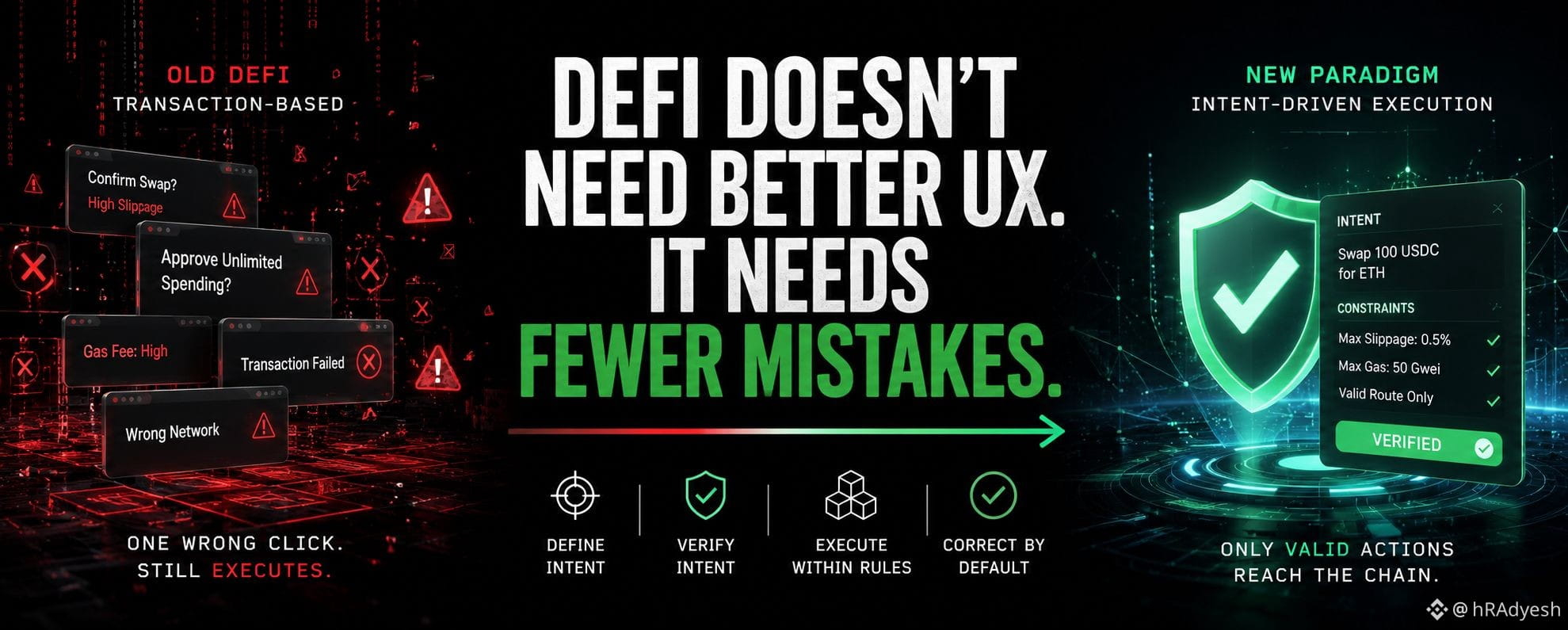
DeFi braucht keine bessere UX. Es braucht weniger Fehler.1/
Alle sagen, DeFi habe ein UX-Problem.
Das ist falsch.
DeFi hat ein Problem mit Fehltritten.
Und das kostet Nutzer mehr, als Gebühren je gekostet haben.
Klick.
Unterschreiben.
Bestätigen.
Wiederhole.
Eine falsche Aktion?
Es führt es trotzdem aus.
Kein Sicherheitsnetz.
Das ist keine UX.
Das ist Absicht im Design.
Schnellere Chains beheben das nicht.
Denn Geschwindigkeit war nie das Problem.
👉 Ausführungsqualität ist.
2/
Die unbequeme Wahrheit ist diese:
DeFi ist nicht für dich gebaut.
Es ist für diejenigen gebaut, die weniger Fehler machen als du.
Power-User gewinnen.
Bots gewinnen.
MEV-Systeme dominieren.
DeFi braucht keine bessere UX. Es braucht weniger Fehler.
1/
Alle sagen, DeFi habe ein UX-Problem.
Das ist falsch.
DeFi hat ein Problem mit Fehltritten.
Und das kostet Nutzer mehr, als Gebühren je gekostet haben.
Klick.
Unterschreiben.
Bestätigen.
Wiederhole.
Eine falsche Aktion?
Es führt es trotzdem aus.
Kein Sicherheitsnetz.
Das ist keine UX.
Das ist Absicht im Design.
Schnellere Chains beheben das nicht.
Denn Geschwindigkeit war nie das Problem.
👉 Ausführungsqualität ist.
2/
Die unbequeme Wahrheit ist diese:
DeFi ist nicht für dich gebaut.
Es ist für diejenigen gebaut, die weniger Fehler machen als du.
Power-User gewinnen.
Bots gewinnen.
MEV-Systeme dominieren.
Alle sagen, DeFi habe ein UX-Problem.
Das ist falsch.
DeFi hat ein Problem mit Fehltritten.
Und das kostet Nutzer mehr, als Gebühren je gekostet haben.
Klick.
Unterschreiben.
Bestätigen.
Wiederhole.
Eine falsche Aktion?
Es führt es trotzdem aus.
Kein Sicherheitsnetz.
Das ist keine UX.
Das ist Absicht im Design.
Schnellere Chains beheben das nicht.
Denn Geschwindigkeit war nie das Problem.
👉 Ausführungsqualität ist.
2/
Die unbequeme Wahrheit ist diese:
DeFi ist nicht für dich gebaut.
Es ist für diejenigen gebaut, die weniger Fehler machen als du.
Power-User gewinnen.
Bots gewinnen.
MEV-Systeme dominieren.
26
1
16
79
·
--
Bullisch
#newt $NEWT
Die meisten optimieren immer noch auf schnellere Transaktionen.
Diese Erzählung ist längst überholt.
Tempo war nie der eigentliche Engpass. Das eigentliche Problem ist die Ausführungsqualität. Krypto ermöglicht es dir, alles sofort zu tun – auch die falschen Dinge.
Newtons Mainnet Beta stellt diese Grundlage still und leise infrage.
Dabei geht es nicht um bessere UX oder niedrigere Gebühren. Es ist ein Wechsel von transaktionsbasierter Interaktion → hin zu ausrichtungs-/intentgesteuerter Ausführung.
Anstatt Nutzer dazu zu zwingen, jeden Schritt zu klicken, zu signieren und zu verwalten, definierst du, was du willst. Das Protokoll prüft die Intention zuerst und führt dann innerhalb vordefinierter Regeln aus.
So wandert das Vertrauen von der Benutzeroberfläche in die Protokollschicht.
Weniger ungültige Aktionen. Weniger verschwendetes Gas. Weniger Abhängigkeit von perfektem Nutzerverhalten.
{future}(NEWTUSDT)
Kontext:
Am 23. Juni 2025 wurde NEWT zum 24. Binance HODLer Airdrops-Projekt. 12,5 Mio. NEWT (1,25 % des Angebots) wurden an BNB Simple Earn- und On-Chain Yields-Nutzer verteilt (14.–17. Juni).
Es wurde mit Seed Tag über USDT-, USDC-, BNB-, FDUSD- und TRY-Paare gelistet.
Es ist immer noch früh. Aber wenn dieses Modell funktioniert, bekommt die Branche nicht nur schneller. Sie wird auch strenger darin, was überhaupt ausgeführt werden darf.
@NewtonProtocol
$NEWT
#Newt
Keine Finanzberatung. Mach deine eigenen Recherchen (DYOR).
#newt $NEWT
Die meisten optimieren immer noch auf schnellere Transaktionen.
Diese Erzählung ist längst überholt.
Tempo war nie der eigentliche Engpass. Das eigentliche Problem ist die Ausführungsqualität. Krypto ermöglicht es dir, alles sofort zu tun – auch die falschen Dinge.
Newtons Mainnet Beta stellt diese Grundlage still und leise infrage.
Dabei geht es nicht um bessere UX oder niedrigere Gebühren. Es ist ein Wechsel von transaktionsbasierter Interaktion → hin zu ausrichtungs-/intentgesteuerter Ausführung.
Anstatt Nutzer dazu zu zwingen, jeden Schritt zu klicken, zu signieren und zu verwalten, definierst du, was du willst. Das Protokoll prüft die Intention zuerst und führt dann innerhalb vordefinierter Regeln aus.
So wandert das Vertrauen von der Benutzeroberfläche in die Protokollschicht.
Weniger ungültige Aktionen. Weniger verschwendetes Gas. Weniger Abhängigkeit von perfektem Nutzerverhalten.
Kontext:
Am 23. Juni 2025 wurde NEWT zum 24. Binance HODLer Airdrops-Projekt. 12,5 Mio. NEWT (1,25 % des Angebots) wurden an BNB Simple Earn- und On-Chain Yields-Nutzer verteilt (14.–17. Juni).
Es wurde mit Seed Tag über USDT-, USDC-, BNB-, FDUSD- und TRY-Paare gelistet.
Es ist immer noch früh. Aber wenn dieses Modell funktioniert, bekommt die Branche nicht nur schneller. Sie wird auch strenger darin, was überhaupt ausgeführt werden darf.
@NewtonProtocol
$NEWT
#Newt
Keine Finanzberatung. Mach deine eigenen Recherchen (DYOR).
Die meisten optimieren immer noch auf schnellere Transaktionen.
Diese Erzählung ist längst überholt.
Tempo war nie der eigentliche Engpass. Das eigentliche Problem ist die Ausführungsqualität. Krypto ermöglicht es dir, alles sofort zu tun – auch die falschen Dinge.
Newtons Mainnet Beta stellt diese Grundlage still und leise infrage.
Dabei geht es nicht um bessere UX oder niedrigere Gebühren. Es ist ein Wechsel von transaktionsbasierter Interaktion → hin zu ausrichtungs-/intentgesteuerter Ausführung.
Anstatt Nutzer dazu zu zwingen, jeden Schritt zu klicken, zu signieren und zu verwalten, definierst du, was du willst. Das Protokoll prüft die Intention zuerst und führt dann innerhalb vordefinierter Regeln aus.
So wandert das Vertrauen von der Benutzeroberfläche in die Protokollschicht.
Weniger ungültige Aktionen. Weniger verschwendetes Gas. Weniger Abhängigkeit von perfektem Nutzerverhalten.
Kontext:
Am 23. Juni 2025 wurde NEWT zum 24. Binance HODLer Airdrops-Projekt. 12,5 Mio. NEWT (1,25 % des Angebots) wurden an BNB Simple Earn- und On-Chain Yields-Nutzer verteilt (14.–17. Juni).
Es wurde mit Seed Tag über USDT-, USDC-, BNB-, FDUSD- und TRY-Paare gelistet.
Es ist immer noch früh. Aber wenn dieses Modell funktioniert, bekommt die Branche nicht nur schneller. Sie wird auch strenger darin, was überhaupt ausgeführt werden darf.
@NewtonProtocol
$NEWT
#Newt
Keine Finanzberatung. Mach deine eigenen Recherchen (DYOR).
Pre-execut intent verification
0%
Removing manual steps
0%
Stronger risk constraints
0%
Simpler onboarding
0%
0 Stimmen • Abstimmung beendet
19
9
85
·
--
Artikel
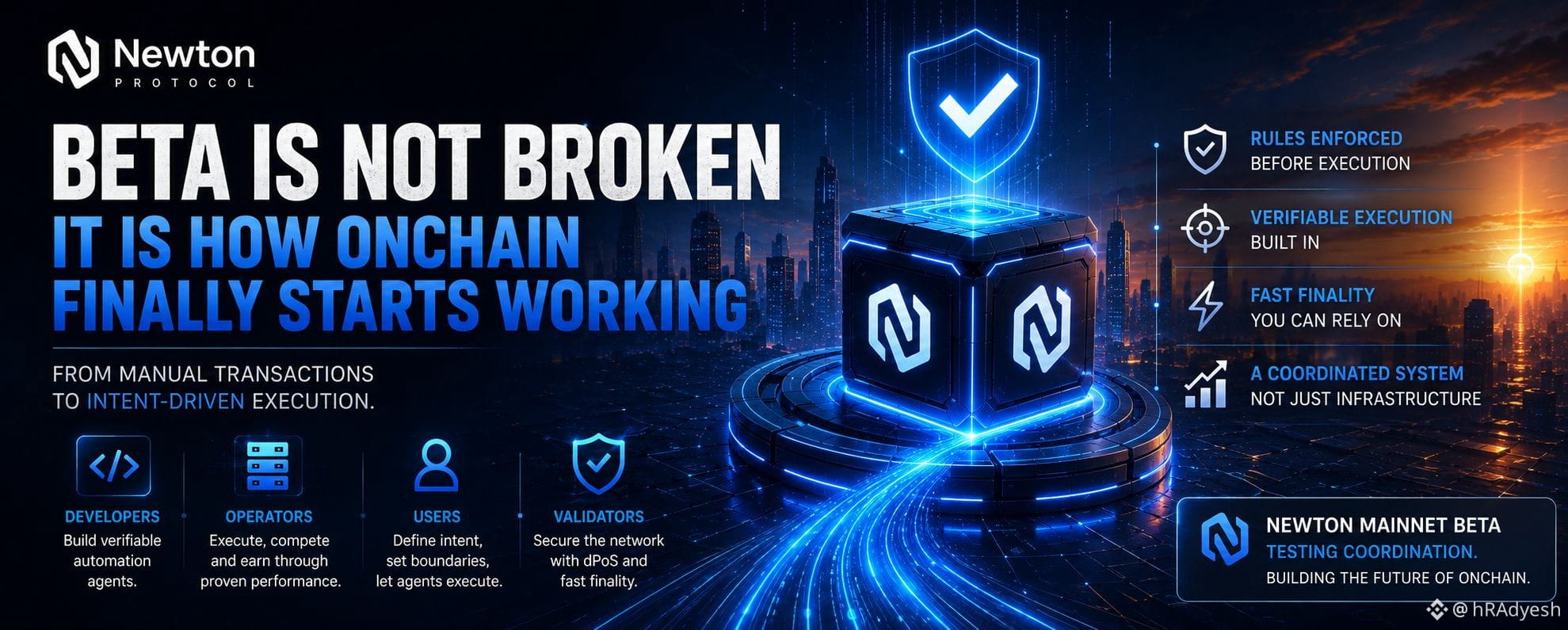
Beta ist nicht kaputt. Es ist, wie Onchain endlich anfängt zu funktionieren1/
Die meisten Menschen denken, „Beta“ bedeutet unfertig.
Diese Annahme bricht onchain.
Ich habe Newton Mainnet Beta geöffnet und Reibung erwartet.
Was ich stattdessen gefunden habe, ist etwas, das die meisten Produkte nie erreichen:
Klarheit vom ersten Klick an.
2/
Daran wurden wir gewöhnt:
Beta = Bugs + kaputte Abläufe + Geduld.
Aber was, wenn Beta nicht darum geht, Schwächen zu beheben…
Was wäre, wenn es darum ginge, zu beweisen, dass ein neues Modell funktioniert?
3/
Newton dreht das Drehbuch um.
Das ist nicht dazu da, Features zu testen.
Hier geht es darum, Intent als Infrastruktur zu testen.
4/
Hier ist der Wandel:
Beta ist nicht kaputt. Es ist, wie Onchain endlich anfängt zu funktionieren
1/
Die meisten Menschen denken, „Beta“ bedeutet unfertig.
Diese Annahme bricht onchain.
Ich habe Newton Mainnet Beta geöffnet und Reibung erwartet.
Was ich stattdessen gefunden habe, ist etwas, das die meisten Produkte nie erreichen:
Klarheit vom ersten Klick an.
2/
Daran wurden wir gewöhnt:
Beta = Bugs + kaputte Abläufe + Geduld.
Aber was, wenn Beta nicht darum geht, Schwächen zu beheben…
Was wäre, wenn es darum ginge, zu beweisen, dass ein neues Modell funktioniert?
3/
Newton dreht das Drehbuch um.
Das ist nicht dazu da, Features zu testen.
Hier geht es darum, Intent als Infrastruktur zu testen.
4/
Hier ist der Wandel:
Die meisten Menschen denken, „Beta“ bedeutet unfertig.
Diese Annahme bricht onchain.
Ich habe Newton Mainnet Beta geöffnet und Reibung erwartet.
Was ich stattdessen gefunden habe, ist etwas, das die meisten Produkte nie erreichen:
Klarheit vom ersten Klick an.
2/
Daran wurden wir gewöhnt:
Beta = Bugs + kaputte Abläufe + Geduld.
Aber was, wenn Beta nicht darum geht, Schwächen zu beheben…
Was wäre, wenn es darum ginge, zu beweisen, dass ein neues Modell funktioniert?
3/
Newton dreht das Drehbuch um.
Das ist nicht dazu da, Features zu testen.
Hier geht es darum, Intent als Infrastruktur zu testen.
4/
Hier ist der Wandel:
22
11
87
·
--
Bullisch
Verifiziert
#newt $NEWT
Ich beschäftige mich in letzter Zeit mehr mit Newton, und die Mainnet-Beta fühlt sich wie ein solider Schritt nach vorn an.
Was besonders auffällt, ist nicht nur die schnelleren Transaktionen. Es ist die Abkehr davon, alles manuell zu machen. Statt jeden Schritt selbst zu signieren, gibst du das Ergebnis an, das du möchtest, und das System ermittelt, wie es dorthin kommt – dann weist es nach, dass es tatsächlich on-chain passiert ist.
Das ist der Kern des intent-basierten Execution. Weniger Klicken, mehr Festlegen. Und mit der live geschalteten Beta kannst du tatsächlich anfangen zu sehen, wie On-Chain-Automation aussieht, wenn sie auf Koordination und Verifikation ausgelegt ist – nicht nur auf Tempo.
Es ist immer noch früh. Aber die Richtung ist klar: Finanzen, die auf einer erklärten Intention laufen – mit Belegen, die du danach prüfen kannst.
Wenn sie es noch einfacher machen, eröffnet das viele Möglichkeiten dafür, wie Menschen und Agenten tatsächlich on-chain miteinander interagieren.
{future}(NEWTUSDT)
@NewtonProtocol
$NEWT
#Newt
Wo würdest du sagen, hilft intent-basiertes Execution zuerst?
#newt $NEWT
Ich beschäftige mich in letzter Zeit mehr mit Newton, und die Mainnet-Beta fühlt sich wie ein solider Schritt nach vorn an.
Was besonders auffällt, ist nicht nur die schnelleren Transaktionen. Es ist die Abkehr davon, alles manuell zu machen. Statt jeden Schritt selbst zu signieren, gibst du das Ergebnis an, das du möchtest, und das System ermittelt, wie es dorthin kommt – dann weist es nach, dass es tatsächlich on-chain passiert ist.
Das ist der Kern des intent-basierten Execution. Weniger Klicken, mehr Festlegen. Und mit der live geschalteten Beta kannst du tatsächlich anfangen zu sehen, wie On-Chain-Automation aussieht, wenn sie auf Koordination und Verifikation ausgelegt ist – nicht nur auf Tempo.
Es ist immer noch früh. Aber die Richtung ist klar: Finanzen, die auf einer erklärten Intention laufen – mit Belegen, die du danach prüfen kannst.
Wenn sie es noch einfacher machen, eröffnet das viele Möglichkeiten dafür, wie Menschen und Agenten tatsächlich on-chain miteinander interagieren.
@NewtonProtocol
$NEWT
#Newt
Wo würdest du sagen, hilft intent-basiertes Execution zuerst?
Ich beschäftige mich in letzter Zeit mehr mit Newton, und die Mainnet-Beta fühlt sich wie ein solider Schritt nach vorn an.
Was besonders auffällt, ist nicht nur die schnelleren Transaktionen. Es ist die Abkehr davon, alles manuell zu machen. Statt jeden Schritt selbst zu signieren, gibst du das Ergebnis an, das du möchtest, und das System ermittelt, wie es dorthin kommt – dann weist es nach, dass es tatsächlich on-chain passiert ist.
Das ist der Kern des intent-basierten Execution. Weniger Klicken, mehr Festlegen. Und mit der live geschalteten Beta kannst du tatsächlich anfangen zu sehen, wie On-Chain-Automation aussieht, wenn sie auf Koordination und Verifikation ausgelegt ist – nicht nur auf Tempo.
Es ist immer noch früh. Aber die Richtung ist klar: Finanzen, die auf einer erklärten Intention laufen – mit Belegen, die du danach prüfen kannst.
Wenn sie es noch einfacher machen, eröffnet das viele Möglichkeiten dafür, wie Menschen und Agenten tatsächlich on-chain miteinander interagieren.
@NewtonProtocol
$NEWT
#Newt
Wo würdest du sagen, hilft intent-basiertes Execution zuerst?
DeFi operations
0%
Payments and subscriptions
0%
Agent coordination
0%
Auditing and compliance
0%
0 Stimmen • Abstimmung beendet
28
11
109
·
--
Artikel
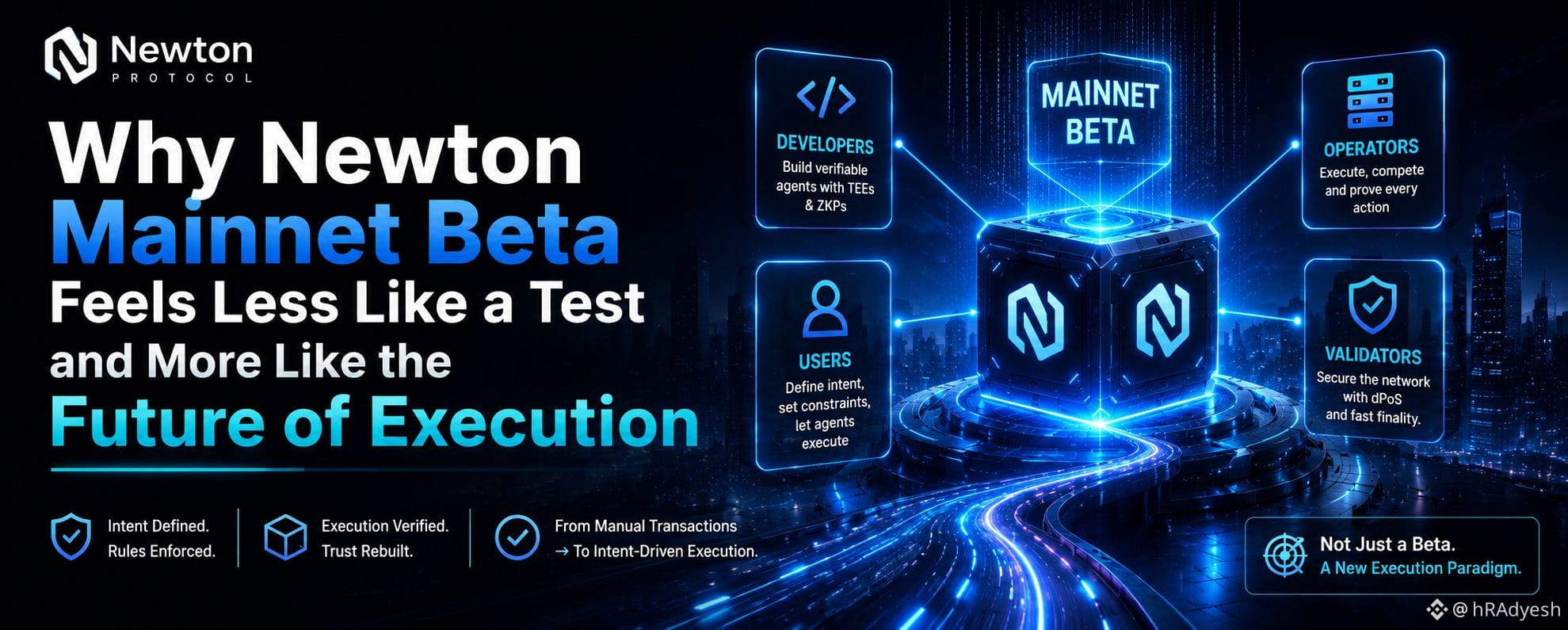
Warum sich das Newton Mainnet Beta weniger wie ein Test anfühlt und mehr wie die Zukunft der AusführungFrüher dachte ich, eine Beta-Veröffentlichung bedeute etwas Bestimmtes. Etwas Unfertiges. Etwas, das man ausprobiert, dem man aber noch nicht wirklich vertraut.
Als ich um 4:30 Uhr aufwachte und NEWT überprüfte, kam diese Annahme für einen Moment zurück. Doch nachdem ich Zeit damit verbracht hatte, das Newton-Protokoll zu lesen und das Mainnet Beta zu beobachten, begann diese Sichtweise veraltet zu wirken.
Das fühlt sich nicht nach einem frühen Produkt an, das Leistung beweisen will. Es fühlt sich an wie ein System, das ganz bewusst entwickelt wurde, um die Koordination unter Einschränkungen zu testen.
Dieser Perspektivwechsel verändert, wie die gesamte Architektur wirkt.
Warum sich das Newton Mainnet Beta weniger wie ein Test anfühlt und mehr wie die Zukunft der Ausführung
Früher dachte ich, eine Beta-Veröffentlichung bedeute etwas Bestimmtes. Etwas Unfertiges. Etwas, das man ausprobiert, dem man aber noch nicht wirklich vertraut.
Als ich um 4:30 Uhr aufwachte und NEWT überprüfte, kam diese Annahme für einen Moment zurück. Doch nachdem ich Zeit damit verbracht hatte, das Newton-Protokoll zu lesen und das Mainnet Beta zu beobachten, begann diese Sichtweise veraltet zu wirken.
Das fühlt sich nicht nach einem frühen Produkt an, das Leistung beweisen will. Es fühlt sich an wie ein System, das ganz bewusst entwickelt wurde, um die Koordination unter Einschränkungen zu testen.
Dieser Perspektivwechsel verändert, wie die gesamte Architektur wirkt.
Als ich um 4:30 Uhr aufwachte und NEWT überprüfte, kam diese Annahme für einen Moment zurück. Doch nachdem ich Zeit damit verbracht hatte, das Newton-Protokoll zu lesen und das Mainnet Beta zu beobachten, begann diese Sichtweise veraltet zu wirken.
Das fühlt sich nicht nach einem frühen Produkt an, das Leistung beweisen will. Es fühlt sich an wie ein System, das ganz bewusst entwickelt wurde, um die Koordination unter Einschränkungen zu testen.
Dieser Perspektivwechsel verändert, wie die gesamte Architektur wirkt.
19
12
87
·
--
Bullisch
#newt $NEWT
Ich habe in letzter Zeit öfter von Newton gelesen, und das Mainnet Beta fühlt sich wie ein bedeutender Schritt nach vorn an. Es wirkt nicht wie eine typische frühe Version, sondern eher wie ein System, das testet, wie die Koordination in der Praxis wirklich funktioniert.
Besonders auffällig ist, wie Newton die Ausführung neu denkt. Anstatt dass Nutzer jede Transaktion manuell auslösen, geht es hin zu automatisierter Ausführung auf Basis von Intentionen: Ergebnisse werden im Voraus definiert und vor dem Settlement durchgesetzt.
Das Protokoll basiert auf vier Teilnehmern:
Entwickler erstellen verifizierbare Agenten mit TEEs & ZKPs
Operatoren führen Aufgaben aus und konkurrieren anhand nachgewiesener Leistung
Nutzer definieren Intention statt Aktionen
Validatoren sichern alles mit dPoS und schneller Finalität
{spot}(NEWTUSDT)
Es fühlt sich an wie ein Wechsel von Vertrauen auf Interface-Ebene → Durchsetzung auf Protokoll-Ebene.
Stablecoins sind vielleicht die Schienen des Internets, aber Newton versucht, die Logik darunter neu aufzubauen: Dort, wo Regeln durchgesetzt werden, bevor überhaupt etwas in Bewegung kommt.
Es ist immer noch früh, aber die Richtung ist klar:
👉 Von manuellen Transaktionen → hin zu intent-gesteuerter Ausführung
Bin gespannt, wie sich das entwickelt, wenn das Zusammenspiel der Teilnehmer anfängt, einen Fliehkrafteffekt (Flywheel) aufzubauen.
@NewtonProtocol
$NEWT
#Newt
Umfrage: Was ist für die Zukunft des On-Chain-Finanzwesens am wichtigsten?
#newt $NEWT
Ich habe in letzter Zeit öfter von Newton gelesen, und das Mainnet Beta fühlt sich wie ein bedeutender Schritt nach vorn an. Es wirkt nicht wie eine typische frühe Version, sondern eher wie ein System, das testet, wie die Koordination in der Praxis wirklich funktioniert.
Besonders auffällig ist, wie Newton die Ausführung neu denkt. Anstatt dass Nutzer jede Transaktion manuell auslösen, geht es hin zu automatisierter Ausführung auf Basis von Intentionen: Ergebnisse werden im Voraus definiert und vor dem Settlement durchgesetzt.
Das Protokoll basiert auf vier Teilnehmern:
Entwickler erstellen verifizierbare Agenten mit TEEs & ZKPs
Operatoren führen Aufgaben aus und konkurrieren anhand nachgewiesener Leistung
Nutzer definieren Intention statt Aktionen
Validatoren sichern alles mit dPoS und schneller Finalität
Es fühlt sich an wie ein Wechsel von Vertrauen auf Interface-Ebene → Durchsetzung auf Protokoll-Ebene.
Stablecoins sind vielleicht die Schienen des Internets, aber Newton versucht, die Logik darunter neu aufzubauen: Dort, wo Regeln durchgesetzt werden, bevor überhaupt etwas in Bewegung kommt.
Es ist immer noch früh, aber die Richtung ist klar:
👉 Von manuellen Transaktionen → hin zu intent-gesteuerter Ausführung
Bin gespannt, wie sich das entwickelt, wenn das Zusammenspiel der Teilnehmer anfängt, einen Fliehkrafteffekt (Flywheel) aufzubauen.
@NewtonProtocol
$NEWT
#Newt
Umfrage: Was ist für die Zukunft des On-Chain-Finanzwesens am wichtigsten?
Ich habe in letzter Zeit öfter von Newton gelesen, und das Mainnet Beta fühlt sich wie ein bedeutender Schritt nach vorn an. Es wirkt nicht wie eine typische frühe Version, sondern eher wie ein System, das testet, wie die Koordination in der Praxis wirklich funktioniert.
Besonders auffällig ist, wie Newton die Ausführung neu denkt. Anstatt dass Nutzer jede Transaktion manuell auslösen, geht es hin zu automatisierter Ausführung auf Basis von Intentionen: Ergebnisse werden im Voraus definiert und vor dem Settlement durchgesetzt.
Das Protokoll basiert auf vier Teilnehmern:
Entwickler erstellen verifizierbare Agenten mit TEEs & ZKPs
Operatoren führen Aufgaben aus und konkurrieren anhand nachgewiesener Leistung
Nutzer definieren Intention statt Aktionen
Validatoren sichern alles mit dPoS und schneller Finalität
Es fühlt sich an wie ein Wechsel von Vertrauen auf Interface-Ebene → Durchsetzung auf Protokoll-Ebene.
Stablecoins sind vielleicht die Schienen des Internets, aber Newton versucht, die Logik darunter neu aufzubauen: Dort, wo Regeln durchgesetzt werden, bevor überhaupt etwas in Bewegung kommt.
Es ist immer noch früh, aber die Richtung ist klar:
👉 Von manuellen Transaktionen → hin zu intent-gesteuerter Ausführung
Bin gespannt, wie sich das entwickelt, wenn das Zusammenspiel der Teilnehmer anfängt, einen Fliehkrafteffekt (Flywheel) aufzubauen.
@NewtonProtocol
$NEWT
#Newt
Umfrage: Was ist für die Zukunft des On-Chain-Finanzwesens am wichtigsten?
Verifiable execution
53%
Faster transactions
27%
Better UX
20%
Decentralization
0%
15 Stimmen • Abstimmung beendet
35
1
15
92
·
--
Artikel
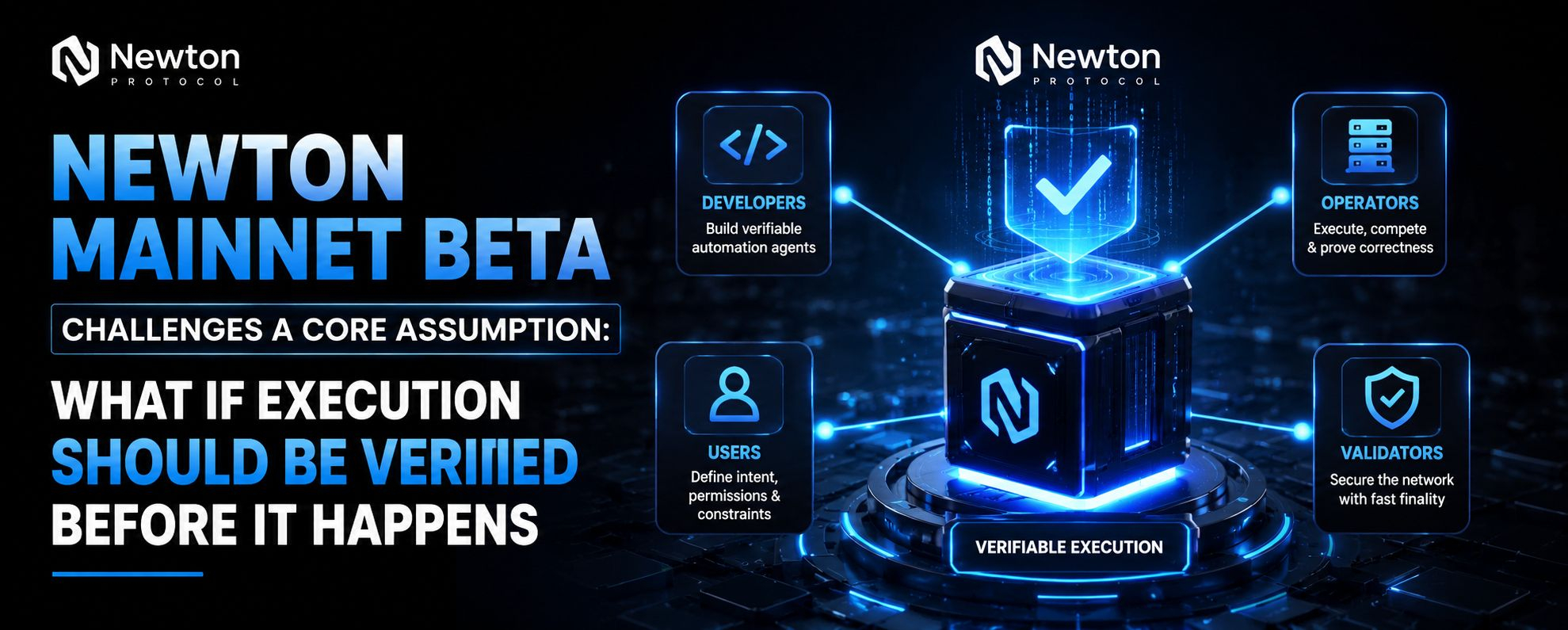
🚀 Newton Mainnet Beta stellt eine zentrale Annahme infrage: Was wäre, wenn die Ausführung verifiziert werden sollte, bevor sieIch verbinde Beta-Preleases normalerweise mit etwas Unfertigem.
Eine Phase, in der Systeme noch getestet werden, die Kanten noch rau sind und die Zuverlässigkeit noch nicht vollständig gegeben ist.
Aber nachdem ich Zeit mit dem Whitepaper des Newton Protocol verbracht und das Newton Mainnet Beta beobachtet habe, beginnt sich diese Annahme zunehmend als begrenzt anzufühlen.
Das wirkt nicht unvollständig.
Es wirkt bewusst eingeschränkt – wie eine Umgebung, die darauf ausgelegt ist, die Koordination zu testen, nicht nur die Leistung.
Der Wandel ist subtil, aber wichtig.
Newton ist nicht darauf aus, Transaktionen schneller zu machen.
🚀 Newton Mainnet Beta stellt eine zentrale Annahme infrage: Was wäre, wenn die Ausführung verifiziert werden sollte, bevor sie
Ich verbinde Beta-Preleases normalerweise mit etwas Unfertigem.
Eine Phase, in der Systeme noch getestet werden, die Kanten noch rau sind und die Zuverlässigkeit noch nicht vollständig gegeben ist.
Aber nachdem ich Zeit mit dem Whitepaper des Newton Protocol verbracht und das Newton Mainnet Beta beobachtet habe, beginnt sich diese Annahme zunehmend als begrenzt anzufühlen.
Das wirkt nicht unvollständig.
Es wirkt bewusst eingeschränkt – wie eine Umgebung, die darauf ausgelegt ist, die Koordination zu testen, nicht nur die Leistung.
Der Wandel ist subtil, aber wichtig.
Newton ist nicht darauf aus, Transaktionen schneller zu machen.
Eine Phase, in der Systeme noch getestet werden, die Kanten noch rau sind und die Zuverlässigkeit noch nicht vollständig gegeben ist.
Aber nachdem ich Zeit mit dem Whitepaper des Newton Protocol verbracht und das Newton Mainnet Beta beobachtet habe, beginnt sich diese Annahme zunehmend als begrenzt anzufühlen.
Das wirkt nicht unvollständig.
Es wirkt bewusst eingeschränkt – wie eine Umgebung, die darauf ausgelegt ist, die Koordination zu testen, nicht nur die Leistung.
Der Wandel ist subtil, aber wichtig.
Newton ist nicht darauf aus, Transaktionen schneller zu machen.
42
1
19
111
·
--
Bullisch
#newt $NEWT
Ich dachte früher, dass die meisten Blockchain-Updates vor allem um Geschwindigkeit gehen. Schnellere Ausführung, niedrigere Gebühren, ein reibungsloseres UX.
Doch wenn man tiefer in das Newton Protocol eintaucht und das Newton Mainnet Beta beobachtet, wirkt die Veränderung anders. Es geht nicht nur darum, wie Transaktionen ablaufen—es geht darum, wer überhaupt an der Ausführung teilnimmt, neu zu definieren.
Newton bringt ein koordiniertes System aus Entwicklern, Operatoren, Nutzern und Validatoren. Entwickler verwandeln Logik in überprüfbare Agents. Operatoren wetteifern darum, Aufgaben auszuführen, müssen aber Korrektheit nachweisen—nicht nur Ergebnisse liefern. Nutzer handeln nicht manuell—sie definieren Absicht, Berechtigungen und Einschränkungen. Validatoren sichern alles mit schneller Finalität.
Diese Struktur verändert den Ablauf komplett.
Anstatt dass Nutzer jede Aktion auslösen, wird die Ausführung absichtsgesteuert. Aufgaben werden eingereicht, erfüllt, verifiziert und aufgezeichnet—ohne sich auf blindes Vertrauen zu stützen. Operatoren bauen sich ihren Ruf über Zeit auf—nicht durch Marketing, sondern durch nachweisbare Leistung.
Das Newton Mainnet Beta fühlt sich wie eine frühe Version dieses Modells in Bewegung an. Es wird noch weiterentwickelt, aber die Richtung ist klar.
On-Chain-Finanzwesen könnte sich von manueller Interaktion hin zu verifizierbaren Automatisierungs-Ebenen bewegen.
Keine Finanzberatung. DYOR.
@NewtonProtocol
$NEWT
#Newt
Umfrage:
Was ist in automatisierten On-Chain-Systemen am wichtigsten?
#newt $NEWT
Ich dachte früher, dass die meisten Blockchain-Updates vor allem um Geschwindigkeit gehen. Schnellere Ausführung, niedrigere Gebühren, ein reibungsloseres UX.
Doch wenn man tiefer in das Newton Protocol eintaucht und das Newton Mainnet Beta beobachtet, wirkt die Veränderung anders. Es geht nicht nur darum, wie Transaktionen ablaufen—es geht darum, wer überhaupt an der Ausführung teilnimmt, neu zu definieren.
Newton bringt ein koordiniertes System aus Entwicklern, Operatoren, Nutzern und Validatoren. Entwickler verwandeln Logik in überprüfbare Agents. Operatoren wetteifern darum, Aufgaben auszuführen, müssen aber Korrektheit nachweisen—nicht nur Ergebnisse liefern. Nutzer handeln nicht manuell—sie definieren Absicht, Berechtigungen und Einschränkungen. Validatoren sichern alles mit schneller Finalität.
Diese Struktur verändert den Ablauf komplett.
Anstatt dass Nutzer jede Aktion auslösen, wird die Ausführung absichtsgesteuert. Aufgaben werden eingereicht, erfüllt, verifiziert und aufgezeichnet—ohne sich auf blindes Vertrauen zu stützen. Operatoren bauen sich ihren Ruf über Zeit auf—nicht durch Marketing, sondern durch nachweisbare Leistung.
Das Newton Mainnet Beta fühlt sich wie eine frühe Version dieses Modells in Bewegung an. Es wird noch weiterentwickelt, aber die Richtung ist klar.
On-Chain-Finanzwesen könnte sich von manueller Interaktion hin zu verifizierbaren Automatisierungs-Ebenen bewegen.
Keine Finanzberatung. DYOR.
@NewtonProtocol
$NEWT
#Newt
Umfrage:
Was ist in automatisierten On-Chain-Systemen am wichtigsten?
Ich dachte früher, dass die meisten Blockchain-Updates vor allem um Geschwindigkeit gehen. Schnellere Ausführung, niedrigere Gebühren, ein reibungsloseres UX.
Doch wenn man tiefer in das Newton Protocol eintaucht und das Newton Mainnet Beta beobachtet, wirkt die Veränderung anders. Es geht nicht nur darum, wie Transaktionen ablaufen—es geht darum, wer überhaupt an der Ausführung teilnimmt, neu zu definieren.
Newton bringt ein koordiniertes System aus Entwicklern, Operatoren, Nutzern und Validatoren. Entwickler verwandeln Logik in überprüfbare Agents. Operatoren wetteifern darum, Aufgaben auszuführen, müssen aber Korrektheit nachweisen—nicht nur Ergebnisse liefern. Nutzer handeln nicht manuell—sie definieren Absicht, Berechtigungen und Einschränkungen. Validatoren sichern alles mit schneller Finalität.
Diese Struktur verändert den Ablauf komplett.
Anstatt dass Nutzer jede Aktion auslösen, wird die Ausführung absichtsgesteuert. Aufgaben werden eingereicht, erfüllt, verifiziert und aufgezeichnet—ohne sich auf blindes Vertrauen zu stützen. Operatoren bauen sich ihren Ruf über Zeit auf—nicht durch Marketing, sondern durch nachweisbare Leistung.
Das Newton Mainnet Beta fühlt sich wie eine frühe Version dieses Modells in Bewegung an. Es wird noch weiterentwickelt, aber die Richtung ist klar.
On-Chain-Finanzwesen könnte sich von manueller Interaktion hin zu verifizierbaren Automatisierungs-Ebenen bewegen.
Keine Finanzberatung. DYOR.
@NewtonProtocol
$NEWT
#Newt
Umfrage:
Was ist in automatisierten On-Chain-Systemen am wichtigsten?
Execution speed
0%
Verifiable correctness
67%
Operator reputation
0%
User-defined constraints
33%
3 Stimmen • Abstimmung beendet
39
13
110
·
--
Artikel
Früher dachte ich, dass schneller besser ist – bis Newton mich dazu brachte, in Frage zu stellen, was überhaupt ausgeführt werden sollteFrüher dachte ich, dass der größte Fortschritt in Krypto daher kommt, Reibung zu reduzieren.
Weniger Schritte. Schnellere Ausführung. Weniger Warten.
Das schien die Richtung zu sein, in die sich alles zu bewegen schien.
Wenn ein System schneller war, galt es als besser.
---
Aber in letzter Zeit, nachdem ich Zeit damit verbracht hatte, über @NewtonProtocol zu lesen und genauer auf das Newton Mainnet Beta zu schauen, begann diese Annahme sich unvollständig anzufühlen.
Nicht falsch.
Es fehlt nur etwas Wichtiges.
---
Denn Geschwindigkeit funktioniert nur, wenn das System bereits weiß, was als Erstes passieren soll.
---
Früher dachte ich, dass schneller besser ist – bis Newton mich dazu brachte, in Frage zu stellen, was überhaupt ausgeführt werden sollte
Früher dachte ich, dass der größte Fortschritt in Krypto daher kommt, Reibung zu reduzieren.
Weniger Schritte. Schnellere Ausführung. Weniger Warten.
Das schien die Richtung zu sein, in die sich alles zu bewegen schien.
Wenn ein System schneller war, galt es als besser.
---
Aber in letzter Zeit, nachdem ich Zeit damit verbracht hatte, über @NewtonProtocol zu lesen und genauer auf das Newton Mainnet Beta zu schauen, begann diese Annahme sich unvollständig anzufühlen.
Nicht falsch.
Es fehlt nur etwas Wichtiges.
---
Denn Geschwindigkeit funktioniert nur, wenn das System bereits weiß, was als Erstes passieren soll.
---
Weniger Schritte. Schnellere Ausführung. Weniger Warten.
Das schien die Richtung zu sein, in die sich alles zu bewegen schien.
Wenn ein System schneller war, galt es als besser.
---
Aber in letzter Zeit, nachdem ich Zeit damit verbracht hatte, über @NewtonProtocol zu lesen und genauer auf das Newton Mainnet Beta zu schauen, begann diese Annahme sich unvollständig anzufühlen.
Nicht falsch.
Es fehlt nur etwas Wichtiges.
---
Denn Geschwindigkeit funktioniert nur, wenn das System bereits weiß, was als Erstes passieren soll.
---
25
14
96
·
--
#newt $NEWT
Ich habe in letzter Zeit viel über Newton gehört; seine Mainnet-Beta fühlt sich wie ein stilles Meilenstein an, der sich mit der Zeit als bedeutsam erweisen könnte.
{spot}(NEWTUSDT)
Ich habe in letzter Zeit mehr Gespräche über Newton bemerkt, und die Mainnet-Beta fühlt sich wie eine dieser stillen Veränderungen an, die im Laufe der Zeit vielleicht noch mehr Bedeutung erlangt.
Was mir an dem Whitepaper auffällt, ist der Schritt von manuellen Transaktionen → einer intent-basierten Ausführung.
Anstatt dass Nutzer jeden Schritt selbst übernehmen, konzentriert sich das System darauf, was du erreichen willst, und bewertet es dann anhand vordefinierter Richtlinien und führt es aus. Diese kleine Verschiebung verändert, wie wir über die Interaktion mit On-Chain-Systemen nachdenken.
Die Newton-Mainnet-Beta scheint diese Richtung widerzuspiegeln. Es geht nicht nur um schnellere Ausführung, sondern um eine strukturierte Entscheidungsfindung vor der Ausführung. Wenn dieses Modell Bestand hat, könnte es unnötiges Risiko reduzieren und Automatisierung für alltägliche Nutzer deutlich praktikabler machen.
Natürlich ist es noch früh. Aber es fühlt sich tatsächlich wie ein Schritt hin dazu an, On-Chain-Finanzierungen weniger reaktiv und stärker auf Absichten ausgerichtet zu machen.
Wenn sie vereinfachen können, wie Nutzer diese „Intents“ definieren und ihnen vertrauen, könnte das die Hürde für eine breitere Akzeptanz senken.
Bin gespannt, wie sich das entwickelt, wenn es von mehr Menschen in echten Szenarien genutzt wird.
@NewtonProtocol
$NEWT
#Newt
🗳️ Umfrage
Was ist für die Zukunft des On-Chain-Finanzwesens wichtiger?
#newt $NEWT
Ich habe in letzter Zeit viel über Newton gehört; seine Mainnet-Beta fühlt sich wie ein stilles Meilenstein an, der sich mit der Zeit als bedeutsam erweisen könnte.
Ich habe in letzter Zeit mehr Gespräche über Newton bemerkt, und die Mainnet-Beta fühlt sich wie eine dieser stillen Veränderungen an, die im Laufe der Zeit vielleicht noch mehr Bedeutung erlangt.
Was mir an dem Whitepaper auffällt, ist der Schritt von manuellen Transaktionen → einer intent-basierten Ausführung.
Anstatt dass Nutzer jeden Schritt selbst übernehmen, konzentriert sich das System darauf, was du erreichen willst, und bewertet es dann anhand vordefinierter Richtlinien und führt es aus. Diese kleine Verschiebung verändert, wie wir über die Interaktion mit On-Chain-Systemen nachdenken.
Die Newton-Mainnet-Beta scheint diese Richtung widerzuspiegeln. Es geht nicht nur um schnellere Ausführung, sondern um eine strukturierte Entscheidungsfindung vor der Ausführung. Wenn dieses Modell Bestand hat, könnte es unnötiges Risiko reduzieren und Automatisierung für alltägliche Nutzer deutlich praktikabler machen.
Natürlich ist es noch früh. Aber es fühlt sich tatsächlich wie ein Schritt hin dazu an, On-Chain-Finanzierungen weniger reaktiv und stärker auf Absichten ausgerichtet zu machen.
Wenn sie vereinfachen können, wie Nutzer diese „Intents“ definieren und ihnen vertrauen, könnte das die Hürde für eine breitere Akzeptanz senken.
Bin gespannt, wie sich das entwickelt, wenn es von mehr Menschen in echten Szenarien genutzt wird.
@NewtonProtocol
$NEWT
#Newt
🗳️ Umfrage
Was ist für die Zukunft des On-Chain-Finanzwesens wichtiger?
Ich habe in letzter Zeit viel über Newton gehört; seine Mainnet-Beta fühlt sich wie ein stilles Meilenstein an, der sich mit der Zeit als bedeutsam erweisen könnte.
Ich habe in letzter Zeit mehr Gespräche über Newton bemerkt, und die Mainnet-Beta fühlt sich wie eine dieser stillen Veränderungen an, die im Laufe der Zeit vielleicht noch mehr Bedeutung erlangt.
Was mir an dem Whitepaper auffällt, ist der Schritt von manuellen Transaktionen → einer intent-basierten Ausführung.
Anstatt dass Nutzer jeden Schritt selbst übernehmen, konzentriert sich das System darauf, was du erreichen willst, und bewertet es dann anhand vordefinierter Richtlinien und führt es aus. Diese kleine Verschiebung verändert, wie wir über die Interaktion mit On-Chain-Systemen nachdenken.
Die Newton-Mainnet-Beta scheint diese Richtung widerzuspiegeln. Es geht nicht nur um schnellere Ausführung, sondern um eine strukturierte Entscheidungsfindung vor der Ausführung. Wenn dieses Modell Bestand hat, könnte es unnötiges Risiko reduzieren und Automatisierung für alltägliche Nutzer deutlich praktikabler machen.
Natürlich ist es noch früh. Aber es fühlt sich tatsächlich wie ein Schritt hin dazu an, On-Chain-Finanzierungen weniger reaktiv und stärker auf Absichten ausgerichtet zu machen.
Wenn sie vereinfachen können, wie Nutzer diese „Intents“ definieren und ihnen vertrauen, könnte das die Hürde für eine breitere Akzeptanz senken.
Bin gespannt, wie sich das entwickelt, wenn es von mehr Menschen in echten Szenarien genutzt wird.
@NewtonProtocol
$NEWT
#Newt
🗳️ Umfrage
Was ist für die Zukunft des On-Chain-Finanzwesens wichtiger?
Faster execution
80%
Lower fees
20%
Intent-based automation
0%
5 Stimmen • Abstimmung beendet
42
16
92
·
--
Artikel
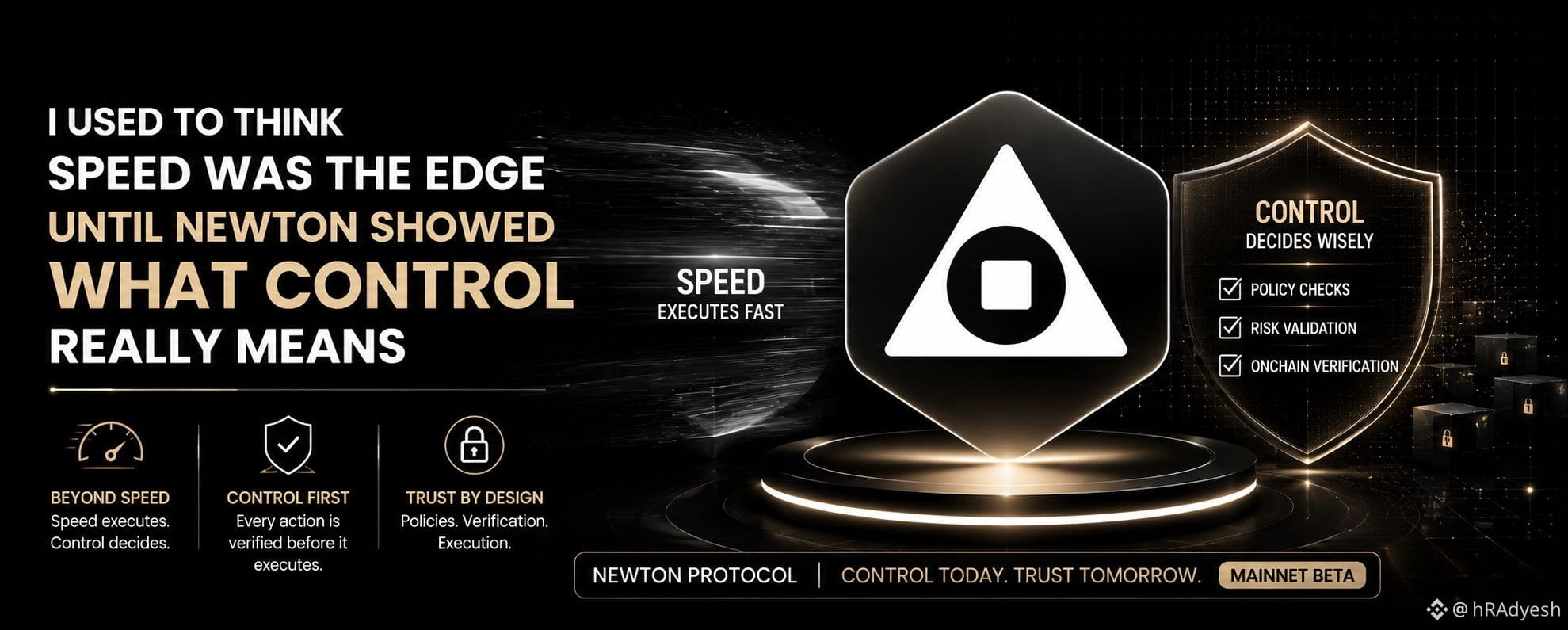
🚨 Früher Dachte Ich, Tempo Sei Der Vorsprung… Bis Newton Zeigte, Was Kontrolle Wirklich BedeutetFrüher Dachte Ich, Fortschritt In Krypto Bedeutet Etwas Bestimmtes:
Weniger Reibung. Mehr Tempo. Schnellere Ausführung.
Wenn Ein System Schneller Agieren Kann…
Es War Automatisch Besser.
Aber Diese Annahme Begann Zu Wanken 👇
Hier Beginnt Die Idee Von Kontrolle, Alles Zu Verändern ↓
Nachdem ich Zeit Verbrachte Mit @NewtonProtocol Und Das Newton Mainnet Beta Erkundete…
Mir Ist Etwas Wichtiges Klar Geworden:
👉 Geschwindigkeit Allein Reicht Nicht
👉 Ausführung Ohne Kontext Ist Risiko
🧠 Das Missverstandene „Beta“
Die Meisten Denken:
Beta = Unfertiges Produkt
🚨 Früher Dachte Ich, Tempo Sei Der Vorsprung… Bis Newton Zeigte, Was Kontrolle Wirklich Bedeutet
Früher Dachte Ich, Fortschritt In Krypto Bedeutet Etwas Bestimmtes:
Weniger Reibung. Mehr Tempo. Schnellere Ausführung.
Wenn Ein System Schneller Agieren Kann…
Es War Automatisch Besser.
Aber Diese Annahme Begann Zu Wanken 👇
Hier Beginnt Die Idee Von Kontrolle, Alles Zu Verändern ↓
Nachdem ich Zeit Verbrachte Mit @NewtonProtocol Und Das Newton Mainnet Beta Erkundete…
Mir Ist Etwas Wichtiges Klar Geworden:
👉 Geschwindigkeit Allein Reicht Nicht
👉 Ausführung Ohne Kontext Ist Risiko
🧠 Das Missverstandene „Beta“
Die Meisten Denken:
Beta = Unfertiges Produkt
Weniger Reibung. Mehr Tempo. Schnellere Ausführung.
Wenn Ein System Schneller Agieren Kann…
Es War Automatisch Besser.
Aber Diese Annahme Begann Zu Wanken 👇
Hier Beginnt Die Idee Von Kontrolle, Alles Zu Verändern ↓
Nachdem ich Zeit Verbrachte Mit @NewtonProtocol Und Das Newton Mainnet Beta Erkundete…
Mir Ist Etwas Wichtiges Klar Geworden:
👉 Geschwindigkeit Allein Reicht Nicht
👉 Ausführung Ohne Kontext Ist Risiko
🧠 Das Missverstandene „Beta“
Die Meisten Denken:
Beta = Unfertiges Produkt
40
18
90
·
--
#newt $NEWT
Ich dachte früher, dass die meiste Fortschritt in Krypto darin besteht, Reibung zu reduzieren. Weniger Klicks, schnellere Ausführung, weniger Warten. Aber nachdem ich das Whitepaper des Newton Protocol gelesen hatte, musste ich diese Annahme hinterfragen. Reibung zu entfernen ist sinnvoll – aber nur, wenn das System überhaupt weiß, was als Nächstes passieren soll.
Was im Newton Mainnet Beta besonders auffällt, ist der Wechsel von manuellen Transaktionen hin zu intent-gesteuerter Ausführung. Anstatt dass Nutzer Transaktionen direkt On-Chain einreichen, definieren sie eine Absicht. Diese Absicht wird dann anhand von Richtlinien bewertet, bevor irgendetwas ausgeführt wird. Dadurch ändert sich die Rolle des Nutzers vom Bediener hin zum Entscheidungsträger.
{spot}(NEWTUSDT)
Das Design trennt Absicht, Validierung und Ausführung in klar getrennte Schritte. Offchain-Akteure prüfen, ob eine Aktion definierte Regeln erfüllt, wie etwa Risikolimits oder Compliance-Checks. Diese Ergebnisse werden anschließend On-Chain verifiziert, bevor es zur Abwicklung kommt. Diese Struktur macht die Autorisierung explizit – statt sie einfach anzunehmen.
Es fühlt sich immer noch nach früh an, aber die Richtung wird zunehmend klarer. Während Systeme sich in Richtung Automatisierung bewegen, insbesondere mit KI-Agenten, lautet die Frage nicht nur, wie schnell Aktionen ausgeführt werden können. Sondern ob diese Aktionen überhaupt erlaubt sein sollten.
Newton scheint sich genau auf diese Ebene der Kontrolle zu konzentrieren. Es geht nicht darum, die Ausführung zu ersetzen, sondern sie zu gestalten, bevor sie überhaupt passiert.
@NewtonProtocol
$NEWT
#Newt
Was wird wichtiger, wenn DeFi sich zu intent-basierten Systemen bewegt?
#newt $NEWT
Ich dachte früher, dass die meiste Fortschritt in Krypto darin besteht, Reibung zu reduzieren. Weniger Klicks, schnellere Ausführung, weniger Warten. Aber nachdem ich das Whitepaper des Newton Protocol gelesen hatte, musste ich diese Annahme hinterfragen. Reibung zu entfernen ist sinnvoll – aber nur, wenn das System überhaupt weiß, was als Nächstes passieren soll.
Was im Newton Mainnet Beta besonders auffällt, ist der Wechsel von manuellen Transaktionen hin zu intent-gesteuerter Ausführung. Anstatt dass Nutzer Transaktionen direkt On-Chain einreichen, definieren sie eine Absicht. Diese Absicht wird dann anhand von Richtlinien bewertet, bevor irgendetwas ausgeführt wird. Dadurch ändert sich die Rolle des Nutzers vom Bediener hin zum Entscheidungsträger.
Das Design trennt Absicht, Validierung und Ausführung in klar getrennte Schritte. Offchain-Akteure prüfen, ob eine Aktion definierte Regeln erfüllt, wie etwa Risikolimits oder Compliance-Checks. Diese Ergebnisse werden anschließend On-Chain verifiziert, bevor es zur Abwicklung kommt. Diese Struktur macht die Autorisierung explizit – statt sie einfach anzunehmen.
Es fühlt sich immer noch nach früh an, aber die Richtung wird zunehmend klarer. Während Systeme sich in Richtung Automatisierung bewegen, insbesondere mit KI-Agenten, lautet die Frage nicht nur, wie schnell Aktionen ausgeführt werden können. Sondern ob diese Aktionen überhaupt erlaubt sein sollten.
Newton scheint sich genau auf diese Ebene der Kontrolle zu konzentrieren. Es geht nicht darum, die Ausführung zu ersetzen, sondern sie zu gestalten, bevor sie überhaupt passiert.
@NewtonProtocol
$NEWT
#Newt
Was wird wichtiger, wenn DeFi sich zu intent-basierten Systemen bewegt?
Ich dachte früher, dass die meiste Fortschritt in Krypto darin besteht, Reibung zu reduzieren. Weniger Klicks, schnellere Ausführung, weniger Warten. Aber nachdem ich das Whitepaper des Newton Protocol gelesen hatte, musste ich diese Annahme hinterfragen. Reibung zu entfernen ist sinnvoll – aber nur, wenn das System überhaupt weiß, was als Nächstes passieren soll.
Was im Newton Mainnet Beta besonders auffällt, ist der Wechsel von manuellen Transaktionen hin zu intent-gesteuerter Ausführung. Anstatt dass Nutzer Transaktionen direkt On-Chain einreichen, definieren sie eine Absicht. Diese Absicht wird dann anhand von Richtlinien bewertet, bevor irgendetwas ausgeführt wird. Dadurch ändert sich die Rolle des Nutzers vom Bediener hin zum Entscheidungsträger.
Das Design trennt Absicht, Validierung und Ausführung in klar getrennte Schritte. Offchain-Akteure prüfen, ob eine Aktion definierte Regeln erfüllt, wie etwa Risikolimits oder Compliance-Checks. Diese Ergebnisse werden anschließend On-Chain verifiziert, bevor es zur Abwicklung kommt. Diese Struktur macht die Autorisierung explizit – statt sie einfach anzunehmen.
Es fühlt sich immer noch nach früh an, aber die Richtung wird zunehmend klarer. Während Systeme sich in Richtung Automatisierung bewegen, insbesondere mit KI-Agenten, lautet die Frage nicht nur, wie schnell Aktionen ausgeführt werden können. Sondern ob diese Aktionen überhaupt erlaubt sein sollten.
Newton scheint sich genau auf diese Ebene der Kontrolle zu konzentrieren. Es geht nicht darum, die Ausführung zu ersetzen, sondern sie zu gestalten, bevor sie überhaupt passiert.
@NewtonProtocol
$NEWT
#Newt
Was wird wichtiger, wenn DeFi sich zu intent-basierten Systemen bewegt?
Smarter automation
57%
Faster settlement
29%
Stronger policy enforcement
0%
Clearer verification systems
14%
7 Stimmen • Abstimmung beendet
32
15
88
·
--
Artikel
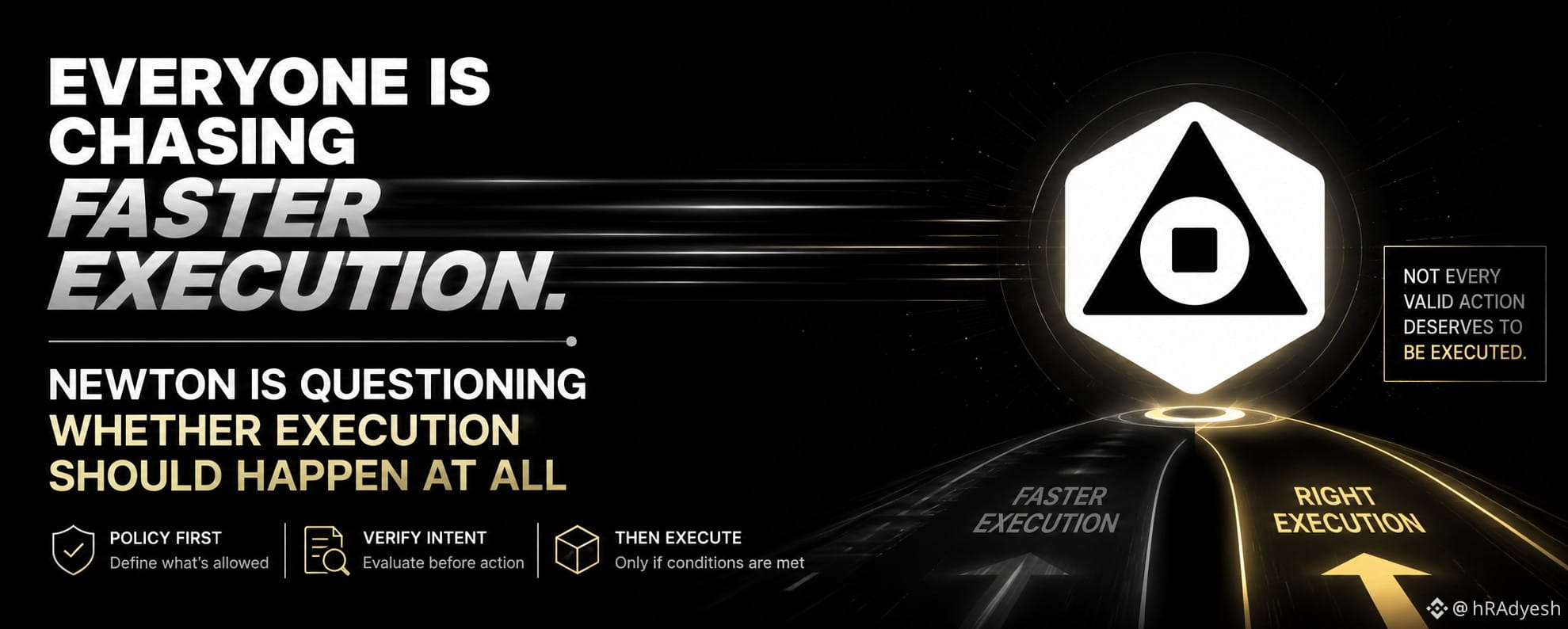
Alle Jagen Schnellere Ausführung. Newton Fragt, Ob Ausführung Überhaupt Stattfinden SollteFrüher dachte ich, dass die meisten Infrastruktur-Updates vor allem um Performance gehen. Schnellere Blöcke. Niedrigere Gebühren. Mehr Durchsatz. Das war die Standardbrille. Wenn etwas die Geschwindigkeit verbesserte, war das Fortschritt. Wenn es die Kosten senkte, war das Innovation. Alles andere wirkte nebensächlich.
Doch wenn man tiefer in das Newton Protocol eintaucht und beobachtet, wie sich die Newton Mainnet Beta entwickelt, hat sich diese Perspektive verändert. Eine Beta signalisiert normalerweise, dass noch etwas unvollständig ist. Dass etwas noch behoben wird. Dass es noch nicht bereit ist. Hier wirkt es anders. Es wirkt bewusst. Weniger wie ein Rohentwurf und mehr wie eine kontrollierte Umgebung, in der eine konkrete Idee unter bestimmten Vorgaben getestet wird.
Alle Jagen Schnellere Ausführung. Newton Fragt, Ob Ausführung Überhaupt Stattfinden Sollte
Früher dachte ich, dass die meisten Infrastruktur-Updates vor allem um Performance gehen. Schnellere Blöcke. Niedrigere Gebühren. Mehr Durchsatz. Das war die Standardbrille. Wenn etwas die Geschwindigkeit verbesserte, war das Fortschritt. Wenn es die Kosten senkte, war das Innovation. Alles andere wirkte nebensächlich.
Doch wenn man tiefer in das Newton Protocol eintaucht und beobachtet, wie sich die Newton Mainnet Beta entwickelt, hat sich diese Perspektive verändert. Eine Beta signalisiert normalerweise, dass noch etwas unvollständig ist. Dass etwas noch behoben wird. Dass es noch nicht bereit ist. Hier wirkt es anders. Es wirkt bewusst. Weniger wie ein Rohentwurf und mehr wie eine kontrollierte Umgebung, in der eine konkrete Idee unter bestimmten Vorgaben getestet wird.
Doch wenn man tiefer in das Newton Protocol eintaucht und beobachtet, wie sich die Newton Mainnet Beta entwickelt, hat sich diese Perspektive verändert. Eine Beta signalisiert normalerweise, dass noch etwas unvollständig ist. Dass etwas noch behoben wird. Dass es noch nicht bereit ist. Hier wirkt es anders. Es wirkt bewusst. Weniger wie ein Rohentwurf und mehr wie eine kontrollierte Umgebung, in der eine konkrete Idee unter bestimmten Vorgaben getestet wird.
61
1
30
142
·
--
#newt $NEWT Ich dachte früher, dass die meisten Infrastruktur-Updates vor allem der Performance dienen. Schnellere Blöcke, niedrigere Gebühren, höhere Durchsatzraten. Doch nachdem ich Teile des Whitepapers zum Newton-Protokoll gelesen hatte, begann ich, stärker auf etwas anderes zu achten: darauf, wie Entscheidungen gesteuert werden, bevor sie überhaupt ausgeführt werden.
Das Newton Mainnet Beta fühlt sich nicht wie ein unfertiges Produkt an. Es wirkt wie eine kontrollierte Umgebung, in der die Durchsetzung von Richtlinien als erstklassige Ebene getestet wird. Anstatt davon auszugehen, dass jede gültige Transaktion ausgeführt werden sollte, führt das System einen Checkpoint ein. Jede Aktion wird anhand vordefinierter Richtlinien bewertet – mit Offchain-Berechnungen und Onchain-Verifikation, bevor die Abrechnung erfolgt.
Was mir besonders auffiel, ist die Trennung der Rollen. Richtliniendefinition, Validierung und Ausführung sind nicht miteinander gebündelt. Operatoren bewerten die Absicht und erstellen Bestätigungen (Attestations), die anschließend Onchain verifiziert werden. So entsteht ein System, in dem die Autorisierung ausdrücklich ist – nicht nur impliziert.
Wenn KI-Agenten zunehmend in das Management von Kapital eingebunden werden, ergibt dieses Design immer mehr Sinn. Die Ausführungsgeschwindigkeit ist wichtig, aber erst, nachdem wir den Bedingungen vertrauen, unter denen die Ausführung stattfindet. Ohne Einschränkungen kann Automatisierung genauso effizient Fehler skalieren wie Erfolge.
Newton legt den Fokus weniger darauf, was getan werden kann, und mehr darauf, was erlaubt sein sollte. Das fühlt sich wie eine subtile, aber wichtige Verschiebung an – in der Art, wie sich die DeFi-Infrastruktur weiterentwickeln könnte.
{future}(NEWTUSDT)
@NewtonProtocol
$NEWT
#Newt
Was ist für die Zukunft von KI in DeFi wichtiger?
#newt $NEWT Ich dachte früher, dass die meisten Infrastruktur-Updates vor allem der Performance dienen. Schnellere Blöcke, niedrigere Gebühren, höhere Durchsatzraten. Doch nachdem ich Teile des Whitepapers zum Newton-Protokoll gelesen hatte, begann ich, stärker auf etwas anderes zu achten: darauf, wie Entscheidungen gesteuert werden, bevor sie überhaupt ausgeführt werden.
Das Newton Mainnet Beta fühlt sich nicht wie ein unfertiges Produkt an. Es wirkt wie eine kontrollierte Umgebung, in der die Durchsetzung von Richtlinien als erstklassige Ebene getestet wird. Anstatt davon auszugehen, dass jede gültige Transaktion ausgeführt werden sollte, führt das System einen Checkpoint ein. Jede Aktion wird anhand vordefinierter Richtlinien bewertet – mit Offchain-Berechnungen und Onchain-Verifikation, bevor die Abrechnung erfolgt.
Was mir besonders auffiel, ist die Trennung der Rollen. Richtliniendefinition, Validierung und Ausführung sind nicht miteinander gebündelt. Operatoren bewerten die Absicht und erstellen Bestätigungen (Attestations), die anschließend Onchain verifiziert werden. So entsteht ein System, in dem die Autorisierung ausdrücklich ist – nicht nur impliziert.
Wenn KI-Agenten zunehmend in das Management von Kapital eingebunden werden, ergibt dieses Design immer mehr Sinn. Die Ausführungsgeschwindigkeit ist wichtig, aber erst, nachdem wir den Bedingungen vertrauen, unter denen die Ausführung stattfindet. Ohne Einschränkungen kann Automatisierung genauso effizient Fehler skalieren wie Erfolge.
Newton legt den Fokus weniger darauf, was getan werden kann, und mehr darauf, was erlaubt sein sollte. Das fühlt sich wie eine subtile, aber wichtige Verschiebung an – in der Art, wie sich die DeFi-Infrastruktur weiterentwickeln könnte.
@NewtonProtocol
$NEWT
#Newt
Was ist für die Zukunft von KI in DeFi wichtiger?
Das Newton Mainnet Beta fühlt sich nicht wie ein unfertiges Produkt an. Es wirkt wie eine kontrollierte Umgebung, in der die Durchsetzung von Richtlinien als erstklassige Ebene getestet wird. Anstatt davon auszugehen, dass jede gültige Transaktion ausgeführt werden sollte, führt das System einen Checkpoint ein. Jede Aktion wird anhand vordefinierter Richtlinien bewertet – mit Offchain-Berechnungen und Onchain-Verifikation, bevor die Abrechnung erfolgt.
Was mir besonders auffiel, ist die Trennung der Rollen. Richtliniendefinition, Validierung und Ausführung sind nicht miteinander gebündelt. Operatoren bewerten die Absicht und erstellen Bestätigungen (Attestations), die anschließend Onchain verifiziert werden. So entsteht ein System, in dem die Autorisierung ausdrücklich ist – nicht nur impliziert.
Wenn KI-Agenten zunehmend in das Management von Kapital eingebunden werden, ergibt dieses Design immer mehr Sinn. Die Ausführungsgeschwindigkeit ist wichtig, aber erst, nachdem wir den Bedingungen vertrauen, unter denen die Ausführung stattfindet. Ohne Einschränkungen kann Automatisierung genauso effizient Fehler skalieren wie Erfolge.
Newton legt den Fokus weniger darauf, was getan werden kann, und mehr darauf, was erlaubt sein sollte. Das fühlt sich wie eine subtile, aber wichtige Verschiebung an – in der Art, wie sich die DeFi-Infrastruktur weiterentwickeln könnte.
@NewtonProtocol
$NEWT
#Newt
Was ist für die Zukunft von KI in DeFi wichtiger?
Smarter AI agents
80%
Faster execution
0%
Stronger risk controls
20%
Transparent decision-making
0%
5 Stimmen • Abstimmung beendet
28
16
104
·
--
Artikel
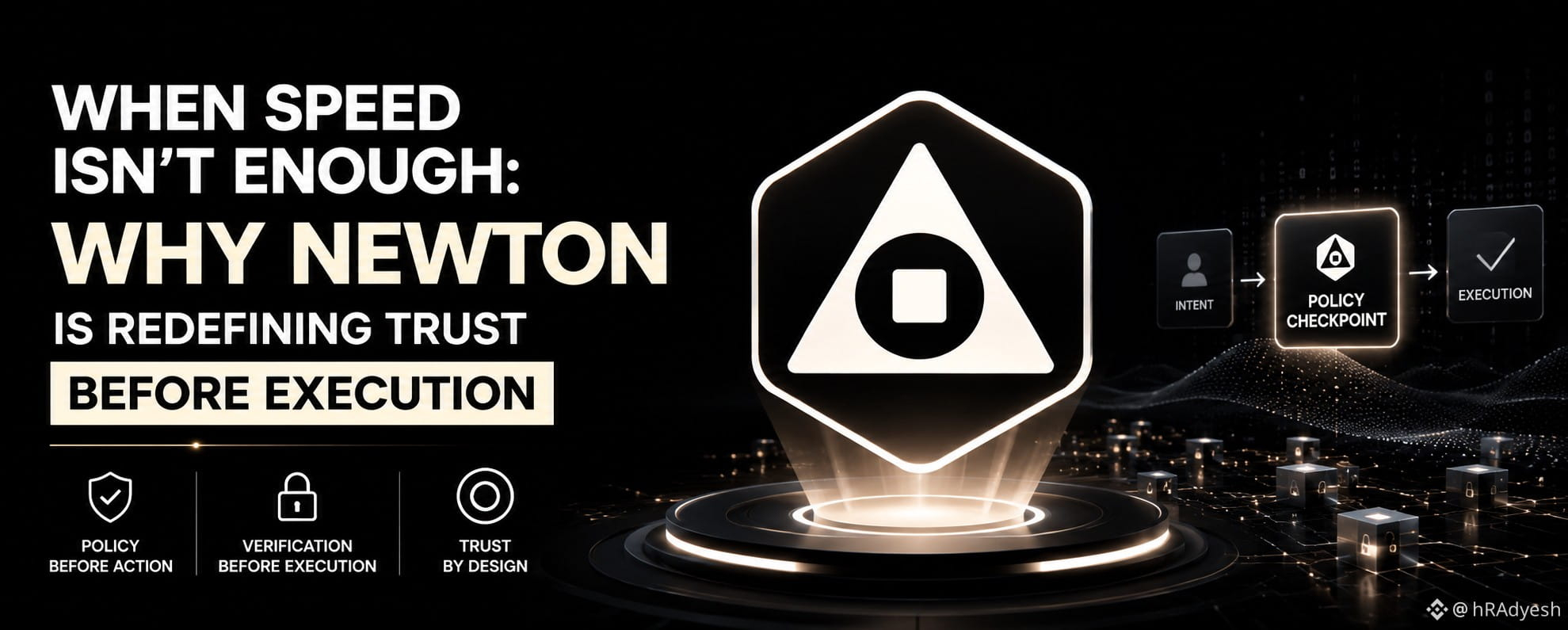
Wenn Geschwindigkeit nicht genug ist: Warum Newton Vertrauen vor der Ausführung neu definiertFrüher dachte ich, jedes ernsthafte Blockchain-Upgrade ginge um genau eine Sache. Transaktionen schneller und günstiger machen. Das war das Maß, mit dem jeder verglich. Latenz, Durchsatz, Gebühren. Alles zeigte in dieselbe Richtung. Wenn die Ausführung besser wird, folgt der Rest.
Aber nachdem ich mir Zeit genommen hatte, über @NewtonProtocol und sein Mainnet Beta zu lesen, fühlte sich diese Annahme plötzlich unvollständig an. Nicht falsch. Nur unzureichend. Denn Geschwindigkeit spielt erst dann eine Rolle, wenn du sicher bist, dass die Aktion selbst überhaupt passieren sollte.
Die Idee, dass Beta auch heißt, dass es noch unfertig ist, hat ebenfalls begonnen, irreführend zu wirken. In den meisten Fällen bedeutet Beta, dass etwas noch getestet wird oder nicht vollständig zuverlässig ist. Hier fühlt es sich anders an. Das System ist nicht unfertig. Es ist kontrolliert. Die Umgebung ist bewusst eingeschränkt, damit die Ausführung beobachtet, verifiziert und geformt werden kann, bevor man skaliert. Das ist keine Einschränkung. Das ist eine Designentscheidung.
Wenn Geschwindigkeit nicht genug ist: Warum Newton Vertrauen vor der Ausführung neu definiert
Früher dachte ich, jedes ernsthafte Blockchain-Upgrade ginge um genau eine Sache. Transaktionen schneller und günstiger machen. Das war das Maß, mit dem jeder verglich. Latenz, Durchsatz, Gebühren. Alles zeigte in dieselbe Richtung. Wenn die Ausführung besser wird, folgt der Rest.
Aber nachdem ich mir Zeit genommen hatte, über @NewtonProtocol und sein Mainnet Beta zu lesen, fühlte sich diese Annahme plötzlich unvollständig an. Nicht falsch. Nur unzureichend. Denn Geschwindigkeit spielt erst dann eine Rolle, wenn du sicher bist, dass die Aktion selbst überhaupt passieren sollte.
Die Idee, dass Beta auch heißt, dass es noch unfertig ist, hat ebenfalls begonnen, irreführend zu wirken. In den meisten Fällen bedeutet Beta, dass etwas noch getestet wird oder nicht vollständig zuverlässig ist. Hier fühlt es sich anders an. Das System ist nicht unfertig. Es ist kontrolliert. Die Umgebung ist bewusst eingeschränkt, damit die Ausführung beobachtet, verifiziert und geformt werden kann, bevor man skaliert. Das ist keine Einschränkung. Das ist eine Designentscheidung.
Aber nachdem ich mir Zeit genommen hatte, über @NewtonProtocol und sein Mainnet Beta zu lesen, fühlte sich diese Annahme plötzlich unvollständig an. Nicht falsch. Nur unzureichend. Denn Geschwindigkeit spielt erst dann eine Rolle, wenn du sicher bist, dass die Aktion selbst überhaupt passieren sollte.
Die Idee, dass Beta auch heißt, dass es noch unfertig ist, hat ebenfalls begonnen, irreführend zu wirken. In den meisten Fällen bedeutet Beta, dass etwas noch getestet wird oder nicht vollständig zuverlässig ist. Hier fühlt es sich anders an. Das System ist nicht unfertig. Es ist kontrolliert. Die Umgebung ist bewusst eingeschränkt, damit die Ausführung beobachtet, verifiziert und geformt werden kann, bevor man skaliert. Das ist keine Einschränkung. Das ist eine Designentscheidung.
22
1
13
116
Anmelden und weiter Inhalte entdecken
Krypto-Nutzer weltweit auf Binance Square kennenlernen
⚡️ Bleib in Sachen Krypto stets am Puls.
💬 Die weltgrößte Kryptobörse vertraut darauf.
👍 Erhalte verlässliche Einblicke von verifizierten Creators.
E-Mail-Adresse/Telefonnummer
Trendthemen
CircleMints500MUSDCOnSolana
31,494 Aufrufe
875 Kommentare
$SOL — CIRCLE prägt gerade eine neue Tranche im Wert von 500 Millionen US-Dollar in USDC auf Solana. 🚨
Circle hat 500 Millionen USDC auf Solana in zwei Tranchen zu je 250 Millionen US-Dollar ausgegeben, was der Netzwerk-Liquidität einen weiteren großen Schub verleiht. Der Bericht bestätigt die Emissionsvorgänge auf der On-Chain-Ebene, obwohl die Token anfangs noch im Circle-eigenen Treasury-Bestand verblieben und nicht sofort in den Handel gelangten.
Das ist keine isolierte Bewegung.
Die Gesamtmenge der Stablecoins auf Solana erreichte mit 17,3 Milliarden US-Dollar ein neues Allzeithoch, während Berichte zufolge Circle allein im August etwa 11 Milliarden US-Dollar an USDC auf Solana ausgegeben hat.
Warum ist das für $SOL wichtig?
Mehr Stablecoin-Liquidität kann mehr Treibstoff für DEX- und DeFi-Trades, Zahlungen und On-Chain-Aktivität bedeuten.
Das Geld verlässt Solana nicht.
Es werden fortlaufend mehr Dollars darauf geprägt. 👀
Bitte folgen
$CRCL
#circlemints500musdconsolana #PolymarketBankFailureBetsDrawFDICConcern #BlackRockBuildsTokenizedPortfoliosForOndo #BitwiseFilesToListNEARETFOnNYSEArca #SECCommissionerPeirceToLeaveOct2
Shamika Metting
·6 Likes
·4.9k Aufrufe
PolymarketBankFailureBetsDrawFDICConcern
46,682 Aufrufe
1,022 Kommentare
BlackRockBuildsTokenizedPortfoliosForOndo
38,194 Aufrufe
691 Kommentare