
heisme
15 Beiträge

heisme
Melden
Nutzer blockieren
Daily Crypto Market & Macro
0 Following
1 Follower
0 Like gegeben
Beiträge
·
--
Übersetzung ansehen
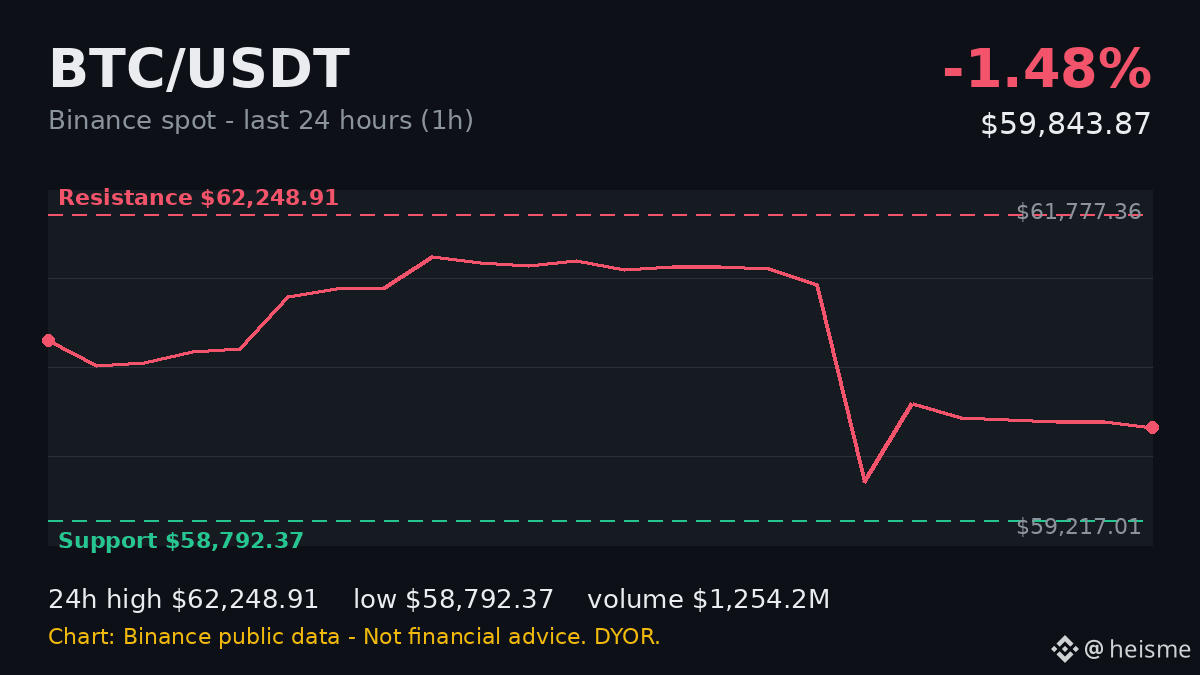
$5.39 billion walked out the door. That is how much US spot Bitcoin ETFs have bled in November — the worst month on record, according to SoSoValue data. And yet Bitcoin is fighting to hold $60,000.
So is this capitulation, or just the start of something worse?
JPMorgan thinks it is the former. Its analysts flagged signs of capitulation this week: Strategy's valuation against its Bitcoin holdings has sunk to a record low, and its mNAV measure fell to 0.88x before recovering to 0.94x. BlackRock's IBIT kept recording outflows even during Bitcoin's brief recovery, and the outflow pace is now faster than the May–June flush. Bitcoin is also trading below JPMorgan's estimated $86,000 production cost, squeezing higher-cost miners.
Meanwhile, CoinShares notes Bitcoin's daily RSI recently fell to around 17 — close to the levels seen around the 2022 trough and among the most oversold readings in Bitcoin's history. After dipping below $58,000 on a hotter-than-expected core PCE print, $BTC recovered toward $60,000 and was on course to end a seven-week losing streak, per CoinDesk.
My stance: cautiously constructive, not euphoric. Capitulation signals plus a historically oversold RSI say the sellers are exhausted, not that buyers have returned. ETF flows are still pointing the wrong way, and a close back below $58,000 would reopen the trapdoor. The Swiss debut of Europe's only active spot Bitcoin ETF (BBIT) shows long-term institutional plumbing is still being built — even as short-term money flees.
Watch next: whether ETF outflows slow, $BTC holds $58,000, and what the Fed signals on rates after that hot inflation print. $BNB and the wider market will follow Bitcoin's lead either way.
Do you think November's record outflows mark the bottom — or is there one more leg down?
#Bitcoin #CryptoMarket #ETF
Follow for daily market + macro breakdowns
Not financial advice. DYOR.

62
·
--
Übersetzung ansehen
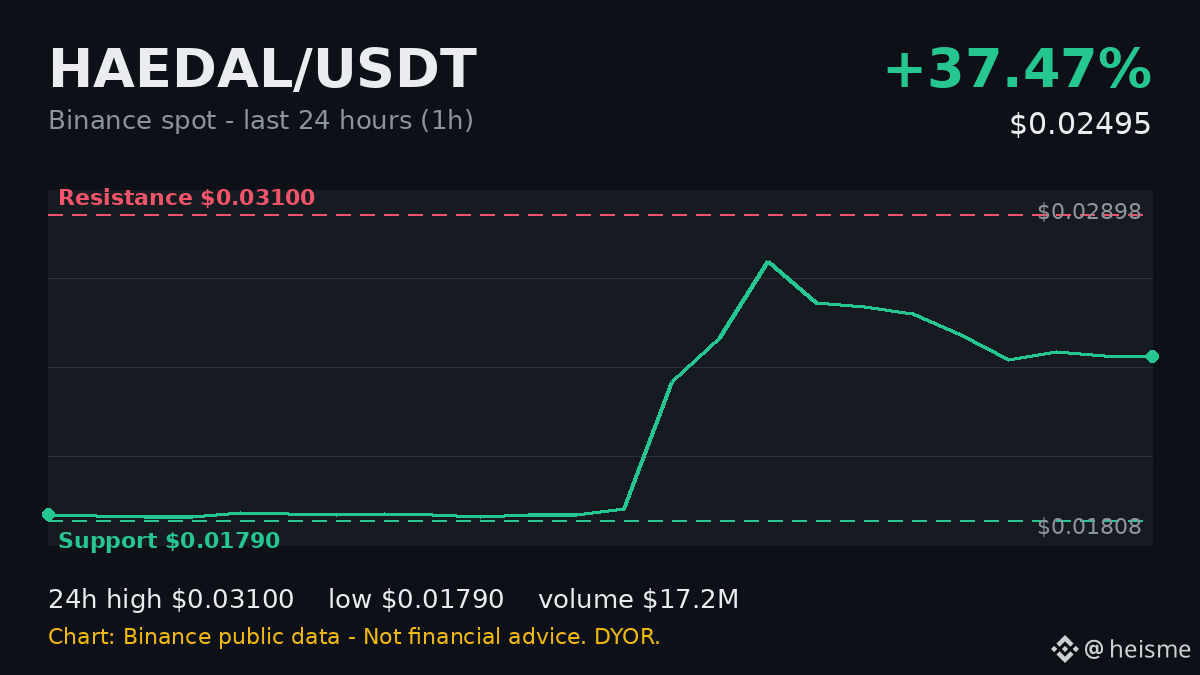
A single exchange listing just did what months of building couldn't — Haedal ($HAEDAL) is up 37% in 24 hours, and the move has a real trigger behind it.
Upbit, South Korea's largest exchange, opened HAEDAL/KRW trading today at 12:20 KST. Korean won pairs open a token to one of the most active retail markets in crypto, and the market reacted fast: HAEDAL spiked 50% to ~$0.028, and 24h spot volume on Binance jumped to $17.2M — roughly 4,800% above its recent daily average. It now trades near $0.025, range $0.0179–$0.031.
Haedal is a liquid staking protocol on Sui, and this wasn't purely a headline trade: the token is already up ~48% this week, so buyers were circling before the announcement.
My stance is cautious, not euphoric. A KRW listing is a genuine catalyst — real new demand and liquidity — which puts this in a different category from no-news pumps. But listing pumps fade fast once the first Korean buying wave is absorbed, and HAEDAL has an overhang: team releases of ~8.33M tokens a month start in late November, ~150M total through April 2028. New supply meeting fading hype has punished plenty of listing rallies.
Meanwhile $BTC is up just 1.27% at $61,578 and $BNB 1.97% at $563.93 — this is a coin-specific story, not a rising tide. Resistance is $0.031, support $0.0179. Holding the mid-$0.02s keeps the story alive; a slide toward $0.018 says the market has moved on.
Listings can change a token's trajectory — or just its Tuesday. Which one is this?
#HAEDAL #Upbit #Sui
Follow for daily market + macro breakdowns.
Not financial advice. DYOR.
A single exchange listing just did what months of building couldn't — Haedal ($HAEDAL ) is up 37% in 24 hours, and the move has a real trigger behind it.
Upbit, South Korea's largest exchange, opened HAEDAL/KRW trading today at 12:20 KST. Korean won pairs open a token to one of the most active retail markets in crypto, and the market reacted fast: HAEDAL spiked 50% to ~$0.028, and 24h spot volume on Binance jumped to $17.2M — roughly 4,800% above its recent daily average. It now trades near $0.025, range $0.0179–$0.031.
Haedal is a liquid staking protocol on Sui, and this wasn't purely a headline trade: the token is already up ~48% this week, so buyers were circling before the announcement.
My stance is cautious, not euphoric. A KRW listing is a genuine catalyst — real new demand and liquidity — which puts this in a different category from no-news pumps. But listing pumps fade fast once the first Korean buying wave is absorbed, and HAEDAL has an overhang: team releases of ~8.33M tokens a month start in late November, ~150M total through April 2028. New supply meeting fading hype has punished plenty of listing rallies.
Meanwhile $BTC is up just 1.27% at $61,578 and $BNB 1.97% at $563.93 — this is a coin-specific story, not a rising tide. Resistance is $0.031, support $0.0179. Holding the mid-$0.02s keeps the story alive; a slide toward $0.018 says the market has moved on.
Listings can change a token's trajectory — or just its Tuesday. Which one is this?
#HAEDAL #Upbit #Sui
Follow for daily market + macro breakdowns.
Not financial advice. DYOR.

103
·
--
Übersetzung ansehen
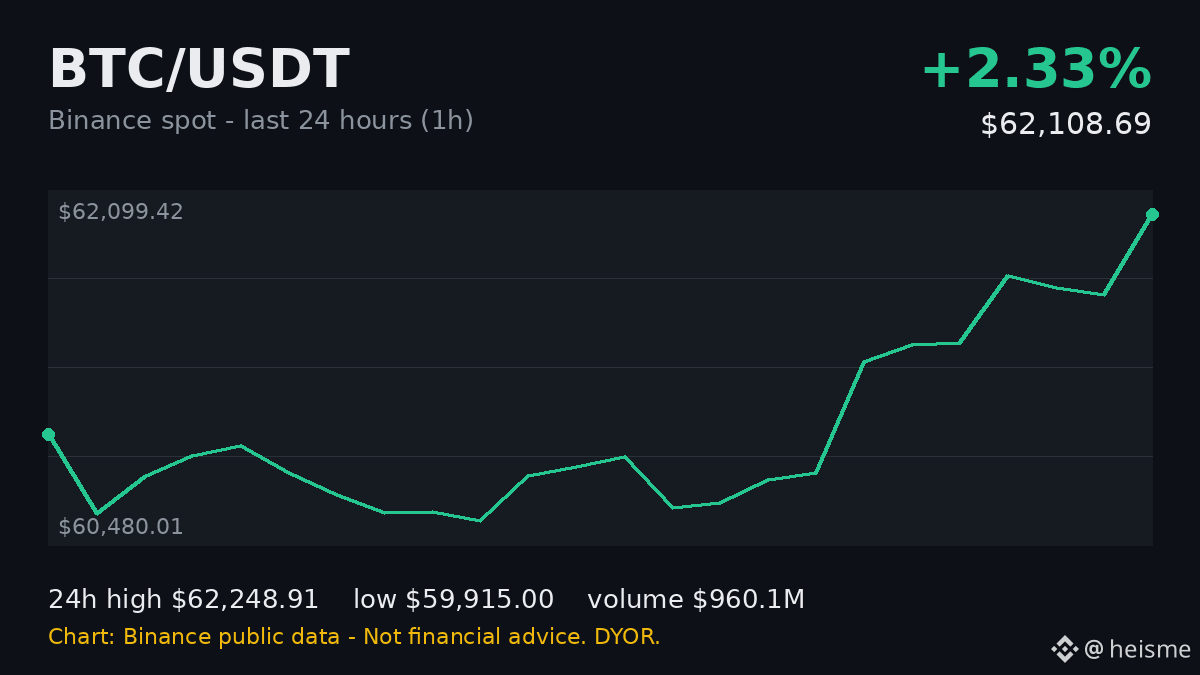
US spot Bitcoin ETFs just posted their worst month on record. According to CoinDesk, November net outflows reached $5.39 billion, beating the previous monthly record of $4.51 billion set in June and putting 2026 on track for the first calendar year of net outflows since the products launched in January 2024. The selling has been relentless: seven straight sessions of outflows, including $453 million on November 26 alone, according to The Defiant.
The trigger is macro. October core PCE inflation rose to 3.3% year on year, above the 3.2% expected, while third-quarter GDP was revised up to 4.3%. Traders now price a December Fed rate hike as the near-certain outcome, with CME FedWatch putting the odds close to 95%, according to ChainCatcher. Higher-for-longer rates have hit $BTC harder than stocks: Bitcoin is down about 25% since October 28, while the Nasdaq 100 has fallen roughly 10%.
$BTC is holding above $60,000 after rebounding from around $57,000, with the Fear and Greed Index at 12, deep in extreme fear. $BNB and the wider market are caught in the same risk-off mood, and stablecoin supply fell $14.75 billion in November, its steepest monthly drop since 2022, according to Crypto Briefing.
What to watch next: around $7.6 billion in $BTC and $ETH options expire today, and the FOMC blackout begins November 28. Whether ETF flows turn after the expiry will say a lot about the next leg.
Not financial advice. DYOR.
55
·
--
Übersetzung ansehen
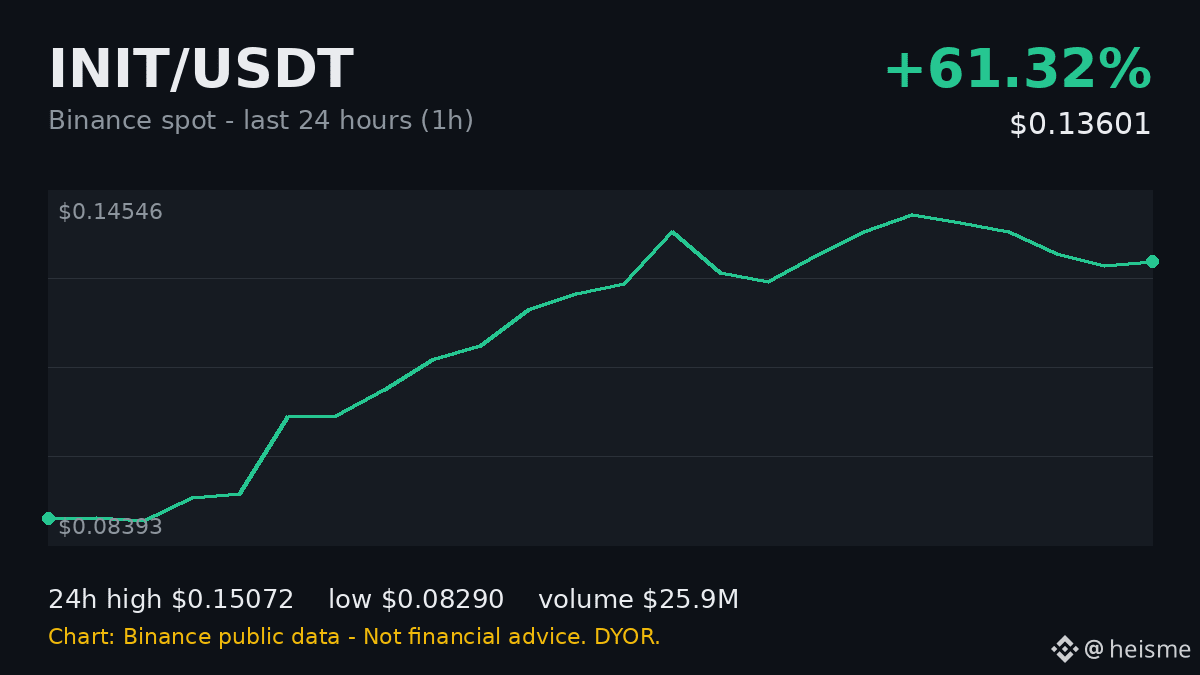
$INIT is today's standout mover, up around 61% in the last 24 hours to roughly $0.136, with spot volume near $26 million on Binance. The move has a clear trigger: Initia's layer-1 and its rollups came back online in the early hours of 26 November after a two-week halt, and the Foundation said it covered the verified shortfalls from the 9 November infrastructure compromise. Enshrined Liquidity providers can also claim restart arbitrage profits until 24 December.
The restart also squeezed a crowded short book. Funding had been deeply negative for days, and on the move OKX open interest jumped about 85% in a few hours while $286k of shorts were liquidated against $93k of longs, per market data. That is mechanical buying as much as fresh conviction, and squeezes can unwind just as fast as they run.
Context matters here. $INIT is still roughly 30% below where it traded a month ago and far below its $1.42 all-time high, and chain TVL has roughly halved since the 23 October exploit. This looks like a repair trade retracing hack damage rather than a new growth story. The 24-hour range of $0.083 to $0.151 frames the near-term battleground, with $0.15 the level to watch after the spike.
$BTC is up about 0.9% and $BNB about 0.6% over the same window, so this is an $INIT-specific story, not a market-wide lift. Worth watching whether the restarted chain holds steady once the squeeze fades.
Not financial advice. DYOR.
$INIT is today's standout mover, up around 61% in the last 24 hours to roughly $0.136, with spot volume near $26 million on Binance. The move has a clear trigger: Initia's layer-1 and its rollups came back online in the early hours of 26 November after a two-week halt, and the Foundation said it covered the verified shortfalls from the 9 November infrastructure compromise. Enshrined Liquidity providers can also claim restart arbitrage profits until 24 December.
The restart also squeezed a crowded short book. Funding had been deeply negative for days, and on the move OKX open interest jumped about 85% in a few hours while $286k of shorts were liquidated against $93k of longs, per market data. That is mechanical buying as much as fresh conviction, and squeezes can unwind just as fast as they run.
Context matters here. $INIT is still roughly 30% below where it traded a month ago and far below its $1.42 all-time high, and chain TVL has roughly halved since the 23 October exploit. This looks like a repair trade retracing hack damage rather than a new growth story. The 24-hour range of $0.083 to $0.151 frames the near-term battleground, with $0.15 the level to watch after the spike.
$BTC is up about 0.9% and $BNB about 0.6% over the same window, so this is an $INIT -specific story, not a market-wide lift. Worth watching whether the restarted chain holds steady once the squeeze fades.
Not financial advice. DYOR.
135
·
--
Übersetzung ansehen
Washington just moved a step closer to putting America's Bitcoin reserve into law. According to CoinDesk, the House Financial Services Committee formally reported H.R. 8957, the American Reserve Modernization Act of 2026, on November 24, placing it on the House Union Calendar — which makes the bill eligible for a vote by the full House. The bill would direct the Treasury to set up a Strategic Bitcoin Reserve and a separate Digital Asset Stockpile within 180 days of becoming law, and it bars the government from selling, swapping or pledging reserve Bitcoin for at least 20 years.
That 20-year lock is the part that matters most for $BTC: it would turn the government's seized Bitcoin from a potential source of selling pressure into a long-term hold, tightening the effective supply story. The bill also covers other government-held crypto in a separate stockpile, so the wider market and $BNB are watching the same vote. But the clock is the catch: Congress ends on January 3, 2027, and no floor vote has been scheduled yet, while Polymarket traders give the reserve about a 4% chance of becoming law this year.
What to watch next: whether House leaders schedule a floor vote in December, and any signal from the Senate. The direction of travel is constructive for Bitcoin, but this is a long way from law.
Not financial advice. DYOR.
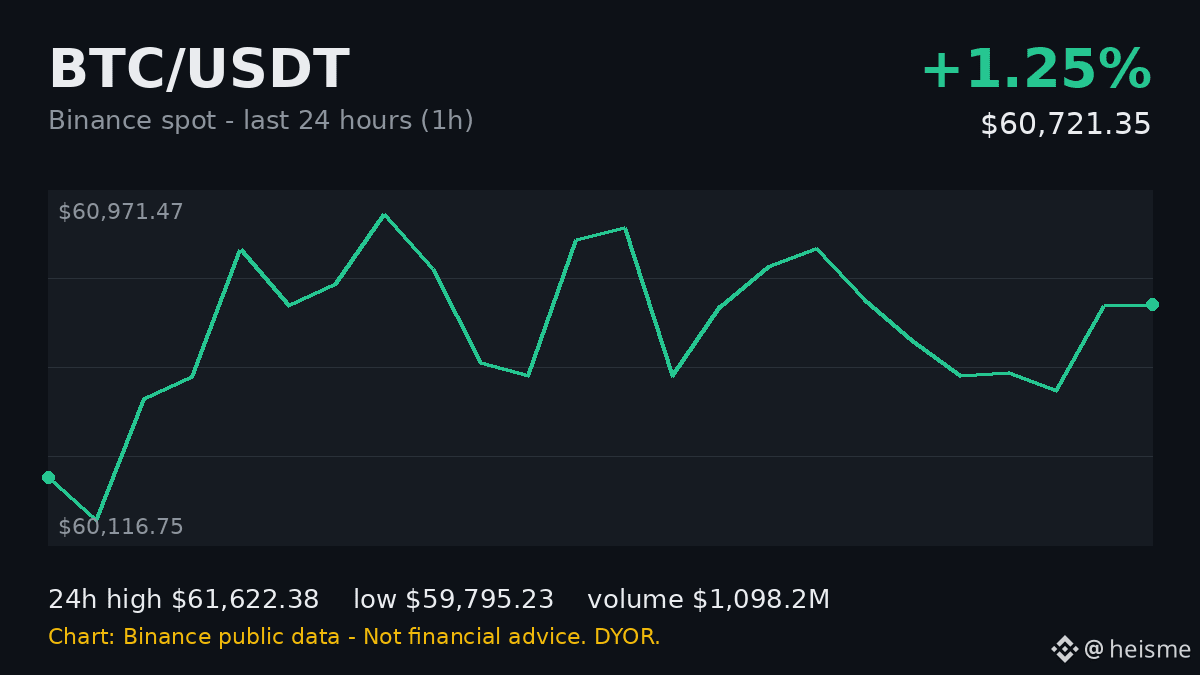
Washington just moved a step closer to putting America's Bitcoin reserve into law. According to CoinDesk, the House Financial Services Committee formally reported H.R. 8957, the American Reserve Modernization Act of 2026, on November 24, placing it on the House Union Calendar — which makes the bill eligible for a vote by the full House. The bill would direct the Treasury to set up a Strategic Bitcoin Reserve and a separate Digital Asset Stockpile within 180 days of becoming law, and it bars the government from selling, swapping or pledging reserve Bitcoin for at least 20 years.
That 20-year lock is the part that matters most for $BTC : it would turn the government's seized Bitcoin from a potential source of selling pressure into a long-term hold, tightening the effective supply story. The bill also covers other government-held crypto in a separate stockpile, so the wider market and $BNB are watching the same vote. But the clock is the catch: Congress ends on January 3, 2027, and no floor vote has been scheduled yet, while Polymarket traders give the reserve about a 4% chance of becoming law this year.
What to watch next: whether House leaders schedule a floor vote in December, and any signal from the Senate. The direction of travel is constructive for Bitcoin, but this is a long way from law.
Not financial advice. DYOR.
29
·
--
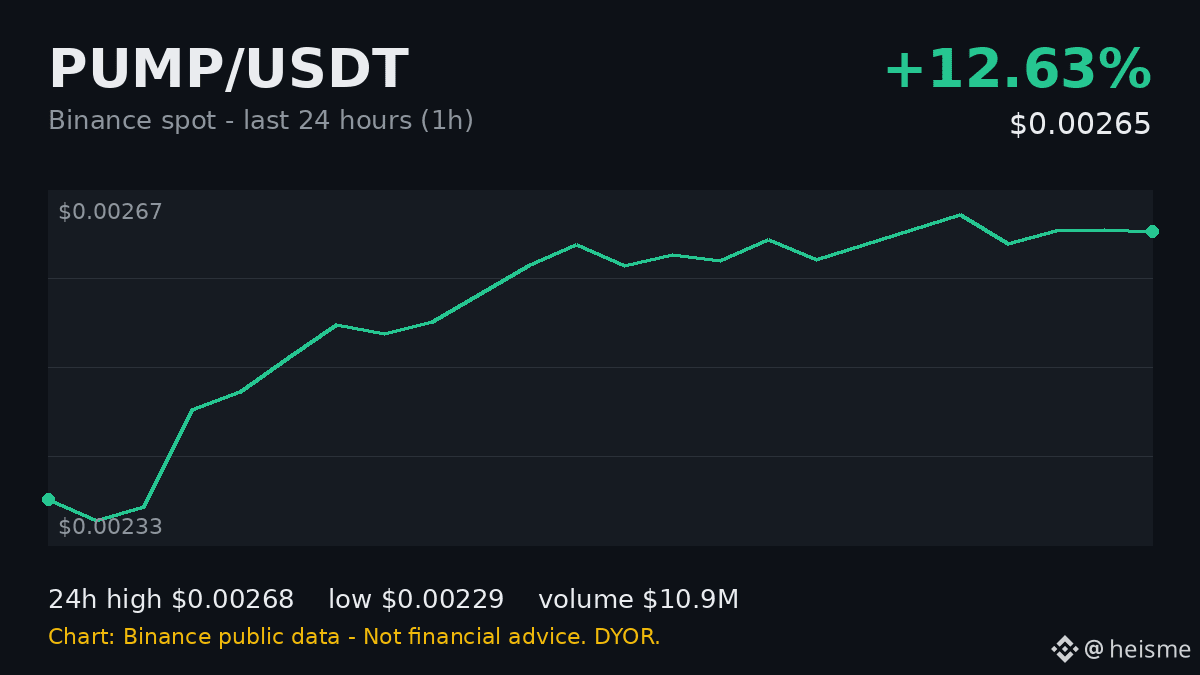
$PUMP ist heute der auffälligste Kursgewinner unter den größeren Binance-Token und legte in den vergangenen 24 Stunden um etwa 12,6 % auf rund 0,00265 $ zu. Hinter dem Anstieg steht ein Spot-Handelsvolumen von ungefähr 11 Millionen $. Der Token erreichte im Tagesverlauf ein Hoch von 0,00268 $, nachdem er zuvor auf 0,00229 $ gefallen war. Die Erholung findet an einem Tag statt, an dem sich auch der breitere Markt erholt.
Zwei Dinge geben Tradern Gesprächsstoff. OKX veranstaltet eine X-Drops-Kampagne, bei der bis zum 30. November 82 Millionen PUMP-Token im Wert von rund 200.000 $ verteilt werden. Unabhängig davon berichtet Coinranking, dass Pump.fun PUMP im Wert von etwa 370 Millionen $ verbrannt hat, die zuvor zurückgekauft worden waren – rund 36 % des Umlaufangebots. Außerdem hat sich das Unternehmen verpflichtet, ein Jahr lang die Hälfte seiner Nettoeinnahmen für weitere Rückkäufe aufzuwenden.
Der Kursanstieg passt zur breiteren Erholung: $BTC hat die Marke von 60.000 $ zurückerobert und ist um etwa 3,6 % gestiegen, nachdem der Kurs angesichts heißer US-Inflationsdaten auf 57.300 $ gefallen war. $BNB liegt rund 2,4 % im Plus bei etwa 553 $. Dennoch bleibt die Stimmung fragil – der Fear-and-Greed-Index steht weiterhin bei 11 und damit tief im Bereich extremer Angst.
Die Risiken sind hier wichtig. $PUMP liegt über die vergangenen 30 Tage weiterhin rund 39 % im Minus und deutlich unter seinem Septemberhoch von etwa 0,009 $. Der heutige Anstieg ist also eine Erholung innerhalb eines viel umfassenderen Abwärtstrends. Das Tageshoch von 0,00268 $ ist der kurzfristig wichtige Wert, während die Unterstützung bei etwa 0,00235 $ liegt. Ein Token, der mit der Aktivität einer Memecoin-Launchpad-Plattform verbunden ist, kann schnell wieder an Wert verlieren. Berücksichtige das bei der Höhe eines möglichen Engagements.
Keine Finanzberatung. Recherchiere selbst.
147
·
--
Übersetzung ansehen
US inflation came in hotter than expected — and crypto felt it immediately. According to Reuters, the Bureau of Economic Analysis reported on Wednesday that the PCE price index, the Federal Reserve's preferred inflation gauge, rose 3.8% year on year in October, while core PCE climbed to 3.3%, above the 3.2% economists had expected. Markets now price a December rate hike as near-certain, with CME's FedWatch tool showing traders betting on a 25-basis-point move at the December 8-9 meeting, and another increase expected in January.
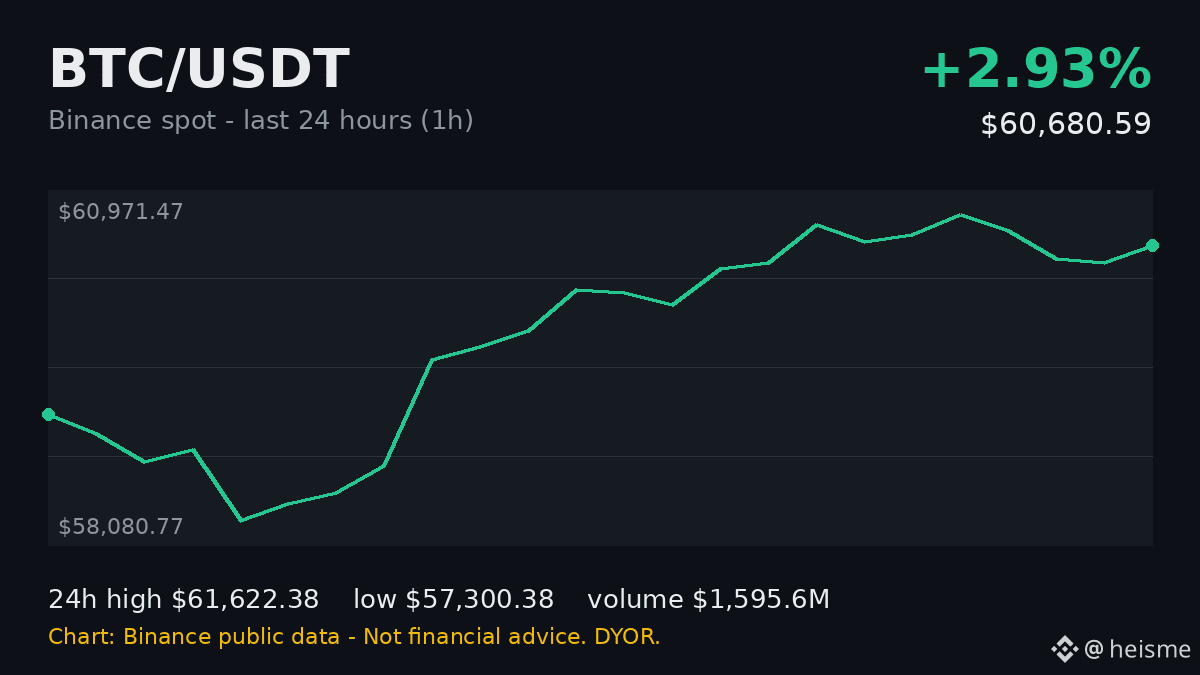
$BTC dropped below $58,000 on the news before recovering above $60,000, a reminder that rate-hike expectations hit risk assets fast. The pressure is already visible in flows: according to SoSoValue data cited by KuCoin, US spot Bitcoin ETFs have now logged six straight sessions of net outflows, taking November's total to roughly $4.94 billion — the largest monthly outflow since the products launched. $BNB and the wider market tracked Bitcoin's swing, with the Fear & Greed Index sitting at 11, deep in extreme fear territory.
What to watch next: the Fed's December 8-9 meeting and the tone of the press conference, the November 27 BTC monthly options expiry, and whether ETF outflows slow once the hike is priced in. A hawkish surprise could extend the pressure; a softer message could steady the market.
Not financial advice. DYOR.
61
·
--
Übersetzung ansehen
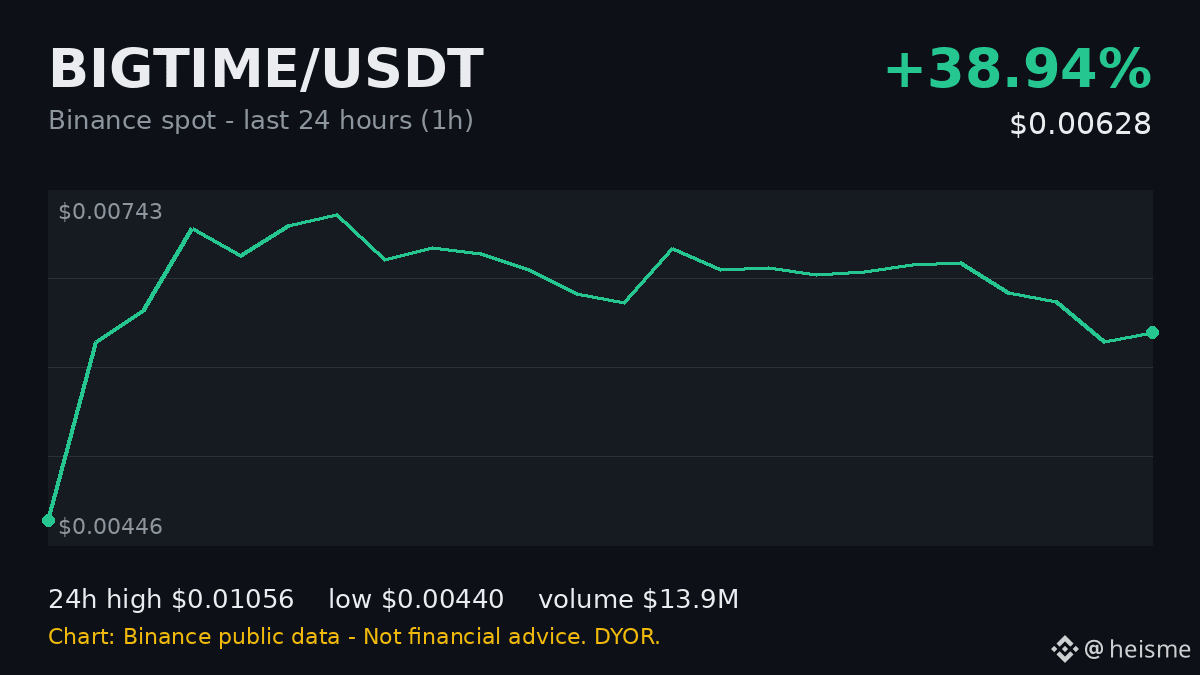
$BIGTIME is the standout mover of the past 24 hours, up around 39% to about $0.0063, far outpacing a broader market that is itself recovering — $BTC is up about 2.7% near $60,800 and $BNB is up around 3.2% near $558.
To be clear, there is no verified new announcement from the Big Time project behind this move. The rally looks flow-driven: the token bounced hard off an all-time low near $0.0038 set just days ago, short positions were squeezed as the price jumped, and trading volume surged many times above its recent daily average, with heavy activity on Korean exchange Upbit. That combination can push a thin token very fast in either direction.
The chart tells the same story. $BIGTIME spiked as high as about $0.0106 in the past day before pulling back to around $0.0063, so much of the day's gain has already been given back from the peak. The levels to watch are support near $0.0046 and resistance near $0.0073.
There is also a real supply risk ahead: around 600 million tokens — roughly a fifth of circulating supply — are reported to unlock around 30 November, with some reports putting the date at 3 December. If recipients sell into this market, that could add serious pressure.
A sharp bounce off the lows is not the same as a trend change, and with a big unlock days away, this one deserves caution rather than chasing.
Not financial advice. DYOR.
402
·
--
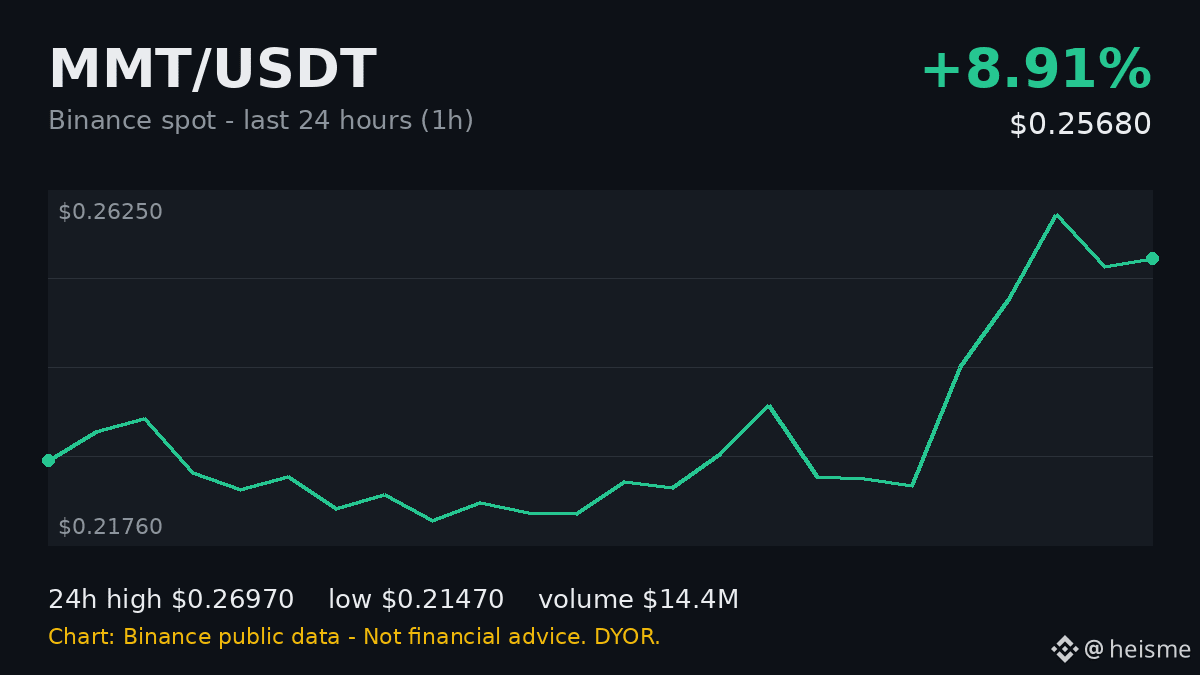
Momentum ($MMT) ist heute der Ausreißer auf Binance und legte innerhalb von 24 Stunden um rund 8.9% auf etwa $0.256 zu, während sich der Großteil des Marktes im Minus befindet. Ein Spot-Handelsvolumen von etwa $14.4 Millionen ist gemessen an den großen Coins bescheiden, für einen Token dieser Größe jedoch beachtlich. Der Anstieg erfolgte in einem schwachen Marktumfeld: $BTC liegt rund 3% im Minus und wird unter $60,000 bei etwa $59,100 gehandelt, während $BNB ungefähr 2% verloren hat.
Auffällig ist die Divergenz. $MMT wurde im Laufe des vergangenen Tages in einer breiten Spanne von $0.215 bis $0.270 gehandelt, und der Wochenverlauf war unruhig statt von einem klaren Trend geprägt — der Token fiel am 23. November stark, bevor er sich erholte. Es gibt keine bestätigte Ankündigung, die die heutigen Käufe erklärt. Marktkommentare beschreiben die Bewegung als coin-spezifischen Kapitalfluss und nicht als Reaktion auf ein Projekt-Update. Die ehrlichste Einschätzung lautet daher: momentumgetriebenes Interesse, kein Handel aufgrund eines Katalysators.
Das ist für das Risiko relevant. Ein Token, der innerhalb einer Woche rund 55% zulegt, an einem einzigen Tag aber zweistellig fallen kann, kann sich ebenso schnell wieder umkehren — besonders angesichts der extremen Angst am Gesamtmarkt und der für heute erwarteten US-PCE-Inflationsdaten, eines Ereignisses, das $BTC und Risikoanlagen bereits bewegt. Wer $MMT beobachtet, sollte die Divergenz vor diesem Hintergrund abwägen und sein Engagement entsprechend bemessen.
Keine Finanzberatung. DYOR.
Momentum ($MMT ) ist heute der Ausreißer auf Binance und legte innerhalb von 24 Stunden um rund 8.9% auf etwa $0.256 zu, während sich der Großteil des Marktes im Minus befindet. Ein Spot-Handelsvolumen von etwa $14.4 Millionen ist gemessen an den großen Coins bescheiden, für einen Token dieser Größe jedoch beachtlich. Der Anstieg erfolgte in einem schwachen Marktumfeld: $BTC liegt rund 3% im Minus und wird unter $60,000 bei etwa $59,100 gehandelt, während $BNB ungefähr 2% verloren hat.
Auffällig ist die Divergenz. $MMT wurde im Laufe des vergangenen Tages in einer breiten Spanne von $0.215 bis $0.270 gehandelt, und der Wochenverlauf war unruhig statt von einem klaren Trend geprägt — der Token fiel am 23. November stark, bevor er sich erholte. Es gibt keine bestätigte Ankündigung, die die heutigen Käufe erklärt. Marktkommentare beschreiben die Bewegung als coin-spezifischen Kapitalfluss und nicht als Reaktion auf ein Projekt-Update. Die ehrlichste Einschätzung lautet daher: momentumgetriebenes Interesse, kein Handel aufgrund eines Katalysators.
Das ist für das Risiko relevant. Ein Token, der innerhalb einer Woche rund 55% zulegt, an einem einzigen Tag aber zweistellig fallen kann, kann sich ebenso schnell wieder umkehren — besonders angesichts der extremen Angst am Gesamtmarkt und der für heute erwarteten US-PCE-Inflationsdaten, eines Ereignisses, das $BTC und Risikoanlagen bereits bewegt. Wer $MMT beobachtet, sollte die Divergenz vor diesem Hintergrund abwägen und sein Engagement entsprechend bemessen.
Keine Finanzberatung. DYOR.
220
·
--
Übersetzung ansehen
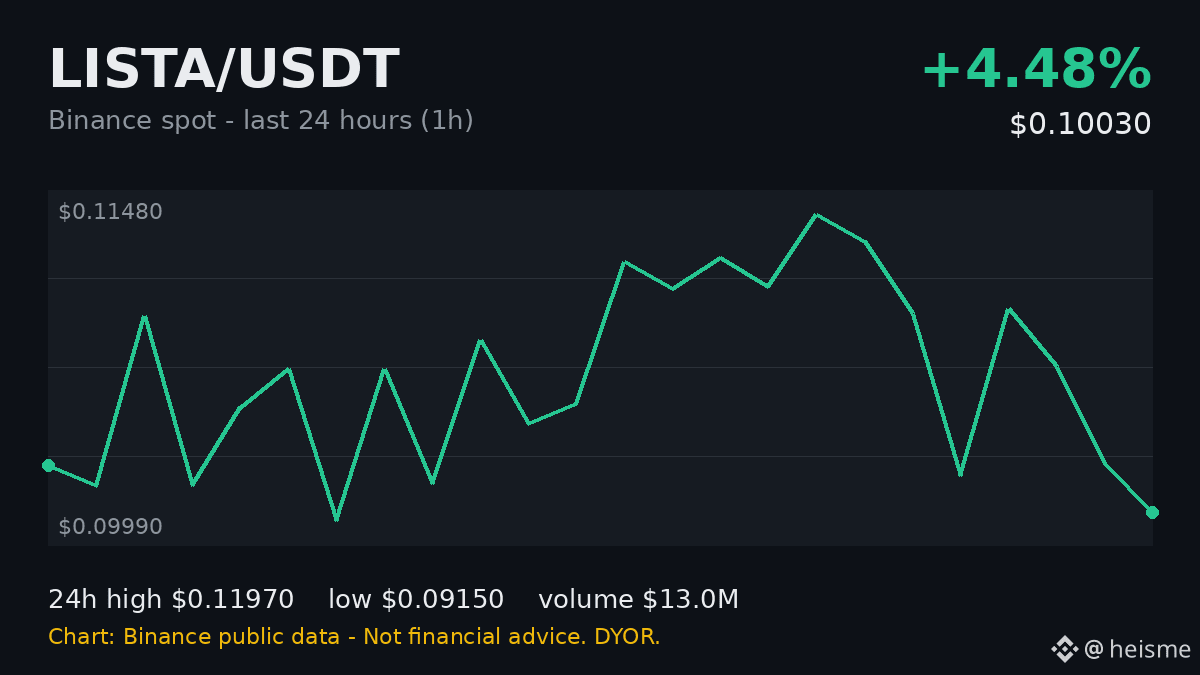
Lista DAO ($LISTA) is the standout name on Binance today, up 5.1% in 24 hours to $0.1010 while most of the market is in the red. The move looks even bigger on a weekly view — the token is up roughly 45% over seven days after a sharp rally on 24 November that pushed it as high as $0.1197 before sellers stepped in.
There is no confirmed catalyst behind the move. Lista posted about using tokenised stock assets as collateral on Lista Lending, and a small weekly buyback was reported, but neither has been shown to drive the buying. What the data does show is leverage: open interest jumped more than 50% and futures volume ran far ahead of spot, while momentum indicators sit deep in overbought territory. That is a classic setup for sharp swings in both directions.
The backdrop does not help. $BTC slipped below $60,000 to around $59,200, down about 1.6% on the day, with US spot ETF outflows now running five sessions in a row and sentiment readings in extreme fear. $BNB is also softer, down 1.7% at $541.
For $LISTA, the recent high near $0.1197 and the $0.0915 low frame the short-term range. A break of either side could move fast given how much leverage is involved, so position sizing and risk management matter more than usual here.
Not financial advice. DYOR.
Lista DAO ($LISTA ) is the standout name on Binance today, up 5.1% in 24 hours to $0.1010 while most of the market is in the red. The move looks even bigger on a weekly view — the token is up roughly 45% over seven days after a sharp rally on 24 November that pushed it as high as $0.1197 before sellers stepped in.
There is no confirmed catalyst behind the move. Lista posted about using tokenised stock assets as collateral on Lista Lending, and a small weekly buyback was reported, but neither has been shown to drive the buying. What the data does show is leverage: open interest jumped more than 50% and futures volume ran far ahead of spot, while momentum indicators sit deep in overbought territory. That is a classic setup for sharp swings in both directions.
The backdrop does not help. $BTC slipped below $60,000 to around $59,200, down about 1.6% on the day, with US spot ETF outflows now running five sessions in a row and sentiment readings in extreme fear. $BNB is also softer, down 1.7% at $541.
For $LISTA , the recent high near $0.1197 and the $0.0915 low frame the short-term range. A break of either side could move fast given how much leverage is involved, so position sizing and risk management matter more than usual here.
Not financial advice. DYOR.
86
·
--
Übersetzung ansehen
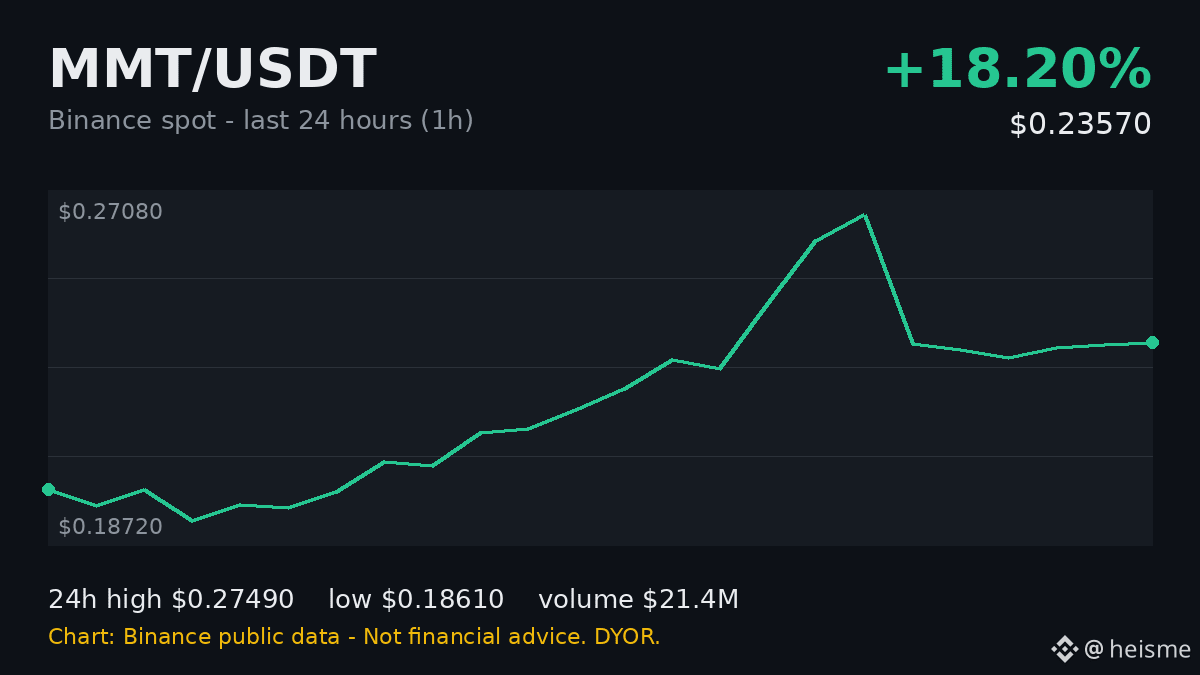
Momentum ($MMT) is today's standout on Binance, up around 18% in 24 hours to about $0.236, with $21.4 million in spot volume — the strongest gainer that passes every filter once thin, leveraged and tokenised-stock names are set aside. The Sui-based DEX token has now climbed a long way from its all-time low near $0.095 on 14 November, yet it still trades roughly 94% below its $4.03 high from its November 2025 launch.
There is no single announcement behind today's move. The most credible context is the ongoing Momentum Ignition rewards campaign, offering up to 100 million MMT to users who lock tokens as veMMT and provide liquidity, plus a wave of speculative interest that has followed the token since its rebound from the low. Trading has been heavy all week, and the token has repeatedly moved against the wider market.
That wider market is still under pressure. $BTC has slipped about 1.3% in the last day to near $60,500, and the Fear and Greed Index sits at 9, deep in extreme fear, while $BNB has also drifted lower with the market. A token rising into that backdrop deserves extra caution, not extra confidence.
Levels to watch: today's high near $0.275 and low near $0.186 frame the session. The other risk is supply: a large unlock of around 252 million MMT landed on 4 November, nearly tripling the circulating float, so fresh selling pressure can appear quickly. Momentum this sharp can reverse just as fast.
Not financial advice. DYOR.
Momentum ($MMT ) is today's standout on Binance, up around 18% in 24 hours to about $0.236, with $21.4 million in spot volume — the strongest gainer that passes every filter once thin, leveraged and tokenised-stock names are set aside. The Sui-based DEX token has now climbed a long way from its all-time low near $0.095 on 14 November, yet it still trades roughly 94% below its $4.03 high from its November 2025 launch.
There is no single announcement behind today's move. The most credible context is the ongoing Momentum Ignition rewards campaign, offering up to 100 million MMT to users who lock tokens as veMMT and provide liquidity, plus a wave of speculative interest that has followed the token since its rebound from the low. Trading has been heavy all week, and the token has repeatedly moved against the wider market.
That wider market is still under pressure. $BTC has slipped about 1.3% in the last day to near $60,500, and the Fear and Greed Index sits at 9, deep in extreme fear, while $BNB has also drifted lower with the market. A token rising into that backdrop deserves extra caution, not extra confidence.
Levels to watch: today's high near $0.275 and low near $0.186 frame the session. The other risk is supply: a large unlock of around 252 million MMT landed on 4 November, nearly tripling the circulating float, so fresh selling pressure can appear quickly. Momentum this sharp can reverse just as fast.
Not financial advice. DYOR.
126
·
--
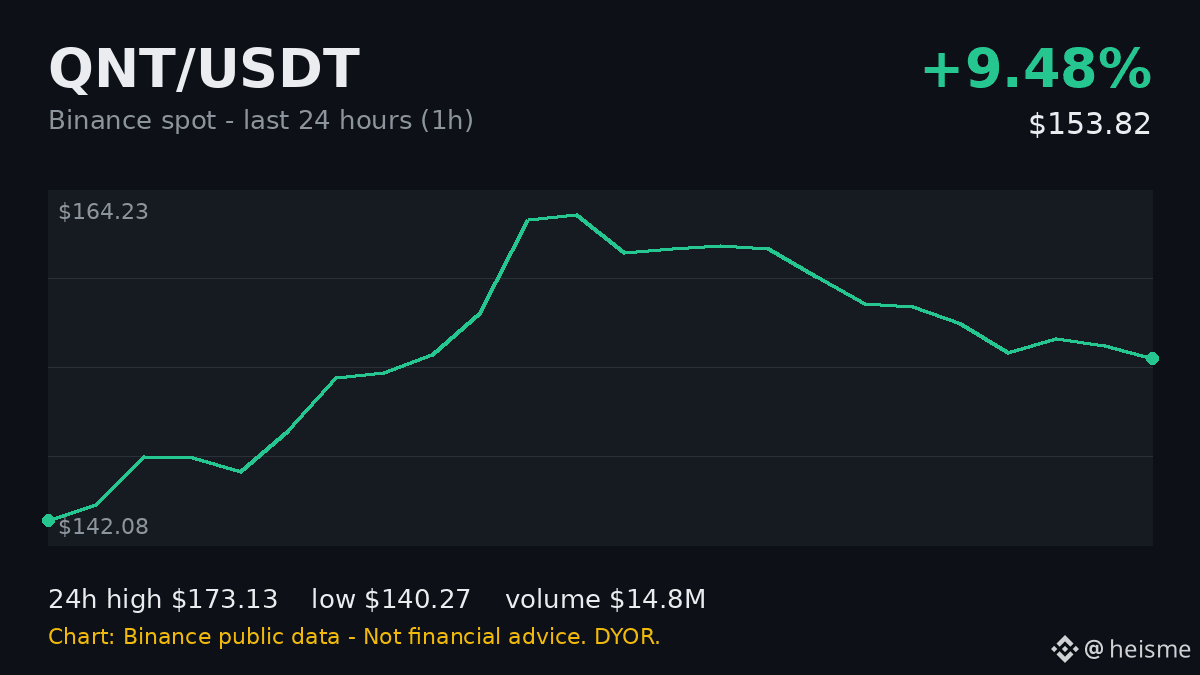
Quants $QNT ist unter den Large Caps der Tagesgewinner: Der Kurs legte innerhalb von 24 Stunden um rund 9 % auf knapp 154 $ zu, nachdem er sich von einem Tief nahe 140 $ erholt hatte. Das Spot-Handelsvolumen der vergangenen 24 Stunden lag bei über 14 Millionen $. Der Anstieg scheint eher technisch bedingt als durch Nachrichten ausgelöst: Der Token kletterte wieder über die Zone zwischen 144 und 147 $, die Händler nach dem Rückgang auf etwa 127 $ am 21. November im Blick hatten. Nun testet er die Marke von 157 $, wobei das 24-Stunden-Hoch nahe 173 $ der nächste Orientierungspunkt ist. On-Chain-Daten liefern zusätzlichen Kontext: Die Börsenbestände sind auf ein Jahrestief gesunken, während die Zahl der Inhaber weiter steigt. Das deutet darauf hin, dass weniger Coins auf Börsen liegen und zum Verkauf bereitstehen.
Die Hintergrundgeschichte ist bekannt und nicht neu. Die Interoperabilitätstechnologie von Quant wurde im September von The Clearing House für dessen Netzwerk für tokenisierte Einlagen ausgewählt, das in der ersten Hälfte des Jahres 2027 für Finanzinstitute starten soll. Auch britische Banken nutzen bei Pilotprojekten zu tokenisierten Einlagen eine von Quant entwickelte Plattform. Diese Erzählung wird im Zuge der Kurserholung erneut aufgegriffen, aber nicht durch eine neue Ankündigung bestätigt.
Der breitere Markt bietet kaum Unterstützung: $BTC bewegt sich um 60.000 $, liegt im Monatsvergleich aber weiterhin deutlich im Minus, und $BNB notiert unverändert bis leicht niedriger. Eine Erholung, die auf technischen Faktoren und einer wiederaufgewärmten Geschichte beruht, kann schnell nachlassen, wenn Bitcoin erneut fällt. Zudem liegt $QNT weiterhin deutlich unter den Höchstständen von Ende Oktober nahe 224 $. Beobachten Sie, ob die Zone zwischen 147 und 150 $ bei einem möglichen Rücksetzer hält.
Keine Finanzberatung. Recherchieren Sie selbst.
177
·
--
Übersetzung ansehen
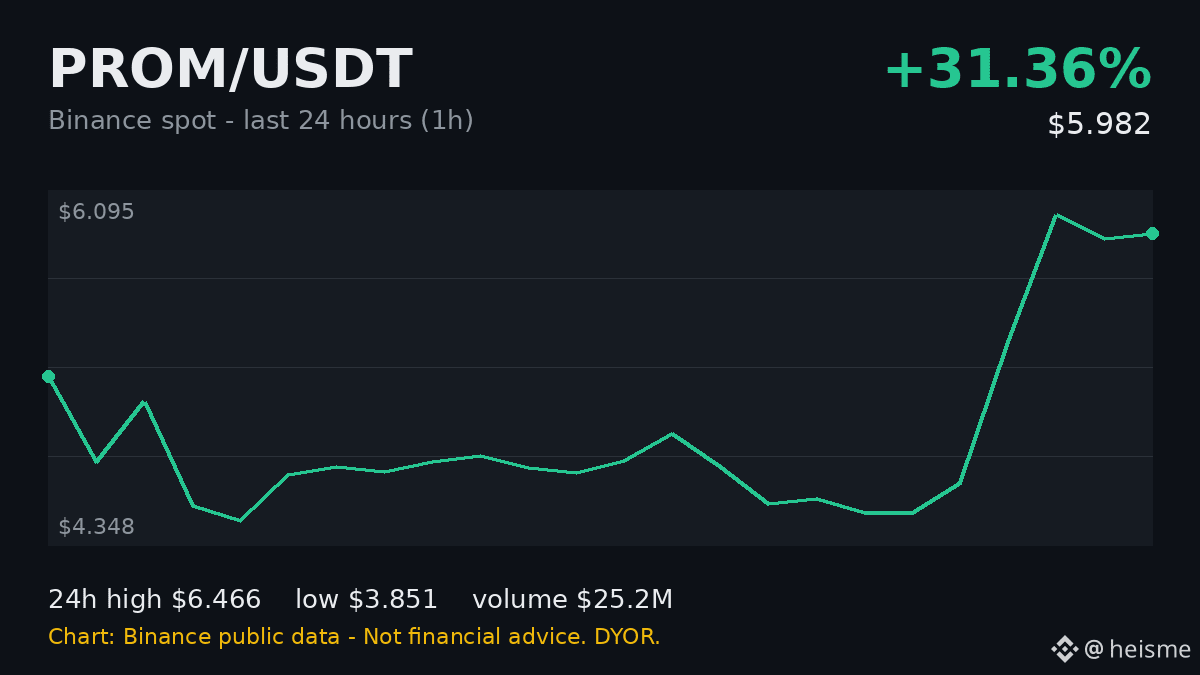
$PROM is today's standout mover, up around 31% in 24 hours to roughly $6.02 on Binance, with spot volume near $25 million. The token has traded a wide range between $3.85 and $6.47 today, and futures open interest has jumped about 50% to roughly $35 million — a sign traders are piling in, but also that leverage is building fast.
There is no single fresh announcement behind today's move. The backdrop is a narrative that has been building for weeks: Prom repositioning itself as a settlement layer for agent-to-agent commerce, with a run of AI-agent partnerships, and Korean spot buying that first lit the tape earlier this month. Today's surge looks like that momentum carrying on rather than a new fundamental trigger, so it should be read as a high-volatility, momentum-driven move.
The wider market is steadier. $BTC is holding near $61,300, recovering from a weekend flush toward $55,100, though it remains down sharply on the month and spot ETF flows are still negative. $BNB is little changed near $556.
For $PROM, the $6.47 intraday high is the near-term reference point, with the $3.85 low showing how fast this token can retrace. Small-cap tokens with surging open interest can reverse just as quickly as they run.
Not financial advice. DYOR.
$PROM is today's standout mover, up around 31% in 24 hours to roughly $6.02 on Binance, with spot volume near $25 million. The token has traded a wide range between $3.85 and $6.47 today, and futures open interest has jumped about 50% to roughly $35 million — a sign traders are piling in, but also that leverage is building fast.
There is no single fresh announcement behind today's move. The backdrop is a narrative that has been building for weeks: Prom repositioning itself as a settlement layer for agent-to-agent commerce, with a run of AI-agent partnerships, and Korean spot buying that first lit the tape earlier this month. Today's surge looks like that momentum carrying on rather than a new fundamental trigger, so it should be read as a high-volatility, momentum-driven move.
The wider market is steadier. $BTC is holding near $61,300, recovering from a weekend flush toward $55,100, though it remains down sharply on the month and spot ETF flows are still negative. $BNB is little changed near $556.
For $PROM , the $6.47 intraday high is the near-term reference point, with the $3.85 low showing how fast this token can retrace. Small-cap tokens with surging open interest can reverse just as quickly as they run.
Not financial advice. DYOR.
123
·
--
Verifiziert
Übersetzung ansehen
$NEAR is quietly leading the majors today, up 5.1% in 24 hours to around $3.02, with more than $68M in spot volume on Binance.
Context matters more than the headline here. This is a market-wide rebound, not a NEAR-only breakout. $BTC has climbed about 3.4% back above $61,000 after last week's liquidation flush to the $55,000 area, and $BNB is up about 3.0% near $559. When Bitcoin stabilises after a leverage washout, liquid altcoins usually bounce first, and NEAR is one of them.
There is also a slower fundamental story underneath. On 16 November, NEAR's House of Stake ratified proposal HSP-029, cutting maximum annual issuance from 2.5% to 1.6% over the next 24 months. That does not move price in a day, but it does tighten future supply.
The risk side is just as clear. NEAR is still down roughly 35% over 30 days and trades well below its October highs, so this is a bounce inside a damaged trend, not a confirmed reversal. The levels I am watching are $3.06, today's high, and $2.85 on the downside, plus whether $BTC can hold $60,000 into the US PCE data on 25 November.
Not financial advice. DYOR.
97
·
--
Bullisch
183
Anmelden und weiter Inhalte entdecken
Krypto-Nutzer weltweit auf Binance Square kennenlernen
⚡️ Bleib in Sachen Krypto stets am Puls.
💬 Die weltgrößte Kryptobörse vertraut darauf.
👍 Erhalte verlässliche Einblicke von verifizierten Creators.
E-Mail-Adresse/Telefonnummer
Trendthemen
EvolveAtBinanceBlockchainWeek
1.5M Aufrufe
16,209 Kommentare
Die Binance Blockchain Week hat offiziell begonnen! 🌍
Am 28. und 29. November: Egal, ob du in Bangkok bist oder von anderswo aus zuschaust – schalte die Livestreams ein und beteilige dich an der Unterhaltung auf Binance Square!
Das erwartet dich 👇
📺 Sieh dir main stage live an
Schalte an beiden Tagen ein, wenn Branchenexpertinnen und -experten ihre Perspektiven zum diesjährigen Thema „Evolve“ teilen. Entdecke von technologischen Innovationen bis hin zu Anwendungen in der realen Welt, was die Zukunft für Krypto bereithält.
⚔️ Sieh dir zwei Trading-Wettbewerbe an
Sowohl Aster Open Qualifier als auch Binance Trading Master Tournament werden live übertragen. Schalte ein und verfolge die Trader in Aktion.
🏆 Sieh dir Blockchain 100 Awards Ceremony an
Die Liste der Blockchain 100 wurde von der Community ausgewählt. Feiere mit uns die Creator und die Ideen, die sie teilen!
💬 Beteilige dich an der Unterhaltung in der Community
Verwende #EvolveAtBinanceBlockchainWeek in einem Beitrag mit einem Foto, um zu teilen, worauf du dich freust, was du von der Branche hältst oder welche Momente der Veranstaltung dir am besten gefallen.
event page ist jetzt live! Abonniere alle Livestreams mit nur einem Klick, damit du keinen Moment verpasst 👏
Binance Blockchain Week
·328 Likes
·286k Aufrufe
ChainflipVaultTheftHaltsProtocol
8,336 Aufrufe
159 Kommentare
VitalikWantsWalletChipDesignsOpened
15,933 Aufrufe
268 Kommentare