

E C H O
285 Beiträge

E C H O
Melden
Nutzer blockieren
62 Following
5.7K+ Follower
397 Like gegeben
Beiträge
Alle
Live
·
--
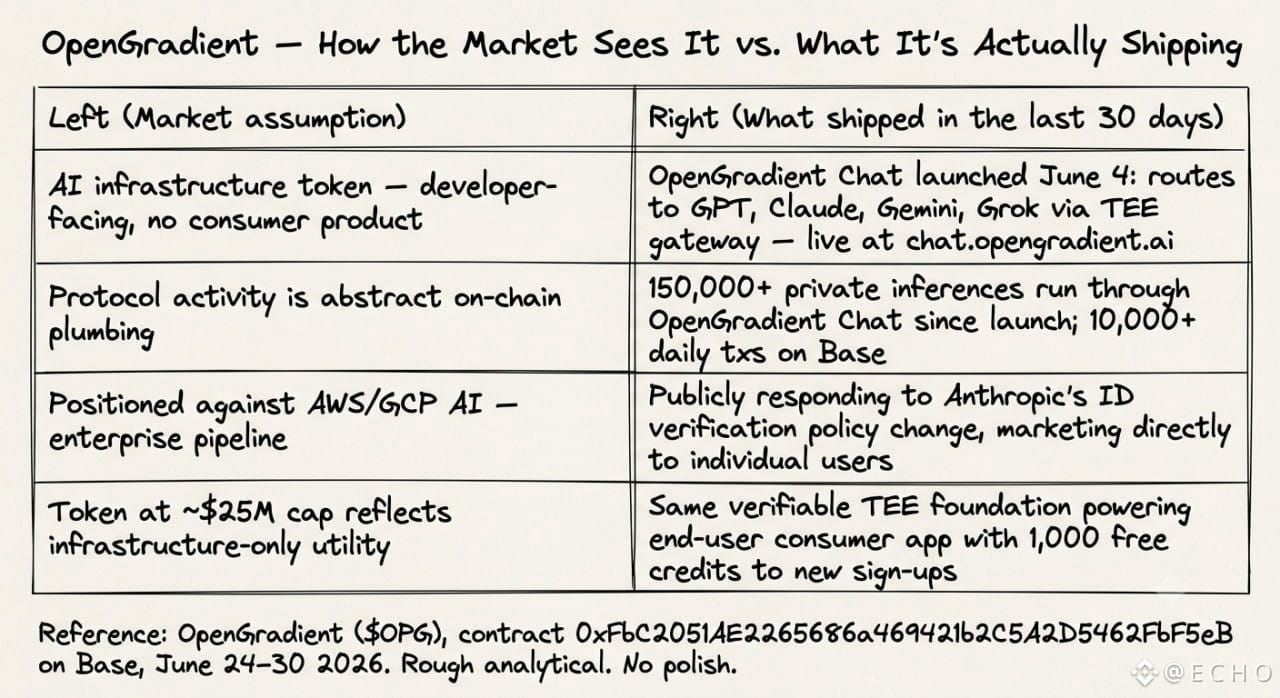
Der Moment, der mich bei dieser Aufgabe eiskalt erwischte, waren nicht die Netzwerkzahlen – es war ein Beitrag von dem Konto @OpenGradient aus dieser Woche, der auf die aktualisierte Datenschutzrichtlinie von Anthropic verwies. Sie hielten fest, dass Anthropic nun das Recht vorbehält, von Nutzern eine staatliche ID, ein Foto und biometrische Daten anzufordern. Und darunter verlinkten sie zu OpenGradient Chat. $OPG #OPG
Moment mal – das ist tatsächlich eine scharfe Positionierung in der echten Welt. OpenGradient Chat leitet Anfragen an GPT, Claude, Gemini und Grok weiter – über TEE-isolierte Gateways mit Oblivious-HTTP-Anonymisierung. Sie haben es am 4. Juni gelauncht. Seitdem berichtet das Konto von 150.000+ Inferences, die privat über die Plattform liefen – jede einzelne innerhalb eines Hardware-Enclaves, nichts wird protokolliert. Und das Netzwerk hinter all dem hat in der vergangenen Woche auch noch weitere 10.000+ tägliche Transaktionen abgewickelt, auf Base, Vertrag 0xFbC2051AE2265686a469421b2C5A2D5462FbF5eB, ganz leise tickend.
Die Erkenntnis ist nicht der Datenschutz-Aspekt an sich. Sondern: Der Markt preist $OPG wie ein reines Infrastruktur-Token mit einer Bewertung von ca. 25 Mio. US-Dollar ein, während das Team im Stillen Verbraucher-KI-Produkte entwickelt, die direkt mit den Apps konkurrieren, die die meisten Menschen täglich nutzen. Das ist eine andere Kategorie von Projekt. Die meisten „AI-Infra“-Tokens kommen nie bei echten Endnutzern an. Dieses hier ist jetzt bei chat.opengradient.ai.
Ich bin ehrlich gesagt unsicher, ob die Consumer-Schicht tatsächlich Inference-Nachfrage erzeugt, die sinnvoll zurück auf das Token fließt, oder ob es sich um eine separate Oberfläche handelt, die nur lose darüber liegt. Aber eines dieser Szenarien ist etwas völlig anderes als das andere...
Der Moment, der mich bei dieser Aufgabe eiskalt erwischte, waren nicht die Netzwerkzahlen – es war ein Beitrag von dem Konto @OpenGradient aus dieser Woche, der auf die aktualisierte Datenschutzrichtlinie von Anthropic verwies. Sie hielten fest, dass Anthropic nun das Recht vorbehält, von Nutzern eine staatliche ID, ein Foto und biometrische Daten anzufordern. Und darunter verlinkten sie zu OpenGradient Chat. $OPG #OPG
Moment mal – das ist tatsächlich eine scharfe Positionierung in der echten Welt. OpenGradient Chat leitet Anfragen an GPT, Claude, Gemini und Grok weiter – über TEE-isolierte Gateways mit Oblivious-HTTP-Anonymisierung. Sie haben es am 4. Juni gelauncht. Seitdem berichtet das Konto von 150.000+ Inferences, die privat über die Plattform liefen – jede einzelne innerhalb eines Hardware-Enclaves, nichts wird protokolliert. Und das Netzwerk hinter all dem hat in der vergangenen Woche auch noch weitere 10.000+ tägliche Transaktionen abgewickelt, auf Base, Vertrag 0xFbC2051AE2265686a469421b2C5A2D5462FbF5eB, ganz leise tickend.
Die Erkenntnis ist nicht der Datenschutz-Aspekt an sich. Sondern: Der Markt preist $OPG wie ein reines Infrastruktur-Token mit einer Bewertung von ca. 25 Mio. US-Dollar ein, während das Team im Stillen Verbraucher-KI-Produkte entwickelt, die direkt mit den Apps konkurrieren, die die meisten Menschen täglich nutzen. Das ist eine andere Kategorie von Projekt. Die meisten „AI-Infra“-Tokens kommen nie bei echten Endnutzern an. Dieses hier ist jetzt bei chat.opengradient.ai.
Ich bin ehrlich gesagt unsicher, ob die Consumer-Schicht tatsächlich Inference-Nachfrage erzeugt, die sinnvoll zurück auf das Token fließt, oder ob es sich um eine separate Oberfläche handelt, die nur lose darüber liegt. Aber eines dieser Szenarien ist etwas völlig anderes als das andere...
Moment mal – das ist tatsächlich eine scharfe Positionierung in der echten Welt. OpenGradient Chat leitet Anfragen an GPT, Claude, Gemini und Grok weiter – über TEE-isolierte Gateways mit Oblivious-HTTP-Anonymisierung. Sie haben es am 4. Juni gelauncht. Seitdem berichtet das Konto von 150.000+ Inferences, die privat über die Plattform liefen – jede einzelne innerhalb eines Hardware-Enclaves, nichts wird protokolliert. Und das Netzwerk hinter all dem hat in der vergangenen Woche auch noch weitere 10.000+ tägliche Transaktionen abgewickelt, auf Base, Vertrag 0xFbC2051AE2265686a469421b2C5A2D5462FbF5eB, ganz leise tickend.
Die Erkenntnis ist nicht der Datenschutz-Aspekt an sich. Sondern: Der Markt preist $OPG wie ein reines Infrastruktur-Token mit einer Bewertung von ca. 25 Mio. US-Dollar ein, während das Team im Stillen Verbraucher-KI-Produkte entwickelt, die direkt mit den Apps konkurrieren, die die meisten Menschen täglich nutzen. Das ist eine andere Kategorie von Projekt. Die meisten „AI-Infra“-Tokens kommen nie bei echten Endnutzern an. Dieses hier ist jetzt bei chat.opengradient.ai.
Ich bin ehrlich gesagt unsicher, ob die Consumer-Schicht tatsächlich Inference-Nachfrage erzeugt, die sinnvoll zurück auf das Token fließt, oder ob es sich um eine separate Oberfläche handelt, die nur lose darüber liegt. Aber eines dieser Szenarien ist etwas völlig anderes als das andere...
7
1
243
·
--
Etwas Kleines in den SDK-Dokumenten hat mich während dieser CreatorPad-Aufgabe aufgehalten. Ich habe Zeit mit OpenGradient $OPG @OpenGradient #OPG verbracht und bin immer wieder zu ein und demselben Punkt zurückgekehrt: den Settlement-Modus-Optionen, die direkt im SDK selbst eingebaut sind.
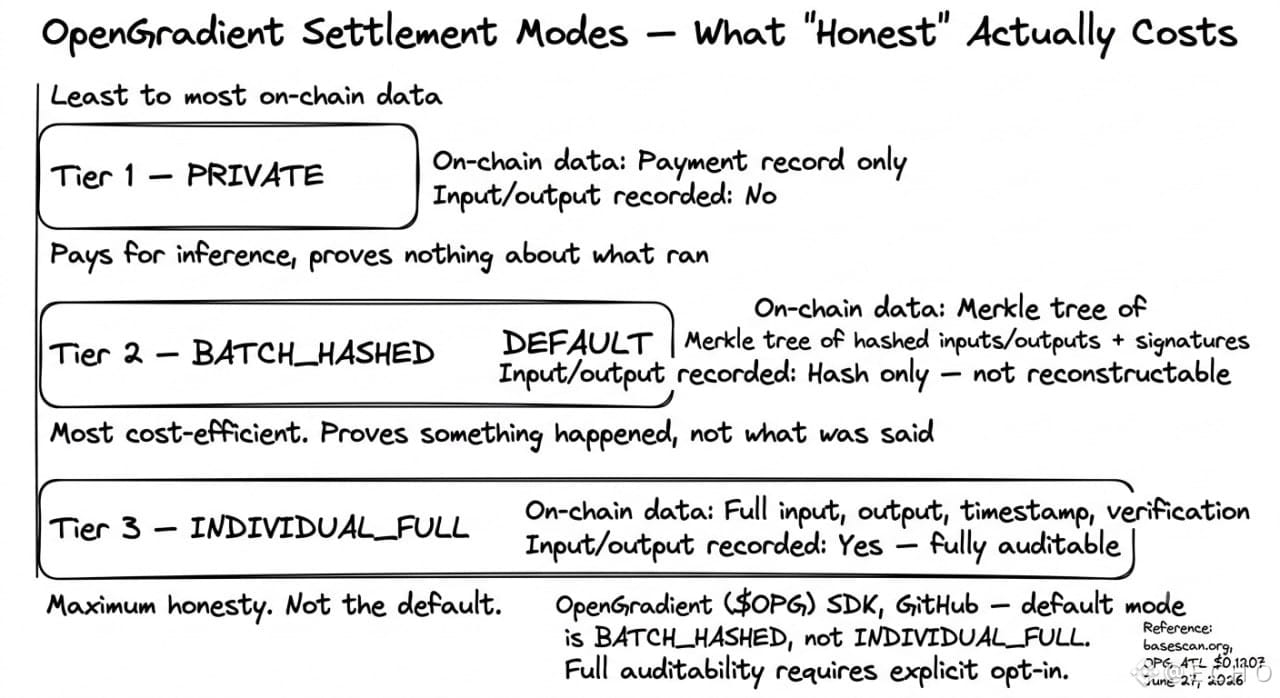
Drei Modi. PRIVATE — Zahlung wird erfasst, sonst nichts. BATCH_HASHED — Hashes der Eingaben und Ausgaben werden in einen Merkle-Baum gebündelt, kosteneffizient und zudem bemerkenswerterweise der Standard. INDIVIDUAL_FULL — Eingabe, Ausgabe, Zeitstempel und Verifikation werden allesamt on-chain geschrieben, maximale Nachvollziehbarkeit. Diese Hierarchie ist entscheidend. Der „honest“-Modus — also der, der tatsächlich erfasst, was angefragt wurde und was zurückkam — ist nicht das, was Entwickler standardmäßig bekommen, ohne danach zu fragen. Sie erhalten den gehashten Batch, der beweist, dass etwas passiert ist, aber nicht zulässt, dass man rekonstruieren kann, was.
Also macht OpenGradient KI ehrlicher? Technisch ja — sogar BATCH_HASHED ist besser nachverfolgbar als ein zentralisierter API-Aufruf. Aber „ehrlicher als gar nichts“ und „man kann tatsächlich auditieren, was das Modell gesagt hat“ sind zwei verschiedene Behauptungen. Mit $OPG , das heute bei etwa $0.133 notiert, nachdem es am 27. Juni nach einem Allzeittief von $0.1207 auf bascan.org eingebrochen war, preist der Markt offenbar keine vollständige Auditierbarkeit als Premium ein. Und die Standardwahl deutet darauf hin, dass das Projekt davon ausgeht, dass die meisten Entwickler den günstigeren Weg wählen.
Ich habe immer wieder abgewogen, ob das eine sinnvolle UX-Kompromisslösung ist oder eine stillschweigende Konzession: vollständige Transparenz kostet zu viel, um standardmäßig gesetzt zu sein.
Ich bin immer noch nicht ganz sicher, was davon zutrifft.
Etwas Kleines in den SDK-Dokumenten hat mich während dieser CreatorPad-Aufgabe aufgehalten. Ich habe Zeit mit OpenGradient $OPG @OpenGradient #OPG verbracht und bin immer wieder zu ein und demselben Punkt zurückgekehrt: den Settlement-Modus-Optionen, die direkt im SDK selbst eingebaut sind.
Drei Modi. PRIVATE — Zahlung wird erfasst, sonst nichts. BATCH_HASHED — Hashes der Eingaben und Ausgaben werden in einen Merkle-Baum gebündelt, kosteneffizient und zudem bemerkenswerterweise der Standard. INDIVIDUAL_FULL — Eingabe, Ausgabe, Zeitstempel und Verifikation werden allesamt on-chain geschrieben, maximale Nachvollziehbarkeit. Diese Hierarchie ist entscheidend. Der „honest“-Modus — also der, der tatsächlich erfasst, was angefragt wurde und was zurückkam — ist nicht das, was Entwickler standardmäßig bekommen, ohne danach zu fragen. Sie erhalten den gehashten Batch, der beweist, dass etwas passiert ist, aber nicht zulässt, dass man rekonstruieren kann, was.
Also macht OpenGradient KI ehrlicher? Technisch ja — sogar BATCH_HASHED ist besser nachverfolgbar als ein zentralisierter API-Aufruf. Aber „ehrlicher als gar nichts“ und „man kann tatsächlich auditieren, was das Modell gesagt hat“ sind zwei verschiedene Behauptungen. Mit $OPG , das heute bei etwa $0.133 notiert, nachdem es am 27. Juni nach einem Allzeittief von $0.1207 auf bascan.org eingebrochen war, preist der Markt offenbar keine vollständige Auditierbarkeit als Premium ein. Und die Standardwahl deutet darauf hin, dass das Projekt davon ausgeht, dass die meisten Entwickler den günstigeren Weg wählen.
Ich habe immer wieder abgewogen, ob das eine sinnvolle UX-Kompromisslösung ist oder eine stillschweigende Konzession: vollständige Transparenz kostet zu viel, um standardmäßig gesetzt zu sein.
Ich bin immer noch nicht ganz sicher, was davon zutrifft.
Drei Modi. PRIVATE — Zahlung wird erfasst, sonst nichts. BATCH_HASHED — Hashes der Eingaben und Ausgaben werden in einen Merkle-Baum gebündelt, kosteneffizient und zudem bemerkenswerterweise der Standard. INDIVIDUAL_FULL — Eingabe, Ausgabe, Zeitstempel und Verifikation werden allesamt on-chain geschrieben, maximale Nachvollziehbarkeit. Diese Hierarchie ist entscheidend. Der „honest“-Modus — also der, der tatsächlich erfasst, was angefragt wurde und was zurückkam — ist nicht das, was Entwickler standardmäßig bekommen, ohne danach zu fragen. Sie erhalten den gehashten Batch, der beweist, dass etwas passiert ist, aber nicht zulässt, dass man rekonstruieren kann, was.
Also macht OpenGradient KI ehrlicher? Technisch ja — sogar BATCH_HASHED ist besser nachverfolgbar als ein zentralisierter API-Aufruf. Aber „ehrlicher als gar nichts“ und „man kann tatsächlich auditieren, was das Modell gesagt hat“ sind zwei verschiedene Behauptungen. Mit $OPG , das heute bei etwa $0.133 notiert, nachdem es am 27. Juni nach einem Allzeittief von $0.1207 auf bascan.org eingebrochen war, preist der Markt offenbar keine vollständige Auditierbarkeit als Premium ein. Und die Standardwahl deutet darauf hin, dass das Projekt davon ausgeht, dass die meisten Entwickler den günstigeren Weg wählen.
Ich habe immer wieder abgewogen, ob das eine sinnvolle UX-Kompromisslösung ist oder eine stillschweigende Konzession: vollständige Transparenz kostet zu viel, um standardmäßig gesetzt zu sein.
Ich bin immer noch nicht ganz sicher, was davon zutrifft.
5
2
347
·
--
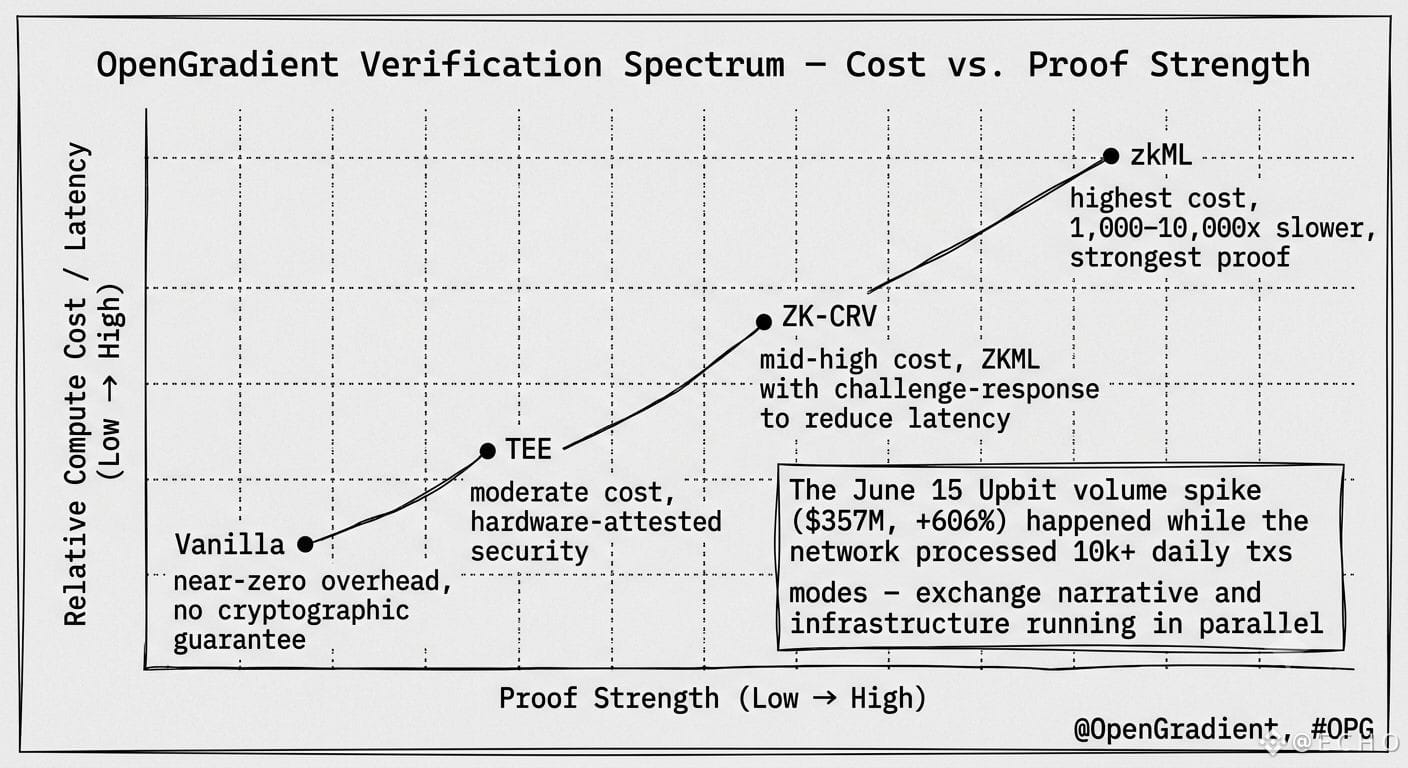
Das, was mich innehalten ließ — nicht die Tonhöhe, nicht die Token-Metriken — war das „Verifikationsmenü“. OpenGradient ermöglicht es Ihnen, auszuwählen, wie viel Belegkraft Sie pro Inferenz haben möchten: zkML, TEE, ZK-CRV oder ganz klassisch mit nahezu keinem Overhead. @OpenGradient rahmt das als eine Designentscheidung für Entwickler ein. In der Praxis ist es eine Aussage darüber, wie eine überprüfbare Welt tatsächlich aussieht — nicht uniform, nicht maximalistisch. Ein Spektrum. $OPG #OPG
Die Upbit-Notierung am 15. Juni schob das 24h-Volumen auf 357,69 Mio. $ — ein 606%iger Sprung bei einem Token mit damals 39 Mio. $ Marktkapitalisierung. Das ist reiner Momentum aus der Börsen-Erzählung. Und dennoch lief On-Chain das weiter, was es tut: 10.000+ tägliche Transaktionen, die sich gegen 4,2M+ erzeugte Blöcke absetzen, wobei Beweise sich schon beim Konsens festschreiben, bevor überhaupt etwas das Ledger berührt. Der Listing-Rauschen und das Infrastruktur-Signal liefen parallel, völlig entkoppelt.
Ich dachte immer wieder darüber nach, was „verifizierbar“ überhaupt im Maßstab bedeutet. Die Vision ist nicht, dass alles einen zkML-Beweis erhält — diese sind 1.000 bis 10.000 Mal langsamer und kosten mehr. Die Vision ist, dass die richtigen Dinge zu den richtigen Kosten überprüft werden. Ein DeFi-Risikomodell bekommt einen schweren Beweis. Eine lockere Agentenabfrage vielleicht nicht. Die Architektur kodiert dieses Urteil direkt.
Hmm … aber wer entscheidet, welche Inferenz den schweren Beweis verdient? Und wird diese Auswahl-Schicht irgendwann selbst zu einem Vertrauensproblem?
Das, was mich innehalten ließ — nicht die Tonhöhe, nicht die Token-Metriken — war das „Verifikationsmenü“. OpenGradient ermöglicht es Ihnen, auszuwählen, wie viel Belegkraft Sie pro Inferenz haben möchten: zkML, TEE, ZK-CRV oder ganz klassisch mit nahezu keinem Overhead. @OpenGradient rahmt das als eine Designentscheidung für Entwickler ein. In der Praxis ist es eine Aussage darüber, wie eine überprüfbare Welt tatsächlich aussieht — nicht uniform, nicht maximalistisch. Ein Spektrum. $OPG #OPG
Die Upbit-Notierung am 15. Juni schob das 24h-Volumen auf 357,69 Mio. $ — ein 606%iger Sprung bei einem Token mit damals 39 Mio. $ Marktkapitalisierung. Das ist reiner Momentum aus der Börsen-Erzählung. Und dennoch lief On-Chain das weiter, was es tut: 10.000+ tägliche Transaktionen, die sich gegen 4,2M+ erzeugte Blöcke absetzen, wobei Beweise sich schon beim Konsens festschreiben, bevor überhaupt etwas das Ledger berührt. Der Listing-Rauschen und das Infrastruktur-Signal liefen parallel, völlig entkoppelt.
Ich dachte immer wieder darüber nach, was „verifizierbar“ überhaupt im Maßstab bedeutet. Die Vision ist nicht, dass alles einen zkML-Beweis erhält — diese sind 1.000 bis 10.000 Mal langsamer und kosten mehr. Die Vision ist, dass die richtigen Dinge zu den richtigen Kosten überprüft werden. Ein DeFi-Risikomodell bekommt einen schweren Beweis. Eine lockere Agentenabfrage vielleicht nicht. Die Architektur kodiert dieses Urteil direkt.
Hmm … aber wer entscheidet, welche Inferenz den schweren Beweis verdient? Und wird diese Auswahl-Schicht irgendwann selbst zu einem Vertrauensproblem?
Die Upbit-Notierung am 15. Juni schob das 24h-Volumen auf 357,69 Mio. $ — ein 606%iger Sprung bei einem Token mit damals 39 Mio. $ Marktkapitalisierung. Das ist reiner Momentum aus der Börsen-Erzählung. Und dennoch lief On-Chain das weiter, was es tut: 10.000+ tägliche Transaktionen, die sich gegen 4,2M+ erzeugte Blöcke absetzen, wobei Beweise sich schon beim Konsens festschreiben, bevor überhaupt etwas das Ledger berührt. Der Listing-Rauschen und das Infrastruktur-Signal liefen parallel, völlig entkoppelt.
Ich dachte immer wieder darüber nach, was „verifizierbar“ überhaupt im Maßstab bedeutet. Die Vision ist nicht, dass alles einen zkML-Beweis erhält — diese sind 1.000 bis 10.000 Mal langsamer und kosten mehr. Die Vision ist, dass die richtigen Dinge zu den richtigen Kosten überprüft werden. Ein DeFi-Risikomodell bekommt einen schweren Beweis. Eine lockere Agentenabfrage vielleicht nicht. Die Architektur kodiert dieses Urteil direkt.
Hmm … aber wer entscheidet, welche Inferenz den schweren Beweis verdient? Und wird diese Auswahl-Schicht irgendwann selbst zu einem Vertrauensproblem?
5
2
152
·
--
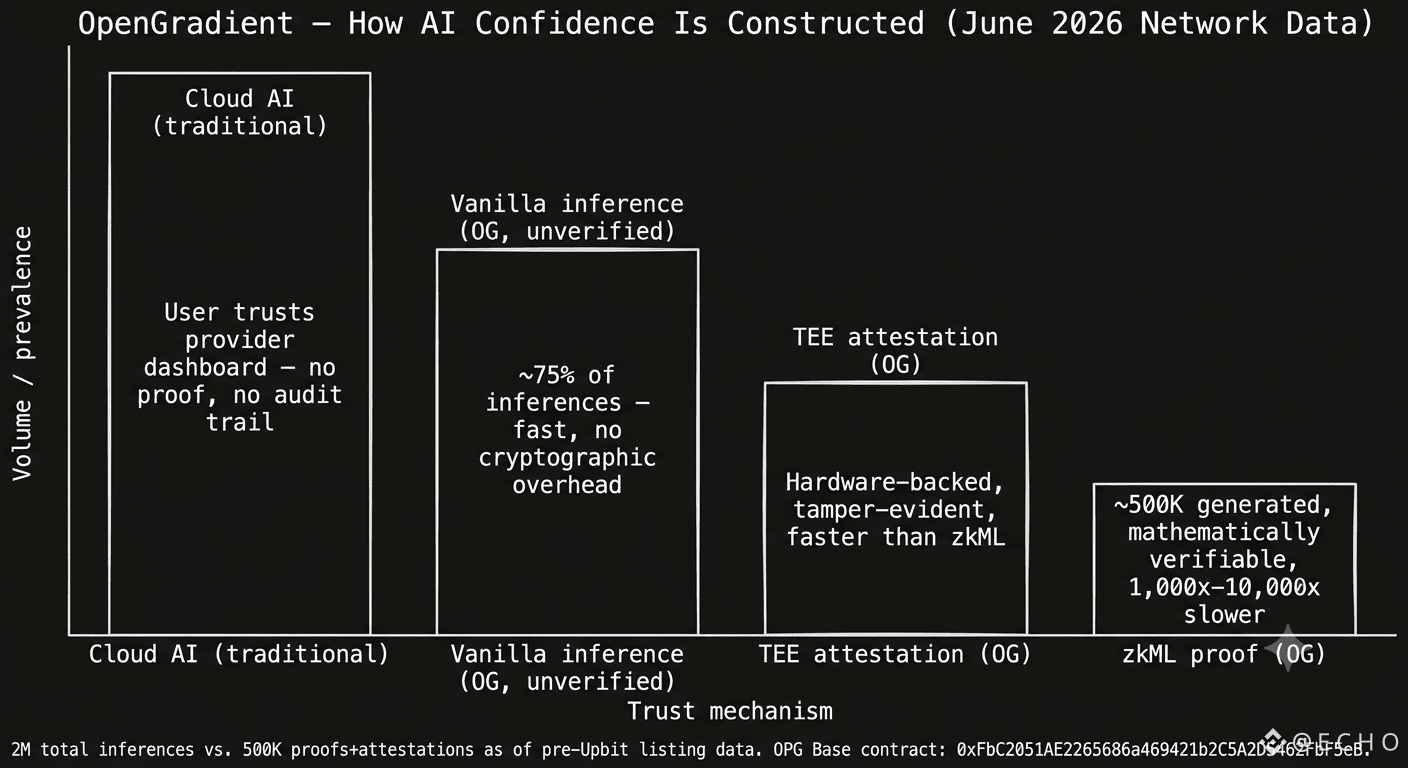
Das, was mich bei der Aufgabe tatsächlich mitten im Prozess gestoppt hat, war das Lesen der Architektur-Seite der OpenGradient-Dokumentation. Genauer: dieser Satz: „Once 2/3+ validators agree, the proof is permanently recorded on the ledger.“ Das ist keine Zusage. Das ist ein aktiver Konsensmechanismus. @OpenGradient hat bereits 500.000+ zkML-Proofs und TEE-Attestations erzeugt — über 2 Millionen verifizierbare Inferenzschritte hinweg. Und irgendwo in dieser Masse steckt ein öffentliches Vertrauensargument, das die KI-Industrie aus der Cloud heraus bis heute nicht zustande bringt. $OPG #OPG
Die Zahlen allein aus diesem Monat verleihen dem Ganzen Tiefe. Am 15. Juni hat das Upbit-Listing das 24-Stunden-Volumen auf 357 Mio. US-Dollar getrieben — mehr als neunmal die Marktkapitalisierung in einer Session. Der Preis schwankte heftig: von 0,3064 US-Dollar Eröffnung auf 0,1815 US-Dollar. Aber das Netzwerk darunter hat nicht mit der Wimper gezuckt. Täglich lagen On-Chain-Transaktionen über 10.000. 4,2 Millionen Blöcke wurden produziert. Die Maschinerie lief weiter — unabhängig von der Spekulationsschicht, die oben darauf sitzt.
Das ist das Entscheidende am Blickwinkel „öffentliches Vertrauen“. Die meisten KI-Systeme bitten dich, einem Dashboard zu vertrauen. OpenGradient bittet Validatoren, einem Proof zuzustimmen — und die Uneinigkeit selbst würde on-chain sichtbar sein. Während der Aufgabe bin ich genau bei diesem Gedanken hängen geblieben. Das ist eine wirklich andere erkenntnistheoretische Struktur für KI-Ausgaben.
…aber der unbequeme Drehpunkt ist dieser: 500K Proofs über 2 Millionen Inferenzschritte hinweg bedeutet ungefähr, dass bei 1 von 4 Inferenzschritten die volle Behandlung erfolgt ist. Wer hat entschieden, dass die anderen drei nicht verifiziert werden müssen?
Das, was mich bei der Aufgabe tatsächlich mitten im Prozess gestoppt hat, war das Lesen der Architektur-Seite der OpenGradient-Dokumentation. Genauer: dieser Satz: „Once 2/3+ validators agree, the proof is permanently recorded on the ledger.“ Das ist keine Zusage. Das ist ein aktiver Konsensmechanismus. @OpenGradient hat bereits 500.000+ zkML-Proofs und TEE-Attestations erzeugt — über 2 Millionen verifizierbare Inferenzschritte hinweg. Und irgendwo in dieser Masse steckt ein öffentliches Vertrauensargument, das die KI-Industrie aus der Cloud heraus bis heute nicht zustande bringt. $OPG #OPG
Die Zahlen allein aus diesem Monat verleihen dem Ganzen Tiefe. Am 15. Juni hat das Upbit-Listing das 24-Stunden-Volumen auf 357 Mio. US-Dollar getrieben — mehr als neunmal die Marktkapitalisierung in einer Session. Der Preis schwankte heftig: von 0,3064 US-Dollar Eröffnung auf 0,1815 US-Dollar. Aber das Netzwerk darunter hat nicht mit der Wimper gezuckt. Täglich lagen On-Chain-Transaktionen über 10.000. 4,2 Millionen Blöcke wurden produziert. Die Maschinerie lief weiter — unabhängig von der Spekulationsschicht, die oben darauf sitzt.
Das ist das Entscheidende am Blickwinkel „öffentliches Vertrauen“. Die meisten KI-Systeme bitten dich, einem Dashboard zu vertrauen. OpenGradient bittet Validatoren, einem Proof zuzustimmen — und die Uneinigkeit selbst würde on-chain sichtbar sein. Während der Aufgabe bin ich genau bei diesem Gedanken hängen geblieben. Das ist eine wirklich andere erkenntnistheoretische Struktur für KI-Ausgaben.
…aber der unbequeme Drehpunkt ist dieser: 500K Proofs über 2 Millionen Inferenzschritte hinweg bedeutet ungefähr, dass bei 1 von 4 Inferenzschritten die volle Behandlung erfolgt ist. Wer hat entschieden, dass die anderen drei nicht verifiziert werden müssen?
Die Zahlen allein aus diesem Monat verleihen dem Ganzen Tiefe. Am 15. Juni hat das Upbit-Listing das 24-Stunden-Volumen auf 357 Mio. US-Dollar getrieben — mehr als neunmal die Marktkapitalisierung in einer Session. Der Preis schwankte heftig: von 0,3064 US-Dollar Eröffnung auf 0,1815 US-Dollar. Aber das Netzwerk darunter hat nicht mit der Wimper gezuckt. Täglich lagen On-Chain-Transaktionen über 10.000. 4,2 Millionen Blöcke wurden produziert. Die Maschinerie lief weiter — unabhängig von der Spekulationsschicht, die oben darauf sitzt.
Das ist das Entscheidende am Blickwinkel „öffentliches Vertrauen“. Die meisten KI-Systeme bitten dich, einem Dashboard zu vertrauen. OpenGradient bittet Validatoren, einem Proof zuzustimmen — und die Uneinigkeit selbst würde on-chain sichtbar sein. Während der Aufgabe bin ich genau bei diesem Gedanken hängen geblieben. Das ist eine wirklich andere erkenntnistheoretische Struktur für KI-Ausgaben.
…aber der unbequeme Drehpunkt ist dieser: 500K Proofs über 2 Millionen Inferenzschritte hinweg bedeutet ungefähr, dass bei 1 von 4 Inferenzschritten die volle Behandlung erfolgt ist. Wer hat entschieden, dass die anderen drei nicht verifiziert werden müssen?
6
1
148
·
--
Etwas hat mich mitten in meiner Aufgabe gestoppt. Nicht die Unternehmens-AI-Präsentation. Das eigentliche Ding, das darunter gebaut wird.
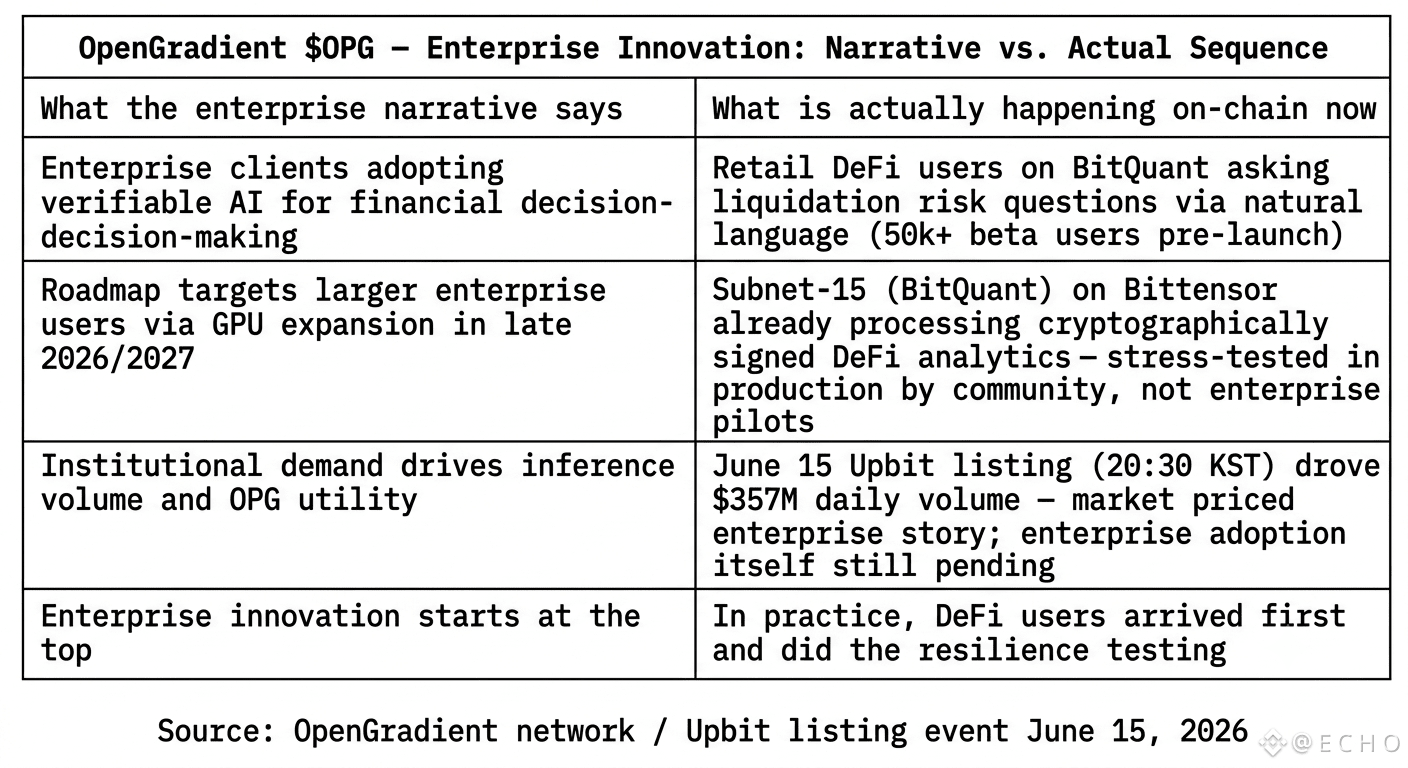
OpenGradient $OPG @OpenGradient #OPG vermarktet sich in Richtung Unternehmensinnovation – verifizierbare AI für DeFi, Finanzagenten, prüfbare Inferenz. Die Roadmap-Sprache deutet auf eine GPU-Erweiterung bis 2027 hin, um größere Unternehmensnutzer zu gewinnen. Aber die Live-Anwendung, die gerade echte Arbeit verrichtet, ist BitQuant, ein Open-Source-DeFi-Quant-Agent, der im Subnetz-15 von Bittensor läuft – verarbeitet natürliche Sprachrisikoanfragen wie "wenn SOL um 20% fällt, welche Pools liquidieren?" und gibt kryptografisch signierte Antworten zurück. Kein Unternehmensdeal. Ein genehmigungsfreies Tool, das von und für Degens zuerst gebaut wurde.
Das ist die Sequenz, die Unternehmen ständig über dieses Infrastrukturmodell übersehen. Der ernsthafte institutionelle Anwendungsfall – prüfbare AI-Entscheidungen für finanzielle Risiken – wird in der Wildnis von Retail-DeFi-Nutzern getestet, die echte Liquidationsfragen stellen, bevor irgendein Beschaffungsteam damit in Berührung kommt. Die über 50.000 Beta-Nutzer von BitQuant vor dem Launch haben im Grunde Unternehmens-Grade Zuverlässigkeitstests durchgeführt, ohne es so zu nennen.
Dann kam das Upbit-Listing am 15. Juni um 20:30 KST, das 24-Stunden-OPG-Volumen schoss auf 357 Millionen Dollar. Der Markt hat die Unternehmensgeschichte eingepreist. Die eigentliche Unternehmensgeschichte wird immer noch eine DeFi-Anfrage nach der anderen geschrieben.
Ich denke ständig darüber nach, welche Unternehmen tatsächlich zuerst handeln würden – und ob sie die Nachweis-Infrastruktur bereits aufgewärmt vorfinden würden, wenn sie hier ankommen, oder ob sie immer noch zu rau um die Kanten sind…
Etwas hat mich mitten in meiner Aufgabe gestoppt. Nicht die Unternehmens-AI-Präsentation. Das eigentliche Ding, das darunter gebaut wird.
OpenGradient $OPG @OpenGradient #OPG vermarktet sich in Richtung Unternehmensinnovation – verifizierbare AI für DeFi, Finanzagenten, prüfbare Inferenz. Die Roadmap-Sprache deutet auf eine GPU-Erweiterung bis 2027 hin, um größere Unternehmensnutzer zu gewinnen. Aber die Live-Anwendung, die gerade echte Arbeit verrichtet, ist BitQuant, ein Open-Source-DeFi-Quant-Agent, der im Subnetz-15 von Bittensor läuft – verarbeitet natürliche Sprachrisikoanfragen wie "wenn SOL um 20% fällt, welche Pools liquidieren?" und gibt kryptografisch signierte Antworten zurück. Kein Unternehmensdeal. Ein genehmigungsfreies Tool, das von und für Degens zuerst gebaut wurde.
Das ist die Sequenz, die Unternehmen ständig über dieses Infrastrukturmodell übersehen. Der ernsthafte institutionelle Anwendungsfall – prüfbare AI-Entscheidungen für finanzielle Risiken – wird in der Wildnis von Retail-DeFi-Nutzern getestet, die echte Liquidationsfragen stellen, bevor irgendein Beschaffungsteam damit in Berührung kommt. Die über 50.000 Beta-Nutzer von BitQuant vor dem Launch haben im Grunde Unternehmens-Grade Zuverlässigkeitstests durchgeführt, ohne es so zu nennen.
Dann kam das Upbit-Listing am 15. Juni um 20:30 KST, das 24-Stunden-OPG-Volumen schoss auf 357 Millionen Dollar. Der Markt hat die Unternehmensgeschichte eingepreist. Die eigentliche Unternehmensgeschichte wird immer noch eine DeFi-Anfrage nach der anderen geschrieben.
Ich denke ständig darüber nach, welche Unternehmen tatsächlich zuerst handeln würden – und ob sie die Nachweis-Infrastruktur bereits aufgewärmt vorfinden würden, wenn sie hier ankommen, oder ob sie immer noch zu rau um die Kanten sind…
OpenGradient $OPG @OpenGradient #OPG vermarktet sich in Richtung Unternehmensinnovation – verifizierbare AI für DeFi, Finanzagenten, prüfbare Inferenz. Die Roadmap-Sprache deutet auf eine GPU-Erweiterung bis 2027 hin, um größere Unternehmensnutzer zu gewinnen. Aber die Live-Anwendung, die gerade echte Arbeit verrichtet, ist BitQuant, ein Open-Source-DeFi-Quant-Agent, der im Subnetz-15 von Bittensor läuft – verarbeitet natürliche Sprachrisikoanfragen wie "wenn SOL um 20% fällt, welche Pools liquidieren?" und gibt kryptografisch signierte Antworten zurück. Kein Unternehmensdeal. Ein genehmigungsfreies Tool, das von und für Degens zuerst gebaut wurde.
Das ist die Sequenz, die Unternehmen ständig über dieses Infrastrukturmodell übersehen. Der ernsthafte institutionelle Anwendungsfall – prüfbare AI-Entscheidungen für finanzielle Risiken – wird in der Wildnis von Retail-DeFi-Nutzern getestet, die echte Liquidationsfragen stellen, bevor irgendein Beschaffungsteam damit in Berührung kommt. Die über 50.000 Beta-Nutzer von BitQuant vor dem Launch haben im Grunde Unternehmens-Grade Zuverlässigkeitstests durchgeführt, ohne es so zu nennen.
Dann kam das Upbit-Listing am 15. Juni um 20:30 KST, das 24-Stunden-OPG-Volumen schoss auf 357 Millionen Dollar. Der Markt hat die Unternehmensgeschichte eingepreist. Die eigentliche Unternehmensgeschichte wird immer noch eine DeFi-Anfrage nach der anderen geschrieben.
Ich denke ständig darüber nach, welche Unternehmen tatsächlich zuerst handeln würden – und ob sie die Nachweis-Infrastruktur bereits aufgewärmt vorfinden würden, wenn sie hier ankommen, oder ob sie immer noch zu rau um die Kanten sind…
25
21
149
·
--
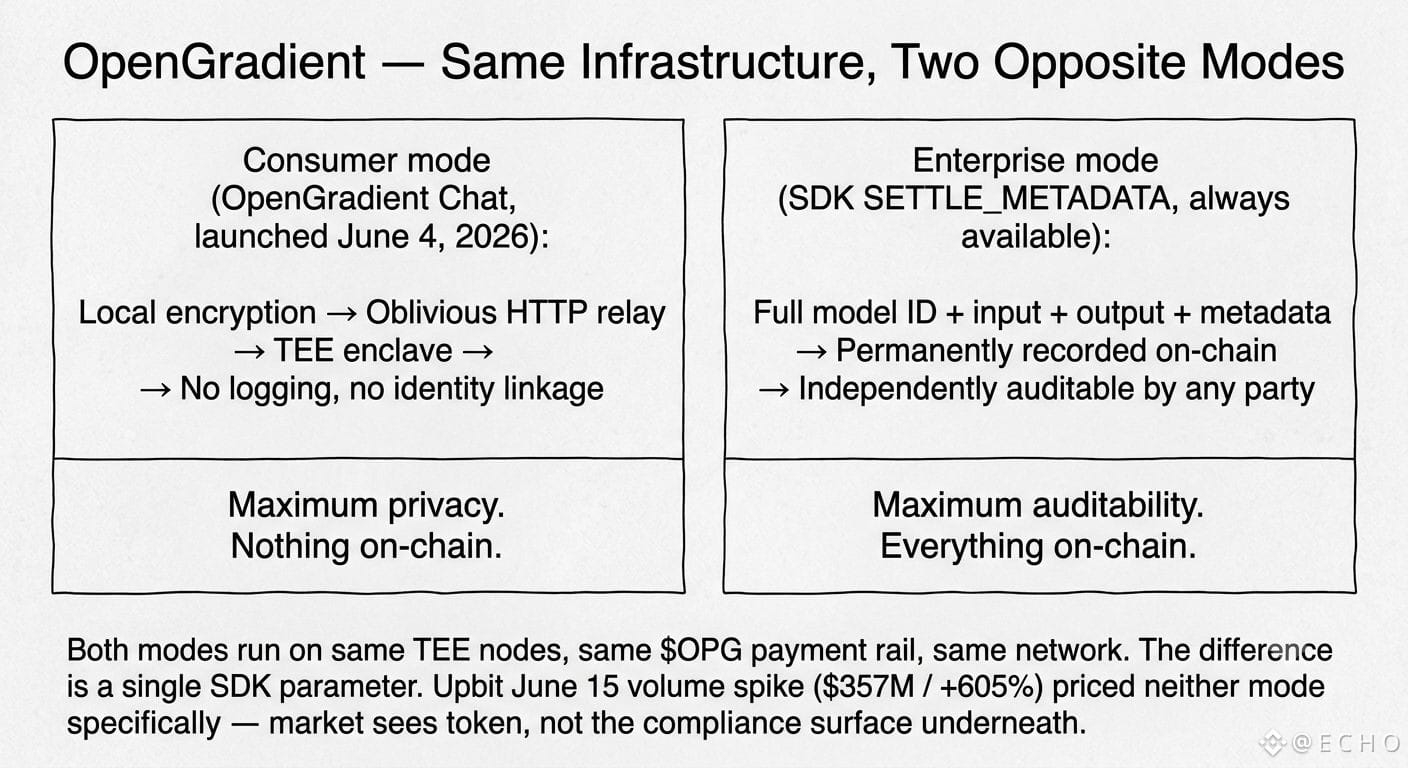
Was mich mitten in der Aufgabe aufgehalten hat, war nicht die Agentengeschichte oder die Token-Mechanik. Es war ein Detail, das in den @OpenGradient SDK-Dokumenten vergraben war: Es gibt einen Abrechnungsmodus namens SETTLE_METADATA, der deine gesamten Modell-Eingabe-, Ausgabe- und Inferenz-Metadaten dauerhaft on-chain speichert. Kein Hash. Das Ganze. Das ist ein Compliance-Dokument für Unternehmen, das sich hinter einer Entwickler-Option versteckt, die die meisten Leute wahrscheinlich nie aktivieren. $OPG #OPG
Hier ist, warum es mich gepackt hat. OpenGradient Chat wurde am 4. Juni mit einer Datenschutz-zuerst-Architektur gestartet — lokale Verschlüsselung, oblivious HTTP-Relay, TEE-isoliertes Gateway. Die ganze Ansage ist, dass deine Eingaben unsichtbar bleiben. Das ist das Verbraucherprodukt. Aber unter der gleichen Infrastruktur bietet das SDK den genauen gegenteiligen Schalter für Unternehmen: maximale Transparenz, vollständige Nachvollziehbarkeit, jede Inferenz dauerhaft on-chain lesbar. Beides ist real. Beides ist aktiv.
Ich habe die Listing-Aktivität von Upbit am 15. Juni durchforstet — $357M Volumen, 605% Spike — und fast keine Aufmerksamkeit wurde darauf gerichtet. Der Markt bewertet $OPG als ein AI-Narrativ-Token. Das, was es tatsächlich sein könnte, ist eine Compliance-Schicht, die Unternehmen nicht wussten, dass sie sie brauchen, die ruhig unter einer Verbraucher-Datenschutz-App sitzt.
…ich überlege immer noch, ob ein Beschaffungsteam eines Unternehmens realistisch die Entscheidung für eine crypto-abgerechnete Inferenz über ihre bestehenden Lieferanten-Beziehungen treffen würde. Diese Reibung wurde nicht einfach durch den Bau des technischen Nachweises gelöst.
Was mich mitten in der Aufgabe aufgehalten hat, war nicht die Agentengeschichte oder die Token-Mechanik. Es war ein Detail, das in den @OpenGradient SDK-Dokumenten vergraben war: Es gibt einen Abrechnungsmodus namens SETTLE_METADATA, der deine gesamten Modell-Eingabe-, Ausgabe- und Inferenz-Metadaten dauerhaft on-chain speichert. Kein Hash. Das Ganze. Das ist ein Compliance-Dokument für Unternehmen, das sich hinter einer Entwickler-Option versteckt, die die meisten Leute wahrscheinlich nie aktivieren. $OPG #OPG
Hier ist, warum es mich gepackt hat. OpenGradient Chat wurde am 4. Juni mit einer Datenschutz-zuerst-Architektur gestartet — lokale Verschlüsselung, oblivious HTTP-Relay, TEE-isoliertes Gateway. Die ganze Ansage ist, dass deine Eingaben unsichtbar bleiben. Das ist das Verbraucherprodukt. Aber unter der gleichen Infrastruktur bietet das SDK den genauen gegenteiligen Schalter für Unternehmen: maximale Transparenz, vollständige Nachvollziehbarkeit, jede Inferenz dauerhaft on-chain lesbar. Beides ist real. Beides ist aktiv.
Ich habe die Listing-Aktivität von Upbit am 15. Juni durchforstet — $357M Volumen, 605% Spike — und fast keine Aufmerksamkeit wurde darauf gerichtet. Der Markt bewertet $OPG als ein AI-Narrativ-Token. Das, was es tatsächlich sein könnte, ist eine Compliance-Schicht, die Unternehmen nicht wussten, dass sie sie brauchen, die ruhig unter einer Verbraucher-Datenschutz-App sitzt.
…ich überlege immer noch, ob ein Beschaffungsteam eines Unternehmens realistisch die Entscheidung für eine crypto-abgerechnete Inferenz über ihre bestehenden Lieferanten-Beziehungen treffen würde. Diese Reibung wurde nicht einfach durch den Bau des technischen Nachweises gelöst.
Hier ist, warum es mich gepackt hat. OpenGradient Chat wurde am 4. Juni mit einer Datenschutz-zuerst-Architektur gestartet — lokale Verschlüsselung, oblivious HTTP-Relay, TEE-isoliertes Gateway. Die ganze Ansage ist, dass deine Eingaben unsichtbar bleiben. Das ist das Verbraucherprodukt. Aber unter der gleichen Infrastruktur bietet das SDK den genauen gegenteiligen Schalter für Unternehmen: maximale Transparenz, vollständige Nachvollziehbarkeit, jede Inferenz dauerhaft on-chain lesbar. Beides ist real. Beides ist aktiv.
Ich habe die Listing-Aktivität von Upbit am 15. Juni durchforstet — $357M Volumen, 605% Spike — und fast keine Aufmerksamkeit wurde darauf gerichtet. Der Markt bewertet $OPG als ein AI-Narrativ-Token. Das, was es tatsächlich sein könnte, ist eine Compliance-Schicht, die Unternehmen nicht wussten, dass sie sie brauchen, die ruhig unter einer Verbraucher-Datenschutz-App sitzt.
…ich überlege immer noch, ob ein Beschaffungsteam eines Unternehmens realistisch die Entscheidung für eine crypto-abgerechnete Inferenz über ihre bestehenden Lieferanten-Beziehungen treffen würde. Diese Reibung wurde nicht einfach durch den Bau des technischen Nachweises gelöst.
160
·
--
Der Moment, der mir während der CreatorPad-Aufgabe am stärksten im Gedächtnis blieb, stand nicht in der Doku. Es war eine Zahl. @OpenGradient befindet sich derzeit bei 263.500+ einzigartigen Wallets, und das Netzwerk hat bereits 4,2 Millionen Blöcke überschritten — aber insgesamt nur ~1,85 Millionen On-Chain-Transaktionen. Das ist ein eher dünnes Tx-zu-Wallet-Verhältnis für ein Projekt, dessen gesamte Zukunft angeblich an autonomen KI-Agenten hängt, die ständig Transaktionen durchführen. $OPG #OPG
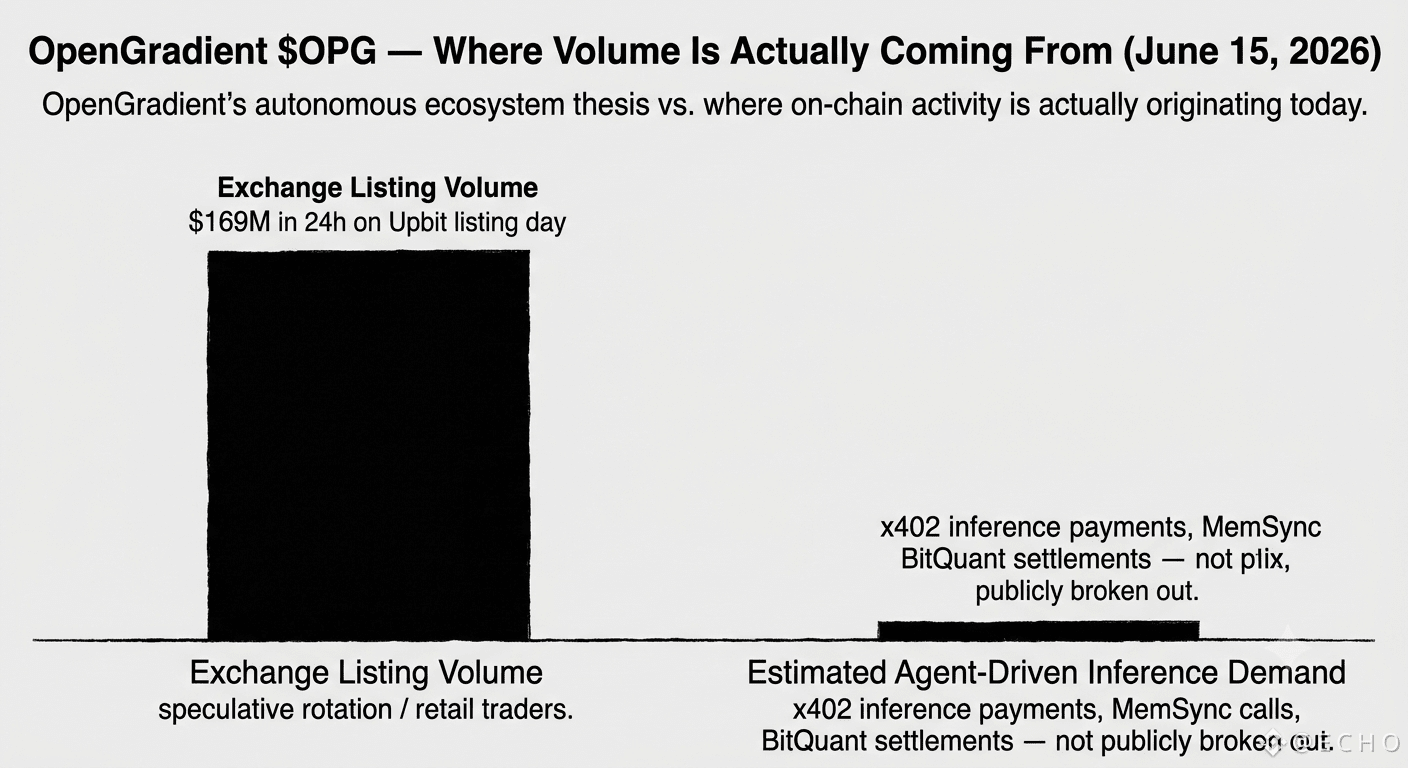
Der Pitch für autonome Ökosysteme lautet: KI-Agenten werden irgendwann Modelle aufrufen, in $OPG via x402 bezahlen, Kontext in MemSync speichern, sich über andere Agenten hinweg koordinieren, sich wiederholen — alles ohne dass Menschen es anfassen. Und strukturell sind die Schienen dafür vorhanden. Das x402-Gateway ist live. MemSync bietet Agenten persistenten Speicher über Sessions hinweg. Der Model Hub hat 2.000+ Modelle bereitstehen. Die Grundlage ist wirklich da.
Aber das ist der Punkt, zu dem ich immer wieder zurückgekehrt bin: Als Upbit $OPG am 15. Juni gelistet hat und das Volumen innerhalb von 24 Stunden auf 357 Mio. $ explodierte — das waren keine Agenten, die transaktieren. Das waren Menschen, die rotierten, ein- und ausstiegen, und darauf spekulierten, wie autonome Aktivitäten irgendwann aussehen könnten. Die Nutzung, die gerade tatsächlich stattfindet, sind Menschen, die auf KI-Tools zugreifen — nicht Agenten, die andere Agenten beauftragen.
Das ist kein zwingender, fataler Fehler. Infrastruktur bleibt oft still, bevor die Nachfrage anzieht. Aber es gibt eine Version davon, in der das autonome Ökosystem dauerhaft zwei Punkte auf der Roadmap hinterherhinkt, während menschliche Spekulanten weiterhin seine Geschichte schreiben.
Materialisiert sich hier wirklich die Agent-zu-Agent-Ökonomie, oder wird OpenGradient am Ende vor allem ein Entwickler-Tool mit einer agentischen Story, die immer ihrer Zeit voraus war…
Der Moment, der mir während der CreatorPad-Aufgabe am stärksten im Gedächtnis blieb, stand nicht in der Doku. Es war eine Zahl. @OpenGradient befindet sich derzeit bei 263.500+ einzigartigen Wallets, und das Netzwerk hat bereits 4,2 Millionen Blöcke überschritten — aber insgesamt nur ~1,85 Millionen On-Chain-Transaktionen. Das ist ein eher dünnes Tx-zu-Wallet-Verhältnis für ein Projekt, dessen gesamte Zukunft angeblich an autonomen KI-Agenten hängt, die ständig Transaktionen durchführen. $OPG #OPG
Der Pitch für autonome Ökosysteme lautet: KI-Agenten werden irgendwann Modelle aufrufen, in $OPG via x402 bezahlen, Kontext in MemSync speichern, sich über andere Agenten hinweg koordinieren, sich wiederholen — alles ohne dass Menschen es anfassen. Und strukturell sind die Schienen dafür vorhanden. Das x402-Gateway ist live. MemSync bietet Agenten persistenten Speicher über Sessions hinweg. Der Model Hub hat 2.000+ Modelle bereitstehen. Die Grundlage ist wirklich da.
Aber das ist der Punkt, zu dem ich immer wieder zurückgekehrt bin: Als Upbit $OPG am 15. Juni gelistet hat und das Volumen innerhalb von 24 Stunden auf 357 Mio. $ explodierte — das waren keine Agenten, die transaktieren. Das waren Menschen, die rotierten, ein- und ausstiegen, und darauf spekulierten, wie autonome Aktivitäten irgendwann aussehen könnten. Die Nutzung, die gerade tatsächlich stattfindet, sind Menschen, die auf KI-Tools zugreifen — nicht Agenten, die andere Agenten beauftragen.
Das ist kein zwingender, fataler Fehler. Infrastruktur bleibt oft still, bevor die Nachfrage anzieht. Aber es gibt eine Version davon, in der das autonome Ökosystem dauerhaft zwei Punkte auf der Roadmap hinterherhinkt, während menschliche Spekulanten weiterhin seine Geschichte schreiben.
Materialisiert sich hier wirklich die Agent-zu-Agent-Ökonomie, oder wird OpenGradient am Ende vor allem ein Entwickler-Tool mit einer agentischen Story, die immer ihrer Zeit voraus war…
Der Pitch für autonome Ökosysteme lautet: KI-Agenten werden irgendwann Modelle aufrufen, in $OPG via x402 bezahlen, Kontext in MemSync speichern, sich über andere Agenten hinweg koordinieren, sich wiederholen — alles ohne dass Menschen es anfassen. Und strukturell sind die Schienen dafür vorhanden. Das x402-Gateway ist live. MemSync bietet Agenten persistenten Speicher über Sessions hinweg. Der Model Hub hat 2.000+ Modelle bereitstehen. Die Grundlage ist wirklich da.
Aber das ist der Punkt, zu dem ich immer wieder zurückgekehrt bin: Als Upbit $OPG am 15. Juni gelistet hat und das Volumen innerhalb von 24 Stunden auf 357 Mio. $ explodierte — das waren keine Agenten, die transaktieren. Das waren Menschen, die rotierten, ein- und ausstiegen, und darauf spekulierten, wie autonome Aktivitäten irgendwann aussehen könnten. Die Nutzung, die gerade tatsächlich stattfindet, sind Menschen, die auf KI-Tools zugreifen — nicht Agenten, die andere Agenten beauftragen.
Das ist kein zwingender, fataler Fehler. Infrastruktur bleibt oft still, bevor die Nachfrage anzieht. Aber es gibt eine Version davon, in der das autonome Ökosystem dauerhaft zwei Punkte auf der Roadmap hinterherhinkt, während menschliche Spekulanten weiterhin seine Geschichte schreiben.
Materialisiert sich hier wirklich die Agent-zu-Agent-Ökonomie, oder wird OpenGradient am Ende vor allem ein Entwickler-Tool mit einer agentischen Story, die immer ihrer Zeit voraus war…
1
125
·
--
Etwas ist mitten im Auftrag passiert, womit ich nicht gerechnet hatte. @OpenGradient , $OPG, #OPG — der Blickwinkel auf die autonome wirtschaftliche Aktivität klingt abstrakt, bis man nachvollzieht, wie die Zahlungs-Schleife tatsächlich geschlossen wird.
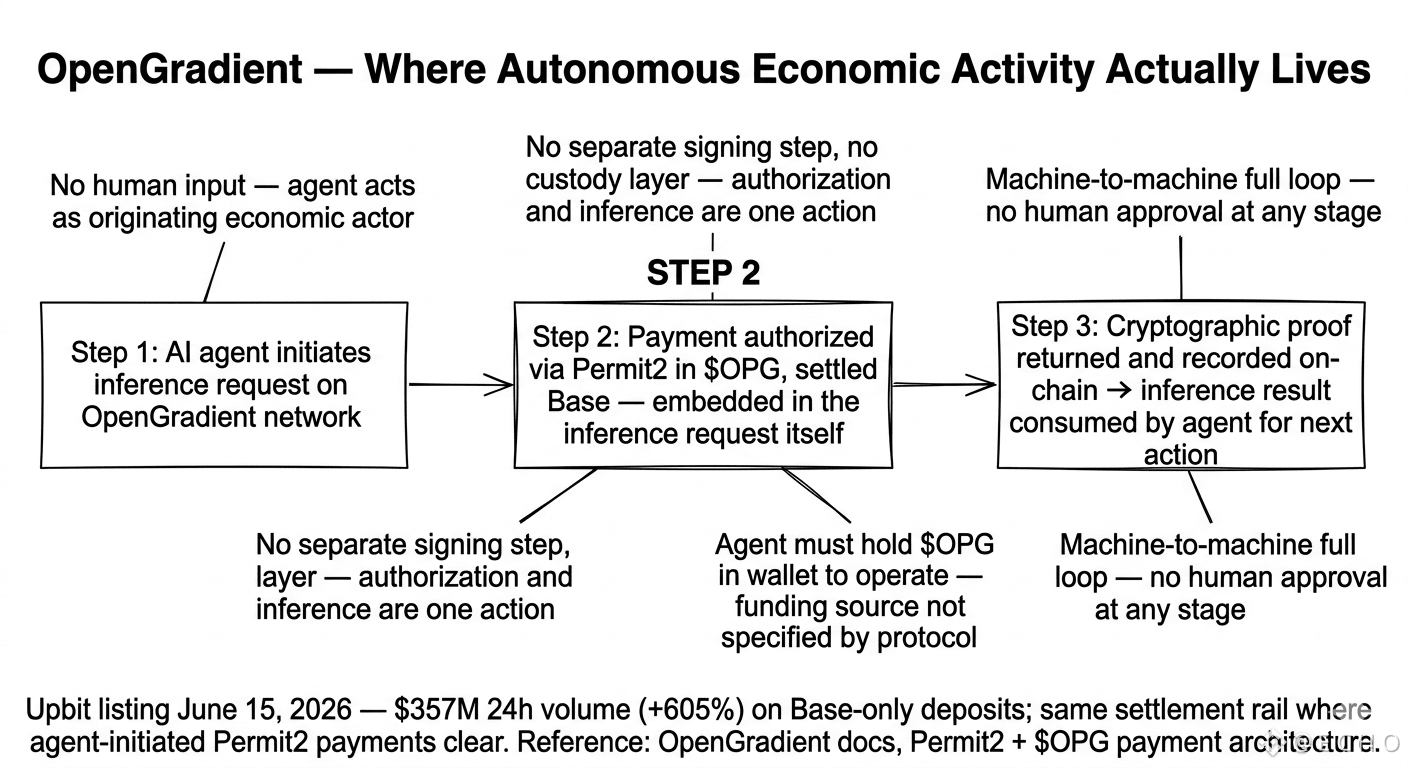
Jeder verifizierte KI-Aufruf im Netzwerk zahlt sich in $OPG auf Base über Permit2 aus. Kein API-Schlüssel. Keine Kreditkarte. Kein Mensch, der die Transaktion freigibt. Der Agent hält eine Wallet, stellt eine Inferenz-Anfrage, zahlt, bekommt ein kryptografisches Ergebnis zurück. Das ist alles. Das Ganze ist Maschine-zu-Maschine, in einem Token denominiert, und wird in einem öffentlichen Ledger abgewickelt. Als Upbit am 15. Juni OPG gelistet hat und das Volumen in 24 Stunden $357M erreichte — ein 605%-Sprung — landete diese Liquidität auf einem Netzwerk, in dem die tatsächlichen wirtschaftlichen Akteure, die On-Chain-Transaktionen auslösen, zunehmend nicht Menschen sind. Das sind Agents, die BitQuant-Strategien oder MemSync-Workflows ausführen, wobei jeder pro Aufruf $OPG ausgibt.
Ich habe diesen Permit2-Detail immer wieder gelesen. Denn die meisten „autonomen Agent“-Projekte haben irgendwo im Prozess einen Menschen — einen Wallet-Signer, eine Custody-Schicht, irgendetwas. Hier ist die Zahlungsautorisierung direkt in die Inferenz-Anfrage selbst eingebaut. Der Agent ist der wirtschaftliche Akteur von Anfang bis Ende.
Hmm… aber das bedeutet auch: Der Agent muss $OPG halten, um zu funktionieren. Und das wirft eine Frage auf, die bisher niemand wirklich beantwortet hat: Wer kapitalisiert diese Agents, und macht diese Abhängigkeit die ganze Sache still und leise wieder zentral um die Person herum, die die Wallet finanziert?
Etwas ist mitten im Auftrag passiert, womit ich nicht gerechnet hatte. @OpenGradient , $OPG , #OPG — der Blickwinkel auf die autonome wirtschaftliche Aktivität klingt abstrakt, bis man nachvollzieht, wie die Zahlungs-Schleife tatsächlich geschlossen wird.
Jeder verifizierte KI-Aufruf im Netzwerk zahlt sich in $OPG auf Base über Permit2 aus. Kein API-Schlüssel. Keine Kreditkarte. Kein Mensch, der die Transaktion freigibt. Der Agent hält eine Wallet, stellt eine Inferenz-Anfrage, zahlt, bekommt ein kryptografisches Ergebnis zurück. Das ist alles. Das Ganze ist Maschine-zu-Maschine, in einem Token denominiert, und wird in einem öffentlichen Ledger abgewickelt. Als Upbit am 15. Juni OPG gelistet hat und das Volumen in 24 Stunden $357M erreichte — ein 605%-Sprung — landete diese Liquidität auf einem Netzwerk, in dem die tatsächlichen wirtschaftlichen Akteure, die On-Chain-Transaktionen auslösen, zunehmend nicht Menschen sind. Das sind Agents, die BitQuant-Strategien oder MemSync-Workflows ausführen, wobei jeder pro Aufruf $OPG ausgibt.
Ich habe diesen Permit2-Detail immer wieder gelesen. Denn die meisten „autonomen Agent“-Projekte haben irgendwo im Prozess einen Menschen — einen Wallet-Signer, eine Custody-Schicht, irgendetwas. Hier ist die Zahlungsautorisierung direkt in die Inferenz-Anfrage selbst eingebaut. Der Agent ist der wirtschaftliche Akteur von Anfang bis Ende.
Hmm… aber das bedeutet auch: Der Agent muss $OPG halten, um zu funktionieren. Und das wirft eine Frage auf, die bisher niemand wirklich beantwortet hat: Wer kapitalisiert diese Agents, und macht diese Abhängigkeit die ganze Sache still und leise wieder zentral um die Person herum, die die Wallet finanziert?
Jeder verifizierte KI-Aufruf im Netzwerk zahlt sich in $OPG auf Base über Permit2 aus. Kein API-Schlüssel. Keine Kreditkarte. Kein Mensch, der die Transaktion freigibt. Der Agent hält eine Wallet, stellt eine Inferenz-Anfrage, zahlt, bekommt ein kryptografisches Ergebnis zurück. Das ist alles. Das Ganze ist Maschine-zu-Maschine, in einem Token denominiert, und wird in einem öffentlichen Ledger abgewickelt. Als Upbit am 15. Juni OPG gelistet hat und das Volumen in 24 Stunden $357M erreichte — ein 605%-Sprung — landete diese Liquidität auf einem Netzwerk, in dem die tatsächlichen wirtschaftlichen Akteure, die On-Chain-Transaktionen auslösen, zunehmend nicht Menschen sind. Das sind Agents, die BitQuant-Strategien oder MemSync-Workflows ausführen, wobei jeder pro Aufruf $OPG ausgibt.
Ich habe diesen Permit2-Detail immer wieder gelesen. Denn die meisten „autonomen Agent“-Projekte haben irgendwo im Prozess einen Menschen — einen Wallet-Signer, eine Custody-Schicht, irgendetwas. Hier ist die Zahlungsautorisierung direkt in die Inferenz-Anfrage selbst eingebaut. Der Agent ist der wirtschaftliche Akteur von Anfang bis Ende.
Hmm… aber das bedeutet auch: Der Agent muss $OPG halten, um zu funktionieren. Und das wirft eine Frage auf, die bisher niemand wirklich beantwortet hat: Wer kapitalisiert diese Agents, und macht diese Abhängigkeit die ganze Sache still und leise wieder zentral um die Person herum, die die Wallet finanziert?
2
1
167
·
--
Das Ding, das mir während dieser @OpenGradient Aufgabe ständig im Kopf rumspukte, war nicht das große Vertrauensthema – es war ein stilles architektonisches Detail in den Docs. $OPG #OPG
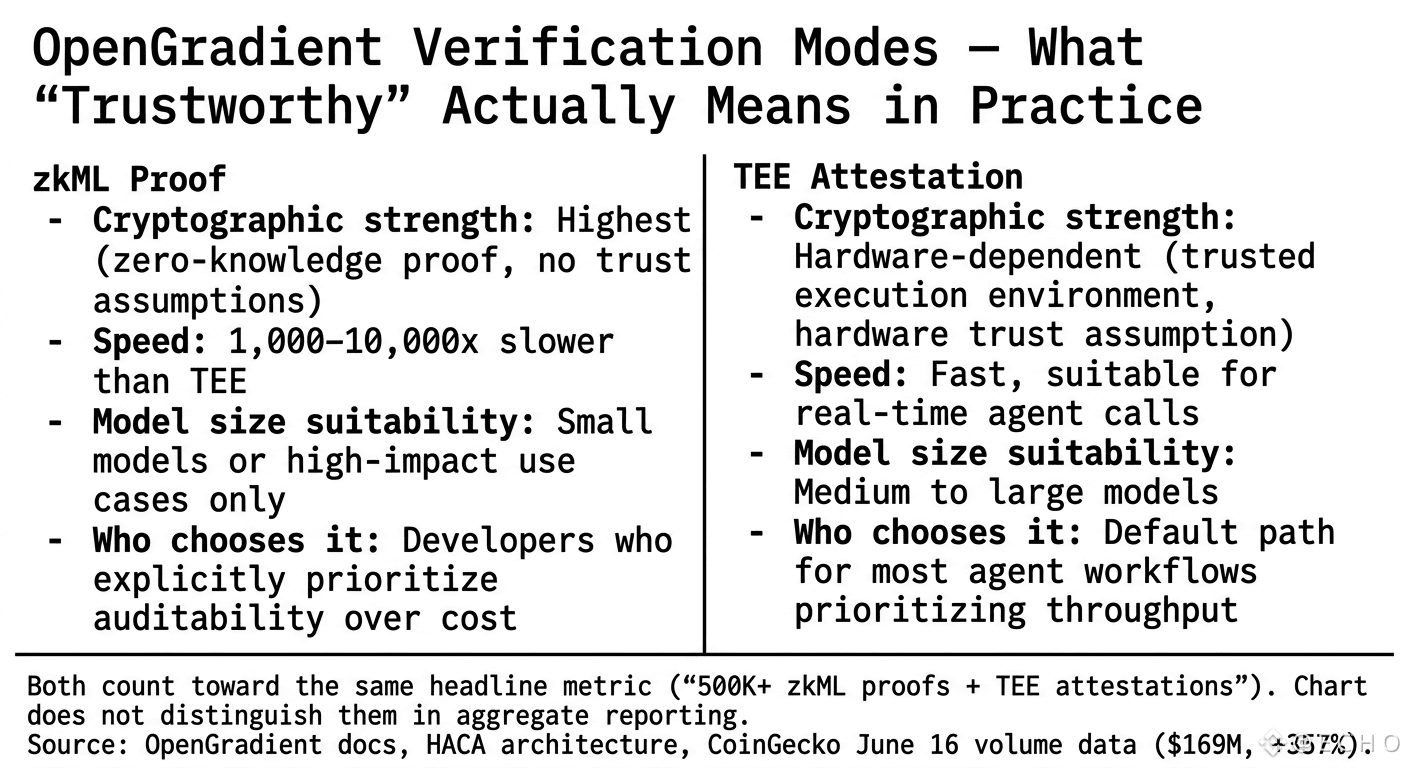
Wenn ein Agent eine Inferenz in diesem Netzwerk durchführt, verzweigt sich der Proof-Pfad tatsächlich. zkML bietet die stärkste kryptografische Garantie, läuft aber 1.000 bis 10.000x langsamer. TEE ist schneller, kann größere Modelle verarbeiten, stützt sich jedoch auf Hardware-Vertrauensannahmen. Entwickler haben die Wahl. Das ist kein nebensächlicher Fußnote – das ist die gesamte Vertrauensfrage, die direkt dort als Konfigurationseinstellung sitzt. Und die meisten Leute, die Agenten betreiben, werden standardmäßig zu dem greifen, was am günstigsten und schnellsten ist, was nicht immer der Modus mit den stärksten Garantien ist.
Ich saß da und habe das mit den On-Chain-Zahlen abgeglichen. Über 2 Millionen verifizierbare Inferenzprozesse wurden verarbeitet, 500K+ zkML-Beweise und TEE-Bestätigungen kombiniert gemäß den offiziellen Zahlen. Upbit listete OPG am 15. Juni 2026 um 20:30 KST mit einem Handelsvolumen von 169 Millionen Dollar am folgenden Tag, ein Anstieg von 357% gegenüber der vorherigen Sitzung laut CoinGecko. Die Chain bewegt sich eindeutig. Aber das Volumen sagt dir nichts darüber, welchen Verifizierungsmodus die Agenten tatsächlich im Hintergrund wählen.
Das ist die ehrliche offene Frage. Vertrauenswürdig für wen und unter welchem Proof-Pfad? Ein Agent, der TEE-Bestätigungen ausführt, erzählt eine andere Sicherheitsgeschichte als einer, der zkML ausführt. Beide zählen zur gleichen Hauptmetrik.
Hmm. Ich frage mich, ob diese Unterscheidung jemals in einem Dashboard auftauchen wird, das reguläre Nutzer tatsächlich sehen…
Das Ding, das mir während dieser @OpenGradient Aufgabe ständig im Kopf rumspukte, war nicht das große Vertrauensthema – es war ein stilles architektonisches Detail in den Docs. $OPG #OPG
Wenn ein Agent eine Inferenz in diesem Netzwerk durchführt, verzweigt sich der Proof-Pfad tatsächlich. zkML bietet die stärkste kryptografische Garantie, läuft aber 1.000 bis 10.000x langsamer. TEE ist schneller, kann größere Modelle verarbeiten, stützt sich jedoch auf Hardware-Vertrauensannahmen. Entwickler haben die Wahl. Das ist kein nebensächlicher Fußnote – das ist die gesamte Vertrauensfrage, die direkt dort als Konfigurationseinstellung sitzt. Und die meisten Leute, die Agenten betreiben, werden standardmäßig zu dem greifen, was am günstigsten und schnellsten ist, was nicht immer der Modus mit den stärksten Garantien ist.
Ich saß da und habe das mit den On-Chain-Zahlen abgeglichen. Über 2 Millionen verifizierbare Inferenzprozesse wurden verarbeitet, 500K+ zkML-Beweise und TEE-Bestätigungen kombiniert gemäß den offiziellen Zahlen. Upbit listete OPG am 15. Juni 2026 um 20:30 KST mit einem Handelsvolumen von 169 Millionen Dollar am folgenden Tag, ein Anstieg von 357% gegenüber der vorherigen Sitzung laut CoinGecko. Die Chain bewegt sich eindeutig. Aber das Volumen sagt dir nichts darüber, welchen Verifizierungsmodus die Agenten tatsächlich im Hintergrund wählen.
Das ist die ehrliche offene Frage. Vertrauenswürdig für wen und unter welchem Proof-Pfad? Ein Agent, der TEE-Bestätigungen ausführt, erzählt eine andere Sicherheitsgeschichte als einer, der zkML ausführt. Beide zählen zur gleichen Hauptmetrik.
Hmm. Ich frage mich, ob diese Unterscheidung jemals in einem Dashboard auftauchen wird, das reguläre Nutzer tatsächlich sehen…
Wenn ein Agent eine Inferenz in diesem Netzwerk durchführt, verzweigt sich der Proof-Pfad tatsächlich. zkML bietet die stärkste kryptografische Garantie, läuft aber 1.000 bis 10.000x langsamer. TEE ist schneller, kann größere Modelle verarbeiten, stützt sich jedoch auf Hardware-Vertrauensannahmen. Entwickler haben die Wahl. Das ist kein nebensächlicher Fußnote – das ist die gesamte Vertrauensfrage, die direkt dort als Konfigurationseinstellung sitzt. Und die meisten Leute, die Agenten betreiben, werden standardmäßig zu dem greifen, was am günstigsten und schnellsten ist, was nicht immer der Modus mit den stärksten Garantien ist.
Ich saß da und habe das mit den On-Chain-Zahlen abgeglichen. Über 2 Millionen verifizierbare Inferenzprozesse wurden verarbeitet, 500K+ zkML-Beweise und TEE-Bestätigungen kombiniert gemäß den offiziellen Zahlen. Upbit listete OPG am 15. Juni 2026 um 20:30 KST mit einem Handelsvolumen von 169 Millionen Dollar am folgenden Tag, ein Anstieg von 357% gegenüber der vorherigen Sitzung laut CoinGecko. Die Chain bewegt sich eindeutig. Aber das Volumen sagt dir nichts darüber, welchen Verifizierungsmodus die Agenten tatsächlich im Hintergrund wählen.
Das ist die ehrliche offene Frage. Vertrauenswürdig für wen und unter welchem Proof-Pfad? Ein Agent, der TEE-Bestätigungen ausführt, erzählt eine andere Sicherheitsgeschichte als einer, der zkML ausführt. Beide zählen zur gleichen Hauptmetrik.
Hmm. Ich frage mich, ob diese Unterscheidung jemals in einem Dashboard auftauchen wird, das reguläre Nutzer tatsächlich sehen…
4
2
333
·
--
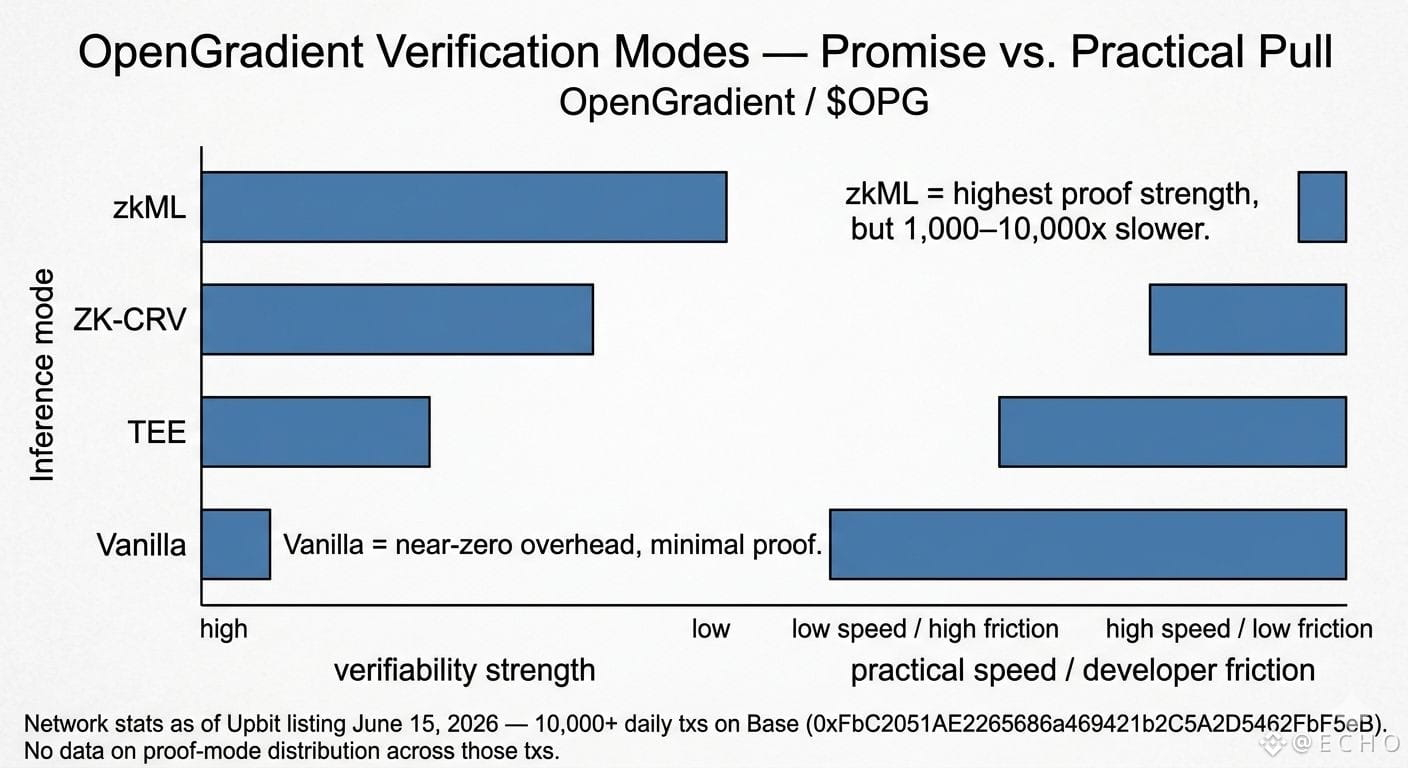
Das Ding, das bei dieser CreatorPad-Aufgabe zu OpenGradient wirklich bei mir hängen blieb – es war nicht die Headline-Infrastruktur. Es war eine stille Designentscheidung, in den Dokus versteckt. @OpenGradient hat in HACA ein „Trust-Menü“ eingebaut: Entwickler wählen pro Inferenz zwischen Vanilla-Signatur, TEE-Atestation oder zkML-Proof. $OPG #OPG . Das ist die Architektur hinter 1,85M+ On-Chain-Transaktionen und 10.000+ täglich laufenden Systemen, Stand beim Upbit-Listing am 15. Juni (Vertrag 0xFbC2051AE2265686a469421b2C5A2D5462FbF5eB, Base Network, das Volumen sprang an diesem Tag auf über 169 Mio. $).
Hier ist, was mich ins Grübeln brachte. Der gesamte Pitch für verifizierbare Marktanalysen lautet: KI-Ausgaben können jetzt kryptografische Belege tragen – welches Modell gelaufen ist, welche Daten hineingingen, und dass der Proof on-chain abgerechnet wurde. Sauber. Aber zkML ist 1.000 bis 10.000-mal langsamer als Vanilla-Inferenz. Die Dokus sagen das offen. Also werden Entwickler in der Praxis, wenn sie etwas Reales ausliefern und Latenz eine Rolle spielt, vermutlich nicht standardmäßig auf maximale Verifizierbarkeit setzen.
Ich dachte ständig über diese Lücke nach. Der leistungsfähigste Proof-Modus ist zugleich der reibungsintensivste. Der Use-Case für Marktanalysen, den OpenGradient immer wieder nennt – Risiko-Prognosen, DeFi-Signale, nachprüfbare Outputs – genau diese Szenarien brauchen die stärkste Verifikation. Und genau dort drückt der Speed-Deadline-Blick die Builder zu den leichteren Modi.
Hmm… also: Wer nutzt am Ende wirklich zkML für High-Stakes-Market-Calls – oder sagt man eher nur, dass man es könnte?
Das Ding, das bei dieser CreatorPad-Aufgabe zu OpenGradient wirklich bei mir hängen blieb – es war nicht die Headline-Infrastruktur. Es war eine stille Designentscheidung, in den Dokus versteckt. @OpenGradient hat in HACA ein „Trust-Menü“ eingebaut: Entwickler wählen pro Inferenz zwischen Vanilla-Signatur, TEE-Atestation oder zkML-Proof. $OPG #OPG . Das ist die Architektur hinter 1,85M+ On-Chain-Transaktionen und 10.000+ täglich laufenden Systemen, Stand beim Upbit-Listing am 15. Juni (Vertrag 0xFbC2051AE2265686a469421b2C5A2D5462FbF5eB, Base Network, das Volumen sprang an diesem Tag auf über 169 Mio. $).
Hier ist, was mich ins Grübeln brachte. Der gesamte Pitch für verifizierbare Marktanalysen lautet: KI-Ausgaben können jetzt kryptografische Belege tragen – welches Modell gelaufen ist, welche Daten hineingingen, und dass der Proof on-chain abgerechnet wurde. Sauber. Aber zkML ist 1.000 bis 10.000-mal langsamer als Vanilla-Inferenz. Die Dokus sagen das offen. Also werden Entwickler in der Praxis, wenn sie etwas Reales ausliefern und Latenz eine Rolle spielt, vermutlich nicht standardmäßig auf maximale Verifizierbarkeit setzen.
Ich dachte ständig über diese Lücke nach. Der leistungsfähigste Proof-Modus ist zugleich der reibungsintensivste. Der Use-Case für Marktanalysen, den OpenGradient immer wieder nennt – Risiko-Prognosen, DeFi-Signale, nachprüfbare Outputs – genau diese Szenarien brauchen die stärkste Verifikation. Und genau dort drückt der Speed-Deadline-Blick die Builder zu den leichteren Modi.
Hmm… also: Wer nutzt am Ende wirklich zkML für High-Stakes-Market-Calls – oder sagt man eher nur, dass man es könnte?
Hier ist, was mich ins Grübeln brachte. Der gesamte Pitch für verifizierbare Marktanalysen lautet: KI-Ausgaben können jetzt kryptografische Belege tragen – welches Modell gelaufen ist, welche Daten hineingingen, und dass der Proof on-chain abgerechnet wurde. Sauber. Aber zkML ist 1.000 bis 10.000-mal langsamer als Vanilla-Inferenz. Die Dokus sagen das offen. Also werden Entwickler in der Praxis, wenn sie etwas Reales ausliefern und Latenz eine Rolle spielt, vermutlich nicht standardmäßig auf maximale Verifizierbarkeit setzen.
Ich dachte ständig über diese Lücke nach. Der leistungsfähigste Proof-Modus ist zugleich der reibungsintensivste. Der Use-Case für Marktanalysen, den OpenGradient immer wieder nennt – Risiko-Prognosen, DeFi-Signale, nachprüfbare Outputs – genau diese Szenarien brauchen die stärkste Verifikation. Und genau dort drückt der Speed-Deadline-Blick die Builder zu den leichteren Modi.
Hmm… also: Wer nutzt am Ende wirklich zkML für High-Stakes-Market-Calls – oder sagt man eher nur, dass man es könnte?
1
209
·
--
Etwas an MemSync zog mich immer wieder mitten in der Aufgabe zurück. Nicht BitQuant, nicht die verifizierbare Inferenzarchitektur — MemSync. OpenGradient #OPG @OpenGradient beschreibt es als eine universelle KI-Memory-Layer, und klar, das klingt nach Marketing. Aber der eigentliche Mechanismus ist anders als das, was ich erwartet hatte: Es ist eine REST-API, die auf der verifizierbaren Inferenzinfrastruktur von OpenGradient aufsetzt und persistenten Kontext über verschiedene KI-Plattformen hinweg zieht — ChatGPT, Claude, Perplexity — speichert, abruft und auf früheren Interaktionen im Verlauf der Zeit aufbaut. Das ist keine hausinterne Funktion. Das ist ein Speicher-Grundbaustein für plattformübergreifende Anwendungen.
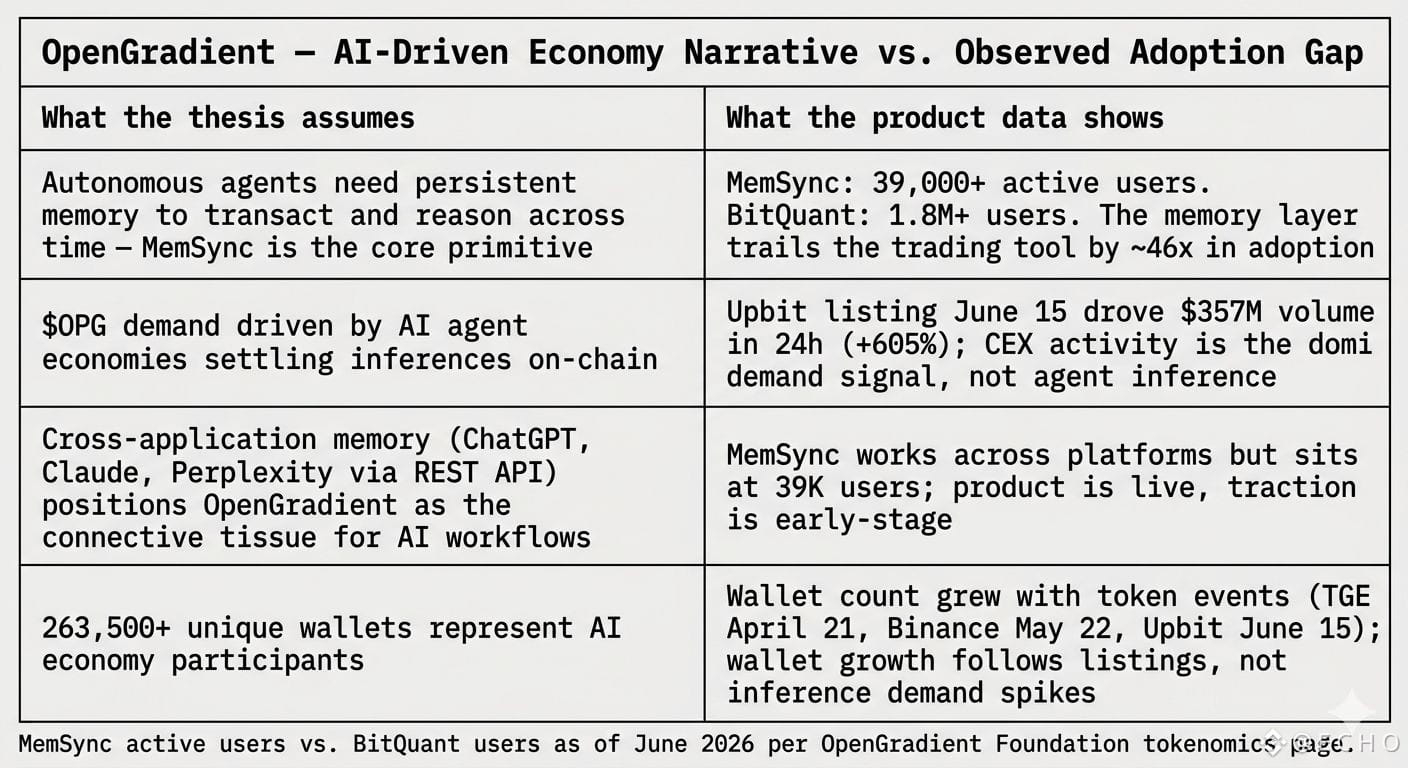
Und hier ist das, was mich zum Innehalten brachte. Damit eine KI-getriebene dezentrale Ökonomie tatsächlich funktioniert — Agenten, die handeln, über Zeit hinweg begründen und im Auftrag von Nutzern ausführen — brauchen diese Agenten ein Gedächtnis, das nicht an eine Sitzung gebunden ist. Aktuell hat MemSync 39.000+ aktive Nutzer, eine kleine Zahl im Vergleich zu BitQuants 1,8 Millionen, aber wahrscheinlich der strukturell bedeutendere Teil der beiden für das, wozu das angeblich aufgebaut wird.
Das Upbit-Listing am 15. Juni brachte in 24 Stunden $OPG Handelsvolumen auf 357 Mio. US-Dollar, +605% am selben Tag. Wallets, die mit dem Netzwerk interagierten, überschritten 263.500. Der Token-Drive ist real. Aber MemSyncs 39K aktive Nutzer im Vergleich zu BitQuants 1,8M zeigt dir, welches Produkt der Markt einpreist — und nicht das, das am wichtigsten ist für persistente Agentenökonomien.
Hmm… wenn die Memory-Layer so dünn angenommen wird, während das Handelsvolumen dominiert, ist $OPG pricing die These für die KI-getriebene Ökonomie — oder nur der CEX-Aufmerksamkeitszyklus?
Etwas an MemSync zog mich immer wieder mitten in der Aufgabe zurück. Nicht BitQuant, nicht die verifizierbare Inferenzarchitektur — MemSync. OpenGradient #OPG @OpenGradient beschreibt es als eine universelle KI-Memory-Layer, und klar, das klingt nach Marketing. Aber der eigentliche Mechanismus ist anders als das, was ich erwartet hatte: Es ist eine REST-API, die auf der verifizierbaren Inferenzinfrastruktur von OpenGradient aufsetzt und persistenten Kontext über verschiedene KI-Plattformen hinweg zieht — ChatGPT, Claude, Perplexity — speichert, abruft und auf früheren Interaktionen im Verlauf der Zeit aufbaut. Das ist keine hausinterne Funktion. Das ist ein Speicher-Grundbaustein für plattformübergreifende Anwendungen.
Und hier ist das, was mich zum Innehalten brachte. Damit eine KI-getriebene dezentrale Ökonomie tatsächlich funktioniert — Agenten, die handeln, über Zeit hinweg begründen und im Auftrag von Nutzern ausführen — brauchen diese Agenten ein Gedächtnis, das nicht an eine Sitzung gebunden ist. Aktuell hat MemSync 39.000+ aktive Nutzer, eine kleine Zahl im Vergleich zu BitQuants 1,8 Millionen, aber wahrscheinlich der strukturell bedeutendere Teil der beiden für das, wozu das angeblich aufgebaut wird.
Das Upbit-Listing am 15. Juni brachte in 24 Stunden $OPG Handelsvolumen auf 357 Mio. US-Dollar, +605% am selben Tag. Wallets, die mit dem Netzwerk interagierten, überschritten 263.500. Der Token-Drive ist real. Aber MemSyncs 39K aktive Nutzer im Vergleich zu BitQuants 1,8M zeigt dir, welches Produkt der Markt einpreist — und nicht das, das am wichtigsten ist für persistente Agentenökonomien.
Hmm… wenn die Memory-Layer so dünn angenommen wird, während das Handelsvolumen dominiert, ist $OPG pricing die These für die KI-getriebene Ökonomie — oder nur der CEX-Aufmerksamkeitszyklus?
Und hier ist das, was mich zum Innehalten brachte. Damit eine KI-getriebene dezentrale Ökonomie tatsächlich funktioniert — Agenten, die handeln, über Zeit hinweg begründen und im Auftrag von Nutzern ausführen — brauchen diese Agenten ein Gedächtnis, das nicht an eine Sitzung gebunden ist. Aktuell hat MemSync 39.000+ aktive Nutzer, eine kleine Zahl im Vergleich zu BitQuants 1,8 Millionen, aber wahrscheinlich der strukturell bedeutendere Teil der beiden für das, wozu das angeblich aufgebaut wird.
Das Upbit-Listing am 15. Juni brachte in 24 Stunden $OPG Handelsvolumen auf 357 Mio. US-Dollar, +605% am selben Tag. Wallets, die mit dem Netzwerk interagierten, überschritten 263.500. Der Token-Drive ist real. Aber MemSyncs 39K aktive Nutzer im Vergleich zu BitQuants 1,8M zeigt dir, welches Produkt der Markt einpreist — und nicht das, das am wichtigsten ist für persistente Agentenökonomien.
Hmm… wenn die Memory-Layer so dünn angenommen wird, während das Handelsvolumen dominiert, ist $OPG pricing die These für die KI-getriebene Ökonomie — oder nur der CEX-Aufmerksamkeitszyklus?
1
1
165
·
--
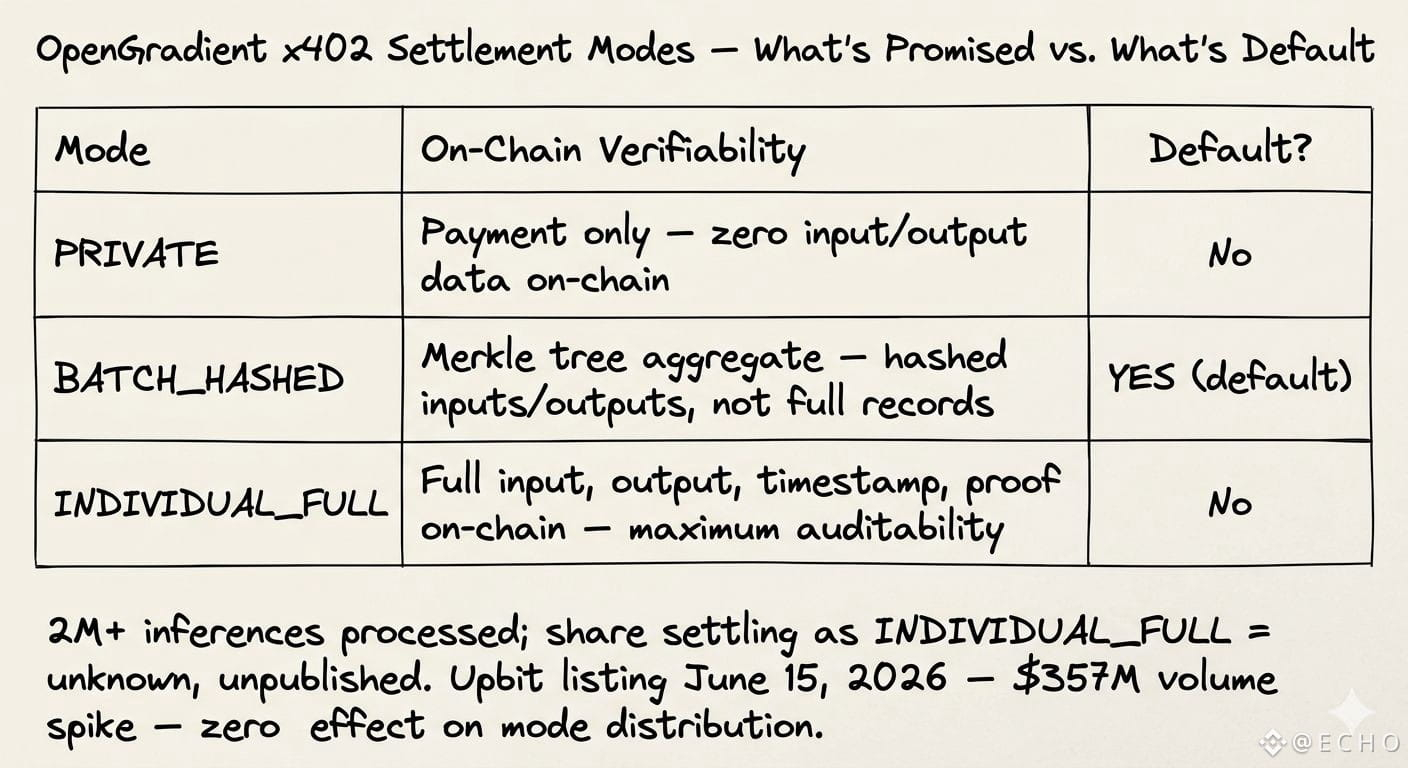
Das, was mich mitten in der Aufgabe erwischt hat, war nicht das Volumen oder die Aufstellungen. Es war eine Zeile, die in den OpenGradient-Python-SDK-Dokumenten vergraben ist – drei Settlement-Modi für Inferenz via x402: PRIVATE, BATCH_HASHED und INDIVIDUAL_FULL. Der Standard? BATCH_HASHED. Er fasst Inferenz in einen Merkle-Baum zusammen, hasht Inputs und Outputs und ist am günstigsten. @OpenGradient $OPG #OPG
Diese Designentscheidung sagt im Grunde alles darüber, wo dezentrale Intelligenz heute tatsächlich lebt. Nicht in vollständiger Nachprüfbarkeit – das ist INDIVIDUAL_FULL, der Modus, auf den niemand standardmäßig setzt, weil er teuer ist. Der Pitch „intelligence is on-chain“ steckt in der mittleren Option: du hasht, aber stellst nicht alles vollständig offen. Die 2.000+ Modelle im Model Hub, 2 Millionen Inferenzvorgänge verarbeitet – der Großteil dieser Aktivität dürfte als Merkle-Baum-Aggregate „settlen“, nicht als einzeln on-chain verifizierbare Datensätze.
Und dann hat Upbit OPG am 15. Juni um 20:30 KST gelistet; das Volumen schoss in 24 Stunden um 357 Mio. $ in die Höhe. Der Token eröffnete bei 0,3064 $, fiel auf 0,1815 $. Klassische Listing-Candle. Keine dieser Kursbewegungen berührte das Inferenzverhalten im Netzwerk überhaupt – zwei völlig getrennte Systeme laufen parallel.
hmm… Ich denke immer wieder an diesen PRIVATE-Modus – nur Zahlung, null Daten on-chain. Das ist gewissermaßen das Fundament dessen, was „dezentrale Intelligenz“ hier bedeuten kann. Also wie sieht die Verteilung in der Praxis tatsächlich über diese drei Modi hinweg aus? Das hat bislang niemand mit dieser Zahl veröffentlicht.
Das, was mich mitten in der Aufgabe erwischt hat, war nicht das Volumen oder die Aufstellungen. Es war eine Zeile, die in den OpenGradient-Python-SDK-Dokumenten vergraben ist – drei Settlement-Modi für Inferenz via x402: PRIVATE, BATCH_HASHED und INDIVIDUAL_FULL. Der Standard? BATCH_HASHED. Er fasst Inferenz in einen Merkle-Baum zusammen, hasht Inputs und Outputs und ist am günstigsten. @OpenGradient $OPG #OPG
Diese Designentscheidung sagt im Grunde alles darüber, wo dezentrale Intelligenz heute tatsächlich lebt. Nicht in vollständiger Nachprüfbarkeit – das ist INDIVIDUAL_FULL, der Modus, auf den niemand standardmäßig setzt, weil er teuer ist. Der Pitch „intelligence is on-chain“ steckt in der mittleren Option: du hasht, aber stellst nicht alles vollständig offen. Die 2.000+ Modelle im Model Hub, 2 Millionen Inferenzvorgänge verarbeitet – der Großteil dieser Aktivität dürfte als Merkle-Baum-Aggregate „settlen“, nicht als einzeln on-chain verifizierbare Datensätze.
Und dann hat Upbit OPG am 15. Juni um 20:30 KST gelistet; das Volumen schoss in 24 Stunden um 357 Mio. $ in die Höhe. Der Token eröffnete bei 0,3064 $, fiel auf 0,1815 $. Klassische Listing-Candle. Keine dieser Kursbewegungen berührte das Inferenzverhalten im Netzwerk überhaupt – zwei völlig getrennte Systeme laufen parallel.
hmm… Ich denke immer wieder an diesen PRIVATE-Modus – nur Zahlung, null Daten on-chain. Das ist gewissermaßen das Fundament dessen, was „dezentrale Intelligenz“ hier bedeuten kann. Also wie sieht die Verteilung in der Praxis tatsächlich über diese drei Modi hinweg aus? Das hat bislang niemand mit dieser Zahl veröffentlicht.
Diese Designentscheidung sagt im Grunde alles darüber, wo dezentrale Intelligenz heute tatsächlich lebt. Nicht in vollständiger Nachprüfbarkeit – das ist INDIVIDUAL_FULL, der Modus, auf den niemand standardmäßig setzt, weil er teuer ist. Der Pitch „intelligence is on-chain“ steckt in der mittleren Option: du hasht, aber stellst nicht alles vollständig offen. Die 2.000+ Modelle im Model Hub, 2 Millionen Inferenzvorgänge verarbeitet – der Großteil dieser Aktivität dürfte als Merkle-Baum-Aggregate „settlen“, nicht als einzeln on-chain verifizierbare Datensätze.
Und dann hat Upbit OPG am 15. Juni um 20:30 KST gelistet; das Volumen schoss in 24 Stunden um 357 Mio. $ in die Höhe. Der Token eröffnete bei 0,3064 $, fiel auf 0,1815 $. Klassische Listing-Candle. Keine dieser Kursbewegungen berührte das Inferenzverhalten im Netzwerk überhaupt – zwei völlig getrennte Systeme laufen parallel.
hmm… Ich denke immer wieder an diesen PRIVATE-Modus – nur Zahlung, null Daten on-chain. Das ist gewissermaßen das Fundament dessen, was „dezentrale Intelligenz“ hier bedeuten kann. Also wie sieht die Verteilung in der Praxis tatsächlich über diese drei Modi hinweg aus? Das hat bislang niemand mit dieser Zahl veröffentlicht.
2
2
156
·
--
Verifiziert
Etwas, das ich bei dieser CreatorPad-Aufgabe auf OpenGradient immer wieder aufgegriffen habe. @OpenGradient $OPG #OPG Märkte „transparentes Rechnen“ — jede Inferenz ist überprüfbar, nichts ist verborgen. Gute Idee. Aber Transparenz hier ist nicht einheitlich. Sie ist geschichtet, und entscheidend ist, wer diese Schicht kontrolliert.
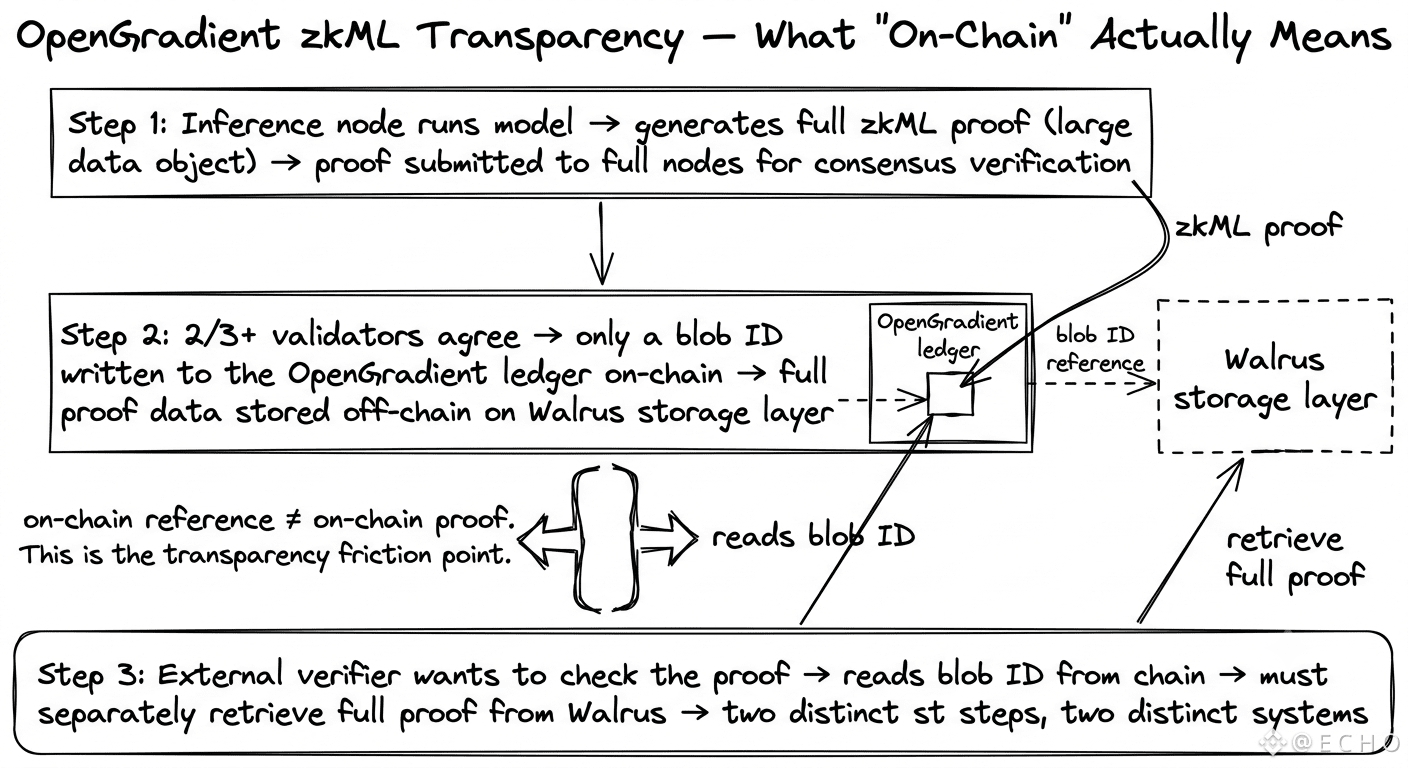
Ich habe in die Architektur-Dokumente eingetaucht. Für zkML-Beweise — den Modus mit der höchsten Vertrauenswürdigkeit — liegt die vollständige Beweisdatenmenge nicht on-chain. Es wird nur eine Blob-ID-Referenz auf dem OpenGradient-Ledger erfasst. Der eigentliche Beweis liegt auf Walrus, einer Off-Chain-Storage-Schicht. „Vollständig transparentes Rechnen“ bedeutet also: Die Kette hält einen Zeiger, nicht die Sache selbst. Dieser Zeiger ist natürlich dauerhaft und manipulationssicher. Aber um den tatsächlichen Beweis zu verifizieren, muss man Off-Chain gehen, um ihn abzurufen. Das sind zwei verschiedene Handlungen — und die meisten, die „verifizierbar on-chain“ lesen, erkennen diesen Unterschied nicht.
Unterdessen, am 15. Juni, als Upbit OPG gelistet hat, erreichte das Volumen 357,69 Mio. $ — ein 606%-Sprung — wobei der Token bei 0,3064 $ eröffnete und dann auf 0,1815 $ zurückging. Das ist Austauschplatz-Lärm. Nichts an diesem Volumen hat die Inferenz-Nachfrage oder die Muster beim Abruf von Beweisen im eigentlichen Netzwerk beeinflusst.
Ich habe mich mit diesem Blob-ID-Detail länger beschäftigt als erwartet. Es ist nicht genau täuschend — es ist ein Engineering-Tradeoff, große Beweisdaten wären chain-unwürdig. Aber „transparent“ bedeutet normalerweise, dass das Ganze sichtbar ist, nicht nur eine Referenz darauf, wo die Sache liegt.
Zählt der Zeiger als Transparenz? Oder gilt Transparenz nur dann, wenn jeder den vollständigen Beweis abrufen kann, ohne irgendwohin gehen zu müssen, um ihn zu holen?
Etwas, das ich bei dieser CreatorPad-Aufgabe auf OpenGradient immer wieder aufgegriffen habe. @OpenGradient $OPG #OPG Märkte „transparentes Rechnen“ — jede Inferenz ist überprüfbar, nichts ist verborgen. Gute Idee. Aber Transparenz hier ist nicht einheitlich. Sie ist geschichtet, und entscheidend ist, wer diese Schicht kontrolliert.
Ich habe in die Architektur-Dokumente eingetaucht. Für zkML-Beweise — den Modus mit der höchsten Vertrauenswürdigkeit — liegt die vollständige Beweisdatenmenge nicht on-chain. Es wird nur eine Blob-ID-Referenz auf dem OpenGradient-Ledger erfasst. Der eigentliche Beweis liegt auf Walrus, einer Off-Chain-Storage-Schicht. „Vollständig transparentes Rechnen“ bedeutet also: Die Kette hält einen Zeiger, nicht die Sache selbst. Dieser Zeiger ist natürlich dauerhaft und manipulationssicher. Aber um den tatsächlichen Beweis zu verifizieren, muss man Off-Chain gehen, um ihn abzurufen. Das sind zwei verschiedene Handlungen — und die meisten, die „verifizierbar on-chain“ lesen, erkennen diesen Unterschied nicht.
Unterdessen, am 15. Juni, als Upbit OPG gelistet hat, erreichte das Volumen 357,69 Mio. $ — ein 606%-Sprung — wobei der Token bei 0,3064 $ eröffnete und dann auf 0,1815 $ zurückging. Das ist Austauschplatz-Lärm. Nichts an diesem Volumen hat die Inferenz-Nachfrage oder die Muster beim Abruf von Beweisen im eigentlichen Netzwerk beeinflusst.
Ich habe mich mit diesem Blob-ID-Detail länger beschäftigt als erwartet. Es ist nicht genau täuschend — es ist ein Engineering-Tradeoff, große Beweisdaten wären chain-unwürdig. Aber „transparent“ bedeutet normalerweise, dass das Ganze sichtbar ist, nicht nur eine Referenz darauf, wo die Sache liegt.
Zählt der Zeiger als Transparenz? Oder gilt Transparenz nur dann, wenn jeder den vollständigen Beweis abrufen kann, ohne irgendwohin gehen zu müssen, um ihn zu holen?
Ich habe in die Architektur-Dokumente eingetaucht. Für zkML-Beweise — den Modus mit der höchsten Vertrauenswürdigkeit — liegt die vollständige Beweisdatenmenge nicht on-chain. Es wird nur eine Blob-ID-Referenz auf dem OpenGradient-Ledger erfasst. Der eigentliche Beweis liegt auf Walrus, einer Off-Chain-Storage-Schicht. „Vollständig transparentes Rechnen“ bedeutet also: Die Kette hält einen Zeiger, nicht die Sache selbst. Dieser Zeiger ist natürlich dauerhaft und manipulationssicher. Aber um den tatsächlichen Beweis zu verifizieren, muss man Off-Chain gehen, um ihn abzurufen. Das sind zwei verschiedene Handlungen — und die meisten, die „verifizierbar on-chain“ lesen, erkennen diesen Unterschied nicht.
Unterdessen, am 15. Juni, als Upbit OPG gelistet hat, erreichte das Volumen 357,69 Mio. $ — ein 606%-Sprung — wobei der Token bei 0,3064 $ eröffnete und dann auf 0,1815 $ zurückging. Das ist Austauschplatz-Lärm. Nichts an diesem Volumen hat die Inferenz-Nachfrage oder die Muster beim Abruf von Beweisen im eigentlichen Netzwerk beeinflusst.
Ich habe mich mit diesem Blob-ID-Detail länger beschäftigt als erwartet. Es ist nicht genau täuschend — es ist ein Engineering-Tradeoff, große Beweisdaten wären chain-unwürdig. Aber „transparent“ bedeutet normalerweise, dass das Ganze sichtbar ist, nicht nur eine Referenz darauf, wo die Sache liegt.
Zählt der Zeiger als Transparenz? Oder gilt Transparenz nur dann, wenn jeder den vollständigen Beweis abrufen kann, ohne irgendwohin gehen zu müssen, um ihn zu holen?
2
1
141
·
--
Irgendwas hat Klick gemacht, während ich an der Bedrock-Teilnahme auf großem Maßstab gearbeitet habe, und es war nicht das, was ich erwartet hatte.
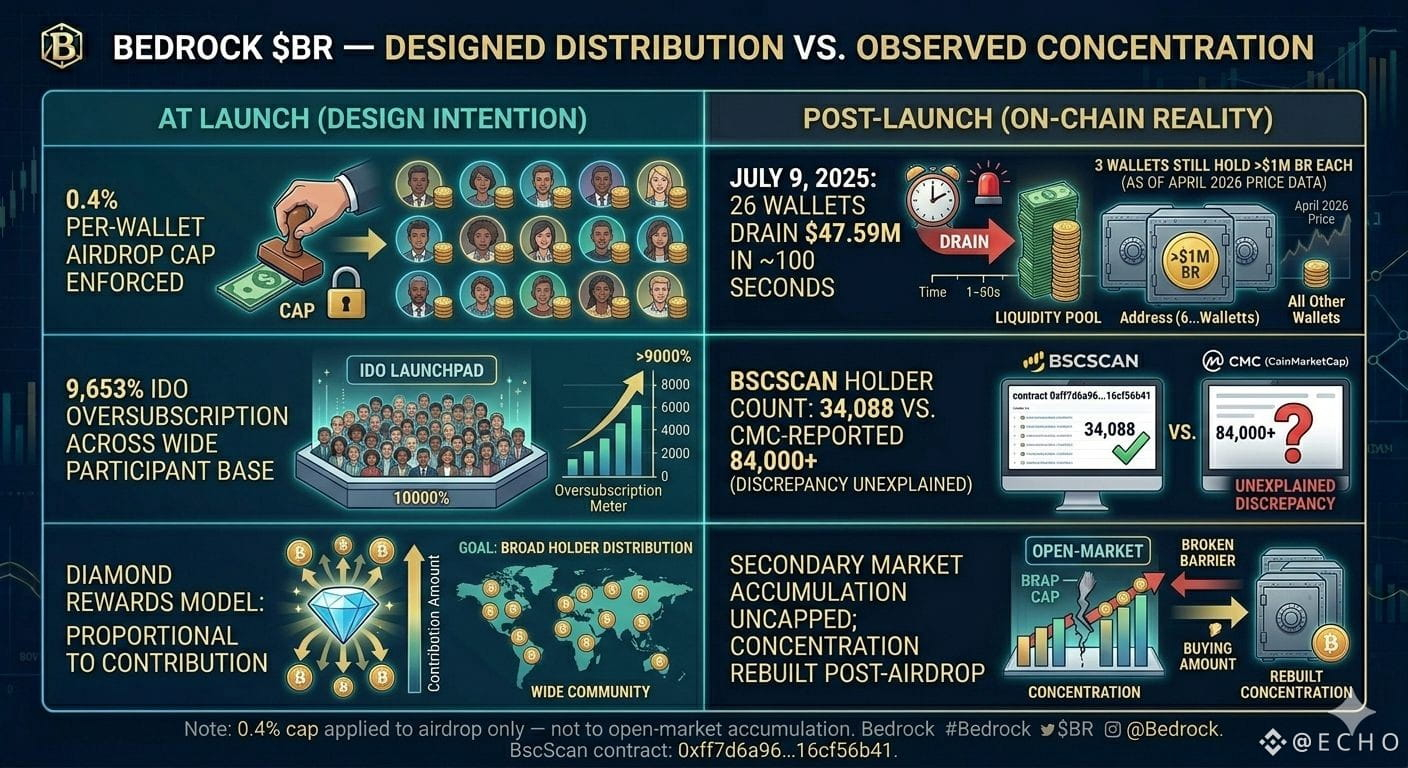
@Bedrock spricht ständig von breiter Teilnahme — Multi-Chain, Multi-Asset, offener Zugang. Und auf den ersten Blick hat $BR geliefert: 9.653% IDO-Überzeichnung, $1,2B TVL bis Mai 2026, über 84.000 CoinMarketCap-getrackte Holder auf der BNBchain. #Bedrock hat sogar einen harten 0,4% pro Wallet Airdrop-Cap eingebaut, um die Wal-Gewinnung während der Verteilung zu verhindern. Diese Designwahl ist echt — proportionale Diamond-Belohnungen, faire Saisonmechaniken. Auf dem Papier, Skalierung und Breite.
Dann halt dich fest — Juli 2025. Sechsundzwanzig Wallets haben in etwa 100 Sekunden $47,59M aus den Binance Alpha Pools abgezogen, was einen 50% BR-Crash ausgelöst hat. Und laut der Preisanalyse von April 2026 sitzen 3 Wallets immer noch über $1M BR jeweils. Die BscScan-Halteranzahl liegt bei 34.088. Der 0,4% Cap hat den Airdrop eingeschränkt — er hat die sekundäre Ansammlung nicht eingeschränkt. Das sind unterschiedliche Probleme, und das Design hat nur eines davon gelöst.
Ich habe Zeit damit verbracht, das uniBTC Etherscan-Angebot mit dem Chainlink PoR Feed zu überprüfen. Dieser Teil hält tatsächlich stand. Die Teilnahme auf Protokollebene funktioniert im großen Stil. Es ist die Teilnahme auf Token-Ebene, die diese leise Abdrift zurück zur Konzentration hat.
Die Frage, die mich nicht loslässt: Führt die Teilnahme auf großem Maßstab am Protokoll tatsächlich zu einer verteilten Teilnahme an dem, was es regiert?
Irgendwas hat Klick gemacht, während ich an der Bedrock-Teilnahme auf großem Maßstab gearbeitet habe, und es war nicht das, was ich erwartet hatte.
@Bedrock spricht ständig von breiter Teilnahme — Multi-Chain, Multi-Asset, offener Zugang. Und auf den ersten Blick hat $BR geliefert: 9.653% IDO-Überzeichnung, $1,2B TVL bis Mai 2026, über 84.000 CoinMarketCap-getrackte Holder auf der BNBchain. #Bedrock hat sogar einen harten 0,4% pro Wallet Airdrop-Cap eingebaut, um die Wal-Gewinnung während der Verteilung zu verhindern. Diese Designwahl ist echt — proportionale Diamond-Belohnungen, faire Saisonmechaniken. Auf dem Papier, Skalierung und Breite.
Dann halt dich fest — Juli 2025. Sechsundzwanzig Wallets haben in etwa 100 Sekunden $47,59M aus den Binance Alpha Pools abgezogen, was einen 50% BR-Crash ausgelöst hat. Und laut der Preisanalyse von April 2026 sitzen 3 Wallets immer noch über $1M BR jeweils. Die BscScan-Halteranzahl liegt bei 34.088. Der 0,4% Cap hat den Airdrop eingeschränkt — er hat die sekundäre Ansammlung nicht eingeschränkt. Das sind unterschiedliche Probleme, und das Design hat nur eines davon gelöst.
Ich habe Zeit damit verbracht, das uniBTC Etherscan-Angebot mit dem Chainlink PoR Feed zu überprüfen. Dieser Teil hält tatsächlich stand. Die Teilnahme auf Protokollebene funktioniert im großen Stil. Es ist die Teilnahme auf Token-Ebene, die diese leise Abdrift zurück zur Konzentration hat.
Die Frage, die mich nicht loslässt: Führt die Teilnahme auf großem Maßstab am Protokoll tatsächlich zu einer verteilten Teilnahme an dem, was es regiert?
@Bedrock spricht ständig von breiter Teilnahme — Multi-Chain, Multi-Asset, offener Zugang. Und auf den ersten Blick hat $BR geliefert: 9.653% IDO-Überzeichnung, $1,2B TVL bis Mai 2026, über 84.000 CoinMarketCap-getrackte Holder auf der BNBchain. #Bedrock hat sogar einen harten 0,4% pro Wallet Airdrop-Cap eingebaut, um die Wal-Gewinnung während der Verteilung zu verhindern. Diese Designwahl ist echt — proportionale Diamond-Belohnungen, faire Saisonmechaniken. Auf dem Papier, Skalierung und Breite.
Dann halt dich fest — Juli 2025. Sechsundzwanzig Wallets haben in etwa 100 Sekunden $47,59M aus den Binance Alpha Pools abgezogen, was einen 50% BR-Crash ausgelöst hat. Und laut der Preisanalyse von April 2026 sitzen 3 Wallets immer noch über $1M BR jeweils. Die BscScan-Halteranzahl liegt bei 34.088. Der 0,4% Cap hat den Airdrop eingeschränkt — er hat die sekundäre Ansammlung nicht eingeschränkt. Das sind unterschiedliche Probleme, und das Design hat nur eines davon gelöst.
Ich habe Zeit damit verbracht, das uniBTC Etherscan-Angebot mit dem Chainlink PoR Feed zu überprüfen. Dieser Teil hält tatsächlich stand. Die Teilnahme auf Protokollebene funktioniert im großen Stil. Es ist die Teilnahme auf Token-Ebene, die diese leise Abdrift zurück zur Konzentration hat.
Die Frage, die mich nicht loslässt: Führt die Teilnahme auf großem Maßstab am Protokoll tatsächlich zu einer verteilten Teilnahme an dem, was es regiert?
6
3
283
·
--
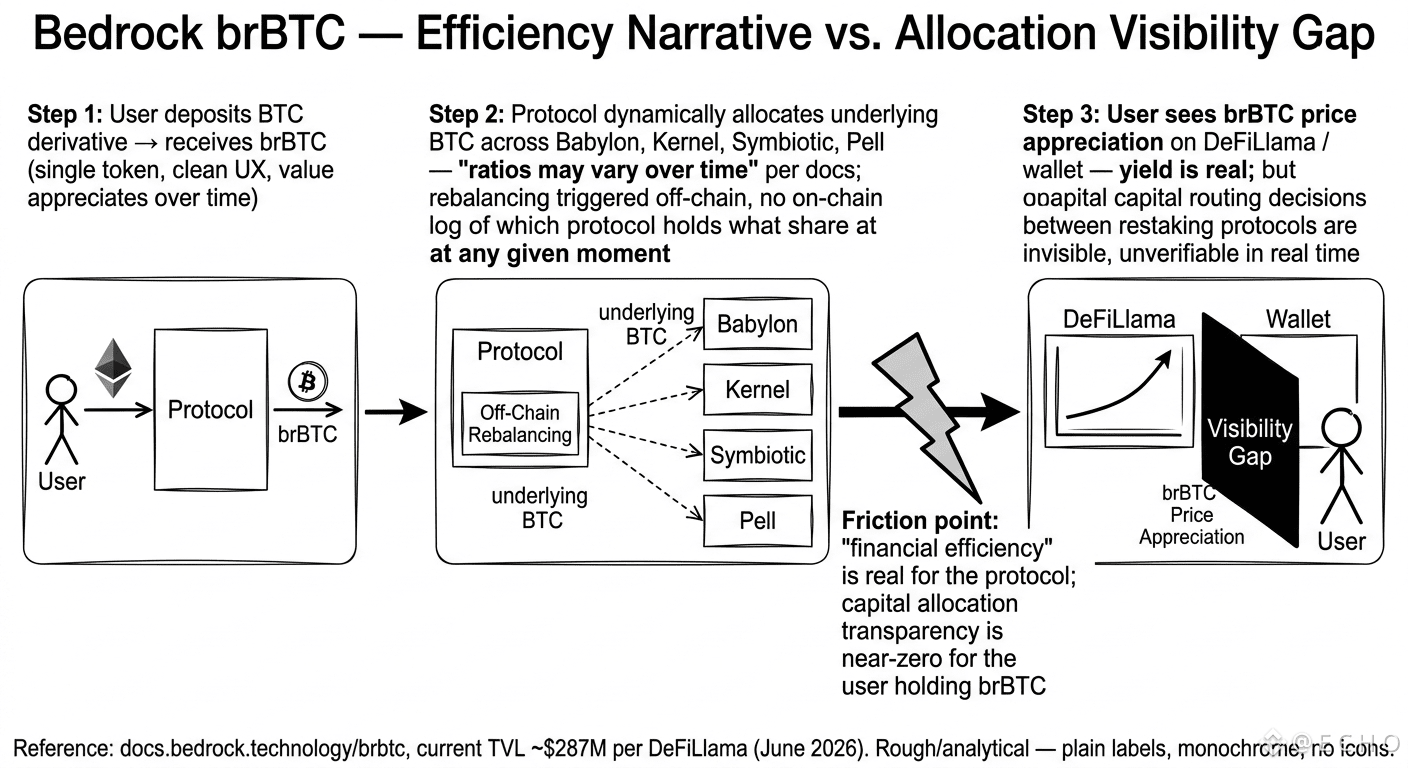
Irgendwas hat mich früh in der @Bedrock Aufgabe gestoppt. Das finanzielle Effizienz-Rahmenwerk wirkt auf den ersten Blick überzeugend — untätige BTC werden gleichzeitig in Babylon, Kernel, Symbiotic, Pell geleitet, die Rendite kumuliert sich, $BR verbindet die Governance-Ebene. Der TVL von #Bedrock liegt gerade bei etwa 287 Millionen Dollar auf DeFiLlama. Echtes Kapital, echte Zahlen.
Aber dann habe ich angefangen, an dem brBTC-Zuordnungsmechanismus zu ziehen. Die Unterlagen besagen, dass die Sicherheiten "dynamisch über mehrere Restaking-Protokolle verteilt werden" und dass "Zuteilungsverhältnisse sich im Laufe der Zeit ändern können." Klingt kompliziert. Halt mal — wo ist das On-Chain-Protokoll, wie dieses Kapital zwischen den Protokollen bewegt wird? Es gibt kein einfach nachverfolgbares. Die Neugewichtung geschieht auf Protokollebene, undurchsichtig. Was die Nutzer sehen, ist ein einzelnes Token, das im Wert steigt. Was tatsächlich darunter passiert — welches Restaking-Protokoll wie viel von deinem BTC hält und wann sich das ändert — wird nirgendwo On-Chain in einer verständlichen Weise angezeigt.
Ich habe immer wieder darüber nachgedacht, was "finanzielle Effizienz" hier tatsächlich bedeutet. Für das Protokoll ist es wirklich effizient — eine gebündelte Position, automatisierte Neuzuteilung, aggregierte Rendite. Für den Nutzer, der brBTC hält, ist die Effizienz real, aber die Sichtbarkeit ist nahe null. Du vertraust dem Routing, ohne es zu verifizieren.
Hmm. Vielleicht ist das in diesem Maßstab in Ordnung. Aber ab welchem TVL hört die Undurchsichtigkeit in der Zuteilungslogik auf, ein Feature zu sein und wird zu einem Risiko?
Irgendwas hat mich früh in der @Bedrock Aufgabe gestoppt. Das finanzielle Effizienz-Rahmenwerk wirkt auf den ersten Blick überzeugend — untätige BTC werden gleichzeitig in Babylon, Kernel, Symbiotic, Pell geleitet, die Rendite kumuliert sich, $BR verbindet die Governance-Ebene. Der TVL von #Bedrock liegt gerade bei etwa 287 Millionen Dollar auf DeFiLlama. Echtes Kapital, echte Zahlen.
Aber dann habe ich angefangen, an dem brBTC-Zuordnungsmechanismus zu ziehen. Die Unterlagen besagen, dass die Sicherheiten "dynamisch über mehrere Restaking-Protokolle verteilt werden" und dass "Zuteilungsverhältnisse sich im Laufe der Zeit ändern können." Klingt kompliziert. Halt mal — wo ist das On-Chain-Protokoll, wie dieses Kapital zwischen den Protokollen bewegt wird? Es gibt kein einfach nachverfolgbares. Die Neugewichtung geschieht auf Protokollebene, undurchsichtig. Was die Nutzer sehen, ist ein einzelnes Token, das im Wert steigt. Was tatsächlich darunter passiert — welches Restaking-Protokoll wie viel von deinem BTC hält und wann sich das ändert — wird nirgendwo On-Chain in einer verständlichen Weise angezeigt.
Ich habe immer wieder darüber nachgedacht, was "finanzielle Effizienz" hier tatsächlich bedeutet. Für das Protokoll ist es wirklich effizient — eine gebündelte Position, automatisierte Neuzuteilung, aggregierte Rendite. Für den Nutzer, der brBTC hält, ist die Effizienz real, aber die Sichtbarkeit ist nahe null. Du vertraust dem Routing, ohne es zu verifizieren.
Hmm. Vielleicht ist das in diesem Maßstab in Ordnung. Aber ab welchem TVL hört die Undurchsichtigkeit in der Zuteilungslogik auf, ein Feature zu sein und wird zu einem Risiko?
Aber dann habe ich angefangen, an dem brBTC-Zuordnungsmechanismus zu ziehen. Die Unterlagen besagen, dass die Sicherheiten "dynamisch über mehrere Restaking-Protokolle verteilt werden" und dass "Zuteilungsverhältnisse sich im Laufe der Zeit ändern können." Klingt kompliziert. Halt mal — wo ist das On-Chain-Protokoll, wie dieses Kapital zwischen den Protokollen bewegt wird? Es gibt kein einfach nachverfolgbares. Die Neugewichtung geschieht auf Protokollebene, undurchsichtig. Was die Nutzer sehen, ist ein einzelnes Token, das im Wert steigt. Was tatsächlich darunter passiert — welches Restaking-Protokoll wie viel von deinem BTC hält und wann sich das ändert — wird nirgendwo On-Chain in einer verständlichen Weise angezeigt.
Ich habe immer wieder darüber nachgedacht, was "finanzielle Effizienz" hier tatsächlich bedeutet. Für das Protokoll ist es wirklich effizient — eine gebündelte Position, automatisierte Neuzuteilung, aggregierte Rendite. Für den Nutzer, der brBTC hält, ist die Effizienz real, aber die Sichtbarkeit ist nahe null. Du vertraust dem Routing, ohne es zu verifizieren.
Hmm. Vielleicht ist das in diesem Maßstab in Ordnung. Aber ab welchem TVL hört die Undurchsichtigkeit in der Zuteilungslogik auf, ein Feature zu sein und wird zu einem Risiko?
9
4
253
·
--
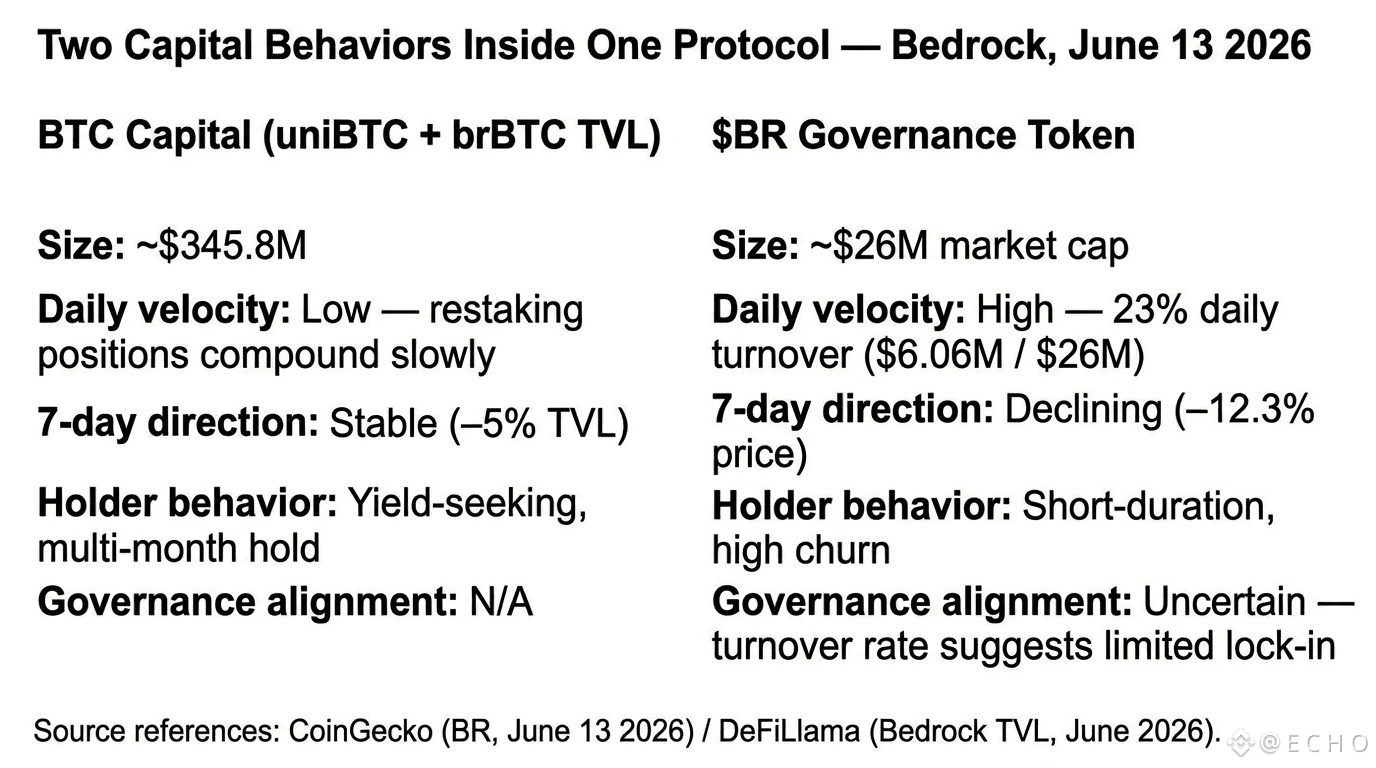
Habe die Zahlen während der Aufgabe gecheckt. Der TVL des Bedrock-Protokolls liegt bei $345,8M über uniBTC und brBTC. @Bedrock und $BR sind so gestaltet, dass der Governance-Token Wert daraus schöpft. #Bedrock . Auf dem Papier stimmig.
Dann habe ich mir speziell den BR-Markt angeschaut. Marktkapitalisierung ~26M $. Tägliches Volumen: $6,06M laut CoinGecko gerade jetzt. Das sind ungefähr 23% täglicher Umsatz. Für einen Governance-Token, der über $345M an verwaltetem BTC-Kapital sitzt… sieht das nicht nach Geduld aus. Es sieht nach schnellem Geld aus, das durchläuft.
Das tatsächliche Bild der Kapitalmärkte zeigt zwei verschiedene Verhaltensweisen innerhalb eines Protokolls. Das BTC ist geduldig – Babylon-Restaking-Positionen, die langsam kumulieren, Zuteilungen, die ruhig im Hintergrund über Kernel, SatLayer, Pell, Mellow, Symbiotic verschoben werden. $BR hingegen wechselt mit einer täglichen Geschwindigkeit von 23%, diese Woche um 12,3% gefallen. Einleger und Token-Trader laufen auf völlig unterschiedlichen Zeitplänen. brBTC routet dynamisch über sechs Protokolle ohne Echtzeit-Zuteilungsoffenlegung – näher an einem verwalteten Ertragsprodukt, als es öffentlich dargestellt wird.
Das BTC bleibt. Wer hält $BR lange genug, um tatsächlich über irgendetwas abzustimmen… das ist der Teil, an dem ich noch arbeite.
Habe die Zahlen während der Aufgabe gecheckt. Der TVL des Bedrock-Protokolls liegt bei $345,8M über uniBTC und brBTC. @Bedrock und $BR sind so gestaltet, dass der Governance-Token Wert daraus schöpft. #Bedrock . Auf dem Papier stimmig.
Dann habe ich mir speziell den BR-Markt angeschaut. Marktkapitalisierung ~26M $. Tägliches Volumen: $6,06M laut CoinGecko gerade jetzt. Das sind ungefähr 23% täglicher Umsatz. Für einen Governance-Token, der über $345M an verwaltetem BTC-Kapital sitzt… sieht das nicht nach Geduld aus. Es sieht nach schnellem Geld aus, das durchläuft.
Das tatsächliche Bild der Kapitalmärkte zeigt zwei verschiedene Verhaltensweisen innerhalb eines Protokolls. Das BTC ist geduldig – Babylon-Restaking-Positionen, die langsam kumulieren, Zuteilungen, die ruhig im Hintergrund über Kernel, SatLayer, Pell, Mellow, Symbiotic verschoben werden. $BR hingegen wechselt mit einer täglichen Geschwindigkeit von 23%, diese Woche um 12,3% gefallen. Einleger und Token-Trader laufen auf völlig unterschiedlichen Zeitplänen. brBTC routet dynamisch über sechs Protokolle ohne Echtzeit-Zuteilungsoffenlegung – näher an einem verwalteten Ertragsprodukt, als es öffentlich dargestellt wird.
Das BTC bleibt. Wer hält $BR lange genug, um tatsächlich über irgendetwas abzustimmen… das ist der Teil, an dem ich noch arbeite.
Dann habe ich mir speziell den BR-Markt angeschaut. Marktkapitalisierung ~26M $. Tägliches Volumen: $6,06M laut CoinGecko gerade jetzt. Das sind ungefähr 23% täglicher Umsatz. Für einen Governance-Token, der über $345M an verwaltetem BTC-Kapital sitzt… sieht das nicht nach Geduld aus. Es sieht nach schnellem Geld aus, das durchläuft.
Das tatsächliche Bild der Kapitalmärkte zeigt zwei verschiedene Verhaltensweisen innerhalb eines Protokolls. Das BTC ist geduldig – Babylon-Restaking-Positionen, die langsam kumulieren, Zuteilungen, die ruhig im Hintergrund über Kernel, SatLayer, Pell, Mellow, Symbiotic verschoben werden. $BR hingegen wechselt mit einer täglichen Geschwindigkeit von 23%, diese Woche um 12,3% gefallen. Einleger und Token-Trader laufen auf völlig unterschiedlichen Zeitplänen. brBTC routet dynamisch über sechs Protokolle ohne Echtzeit-Zuteilungsoffenlegung – näher an einem verwalteten Ertragsprodukt, als es öffentlich dargestellt wird.
Das BTC bleibt. Wer hält $BR lange genug, um tatsächlich über irgendetwas abzustimmen… das ist der Teil, an dem ich noch arbeite.
13
8
193
·
--
Habe eine CreatorPad-Aufgabe zum Alignierungsmodell #Bedrock abgeschlossen, und das, was mich mitten im Lesen tatsächlich gestoppt hat, war eine Zahl von vor fast genau einem Jahr — immer noch in den Daten, immer noch ungelöst.
9. Juli 2025: 26 Wallets haben in weniger als 100 Sekunden $47,59M aus den Binance Alpha Pools abgezogen. $BR ist um 50% gefallen. @Bedrock hat reagiert, indem sie ihre offizielle PancakeSwap LP-Adresse (0x5f6f…) veröffentlicht und Stabilität der Liquidität zugesichert haben. Das ist der Transparenz-Move. Gut. Aber der Kontrast ist krass: Das Protokoll hatte gerade Wochen damit verbracht, eine veBR-Alignierungsstory aufzubauen — $BR sperren, an der Governance teilnehmen, erhöhten Ertrag verdienen, Skin in the Game — und das dominante On-Chain-Verhalten in diesem Moment war, dass 26 Adressen schnell ausstiegen, nicht 26 engagierte Staker, die durchhielten.
Diese Lücke ist die eigentliche Einsicht. Der Alignierungsmechanismus existiert — PoSL, veBR-Emissionen, saisonale Rücksetzungen, Rückkäufe des Protokollumsatzes. Auf dem Papier ist es kohärent. Aber die Teilnehmer, die den Preis bewegt haben, waren mit keiner dieser Ebenen engagiert. Sie haben Handelsanreizkampagnen betrieben, nicht das Protokoll überzeugt. Das veBR-Modell aligniert nur die Leute, die sich dafür entschieden haben. Alle anderen sind einfach… da für den Zyklus.
Ich bin aus dieser Aufgabe ehrlicher Weise neugieriger als kritisch herausgekommen. Das Design ist echt. Aber ich frage mich ständig: Mit dem Unlock am 20. Juni, der diese Woche weitere 40,63M BR in Umlauf bringt, wie viele der neuen Empfänger gehen direkt in die veBR-Sperre… im Vergleich zu direkt zu PancakeSwap?
Habe eine CreatorPad-Aufgabe zum Alignierungsmodell #Bedrock abgeschlossen, und das, was mich mitten im Lesen tatsächlich gestoppt hat, war eine Zahl von vor fast genau einem Jahr — immer noch in den Daten, immer noch ungelöst.
9. Juli 2025: 26 Wallets haben in weniger als 100 Sekunden $47,59M aus den Binance Alpha Pools abgezogen. $BR ist um 50% gefallen. @Bedrock hat reagiert, indem sie ihre offizielle PancakeSwap LP-Adresse (0x5f6f…) veröffentlicht und Stabilität der Liquidität zugesichert haben. Das ist der Transparenz-Move. Gut. Aber der Kontrast ist krass: Das Protokoll hatte gerade Wochen damit verbracht, eine veBR-Alignierungsstory aufzubauen — $BR sperren, an der Governance teilnehmen, erhöhten Ertrag verdienen, Skin in the Game — und das dominante On-Chain-Verhalten in diesem Moment war, dass 26 Adressen schnell ausstiegen, nicht 26 engagierte Staker, die durchhielten.
Diese Lücke ist die eigentliche Einsicht. Der Alignierungsmechanismus existiert — PoSL, veBR-Emissionen, saisonale Rücksetzungen, Rückkäufe des Protokollumsatzes. Auf dem Papier ist es kohärent. Aber die Teilnehmer, die den Preis bewegt haben, waren mit keiner dieser Ebenen engagiert. Sie haben Handelsanreizkampagnen betrieben, nicht das Protokoll überzeugt. Das veBR-Modell aligniert nur die Leute, die sich dafür entschieden haben. Alle anderen sind einfach… da für den Zyklus.
Ich bin aus dieser Aufgabe ehrlicher Weise neugieriger als kritisch herausgekommen. Das Design ist echt. Aber ich frage mich ständig: Mit dem Unlock am 20. Juni, der diese Woche weitere 40,63M BR in Umlauf bringt, wie viele der neuen Empfänger gehen direkt in die veBR-Sperre… im Vergleich zu direkt zu PancakeSwap?
9. Juli 2025: 26 Wallets haben in weniger als 100 Sekunden $47,59M aus den Binance Alpha Pools abgezogen. $BR ist um 50% gefallen. @Bedrock hat reagiert, indem sie ihre offizielle PancakeSwap LP-Adresse (0x5f6f…) veröffentlicht und Stabilität der Liquidität zugesichert haben. Das ist der Transparenz-Move. Gut. Aber der Kontrast ist krass: Das Protokoll hatte gerade Wochen damit verbracht, eine veBR-Alignierungsstory aufzubauen — $BR sperren, an der Governance teilnehmen, erhöhten Ertrag verdienen, Skin in the Game — und das dominante On-Chain-Verhalten in diesem Moment war, dass 26 Adressen schnell ausstiegen, nicht 26 engagierte Staker, die durchhielten.
Diese Lücke ist die eigentliche Einsicht. Der Alignierungsmechanismus existiert — PoSL, veBR-Emissionen, saisonale Rücksetzungen, Rückkäufe des Protokollumsatzes. Auf dem Papier ist es kohärent. Aber die Teilnehmer, die den Preis bewegt haben, waren mit keiner dieser Ebenen engagiert. Sie haben Handelsanreizkampagnen betrieben, nicht das Protokoll überzeugt. Das veBR-Modell aligniert nur die Leute, die sich dafür entschieden haben. Alle anderen sind einfach… da für den Zyklus.
Ich bin aus dieser Aufgabe ehrlicher Weise neugieriger als kritisch herausgekommen. Das Design ist echt. Aber ich frage mich ständig: Mit dem Unlock am 20. Juni, der diese Woche weitere 40,63M BR in Umlauf bringt, wie viele der neuen Empfänger gehen direkt in die veBR-Sperre… im Vergleich zu direkt zu PancakeSwap?
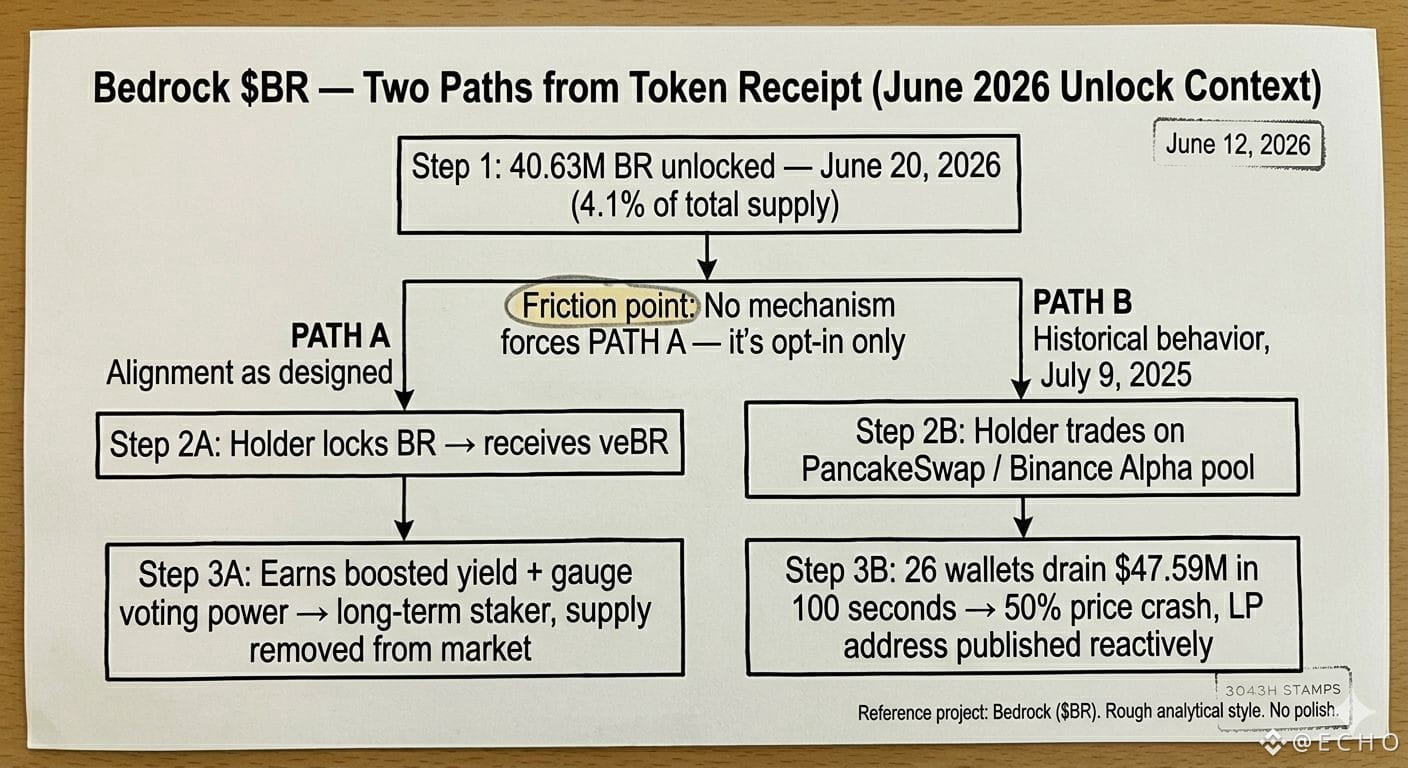
8
5
196
·
--
Ich war gerade dabei, eine CreatorPad-Aufgabe über die Frage, wie Bedrock die Teilnahme-Modelle neu definieren könnte, als mich die Struktur des BR Trade Streak einfach kalt erwischte.
@Bedrock $BR #Bedrock rahmt die Teilnahme als breit und zugänglich ein – veBR Governance, Gauge Voting, Community Steering Protocol Richtung. Das ist das Versprechen. Aber dann habe ich mir angeschaut, was Trade Streak Woche 1 (2.–9. Juli) tatsächlich als Teilnahme definiert hat: $30.000 pro Tag für sieben aufeinanderfolgende Tage oder $300.000 Gesamtvolumen in BR/USDT, um sich zu qualifizieren. Die ersten 10.000 berechtigten Beansprucher teilen sich den $100K Pool. Nur die Schnellsten kommen rein.
Halt mal – das ist kein Teilnahme-Modell. Das ist ein Kapital- und Geschwindigkeitsfilter, der als Community-Engagement verkleidet ist. Das vorherige Trading Carnival belohnte 60.000 Wallets mit insgesamt $180.000. Was breit klingt, bis du bemerkst, dass die Top 50 Trader im Durchschnitt jeweils $4,45 Millionen gemacht haben. Also, wer definiert hier eigentlich die Teilnahme?
Ich komme immer wieder darauf zurück: Die veBR Governance-Ebene ist wirklich für breite, geduldige Holder konzipiert. Die Lock-Dauer erhöht die Stimmkraft. Saisonale Rücksetzungen verhindern Konzentration. Auf dem Papier ist das egalitärer als die meisten. Aber die Kampagnen, die gerade laufen – die, die die echte On-Chain-Aktivität erzeugen – erfordern leise Kapitalzugang, den die meisten Wallets einfach nicht haben.
Hmm. Vielleicht sind das Teilnahme-Modell, das Bedrock aufbaut, und das Teilnahme-Modell, das Bedrock in der Praxis betreibt, zwei verschiedene Dinge, die noch aufeinanderprallen warten…
Ich war gerade dabei, eine CreatorPad-Aufgabe über die Frage, wie Bedrock die Teilnahme-Modelle neu definieren könnte, als mich die Struktur des BR Trade Streak einfach kalt erwischte.
@Bedrock $BR #Bedrock rahmt die Teilnahme als breit und zugänglich ein – veBR Governance, Gauge Voting, Community Steering Protocol Richtung. Das ist das Versprechen. Aber dann habe ich mir angeschaut, was Trade Streak Woche 1 (2.–9. Juli) tatsächlich als Teilnahme definiert hat: $30.000 pro Tag für sieben aufeinanderfolgende Tage oder $300.000 Gesamtvolumen in BR/USDT, um sich zu qualifizieren. Die ersten 10.000 berechtigten Beansprucher teilen sich den $100K Pool. Nur die Schnellsten kommen rein.
Halt mal – das ist kein Teilnahme-Modell. Das ist ein Kapital- und Geschwindigkeitsfilter, der als Community-Engagement verkleidet ist. Das vorherige Trading Carnival belohnte 60.000 Wallets mit insgesamt $180.000. Was breit klingt, bis du bemerkst, dass die Top 50 Trader im Durchschnitt jeweils $4,45 Millionen gemacht haben. Also, wer definiert hier eigentlich die Teilnahme?
Ich komme immer wieder darauf zurück: Die veBR Governance-Ebene ist wirklich für breite, geduldige Holder konzipiert. Die Lock-Dauer erhöht die Stimmkraft. Saisonale Rücksetzungen verhindern Konzentration. Auf dem Papier ist das egalitärer als die meisten. Aber die Kampagnen, die gerade laufen – die, die die echte On-Chain-Aktivität erzeugen – erfordern leise Kapitalzugang, den die meisten Wallets einfach nicht haben.
Hmm. Vielleicht sind das Teilnahme-Modell, das Bedrock aufbaut, und das Teilnahme-Modell, das Bedrock in der Praxis betreibt, zwei verschiedene Dinge, die noch aufeinanderprallen warten…
@Bedrock $BR #Bedrock rahmt die Teilnahme als breit und zugänglich ein – veBR Governance, Gauge Voting, Community Steering Protocol Richtung. Das ist das Versprechen. Aber dann habe ich mir angeschaut, was Trade Streak Woche 1 (2.–9. Juli) tatsächlich als Teilnahme definiert hat: $30.000 pro Tag für sieben aufeinanderfolgende Tage oder $300.000 Gesamtvolumen in BR/USDT, um sich zu qualifizieren. Die ersten 10.000 berechtigten Beansprucher teilen sich den $100K Pool. Nur die Schnellsten kommen rein.
Halt mal – das ist kein Teilnahme-Modell. Das ist ein Kapital- und Geschwindigkeitsfilter, der als Community-Engagement verkleidet ist. Das vorherige Trading Carnival belohnte 60.000 Wallets mit insgesamt $180.000. Was breit klingt, bis du bemerkst, dass die Top 50 Trader im Durchschnitt jeweils $4,45 Millionen gemacht haben. Also, wer definiert hier eigentlich die Teilnahme?
Ich komme immer wieder darauf zurück: Die veBR Governance-Ebene ist wirklich für breite, geduldige Holder konzipiert. Die Lock-Dauer erhöht die Stimmkraft. Saisonale Rücksetzungen verhindern Konzentration. Auf dem Papier ist das egalitärer als die meisten. Aber die Kampagnen, die gerade laufen – die, die die echte On-Chain-Aktivität erzeugen – erfordern leise Kapitalzugang, den die meisten Wallets einfach nicht haben.
Hmm. Vielleicht sind das Teilnahme-Modell, das Bedrock aufbaut, und das Teilnahme-Modell, das Bedrock in der Praxis betreibt, zwei verschiedene Dinge, die noch aufeinanderprallen warten…
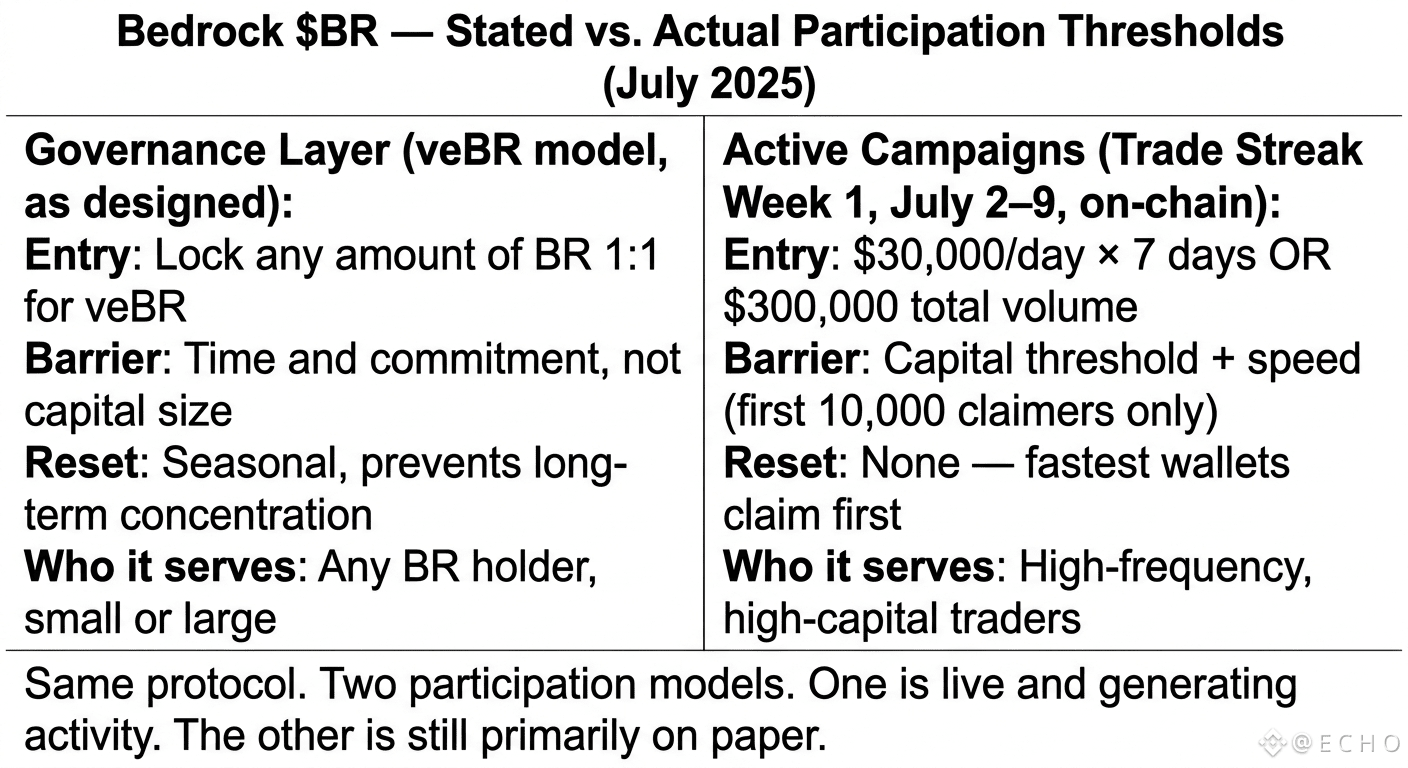
9
6
222
·
--
Die CreatorPad-Aufgabe auf Bedrock und die Benutzeroptionen hielten mich auf Trab, und das, was mich wirklich störte, war nicht die Anzahl der Chains – es war das Kleingedruckte darunter.
@Bedrock $BR uniBTC und brBTC sind tatsächlich über 19+ Netzwerke via Chainlink CCIP bridgebar. Das ist echt. Der Token-Unlock am 20. Juni in zehn Tagen – 40,63 Millionen BR, die laut CoinGeckos Tracker fallen – ließ mich die tatsächlichen Bridge-Dokumente genauer unter die Lupe nehmen als sonst. Und da bemerkte ich es: Jeder Korridor hat eine harte Quotenobergrenze, die live auf Vertragsniveau durchgesetzt wird. Bridge-Anfragen werden stillschweigend abgelehnt, wenn die verfügbare Kapazität der Route voll ist. Keine Fehlermeldung. Nur eine Ablehnung. #Bedrock
Das ist nicht genau eine Kritik. Es ist eine Designentscheidung zur Sicherheit, und eine vernünftige. Aber es verändert, was "Optionen" in der Praxis tatsächlich bedeutet. Die Erzählung ist neunzehn Chains, frei bewegen. Die Realität ist neunzehn Chains, frei bewegen innerhalb der Kapazitätsfenster pro Route, die sich basierend auf der Nachfrage und der eigenen Sicherheitslage des Protokolls verschieben. Die meisten Nutzer werden diese Obergrenzen unter normalen Bedingungen nicht erreichen. Aber die Optionalität ist nicht bedingungslos.
Ich dachte ständig über dies im Vergleich zur Überschrift nach… hmm. Es ist der Unterschied zwischen "du kannst überall hin" und "du kannst überall hin, wenn die Spur nicht voll ist." Beide könnten technisch gesehen wahr sein.
Fügt das Bridge-Cap-Modell bedeutende Sicherheit hinzu, ohne die Optionalität im großen Maßstab praktisch einzuschränken, oder wird es still und leise die bindende Einschränkung, sobald der TVL wieder auf $1B klettert?
Die CreatorPad-Aufgabe auf Bedrock und die Benutzeroptionen hielten mich auf Trab, und das, was mich wirklich störte, war nicht die Anzahl der Chains – es war das Kleingedruckte darunter.
@Bedrock $BR uniBTC und brBTC sind tatsächlich über 19+ Netzwerke via Chainlink CCIP bridgebar. Das ist echt. Der Token-Unlock am 20. Juni in zehn Tagen – 40,63 Millionen BR, die laut CoinGeckos Tracker fallen – ließ mich die tatsächlichen Bridge-Dokumente genauer unter die Lupe nehmen als sonst. Und da bemerkte ich es: Jeder Korridor hat eine harte Quotenobergrenze, die live auf Vertragsniveau durchgesetzt wird. Bridge-Anfragen werden stillschweigend abgelehnt, wenn die verfügbare Kapazität der Route voll ist. Keine Fehlermeldung. Nur eine Ablehnung. #Bedrock
Das ist nicht genau eine Kritik. Es ist eine Designentscheidung zur Sicherheit, und eine vernünftige. Aber es verändert, was "Optionen" in der Praxis tatsächlich bedeutet. Die Erzählung ist neunzehn Chains, frei bewegen. Die Realität ist neunzehn Chains, frei bewegen innerhalb der Kapazitätsfenster pro Route, die sich basierend auf der Nachfrage und der eigenen Sicherheitslage des Protokolls verschieben. Die meisten Nutzer werden diese Obergrenzen unter normalen Bedingungen nicht erreichen. Aber die Optionalität ist nicht bedingungslos.
Ich dachte ständig über dies im Vergleich zur Überschrift nach… hmm. Es ist der Unterschied zwischen "du kannst überall hin" und "du kannst überall hin, wenn die Spur nicht voll ist." Beide könnten technisch gesehen wahr sein.
Fügt das Bridge-Cap-Modell bedeutende Sicherheit hinzu, ohne die Optionalität im großen Maßstab praktisch einzuschränken, oder wird es still und leise die bindende Einschränkung, sobald der TVL wieder auf $1B klettert?
@Bedrock $BR uniBTC und brBTC sind tatsächlich über 19+ Netzwerke via Chainlink CCIP bridgebar. Das ist echt. Der Token-Unlock am 20. Juni in zehn Tagen – 40,63 Millionen BR, die laut CoinGeckos Tracker fallen – ließ mich die tatsächlichen Bridge-Dokumente genauer unter die Lupe nehmen als sonst. Und da bemerkte ich es: Jeder Korridor hat eine harte Quotenobergrenze, die live auf Vertragsniveau durchgesetzt wird. Bridge-Anfragen werden stillschweigend abgelehnt, wenn die verfügbare Kapazität der Route voll ist. Keine Fehlermeldung. Nur eine Ablehnung. #Bedrock
Das ist nicht genau eine Kritik. Es ist eine Designentscheidung zur Sicherheit, und eine vernünftige. Aber es verändert, was "Optionen" in der Praxis tatsächlich bedeutet. Die Erzählung ist neunzehn Chains, frei bewegen. Die Realität ist neunzehn Chains, frei bewegen innerhalb der Kapazitätsfenster pro Route, die sich basierend auf der Nachfrage und der eigenen Sicherheitslage des Protokolls verschieben. Die meisten Nutzer werden diese Obergrenzen unter normalen Bedingungen nicht erreichen. Aber die Optionalität ist nicht bedingungslos.
Ich dachte ständig über dies im Vergleich zur Überschrift nach… hmm. Es ist der Unterschied zwischen "du kannst überall hin" und "du kannst überall hin, wenn die Spur nicht voll ist." Beide könnten technisch gesehen wahr sein.
Fügt das Bridge-Cap-Modell bedeutende Sicherheit hinzu, ohne die Optionalität im großen Maßstab praktisch einzuschränken, oder wird es still und leise die bindende Einschränkung, sobald der TVL wieder auf $1B klettert?
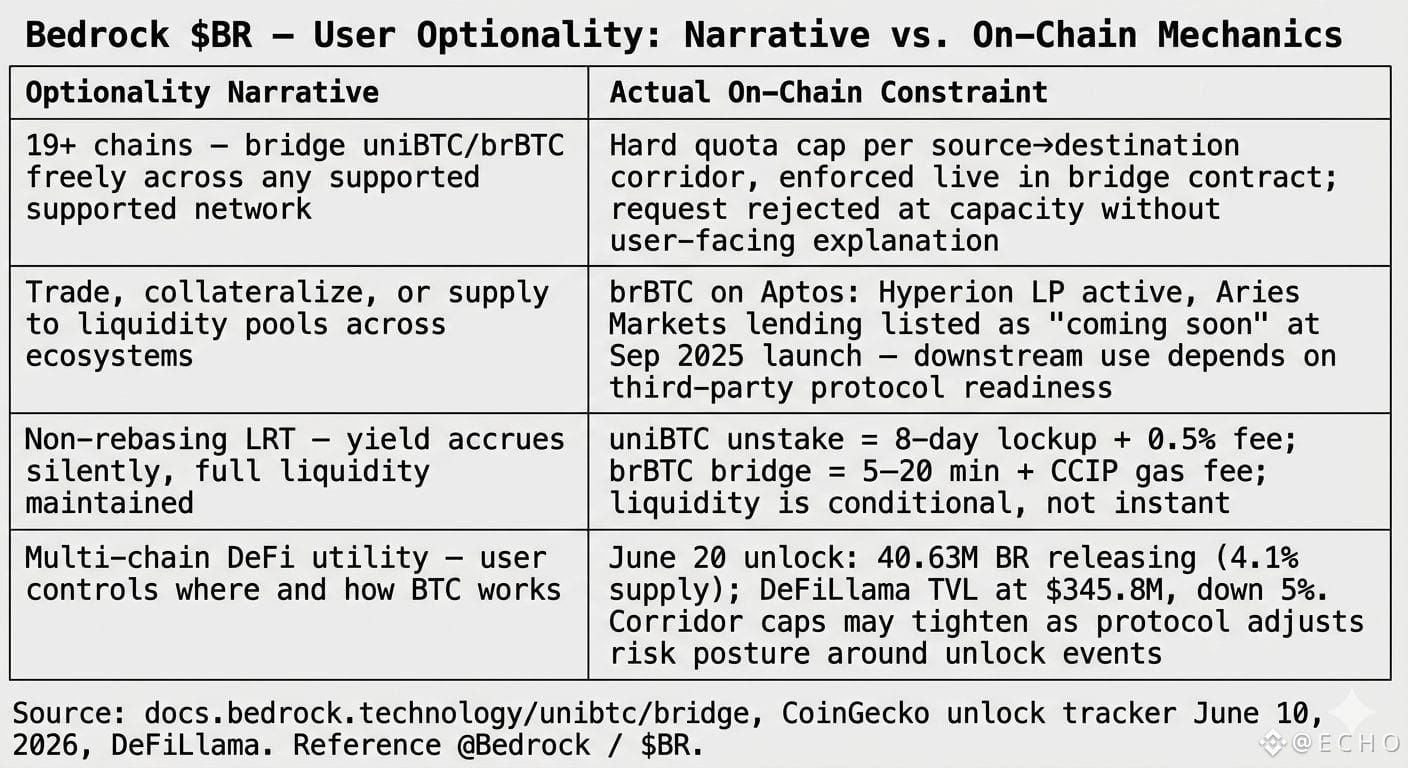
2
128
·
--
Gerade die DeFiLlama-Seite für @Bedrock uniBTC gecheckt. $289,14M sind über 18 Chains locked. $BR . #Bedrock . Dann habe ich die 7-Tage-Gebührenlinie angeschaut — da stand $1. Ein Dollar. Gegenüber fast dreihundert Millionen in gestaktem BTC.
Das ist kein Bug. Das Geschäftsmodell von Bedrock läuft komplett über Einzahlungsgebühren — das Protokoll verdient nur, wenn Nutzer verzögerte Abhebungsanträge stellen. Wenn BTC sitzt, kommt nichts dazu. Und gerade sitzt es richtig fest. $104M auf Bitcoin native, $80M auf Ethereum, $63,9M auf Merlin, und Kleingeld verteilt über BOB, BSC, Mantle, Berachain und ein Dutzend weitere. Alles locked, kaum Bewegung. Kumulative Protokoll-Einnahmen seit dem Start über all das: $26.381. Insgesamt. Diese Zahl kann jetzt auf dem DeFiLlama-Adapter verifiziert werden.
Moment mal — das könnte tatsächlich der Fall sein. Wenn BTC reinkommt und nicht wieder rausgeht, funktioniert das Protokoll als Basisinfrastruktur. Du sammelst keine Gebühren für Bewegungen, für die du nie Gebühren erhebst. Die eigentliche Frage ist, ob die Null-Gebühren-im-Ruhe-Strategie eine absichtliche Positionierung ist — erst die Routing-Schicht festlegen, später Wert erfassen — oder ein Modell, das einfach nie wieder überarbeitet wird.
$289M sticky und in der letzten Woche $1 eingenommen. Hmm. Ob das das Verhalten von etwas ist, das leise grundlegend wird, oder von einem Protokoll, das die Rohre gebaut hat, bevor der Zähler kam, habe ich noch nicht entschieden.
Gerade die DeFiLlama-Seite für @Bedrock uniBTC gecheckt. $289,14M sind über 18 Chains locked. $BR . #Bedrock . Dann habe ich die 7-Tage-Gebührenlinie angeschaut — da stand $1. Ein Dollar. Gegenüber fast dreihundert Millionen in gestaktem BTC.
Das ist kein Bug. Das Geschäftsmodell von Bedrock läuft komplett über Einzahlungsgebühren — das Protokoll verdient nur, wenn Nutzer verzögerte Abhebungsanträge stellen. Wenn BTC sitzt, kommt nichts dazu. Und gerade sitzt es richtig fest. $104M auf Bitcoin native, $80M auf Ethereum, $63,9M auf Merlin, und Kleingeld verteilt über BOB, BSC, Mantle, Berachain und ein Dutzend weitere. Alles locked, kaum Bewegung. Kumulative Protokoll-Einnahmen seit dem Start über all das: $26.381. Insgesamt. Diese Zahl kann jetzt auf dem DeFiLlama-Adapter verifiziert werden.
Moment mal — das könnte tatsächlich der Fall sein. Wenn BTC reinkommt und nicht wieder rausgeht, funktioniert das Protokoll als Basisinfrastruktur. Du sammelst keine Gebühren für Bewegungen, für die du nie Gebühren erhebst. Die eigentliche Frage ist, ob die Null-Gebühren-im-Ruhe-Strategie eine absichtliche Positionierung ist — erst die Routing-Schicht festlegen, später Wert erfassen — oder ein Modell, das einfach nie wieder überarbeitet wird.
$289M sticky und in der letzten Woche $1 eingenommen. Hmm. Ob das das Verhalten von etwas ist, das leise grundlegend wird, oder von einem Protokoll, das die Rohre gebaut hat, bevor der Zähler kam, habe ich noch nicht entschieden.
Das ist kein Bug. Das Geschäftsmodell von Bedrock läuft komplett über Einzahlungsgebühren — das Protokoll verdient nur, wenn Nutzer verzögerte Abhebungsanträge stellen. Wenn BTC sitzt, kommt nichts dazu. Und gerade sitzt es richtig fest. $104M auf Bitcoin native, $80M auf Ethereum, $63,9M auf Merlin, und Kleingeld verteilt über BOB, BSC, Mantle, Berachain und ein Dutzend weitere. Alles locked, kaum Bewegung. Kumulative Protokoll-Einnahmen seit dem Start über all das: $26.381. Insgesamt. Diese Zahl kann jetzt auf dem DeFiLlama-Adapter verifiziert werden.
Moment mal — das könnte tatsächlich der Fall sein. Wenn BTC reinkommt und nicht wieder rausgeht, funktioniert das Protokoll als Basisinfrastruktur. Du sammelst keine Gebühren für Bewegungen, für die du nie Gebühren erhebst. Die eigentliche Frage ist, ob die Null-Gebühren-im-Ruhe-Strategie eine absichtliche Positionierung ist — erst die Routing-Schicht festlegen, später Wert erfassen — oder ein Modell, das einfach nie wieder überarbeitet wird.
$289M sticky und in der letzten Woche $1 eingenommen. Hmm. Ob das das Verhalten von etwas ist, das leise grundlegend wird, oder von einem Protokoll, das die Rohre gebaut hat, bevor der Zähler kam, habe ich noch nicht entschieden.
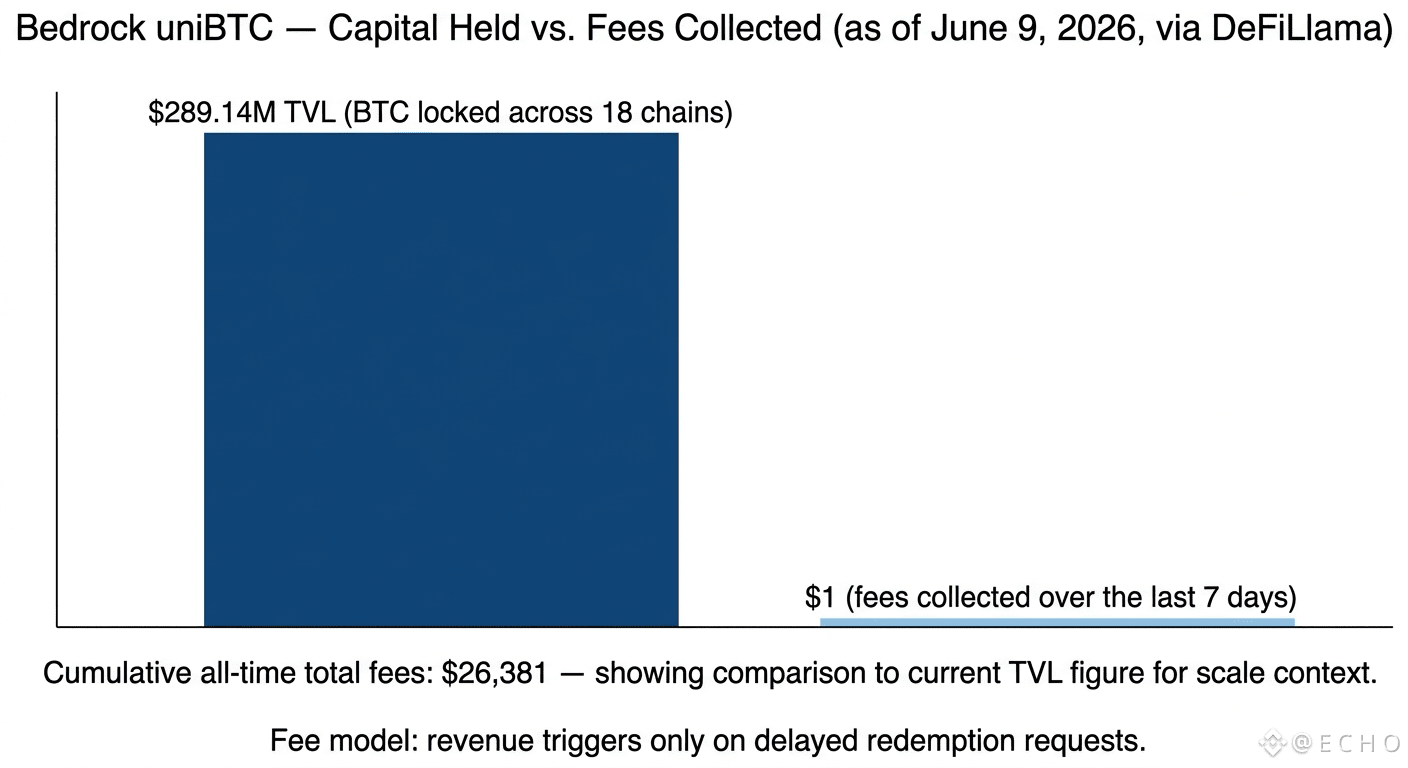
6
2
212
Anmelden und weiter Inhalte entdecken
Krypto-Nutzer weltweit auf Binance Square kennenlernen
⚡️ Bleib in Sachen Krypto stets am Puls.
💬 Die weltgrößte Kryptobörse vertraut darauf.
👍 Erhalte verlässliche Einblicke von verifizierten Creators.
E-Mail-Adresse/Telefonnummer
Trendthemen
QNTRises287%
1,281 Aufrufe
85 Kommentare
#QNTRises287%
🚀 QNT +287% — eine Bewegung, die Aufmerksamkeit verlangt.
Ein Anstieg dieser Schärfe kann einen plötzlichen Stimmungsumschwung im Markt, bei der Liquidität und im Handelsgeschehen widerspiegeln. Doch nach einem vertikalen Move kann die Volatilität schnell zunehmen.
Mein Fazit: Verfolge nicht einfach die Kerze—beobachte Volumen, Liquidität und ob QNT den Ausbruch durchhalten kann. 📊
#QNTRises287% #QNT #Crypto #Binance
$QNT
PALASH5
·0 Likes
·227 Aufrufe
TrumpRejectsAIRulesForVoluntaryAudits
5,366 Aufrufe
247 Kommentare
BitgetHotWalletBreachTiedToThirdPartySecurityFlaw
2,730 Aufrufe
187 Kommentare