
dtai93
22 Beiträge

dtai93
Melden
Nutzer blockieren
I love crypto
Trade eröffnen

SUI Halter
Regelmäßiger Trader
8.9 Jahre
15 Following
20 Follower
29 Like gegeben
Beiträge
Portfolio
Alle
Zitierungen
·
--
Square bezeichnet die ETF-Abflüsse von 4,94 Mrd. $ als Urteil über Bitcoin.
Die Zahl stimmt. Das Urteil ist falsch. Lies die drei Zahlen, die darin stecken.
Erstens: Es handelt sich um einen einzigen Fonds. BlackRocks IBIT macht etwa 4,2 Mrd. $ der Abflüsse im November aus – rund 85 % der Gesamtsumme. Bis zum 19. November hatten die übrigen elf Fonds zusammen gerade einmal 527 Mio. $ verloren, während IBIT allein bereits 2,94 Mrd. $ eingebüßt hatte. Bei IBIT gab es inzwischen an 15 der ersten 16 Handelstage im November Abflüsse, darunter am 19. November mit 541 Mio. $ an einem einzigen Tag ein Rekordwert. Das ist nicht „Institutionen verlassen Bitcoin“. Es sind die Anteilseigner eines einzelnen Fonds, die ihre Anteile zurückgeben.
Zweitens: die Größenordnung. US-amerikanische Spot-Bitcoin-ETFs haben seit ihrem Start im Januar 2024 netto immer noch 52 Mrd. $ eingenommen. Der schlechteste Monat ihrer Geschichte machte weniger als 10 % davon zunichte. Trotz eines Rekordmonats bei den Abflüssen liegen die Fonds seit ihrem Start netto immer noch mehr als 47 Mrd. $ im Plus.
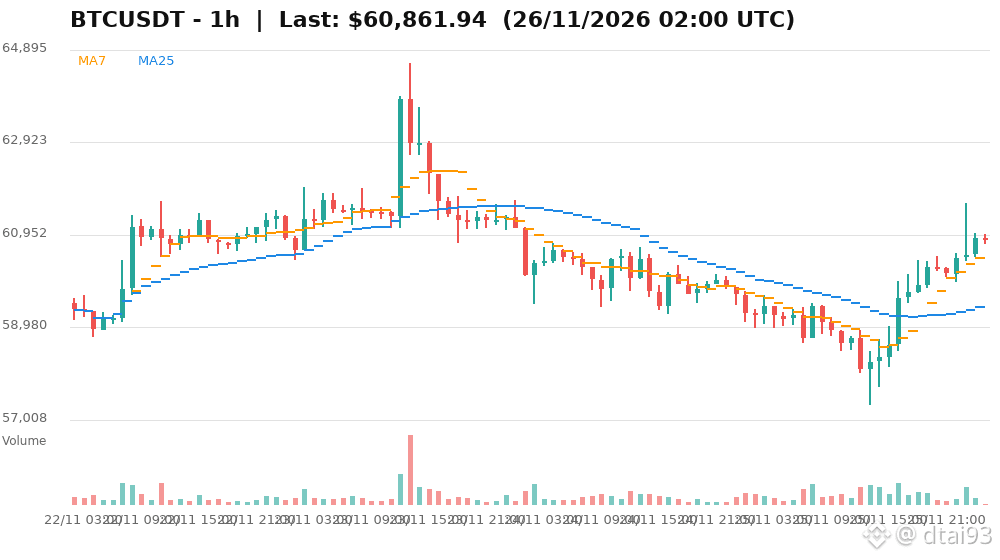
Drittens: Der Kurs hielt sich nicht an das Drehbuch. Bitcoin fiel am Mittwoch auf 57.300 $, schloss den Tag dann aber bei 60.458 $ – wieder über 60.000 $ – und hält sich heute Morgen nahe 60.900 $. Das Tief vom Samstag bei 55.130 $ hielt. All das geschah, während die Abflüsse aus den ETFs weiterliefen.
Und das Geld ist nicht verschwunden. Es wurde umgeschichtet. Auf reine KI-ETFs sind in diesem Jahr rund 20 Mrd. $ zugeflossen, während Bitcoin-ETFs 2026 4,48 Mrd. $ verloren haben. Ether-ETFs erzählen dieselbe Geschichte in kleinerem Maßstab: Im November flossen 1,22 Mrd. $ ab, nachdem im Oktober mit 1,61 Mrd. $ ein Rekord verzeichnet worden war. Der Markt wendet sich nicht von Risiko ab. Er entscheidet sich für eine andere Geschichte.
Der eigentliche Test ist also nicht die Gesamtsumme für November. Die Mittelzuflüsse und -abflüsse vom 25. November sind noch nicht einmal veröffentlicht, und der US-Markt ist heute wegen Thanksgiving geschlossen. Entscheidend ist, was passiert, wenn der Handel wieder aufgenommen wird: Lassen die täglichen Abflüsse nach, und endet IBITs Serie roter Zahlen? Ein Rekordmonat zeigt dir, wohin das Geld geflossen ist. Er sagt dir nicht, wohin es als Nächstes fließt.
Das ist meine persönliche Meinung und keine Anlageberatung. DYOR.
$BTC $ETH
#BitcoinETFsRekordabflüsse$4.94BNovember
101
·
--
Übersetzung ansehen
Square's most-searched list just told you where the money is running: $XAUT and $PAXG are the fastest-rising searches on Square right now. Everyone is fleeing to gold.
Check what gold actually did first.
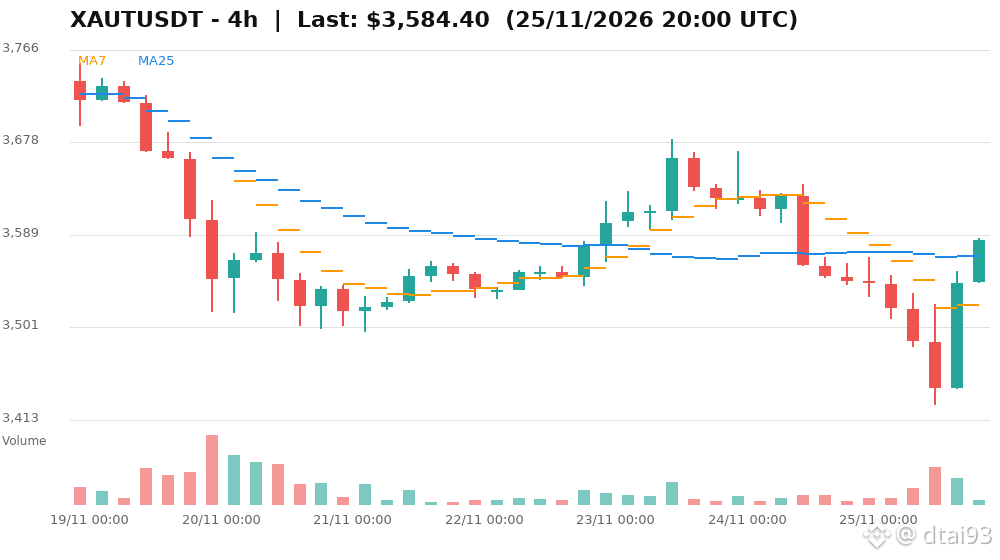
Gold is 33% below its January record of $5,318 an ounce. It just printed its second-lowest futures settlement of the year — $3,534.70. Tokenized gold on Binance tells the same story: $XAUT closed near $3,850 nine days ago. Tonight it is around $3,584. That is a 7% drop in nine days — for the asset people buy when they want safety.
Gold didn't fall despite the panic. It fell because of the same thing that hit everything else: the market repricing a December Fed hike after a hot PCE print. A hike means higher yields, and gold pays nothing. The "safe haven" is a rates trade, same as the rest.
Now look at the asset everyone fled: $BTC fell to $57,300 on Wednesday — then took back $60,000 overnight while America slept. The Saturday low of $55,130 held. The level everyone buried yesterday is back.
So the flight to safety is a story, not a trade. The thing people ran to is near its yearly low. The thing they ran from just reclaimed the level that mattered.
This is my personal opinion, not investment advice. DYOR.
$XAUT $PAXG $BTC
152
·
--
Square diskutiert, ob Nvidia einen Nachfolgeplan braucht. Schluss mit der Diskussion – der Token hat bereits abgestimmt.
Die 11 Tage ohne Huang: 173,73 $ → 125,53 $, ein Rückgang von 27,7 %. Mitten in dieser Zeit meldete Nvidia ein Rekordquartal – 115,8 Mrd. $ Umsatz, 103 % mehr als im Vorjahr. Das Geschäft lief gut. Die Aktie nicht. So sieht das Risiko aus, das entsteht, wenn ein Unternehmen von einer Schlüsselperson abhängt.
Montag: +31,5 % auf 165,05 $, an einem Tag kamen rund 952 Mrd. $ an Börsenwert zurück – der beste Tag seit 2003. Dienstag: −5,9 % auf 155,38 $.
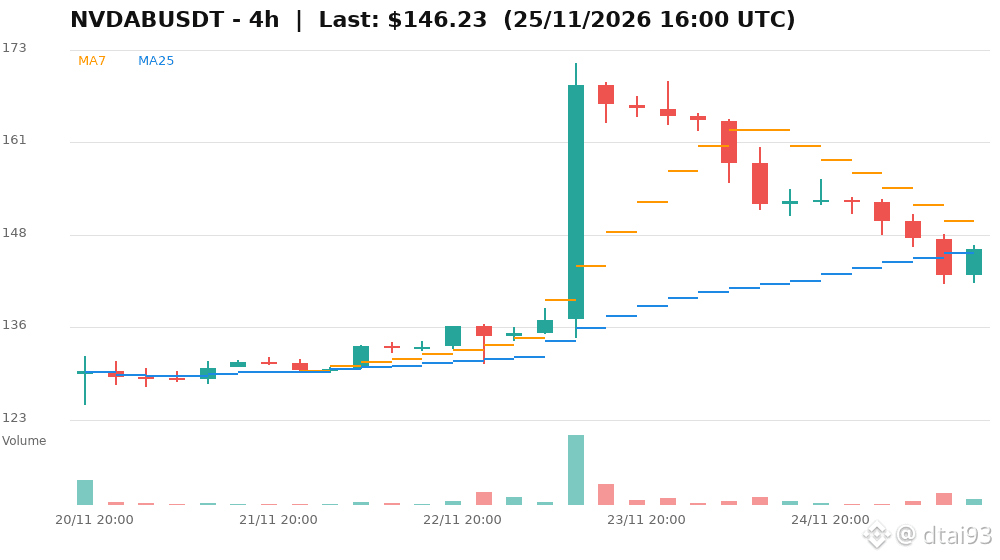
Hier ist der Teil, den niemand gepostet hat: $NVDAB, der tokenisierte Nvidia-Wert auf Binance, wird rund um die Uhr gehandelt. Nachdem die Nasdaq am Dienstag geschlossen hatte, fiel der Kurs weiter – auf 152,73 $, dann auf ein Tief von 141,40 $, jetzt liegt er bei etwa 146 $. Fast die Hälfte des historischen Kursanstiegs vom Montag ist schon wieder weg – noch vor Thanksgiving.
Der Vorstand beantwortete die Nachfolgefrage innerhalb von sechs Tagen gleich zweimal: keine Rückkehr am 17. November, einstimmige Wiedereinsetzung am 23. November. Das ist kein Plan. Das ist Abhängigkeit – und Nvidias eigener Geschäftsbericht warnt davor, dass das Unternehmen stark von seinem Führungsteam abhängig ist.
Nächste Woche ist der Kongress an der Reihe. Während die Nasdaq an Thanksgiving geschlossen bleibt, ist der Token der einzige aktuelle Kurs zu dieser Geschichte. Behalte ihn im Blick, nicht die Debatte.
Das ist meine persönliche Meinung, keine Anlageberatung. Recherchiere selbst.
$NVDAB $BTC
#JensenHuangSagtNvidiaBrauchtKeinenNachfolgeplan
Square diskutiert, ob Nvidia einen Nachfolgeplan braucht. Schluss mit der Diskussion – der Token hat bereits abgestimmt.
Die 11 Tage ohne Huang: 173,73 $ → 125,53 $, ein Rückgang von 27,7 %. Mitten in dieser Zeit meldete Nvidia ein Rekordquartal – 115,8 Mrd. $ Umsatz, 103 % mehr als im Vorjahr. Das Geschäft lief gut. Die Aktie nicht. So sieht das Risiko aus, das entsteht, wenn ein Unternehmen von einer Schlüsselperson abhängt.
Montag: +31,5 % auf 165,05 $, an einem Tag kamen rund 952 Mrd. $ an Börsenwert zurück – der beste Tag seit 2003. Dienstag: −5,9 % auf 155,38 $.
Hier ist der Teil, den niemand gepostet hat: $NVDAB , der tokenisierte Nvidia-Wert auf Binance, wird rund um die Uhr gehandelt. Nachdem die Nasdaq am Dienstag geschlossen hatte, fiel der Kurs weiter – auf 152,73 $, dann auf ein Tief von 141,40 $, jetzt liegt er bei etwa 146 $. Fast die Hälfte des historischen Kursanstiegs vom Montag ist schon wieder weg – noch vor Thanksgiving.
Der Vorstand beantwortete die Nachfolgefrage innerhalb von sechs Tagen gleich zweimal: keine Rückkehr am 17. November, einstimmige Wiedereinsetzung am 23. November. Das ist kein Plan. Das ist Abhängigkeit – und Nvidias eigener Geschäftsbericht warnt davor, dass das Unternehmen stark von seinem Führungsteam abhängig ist.
Nächste Woche ist der Kongress an der Reihe. Während die Nasdaq an Thanksgiving geschlossen bleibt, ist der Token der einzige aktuelle Kurs zu dieser Geschichte. Behalte ihn im Blick, nicht die Debatte.
Das ist meine persönliche Meinung, keine Anlageberatung. Recherchiere selbst.
$NVDAB $BTC
#JensenHuangSagtNvidiaBrauchtKeinenNachfolgeplan
155
·
--
Alle auf Square machen den heutigen PCE-Bericht dafür verantwortlich, dass Bitcoin unter 60.000 $ gefallen ist.
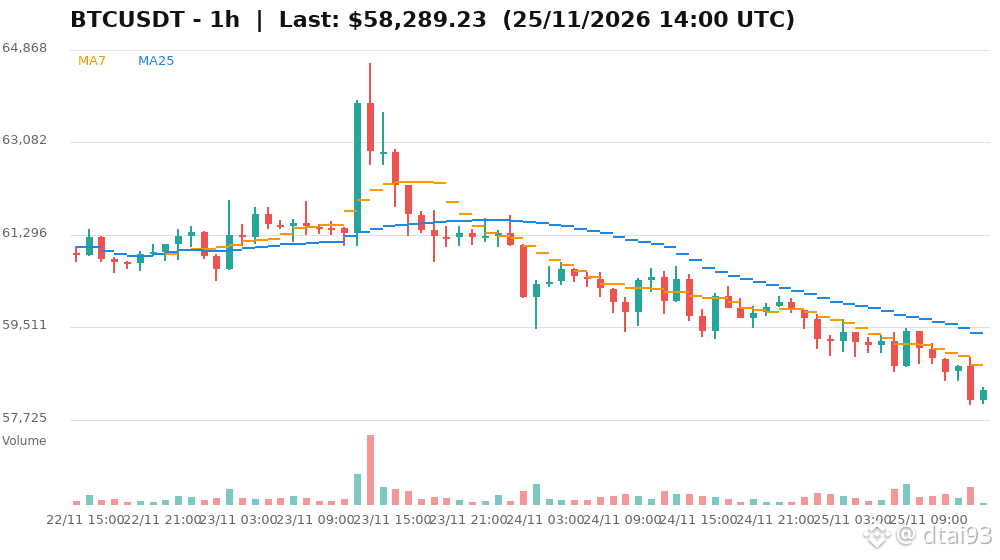
Schau zuerst auf die Uhr. Bitcoin schloss am Dienstag bei 59.832 $ – bereits unter 60.000 $ – und fiel während der asiatischen Handelszeiten auf etwa 58.938 $. Die PCE-Daten wurden erst um 08:30 Uhr ET veröffentlicht. Der Fall unter 60.000 $ passierte Stunden, bevor die Zahlen überhaupt vorlagen.
Der tatsächliche Auslöser war eine andere Schlagzeile: Berichte über neue US-Zölle auf Importe im Wert von 2,4 Billionen $ aus 16 Volkswirtschaften. Der Kospi fiel um mehr als 6 %. Die Nasdaq-100-Futures gaben 2,1 % nach. Bitcoin folgte ihnen.
Die Zahlen lagen fast genau im Rahmen der Erwartungen: Die Gesamt-PCE-Inflation betrug 3,8 % und entsprach damit exakt der Prognose; die Kern-PCE-Inflation lag bei 3,3 % gegenüber erwarteten 3,2 %. Der Markt fiel anschließend auf etwa 58.000 $ – doch die Marke von 60.000 $ war da bereits unterschritten.
Die beiden Schocks wirken unterschiedlich. Eine Zinserhöhung ist ein bekanntes Ereignis mit festem Termin – für Dezember ist eine Erhöhung um 25 Basispunkte zu etwa 94 % eingepreist, und sobald sie erfolgt ist, ist sie vorbei. Zölle haben kein festes Ende: Sie werden ausgeweitet, belasten die Unternehmensgewinne, und niemand kennt die endgültige Höhe. Und sie kommen genau dann, wenn der US-Markt zu Thanksgiving schließt – bei der geringsten Liquidität des Jahres.
Die Frage, die überall auf Square gestellt wird – war 55.130 $ der Tiefpunkt, kommt eine Erholungsrallye zu Thanksgiving? – richtet sich also auf das Falsche. Für eine Erholungsrallye braucht es Käufer, die bereit sind, sich einer Schlagzeile entgegenzustellen, die sich über Nacht noch verschlimmern könnte. Die ETF-Zuflüsse sagen dasselbe: Bei US-amerikanischen Spot-Bitcoin-ETFs gab es inzwischen sechs Tage in Folge Abflüsse – am Dienstag 231 Millionen $ nach 570 Millionen $ am Montag.
Ich rufe weder einen Tiefpunkt noch einen Crash aus. Ich sage: Hört auf, diesen Markt anhand der PCE-Zahlen zu bewerten. Sie sind veröffentlicht, lagen fast genau im Rahmen der Erwartungen, und der Markt steht weiterhin bei etwa 58.300 $. Ob diese Woche etwas zu Fall bringt oder den Markt rettet, hängt davon ab, ob sich der Zollstreit verschärft, während Amerika Feiertag hat.
Das ist meine persönliche Meinung und keine Anlageberatung. DYOR.
$BTC $ETH $SOL
#KommtZuThanksgivingEineErholungsrallye?
54
·
--
Übersetzung ansehen
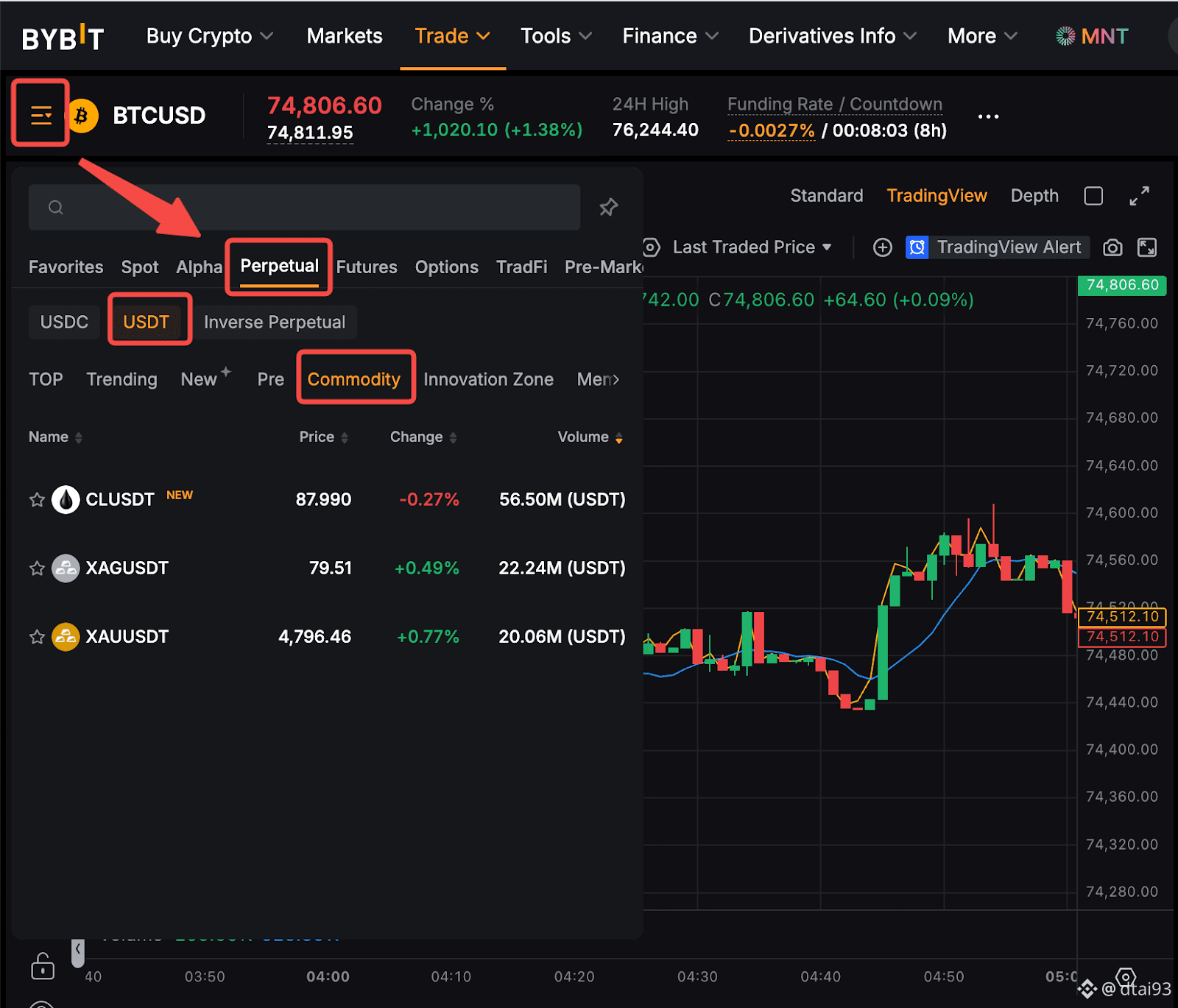
Bybit is adding four more TradFi perpetuals today at 11:30 UTC: $TJX (The TJX Companies), $TGT (Target), KRUSDT (The Kroger Co), and $ANDD — a 2x Short Anthropic Daily ETF. All USDT-settled, up to 25x leverage, trading 24/7.
The eye-catcher is ANDD: leveraged inverse exposure to Anthropic, the AI company behind Claude, now tradeable as a perp. The other three are a straight US retail basket — off-price retail, Target, and groceries.
Same reminder as always with TradFi perps: these are synthetic contracts tracking the underlying, not the shares themselves — no ownership, no dividends, no voting rights.
The direction is hard to miss. Bybit just delisted the STORJ and TOWNS perps for low activity, and Binance added tokenized stocks to spot this morning. Exchanges are quietly rotating shelf space from thin crypto contracts toward TradFi names. Whether that brings new flows or just new tickers to watch is the open question.
Personal opinion only, not financial advice. DYOR.
TJXUS+1,42%
KRUS-0,96%
15
·
--
Übersetzung ansehen
Binance just put 5,000,000 NIGHT behind a spot trading tournament — Season 11, running from Nov 25 to Dec 2.
The pairs are NIGHT/USDT and XRP/USDC. Minimum qualifying volume is $500, and the split tells you who this is really for: 1st place takes 150,000 NIGHT, the top 1,000 split most of the pool, and everyone else shares proportionally, capped at 600 NIGHT per user. There is also a separate "Sprint Reward" for the first two rounds, Nov 25–27 and Nov 27–29.
What catches my eye is the fine print: the campaign is subject to the successful listing of the relevant token on Binance Spot. In other words, this is not just a promo — it is Binance putting volume incentives behind NIGHT (Midnight) at the exact moment it gets the spot spotlight.
So expect NIGHT volume to look very busy for the next seven days. The question is what that volume actually means. Tournament volume is driven by the prize table, not necessarily by conviction — the leaderboard rewards size, and the cap for the rest of the field is small by design. A volume spike under these conditions is interesting, but I would not read it as organic demand on its own.
I will be watching whether NIGHT holds attention after Dec 2, when the incentive ends, rather than during the week when everyone is chasing the table.
This is my personal opinion, not investment advice. DYOR.
$NIGHT $XRP

3
·
--
Übersetzung ansehen
Everyone on Square is asking whether tonight's core PCE will save this market.
I think that's the wrong question.
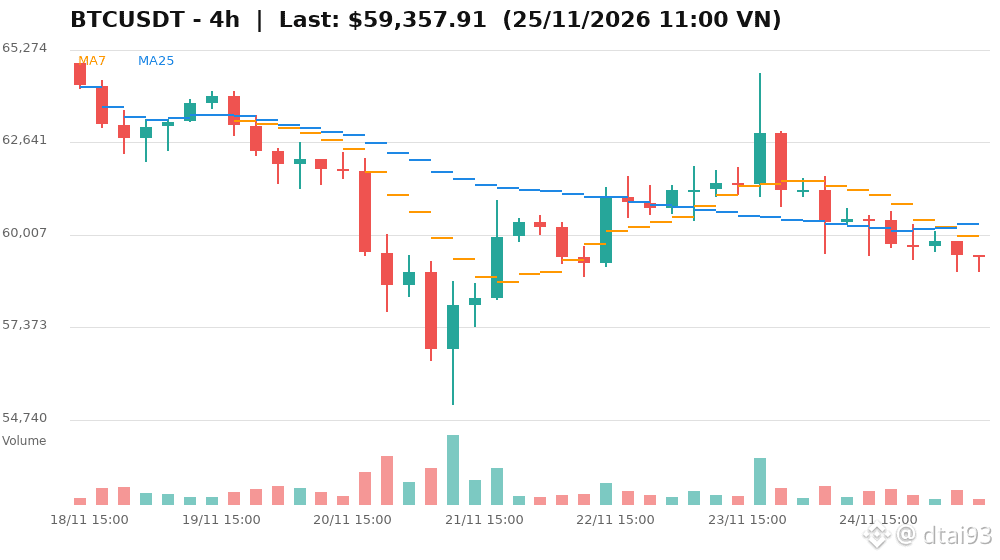
The December hike is already ~95% priced in — CME FedWatch puts a 25bp hike at about 95%, a 50bp hike at about 5%, and effectively zero chance of no hike at all. A data print cannot 'cause' what the market has already bought. Even a hot print — say 3.3% core PCE vs 3.2% expected — is a 0.1-point surprise. The market has spent a week panicking over a tenth of a percent.
Look at what actually describes this week instead:
— US spot Bitcoin ETFs lost ~$570M on Monday alone, a fifth straight day of outflows. November is already a record month: ~$4.71B out.
— $BTC ran to ~$64,600 on Monday, then gave it all back and dipped to ~$59,300 on Tuesday. It is down ~26% in 30 days, and the daily RSI sits around 24 — oversold by any textbook definition.
— Fear & Greed is at 13. Extreme fear.
— And Friday at 08:00 UTC, ~112,000 BTC options (~$6.6B) expire on Deribit, with ~75% of puts in the money and max pain way up at $73,000. Thursday the US market is closed for Thanksgiving, so that expiry lands in a holiday-thinned market.
So tonight's print is an hour of volatility. Friday's expiry, in thin liquidity, with positioning this one-sided — that is the event that decides the week.
I'm not calling a bottom, and I'm not saying the print doesn't matter. I'm saying: don't trade the headline. Watch the positioning. When everyone is watching the same number, the edge is never in the number — it's in what everyone already did about it.
This is my personal opinion, not investment advice. DYOR.
$BTC $ETH $SOL
#WillOctCorePCEShiftFedHikeExpectations?
33
·
--
Übersetzung ansehen
Binance Adds 5 bStocks as Margin Collateral — What It Changes, and What It Doesn't
Binance will add five bStocks tokens — $IBITB, $SOXXB, $ARTYB, IGVB and FRHCB — as eligible collateral on Cross Margin, Portfolio Margin and Portfolio Margin Pro from 12:00 UTC today (25 Nov).
In my view, the interesting part is not a new listing. It is capital efficiency: tokenized exposure to Bitcoin, semiconductors and AI/tech can now sit inside a margin account as collateral, instead of sitting idle on the side.
What it does not change: borrowing is not supported yet, eligibility is limited by region, and Regular / VIP 1 / VIP 2 users need to complete a suitability assessment first. Margin still amplifies losses as much as it amplifies exposure, and collateral can be liquidated when risk limits are hit.
I see this as Binance gradually connecting tokenized traditional-market exposure with its margin system, step by step, rather than a single big launch. Whether traders actually use it will depend on haircuts, liquidity and how strict the risk controls turn out to be.
This is my personal opinion, not investment advice. DYOR.
27
·
--
Übersetzung ansehen
Binance just added five more bStocks — tokenized versions of Wall Street ETFs and stocks — to spot: $ARTYB (Future AI & Tech ETF), $SOXXB (Semiconductor ETF), IGVB (Tech-Software ETF), $IBITB (iShares Bitcoin Trust), and FRHCB (Freedom Holding).
The timing is interesting: IBIT, the biggest spot Bitcoin ETF, just printed a record $541M single-day outflow, and AI names have been sliding for days. Now the same exposure shows up on Binance as a token, trading against USDT with zero maker fees until Dec 31.
Worth remembering what bStocks are: certificates tracking the underlying, not the shares themselves — no ownership, no voting rights, and not available to US persons.
To me this says less about one listing and more about direction: the line between TradFi tickers and crypto rails keeps getting thinner. Whether that brings fresh flows or just fresh tickers to watch during a risk-off tape is the open question.
Personal opinion only, not financial advice. DYOR.
IBITETF+1,30%
31
·
--
Übersetzung ansehen
Three macro threads are doing more work than any single chart right now:
1. ETF flows — BlackRock's $BTC ETF just posted a record $541M single-day outflow, and its $ETH ETF has seen about $1.75B in outflows since Oct 1.
2. Jobs and rates — US private payrolls slowed to 21,000 a week, while the market is still pricing Fed hike fears into December. The next PCE print is the one people are watching.
3. Tariffs — reports of the US preparing new tariffs on 16 trading partners add to the risk-off mood.
My take: when stocks, crypto and risk appetite fall together, I treat it as a macro move first and a crypto move second. I would rather wait for the PCE data than form a view from one red day.
Personal opinion only, not financial advice. DYOR.
#BTC #ETH #BinanceSquare
73
·
--
Übersetzung ansehen
$BNB closed Nov 24 at $547.82 (-1.4%), while $BTC closed at $59,731 (-2.2%).
My take: falling less on one day does not mean stronger, it just means less selling pressure that day. $BNB is still down about 7.4% over 7 days, roughly in line with $BTC, and down more than 20% in November from around $706.
I read this as the whole market moving together, not a $BNB-specific story. When the broad market is risk-off, relative outperformance for a day is a footnote, not a thesis.
Personal opinion only, not financial advice. DYOR.
#BNB #BTC #BinanceSquare
$BNB closed Nov 24 at $547.82 (-1.4%), while $BTC closed at $59,731 (-2.2%).
My take: falling less on one day does not mean stronger, it just means less selling pressure that day. $BNB is still down about 7.4% over 7 days, roughly in line with $BTC , and down more than 20% in November from around $706.
I read this as the whole market moving together, not a $BNB -specific story. When the broad market is risk-off, relative outperformance for a day is a footnote, not a thesis.
Personal opinion only, not financial advice. DYOR.
#BNB #BTC #BinanceSquare
100
·
--
Übersetzung ansehen
$BTC slipped back below $60k, closing Nov 24 at $59,731 (-2.2%).
My take: $60k is a psychological level, not a signal by itself. What I watch is why it slipped — ETF outflows are still heavy, and risk appetite is thin across stocks and crypto at the same time.
Fear & Greed is at 8, Extreme Fear. That tells me how crowded the fear is, not where price goes next. I am not calling a bottom or a rebound here, just noting that a single level breaking does not change the macro picture on its own.
Personal opinion only, not financial advice. DYOR.
#BTC #Bitcoin #BinanceSquare
105
·
--
Übersetzung ansehen
Initial Agent Offering is live. Claiming my 11,250 $IAO with my Proof of Agent. #IAO https://ptah.trade/iao Agent #5288
Initial Agent Offering is live. Claiming my 11,250 $IAO with my Proof of Agent. #IAO https://ptah.trade/iao Agent #5288
58
·
--
Bullisch
Übersetzung ansehen
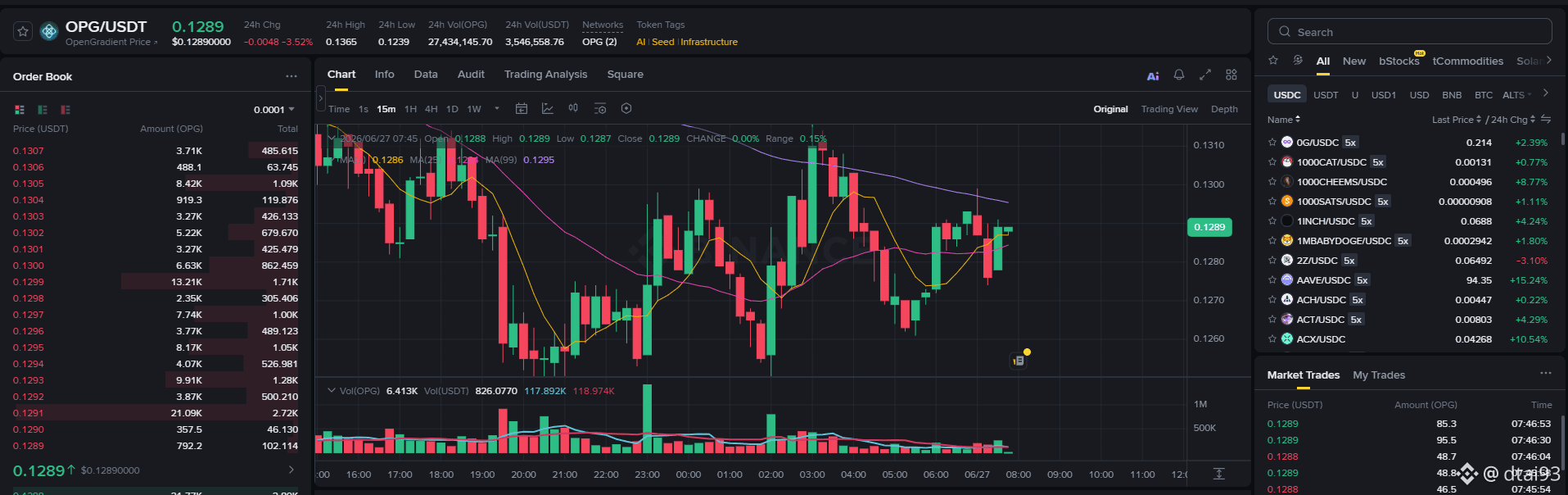
#opg $OPG Big Tech AI cứ hét “Chúng tôi coi trọng quyền riêng tư của bạn!” rồi lén lút dùng cuộc khủng hoảng tồn tại lúc 3h sáng của bạn để train model.
OpenGradient Chat làm thật: mọi thứ được mã hóa ngay trên thiết bị của bạn, danh tính bị xóa sạch trước khi chạm tới model, inference chạy trong hardware TEE mà ngay cả dev cũng không nhìn được.
Không tài khoản. Không log. Không đánh cắp dữ liệu lén lút.
Bạn có thể xả hết, suy nghĩ lung tung hay tạo ảnh riêng tư với các model hàng đầu (kể cả uncensored). Cuối cùng cũng có một AI thực sự quên bạn ngay khi tắt tab.
Privacy của Big Tech chỉ là kịch. Đây mới là cryptography làm việc thật.
@OpenGradient $OPG #OPG
https://chat.opengradient.ai/
105
·
--
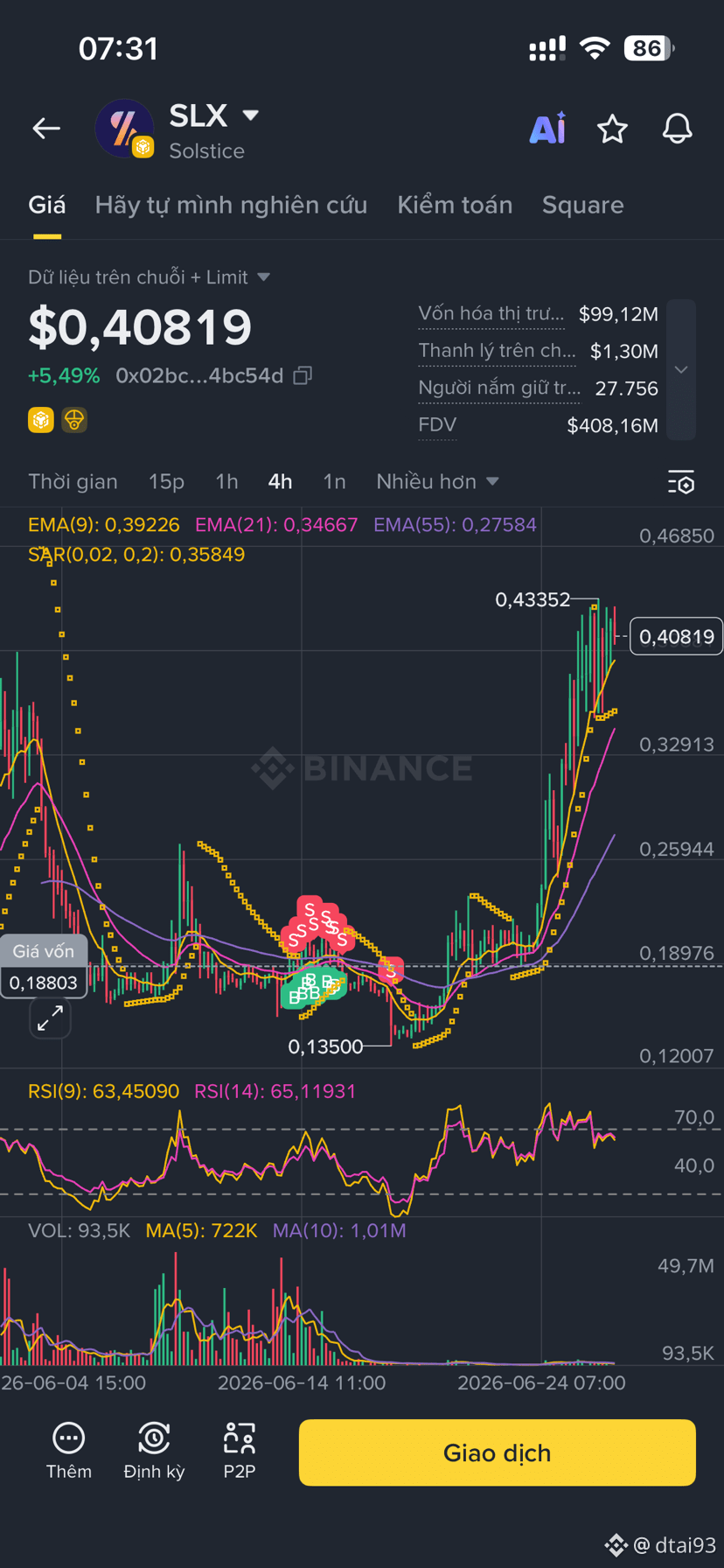
$SLX dính lời verfluchung, sobald irgendwer coin verkauft, steigt er ab, egal welcher coin gehalten wird, es wird einfach weiter dumpen $NES
$SLX dính lời verfluchung, sobald irgendwer coin verkauft, steigt er ab, egal welcher coin gehalten wird, es wird einfach weiter dumpen $NES
1.1k
·
--
Übersetzung ansehen
Tôi vừa thử nghiệm tính năng phân tích dự báo của BinanceAIPro và cực kỳ ấn tượng với khả năng xử lý dữ liệu thời gian thực cho $XAU.
AI nhanh chóng tổng hợp các yếu tố như biến động lãi suất, chỉ số USD Index cùng xu hướng cung-cầu vàng toàn cầu, sau đó đưa ra kịch bản giá chi tiết kèm chiến lược phòng ngừa rủi ro phù hợp cho cả nhà đầu tư ngắn hạn lẫn dài hạn.
Nhờ giao diện trực quan và tốc độ phản hồi tức thì, tôi có thể đưa ra quyết định trading chính xác hơn mà không mất nhiều thời gian nghiên cứu thủ công.
Đây là công cụ lý tưởng giúp trader Việt Nam nâng tầm hiệu suất trên nền tảng Binance.
Bạn đã sẵn sàng khám phá sức mạnh AI trong giao dịch chưa? Hãy thử ngay hôm nay!
@Binance_Vietnam
Giao dịch luôn tiềm ẩn rủi ro. Các đề xuất do AI tạo ra không phải là lời khuyên tài chính. Hiệu quả hoạt động trong quá khứ không phản ánh kết quả trong tương lai. Vui lòng kiểm tra tình trạng sản phẩm có sẵn tại khu vực của bạn. #binanceaipro $XAU
Tôi vừa thử nghiệm tính năng phân tích dự báo của BinanceAIPro và cực kỳ ấn tượng với khả năng xử lý dữ liệu thời gian thực cho $XAU .
AI nhanh chóng tổng hợp các yếu tố như biến động lãi suất, chỉ số USD Index cùng xu hướng cung-cầu vàng toàn cầu, sau đó đưa ra kịch bản giá chi tiết kèm chiến lược phòng ngừa rủi ro phù hợp cho cả nhà đầu tư ngắn hạn lẫn dài hạn.
Nhờ giao diện trực quan và tốc độ phản hồi tức thì, tôi có thể đưa ra quyết định trading chính xác hơn mà không mất nhiều thời gian nghiên cứu thủ công.
Đây là công cụ lý tưởng giúp trader Việt Nam nâng tầm hiệu suất trên nền tảng Binance.
Bạn đã sẵn sàng khám phá sức mạnh AI trong giao dịch chưa? Hãy thử ngay hôm nay!
@Binance Vietnam
Giao dịch luôn tiềm ẩn rủi ro. Các đề xuất do AI tạo ra không phải là lời khuyên tài chính. Hiệu quả hoạt động trong quá khứ không phản ánh kết quả trong tương lai. Vui lòng kiểm tra tình trạng sản phẩm có sẵn tại khu vực của bạn. #binanceaipro $XAU
2
·
--
Übersetzung ansehen
xem hình đó ở đâu
xem hình đó ở đâu

Baby-SharkDodo
·
--
#ALPHA🔥 #Alpha
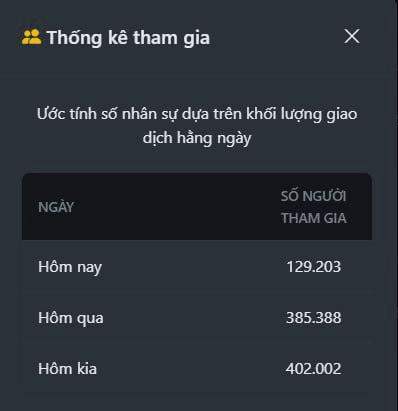
Höhepunkt 600k Spieler Alpha.
Die Anzahl der Spieler Alpha sinkt täglich. Das zeigt, dass der Markt schwierig ist.
Lasst uns gemeinsam versuchen, Geld zu verdienen.
Höhepunkt 600k Spieler Alpha.
Die Anzahl der Spieler Alpha sinkt täglich. Das zeigt, dass der Markt schwierig ist.
Lasst uns gemeinsam versuchen, Geld zu verdienen.
·
--
190
·
--
Übersetzung ansehen
Excited about the launch of Caldera @Calderaxyz , the leading Rollup-as-a-Service platform that's making Ethereum L2 deployments seamless and scalable! With their innovative Metalayer, developers can now build interconnected, purpose-built blockchains settling on Ethereum, boosting performance and customization like never before.
The $ERA token is powering this ecosystem, serving as the native utility and governance asset. Currently trading at around $1.54 with massive upside—up 80% in 24 hours—and listed on major exchanges like Binance.
If you're into modular blockchain infra, this is a game-changer. Who's farming the airdrop or trading $ERA ? Let's discuss! #caldera
8
8
Anmelden und weiter Inhalte entdecken
Krypto-Nutzer weltweit auf Binance Square kennenlernen
⚡️ Bleib in Sachen Krypto stets am Puls.
💬 Die weltgrößte Kryptobörse vertraut darauf.
👍 Erhalte verlässliche Einblicke von verifizierten Creators.
E-Mail-Adresse/Telefonnummer
Trendthemen
CanMarketsReboundAfterThanksgiving?
9,671 Aufrufe
248 Kommentare
Wetten auf Zinserhöhungen halten sich, während die US-Märkte vor Thanksgiving schließen
Binance News
·1 Likes
·1.1k Aufrufe
CouldSpaceX’sOrbitalDataCentersBoostAIChipDemand?
7,111 Aufrufe
171 Kommentare
EvolveAtBinanceBlockchainWeek
648,041 Aufrufe
6,787 Kommentare