

CryptonewsCom
11.8k Beiträge

CryptonewsCom
 Square Verified+
Melden
Nutzer blockieren
Latest cryptocurrency news from cryptonews.com
0 Following
3.8K+ Follower
7.5K+ Like gegeben
Beiträge
Artikel
Übersetzung ansehen
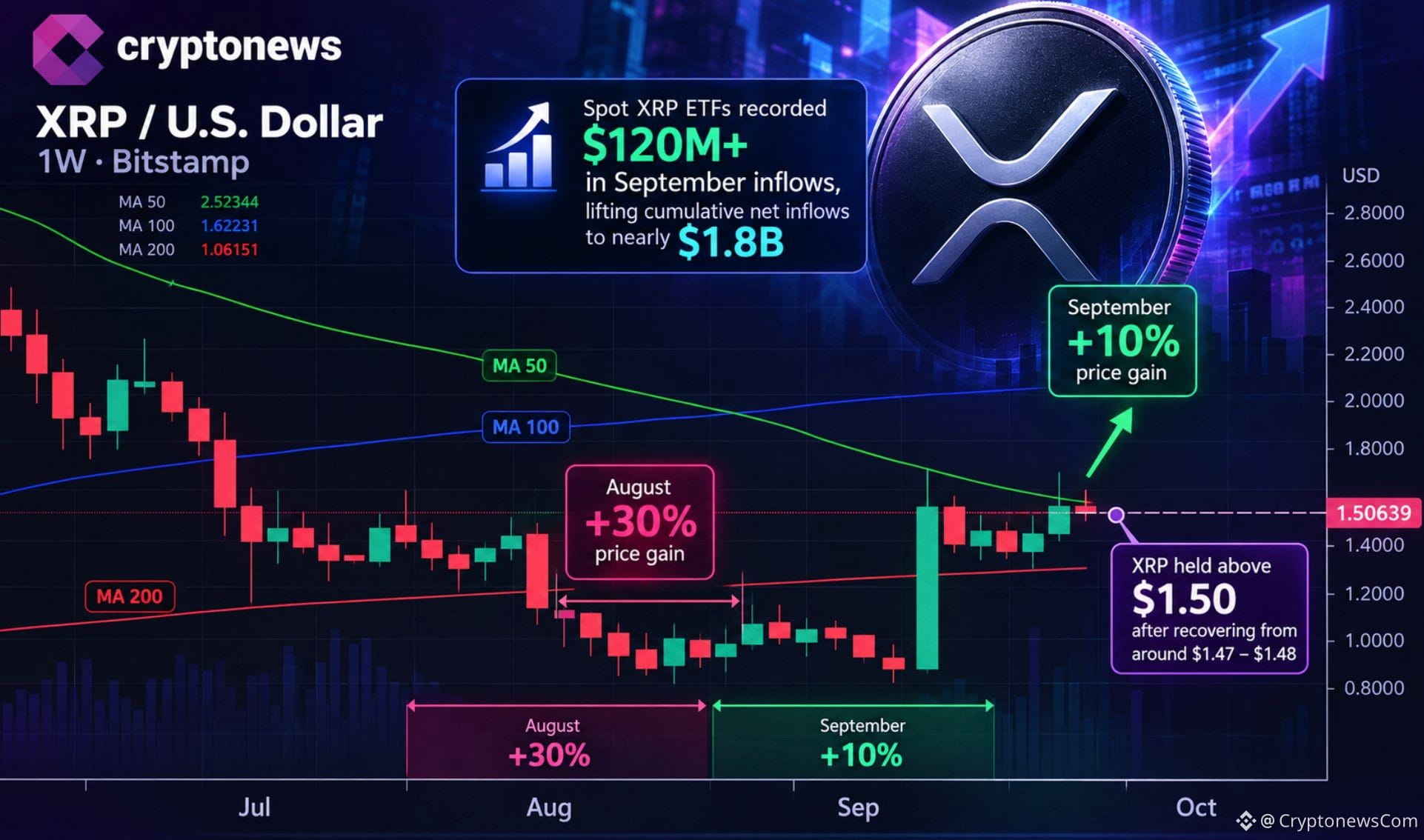
XRP Price Prediction: Ripple Targets 4 Straight Green Months in OctoberXRP price prediction is slightly bullish as it enters October at $1.50, and traders weigh whether September’s advance can extend the token’s run to four consecutive green months. The setup is constructive, but the $1.55–$1.60 resistance band has yet to give way.
September added just under 10% to XRP’s price, following a 30% August gain. Spot XRP ETFs recorded more than $120 million in September inflows, lifting cumulative net inflows to nearly $1.8 billion, while XRP held above $1.50 after recovering from around $1.47–$1.48.
October’s bullish reputation offers little protection by itself: XRP fell 16.7% in October 2024 and suffered another sharp decline during last year’s October 10 market liquidation. This time, institutional demand and upcoming XRP Ledger amendments meet macro pressure from elevated Treasury yields and crowded long positioning.
Which force wins should determine whether the monthly streak survives.
Earn $50 and Enter $300K Prize Draw on EdgeXXRP Price Prediction: Can Ripple Break $1.60 in October?
XRP’s latest price is $1.50, putting it green by a slight 1% gain over 24 hours. Price has rebounded from the $1.47–$1.48 area, but the immediate test is $1.55, followed by resistance between $1.60 and $1.65.
Technical reports place XRP above its 50-day and 200-day moving averages, while momentum remains constrained below resistance, and some analysts flag bearish RSI divergence. That combination points to consolidation.
A sustained move through $1.60–$1.65 could put $1.70 in play; a stronger breakout would require follow-through, not just a brief wick. XRP will likely hold $1.48–$1.50 and continue ranging as traders wait for flows and macro cues. However, a loss of $1.48 weakens the setup and exposes $1.42–$1.45, with lower support around $1.25–$1.32.
RIPPLE UNLOCKS 1 BILLION XRP
Ripple has now unlocked a total of 1B ripple:native (~$1.49B) from escrow across four transactions:
· 400M ripple:native
· 300M ripple:native
· 200M ripple:native
· 100M ripple:native
All four unlocks were executed within minutes. pic.twitter.com/HJ9yHAPJhb
— Onchain Lens (@OnchainLens) October 1, 2026
Ripple’s October 1 escrow has unlocked 1 billion XRP, worth $1.5 billion at current prices. Much of the released supply has historically been returned to escrow, so the headline amount is not equivalent to immediate sell pressure.
ETF flows and the ledger amendments’ required validator support above 80% are additional catalysts to monitor. For a related look at resistance and breakout prospects, see this XRP price-level analysis. The near-term read: constructive above support, unproven below resistance.
Trade XRP on Bybit and Get a Chance to Win Our $1,000 USDT AirdropMaxi Doge Targets Early-Stage Interest as XRP Tests Resistance
XRP’s recent gains have improved the chart, but the next leg depends on clearing resistance while holding the recovery zone. If price stalls below $1.60, traders may look beyond a large-cap asset for higher-risk exposure; that rotation carries its own risk, not a guaranteed shortcut to returns.
pic.twitter.com/Vg6OpDX6Bq
— MaxiDoge (@MaxiDoge_) August 13, 2026
Maxi Doge is an Ethereum ERC-20 meme token built around a trading-community identity: a 240-lb canine juggernaut channeling “1000x” leverage culture. Its presale price is just at $0.0002841, with $4.8 million already raised.
The project also gives a huge 65% APY for staking, holder-only trading competitions with leaderboard rewards, and a treasury intended for liquidity and partnerships. The appeal is community participation and meme-first marketing
Research Maxi Doge and review the project details before the presale ends.
Discover: The Best Token Presales
The post XRP Price Prediction: Ripple Targets 4 Straight Green Months in October appeared first on Cryptonews.
XRP Price Prediction: Ripple Targets 4 Straight Green Months in October
XRP price prediction is slightly bullish as it enters October at $1.50, and traders weigh whether September’s advance can extend the token’s run to four consecutive green months. The setup is constructive, but the $1.55–$1.60 resistance band has yet to give way.
September added just under 10% to XRP’s price, following a 30% August gain. Spot XRP ETFs recorded more than $120 million in September inflows, lifting cumulative net inflows to nearly $1.8 billion, while XRP held above $1.50 after recovering from around $1.47–$1.48.
October’s bullish reputation offers little protection by itself: XRP fell 16.7% in October 2024 and suffered another sharp decline during last year’s October 10 market liquidation. This time, institutional demand and upcoming XRP Ledger amendments meet macro pressure from elevated Treasury yields and crowded long positioning.
Which force wins should determine whether the monthly streak survives.
Earn $50 and Enter $300K Prize Draw on EdgeXXRP Price Prediction: Can Ripple Break $1.60 in October?
XRP’s latest price is $1.50, putting it green by a slight 1% gain over 24 hours. Price has rebounded from the $1.47–$1.48 area, but the immediate test is $1.55, followed by resistance between $1.60 and $1.65.
Technical reports place XRP above its 50-day and 200-day moving averages, while momentum remains constrained below resistance, and some analysts flag bearish RSI divergence. That combination points to consolidation.
A sustained move through $1.60–$1.65 could put $1.70 in play; a stronger breakout would require follow-through, not just a brief wick. XRP will likely hold $1.48–$1.50 and continue ranging as traders wait for flows and macro cues. However, a loss of $1.48 weakens the setup and exposes $1.42–$1.45, with lower support around $1.25–$1.32.
RIPPLE UNLOCKS 1 BILLION XRP
Ripple has now unlocked a total of 1B ripple:native (~$1.49B) from escrow across four transactions:
· 400M ripple:native
· 300M ripple:native
· 200M ripple:native
· 100M ripple:native
All four unlocks were executed within minutes. pic.twitter.com/HJ9yHAPJhb
— Onchain Lens (@OnchainLens) October 1, 2026
Ripple’s October 1 escrow has unlocked 1 billion XRP, worth $1.5 billion at current prices. Much of the released supply has historically been returned to escrow, so the headline amount is not equivalent to immediate sell pressure.
ETF flows and the ledger amendments’ required validator support above 80% are additional catalysts to monitor. For a related look at resistance and breakout prospects, see this XRP price-level analysis. The near-term read: constructive above support, unproven below resistance.
Trade XRP on Bybit and Get a Chance to Win Our $1,000 USDT AirdropMaxi Doge Targets Early-Stage Interest as XRP Tests Resistance
XRP’s recent gains have improved the chart, but the next leg depends on clearing resistance while holding the recovery zone. If price stalls below $1.60, traders may look beyond a large-cap asset for higher-risk exposure; that rotation carries its own risk, not a guaranteed shortcut to returns.
pic.twitter.com/Vg6OpDX6Bq
— MaxiDoge (@MaxiDoge_) August 13, 2026
Maxi Doge is an Ethereum ERC-20 meme token built around a trading-community identity: a 240-lb canine juggernaut channeling “1000x” leverage culture. Its presale price is just at $0.0002841, with $4.8 million already raised.
The project also gives a huge 65% APY for staking, holder-only trading competitions with leaderboard rewards, and a treasury intended for liquidity and partnerships. The appeal is community participation and meme-first marketing
Research Maxi Doge and review the project details before the presale ends.
Discover: The Best Token Presales
The post XRP Price Prediction: Ripple Targets 4 Straight Green Months in October appeared first on Cryptonews.
September added just under 10% to XRP’s price, following a 30% August gain. Spot XRP ETFs recorded more than $120 million in September inflows, lifting cumulative net inflows to nearly $1.8 billion, while XRP held above $1.50 after recovering from around $1.47–$1.48.
October’s bullish reputation offers little protection by itself: XRP fell 16.7% in October 2024 and suffered another sharp decline during last year’s October 10 market liquidation. This time, institutional demand and upcoming XRP Ledger amendments meet macro pressure from elevated Treasury yields and crowded long positioning.
Which force wins should determine whether the monthly streak survives.
Earn $50 and Enter $300K Prize Draw on EdgeXXRP Price Prediction: Can Ripple Break $1.60 in October?
XRP’s latest price is $1.50, putting it green by a slight 1% gain over 24 hours. Price has rebounded from the $1.47–$1.48 area, but the immediate test is $1.55, followed by resistance between $1.60 and $1.65.
Technical reports place XRP above its 50-day and 200-day moving averages, while momentum remains constrained below resistance, and some analysts flag bearish RSI divergence. That combination points to consolidation.
A sustained move through $1.60–$1.65 could put $1.70 in play; a stronger breakout would require follow-through, not just a brief wick. XRP will likely hold $1.48–$1.50 and continue ranging as traders wait for flows and macro cues. However, a loss of $1.48 weakens the setup and exposes $1.42–$1.45, with lower support around $1.25–$1.32.
RIPPLE UNLOCKS 1 BILLION XRP
Ripple has now unlocked a total of 1B ripple:native (~$1.49B) from escrow across four transactions:
· 400M ripple:native
· 300M ripple:native
· 200M ripple:native
· 100M ripple:native
All four unlocks were executed within minutes. pic.twitter.com/HJ9yHAPJhb
— Onchain Lens (@OnchainLens) October 1, 2026
Ripple’s October 1 escrow has unlocked 1 billion XRP, worth $1.5 billion at current prices. Much of the released supply has historically been returned to escrow, so the headline amount is not equivalent to immediate sell pressure.
ETF flows and the ledger amendments’ required validator support above 80% are additional catalysts to monitor. For a related look at resistance and breakout prospects, see this XRP price-level analysis. The near-term read: constructive above support, unproven below resistance.
Trade XRP on Bybit and Get a Chance to Win Our $1,000 USDT AirdropMaxi Doge Targets Early-Stage Interest as XRP Tests Resistance
XRP’s recent gains have improved the chart, but the next leg depends on clearing resistance while holding the recovery zone. If price stalls below $1.60, traders may look beyond a large-cap asset for higher-risk exposure; that rotation carries its own risk, not a guaranteed shortcut to returns.
pic.twitter.com/Vg6OpDX6Bq
— MaxiDoge (@MaxiDoge_) August 13, 2026
Maxi Doge is an Ethereum ERC-20 meme token built around a trading-community identity: a 240-lb canine juggernaut channeling “1000x” leverage culture. Its presale price is just at $0.0002841, with $4.8 million already raised.
The project also gives a huge 65% APY for staking, holder-only trading competitions with leaderboard rewards, and a treasury intended for liquidity and partnerships. The appeal is community participation and meme-first marketing
Research Maxi Doge and review the project details before the presale ends.
Discover: The Best Token Presales
The post XRP Price Prediction: Ripple Targets 4 Straight Green Months in October appeared first on Cryptonews.
4
Artikel
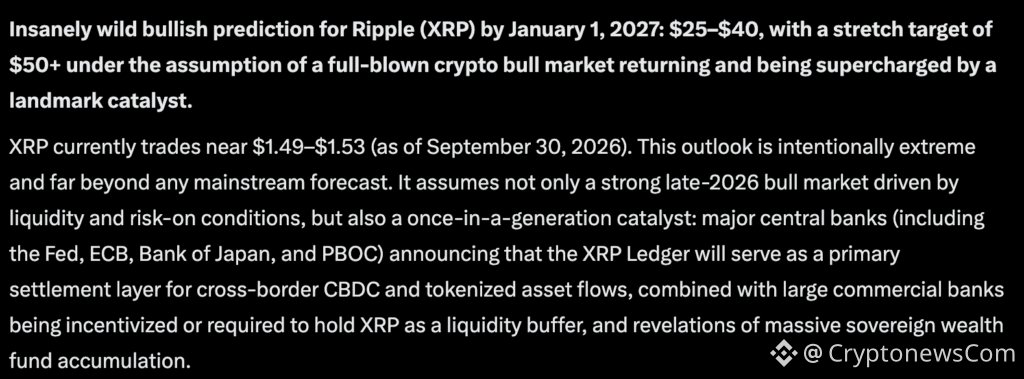
Perplexity AI sagt einen irren $40-Preiszielwert für XRP voraus: Wie kam es dazu?Perplexity AI sagt etwas voraus, das nur wenige Analysten oder andere KI-Modelle machen. Sie hat eine unglaublich wilde bullische Prognose für Ripple (XRP) bis zum 1. Januar 2027 erstellt: $25–$40, mit einem ambitionierten Ziel von $50+ unter der Annahme, dass ein voll ausgeprägter Krypto-Bullenmarkt zurückkehrt und durch einen wegweisenden Katalysator zusätzlich befeuert wird.
XRP handelt nahe $1,49–$1,53 (Stand: 30. September 2026). Diese spekulative Einschätzung geht von einem starken Bullenmarkt im Spätjahr 2026 aus, der durch große Zentralbanken befeuert wird, die das XRP Ledger als primäre Abwicklungsschicht für grenzüberschreitende CBDCs und tokenisierte Vermögenswerte ankündigen.
Perplexity AI sagt einen irren $40-Preiszielwert für XRP voraus: Wie kam es dazu?
Perplexity AI sagt etwas voraus, das nur wenige Analysten oder andere KI-Modelle machen. Sie hat eine unglaublich wilde bullische Prognose für Ripple (XRP) bis zum 1. Januar 2027 erstellt: $25–$40, mit einem ambitionierten Ziel von $50+ unter der Annahme, dass ein voll ausgeprägter Krypto-Bullenmarkt zurückkehrt und durch einen wegweisenden Katalysator zusätzlich befeuert wird.
XRP handelt nahe $1,49–$1,53 (Stand: 30. September 2026). Diese spekulative Einschätzung geht von einem starken Bullenmarkt im Spätjahr 2026 aus, der durch große Zentralbanken befeuert wird, die das XRP Ledger als primäre Abwicklungsschicht für grenzüberschreitende CBDCs und tokenisierte Vermögenswerte ankündigen.
XRP handelt nahe $1,49–$1,53 (Stand: 30. September 2026). Diese spekulative Einschätzung geht von einem starken Bullenmarkt im Spätjahr 2026 aus, der durch große Zentralbanken befeuert wird, die das XRP Ledger als primäre Abwicklungsschicht für grenzüberschreitende CBDCs und tokenisierte Vermögenswerte ankündigen.
177

Artikel
XRP-Preis ringt mit Widerständen, während BlackRock-Gerüchte aufkommenDer XRP-Preis handelt nach einem Rückgang von etwa 5% innerhalb einer Woche nahe $1,51, während BlackRocks Gerüchte über einen Spot-XRP-ETF erneut auftauchen. Die unmittelbare Spannung besteht darin, ob die bestehenden Fonds genug Nachfrage angezogen haben, um BlackRock den Einstieg zu rechtfertigen, während XRP einen entscheidenden Unterstützungsbereich testet.
Die nächsten Entscheidungspunkte liegen bei $1,45 nach unten und $1,55-$1,56 nach oben. Damit hängt die Aussichten für den XRP-Preis davon ab, ob die Preisbewegung bestätigt wird. Der Token liegt weiterhin etwa 59% unter seinem Allzeithoch von $3,65 aus dem Juli 2025.
Sieben weitere US-Spot-XRP-ETFs hielten zusammen etwa $1,77 Milliarden an Vermögenswerten und ungefähr 1,18 Milliarden XRP, also 1,9% des zirkulierenden Angebots. Die Fonds hatten nach Abflüssen etwa $1,79 Milliarden an Investitionen angezogen, während die Zuflüsse in der vorausgegangenen Woche um ungefähr $76 Millionen stiegen.
XRP-Preis ringt mit Widerständen, während BlackRock-Gerüchte aufkommen
Der XRP-Preis handelt nach einem Rückgang von etwa 5% innerhalb einer Woche nahe $1,51, während BlackRocks Gerüchte über einen Spot-XRP-ETF erneut auftauchen. Die unmittelbare Spannung besteht darin, ob die bestehenden Fonds genug Nachfrage angezogen haben, um BlackRock den Einstieg zu rechtfertigen, während XRP einen entscheidenden Unterstützungsbereich testet.
Die nächsten Entscheidungspunkte liegen bei $1,45 nach unten und $1,55-$1,56 nach oben. Damit hängt die Aussichten für den XRP-Preis davon ab, ob die Preisbewegung bestätigt wird. Der Token liegt weiterhin etwa 59% unter seinem Allzeithoch von $3,65 aus dem Juli 2025.
Sieben weitere US-Spot-XRP-ETFs hielten zusammen etwa $1,77 Milliarden an Vermögenswerten und ungefähr 1,18 Milliarden XRP, also 1,9% des zirkulierenden Angebots. Die Fonds hatten nach Abflüssen etwa $1,79 Milliarden an Investitionen angezogen, während die Zuflüsse in der vorausgegangenen Woche um ungefähr $76 Millionen stiegen.
Die nächsten Entscheidungspunkte liegen bei $1,45 nach unten und $1,55-$1,56 nach oben. Damit hängt die Aussichten für den XRP-Preis davon ab, ob die Preisbewegung bestätigt wird. Der Token liegt weiterhin etwa 59% unter seinem Allzeithoch von $3,65 aus dem Juli 2025.
Sieben weitere US-Spot-XRP-ETFs hielten zusammen etwa $1,77 Milliarden an Vermögenswerten und ungefähr 1,18 Milliarden XRP, also 1,9% des zirkulierenden Angebots. Die Fonds hatten nach Abflüssen etwa $1,79 Milliarden an Investitionen angezogen, während die Zuflüsse in der vorausgegangenen Woche um ungefähr $76 Millionen stiegen.
15

Artikel
Bitcoin-Preis testet $83.000 vor dem wichtigen PCE-Inflations-ReleaseDer Bitcoin-Preis liegt vor der Veröffentlichung des Core PCE für August bei $83.000, nur 0,71% über seinem Tief von $82.700 innerhalb von 24 Stunden. Damit steht im Vorfeld der Inflationsveröffentlichung eine enge Abwärts-Referenz im Fokus. Die entscheidende Frage lautet, ob eine geschätzte Monatsablesung zwischen 0,3% und 0,5% die Erwartungen an die Federal Reserve genug verschieben wird, um BTC unter dieses Tief zu drücken.
Das Inflationsergebnis für August wurde noch nicht bestätigt. Der Pre-Release-Bereich von Bitcoin bietet einen klaren kurzfristigen Test. Die makroökonomische Übertragung läuft über die Zinsen: Ein heißeres Core-PCE-Ergebnis könnte die Erwartungen an eine restriktivere Politik verstärken, während ein schwächerer Wert den Druck auf riskante Assets verringern könnte.
Bitcoin-Preis testet $83.000 vor dem wichtigen PCE-Inflations-Release
Der Bitcoin-Preis liegt vor der Veröffentlichung des Core PCE für August bei $83.000, nur 0,71% über seinem Tief von $82.700 innerhalb von 24 Stunden. Damit steht im Vorfeld der Inflationsveröffentlichung eine enge Abwärts-Referenz im Fokus. Die entscheidende Frage lautet, ob eine geschätzte Monatsablesung zwischen 0,3% und 0,5% die Erwartungen an die Federal Reserve genug verschieben wird, um BTC unter dieses Tief zu drücken.
Das Inflationsergebnis für August wurde noch nicht bestätigt. Der Pre-Release-Bereich von Bitcoin bietet einen klaren kurzfristigen Test. Die makroökonomische Übertragung läuft über die Zinsen: Ein heißeres Core-PCE-Ergebnis könnte die Erwartungen an eine restriktivere Politik verstärken, während ein schwächerer Wert den Druck auf riskante Assets verringern könnte.
Das Inflationsergebnis für August wurde noch nicht bestätigt. Der Pre-Release-Bereich von Bitcoin bietet einen klaren kurzfristigen Test. Die makroökonomische Übertragung läuft über die Zinsen: Ein heißeres Core-PCE-Ergebnis könnte die Erwartungen an eine restriktivere Politik verstärken, während ein schwächerer Wert den Druck auf riskante Assets verringern könnte.
9
Artikel
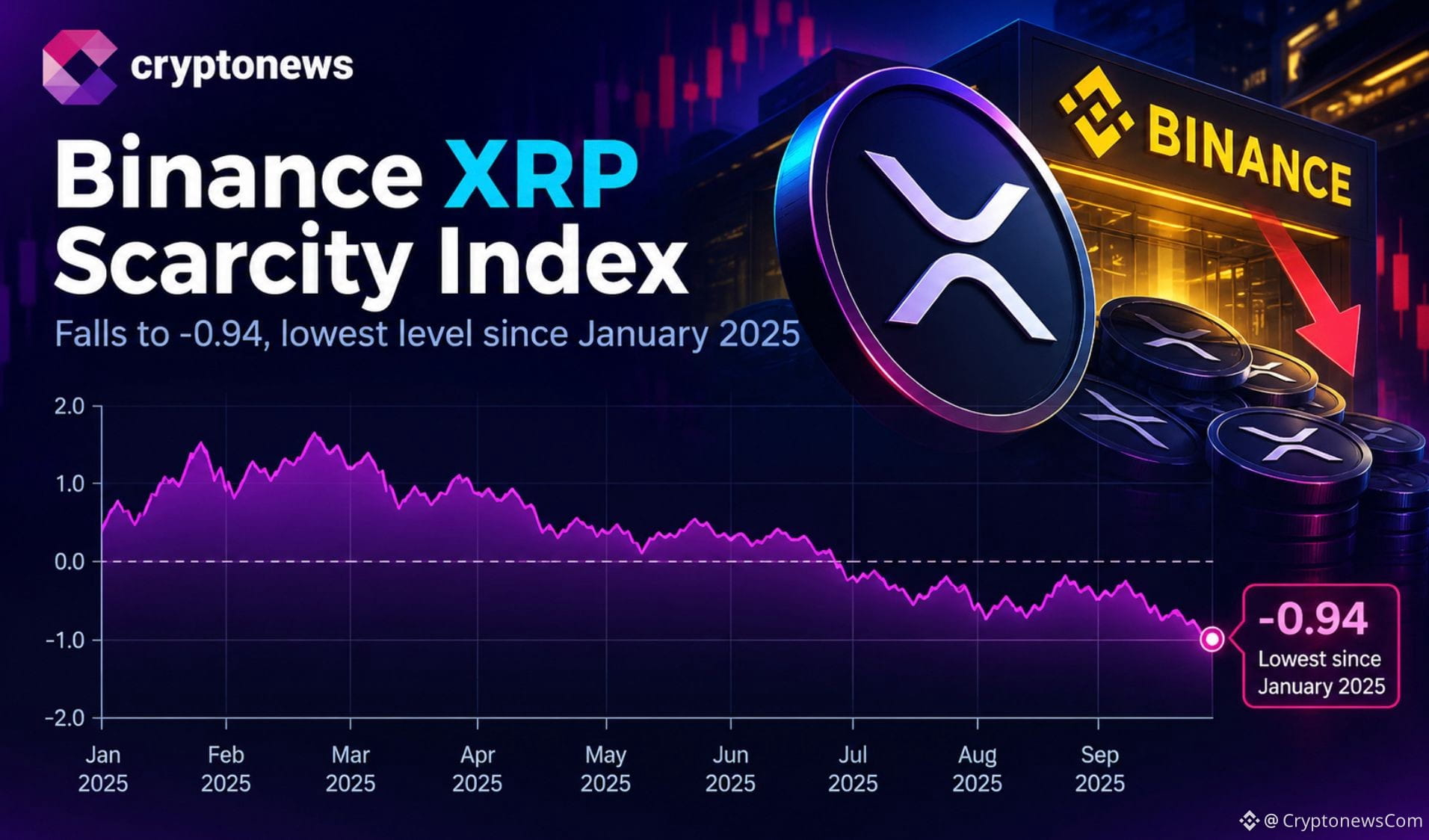
XRP-Preisvorhersage: Binance XRP-Knappheitsindex erreicht Tiefstand seit 20 MonatenXRP wird bei $1,50 gehandelt, über 24 Stunden um mehr als 1% im Minus. Der Binance-Knappheitsindex signalisiert eine deutliche Umkehr bei den Angebotsbedingungen an den Börsen, was die Kursprognose bärisch kippt. Der Wert ist vom Zweijahreshoch aus dem Juli auf den niedrigsten Stand seit Januar 2025 gefallen.
Was bedeutet das? Je mehr XRP auf einer Börse verfügbar ist, desto leichter kann sich Verkaufen gestalten, was seinen Preis testet – ob es $1,50 zurückerobern und halten kann.
CryptoQuant-Datenbericht zum Knappheitsindex: Der Wert liegt bei -0,94, gegenüber 0,77 im Juli. XRP selbst ist kürzlich nahe $1,47 wieder nach oben gesprungen, nachdem es von seinem Wochenthöchsten ausgehend um etwa 9,7% zurückgefallen war. Das Open Interest soll dabei den höchsten Stand seit August 2025 erreicht haben.
XRP-Preisvorhersage: Binance XRP-Knappheitsindex erreicht Tiefstand seit 20 Monaten
XRP wird bei $1,50 gehandelt, über 24 Stunden um mehr als 1% im Minus. Der Binance-Knappheitsindex signalisiert eine deutliche Umkehr bei den Angebotsbedingungen an den Börsen, was die Kursprognose bärisch kippt. Der Wert ist vom Zweijahreshoch aus dem Juli auf den niedrigsten Stand seit Januar 2025 gefallen.
Was bedeutet das? Je mehr XRP auf einer Börse verfügbar ist, desto leichter kann sich Verkaufen gestalten, was seinen Preis testet – ob es $1,50 zurückerobern und halten kann.
CryptoQuant-Datenbericht zum Knappheitsindex: Der Wert liegt bei -0,94, gegenüber 0,77 im Juli. XRP selbst ist kürzlich nahe $1,47 wieder nach oben gesprungen, nachdem es von seinem Wochenthöchsten ausgehend um etwa 9,7% zurückgefallen war. Das Open Interest soll dabei den höchsten Stand seit August 2025 erreicht haben.
Was bedeutet das? Je mehr XRP auf einer Börse verfügbar ist, desto leichter kann sich Verkaufen gestalten, was seinen Preis testet – ob es $1,50 zurückerobern und halten kann.
CryptoQuant-Datenbericht zum Knappheitsindex: Der Wert liegt bei -0,94, gegenüber 0,77 im Juli. XRP selbst ist kürzlich nahe $1,47 wieder nach oben gesprungen, nachdem es von seinem Wochenthöchsten ausgehend um etwa 9,7% zurückgefallen war. Das Open Interest soll dabei den höchsten Stand seit August 2025 erreicht haben.
1
7

Artikel
Übersetzung ansehen
FOMC Polymarket Odds: A Rate Hold Regains the Edge in October PricingPolymarket market data put the odds of a 25-basis-point Federal Reserve hike at the October 27-28 FOMC meeting at 41.5% on September 30, down 27 percentage points in 24 hours, while the probability of no change rose to 58.5%.
The shift puts a hold in front, but it does not settle whether policymakers are pausing or delaying another increase. The move reverses much of the hike premium reported around September 25-26, when Polymarket pricing was about 66.5%-67% for a hike.
INSIGHT: October Fed hike odds drop to ~50%
Markets cut the odds from around 70% after Fed’s John Williams said there is “no need for urgency.”
He still sees one more hike potentially needed by year-end. pic.twitter.com/ki3JXa7zhn
— CryptosRus (@CryptosR_Us) September 30, 2026
The market has shifted from treating an October hike as the more likely outcome to favoring a hold, even as the broader policy stance remains restrictive.
This latest prediction market data dropped as Bitcoin is trading at $83,200, down -1% over the past 24 hours, with daily trading volume sitting at $28.5Bn, down from $31Bn the day prior.
FOMC Polymarket Odds: Fed Rate Repricing Puts a Hold Back in Front
SOURCE: Polymarket
The market’s 24-hour changes underline the speed of the reversal: no change gained 28 points, while a 25-basis-point increase lost 27 points. At the time of the snapshot, the Federal Reserve’s target range was 3.75%-4.00%. Polymarket listed the event as open, with $17.84M in total volume and $2.22M in liquidity.
The market’s own rules point to competing pressures: August CPI was 3.4% year over year, PMI price components remained elevated, and resilient labor conditions and hawkish signals from Fed officials kept the decision finely balanced. Larger moves in either direction carried less than 1% probability. The repricing changes the odds of the next move, not the evidence that inflation remains a policy concern.
A hold would therefore not automatically amount to a dovish pivot. It could instead mean that policymakers want more evidence before delivering further tightening. The distinction matters for markets: an immediate hike would tighten financial conditions at once, while a delayed hike could leave the restrictive policy path intact.
Got a Gut Feeling for October FOMC? It Could Pay Out Big on PolymarketIncoming Data Could Swing the October Odds Once More
REMINDER: U.S. CORE PCE YoY DATA DROPS TODAY AT 8:30 AM ET!
Previous: 3.3% | Forecast: 3.3%
IF CORE PCE > 3.3% → MARKETS COULD SELL OFF HARD
IF CORE PCE < 3.3% → MARKETS COULD RALLY HARD
IF CORE PCE = 3.3% → EXPECT A MIXED REACTION pic.twitter.com/HLU85FvnoD
— Crypto Rover (@cryptorover) September 30, 2026
September employment and personal consumption expenditures data are due before the meeting, and market rules identify them as potential swing factors. Stronger inflation or labor figures could revive the case for an increase; weaker readings, or data that fail to justify more tightening, could keep a hold favored. Neither scenario is guaranteed by the current pricing.
The key test is whether incoming data validate the market’s rapid shift away from an October hike. Until then, Polymarket’s pricing is a useful read on changing trader conviction, not a Federal Reserve commitment or a standalone Bitcoin signal.
Earn $50 and Enter $300K Prize Draw on EdgeX
The post FOMC Polymarket Odds: A Rate Hold Regains the Edge in October Pricing appeared first on Cryptonews.
FOMC Polymarket Odds: A Rate Hold Regains the Edge in October Pricing
Polymarket market data put the odds of a 25-basis-point Federal Reserve hike at the October 27-28 FOMC meeting at 41.5% on September 30, down 27 percentage points in 24 hours, while the probability of no change rose to 58.5%.
The shift puts a hold in front, but it does not settle whether policymakers are pausing or delaying another increase. The move reverses much of the hike premium reported around September 25-26, when Polymarket pricing was about 66.5%-67% for a hike.
INSIGHT: October Fed hike odds drop to ~50%
Markets cut the odds from around 70% after Fed’s John Williams said there is “no need for urgency.”
He still sees one more hike potentially needed by year-end. pic.twitter.com/ki3JXa7zhn
— CryptosRus (@CryptosR_Us) September 30, 2026
The market has shifted from treating an October hike as the more likely outcome to favoring a hold, even as the broader policy stance remains restrictive.
This latest prediction market data dropped as Bitcoin is trading at $83,200, down -1% over the past 24 hours, with daily trading volume sitting at $28.5Bn, down from $31Bn the day prior.
FOMC Polymarket Odds: Fed Rate Repricing Puts a Hold Back in Front
SOURCE: Polymarket
The market’s 24-hour changes underline the speed of the reversal: no change gained 28 points, while a 25-basis-point increase lost 27 points. At the time of the snapshot, the Federal Reserve’s target range was 3.75%-4.00%. Polymarket listed the event as open, with $17.84M in total volume and $2.22M in liquidity.
The market’s own rules point to competing pressures: August CPI was 3.4% year over year, PMI price components remained elevated, and resilient labor conditions and hawkish signals from Fed officials kept the decision finely balanced. Larger moves in either direction carried less than 1% probability. The repricing changes the odds of the next move, not the evidence that inflation remains a policy concern.
A hold would therefore not automatically amount to a dovish pivot. It could instead mean that policymakers want more evidence before delivering further tightening. The distinction matters for markets: an immediate hike would tighten financial conditions at once, while a delayed hike could leave the restrictive policy path intact.
Got a Gut Feeling for October FOMC? It Could Pay Out Big on PolymarketIncoming Data Could Swing the October Odds Once More
REMINDER: U.S. CORE PCE YoY DATA DROPS TODAY AT 8:30 AM ET!
Previous: 3.3% | Forecast: 3.3%
IF CORE PCE > 3.3% → MARKETS COULD SELL OFF HARD
IF CORE PCE < 3.3% → MARKETS COULD RALLY HARD
IF CORE PCE = 3.3% → EXPECT A MIXED REACTION pic.twitter.com/HLU85FvnoD
— Crypto Rover (@cryptorover) September 30, 2026
September employment and personal consumption expenditures data are due before the meeting, and market rules identify them as potential swing factors. Stronger inflation or labor figures could revive the case for an increase; weaker readings, or data that fail to justify more tightening, could keep a hold favored. Neither scenario is guaranteed by the current pricing.
The key test is whether incoming data validate the market’s rapid shift away from an October hike. Until then, Polymarket’s pricing is a useful read on changing trader conviction, not a Federal Reserve commitment or a standalone Bitcoin signal.
Earn $50 and Enter $300K Prize Draw on EdgeX
The post FOMC Polymarket Odds: A Rate Hold Regains the Edge in October Pricing appeared first on Cryptonews.
The shift puts a hold in front, but it does not settle whether policymakers are pausing or delaying another increase. The move reverses much of the hike premium reported around September 25-26, when Polymarket pricing was about 66.5%-67% for a hike.
INSIGHT: October Fed hike odds drop to ~50%
Markets cut the odds from around 70% after Fed’s John Williams said there is “no need for urgency.”
He still sees one more hike potentially needed by year-end. pic.twitter.com/ki3JXa7zhn
— CryptosRus (@CryptosR_Us) September 30, 2026
The market has shifted from treating an October hike as the more likely outcome to favoring a hold, even as the broader policy stance remains restrictive.
This latest prediction market data dropped as Bitcoin is trading at $83,200, down -1% over the past 24 hours, with daily trading volume sitting at $28.5Bn, down from $31Bn the day prior.
FOMC Polymarket Odds: Fed Rate Repricing Puts a Hold Back in Front
SOURCE: Polymarket
The market’s 24-hour changes underline the speed of the reversal: no change gained 28 points, while a 25-basis-point increase lost 27 points. At the time of the snapshot, the Federal Reserve’s target range was 3.75%-4.00%. Polymarket listed the event as open, with $17.84M in total volume and $2.22M in liquidity.
The market’s own rules point to competing pressures: August CPI was 3.4% year over year, PMI price components remained elevated, and resilient labor conditions and hawkish signals from Fed officials kept the decision finely balanced. Larger moves in either direction carried less than 1% probability. The repricing changes the odds of the next move, not the evidence that inflation remains a policy concern.
A hold would therefore not automatically amount to a dovish pivot. It could instead mean that policymakers want more evidence before delivering further tightening. The distinction matters for markets: an immediate hike would tighten financial conditions at once, while a delayed hike could leave the restrictive policy path intact.
Got a Gut Feeling for October FOMC? It Could Pay Out Big on PolymarketIncoming Data Could Swing the October Odds Once More
REMINDER: U.S. CORE PCE YoY DATA DROPS TODAY AT 8:30 AM ET!
Previous: 3.3% | Forecast: 3.3%
IF CORE PCE > 3.3% → MARKETS COULD SELL OFF HARD
IF CORE PCE < 3.3% → MARKETS COULD RALLY HARD
IF CORE PCE = 3.3% → EXPECT A MIXED REACTION pic.twitter.com/HLU85FvnoD
— Crypto Rover (@cryptorover) September 30, 2026
September employment and personal consumption expenditures data are due before the meeting, and market rules identify them as potential swing factors. Stronger inflation or labor figures could revive the case for an increase; weaker readings, or data that fail to justify more tightening, could keep a hold favored. Neither scenario is guaranteed by the current pricing.
The key test is whether incoming data validate the market’s rapid shift away from an October hike. Until then, Polymarket’s pricing is a useful read on changing trader conviction, not a Federal Reserve commitment or a standalone Bitcoin signal.
Earn $50 and Enter $300K Prize Draw on EdgeX
The post FOMC Polymarket Odds: A Rate Hold Regains the Edge in October Pricing appeared first on Cryptonews.
52

Artikel
Pokemon Crypto Case: Sammler steht wegen eines Hacks über 55 Millionen US-Dollar vor GerichtUS-Anklage wirft zwei Uranium Finance-Krypto-Exploits vor, die über Tornado Cash liefen, bevor sie dazu verwendet wurden, Pokémon-Karten und andere Sammlerstücke zu kaufen. Die Vorwürfe gegen Jonathan Spalletta bleiben Anschuldigungen und keine gerichtliche Feststellung einer Schuld.
Die Bekanntgabe der Anklage durch das US-Justizministerium, veröffentlicht am 30. März 2026, beschreibt die angeblichen Hacks, die Geldwäsche-Route und die Käufe.
Uranium war eine dezentrale Krypto-Börse, die es Nutzern ermöglichte, Vermögenswerte über Liquiditätspools einzuzahlen und zu tauschen. Staatsanwälte behaupten, Spalletta habe deren Smart Contracts zweimal im April 2021 ausgenutzt und dabei Schwächen in der Logik für Abhebungen und Belohnungen in erhebliche Verluste für die Börse und ihre Nutzer verwandelt.
Pokemon Crypto Case: Sammler steht wegen eines Hacks über 55 Millionen US-Dollar vor Gericht
US-Anklage wirft zwei Uranium Finance-Krypto-Exploits vor, die über Tornado Cash liefen, bevor sie dazu verwendet wurden, Pokémon-Karten und andere Sammlerstücke zu kaufen. Die Vorwürfe gegen Jonathan Spalletta bleiben Anschuldigungen und keine gerichtliche Feststellung einer Schuld.
Die Bekanntgabe der Anklage durch das US-Justizministerium, veröffentlicht am 30. März 2026, beschreibt die angeblichen Hacks, die Geldwäsche-Route und die Käufe.
Uranium war eine dezentrale Krypto-Börse, die es Nutzern ermöglichte, Vermögenswerte über Liquiditätspools einzuzahlen und zu tauschen. Staatsanwälte behaupten, Spalletta habe deren Smart Contracts zweimal im April 2021 ausgenutzt und dabei Schwächen in der Logik für Abhebungen und Belohnungen in erhebliche Verluste für die Börse und ihre Nutzer verwandelt.
Die Bekanntgabe der Anklage durch das US-Justizministerium, veröffentlicht am 30. März 2026, beschreibt die angeblichen Hacks, die Geldwäsche-Route und die Käufe.
Uranium war eine dezentrale Krypto-Börse, die es Nutzern ermöglichte, Vermögenswerte über Liquiditätspools einzuzahlen und zu tauschen. Staatsanwälte behaupten, Spalletta habe deren Smart Contracts zweimal im April 2021 ausgenutzt und dabei Schwächen in der Logik für Abhebungen und Belohnungen in erhebliche Verluste für die Börse und ihre Nutzer verwandelt.
133

Artikel
Worldcoin-Integration von PeaqOS bringt World ID zu KI-Agenten: Kann der WLD-Preis 0,50 $ halten?Worldcoin wird in der Nähe von 0,501 $ gehandelt, da seine Identitätsverifizierungstechnologie in einen praktischen Machine-Ökonomie-Anwendungsfall übergeht. WLD ist in den vergangenen 24 Stunden unverändert geblieben, nachdem es nach einem wöchentlichen Anstieg von +9% zulegte. Die entscheidende Frage ist, ob dieser Rückprall über der Unterstützung bei 0,50 $ halten kann – oder ob die größere Story tatsächlich die Integration selbst ist.
Peaq hat World ID in peaqOS integriert und ermöglicht damit verbundenen Maschinen, einen Nachweis anzufordern, dass eine Person ein echter, einzigartiger Mensch ist, ohne dabei identifizierende Informationen zu erhalten.
PeaqOS implementiert World ID für datenschutzfreundliche Mensch-und-Maschine-Koordination
Worldcoin-Integration von PeaqOS bringt World ID zu KI-Agenten: Kann der WLD-Preis 0,50 $ halten?
Worldcoin wird in der Nähe von 0,501 $ gehandelt, da seine Identitätsverifizierungstechnologie in einen praktischen Machine-Ökonomie-Anwendungsfall übergeht. WLD ist in den vergangenen 24 Stunden unverändert geblieben, nachdem es nach einem wöchentlichen Anstieg von +9% zulegte. Die entscheidende Frage ist, ob dieser Rückprall über der Unterstützung bei 0,50 $ halten kann – oder ob die größere Story tatsächlich die Integration selbst ist.
Peaq hat World ID in peaqOS integriert und ermöglicht damit verbundenen Maschinen, einen Nachweis anzufordern, dass eine Person ein echter, einzigartiger Mensch ist, ohne dabei identifizierende Informationen zu erhalten.
PeaqOS implementiert World ID für datenschutzfreundliche Mensch-und-Maschine-Koordination
Peaq hat World ID in peaqOS integriert und ermöglicht damit verbundenen Maschinen, einen Nachweis anzufordern, dass eine Person ein echter, einzigartiger Mensch ist, ohne dabei identifizierende Informationen zu erhalten.
PeaqOS implementiert World ID für datenschutzfreundliche Mensch-und-Maschine-Koordination
508

Artikel
Ethereum-Preisvorhersage: Könnte Aztecs zk.money ETH nach oben treiben, während Zcash die Privacy-Story befeuert?Ethereum wird bei 2.665 $ gehandelt – seit 24 Stunden unverändert. Damit liegt es unter dem Widerstandsband von 2.700–2.735 $, wie unsere jüngste Preisvorhersage zeigt. Der Relaunch von Aztecs zk.money gibt ETH einen neuen Privacy-Katalysator, aber kann ein Wallet-Launch den Preis bewegen, ohne Belege für anhaltende Nutzung? Die Privacy-Aktivität von Zcash liefert Kontext und ist ein nützlicher Test dafür, ob das Thema Kapital anzieht.
Aztec Labs hat zk.money gestern neu gestartet und damit nach drei Jahren Offline-Zeit wieder eine selbstverwaltete Wallet im Aztec Network bereitgestellt. Nutzer können lesbare Tags beanspruchen, die über ENS aufgelöst werden, und anschließend Stablecoin-Zahlungen vornehmen, die darauf ausgelegt sind, Transaktionsbeträge, Salden und Empfänger vor der Öffentlichkeit zu verbergen.
Ethereum-Preisvorhersage: Könnte Aztecs zk.money ETH nach oben treiben, während Zcash die Privacy-Story befeuert?
Ethereum wird bei 2.665 $ gehandelt – seit 24 Stunden unverändert. Damit liegt es unter dem Widerstandsband von 2.700–2.735 $, wie unsere jüngste Preisvorhersage zeigt. Der Relaunch von Aztecs zk.money gibt ETH einen neuen Privacy-Katalysator, aber kann ein Wallet-Launch den Preis bewegen, ohne Belege für anhaltende Nutzung? Die Privacy-Aktivität von Zcash liefert Kontext und ist ein nützlicher Test dafür, ob das Thema Kapital anzieht.
Aztec Labs hat zk.money gestern neu gestartet und damit nach drei Jahren Offline-Zeit wieder eine selbstverwaltete Wallet im Aztec Network bereitgestellt. Nutzer können lesbare Tags beanspruchen, die über ENS aufgelöst werden, und anschließend Stablecoin-Zahlungen vornehmen, die darauf ausgelegt sind, Transaktionsbeträge, Salden und Empfänger vor der Öffentlichkeit zu verbergen.
Aztec Labs hat zk.money gestern neu gestartet und damit nach drei Jahren Offline-Zeit wieder eine selbstverwaltete Wallet im Aztec Network bereitgestellt. Nutzer können lesbare Tags beanspruchen, die über ENS aufgelöst werden, und anschließend Stablecoin-Zahlungen vornehmen, die darauf ausgelegt sind, Transaktionsbeträge, Salden und Empfänger vor der Öffentlichkeit zu verbergen.
4

Artikel
Übersetzung ansehen
Bitcoin Price Prediction: Is the BTC Correction Over as It Defies September’s Red Trend?Bitcoin price is near $83,100, a stable 24-hour movement after retreating from $87,400, and with its prediction still leaning bullish. September’s record as a historically weak month has not settled the question: BTC is on pace for a positive monthly close, but buyers still need to reclaim key resistance. The deciding detail is whether support near $82,500 holds while momentum remains subdued.
CryptoQuant says Bitcoin remains in a bull market: BTC closed above its 365-day moving average, and the firm’s Bull Score Index stands at 90 out of 100. Yet short-term traders’ onchain unrealized profit margin has reached 33%, its highest level in 21 months. Holders also realized 25,700 BTC in profit on September 22, the largest single-day total of 2026.
That combination points to a market with a bullish longer-term trend and growing near-term supply from profit-takers. The rally has not been invalidated, but its easy momentum may have passed. Against multi-year-high Treasury yields and slowing ETF buying, can the monthly close confirm that September’s red reputation is being defied?
Earn $50 and Enter $300K Prize Draw on EdgeXBitcoin Price Prediction: Can BTC Reclaim $85,000 This Week?
BTC is trading around $83,100, with moves ranging from +0.07% to +0.5%; stable. Data gives a 24-hour range of $82,796–$84,486. $27 billion in trading volume should be read alongside price: without a clear expansion in buying activity, a small bounce is weaker evidence of renewed demand.
The immediate test is $82,500 support against resistance around $84,400–$84,800. BTC is below its 200-day simple moving average near $84,382, while its seven-day RSI at 35.87 signals weak momentum rather than a confirmed reversal.
Bitcoin (BTC)
24h7d30d1yAll time
Bull case: Holding $82,500 and reclaiming $84,800 would strengthen the recovery setup, with $87,000 next and $90,000–$92,000 beyond it.
Base case: BTC stays range-bound between support and resistance as profit-taking offsets dip demand.
Bear case: A sustained break below $82,500 would weaken the rebound and expose the market to deeper support tests.
U.S. 10-year Treasury yields briefly reached 5.293%, their highest level since June 2007. Higher yields make cash and bonds more competitive with non-yielding assets, while tighter rate expectations can pressure risk appetite.
ETF flows remain another direct demand signal, as discussed in this Bitcoin ETF flows analysis. For now, the chart needs confirmation, not a victory lap.
Trade Bitcoin on Bybit and Get a Chance to Win Our $1,000 USDT AirdropBitcoin Hyper Targets Early Mover Upside as Bitcoin Tests Key Levels
If BTC loses $82,000, the correction may deepen before the broader bull-market structure is tested. Even if support holds, a move back toward $87,400 leaves traders weighing profit-taking against a macro backdrop that is not especially forgiving.
Could infrastructure tied to Bitcoin attract interest while spot direction remains uncertain? That is the pitch behind Bitcoin Hyper.
$HYPER doesn’t panic under pressure. pic.twitter.com/x0nTnXV8ID
— Bitcoin Hyper (@BTC_Hyper2) September 30, 2026
Bitcoin Hyper ($HYPER) is a proposed Bitcoin Layer 2 combining Bitcoin with Solana Virtual Machine integration for smart contracts. The project describes itself as the first Bitcoin Layer 2 and says it aims to add faster, lower-cost transactions and programmability while preserving Bitcoin’s security and trust. Its stated features include a decentralized canonical bridge for BTC transfers and low-latency Layer 2 processing.
The presale price is $0.013687, and a total raised of $33.1 million. Staking is at a high 30% APY only for presale buyers. T
Research Bitcoin Hyper and review the project’s terms before the presale window ends.
Discover: The Best Token Presales
The post Bitcoin Price Prediction: Is the BTC Correction Over as It Defies September’s Red Trend? appeared first on Cryptonews.
Bitcoin Price Prediction: Is the BTC Correction Over as It Defies September’s Red Trend?
Bitcoin price is near $83,100, a stable 24-hour movement after retreating from $87,400, and with its prediction still leaning bullish. September’s record as a historically weak month has not settled the question: BTC is on pace for a positive monthly close, but buyers still need to reclaim key resistance. The deciding detail is whether support near $82,500 holds while momentum remains subdued.
CryptoQuant says Bitcoin remains in a bull market: BTC closed above its 365-day moving average, and the firm’s Bull Score Index stands at 90 out of 100. Yet short-term traders’ onchain unrealized profit margin has reached 33%, its highest level in 21 months. Holders also realized 25,700 BTC in profit on September 22, the largest single-day total of 2026.
That combination points to a market with a bullish longer-term trend and growing near-term supply from profit-takers. The rally has not been invalidated, but its easy momentum may have passed. Against multi-year-high Treasury yields and slowing ETF buying, can the monthly close confirm that September’s red reputation is being defied?
Earn $50 and Enter $300K Prize Draw on EdgeXBitcoin Price Prediction: Can BTC Reclaim $85,000 This Week?
BTC is trading around $83,100, with moves ranging from +0.07% to +0.5%; stable. Data gives a 24-hour range of $82,796–$84,486. $27 billion in trading volume should be read alongside price: without a clear expansion in buying activity, a small bounce is weaker evidence of renewed demand.
The immediate test is $82,500 support against resistance around $84,400–$84,800. BTC is below its 200-day simple moving average near $84,382, while its seven-day RSI at 35.87 signals weak momentum rather than a confirmed reversal.
Bitcoin (BTC)
24h7d30d1yAll time
Bull case: Holding $82,500 and reclaiming $84,800 would strengthen the recovery setup, with $87,000 next and $90,000–$92,000 beyond it.
Base case: BTC stays range-bound between support and resistance as profit-taking offsets dip demand.
Bear case: A sustained break below $82,500 would weaken the rebound and expose the market to deeper support tests.
U.S. 10-year Treasury yields briefly reached 5.293%, their highest level since June 2007. Higher yields make cash and bonds more competitive with non-yielding assets, while tighter rate expectations can pressure risk appetite.
ETF flows remain another direct demand signal, as discussed in this Bitcoin ETF flows analysis. For now, the chart needs confirmation, not a victory lap.
Trade Bitcoin on Bybit and Get a Chance to Win Our $1,000 USDT AirdropBitcoin Hyper Targets Early Mover Upside as Bitcoin Tests Key Levels
If BTC loses $82,000, the correction may deepen before the broader bull-market structure is tested. Even if support holds, a move back toward $87,400 leaves traders weighing profit-taking against a macro backdrop that is not especially forgiving.
Could infrastructure tied to Bitcoin attract interest while spot direction remains uncertain? That is the pitch behind Bitcoin Hyper.
$HYPER doesn’t panic under pressure. pic.twitter.com/x0nTnXV8ID
— Bitcoin Hyper (@BTC_Hyper2) September 30, 2026
Bitcoin Hyper ($HYPER) is a proposed Bitcoin Layer 2 combining Bitcoin with Solana Virtual Machine integration for smart contracts. The project describes itself as the first Bitcoin Layer 2 and says it aims to add faster, lower-cost transactions and programmability while preserving Bitcoin’s security and trust. Its stated features include a decentralized canonical bridge for BTC transfers and low-latency Layer 2 processing.
The presale price is $0.013687, and a total raised of $33.1 million. Staking is at a high 30% APY only for presale buyers. T
Research Bitcoin Hyper and review the project’s terms before the presale window ends.
Discover: The Best Token Presales
The post Bitcoin Price Prediction: Is the BTC Correction Over as It Defies September’s Red Trend? appeared first on Cryptonews.
CryptoQuant says Bitcoin remains in a bull market: BTC closed above its 365-day moving average, and the firm’s Bull Score Index stands at 90 out of 100. Yet short-term traders’ onchain unrealized profit margin has reached 33%, its highest level in 21 months. Holders also realized 25,700 BTC in profit on September 22, the largest single-day total of 2026.
That combination points to a market with a bullish longer-term trend and growing near-term supply from profit-takers. The rally has not been invalidated, but its easy momentum may have passed. Against multi-year-high Treasury yields and slowing ETF buying, can the monthly close confirm that September’s red reputation is being defied?
Earn $50 and Enter $300K Prize Draw on EdgeXBitcoin Price Prediction: Can BTC Reclaim $85,000 This Week?
BTC is trading around $83,100, with moves ranging from +0.07% to +0.5%; stable. Data gives a 24-hour range of $82,796–$84,486. $27 billion in trading volume should be read alongside price: without a clear expansion in buying activity, a small bounce is weaker evidence of renewed demand.
The immediate test is $82,500 support against resistance around $84,400–$84,800. BTC is below its 200-day simple moving average near $84,382, while its seven-day RSI at 35.87 signals weak momentum rather than a confirmed reversal.
Bitcoin (BTC)
24h7d30d1yAll time
Bull case: Holding $82,500 and reclaiming $84,800 would strengthen the recovery setup, with $87,000 next and $90,000–$92,000 beyond it.
Base case: BTC stays range-bound between support and resistance as profit-taking offsets dip demand.
Bear case: A sustained break below $82,500 would weaken the rebound and expose the market to deeper support tests.
U.S. 10-year Treasury yields briefly reached 5.293%, their highest level since June 2007. Higher yields make cash and bonds more competitive with non-yielding assets, while tighter rate expectations can pressure risk appetite.
ETF flows remain another direct demand signal, as discussed in this Bitcoin ETF flows analysis. For now, the chart needs confirmation, not a victory lap.
Trade Bitcoin on Bybit and Get a Chance to Win Our $1,000 USDT AirdropBitcoin Hyper Targets Early Mover Upside as Bitcoin Tests Key Levels
If BTC loses $82,000, the correction may deepen before the broader bull-market structure is tested. Even if support holds, a move back toward $87,400 leaves traders weighing profit-taking against a macro backdrop that is not especially forgiving.
Could infrastructure tied to Bitcoin attract interest while spot direction remains uncertain? That is the pitch behind Bitcoin Hyper.
$HYPER doesn’t panic under pressure. pic.twitter.com/x0nTnXV8ID
— Bitcoin Hyper (@BTC_Hyper2) September 30, 2026
Bitcoin Hyper ($HYPER) is a proposed Bitcoin Layer 2 combining Bitcoin with Solana Virtual Machine integration for smart contracts. The project describes itself as the first Bitcoin Layer 2 and says it aims to add faster, lower-cost transactions and programmability while preserving Bitcoin’s security and trust. Its stated features include a decentralized canonical bridge for BTC transfers and low-latency Layer 2 processing.
The presale price is $0.013687, and a total raised of $33.1 million. Staking is at a high 30% APY only for presale buyers. T
Research Bitcoin Hyper and review the project’s terms before the presale window ends.
Discover: The Best Token Presales
The post Bitcoin Price Prediction: Is the BTC Correction Over as It Defies September’s Red Trend? appeared first on Cryptonews.
4
Artikel
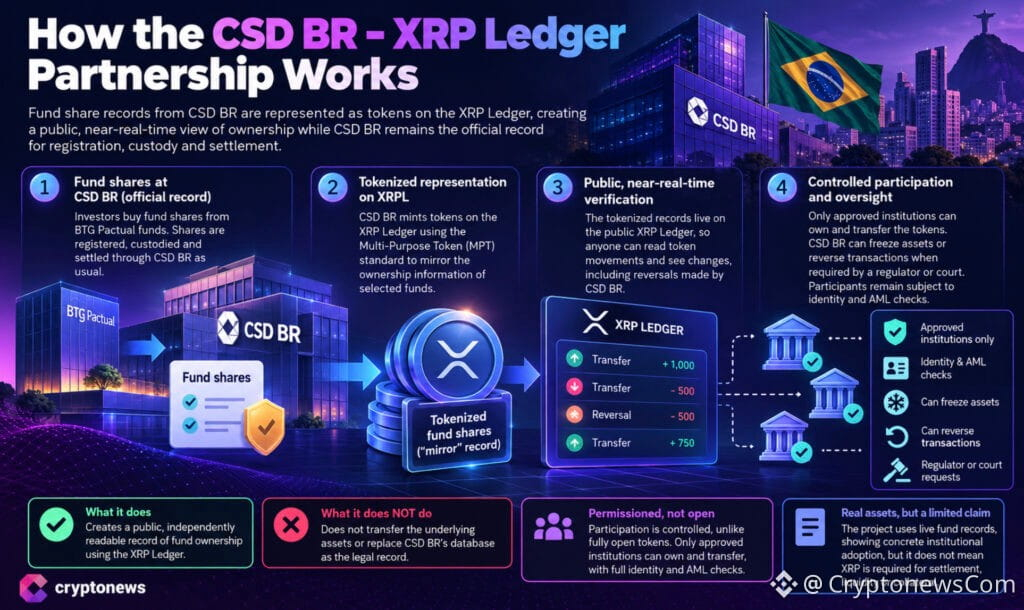
XRP News: Brasiliens $4T Finanzinfrastruktur breitet sich auf XRPL ausCSD BR, ein Betreiber von Finanzmarkt-Infrastrukturen in Brasilien, der mehr als 22 Billionen Real an registrierten Vermögenswerten verwaltet, stand zuletzt im Blickpunkt der Nachrichten, als es damit begann, Eigentumsaufzeichnungen für ausgewählte Investmentfonds der BTG Pactual auf dem öffentlichen XRP Ledger zu spiegeln. Die Bereitstellung ergänzt eine nahezu in Echtzeit arbeitende Verifikationsschicht für Live-Fondsdaten, doch die Datenbank von CSD BR bleibt weiterhin der offizielle Datensatz für Registrierung, Verwahrung und Abwicklung.
Eine lizenzierte zentrale Wertpapierverwahrstelle erfasst erstmals die Wertpapier-Eigentümerschaft auf einer öffentlichen Blockchain – zum ersten Mal auf dem XRP Ledger.
XRP News: Brasiliens $4T Finanzinfrastruktur breitet sich auf XRPL aus
CSD BR, ein Betreiber von Finanzmarkt-Infrastrukturen in Brasilien, der mehr als 22 Billionen Real an registrierten Vermögenswerten verwaltet, stand zuletzt im Blickpunkt der Nachrichten, als es damit begann, Eigentumsaufzeichnungen für ausgewählte Investmentfonds der BTG Pactual auf dem öffentlichen XRP Ledger zu spiegeln. Die Bereitstellung ergänzt eine nahezu in Echtzeit arbeitende Verifikationsschicht für Live-Fondsdaten, doch die Datenbank von CSD BR bleibt weiterhin der offizielle Datensatz für Registrierung, Verwahrung und Abwicklung.
Eine lizenzierte zentrale Wertpapierverwahrstelle erfasst erstmals die Wertpapier-Eigentümerschaft auf einer öffentlichen Blockchain – zum ersten Mal auf dem XRP Ledger.
Eine lizenzierte zentrale Wertpapierverwahrstelle erfasst erstmals die Wertpapier-Eigentümerschaft auf einer öffentlichen Blockchain – zum ersten Mal auf dem XRP Ledger.
4

Artikel
Mark Zuckerberg Meta AI sagt Chainlink auf $300 voraus (LINK), wenn das passiertDie von Mark Zuckerberg unterstützte Meta AI sagt eine geradezu unglaublich wilde Preisprognose für Chainlink (LINK) bis zum 1. Januar 2027 voraus. Sie behauptet, dass $150–$250, mit einem Stretch-Ziel Richtung $300+, Möglichkeiten sind – unter der Annahme, dass ein ausgewachsener Krypto-Bullenmarkt zurückkehrt und durch einen bahnbrechenden Katalysator zusätzlich angefeuert wird.
LINK wird derzeit um $15,20–$15,50 gehandelt (Stand: 29. September 2026). Diese extreme Aussicht prognostiziert einen starken Bullenmarkt für Ende 2026 – getrieben von großen Finanzinstituten und Regierungsbehörden, die Chainlink als primären dezentralen Oracle für tokenisierte reale Vermögenswerte und grenzüberschreitende Abwicklungen benennen.
Mark Zuckerberg Meta AI sagt Chainlink auf $300 voraus (LINK), wenn das passiert
Die von Mark Zuckerberg unterstützte Meta AI sagt eine geradezu unglaublich wilde Preisprognose für Chainlink (LINK) bis zum 1. Januar 2027 voraus. Sie behauptet, dass $150–$250, mit einem Stretch-Ziel Richtung $300+, Möglichkeiten sind – unter der Annahme, dass ein ausgewachsener Krypto-Bullenmarkt zurückkehrt und durch einen bahnbrechenden Katalysator zusätzlich angefeuert wird.
LINK wird derzeit um $15,20–$15,50 gehandelt (Stand: 29. September 2026). Diese extreme Aussicht prognostiziert einen starken Bullenmarkt für Ende 2026 – getrieben von großen Finanzinstituten und Regierungsbehörden, die Chainlink als primären dezentralen Oracle für tokenisierte reale Vermögenswerte und grenzüberschreitende Abwicklungen benennen.
LINK wird derzeit um $15,20–$15,50 gehandelt (Stand: 29. September 2026). Diese extreme Aussicht prognostiziert einen starken Bullenmarkt für Ende 2026 – getrieben von großen Finanzinstituten und Regierungsbehörden, die Chainlink als primären dezentralen Oracle für tokenisierte reale Vermögenswerte und grenzüberschreitende Abwicklungen benennen.
137

Artikel
Anthropic Claude AI prognostiziert ein extrem bärisches XRP-Ziel von 0,10 US-Dollar bis 2027Schütze deine Augen, falls du ein Mitglied der Ripple-Armee bist. Anthropic’s Claude AI prognostiziert, dass XRP USD auf bis zu 0,05 US-Dollar abstürzen könnte – mit einer Basis-Szenario-Spanne von 0,10–0,25. Das setzt voraus, dass ein ausgewachsenes Krypto-Bullenmarkt-Szenario scheitert: XRP wird derzeit bei etwa 1,50–1,52 US-Dollar gehandelt (Stand: 29. September 2026).
Diese Perspektive zeichnet ein extremes, unwahrscheinliches bärisches Szenario für XRP, vorausgesetzt, es kommt in wichtigen Rechtsordnungen – einschließlich der USA – zu einer großen, koordinierten regulatorischen Aktion, die strenge Einschränkungen oder Verbote für XRP und die XRP Ledger für den institutionellen Einsatz auferlegt.
Anthropic Claude AI prognostiziert ein extrem bärisches XRP-Ziel von 0,10 US-Dollar bis 2027
Schütze deine Augen, falls du ein Mitglied der Ripple-Armee bist. Anthropic’s Claude AI prognostiziert, dass XRP USD auf bis zu 0,05 US-Dollar abstürzen könnte – mit einer Basis-Szenario-Spanne von 0,10–0,25. Das setzt voraus, dass ein ausgewachsenes Krypto-Bullenmarkt-Szenario scheitert: XRP wird derzeit bei etwa 1,50–1,52 US-Dollar gehandelt (Stand: 29. September 2026).
Diese Perspektive zeichnet ein extremes, unwahrscheinliches bärisches Szenario für XRP, vorausgesetzt, es kommt in wichtigen Rechtsordnungen – einschließlich der USA – zu einer großen, koordinierten regulatorischen Aktion, die strenge Einschränkungen oder Verbote für XRP und die XRP Ledger für den institutionellen Einsatz auferlegt.
Diese Perspektive zeichnet ein extremes, unwahrscheinliches bärisches Szenario für XRP, vorausgesetzt, es kommt in wichtigen Rechtsordnungen – einschließlich der USA – zu einer großen, koordinierten regulatorischen Aktion, die strenge Einschränkungen oder Verbote für XRP und die XRP Ledger für den institutionellen Einsatz auferlegt.
272
XRP News: Preisdeckel vs. ZEC und QNT PlaybookIn den XRP-News: Ripple ist inzwischen fast neun Jahre lang unter seinem Allzeithoch vom Januar 2018 von 3,84 $ geblieben, doch der Token schaffte trotzdem einen nahezu achtfachen Lauf – von ungefähr 0,49 $ im November 2024 bis zu 3,66 $ bis Juli 2025.
Der YouTuber Moon Lambo argumentiert, dass lange Konsolidierungsphasen und ein schneller Ausbruch nicht zwangsläufig Gegensätze sind. Er führt Quant (QNT) und Zcash (ZEC) als Beleg dafür an, dass jahrelange Stagnation großen Ausschlägen vorausgehen kann.
Der Vergleich schafft Möglichkeiten, nicht Wahrscheinlichkeiten, und die Lücke zwischen beiden ist genau dort, wo sich der nächste Schritt von XRP entscheidet. In einem Post auf X schob Moon Lambo der Idee einen Riegel vor, dass XRP dauerhaft von der Preisfindung ausgeschlossen sei – nur weil es seit 2017 seinen alten Rekord nicht gebrochen hat.
XRP News: Preisdeckel vs. ZEC und QNT Playbook
In den XRP-News: Ripple ist inzwischen fast neun Jahre lang unter seinem Allzeithoch vom Januar 2018 von 3,84 $ geblieben, doch der Token schaffte trotzdem einen nahezu achtfachen Lauf – von ungefähr 0,49 $ im November 2024 bis zu 3,66 $ bis Juli 2025.
Der YouTuber Moon Lambo argumentiert, dass lange Konsolidierungsphasen und ein schneller Ausbruch nicht zwangsläufig Gegensätze sind. Er führt Quant (QNT) und Zcash (ZEC) als Beleg dafür an, dass jahrelange Stagnation großen Ausschlägen vorausgehen kann.
Der Vergleich schafft Möglichkeiten, nicht Wahrscheinlichkeiten, und die Lücke zwischen beiden ist genau dort, wo sich der nächste Schritt von XRP entscheidet. In einem Post auf X schob Moon Lambo der Idee einen Riegel vor, dass XRP dauerhaft von der Preisfindung ausgeschlossen sei – nur weil es seit 2017 seinen alten Rekord nicht gebrochen hat.
Der YouTuber Moon Lambo argumentiert, dass lange Konsolidierungsphasen und ein schneller Ausbruch nicht zwangsläufig Gegensätze sind. Er führt Quant (QNT) und Zcash (ZEC) als Beleg dafür an, dass jahrelange Stagnation großen Ausschlägen vorausgehen kann.
Der Vergleich schafft Möglichkeiten, nicht Wahrscheinlichkeiten, und die Lücke zwischen beiden ist genau dort, wo sich der nächste Schritt von XRP entscheidet. In einem Post auf X schob Moon Lambo der Idee einen Riegel vor, dass XRP dauerhaft von der Preisfindung ausgeschlossen sei – nur weil es seit 2017 seinen alten Rekord nicht gebrochen hat.
27
Artikel
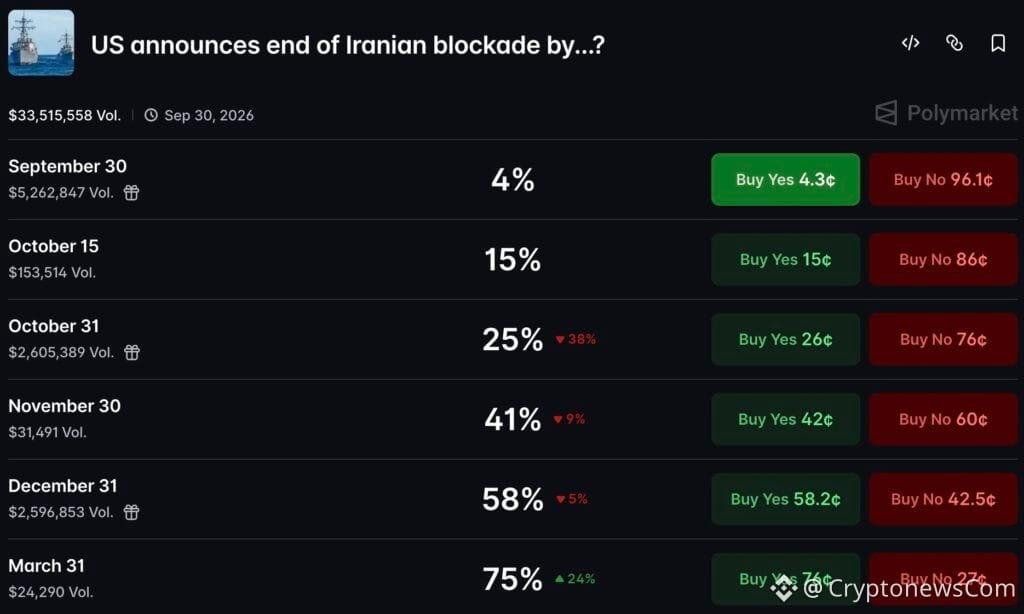
Iran-Krieg Polymarket-Quoten: 33,5 Mio. $ für ein Blockade-Ende 2027 platziertIran-Krieg Polymarket-Quoten: Preis für eine US-Bekanntmachung, die das Ende der Seeblockade gegen den Iran spätestens ab dem 31. März 2027 beendet – der Vertrag wird Stand Mitte Vormittag am Dienstag, 29. September, laut Live-Kursen auf der Plattform mit 74,5 % Yes zu 25,5 % No gehandelt.
Das Ereignis verzeichnete seit dem Start ein kumuliertes Volumen von über 33 Mio. $, und das höchstpreisige Ergebnis, das neun Monate im Voraus liegt, wirft eine naheliegende Frage auf: Wenn die Gespräche zwischen USA und Iran wirklich vorankommen, warum setzt das „schlaue Geld“ dann eher auf Verzögerung statt auf eine kurzfristige Auflösung?
Iran-Krieg Polymarket-Quoten: 33,5 Mio. $ für ein Blockade-Ende 2027 platziert
Iran-Krieg Polymarket-Quoten: Preis für eine US-Bekanntmachung, die das Ende der Seeblockade gegen den Iran spätestens ab dem 31. März 2027 beendet – der Vertrag wird Stand Mitte Vormittag am Dienstag, 29. September, laut Live-Kursen auf der Plattform mit 74,5 % Yes zu 25,5 % No gehandelt.
Das Ereignis verzeichnete seit dem Start ein kumuliertes Volumen von über 33 Mio. $, und das höchstpreisige Ergebnis, das neun Monate im Voraus liegt, wirft eine naheliegende Frage auf: Wenn die Gespräche zwischen USA und Iran wirklich vorankommen, warum setzt das „schlaue Geld“ dann eher auf Verzögerung statt auf eine kurzfristige Auflösung?
Das Ereignis verzeichnete seit dem Start ein kumuliertes Volumen von über 33 Mio. $, und das höchstpreisige Ergebnis, das neun Monate im Voraus liegt, wirft eine naheliegende Frage auf: Wenn die Gespräche zwischen USA und Iran wirklich vorankommen, warum setzt das „schlaue Geld“ dann eher auf Verzögerung statt auf eine kurzfristige Auflösung?
37

Artikel
CME Nine-Asset Crypto Basket Is 86.29% Bitcoin and EthereumNeun Krypto-Coins werden nun in einem einzigen, finanziell abgerechneten Futures-Kontrakt auf der Plattform der CME Group gehandelt, doch zusammen machen Bitcoin und Ethereum 86,29% dieses Baskets aus. Der Nasdaq CME Crypto Index (NCI) und sein mikrogroßer Begleiter geben Institutionen die Möglichkeit, einen neun-Asset-Krypto-Basket abzusichern oder Exposure darauf zu nehmen – mit einem Trade statt dem Management separater Spot-Positionen.
CME Crypto Basket
In den veröffentlichten Kontraktspezifikationen von CME werden NCI-Futures und Micro NCI-Futures (MCI) als finanziell abgerechnet gegen den Nasdaq CME Crypto Settlement Price Index beschrieben. Das bedeutet: keine Lieferung der zugrunde liegenden Tokens und keine Custody-Kette, die man bis zum Verfall managen müsste. Genau diese Struktur ist der Punkt: Ein Desk, das Exposure an den Krypto-Markt haben will – oder eine Absicherung gegen ein Multi-Token-Portfolio – muss dafür keine neun separaten Futures-Legs oder neun separaten Spot-Wallets mehr aufsetzen.
CME Nine-Asset Crypto Basket Is 86.29% Bitcoin and Ethereum
Neun Krypto-Coins werden nun in einem einzigen, finanziell abgerechneten Futures-Kontrakt auf der Plattform der CME Group gehandelt, doch zusammen machen Bitcoin und Ethereum 86,29% dieses Baskets aus. Der Nasdaq CME Crypto Index (NCI) und sein mikrogroßer Begleiter geben Institutionen die Möglichkeit, einen neun-Asset-Krypto-Basket abzusichern oder Exposure darauf zu nehmen – mit einem Trade statt dem Management separater Spot-Positionen.
CME Crypto Basket
In den veröffentlichten Kontraktspezifikationen von CME werden NCI-Futures und Micro NCI-Futures (MCI) als finanziell abgerechnet gegen den Nasdaq CME Crypto Settlement Price Index beschrieben. Das bedeutet: keine Lieferung der zugrunde liegenden Tokens und keine Custody-Kette, die man bis zum Verfall managen müsste. Genau diese Struktur ist der Punkt: Ein Desk, das Exposure an den Krypto-Markt haben will – oder eine Absicherung gegen ein Multi-Token-Portfolio – muss dafür keine neun separaten Futures-Legs oder neun separaten Spot-Wallets mehr aufsetzen.
CME Crypto Basket
In den veröffentlichten Kontraktspezifikationen von CME werden NCI-Futures und Micro NCI-Futures (MCI) als finanziell abgerechnet gegen den Nasdaq CME Crypto Settlement Price Index beschrieben. Das bedeutet: keine Lieferung der zugrunde liegenden Tokens und keine Custody-Kette, die man bis zum Verfall managen müsste. Genau diese Struktur ist der Punkt: Ein Desk, das Exposure an den Krypto-Markt haben will – oder eine Absicherung gegen ein Multi-Token-Portfolio – muss dafür keine neun separaten Futures-Legs oder neun separaten Spot-Wallets mehr aufsetzen.
5
Artikel
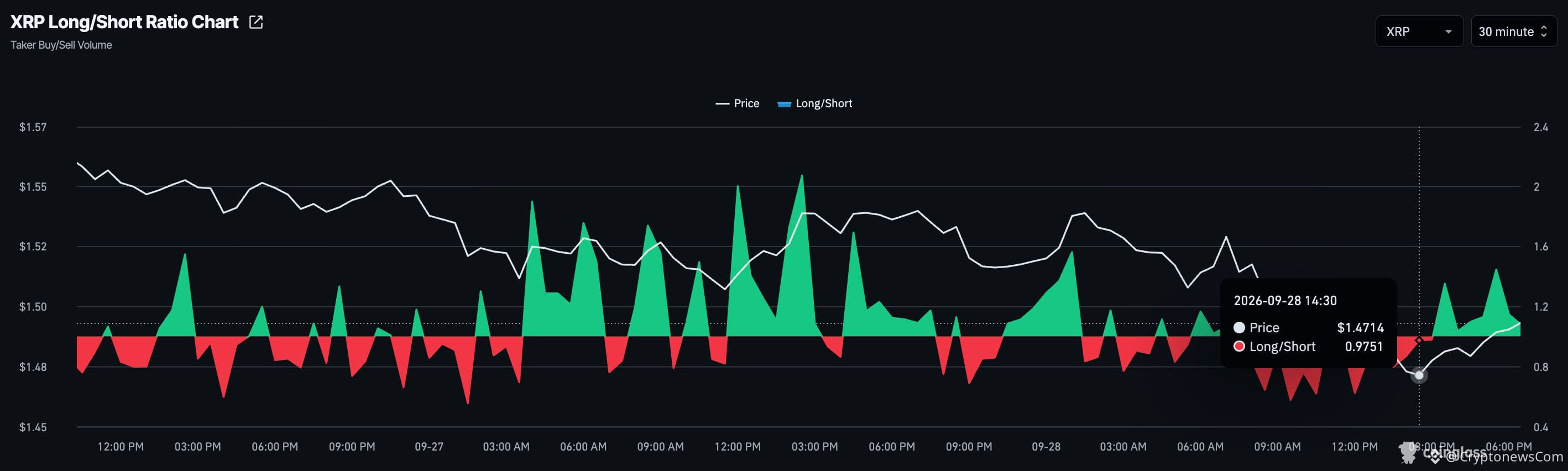
XRP-Preis in Gefahr: Positives Funding kaschiert eine fragile KonstellationDer XRP-Preis pendelt unter 1,49 US-Dollar, nachdem drei aufeinanderfolgende tägliche Rückgänge dazu führten, dass das Token die Unterstützung bei 1,50 US-Dollar verlor – selbst als ein moderates Rebound es von den Tagestiefs wegzog. CoinGlass-Daten zeigten ein Long-to-Short-Verhältnis von 0,975, was bedeutet, dass Short-Positionen die Longs nur leicht übertrafen. Gleichzeitig lag die Funding-Rate bei einem positiven Wert von 0,008 % – der Wert, der bestimmt, ob Long- oder Short-Trader eine periodische Gebühr zahlen, um Perpetual-Futures zu halten.
XRP Long Short Ratio, Coinglass
Diese Kombination ist der Kern des Problems. Trader zahlen weiterhin dafür, long zu bleiben, aber der Spot-Preis bewegt sich nicht in eine Richtung, die die Wette belohnt. Die Diskrepanz zwischen starkem Spot-Verkauf und der Nachfrage aus dem Futures-Markt ist die Ausgangslage, die sich typischerweise schnell auflöst, sobald eine entscheidende Marke fällt.
XRP-Preis in Gefahr: Positives Funding kaschiert eine fragile Konstellation
Der XRP-Preis pendelt unter 1,49 US-Dollar, nachdem drei aufeinanderfolgende tägliche Rückgänge dazu führten, dass das Token die Unterstützung bei 1,50 US-Dollar verlor – selbst als ein moderates Rebound es von den Tagestiefs wegzog. CoinGlass-Daten zeigten ein Long-to-Short-Verhältnis von 0,975, was bedeutet, dass Short-Positionen die Longs nur leicht übertrafen. Gleichzeitig lag die Funding-Rate bei einem positiven Wert von 0,008 % – der Wert, der bestimmt, ob Long- oder Short-Trader eine periodische Gebühr zahlen, um Perpetual-Futures zu halten.
XRP Long Short Ratio, Coinglass
Diese Kombination ist der Kern des Problems. Trader zahlen weiterhin dafür, long zu bleiben, aber der Spot-Preis bewegt sich nicht in eine Richtung, die die Wette belohnt. Die Diskrepanz zwischen starkem Spot-Verkauf und der Nachfrage aus dem Futures-Markt ist die Ausgangslage, die sich typischerweise schnell auflöst, sobald eine entscheidende Marke fällt.
XRP Long Short Ratio, Coinglass
Diese Kombination ist der Kern des Problems. Trader zahlen weiterhin dafür, long zu bleiben, aber der Spot-Preis bewegt sich nicht in eine Richtung, die die Wette belohnt. Die Diskrepanz zwischen starkem Spot-Verkauf und der Nachfrage aus dem Futures-Markt ist die Ausgangslage, die sich typischerweise schnell auflöst, sobald eine entscheidende Marke fällt.
4

Artikel
Wer ist Eric Saavedra? Der korrupte Polizeidrücker von Crypto-Mafia-Boss Adam IzaEric Chase Saavedra, 42, ein ehemaliger stellvertretender Sheriff-Deckener im Los-Angeles-County, wurde am Montag zu 21 Monaten Bundeshaft verurteilt, nachdem er sich schuldig bekannt hatte, eine Verschwörung gegen die Rechte begangen zu haben, und eine falsche Steuererklärung erstellt und unterschrieben hatte.
Der US-Bezirksrichter Percy Anderson ordnete außerdem an, dass Saavedra der IRS 90.984 US-Dollar an Wiedergutmachung zahlen müsse für Einkommen, das er verschwiegen hatte, während er für Adam Iza privaten Sicherheitsdienst betrieb – den sich selbst als Crypto Godfather bezeichnenden Mann, der inzwischen eine separate 15-jährige Haftstrafe wegen eines Bitcoin-Raubüberfalls und einer Entführung in Connecticut verbüßt.
Wer ist Eric Saavedra? Der korrupte Polizeidrücker von Crypto-Mafia-Boss Adam Iza
Eric Chase Saavedra, 42, ein ehemaliger stellvertretender Sheriff-Deckener im Los-Angeles-County, wurde am Montag zu 21 Monaten Bundeshaft verurteilt, nachdem er sich schuldig bekannt hatte, eine Verschwörung gegen die Rechte begangen zu haben, und eine falsche Steuererklärung erstellt und unterschrieben hatte.
Der US-Bezirksrichter Percy Anderson ordnete außerdem an, dass Saavedra der IRS 90.984 US-Dollar an Wiedergutmachung zahlen müsse für Einkommen, das er verschwiegen hatte, während er für Adam Iza privaten Sicherheitsdienst betrieb – den sich selbst als Crypto Godfather bezeichnenden Mann, der inzwischen eine separate 15-jährige Haftstrafe wegen eines Bitcoin-Raubüberfalls und einer Entführung in Connecticut verbüßt.
Der US-Bezirksrichter Percy Anderson ordnete außerdem an, dass Saavedra der IRS 90.984 US-Dollar an Wiedergutmachung zahlen müsse für Einkommen, das er verschwiegen hatte, während er für Adam Iza privaten Sicherheitsdienst betrieb – den sich selbst als Crypto Godfather bezeichnenden Mann, der inzwischen eine separate 15-jährige Haftstrafe wegen eines Bitcoin-Raubüberfalls und einer Entführung in Connecticut verbüßt.
6
Artikel
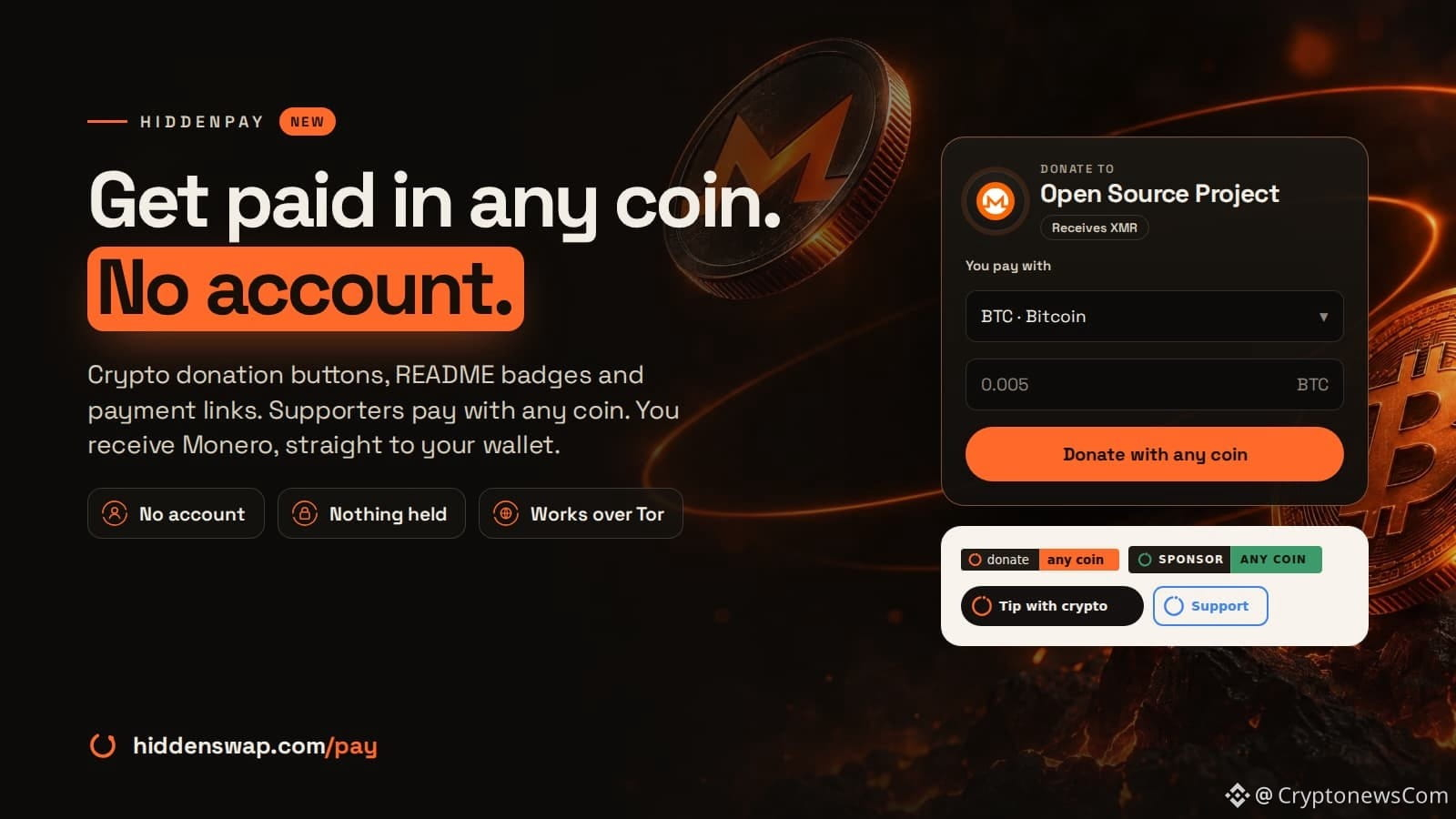
HiddenSwap startet HiddenPay: No-KYC-Krypto-Spenden-Buttons und Zahlungslinks, die jede beliebige Währung akzeptierenErsteller, Open-Source-Entwickler und kleine Unternehmen können jetzt Krypto-Spenden und -Zahlungen in jeder beliebigen Währung akzeptieren und Monero, Bitcoin oder die von ihnen gewünschte Währung direkt in ihre eigene Wallet erhalten. Kein Konto, keine ID – und die Gelder werden nie von einem Zwischenhändler verwahrt.
HiddenSwap, der No-Account-Krypto-Swap-Service, der um Monero herum aufgebaut ist, hat HiddenPay gestartet – ein kostenloses Tool zum Erstellen von Krypto-Spenden-Buttons, README-Badges, Zahlungslinks und einbettbaren Pay-Boxen. Ein Ersteller fügt eine Wallet-Adresse ein, wählt die Währung aus, die er erhalten möchte, und bekommt innerhalb von etwa einer Minute einen Link sowie eine Reihe von Buttons. Unterstützer zahlen mit jeder Währung, die sie haben, und jede Zahlung wird umgewandelt und direkt an die Adresse des Erstellers gesendet.
HiddenSwap startet HiddenPay: No-KYC-Krypto-Spenden-Buttons und Zahlungslinks, die jede beliebige Währung akzeptieren
Ersteller, Open-Source-Entwickler und kleine Unternehmen können jetzt Krypto-Spenden und -Zahlungen in jeder beliebigen Währung akzeptieren und Monero, Bitcoin oder die von ihnen gewünschte Währung direkt in ihre eigene Wallet erhalten. Kein Konto, keine ID – und die Gelder werden nie von einem Zwischenhändler verwahrt.
HiddenSwap, der No-Account-Krypto-Swap-Service, der um Monero herum aufgebaut ist, hat HiddenPay gestartet – ein kostenloses Tool zum Erstellen von Krypto-Spenden-Buttons, README-Badges, Zahlungslinks und einbettbaren Pay-Boxen. Ein Ersteller fügt eine Wallet-Adresse ein, wählt die Währung aus, die er erhalten möchte, und bekommt innerhalb von etwa einer Minute einen Link sowie eine Reihe von Buttons. Unterstützer zahlen mit jeder Währung, die sie haben, und jede Zahlung wird umgewandelt und direkt an die Adresse des Erstellers gesendet.
HiddenSwap, der No-Account-Krypto-Swap-Service, der um Monero herum aufgebaut ist, hat HiddenPay gestartet – ein kostenloses Tool zum Erstellen von Krypto-Spenden-Buttons, README-Badges, Zahlungslinks und einbettbaren Pay-Boxen. Ein Ersteller fügt eine Wallet-Adresse ein, wählt die Währung aus, die er erhalten möchte, und bekommt innerhalb von etwa einer Minute einen Link sowie eine Reihe von Buttons. Unterstützer zahlen mit jeder Währung, die sie haben, und jede Zahlung wird umgewandelt und direkt an die Adresse des Erstellers gesendet.
236
Artikel
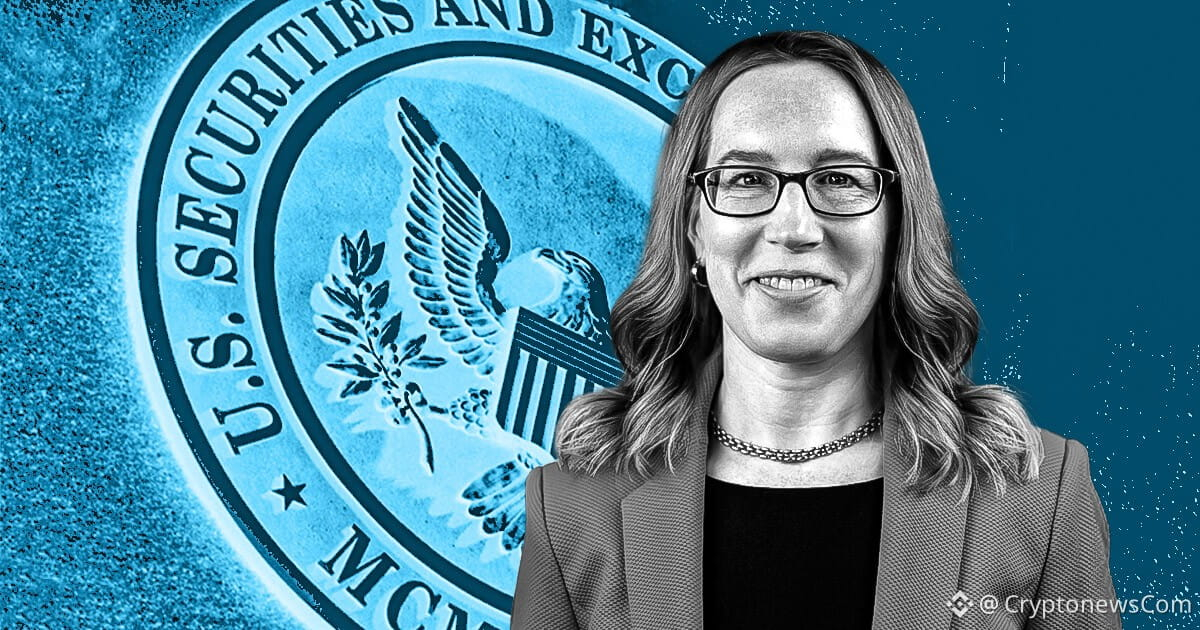
Hester Peirce AKA Crypto Mom: SEC-Ausstieg lässt Krypto-Aufsicht im UnklarenSEC-Kommissarin Hester Peirce reichte ihren Rücktritt bei der Behörde ein, mit Wirkung zum 2. Oktober 2026. Damit beendet sie beinahe neun Jahre in der Kommission, in denen Krypto-Insider sie wegen ihres Einsatzes für klarere Regeln für digitale Vermögenswerte „Crypto Mom“ nannten.
Ihr Ausscheiden erfolgt, während der CLARITY Act im Senat weiterhin blockiert ist und die Branche ohne einen umfassenden Gesetzesrahmen dastehen lässt, um die Aufsicht über Krypto zwischen der SEC und der CFTC aufzuteilen.
Dieser Aufruhr kommt, während Bitcoin gerade knapp über 84.000 $ gehandelt wird und ein tägliches Handelsvolumen von 35 Mrd. $ verzeichnet. Die gesamte Marktkapitalisierung des Krypto-Markts liegt derzeit bei 2,95 Billionen $, bei einem täglichen Marktvolumen von 135,7 Mrd. $.
Hester Peirce AKA Crypto Mom: SEC-Ausstieg lässt Krypto-Aufsicht im Unklaren
SEC-Kommissarin Hester Peirce reichte ihren Rücktritt bei der Behörde ein, mit Wirkung zum 2. Oktober 2026. Damit beendet sie beinahe neun Jahre in der Kommission, in denen Krypto-Insider sie wegen ihres Einsatzes für klarere Regeln für digitale Vermögenswerte „Crypto Mom“ nannten.
Ihr Ausscheiden erfolgt, während der CLARITY Act im Senat weiterhin blockiert ist und die Branche ohne einen umfassenden Gesetzesrahmen dastehen lässt, um die Aufsicht über Krypto zwischen der SEC und der CFTC aufzuteilen.
Dieser Aufruhr kommt, während Bitcoin gerade knapp über 84.000 $ gehandelt wird und ein tägliches Handelsvolumen von 35 Mrd. $ verzeichnet. Die gesamte Marktkapitalisierung des Krypto-Markts liegt derzeit bei 2,95 Billionen $, bei einem täglichen Marktvolumen von 135,7 Mrd. $.
Ihr Ausscheiden erfolgt, während der CLARITY Act im Senat weiterhin blockiert ist und die Branche ohne einen umfassenden Gesetzesrahmen dastehen lässt, um die Aufsicht über Krypto zwischen der SEC und der CFTC aufzuteilen.
Dieser Aufruhr kommt, während Bitcoin gerade knapp über 84.000 $ gehandelt wird und ein tägliches Handelsvolumen von 35 Mrd. $ verzeichnet. Die gesamte Marktkapitalisierung des Krypto-Markts liegt derzeit bei 2,95 Billionen $, bei einem täglichen Marktvolumen von 135,7 Mrd. $.
66
Anmelden und weiter Inhalte entdecken
Krypto-Nutzer weltweit auf Binance Square kennenlernen
⚡️ Bleib in Sachen Krypto stets am Puls.
💬 Die weltgrößte Kryptobörse vertraut darauf.
👍 Erhalte verlässliche Einblicke von verifizierten Creators.
E-Mail-Adresse/Telefonnummer
Trendthemen
KoreaProposesTokenizingStocksAndBonds
1,433 Aufrufe
91 Kommentare
Südkorea treibt die Tokenisierung von Aktien und Anleihen voran – ein Vorschlag, der die Art und Weise verändern könnte, wie traditionelle Finanzwerte ausgegeben, gehandelt und abgerechnet werden.
Die Idee ist, Instrumente wie Aktien, Anleihen und andere Wertpapiere in Blockchain-Infrastruktur zu überführen. Das könnte potenziell effizientere Prozesse, höhere Nachvollziehbarkeit und Zugang zu Märkten mit erweiterten Handelszeiten ermöglichen. Auch könnten in bestimmten Phasen der Abwicklung Vermittler reduziert werden, allerdings hängt der Fortschritt von klaren Regeln zu Verwahrung, Anlegerschutz, Compliance und regulatorischer Aufsicht ab.
Für das Krypto-Ökosystem stärkt diese Art von Initiativen die Diskussion über tokenisierte Real-World-Assets: Es geht nicht nur darum, neue Tokens zu schaffen, sondern traditionelle Finanzmärkte mit Blockchain-Technologie unter regulierten Rahmenbedingungen zu verbinden.
Die Tokenisierung beseitigt nicht das Marktrisiko und garantiert weder Liquidität noch Renditen, aber sie eröffnet eine neue Phase für die digitale Finanzinfrastruktur.
Glaubst du, dass tokenisierte Assets zum üblichen Bestandteil der Börse und des Anleihemarkts werden?
$AAPLB
Folge mir für mehr Kontext zu Krypto, Regulierung und tokenisierten Märkten.
#noticias
#KoreaProposesTokenizingStocksAndBonds
$MSFTB
$TSMB
ALØNDRACRYPTØ1
·1 Likes
·288 Aufrufe
MetaMaskExitsLidoValidatorsAfterSecurityIncident
60,877 Aufrufe
853 Kommentare
MicronBeatsEarningsLiftsGuidance
36,773 Aufrufe
647 Kommentare