
Classifiedweb3
11 Beiträge

Classifiedweb3
Melden
Nutzer blockieren
Trade eröffnen
Gelegenheitstrader
6.4 Jahre
37 Following
1 Follower
4 Like gegeben
Beiträge
Portfolio
Alle
Zitierungen
·
--
Bullisch
Übersetzung ansehen
Thanksgiving is approaching, and the big question is whether the markets will find their momentum again afterward.
Historically, holiday periods can bring thinner trading volumes, but the real direction depends on liquidity, investor sentiment, and how buyers respond when activity picks up.
I'm watching for signs of renewed buying pressure rather than rushing into predictions.
A rebound is possible, but confirmation matters more than optimism.
What do you think? Are we getting a post-Thanksgiving recovery, or should we prepare for more volatility?
#CanMarketsReboundAfterThanksgiving?
68
·
--
Bullisch
Übersetzung ansehen
Bitcoin is falling, but are investors actually leaving?
That's the question worth asking.
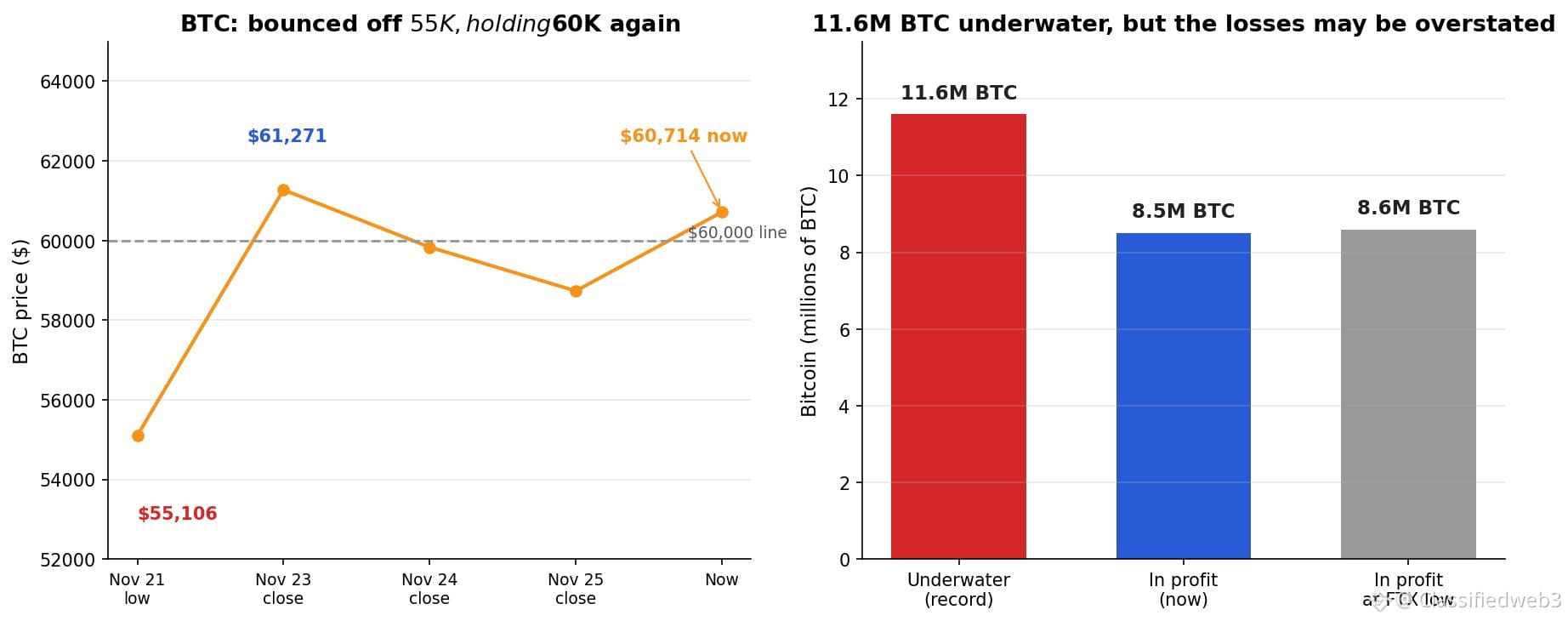
The recent ETF outflows have raised concerns, with approximately $569.7M leaving Bitcoin ETFs in Monday's session.
To put that into perspective, that's roughly 9,570 BTC at a price of $59,540.
Since the 2024 halving, Bitcoin produces approximately 450 new BTC daily. That means one session of ETF outflows represented around 21 days of newly mined supply.
Yet Bitcoin's market has continued to absorb the pressure.
There's another detail worth watching.
The reported $4.71B in monthly outflows is significant, but against approximately $81B in ETF holdings, it represents about 5.8%.
That suggests some investors are reducing exposure rather than abandoning Bitcoin altogether.
The bigger concern is market participation.
$BTC BTC has dropped 5.1% in 24 hours, while trading volume has also declined from $44.9B to $35.4B.
Less volume during a sell-off can indicate that selling pressure is easing. However, it can equally signal that buyers are not stepping in aggressively enough.
That's where the next move becomes interesting.
Three things I'm watching:
→ Whether Bitcoin can maintain support above $55K.
→ Whether spot ETF flows return to positive territory.
→ How Wednesday's inflation data influences market sentiment.
If ETF flows recover while BTC holds its ground, this correction could eventually look like a positioning reset.
But if heavy outflows continue and buyers remain absent, another test of support becomes increasingly likely.
The important thing is to watch what capital does next, not just what price does today.
Bitcoin's long-term story and its short-term market structure are two different conversations.
DYOR. Not financial advice.
100
Übersetzung ansehen
CPIWatch 👀📊
The next 6 hours could bring volatility to the market as traders watch U.S. economic data and reassess risk.
My watchlist:
₿ $BTC — Can Bitcoin hold support and lead a recovery?
◆ $ETH — Will Ethereum follow BTC’s direction?
💎 $GRAM — Can it show relative strength?
👀 $SOL, $TON and the wider altcoin market are also on my radar.
With U.S. inflation coming in hotter than expected, I’m watching how the market reacts rather than blindly betting on a direction. "Source" (https://www.reuters.com/world/us/us-consumer-prices-accelerate-september-costlier-gasoline-core-cpi-firmer-2026-10-14/)
My focus for the next 6 hours: price action, volume, key support levels and market sentiment.
What’s your prediction? 🧐
Bullish 📈 or bearish 📉?
Drop your targets below. Let's see who reads the market right.
$NEAR #Crypto #CPIWatch
1
120
Artikel
Übersetzung ansehen
Pixels Is Quietly Building the Most Sustainable Web3 Game EconomyThe evolution of Web3 gaming is no longer about hype cycles — it’s about systems that can actually sustain player engagement and economic activity over time. That’s exactly where @pixels is starting to separate itself from the crowd.
At its core, Pixels delivers a simple but powerful loop: farm, craft, explore, and trade. But what makes it different is how this loop connects to a real onchain economy powered by $PIXEL . Players aren’t just grinding aimlessly — they’re participating in a living system where effort, strategy, and time can translate into tangible value.
Now, with the introduction of the Stacked ecosystem, this model is being taken even further.
Stacked isn’t just an add-on — it’s an expansion layer that deepens how players interact with the game’s economy. It introduces more structured participation, smarter reward distribution, and mechanisms that aim to reduce the typical inflation problems seen in older play-to-earn models. Instead of extracting value quickly, players are encouraged to engage longer and more meaningfully.
This shift is important.
Most Web3 games failed because they prioritized short-term incentives over long-term design. Pixels is moving in the opposite direction — focusing on retention, balance, and scalability. The result is a game that feels less like a speculative experiment and more like a persistent digital world.
Another key factor is accessibility. Pixels remains free to start, lowering the barrier for new users while still offering depth for advanced players who want to optimize strategies, acquire land, or participate more deeply in the economy.
The combination of:
• Strong core gameplay
• A functioning token economy ($PIXEL)
• Continuous updates and expansions
• And now the Stacked ecosystem
…creates a foundation that looks far more sustainable than most Web3 gaming projects we’ve seen.
If the future of onchain gaming is about blending fun with real economic participation, then Pixels is already showing what that future can look like.
#PİXEL
Pixels Is Quietly Building the Most Sustainable Web3 Game Economy
The evolution of Web3 gaming is no longer about hype cycles — it’s about systems that can actually sustain player engagement and economic activity over time. That’s exactly where @Pixels is starting to separate itself from the crowd.
At its core, Pixels delivers a simple but powerful loop: farm, craft, explore, and trade. But what makes it different is how this loop connects to a real onchain economy powered by $PIXEL . Players aren’t just grinding aimlessly — they’re participating in a living system where effort, strategy, and time can translate into tangible value.
Now, with the introduction of the Stacked ecosystem, this model is being taken even further.
Stacked isn’t just an add-on — it’s an expansion layer that deepens how players interact with the game’s economy. It introduces more structured participation, smarter reward distribution, and mechanisms that aim to reduce the typical inflation problems seen in older play-to-earn models. Instead of extracting value quickly, players are encouraged to engage longer and more meaningfully.
This shift is important.
Most Web3 games failed because they prioritized short-term incentives over long-term design. Pixels is moving in the opposite direction — focusing on retention, balance, and scalability. The result is a game that feels less like a speculative experiment and more like a persistent digital world.
Another key factor is accessibility. Pixels remains free to start, lowering the barrier for new users while still offering depth for advanced players who want to optimize strategies, acquire land, or participate more deeply in the economy.
The combination of:
• Strong core gameplay
• A functioning token economy ($PIXEL )
• Continuous updates and expansions
• And now the Stacked ecosystem
…creates a foundation that looks far more sustainable than most Web3 gaming projects we’ve seen.
If the future of onchain gaming is about blending fun with real economic participation, then Pixels is already showing what that future can look like.
#PİXEL
1
43
Übersetzung ansehen
Pixels Is Quietly Building the Most Sustainable Web3 Game EconomyThe evolution of Web3 gaming is no longer about hype cycles — it’s about systems that can actually sustain player engagement and economic activity over time. That’s exactly where @Pixels is starting to separate itself from the crowd.
At its core, Pixels delivers a simple but powerful loop: farm, craft, explore, and trade. But what makes it different is how this loop connects to a real onchain economy powered by $PIXEL. Players aren’t just grinding aimlessly — they’re participating in a living system where effort, strategy, and time can translate into tangible value.
Now, with the introduction of the Stacked ecosystem, this model is being taken even further.
Stacked isn’t just an add-on — it’s an expansion layer that deepens how players interact with the game’s economy. It introduces more structured participation, smarter reward distribution, and mechanisms that aim to reduce the typical inflation problems seen in older play-to-earn models. Instead of extracting value quickly, players are encouraged to engage longer and more meaningfully.
This shift is important.
Most Web3 games failed because they prioritized short-term incentives over long-term design. Pixels is moving in the opposite direction — focusing on retention, balance, and scalability. The result is a game that feels less like a speculative experiment and more like a persistent digital world.
Another key factor is accessibility. Pixels remains free to start, lowering the barrier for new users while still offering depth for advanced players who want to optimize strategies, acquire land, or participate more deeply in the economy.
The combination of:
• Strong core gameplay
• A functioning token economy ($PIXEL)
• Continuous updates and expansions
• And now the Stacked ecosystem
…creates a foundation that looks far more sustainable than most Web3 gaming projects we’ve seen.
If the future of onchain gaming is about blending fun with real economic participation, then Pixels is already showing what that future can look like.
#pixel
Pixels Is Quietly Building the Most Sustainable Web3 Game Economy
The evolution of Web3 gaming is no longer about hype cycles — it’s about systems that can actually sustain player engagement and economic activity over time. That’s exactly where @Pixels is starting to separate itself from the crowd.
At its core, Pixels delivers a simple but powerful loop: farm, craft, explore, and trade. But what makes it different is how this loop connects to a real onchain economy powered by $PIXEL. Players aren’t just grinding aimlessly — they’re participating in a living system where effort, strategy, and time can translate into tangible value.
Now, with the introduction of the Stacked ecosystem, this model is being taken even further.
Stacked isn’t just an add-on — it’s an expansion layer that deepens how players interact with the game’s economy. It introduces more structured participation, smarter reward distribution, and mechanisms that aim to reduce the typical inflation problems seen in older play-to-earn models. Instead of extracting value quickly, players are encouraged to engage longer and more meaningfully.
This shift is important.
Most Web3 games failed because they prioritized short-term incentives over long-term design. Pixels is moving in the opposite direction — focusing on retention, balance, and scalability. The result is a game that feels less like a speculative experiment and more like a persistent digital world.
Another key factor is accessibility. Pixels remains free to start, lowering the barrier for new users while still offering depth for advanced players who want to optimize strategies, acquire land, or participate more deeply in the economy.
The combination of:
• Strong core gameplay
• A functioning token economy ($PIXEL)
• Continuous updates and expansions
• And now the Stacked ecosystem
…creates a foundation that looks far more sustainable than most Web3 gaming projects we’ve seen.
If the future of onchain gaming is about blending fun with real economic participation, then Pixels is already showing what that future can look like.
#pixel
51
Übersetzung ansehen
Most people still underestimate how far @pixels has come.
This isn’t just a farming game anymore — it’s a live, evolving onchain economy powered by $PIXEL and now extended through the Stacked ecosystem.
Stacked is quietly pushing Pixels beyond gameplay:
→ deeper player participation
→ smarter reward systems
→ stronger economic loops that actually last
What stands out is the balance — gameplay stays fun, while the economy keeps gaining depth.
That’s rare in Web3.
If you’re watching the future of sustainable onchain gaming, Pixels + Stacked is one of the clearest signals right now.
#pixel #pixel $PIXEL
Most people still underestimate how far @Pixels has come.
This isn’t just a farming game anymore — it’s a live, evolving onchain economy powered by $PIXEL and now extended through the Stacked ecosystem.
Stacked is quietly pushing Pixels beyond gameplay:
→ deeper player participation
→ smarter reward systems
→ stronger economic loops that actually last
What stands out is the balance — gameplay stays fun, while the economy keeps gaining depth.
That’s rare in Web3.
If you’re watching the future of sustainable onchain gaming, Pixels + Stacked is one of the clearest signals right now.
#pixel #pixel $PIXEL
1
81
Übersetzung ansehen
hello legends can't I get welcome too this platform
hello legends can't I get welcome too this platform
2
Übersetzung ansehen
#MyFirstSquarePost New to Binance Square, thrilled to share and connect with everyone here!
#MyFirstSquarePost New to Binance Square, thrilled to share and connect with everyone here!


CatizenAI
·
--
📢 Hey, Catizens! 🔥
😺 Wir möchten einen leistungsstarken Anwendungsfall von CATI vorstellen – den Catizen Airdrop Pass!
Insgesamt 34 % der CATI-Zuteilung sind für Airdrops 🪂 vorgesehen, wobei 15 % bereits an frühe Teilnehmer verteilt wurden. Die restlichen 19 % werden hauptsächlich über den Airdrop Pass verteilt! 🪙
Nach dieser Welle von CATI-Airdrops haben wir wertvolles Feedback von der Catizen-Community erhalten. 🐱 Wir haben zugehört und werden im Airdrop Pass S1 ein vollständig transparentes Verteilungsmodell für CATI implementieren.
🐾 Der Airdrop Pass hat einen 90-Tage-Zyklus und verteilt 1 % der Token pro Saison. Spieler können Punkte verdienen, indem sie Aufgaben erledigen, und der Airdrop Pass zeigt die Punkte der Spieler zusammen mit denen aller Catizen-Spieler an.
Jeder kann am Ende der Saison seine geschätzte CATI-Airdrop-Menge sehen! Zusammen mit Airdrops von anderen Partnerprodukten wie „Bombie“ und „Vanilla“ usw. 💰
Catizens Stimmung: Spiele für den Airdrop🪂, heile die Welt!🌍
#Catizen#CATI #Play2airdrop

71
Anmelden und weiter Inhalte entdecken
Krypto-Nutzer weltweit auf Binance Square kennenlernen
⚡️ Bleib in Sachen Krypto stets am Puls.
💬 Die weltgrößte Kryptobörse vertraut darauf.
👍 Erhalte verlässliche Einblicke von verifizierten Creators.
E-Mail-Adresse/Telefonnummer
Trendthemen
CanMarketsReboundAfterThanksgiving?
9,671 Aufrufe
242 Kommentare
Wetten auf Zinserhöhungen halten sich, während die US-Märkte vor Thanksgiving schließen
Binance News
·1 Likes
·1k Aufrufe
CouldSpaceX’sOrbitalDataCentersBoostAIChipDemand?
6,687 Aufrufe
161 Kommentare
EvolveAtBinanceBlockchainWeek
646,556 Aufrufe
6,757 Kommentare