

Joshua Brown 007
3k Beiträge

Joshua Brown 007
Melden
Nutzer blockieren
I am a forward-thinking crypto advisor with a strong grasp of blockchain innovation and digital asset management. @JavedJatt331726
Trade eröffnen
Hochfrequenz-Trader
2.6 Jahre
1.2K+ Following
15.7K+ Follower
6.5K+ Like gegeben
Beiträge
Portfolio
Alle
Zitierungen
Videos
Live
Übersetzung ansehen
#QNT Short scalp
Entry 272
SL 278
TP 251
TP 233
Invalidation Conditions:
Short Setup: Invalidated if price closes above 278 on the 15m chart.
Long Setup: Invalidated if price falls below 260.
{future}(QNTUSDT)
#QNT Short scalp
Entry 272
SL 278
TP 251
TP 233
Invalidation Conditions:
Short Setup: Invalidated if price closes above 278 on the 15m chart.
Long Setup: Invalidated if price falls below 260.
Entry 272
SL 278
TP 251
TP 233
Invalidation Conditions:
Short Setup: Invalidated if price closes above 278 on the 15m chart.
Long Setup: Invalidated if price falls below 260.
83
Artikel
Übersetzung ansehen
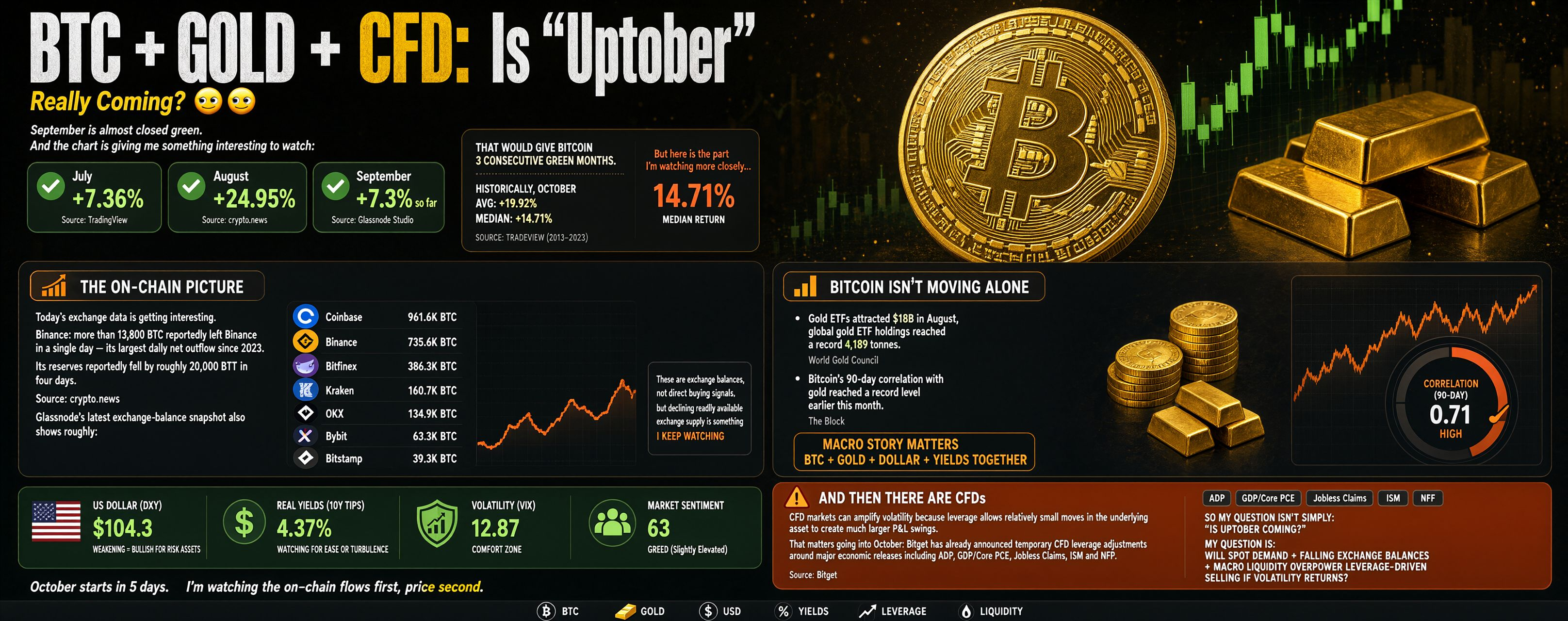
BTC + GOLD + CFD: Is “Uptober” Really Coming?September is almost closed green.
And the chart is giving me something interesting to watch:
🟢 July: +7.36%
🟢 August: +24.95%
🟢 September: +7.3% so far
That would give Bitcoin 3 consecutive green months.
But here is the part I’m watching more closely…
Historically, the chart shows October averaging +19.92% with a +14.71% median. That sounds bullish, but seasonality is not a guarantee.
TradingView
The on chain picture
Today’s exchange data is getting interesting.
Binance: more than 13,800 BTC reportedly left Binance in a single day — its largest daily net outflow since 2023. Its reserves reportedly fell by roughly 20,000 BTC in four days.
crypto.news
Glassnode’s latest exchange-balance snapshot also shows roughly:
Coinbase: 961.6K BTC
Binance: 735.6K BTC
Bitfinex: 386.3K BTC
Kraken: 160.7K BTC
OKX: 134.9K BTC
Bybit: 63.3K BTC
Bitstamp: 39.3K BTC
These are exchange balances, not direct buying signals, but declining readily available exchange supply is something I keep watching when price is holding higher levels.
Glassnode Studio
But Bitcoin isn't moving alone
Gold is telling another part of the same macro story.
Gold ETFs attracted $18B in August, while global gold ETF holdings reached a record 4,189 tonnes.
World Gold Council
And The Block reported that Bitcoin's 90-day correlation with gold reached a record level earlier this month.
The Block
So I’m watching BTC + Gold + Dollar + yields together, not BTC in isolation.
And then there are CFDs
CFD markets can amplify volatility because leverage allows relatively small moves in the underlying asset to create much larger P&L swings.
That matters going into October: Bitget has already announced temporary CFD leverage adjustments around major economic releases including ADP, GDP/Core PCE, Jobless Claims, ISM and NFP.
Bitget
So my question isn't simply:
“Is Uptober coming?”
My question is:
Will spot demand + falling exchange balances + macro liquidity overpower leverage-driven selling if volatility returns?
October starts in 5 days.
I'm watching the on chain flows first, price second.
#QNTRises39% #BitgetBreachForgedRequestsNotStolenKeys #CFTCUpdatesGuidanceOnTokenizedAssets #BitcoinSpotETFsNetInflow$191M
$BTC
{spot}(BTCUSDT)
$NVDAB
{spot}(NVDABUSDT)
$XAU
{future}(XAUUSDT)
BTC + GOLD + CFD: Is “Uptober” Really Coming?
September is almost closed green.
And the chart is giving me something interesting to watch:
🟢 July: +7.36%
🟢 August: +24.95%
🟢 September: +7.3% so far
That would give Bitcoin 3 consecutive green months.
But here is the part I’m watching more closely…
Historically, the chart shows October averaging +19.92% with a +14.71% median. That sounds bullish, but seasonality is not a guarantee.
TradingView
The on chain picture
Today’s exchange data is getting interesting.
Binance: more than 13,800 BTC reportedly left Binance in a single day — its largest daily net outflow since 2023. Its reserves reportedly fell by roughly 20,000 BTC in four days.
crypto.news
Glassnode’s latest exchange-balance snapshot also shows roughly:
Coinbase: 961.6K BTC
Binance: 735.6K BTC
Bitfinex: 386.3K BTC
Kraken: 160.7K BTC
OKX: 134.9K BTC
Bybit: 63.3K BTC
Bitstamp: 39.3K BTC
These are exchange balances, not direct buying signals, but declining readily available exchange supply is something I keep watching when price is holding higher levels.
Glassnode Studio
But Bitcoin isn't moving alone
Gold is telling another part of the same macro story.
Gold ETFs attracted $18B in August, while global gold ETF holdings reached a record 4,189 tonnes.
World Gold Council
And The Block reported that Bitcoin's 90-day correlation with gold reached a record level earlier this month.
The Block
So I’m watching BTC + Gold + Dollar + yields together, not BTC in isolation.
And then there are CFDs
CFD markets can amplify volatility because leverage allows relatively small moves in the underlying asset to create much larger P&L swings.
That matters going into October: Bitget has already announced temporary CFD leverage adjustments around major economic releases including ADP, GDP/Core PCE, Jobless Claims, ISM and NFP.
Bitget
So my question isn't simply:
“Is Uptober coming?”
My question is:
Will spot demand + falling exchange balances + macro liquidity overpower leverage-driven selling if volatility returns?
October starts in 5 days.
I'm watching the on chain flows first, price second.
#QNTRises39% #BitgetBreachForgedRequestsNotStolenKeys #CFTCUpdatesGuidanceOnTokenizedAssets #BitcoinSpotETFsNetInflow$191M
$BTC
$NVDAB
$XAU
And the chart is giving me something interesting to watch:
🟢 July: +7.36%
🟢 August: +24.95%
🟢 September: +7.3% so far
That would give Bitcoin 3 consecutive green months.
But here is the part I’m watching more closely…
Historically, the chart shows October averaging +19.92% with a +14.71% median. That sounds bullish, but seasonality is not a guarantee.
TradingView
The on chain picture
Today’s exchange data is getting interesting.
Binance: more than 13,800 BTC reportedly left Binance in a single day — its largest daily net outflow since 2023. Its reserves reportedly fell by roughly 20,000 BTC in four days.
crypto.news
Glassnode’s latest exchange-balance snapshot also shows roughly:
Coinbase: 961.6K BTC
Binance: 735.6K BTC
Bitfinex: 386.3K BTC
Kraken: 160.7K BTC
OKX: 134.9K BTC
Bybit: 63.3K BTC
Bitstamp: 39.3K BTC
These are exchange balances, not direct buying signals, but declining readily available exchange supply is something I keep watching when price is holding higher levels.
Glassnode Studio
But Bitcoin isn't moving alone
Gold is telling another part of the same macro story.
Gold ETFs attracted $18B in August, while global gold ETF holdings reached a record 4,189 tonnes.
World Gold Council
And The Block reported that Bitcoin's 90-day correlation with gold reached a record level earlier this month.
The Block
So I’m watching BTC + Gold + Dollar + yields together, not BTC in isolation.
And then there are CFDs
CFD markets can amplify volatility because leverage allows relatively small moves in the underlying asset to create much larger P&L swings.
That matters going into October: Bitget has already announced temporary CFD leverage adjustments around major economic releases including ADP, GDP/Core PCE, Jobless Claims, ISM and NFP.
Bitget
So my question isn't simply:
“Is Uptober coming?”
My question is:
Will spot demand + falling exchange balances + macro liquidity overpower leverage-driven selling if volatility returns?
October starts in 5 days.
I'm watching the on chain flows first, price second.
#QNTRises39% #BitgetBreachForgedRequestsNotStolenKeys #CFTCUpdatesGuidanceOnTokenizedAssets #BitcoinSpotETFsNetInflow$191M
$BTC
$NVDAB
$XAU
1
187
Übersetzung ansehen
#USGovernment
US Durable Goods just came in better than expected
Expectations: -0.3% Actual: 0.0% Previous: +1.1%
At first glance, this looks bullish for risk assets.
Why?
The market was positioned for a contraction in new durable goods orders. Instead, demand held flat, meaning the US economy is showing more resilience than the headline forecast suggested.
The interesting part is underneath the headline:
➡️ Core durable goods ex-transportation: +0.3% ➡️ Non-defense capital goods orders ex-aircraft: +1.6%
That matters because these measures give a better read on business investment and underlying demand.
For BTC and crypto, the reaction can be positive if this data supports a softer-dollar / risk-on move.
But there is a catch:
Strong economic data can also keep the Fed more cautious on rate cuts. Treasury yields and the dollar therefore remain important confirmation signals. Recent market commentary has highlighted elevated yields and hawkish Fed expectations as a major cross-asset driver.
So I’m watching:
DXY ↓ + yields ↓ + BTC volume ↑ = stronger bullish confirmation
Without that confirmation, I would not chase the first green candle.
Data beat expectations. Now the market has to prove the move.
$BTC
{future}(BTCUSDT)
$NEAR
{future}(NEARUSDT)
$ETC
{future}(ETCUSDT)
#USGovernment
US Durable Goods just came in better than expected
Expectations: -0.3% Actual: 0.0% Previous: +1.1%
At first glance, this looks bullish for risk assets.
Why?
The market was positioned for a contraction in new durable goods orders. Instead, demand held flat, meaning the US economy is showing more resilience than the headline forecast suggested.
The interesting part is underneath the headline:
➡️ Core durable goods ex-transportation: +0.3% ➡️ Non-defense capital goods orders ex-aircraft: +1.6%
That matters because these measures give a better read on business investment and underlying demand.
For BTC and crypto, the reaction can be positive if this data supports a softer-dollar / risk-on move.
But there is a catch:
Strong economic data can also keep the Fed more cautious on rate cuts. Treasury yields and the dollar therefore remain important confirmation signals. Recent market commentary has highlighted elevated yields and hawkish Fed expectations as a major cross-asset driver.
So I’m watching:
DXY ↓ + yields ↓ + BTC volume ↑ = stronger bullish confirmation
Without that confirmation, I would not chase the first green candle.
Data beat expectations. Now the market has to prove the move.
$BTC
$NEAR
$ETC
US Durable Goods just came in better than expected
Expectations: -0.3% Actual: 0.0% Previous: +1.1%
At first glance, this looks bullish for risk assets.
Why?
The market was positioned for a contraction in new durable goods orders. Instead, demand held flat, meaning the US economy is showing more resilience than the headline forecast suggested.
The interesting part is underneath the headline:
➡️ Core durable goods ex-transportation: +0.3% ➡️ Non-defense capital goods orders ex-aircraft: +1.6%
That matters because these measures give a better read on business investment and underlying demand.
For BTC and crypto, the reaction can be positive if this data supports a softer-dollar / risk-on move.
But there is a catch:
Strong economic data can also keep the Fed more cautious on rate cuts. Treasury yields and the dollar therefore remain important confirmation signals. Recent market commentary has highlighted elevated yields and hawkish Fed expectations as a major cross-asset driver.
So I’m watching:
DXY ↓ + yields ↓ + BTC volume ↑ = stronger bullish confirmation
Without that confirmation, I would not chase the first green candle.
Data beat expectations. Now the market has to prove the move.
$BTC
$NEAR
$ETC

179
Übersetzung ansehen
#NEAR
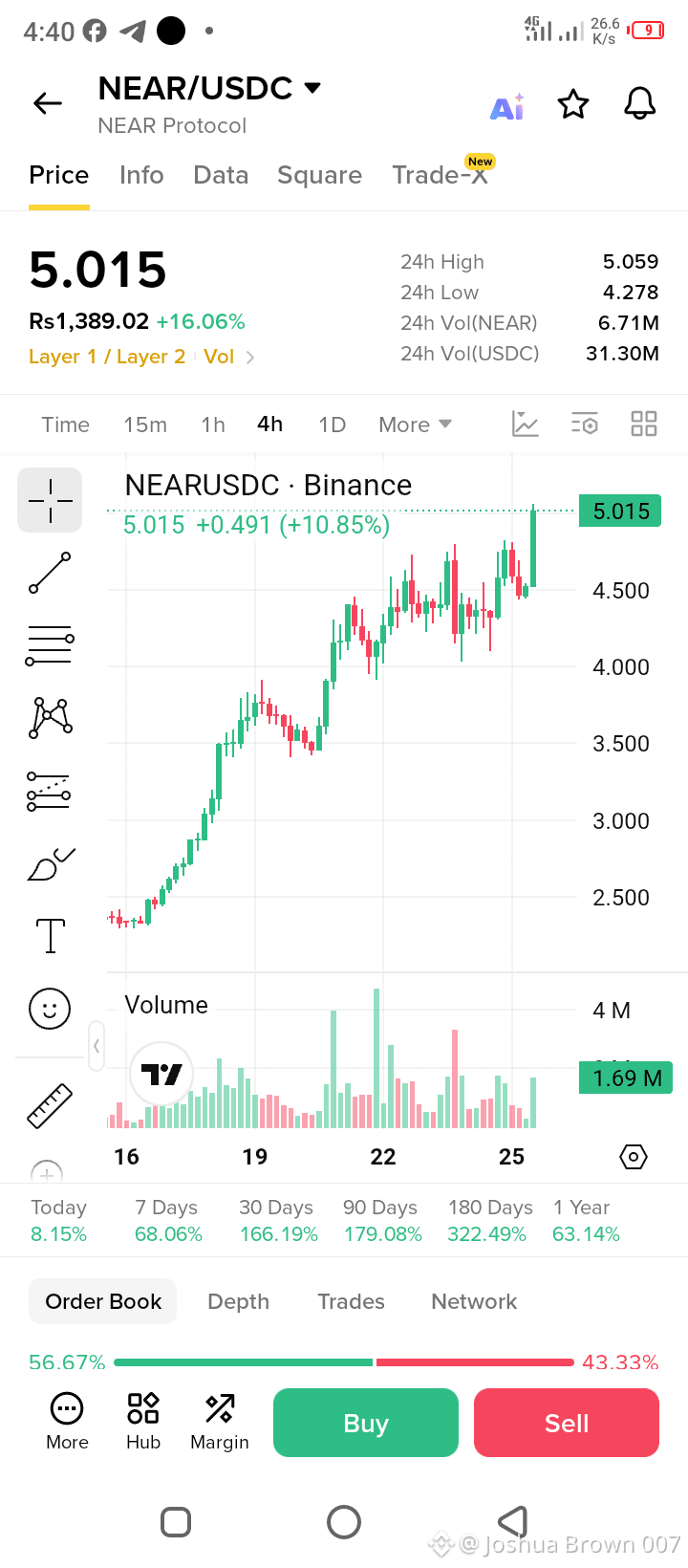
$NEAR USDC is in a powerful macro uptrend, having rallied +68% this week. The indicators are extended on the micro timeframe, and the price is consolidating below the 5.059 high.
Limit Long Entry 4.800 - 4.900
SL 4.650
TP 5.059
TP 5.500
Invalidation Conditions:
4H candle close below 4.500 completely invalidates the bullish macro thesis.
{future}(NEARUSDT)
$AVAX
{future}(AVAXUSDT)
#NEAR
$NEAR USDC is in a powerful macro uptrend, having rallied +68% this week. The indicators are extended on the micro timeframe, and the price is consolidating below the 5.059 high.
Limit Long Entry 4.800 - 4.900
SL 4.650
TP 5.059
TP 5.500
Invalidation Conditions:
4H candle close below 4.500 completely invalidates the bullish macro thesis.
$AVAX
$NEAR USDC is in a powerful macro uptrend, having rallied +68% this week. The indicators are extended on the micro timeframe, and the price is consolidating below the 5.059 high.
Limit Long Entry 4.800 - 4.900
SL 4.650
TP 5.059
TP 5.500
Invalidation Conditions:
4H candle close below 4.500 completely invalidates the bullish macro thesis.
$AVAX
198
#TradeNTell
$2,5 MILLIONEN AUF DEM SPIEL, WÄHREND MASSIVE BITCOIN-LONGS SICH DER LIQUIDATION NÄHERN
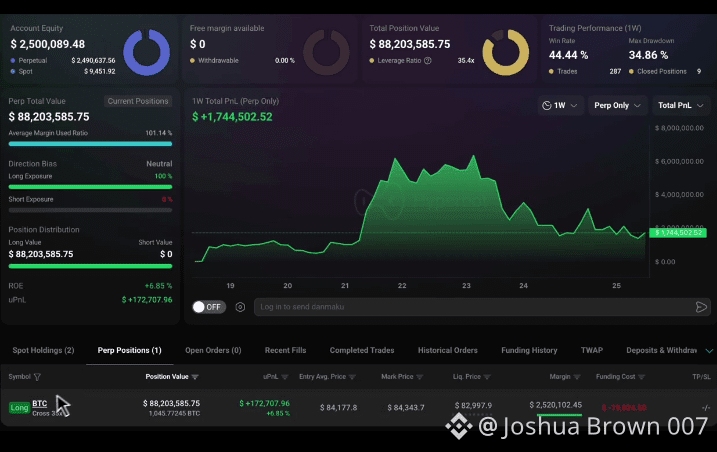
Ein Händler für Kryptowährungen mit hohem Risiko auf der dezentralen Handelsplattform Hyperliquid steht vor dem völligen Aus. Die enorme gehebelt Long-Position des Traders in Bitcoin (BTC) im Wert von 88.203.585,75 US-Dollar steht gefährlich kurz vor ihrem Bruchpunkt.
Wenn der Markt nur leicht weiter fällt und eine Zwangsliquidation auslöst, erleidet der Trader einen unmittelbaren Verlust von 2.500.089,48 US-Dollar – und damit wird das gesamte Eigenkapital des Kontos vollständig ausgelöscht.
Die Zahlen hinter dem riskanten Trade
Gesamtpositionsgröße: 1.048,77 BTC (bewertet mit 88.203.585,75 US-Dollar)
Hebel-Verhältnis: 35,4x
Eingezahlte Margin: 2.520.102,45 US-Dollar
Durchschnittlicher Einstiegspreis: 84.177,8 US-Dollar pro BTC
Aktueller Mark-Preis: 84.343,7 US-Dollar pro BTC
Liquidationspreis: 82.997,9 US-Dollar pro BTC
Läuft auf Luft: 0 US-Dollar freie Margin verfügbar
Das Dashboard des Traders zeigt einen aktiven, nicht realisierten Gewinn (uPnL) von +172.707,96 US-Dollar (+6,85%). Trotz dieses kurzfristigen grünen Signals arbeiten sie jedoch mit 0 US-Dollar frei verfügbarer Margin.
Da der Hebel auf ein volatiles Niveau von 35,4x ausgereizt ist, ist die Pufferzone unglaublich dünn. Der Abstand zwischen dem aktuellen Marktpreis (84.343,7) und dem Liquidationspreis (82.997,9) beträgt weniger als 1,6%. Wenn Bitcoins Preis unter die Marke von 82.997,9 fällt, wird das Protokoll automatisch die Position beschlagnahmen und liquidieren, um die Liquiditätspools der Plattform zu schützen. Dieser Schritt wird das 2,5-Millionen-Dollar-Nestegg des Traders augenblicklich verdampfen lassen und aus einem äußerst profitablen Wochenlauf einen katastrophalen Verlust machen.
$BTC
{future}(BTCUSDT)
$ETH
{future}(ETHUSDT)
#Whale.Alert #BinanceWillListHyperliquid(HYPE) #OndoFinanceSoughtSaleAfterFoundersDeath
#TradeNTell
$2,5 MILLIONEN AUF DEM SPIEL, WÄHREND MASSIVE BITCOIN-LONGS SICH DER LIQUIDATION NÄHERN
Ein Händler für Kryptowährungen mit hohem Risiko auf der dezentralen Handelsplattform Hyperliquid steht vor dem völligen Aus. Die enorme gehebelt Long-Position des Traders in Bitcoin (BTC) im Wert von 88.203.585,75 US-Dollar steht gefährlich kurz vor ihrem Bruchpunkt.
Wenn der Markt nur leicht weiter fällt und eine Zwangsliquidation auslöst, erleidet der Trader einen unmittelbaren Verlust von 2.500.089,48 US-Dollar – und damit wird das gesamte Eigenkapital des Kontos vollständig ausgelöscht.
Die Zahlen hinter dem riskanten Trade
Gesamtpositionsgröße: 1.048,77 BTC (bewertet mit 88.203.585,75 US-Dollar)
Hebel-Verhältnis: 35,4x
Eingezahlte Margin: 2.520.102,45 US-Dollar
Durchschnittlicher Einstiegspreis: 84.177,8 US-Dollar pro BTC
Aktueller Mark-Preis: 84.343,7 US-Dollar pro BTC
Liquidationspreis: 82.997,9 US-Dollar pro BTC
Läuft auf Luft: 0 US-Dollar freie Margin verfügbar
Das Dashboard des Traders zeigt einen aktiven, nicht realisierten Gewinn (uPnL) von +172.707,96 US-Dollar (+6,85%). Trotz dieses kurzfristigen grünen Signals arbeiten sie jedoch mit 0 US-Dollar frei verfügbarer Margin.
Da der Hebel auf ein volatiles Niveau von 35,4x ausgereizt ist, ist die Pufferzone unglaublich dünn. Der Abstand zwischen dem aktuellen Marktpreis (84.343,7) und dem Liquidationspreis (82.997,9) beträgt weniger als 1,6%. Wenn Bitcoins Preis unter die Marke von 82.997,9 fällt, wird das Protokoll automatisch die Position beschlagnahmen und liquidieren, um die Liquiditätspools der Plattform zu schützen. Dieser Schritt wird das 2,5-Millionen-Dollar-Nestegg des Traders augenblicklich verdampfen lassen und aus einem äußerst profitablen Wochenlauf einen katastrophalen Verlust machen.
$BTC
$ETH
#Whale.Alert #BinanceWillListHyperliquid(HYPE) #OndoFinanceSoughtSaleAfterFoundersDeath
$2,5 MILLIONEN AUF DEM SPIEL, WÄHREND MASSIVE BITCOIN-LONGS SICH DER LIQUIDATION NÄHERN
Ein Händler für Kryptowährungen mit hohem Risiko auf der dezentralen Handelsplattform Hyperliquid steht vor dem völligen Aus. Die enorme gehebelt Long-Position des Traders in Bitcoin (BTC) im Wert von 88.203.585,75 US-Dollar steht gefährlich kurz vor ihrem Bruchpunkt.
Wenn der Markt nur leicht weiter fällt und eine Zwangsliquidation auslöst, erleidet der Trader einen unmittelbaren Verlust von 2.500.089,48 US-Dollar – und damit wird das gesamte Eigenkapital des Kontos vollständig ausgelöscht.
Die Zahlen hinter dem riskanten Trade
Gesamtpositionsgröße: 1.048,77 BTC (bewertet mit 88.203.585,75 US-Dollar)
Hebel-Verhältnis: 35,4x
Eingezahlte Margin: 2.520.102,45 US-Dollar
Durchschnittlicher Einstiegspreis: 84.177,8 US-Dollar pro BTC
Aktueller Mark-Preis: 84.343,7 US-Dollar pro BTC
Liquidationspreis: 82.997,9 US-Dollar pro BTC
Läuft auf Luft: 0 US-Dollar freie Margin verfügbar
Das Dashboard des Traders zeigt einen aktiven, nicht realisierten Gewinn (uPnL) von +172.707,96 US-Dollar (+6,85%). Trotz dieses kurzfristigen grünen Signals arbeiten sie jedoch mit 0 US-Dollar frei verfügbarer Margin.
Da der Hebel auf ein volatiles Niveau von 35,4x ausgereizt ist, ist die Pufferzone unglaublich dünn. Der Abstand zwischen dem aktuellen Marktpreis (84.343,7) und dem Liquidationspreis (82.997,9) beträgt weniger als 1,6%. Wenn Bitcoins Preis unter die Marke von 82.997,9 fällt, wird das Protokoll automatisch die Position beschlagnahmen und liquidieren, um die Liquiditätspools der Plattform zu schützen. Dieser Schritt wird das 2,5-Millionen-Dollar-Nestegg des Traders augenblicklich verdampfen lassen und aus einem äußerst profitablen Wochenlauf einen katastrophalen Verlust machen.
$BTC
$ETH
#Whale.Alert #BinanceWillListHyperliquid(HYPE) #OndoFinanceSoughtSaleAfterFoundersDeath
92
Ich beobachte eine Zahl, bevor ich meine nächste BTC-Entscheidung treffe:
🇺🇸 US-Arbeitslosenanträge
Der Markt schaute auf etwa 201K, nachdem die Vorwoche mit überraschend niedrigen 196K aufhorchen ließ.
Aber das ist für mich entscheidend:
🔹 Unter 198K → Starker Arbeitsmarkt
→ Weniger Druck für eine lockere Fed-Politik
→ Könnte USD/Renditen stützen
→ Risikoanlagen könnten unter Druck geraten
🔹 Um 202K → Nahe an den Erwartungen
→ Wahrscheinlich begrenzte unmittelbare Reaktion
→ BTC könnte zu technischen Kursniveaus zurückkehren
🔹 Über 210K → Deutlichere Abkühlung am Arbeitsmarkt
→ Mehr Fokus auf die künftige Fed-Politik
→ Könnte zins-/rate-sensible Assets stützen, einschließlich Krypto
Das große Ganze ist spannend.
Reuters berichtete, dass der jüngste Wert von 196K durch die saisonale Volatilität rund um den Labor Day verzerrt sein könnte, während der zugrunde liegende Arbeitsmarkt relativ stabil geblieben sei.
Und noch eine wichtige Warnung: Arbeitslosenanträge messen hauptsächlich Entlassungen, nicht Einstellungen. Eine niedrige Zahl allein beweist also nicht, dass sich der gesamte Arbeitsmarkt insgesamt deutlich stärker entwickelt.
Für BTC trade ich nicht nur die Schlagzeile.
Ich schaue auf:
Anträge → DXY → Treasury-Renditen → Fed-Erwartungen → BTC-Liquidität
Diese Kettenreaktion ist wichtiger als nur eine einzelne Konjunkturziffer.
Kein blindes Long.
Kein blindes Short.
Erst die Daten wirken lassen, dann beobachten, wie der Kurs reagiert.
#USGovernment
{future}(BTCUSDT)
{future}(BNBUSDT)
{future}(XRPUSDT)
Ich beobachte eine Zahl, bevor ich meine nächste BTC-Entscheidung treffe:
🇺🇸 US-Arbeitslosenanträge
Der Markt schaute auf etwa 201K, nachdem die Vorwoche mit überraschend niedrigen 196K aufhorchen ließ.
Aber das ist für mich entscheidend:
🔹 Unter 198K → Starker Arbeitsmarkt
→ Weniger Druck für eine lockere Fed-Politik
→ Könnte USD/Renditen stützen
→ Risikoanlagen könnten unter Druck geraten
🔹 Um 202K → Nahe an den Erwartungen
→ Wahrscheinlich begrenzte unmittelbare Reaktion
→ BTC könnte zu technischen Kursniveaus zurückkehren
🔹 Über 210K → Deutlichere Abkühlung am Arbeitsmarkt
→ Mehr Fokus auf die künftige Fed-Politik
→ Könnte zins-/rate-sensible Assets stützen, einschließlich Krypto
Das große Ganze ist spannend.
Reuters berichtete, dass der jüngste Wert von 196K durch die saisonale Volatilität rund um den Labor Day verzerrt sein könnte, während der zugrunde liegende Arbeitsmarkt relativ stabil geblieben sei.
Und noch eine wichtige Warnung: Arbeitslosenanträge messen hauptsächlich Entlassungen, nicht Einstellungen. Eine niedrige Zahl allein beweist also nicht, dass sich der gesamte Arbeitsmarkt insgesamt deutlich stärker entwickelt.
Für BTC trade ich nicht nur die Schlagzeile.
Ich schaue auf:
Anträge → DXY → Treasury-Renditen → Fed-Erwartungen → BTC-Liquidität
Diese Kettenreaktion ist wichtiger als nur eine einzelne Konjunkturziffer.
Kein blindes Long.
Kein blindes Short.
Erst die Daten wirken lassen, dann beobachten, wie der Kurs reagiert.
#USGovernment
🇺🇸 US-Arbeitslosenanträge
Der Markt schaute auf etwa 201K, nachdem die Vorwoche mit überraschend niedrigen 196K aufhorchen ließ.
Aber das ist für mich entscheidend:
🔹 Unter 198K → Starker Arbeitsmarkt
→ Weniger Druck für eine lockere Fed-Politik
→ Könnte USD/Renditen stützen
→ Risikoanlagen könnten unter Druck geraten
🔹 Um 202K → Nahe an den Erwartungen
→ Wahrscheinlich begrenzte unmittelbare Reaktion
→ BTC könnte zu technischen Kursniveaus zurückkehren
🔹 Über 210K → Deutlichere Abkühlung am Arbeitsmarkt
→ Mehr Fokus auf die künftige Fed-Politik
→ Könnte zins-/rate-sensible Assets stützen, einschließlich Krypto
Das große Ganze ist spannend.
Reuters berichtete, dass der jüngste Wert von 196K durch die saisonale Volatilität rund um den Labor Day verzerrt sein könnte, während der zugrunde liegende Arbeitsmarkt relativ stabil geblieben sei.
Und noch eine wichtige Warnung: Arbeitslosenanträge messen hauptsächlich Entlassungen, nicht Einstellungen. Eine niedrige Zahl allein beweist also nicht, dass sich der gesamte Arbeitsmarkt insgesamt deutlich stärker entwickelt.
Für BTC trade ich nicht nur die Schlagzeile.
Ich schaue auf:
Anträge → DXY → Treasury-Renditen → Fed-Erwartungen → BTC-Liquidität
Diese Kettenreaktion ist wichtiger als nur eine einzelne Konjunkturziffer.
Kein blindes Long.
Kein blindes Short.
Erst die Daten wirken lassen, dann beobachten, wie der Kurs reagiert.
#USGovernment
123
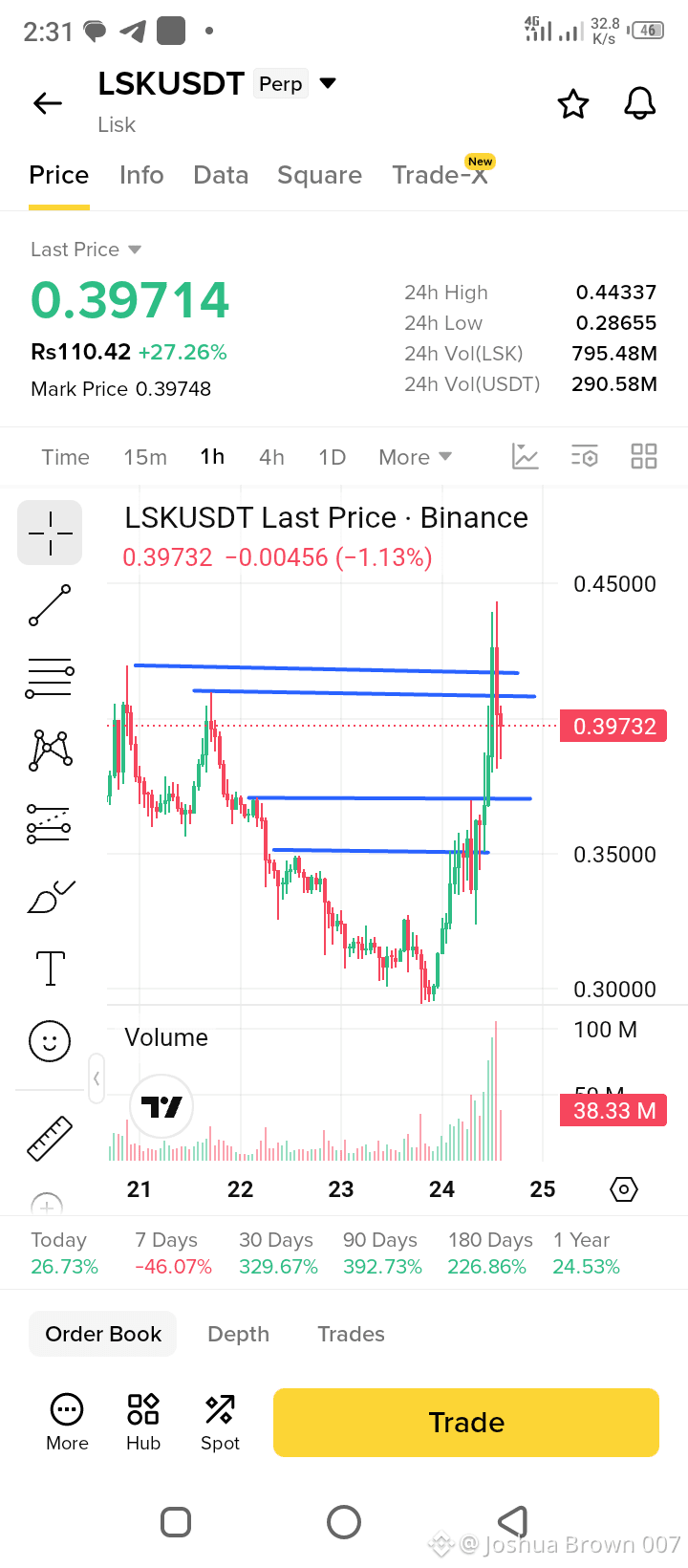
30D-Trade $LSK 10.7K USDT
#Trade Kurzer Kopfbereich $LSK
Einstieg 0.3930 - 0.4000
SL 0.4150
TP 0.3700 FVG 1H
TP 0.3500 große Nachfrageszone
Ungültigkeitsbedingungen:
Ein 1H-Kerzenabschluss über 0.4200 macht die bärische Micro-Thesis vollständig ungültig.
$LSK
{future}(LSKUSDT)
#Trade Kurzer Kopfbereich $LSK
Einstieg 0.3930 - 0.4000
SL 0.4150
TP 0.3700 FVG 1H
TP 0.3500 große Nachfrageszone
Ungültigkeitsbedingungen:
Ein 1H-Kerzenabschluss über 0.4200 macht die bärische Micro-Thesis vollständig ungültig.
$LSK
Einstieg 0.3930 - 0.4000
SL 0.4150
TP 0.3700 FVG 1H
TP 0.3500 große Nachfrageszone
Ungültigkeitsbedingungen:
Ein 1H-Kerzenabschluss über 0.4200 macht die bärische Micro-Thesis vollständig ungültig.
$LSK
202
·
--
Bullisch
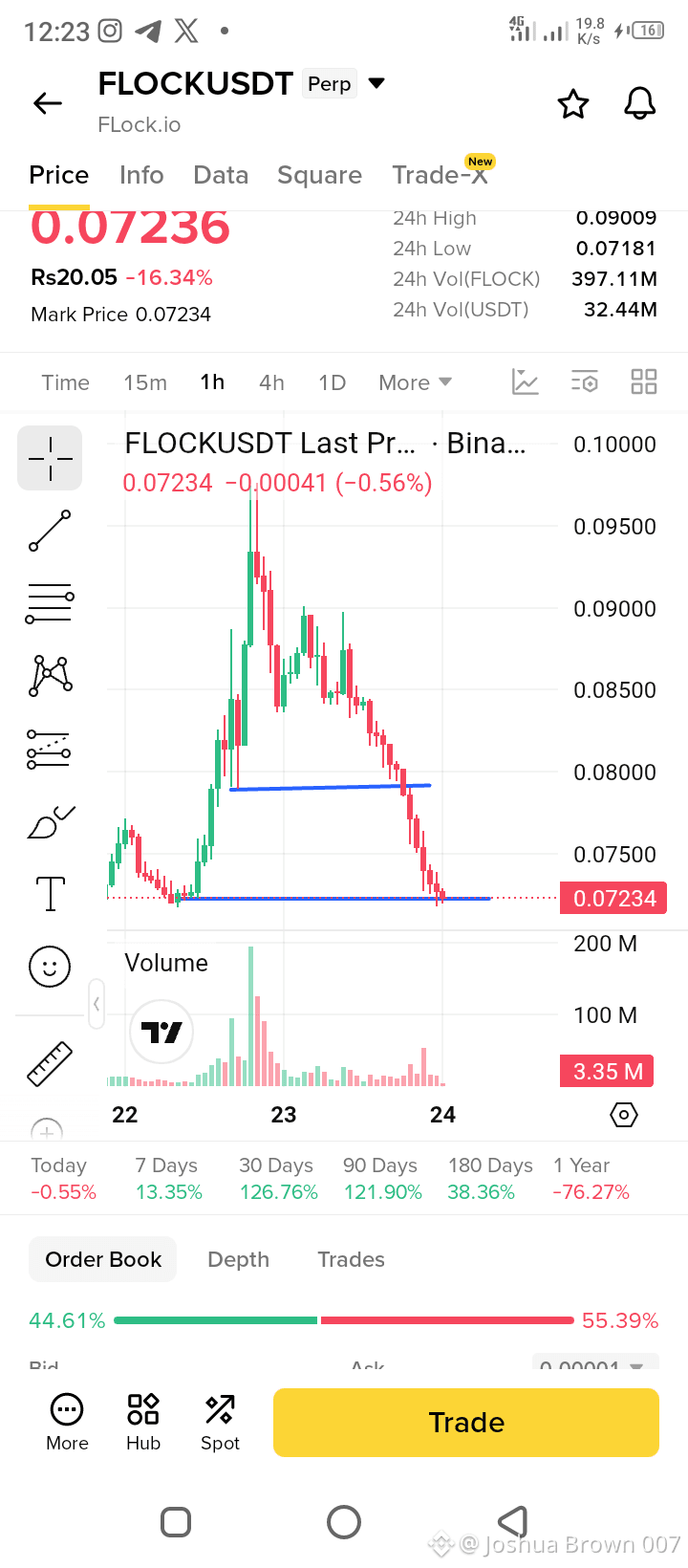
30D-Trade $FLOCK 7K USDT
#Trade $FLOCK LONG Setup
Limit Entry 0.0715 - 0.0725
SL 0.0690
TP 0.07482
TP 0.08050
Ungültigkeitsbedingungen:
1H Kerzenschluss unter 0.0690 macht die These vom unmittelbaren Rebound ungültig.
plötzlicher Spike im Verkaufsvolumen, der die Unterstützung bei 0.0650 durchbricht.
Wenn der Preis bei hohem Volumen unter 0.0690 fällt, gehe short beim Retest von 0.0710, mit Ziel 0.0650. SL bei 0.0730.
$TAKE $CAP
{future}(FLOCKUSDT)
{future}(TAKEUSDT)
{future}(CAPUSDT)
#Trade $FLOCK LONG Setup
Limit Entry 0.0715 - 0.0725
SL 0.0690
TP 0.07482
TP 0.08050
Ungültigkeitsbedingungen:
1H Kerzenschluss unter 0.0690 macht die These vom unmittelbaren Rebound ungültig.
plötzlicher Spike im Verkaufsvolumen, der die Unterstützung bei 0.0650 durchbricht.
Wenn der Preis bei hohem Volumen unter 0.0690 fällt, gehe short beim Retest von 0.0710, mit Ziel 0.0650. SL bei 0.0730.
$TAKE $CAP
Limit Entry 0.0715 - 0.0725
SL 0.0690
TP 0.07482
TP 0.08050
Ungültigkeitsbedingungen:
1H Kerzenschluss unter 0.0690 macht die These vom unmittelbaren Rebound ungültig.
plötzlicher Spike im Verkaufsvolumen, der die Unterstützung bei 0.0650 durchbricht.
Wenn der Preis bei hohem Volumen unter 0.0690 fällt, gehe short beim Retest von 0.0710, mit Ziel 0.0650. SL bei 0.0730.
$TAKE $CAP
564
Artikel
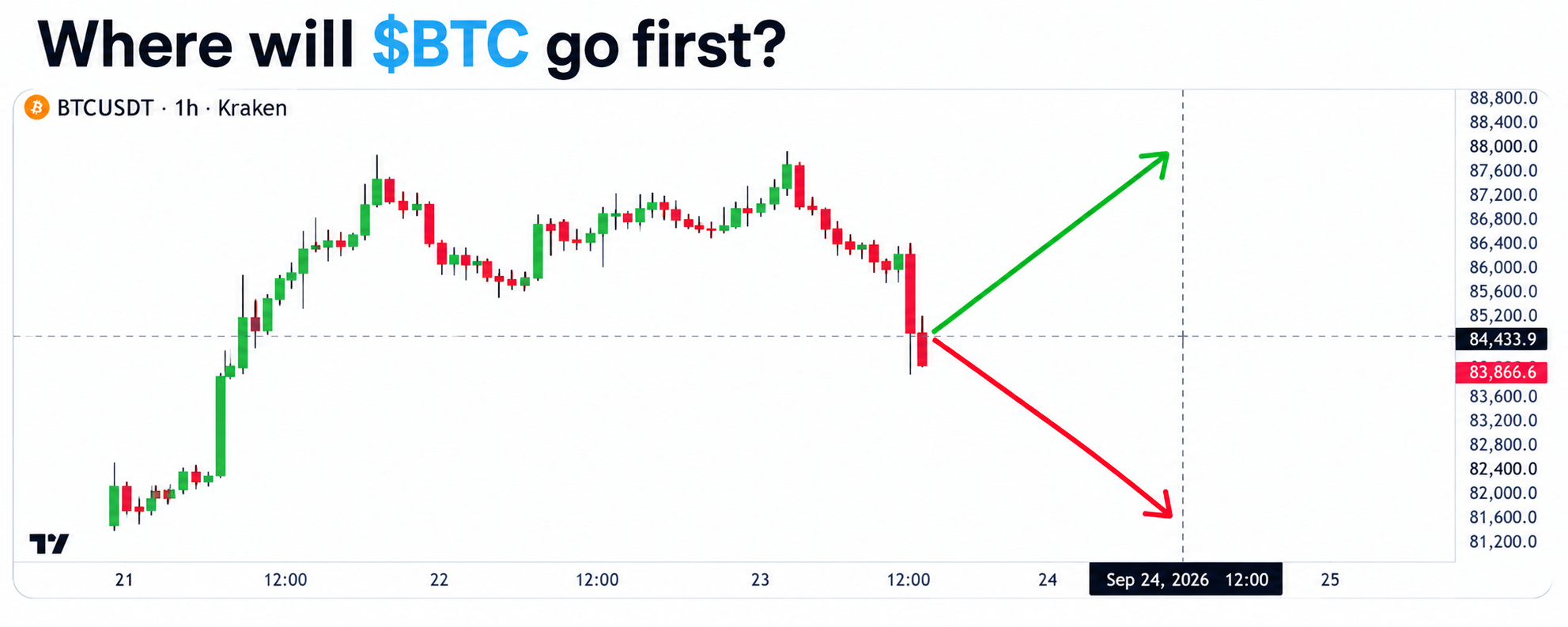
Wohin wird $BTC zuerst gehen: nach oben oder nach unten?Ich schaue immer wieder auf dieses Chart und eine Frage sticht heraus:
Wird Bitcoin zuerst die Liquidität oberhalb abgreifen oder zuerst das Abwärtsniveau durchlaufen, bevor die nächste Bewegung kommt?
Das Chart zeigt die entscheidende Zone um 84,4K $, mit ungefähr 87,6K $ auf der Oberseite und 81,6K $ auf der Unterseite.
Aber es gibt ein wichtiges Update: BTC ist heute bereits in den Bereich von 87K $ vorgedrungen, daher sollte dieses Chart als Momentaufnahme des früheren Setups betrachtet werden, nicht als die aktuelle Live-Struktur. Das neueste Dashboard von CryptoQuant zeigte BTC bei etwa 87,36K $ und sein Bull/Bear-Indikator war auf positiv umgeschaltet, bei +0,27.
Wohin wird $BTC zuerst gehen: nach oben oder nach unten?
Ich schaue immer wieder auf dieses Chart und eine Frage sticht heraus:
Wird Bitcoin zuerst die Liquidität oberhalb abgreifen oder zuerst das Abwärtsniveau durchlaufen, bevor die nächste Bewegung kommt?
Das Chart zeigt die entscheidende Zone um 84,4K $, mit ungefähr 87,6K $ auf der Oberseite und 81,6K $ auf der Unterseite.
Aber es gibt ein wichtiges Update: BTC ist heute bereits in den Bereich von 87K $ vorgedrungen, daher sollte dieses Chart als Momentaufnahme des früheren Setups betrachtet werden, nicht als die aktuelle Live-Struktur. Das neueste Dashboard von CryptoQuant zeigte BTC bei etwa 87,36K $ und sein Bull/Bear-Indikator war auf positiv umgeschaltet, bei +0,27.
Wird Bitcoin zuerst die Liquidität oberhalb abgreifen oder zuerst das Abwärtsniveau durchlaufen, bevor die nächste Bewegung kommt?
Das Chart zeigt die entscheidende Zone um 84,4K $, mit ungefähr 87,6K $ auf der Oberseite und 81,6K $ auf der Unterseite.
Aber es gibt ein wichtiges Update: BTC ist heute bereits in den Bereich von 87K $ vorgedrungen, daher sollte dieses Chart als Momentaufnahme des früheren Setups betrachtet werden, nicht als die aktuelle Live-Struktur. Das neueste Dashboard von CryptoQuant zeigte BTC bei etwa 87,36K $ und sein Bull/Bear-Indikator war auf positiv umgeschaltet, bei +0,27.
1
8
9k
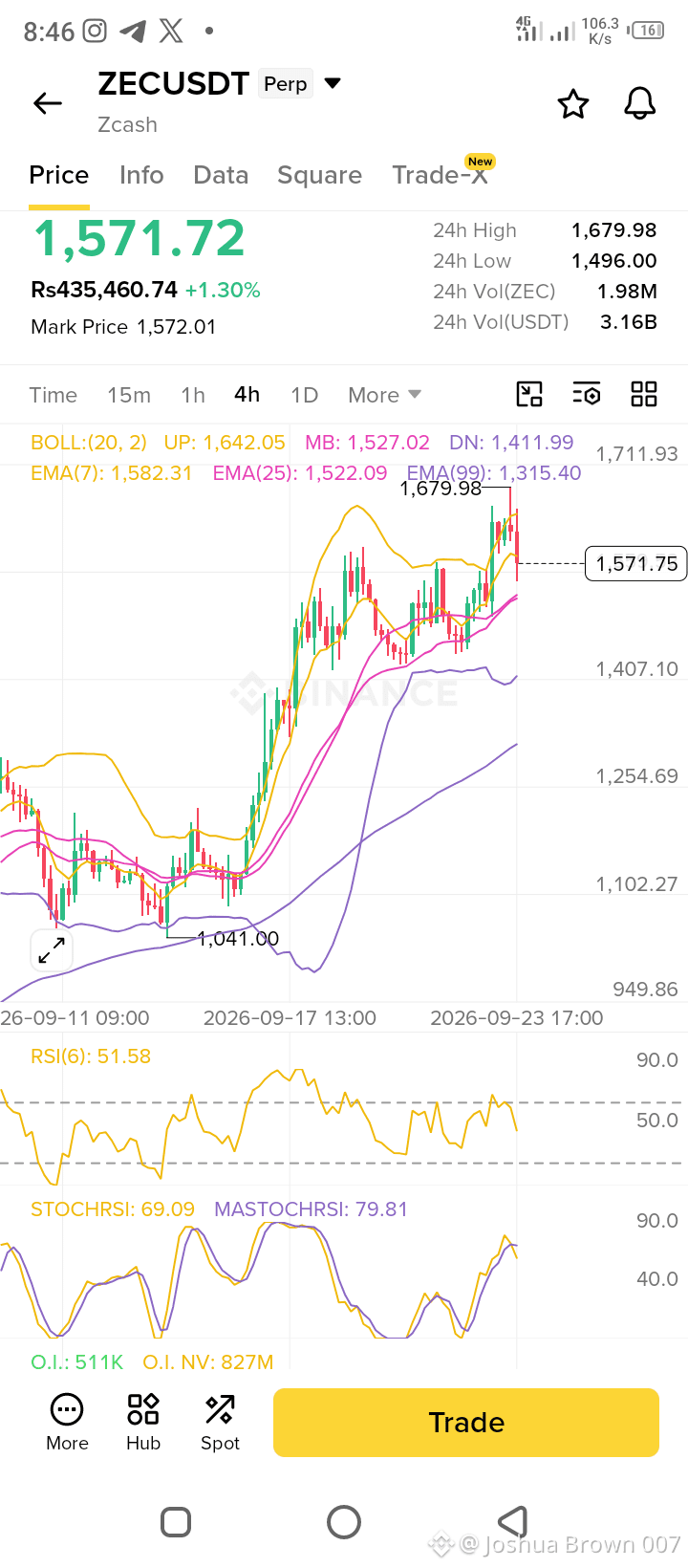
#zec
WARTEN SIE AUF EINEN RÜCKSETZER UND GEHEN SIE LONG.
$ZEC USDT befindet sich in einem starken Aufwärtstrend, durchläuft jedoch derzeit eine notwendige kurzfristige Korrektur. Die Indikatoren haben sich deutlich abgekühlt, und der Preis testet die EMA(25).
Nicht FOMO beim aktuellen Preis (1,571) eingehen.
Einstieg Long 1,520 - 1,540
SL 1,480
TP 1,645
TP 1,780
Erwarteter Zeitraum 08 Std. - 1 Tag
Ungültigkeitsbedingungen:
Wenn der 4H-Kerzenabschluss unter 1,315 liegt (EMA 99), wird die bullische Makro-These vollständig ungültig.
{future}(ZECUSDT)
$TAO
{future}(TAOUSDT)
$ZEN
{future}(ZENUSDT)
#zec
WARTEN SIE AUF EINEN RÜCKSETZER UND GEHEN SIE LONG.
$ZEC USDT befindet sich in einem starken Aufwärtstrend, durchläuft jedoch derzeit eine notwendige kurzfristige Korrektur. Die Indikatoren haben sich deutlich abgekühlt, und der Preis testet die EMA(25).
Nicht FOMO beim aktuellen Preis (1,571) eingehen.
Einstieg Long 1,520 - 1,540
SL 1,480
TP 1,645
TP 1,780
Erwarteter Zeitraum 08 Std. - 1 Tag
Ungültigkeitsbedingungen:
Wenn der 4H-Kerzenabschluss unter 1,315 liegt (EMA 99), wird die bullische Makro-These vollständig ungültig.
$TAO
$ZEN
WARTEN SIE AUF EINEN RÜCKSETZER UND GEHEN SIE LONG.
$ZEC USDT befindet sich in einem starken Aufwärtstrend, durchläuft jedoch derzeit eine notwendige kurzfristige Korrektur. Die Indikatoren haben sich deutlich abgekühlt, und der Preis testet die EMA(25).
Nicht FOMO beim aktuellen Preis (1,571) eingehen.
Einstieg Long 1,520 - 1,540
SL 1,480
TP 1,645
TP 1,780
Erwarteter Zeitraum 08 Std. - 1 Tag
Ungültigkeitsbedingungen:
Wenn der 4H-Kerzenabschluss unter 1,315 liegt (EMA 99), wird die bullische Makro-These vollständig ungültig.
$TAO
$ZEN
436
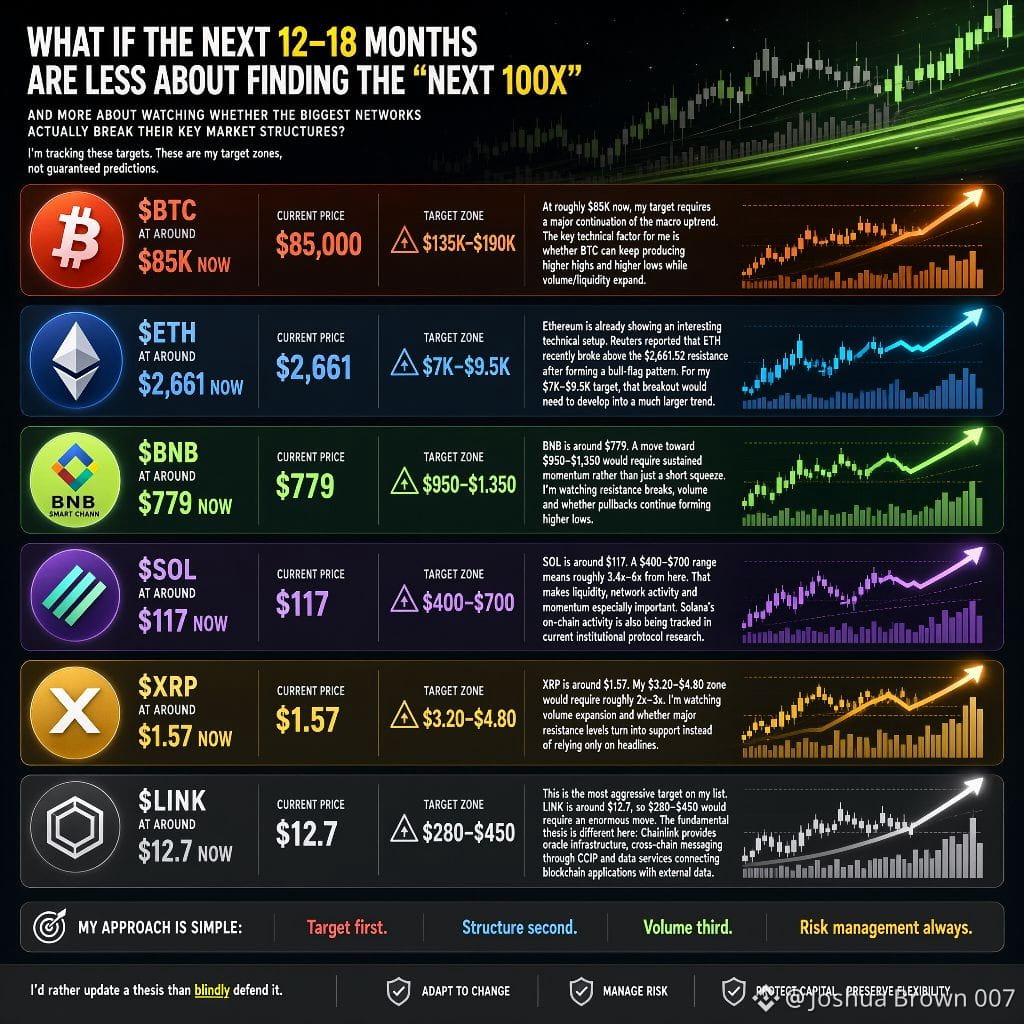
Was wäre, wenn die nächsten 12–18 Monate weniger darum drehen würden, das „nächste 100x“ zu finden, und mehr darum, zu beobachten, ob die größten Netzwerke tatsächlich ihre wichtigsten Marktstrukturen aufbrechen?
Ich verfolge diese Ziele:
$BTC → 135.000–190.000 $
$ETH → 7.000–9.500 $
$BNB → 950–1.350
$SOL → 400–700
$XRP → 3,20–4,80
$LINK → 280–450
Das sind meine Zielbereiche, keine garantierten Prognosen.
🔹 $BTC
Bei ungefähr 85.000 $ heute erfordert mein Ziel eine starke Fortsetzung des makroökonomischen Aufwärtstrends. Der entscheidende technische Faktor für mich ist, ob BTC weiterhin höhere Hochs und höhere Tiefs bildet, während Volumen/Liquidität zunehmen.
🔹 $ETH
Ethereum zeigt bereits ein interessantes technisches Setup. Reuters berichtete, dass ETH kürzlich den Widerstand bei 2.661,52 $ durchbrochen hat, nachdem zuvor ein Bullen-Flaggen-Pattern entstanden war.
Für mein Ziel von 7.000–9.500 $ müsste dieser Ausbruch sich zu einem viel größeren Trend entwickeln.
🔹 $BNB
BNB liegt bei etwa 779. Eine Bewegung in Richtung 950–1.350 $ würde anhaltenden Schub erfordern – nicht nur einen kurzen Squeeze. Ich beobachte Widerstandsbrüche, das Volumen und ob Rücksetzer weiterhin höhere Tiefs bilden.
🔹 $SOL
SOL liegt bei etwa 117. Ein Bereich von 400–700 $ bedeutet ungefähr 3,4x–6x von hier aus.
Das macht Liquidität, Netzwerkaktivität und Momentum besonders wichtig. Die On-Chain-Aktivität von Solana wird außerdem in aktueller institutioneller Protokollforschung mitverfolgt.
🔹 $XRP
XRP liegt bei etwa 1,57 $. Mein Bereich von 3,20–4,80 $ würde ungefähr 2x–3x erfordern. Ich beobachte eine Ausweitung des Volumens und ob wichtige Widerstandsniveaus zu Unterstützung werden – statt sich nur auf Schlagzeilen zu verlassen.
Mein Ansatz ist einfach:
Ziel zuerst.
Struktur als Zweites.
Volumen an dritter Stelle.
Risikomanagement immer.
Wenn sich die Marktstruktur verändert, können sich auch meine Ziele ändern.
Ich würde lieber eine These aktualisieren, als sie blind zu verteidigen.
{spot}(BTCUSDT)
{spot}(ETHUSDT)
{spot}(BNBUSDT)
Was wäre, wenn die nächsten 12–18 Monate weniger darum drehen würden, das „nächste 100x“ zu finden, und mehr darum, zu beobachten, ob die größten Netzwerke tatsächlich ihre wichtigsten Marktstrukturen aufbrechen?
Ich verfolge diese Ziele:
$BTC → 135.000–190.000 $
$ETH → 7.000–9.500 $
$BNB → 950–1.350
$SOL → 400–700
$XRP → 3,20–4,80
$LINK → 280–450
Das sind meine Zielbereiche, keine garantierten Prognosen.
🔹 $BTC
Bei ungefähr 85.000 $ heute erfordert mein Ziel eine starke Fortsetzung des makroökonomischen Aufwärtstrends. Der entscheidende technische Faktor für mich ist, ob BTC weiterhin höhere Hochs und höhere Tiefs bildet, während Volumen/Liquidität zunehmen.
🔹 $ETH
Ethereum zeigt bereits ein interessantes technisches Setup. Reuters berichtete, dass ETH kürzlich den Widerstand bei 2.661,52 $ durchbrochen hat, nachdem zuvor ein Bullen-Flaggen-Pattern entstanden war.
Für mein Ziel von 7.000–9.500 $ müsste dieser Ausbruch sich zu einem viel größeren Trend entwickeln.
🔹 $BNB
BNB liegt bei etwa 779. Eine Bewegung in Richtung 950–1.350 $ würde anhaltenden Schub erfordern – nicht nur einen kurzen Squeeze. Ich beobachte Widerstandsbrüche, das Volumen und ob Rücksetzer weiterhin höhere Tiefs bilden.
🔹 $SOL
SOL liegt bei etwa 117. Ein Bereich von 400–700 $ bedeutet ungefähr 3,4x–6x von hier aus.
Das macht Liquidität, Netzwerkaktivität und Momentum besonders wichtig. Die On-Chain-Aktivität von Solana wird außerdem in aktueller institutioneller Protokollforschung mitverfolgt.
🔹 $XRP
XRP liegt bei etwa 1,57 $. Mein Bereich von 3,20–4,80 $ würde ungefähr 2x–3x erfordern. Ich beobachte eine Ausweitung des Volumens und ob wichtige Widerstandsniveaus zu Unterstützung werden – statt sich nur auf Schlagzeilen zu verlassen.
Mein Ansatz ist einfach:
Ziel zuerst.
Struktur als Zweites.
Volumen an dritter Stelle.
Risikomanagement immer.
Wenn sich die Marktstruktur verändert, können sich auch meine Ziele ändern.
Ich würde lieber eine These aktualisieren, als sie blind zu verteidigen.
Ich verfolge diese Ziele:
$BTC → 135.000–190.000 $
$ETH → 7.000–9.500 $
$BNB → 950–1.350
$SOL → 400–700
$XRP → 3,20–4,80
$LINK → 280–450
Das sind meine Zielbereiche, keine garantierten Prognosen.
🔹 $BTC
Bei ungefähr 85.000 $ heute erfordert mein Ziel eine starke Fortsetzung des makroökonomischen Aufwärtstrends. Der entscheidende technische Faktor für mich ist, ob BTC weiterhin höhere Hochs und höhere Tiefs bildet, während Volumen/Liquidität zunehmen.
🔹 $ETH
Ethereum zeigt bereits ein interessantes technisches Setup. Reuters berichtete, dass ETH kürzlich den Widerstand bei 2.661,52 $ durchbrochen hat, nachdem zuvor ein Bullen-Flaggen-Pattern entstanden war.
Für mein Ziel von 7.000–9.500 $ müsste dieser Ausbruch sich zu einem viel größeren Trend entwickeln.
🔹 $BNB
BNB liegt bei etwa 779. Eine Bewegung in Richtung 950–1.350 $ würde anhaltenden Schub erfordern – nicht nur einen kurzen Squeeze. Ich beobachte Widerstandsbrüche, das Volumen und ob Rücksetzer weiterhin höhere Tiefs bilden.
🔹 $SOL
SOL liegt bei etwa 117. Ein Bereich von 400–700 $ bedeutet ungefähr 3,4x–6x von hier aus.
Das macht Liquidität, Netzwerkaktivität und Momentum besonders wichtig. Die On-Chain-Aktivität von Solana wird außerdem in aktueller institutioneller Protokollforschung mitverfolgt.
🔹 $XRP
XRP liegt bei etwa 1,57 $. Mein Bereich von 3,20–4,80 $ würde ungefähr 2x–3x erfordern. Ich beobachte eine Ausweitung des Volumens und ob wichtige Widerstandsniveaus zu Unterstützung werden – statt sich nur auf Schlagzeilen zu verlassen.
Mein Ansatz ist einfach:
Ziel zuerst.
Struktur als Zweites.
Volumen an dritter Stelle.
Risikomanagement immer.
Wenn sich die Marktstruktur verändert, können sich auch meine Ziele ändern.
Ich würde lieber eine These aktualisieren, als sie blind zu verteidigen.
200
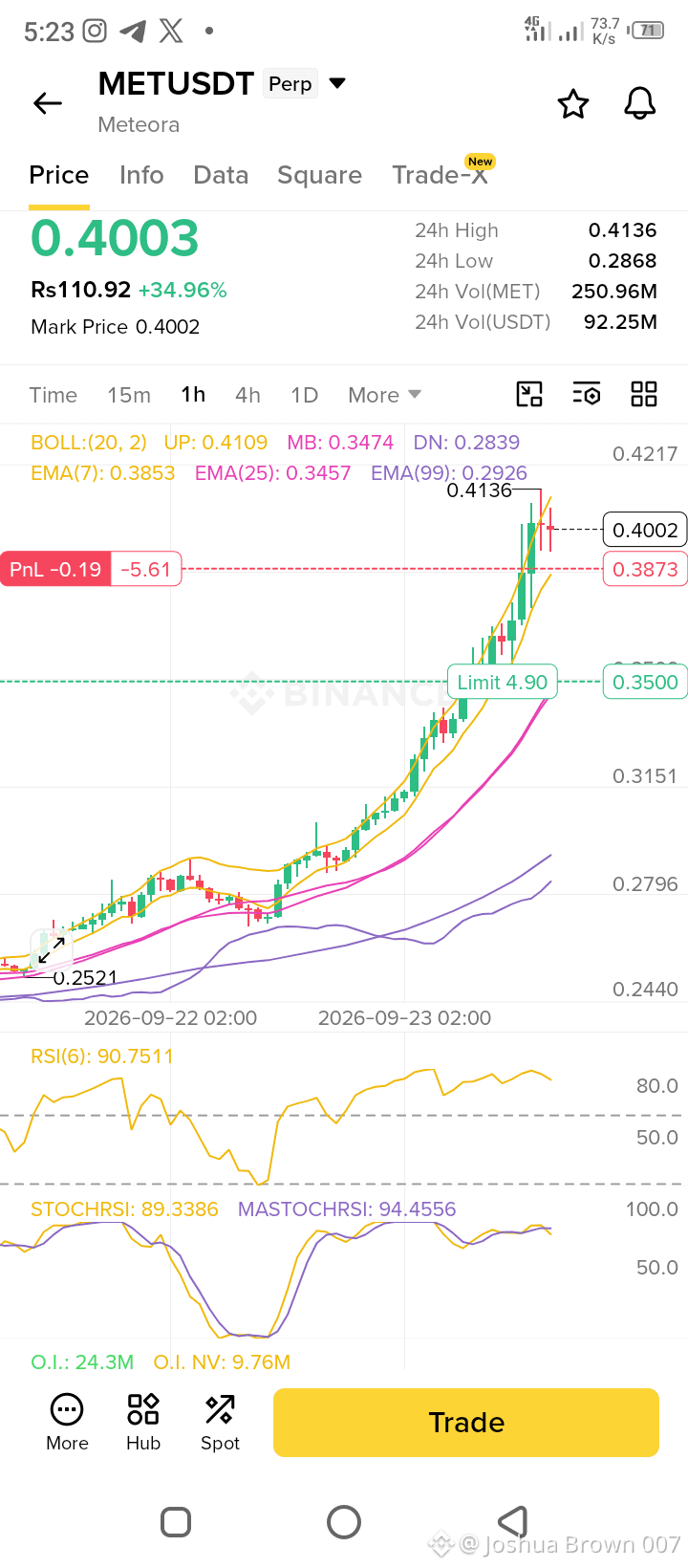
$MET Short Sell
Entry0.4000 - 0.4050
SL 0.4150
TP 0.3860 und 0.3490
Achtung:
Wenn der Preis 0.4136 mit hohem Volumen zurückerobert und 0.4217 durchbricht, gehe long mit Kursziel 0.450. SL bei 0.400.
{future}(METUSDT)
$MET Short Sell
Entry0.4000 - 0.4050
SL 0.4150
TP 0.3860 und 0.3490
Achtung:
Wenn der Preis 0.4136 mit hohem Volumen zurückerobert und 0.4217 durchbricht, gehe long mit Kursziel 0.450. SL bei 0.400.
Entry0.4000 - 0.4050
SL 0.4150
TP 0.3860 und 0.3490
Achtung:
Wenn der Preis 0.4136 mit hohem Volumen zurückerobert und 0.4217 durchbricht, gehe long mit Kursziel 0.450. SL bei 0.400.
154
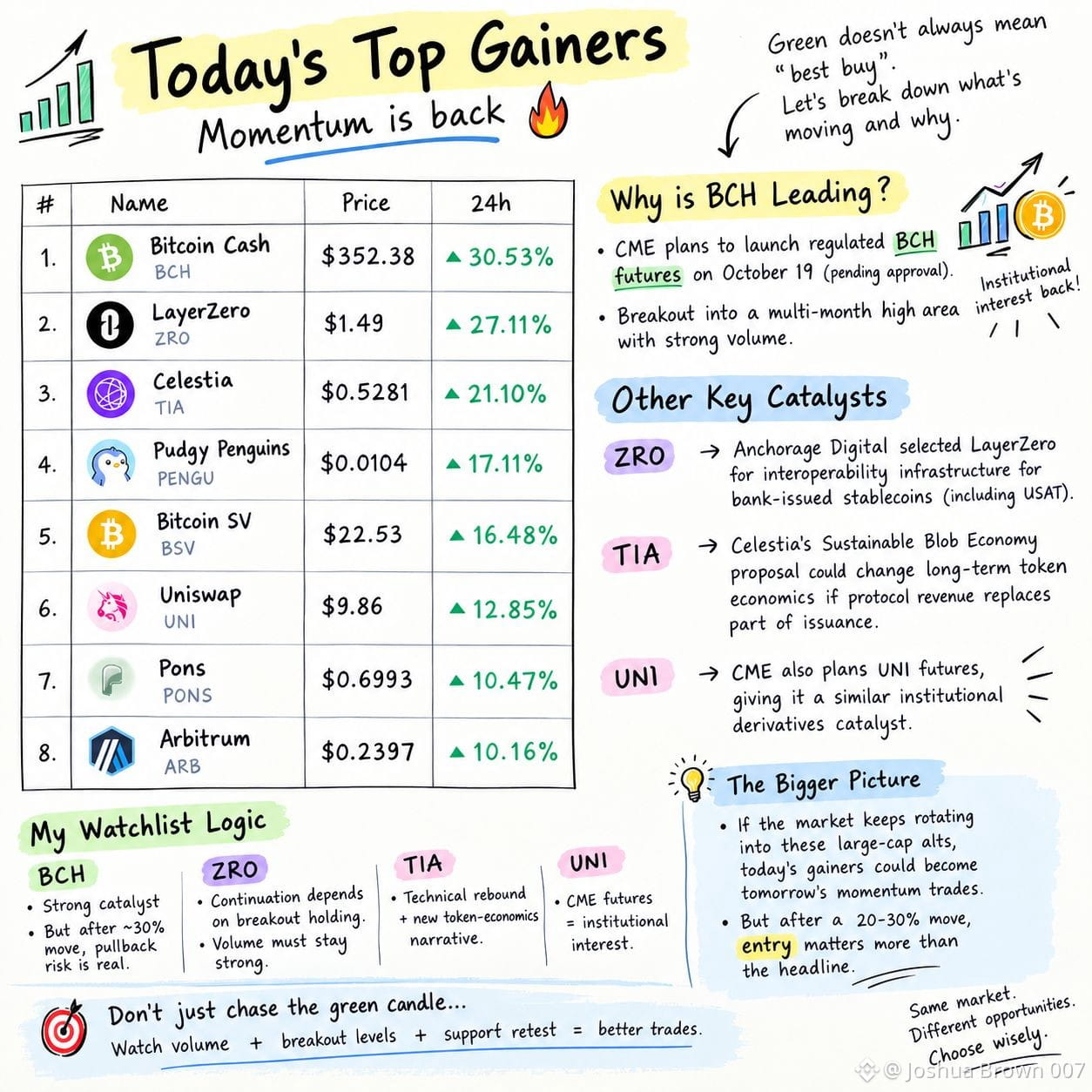
Das Momentum der Top-Gewinner ist zurück 🔥
Das heutige Leaderboard ist interessant, weil das nicht einfach nur ein Small-Cap-Pump ist.
$BCH +30,53%
$ZRO +27,11%
$TIA +21,10%
$PENGU +17,11%
$BSV +16,48%
$UNI +12,85%
$PONS +10,47%
$ARB +10,16%
Die größte Story ist BCH. Die Bewegung hängt mit den CME-Plänen für regulierte BCH-Futures zusammen, die für den 19. Oktober vorgesehen sind, vorbehaltlich der regulatorischen Genehmigung. BCH ist außerdem in einen mehrmonatigen Hochbereich mit hohem Volumen ausgebrochen.
Aber hier ist der wichtige Teil 👇
Eine Münze, die bereits um 30 % gepumpt hat, ist nicht automatisch die Aktie mit dem meisten Upside, das noch übrig ist.
ZRO hat noch einen weiteren interessanten fundamentalen Katalysator: Anchorage Digital hat LayerZero für die Interoperabilitäts-Infrastruktur ausgewählt, die von Banken ausgegebene Stablecoins umfasst, einschließlich Tethers USAT.
Auch TIA verdient Aufmerksamkeit, weil Celestia mit dem neuen Vorschlag für eine „Sustainable Blob Economy“ die langfristigen Token-Ökonomien verändern könnte, falls Protokolleinnahmen irgendwann einen Teil der Emissionen ersetzen.
Meine Watchlist-Logik
BCH: stärkster aktueller Katalysator, aber nach einer ~30%igen Tagesbewegung ist das Rücksetzer-Risiko relevant.
ZRO: die Fortsetzung hängt davon ab, ob der heutige Ausbruch hält und das Volumen stark bleibt.
TIA: spannender Mix aus technischem Rebound + neuer Token-Ökonomik-Story.
UNI: Auch die CME plant UNI-Futures und liefert damit einen ähnlichen institutionellen-derivativen Katalysator.
Also beobachte ich statt blind dem größten grünen Kerzen hinterherzujagen: Volumen + Ausbruchsniveau + Retest der Unterstützung.
Wenn der Markt sich weiterhin in diese großen Cap-Alts rotiert, könnten die heutigen Gainer zu den Momentum-Trades von morgen werden – aber nach einer 20–30% Bewegung ist der Einstieg wichtiger als die Schlagzeile.
{future}(BCHUSDT)
{future}(ZROUSDT)
{future}(TIAUSDT)
Das Momentum der Top-Gewinner ist zurück 🔥
Das heutige Leaderboard ist interessant, weil das nicht einfach nur ein Small-Cap-Pump ist.
$BCH +30,53%
$ZRO +27,11%
$TIA +21,10%
$PENGU +17,11%
$BSV +16,48%
$UNI +12,85%
$PONS +10,47%
$ARB +10,16%
Die größte Story ist BCH. Die Bewegung hängt mit den CME-Plänen für regulierte BCH-Futures zusammen, die für den 19. Oktober vorgesehen sind, vorbehaltlich der regulatorischen Genehmigung. BCH ist außerdem in einen mehrmonatigen Hochbereich mit hohem Volumen ausgebrochen.
Aber hier ist der wichtige Teil 👇
Eine Münze, die bereits um 30 % gepumpt hat, ist nicht automatisch die Aktie mit dem meisten Upside, das noch übrig ist.
ZRO hat noch einen weiteren interessanten fundamentalen Katalysator: Anchorage Digital hat LayerZero für die Interoperabilitäts-Infrastruktur ausgewählt, die von Banken ausgegebene Stablecoins umfasst, einschließlich Tethers USAT.
Auch TIA verdient Aufmerksamkeit, weil Celestia mit dem neuen Vorschlag für eine „Sustainable Blob Economy“ die langfristigen Token-Ökonomien verändern könnte, falls Protokolleinnahmen irgendwann einen Teil der Emissionen ersetzen.
Meine Watchlist-Logik
BCH: stärkster aktueller Katalysator, aber nach einer ~30%igen Tagesbewegung ist das Rücksetzer-Risiko relevant.
ZRO: die Fortsetzung hängt davon ab, ob der heutige Ausbruch hält und das Volumen stark bleibt.
TIA: spannender Mix aus technischem Rebound + neuer Token-Ökonomik-Story.
UNI: Auch die CME plant UNI-Futures und liefert damit einen ähnlichen institutionellen-derivativen Katalysator.
Also beobachte ich statt blind dem größten grünen Kerzen hinterherzujagen: Volumen + Ausbruchsniveau + Retest der Unterstützung.
Wenn der Markt sich weiterhin in diese großen Cap-Alts rotiert, könnten die heutigen Gainer zu den Momentum-Trades von morgen werden – aber nach einer 20–30% Bewegung ist der Einstieg wichtiger als die Schlagzeile.
Das heutige Leaderboard ist interessant, weil das nicht einfach nur ein Small-Cap-Pump ist.
$BCH +30,53%
$ZRO +27,11%
$TIA +21,10%
$PENGU +17,11%
$BSV +16,48%
$UNI +12,85%
$PONS +10,47%
$ARB +10,16%
Die größte Story ist BCH. Die Bewegung hängt mit den CME-Plänen für regulierte BCH-Futures zusammen, die für den 19. Oktober vorgesehen sind, vorbehaltlich der regulatorischen Genehmigung. BCH ist außerdem in einen mehrmonatigen Hochbereich mit hohem Volumen ausgebrochen.
Aber hier ist der wichtige Teil 👇
Eine Münze, die bereits um 30 % gepumpt hat, ist nicht automatisch die Aktie mit dem meisten Upside, das noch übrig ist.
ZRO hat noch einen weiteren interessanten fundamentalen Katalysator: Anchorage Digital hat LayerZero für die Interoperabilitäts-Infrastruktur ausgewählt, die von Banken ausgegebene Stablecoins umfasst, einschließlich Tethers USAT.
Auch TIA verdient Aufmerksamkeit, weil Celestia mit dem neuen Vorschlag für eine „Sustainable Blob Economy“ die langfristigen Token-Ökonomien verändern könnte, falls Protokolleinnahmen irgendwann einen Teil der Emissionen ersetzen.
Meine Watchlist-Logik
BCH: stärkster aktueller Katalysator, aber nach einer ~30%igen Tagesbewegung ist das Rücksetzer-Risiko relevant.
ZRO: die Fortsetzung hängt davon ab, ob der heutige Ausbruch hält und das Volumen stark bleibt.
TIA: spannender Mix aus technischem Rebound + neuer Token-Ökonomik-Story.
UNI: Auch die CME plant UNI-Futures und liefert damit einen ähnlichen institutionellen-derivativen Katalysator.
Also beobachte ich statt blind dem größten grünen Kerzen hinterherzujagen: Volumen + Ausbruchsniveau + Retest der Unterstützung.
Wenn der Markt sich weiterhin in diese großen Cap-Alts rotiert, könnten die heutigen Gainer zu den Momentum-Trades von morgen werden – aber nach einer 20–30% Bewegung ist der Einstieg wichtiger als die Schlagzeile.
1
314
#AIStocksWhatNext
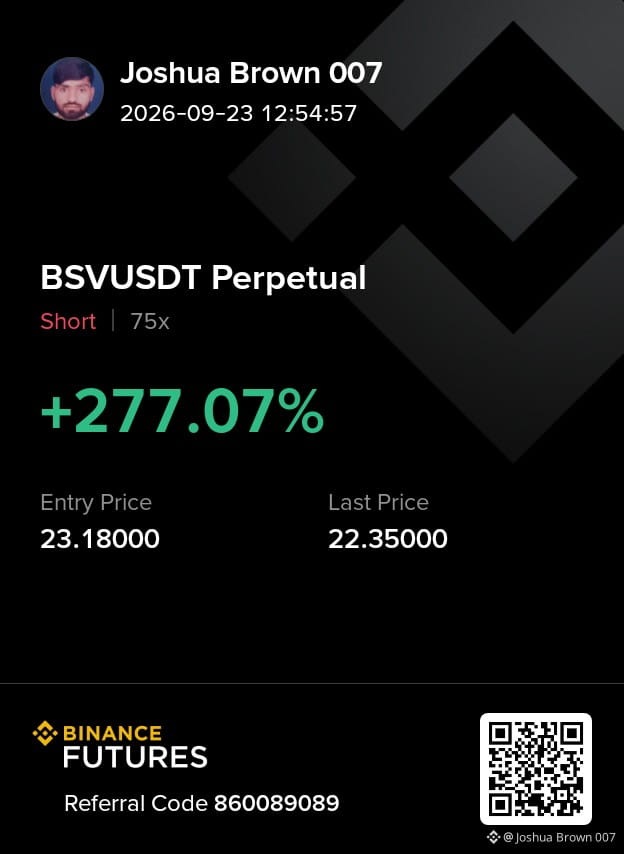
Der Handel muss den Markt + die Leidenschaft berechnen und auf das Ergebnis warten😎
{future}(BSVUSDT)
[https://www.binance.info/en/futures/ref/860089089](https://www.binance.info/en/futures/ref/860089089)
#AIStocksWhatNext
Der Handel muss den Markt + die Leidenschaft berechnen und auf das Ergebnis warten😎
https://www.binance.info/en/futures/ref/860089089
Der Handel muss den Markt + die Leidenschaft berechnen und auf das Ergebnis warten😎
https://www.binance.info/en/futures/ref/860089089
127
Artikel
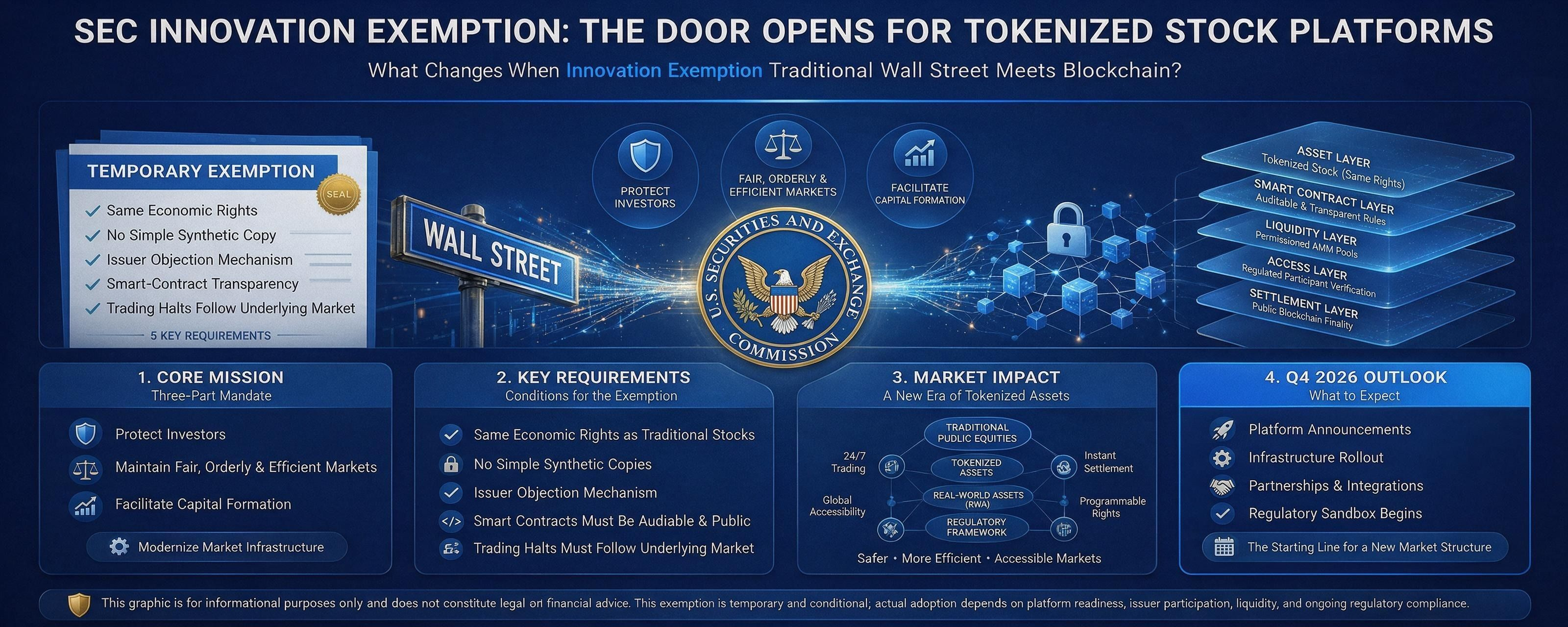
SEC-Innovation-Exemption könnte im 4. Quartal den Weg für Plattformen mit tokenisierten Aktien öffnenEtwas Wichtiges ändert sich zwischen traditionellem Wall Street und Blockchain.
Am 17. September 2026 hat die US-Börsenaufsichtsbehörde (SEC) ihre vorübergehende „Innovation Exemption“ eingeführt und damit einen regulatorischen Weg geschaffen, der es bestimmten Plattformen ermöglicht, tokenisierte US-Aktien über handelsbasierte Börsenplätze auf Blockchain-Basis zu handeln. Die Entwicklung könnte interessierten Plattformen für tokenisierte Aktien erlauben, Pläne bereits ab dem 4. Quartal 2026 anzukündigen.
Bevor man jedoch die Auswirkungen auf Krypto betrachtet, ist es wichtig zu verstehen, was die SEC tatsächlich tut.
SEC-Innovation-Exemption könnte im 4. Quartal den Weg für Plattformen mit tokenisierten Aktien öffnen
Etwas Wichtiges ändert sich zwischen traditionellem Wall Street und Blockchain.
Am 17. September 2026 hat die US-Börsenaufsichtsbehörde (SEC) ihre vorübergehende „Innovation Exemption“ eingeführt und damit einen regulatorischen Weg geschaffen, der es bestimmten Plattformen ermöglicht, tokenisierte US-Aktien über handelsbasierte Börsenplätze auf Blockchain-Basis zu handeln. Die Entwicklung könnte interessierten Plattformen für tokenisierte Aktien erlauben, Pläne bereits ab dem 4. Quartal 2026 anzukündigen.
Bevor man jedoch die Auswirkungen auf Krypto betrachtet, ist es wichtig zu verstehen, was die SEC tatsächlich tut.
Am 17. September 2026 hat die US-Börsenaufsichtsbehörde (SEC) ihre vorübergehende „Innovation Exemption“ eingeführt und damit einen regulatorischen Weg geschaffen, der es bestimmten Plattformen ermöglicht, tokenisierte US-Aktien über handelsbasierte Börsenplätze auf Blockchain-Basis zu handeln. Die Entwicklung könnte interessierten Plattformen für tokenisierte Aktien erlauben, Pläne bereits ab dem 4. Quartal 2026 anzukündigen.
Bevor man jedoch die Auswirkungen auf Krypto betrachtet, ist es wichtig zu verstehen, was die SEC tatsächlich tut.
1
178
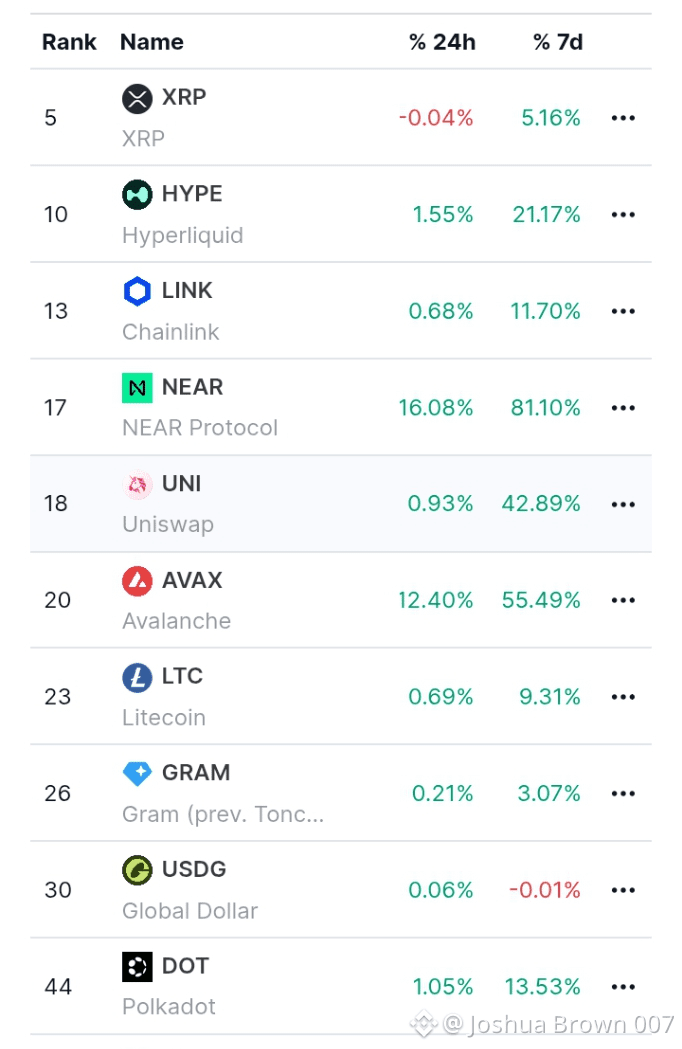
Top 10 Assets nach Volumen Crypto-Markt-Übersicht | 20. September 2026.
Die Rotation wird interessant
Die Daten vom 20. September zeigen starken 7-Tage-Impuls über mehrere große Altcoins hinweg.
🔹 $NEAR: +81,10% in 7D die größte Bewegung in dieser Gruppe
🔹 $AVAX: +55,49%
🔹 $UNI: +42,89%
🔹 $HYPE: +21,17%
🔹 $DOT: +13,53%
🔹 $LINK: +11,70%
🔹 $LTC: +9,31%
🔹 $XRP: +5,16%
Der interessante Teil ist das Volumen.
$XRP handelte $2,69 Mrd., $NEAR $2,05 Mrd., $AVAX $1,48 Mrd. und $HYPE $854 Mio. in 24 Stunden.
Das ist nicht nur eine Preisbewegung – Kapital und Volumen rotieren über verschiedene Sektoren.
Doch nach so starken wöchentlichen Gewinnen kann die Volatilität schnell zunehmen.
Ich beobachte, ob das Volumen die Bewegung weiterhin bestätigt oder nachlässt.
Nicht den Kerzen hinterherjagen. Den Flow beobachten.
Top 10 Assets nach Volumen Crypto-Markt-Übersicht | 20. September 2026.
Die Rotation wird interessant
Die Daten vom 20. September zeigen starken 7-Tage-Impuls über mehrere große Altcoins hinweg.
🔹 $NEAR: +81,10% in 7D die größte Bewegung in dieser Gruppe
🔹 $AVAX: +55,49%
🔹 $UNI: +42,89%
🔹 $HYPE: +21,17%
🔹 $DOT: +13,53%
🔹 $LINK: +11,70%
🔹 $LTC: +9,31%
🔹 $XRP: +5,16%
Der interessante Teil ist das Volumen.
$XRP handelte $2,69 Mrd., $NEAR $2,05 Mrd., $AVAX $1,48 Mrd. und $HYPE $854 Mio. in 24 Stunden.
Das ist nicht nur eine Preisbewegung – Kapital und Volumen rotieren über verschiedene Sektoren.
Doch nach so starken wöchentlichen Gewinnen kann die Volatilität schnell zunehmen.
Ich beobachte, ob das Volumen die Bewegung weiterhin bestätigt oder nachlässt.
Nicht den Kerzen hinterherjagen. Den Flow beobachten.
Die Rotation wird interessant
Die Daten vom 20. September zeigen starken 7-Tage-Impuls über mehrere große Altcoins hinweg.
🔹 $NEAR: +81,10% in 7D die größte Bewegung in dieser Gruppe
🔹 $AVAX: +55,49%
🔹 $UNI: +42,89%
🔹 $HYPE: +21,17%
🔹 $DOT: +13,53%
🔹 $LINK: +11,70%
🔹 $LTC: +9,31%
🔹 $XRP: +5,16%
Der interessante Teil ist das Volumen.
$XRP handelte $2,69 Mrd., $NEAR $2,05 Mrd., $AVAX $1,48 Mrd. und $HYPE $854 Mio. in 24 Stunden.
Das ist nicht nur eine Preisbewegung – Kapital und Volumen rotieren über verschiedene Sektoren.
Doch nach so starken wöchentlichen Gewinnen kann die Volatilität schnell zunehmen.
Ich beobachte, ob das Volumen die Bewegung weiterhin bestätigt oder nachlässt.
Nicht den Kerzen hinterherjagen. Den Flow beobachten.
1
386
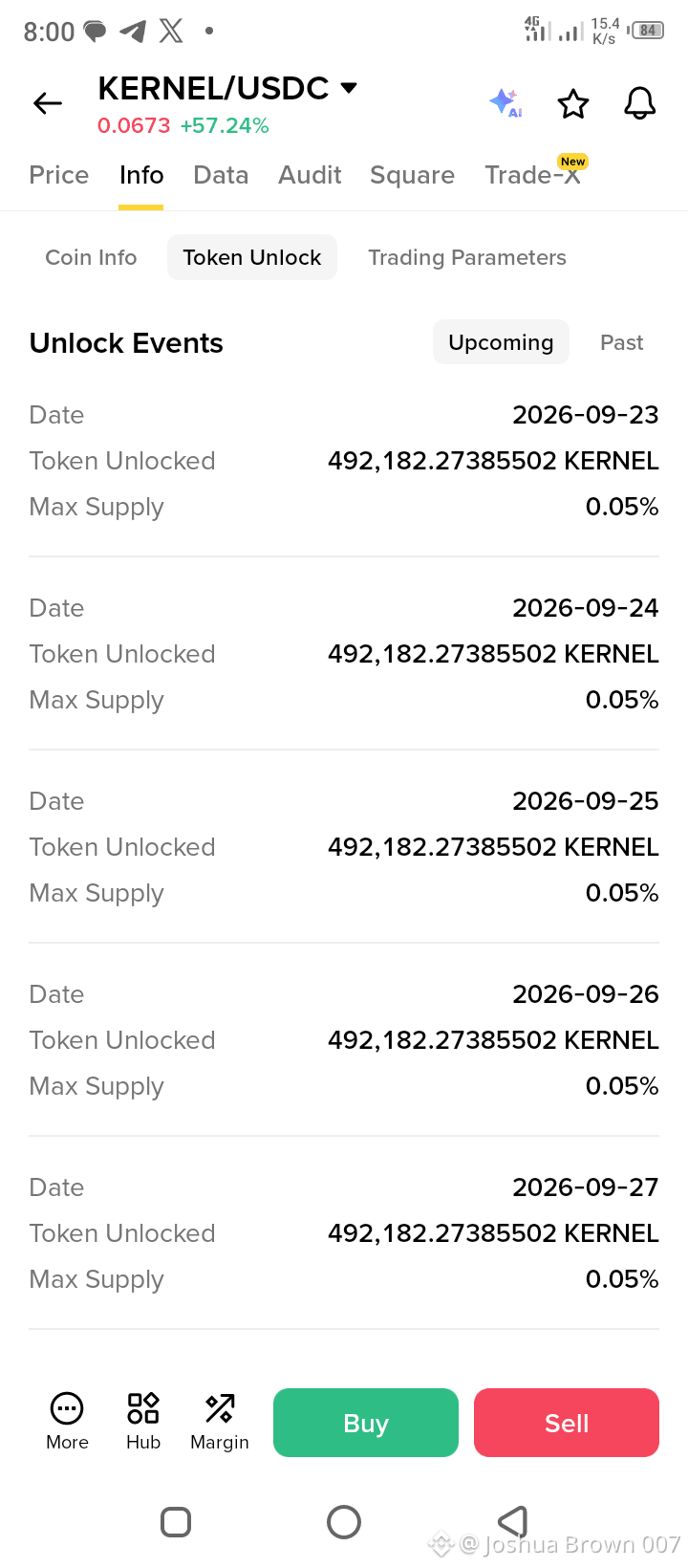
$KERNEL steigt deutlich an, aber morgen beginnt ein Versorgungstest.
KERNEL liegt bei etwa $0.0673, bereits +57% auf dem Bildschirm, den ich sehe.
Aber ab dem 23. Sept. zeigt der Token-Freigabeplan:
492.182 KERNEL jeden Tag = 0,05% des maximalen Angebots
23. Sept. → 24 → 25 → 26 → 27…
Diese gleiche Rate bleibt bestehen, das sind ~1% des maximalen Angebots in den nächsten 20 Tagen.
Bei $0.0673 entspricht jede tägliche Freigabe grob $33K an Token.
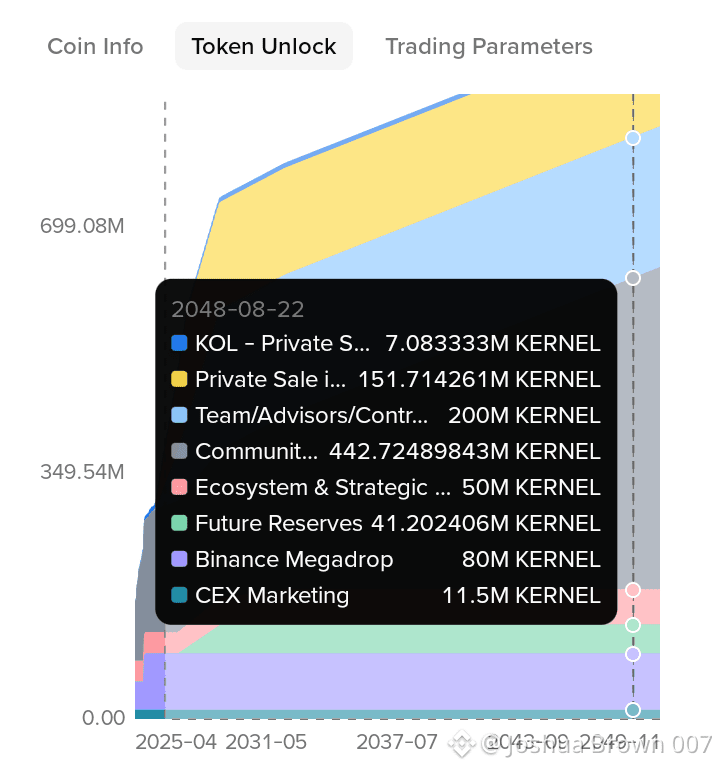
Das klingt klein, aber die im Umlauf befindliche KERNEL-Zirkulation ist nur etwa 28,8% des 1B maximalen Angebots, also erhöht selbst eine relativ kleine tägliche Freigabe das verfügbare Angebot.
Tokenomist +1
Der interessante Teil:
Der Preis pumpt +57%, während jeden Tag neues Angebot hinzukommt.
Das erzeugt zwei Kräfte:
🟢 Starkes Volumen kann die neuen Token absorbieren
🔴 Schwache Nachfrage kann Freigaben in Verkaufsdruck verwandeln
Und KERNEL hat historisch gesehen eine bemerkenswerte Volatilität rund um größere Unlock-Events gezeigt; frühere Freigaben wurden in mehreren Zeiträumen von Rückgängen gefolgt, obwohl das nicht bedeutet, dass sich das gleiche Muster wiederholen muss.
Also beobachte ich morgen:
Preis + Volumen + CEX-Zuflüsse + tägliche Freigaben
Der Pump ist eine Geschichte.
Das Angebot, das in den Markt gelangt, ist die Geschichte, die ich als Nächstes beobachte.
#DAO #ARB🔥🔥🔥 #NEARRisesNearly80%InAWeek
{future}(KERNELUSDT)
{future}(ARBUSDT)
{future}(NEARUSDT)
$KERNEL steigt deutlich an, aber morgen beginnt ein Versorgungstest.
KERNEL liegt bei etwa $0.0673, bereits +57% auf dem Bildschirm, den ich sehe.
Aber ab dem 23. Sept. zeigt der Token-Freigabeplan:
492.182 KERNEL jeden Tag = 0,05% des maximalen Angebots
23. Sept. → 24 → 25 → 26 → 27…
Diese gleiche Rate bleibt bestehen, das sind ~1% des maximalen Angebots in den nächsten 20 Tagen.
Bei $0.0673 entspricht jede tägliche Freigabe grob $33K an Token.
Das klingt klein, aber die im Umlauf befindliche KERNEL-Zirkulation ist nur etwa 28,8% des 1B maximalen Angebots, also erhöht selbst eine relativ kleine tägliche Freigabe das verfügbare Angebot.
Tokenomist +1
Der interessante Teil:
Der Preis pumpt +57%, während jeden Tag neues Angebot hinzukommt.
Das erzeugt zwei Kräfte:
🟢 Starkes Volumen kann die neuen Token absorbieren
🔴 Schwache Nachfrage kann Freigaben in Verkaufsdruck verwandeln
Und KERNEL hat historisch gesehen eine bemerkenswerte Volatilität rund um größere Unlock-Events gezeigt; frühere Freigaben wurden in mehreren Zeiträumen von Rückgängen gefolgt, obwohl das nicht bedeutet, dass sich das gleiche Muster wiederholen muss.
Also beobachte ich morgen:
Preis + Volumen + CEX-Zuflüsse + tägliche Freigaben
Der Pump ist eine Geschichte.
Das Angebot, das in den Markt gelangt, ist die Geschichte, die ich als Nächstes beobachte.
#DAO #ARB🔥🔥🔥 #NEARRisesNearly80%InAWeek
KERNEL liegt bei etwa $0.0673, bereits +57% auf dem Bildschirm, den ich sehe.
Aber ab dem 23. Sept. zeigt der Token-Freigabeplan:
492.182 KERNEL jeden Tag = 0,05% des maximalen Angebots
23. Sept. → 24 → 25 → 26 → 27…
Diese gleiche Rate bleibt bestehen, das sind ~1% des maximalen Angebots in den nächsten 20 Tagen.
Bei $0.0673 entspricht jede tägliche Freigabe grob $33K an Token.
Das klingt klein, aber die im Umlauf befindliche KERNEL-Zirkulation ist nur etwa 28,8% des 1B maximalen Angebots, also erhöht selbst eine relativ kleine tägliche Freigabe das verfügbare Angebot.
Tokenomist +1
Der interessante Teil:
Der Preis pumpt +57%, während jeden Tag neues Angebot hinzukommt.
Das erzeugt zwei Kräfte:
🟢 Starkes Volumen kann die neuen Token absorbieren
🔴 Schwache Nachfrage kann Freigaben in Verkaufsdruck verwandeln
Und KERNEL hat historisch gesehen eine bemerkenswerte Volatilität rund um größere Unlock-Events gezeigt; frühere Freigaben wurden in mehreren Zeiträumen von Rückgängen gefolgt, obwohl das nicht bedeutet, dass sich das gleiche Muster wiederholen muss.
Also beobachte ich morgen:
Preis + Volumen + CEX-Zuflüsse + tägliche Freigaben
Der Pump ist eine Geschichte.
Das Angebot, das in den Markt gelangt, ist die Geschichte, die ich als Nächstes beobachte.
#DAO #ARB🔥🔥🔥 #NEARRisesNearly80%InAWeek
1
1
450
#Binance
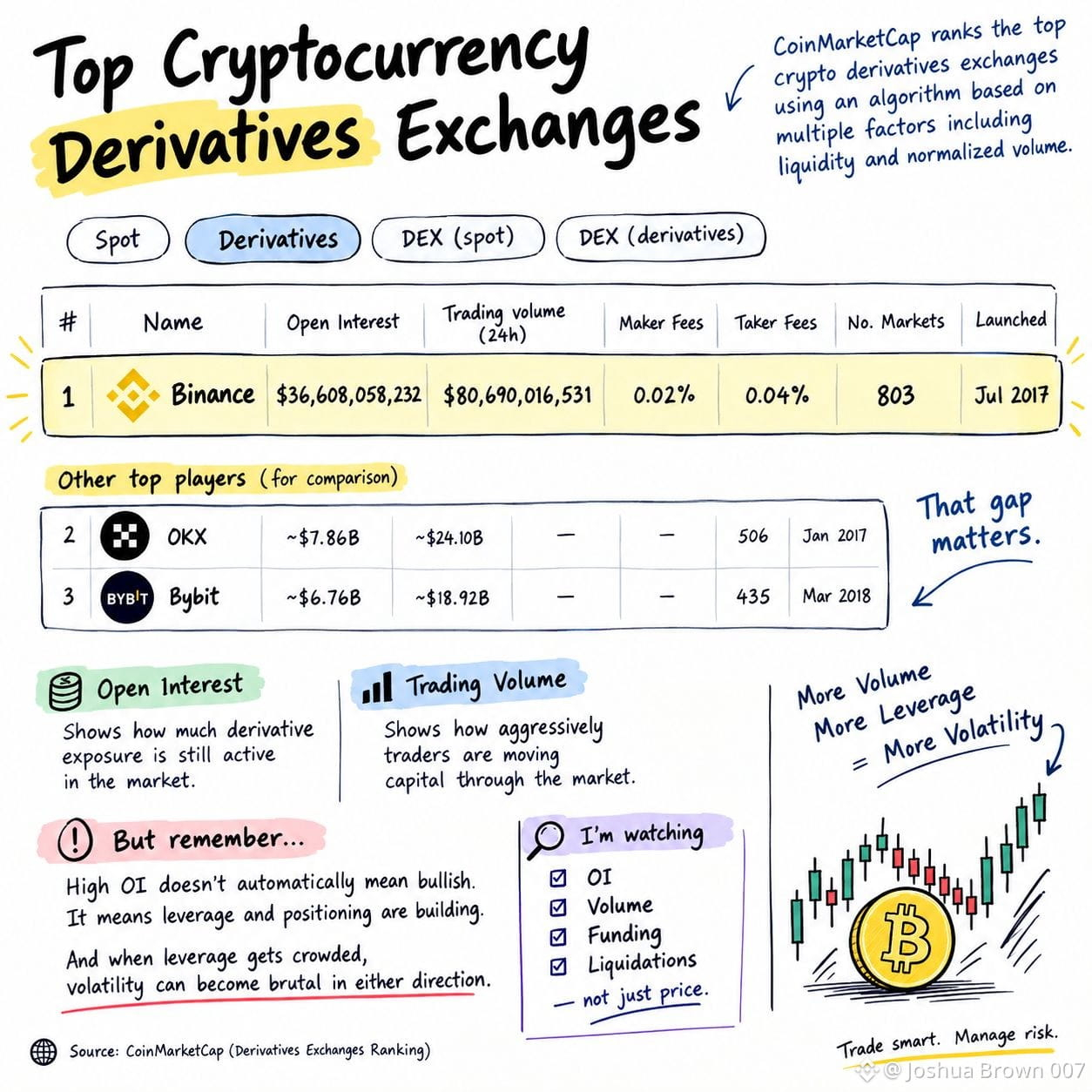
Ich habe die neuesten Derivate-Daten von CoinMarketCap geprüft und eine Zahl sticht sofort heraus:
Das Ökosystem-Exchange von $BNB, Binance, dominiert weiterhin die Derivate.
Binance • $35,09 Mrd. Open Interest • $51,10 Mrd. 24H-Derivate-Volumen • 803 Märkte • 0,02% Maker-Gebühr • 0,04% Taker-Gebühr
Zum Vergleich: OKX hat etwa ~$7,86 Mrd. OI und Bybit ~$6,76 Mrd.
Diese Lücke ist entscheidend.
Open Interest zeigt, wie viel Derivate-Exposure noch aktiv ist, während das Volumen zeigt, wie aggressiv Trader Kapital durch den Markt bewegen.
Aber denk daran: Ein hohes OI bedeutet nicht automatisch bullish.
Es heißt, dass sich Leverage und Positionierung aufbauen.
Und wenn sich der Leverage-Bereich überfüllt, kann Volatilität in beide Richtungen brutal werden.
Ich beobachte OI + Volumen + Funding + Liquidationen zusammen – nicht nur den Preis.
{spot}(BNBUSDT)
$PHA
{future}(PHAUSDT)
$SUI
{future}(SUIUSDT)
#Binance
Ich habe die neuesten Derivate-Daten von CoinMarketCap geprüft und eine Zahl sticht sofort heraus:
Das Ökosystem-Exchange von $BNB, Binance, dominiert weiterhin die Derivate.
Binance • $35,09 Mrd. Open Interest • $51,10 Mrd. 24H-Derivate-Volumen • 803 Märkte • 0,02% Maker-Gebühr • 0,04% Taker-Gebühr
Zum Vergleich: OKX hat etwa ~$7,86 Mrd. OI und Bybit ~$6,76 Mrd.
Diese Lücke ist entscheidend.
Open Interest zeigt, wie viel Derivate-Exposure noch aktiv ist, während das Volumen zeigt, wie aggressiv Trader Kapital durch den Markt bewegen.
Aber denk daran: Ein hohes OI bedeutet nicht automatisch bullish.
Es heißt, dass sich Leverage und Positionierung aufbauen.
Und wenn sich der Leverage-Bereich überfüllt, kann Volatilität in beide Richtungen brutal werden.
Ich beobachte OI + Volumen + Funding + Liquidationen zusammen – nicht nur den Preis.
$PHA
$SUI
Ich habe die neuesten Derivate-Daten von CoinMarketCap geprüft und eine Zahl sticht sofort heraus:
Das Ökosystem-Exchange von $BNB, Binance, dominiert weiterhin die Derivate.
Binance • $35,09 Mrd. Open Interest • $51,10 Mrd. 24H-Derivate-Volumen • 803 Märkte • 0,02% Maker-Gebühr • 0,04% Taker-Gebühr
Zum Vergleich: OKX hat etwa ~$7,86 Mrd. OI und Bybit ~$6,76 Mrd.
Diese Lücke ist entscheidend.
Open Interest zeigt, wie viel Derivate-Exposure noch aktiv ist, während das Volumen zeigt, wie aggressiv Trader Kapital durch den Markt bewegen.
Aber denk daran: Ein hohes OI bedeutet nicht automatisch bullish.
Es heißt, dass sich Leverage und Positionierung aufbauen.
Und wenn sich der Leverage-Bereich überfüllt, kann Volatilität in beide Richtungen brutal werden.
Ich beobachte OI + Volumen + Funding + Liquidationen zusammen – nicht nur den Preis.
$PHA
$SUI
1
206
#BTC☀
Warten Sie auf einen Rücksetzer auf 64.000 US-Dollar für Bitcoin? Sehen wir uns einen Blick auf den institutionellen Kauf und die Nachfrage an.
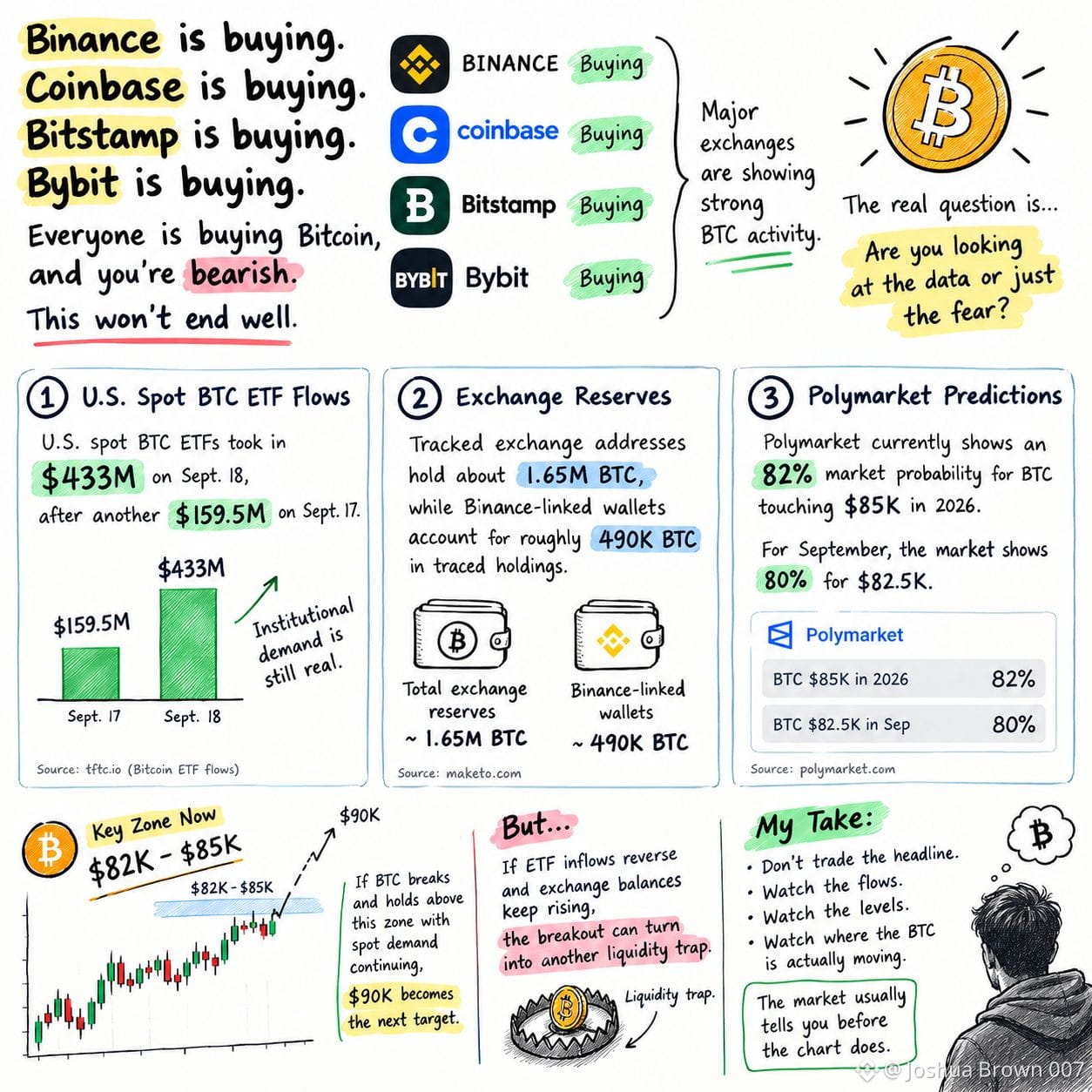
Das Interessante ist nicht nur die Erzählung – die Daten zeigen inzwischen eine Spaltung zwischen der Börsenliquidität und der institutionellen Nachfrage.
Aktuelle Daten zeigen, dass US-amerikanische Spot-BTC-ETFs am 18. September 433 Mio. US-Dollar aufgenommen haben, nach weiteren 159,5 Mio. US-Dollar am 17. September.
TFTC +1
Gleichzeitig halten überwachte Börsenadressen etwa 1,65 Mio. BTC, während bei Binance verknüpfte Wallets in nachverfolgten Beständen rund 490K BTC ausmachen.
Und Polymarket zeigt derzeit eine Markt-Wahrscheinlichkeit von 82 %, dass BTC im Jahr 2026 die 85.000 US-Dollar erreicht, während der Markt im September eine Wahrscheinlichkeit von 80 % für 82,5K zeigt.
Mein Fazit:
82K–85K ist die entscheidende Zone im Moment.
Wenn BTC darüberausbricht und dort hält, während die Spot-Nachfrage weiterläuft, wird 90K zum nächsten psychologischen Kursziel.
Wenn sich die ETF-Zuflüsse jedoch umkehren und die Börsenbestände weiter steigen, kann der Ausbruch zu einer weiteren Liquiditätsfalle werden.
Handeln Sie nicht die Schlagzeile.
Beobachten Sie die Ströme. Beobachten Sie die Kursniveaus. Beobachten Sie, wo sich der BTC tatsächlich bewegt.
Der Markt sagt es Ihnen normalerweise, bevor es der Chart tut.$BTC
{spot}(BTCUSDT)
#BTC☀
Warten Sie auf einen Rücksetzer auf 64.000 US-Dollar für Bitcoin? Sehen wir uns einen Blick auf den institutionellen Kauf und die Nachfrage an.
Das Interessante ist nicht nur die Erzählung – die Daten zeigen inzwischen eine Spaltung zwischen der Börsenliquidität und der institutionellen Nachfrage.
Aktuelle Daten zeigen, dass US-amerikanische Spot-BTC-ETFs am 18. September 433 Mio. US-Dollar aufgenommen haben, nach weiteren 159,5 Mio. US-Dollar am 17. September.
TFTC +1
Gleichzeitig halten überwachte Börsenadressen etwa 1,65 Mio. BTC, während bei Binance verknüpfte Wallets in nachverfolgten Beständen rund 490K BTC ausmachen.
Und Polymarket zeigt derzeit eine Markt-Wahrscheinlichkeit von 82 %, dass BTC im Jahr 2026 die 85.000 US-Dollar erreicht, während der Markt im September eine Wahrscheinlichkeit von 80 % für 82,5K zeigt.
Mein Fazit:
82K–85K ist die entscheidende Zone im Moment.
Wenn BTC darüberausbricht und dort hält, während die Spot-Nachfrage weiterläuft, wird 90K zum nächsten psychologischen Kursziel.
Wenn sich die ETF-Zuflüsse jedoch umkehren und die Börsenbestände weiter steigen, kann der Ausbruch zu einer weiteren Liquiditätsfalle werden.
Handeln Sie nicht die Schlagzeile.
Beobachten Sie die Ströme. Beobachten Sie die Kursniveaus. Beobachten Sie, wo sich der BTC tatsächlich bewegt.
Der Markt sagt es Ihnen normalerweise, bevor es der Chart tut.$BTC
Warten Sie auf einen Rücksetzer auf 64.000 US-Dollar für Bitcoin? Sehen wir uns einen Blick auf den institutionellen Kauf und die Nachfrage an.
Das Interessante ist nicht nur die Erzählung – die Daten zeigen inzwischen eine Spaltung zwischen der Börsenliquidität und der institutionellen Nachfrage.
Aktuelle Daten zeigen, dass US-amerikanische Spot-BTC-ETFs am 18. September 433 Mio. US-Dollar aufgenommen haben, nach weiteren 159,5 Mio. US-Dollar am 17. September.
TFTC +1
Gleichzeitig halten überwachte Börsenadressen etwa 1,65 Mio. BTC, während bei Binance verknüpfte Wallets in nachverfolgten Beständen rund 490K BTC ausmachen.
Und Polymarket zeigt derzeit eine Markt-Wahrscheinlichkeit von 82 %, dass BTC im Jahr 2026 die 85.000 US-Dollar erreicht, während der Markt im September eine Wahrscheinlichkeit von 80 % für 82,5K zeigt.
Mein Fazit:
82K–85K ist die entscheidende Zone im Moment.
Wenn BTC darüberausbricht und dort hält, während die Spot-Nachfrage weiterläuft, wird 90K zum nächsten psychologischen Kursziel.
Wenn sich die ETF-Zuflüsse jedoch umkehren und die Börsenbestände weiter steigen, kann der Ausbruch zu einer weiteren Liquiditätsfalle werden.
Handeln Sie nicht die Schlagzeile.
Beobachten Sie die Ströme. Beobachten Sie die Kursniveaus. Beobachten Sie, wo sich der BTC tatsächlich bewegt.
Der Markt sagt es Ihnen normalerweise, bevor es der Chart tut.$BTC
1
67
$TRUMP ON CHAIN-ALERT
Das Trump Meme-Team hat gerade weitere 8,73 Mio. $TRUMP (~17,99 Mio. $) in die Verwahrung von BitGo verschoben.
Damit liegt das 2-Wochen-Gesamtvolumen bei ~31 Mio. TRUMP, im Wert von ~70,64 Mio. $.
Aber hier ist der wichtige Teil:
⚠️ BitGo-Verwahrung ≠ bestätigtes Verkaufen.
Daher beobachte ich die nächste Wallet-Bewegung und nehme nicht einfach einen Dump an.
📉 Preis-Auswirkungen bei anschließendem Verkauf:
Eine große, team-zugeordnete Menge, die in die Marktliquidität gelangt, könnte den Verkaufsdruck erhöhen und die Unterstützung schwächen. Wenn danach Einlagen an der Börse auftauchen, steigt das Risiko für einen stärkeren Move.
📊 Technische Bereiche, die es zu beobachten gilt:
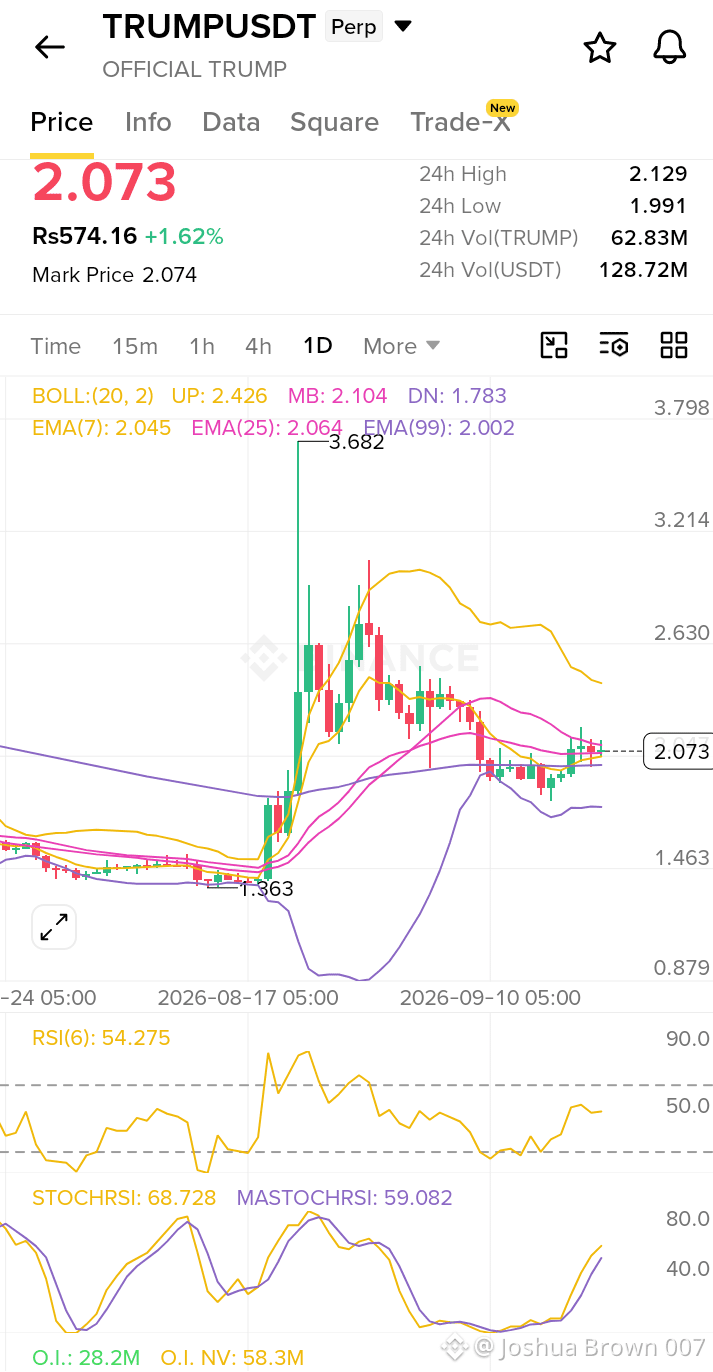
Aktuelle Meldungen platzieren $TRUMP bei etwa 2,05 $, mit einem Widerstand nahe 2,14 $ und einer Unterstützung bei rund 1,96 $. Der Kurs befindet sich zudem nahe der Zone der 50-/200-EMA, was das zu einem wichtigen Bereich für die Bestätigung macht.
Mein Vorgehen: Nicht in Panik verkaufen. Nicht blind den Dip kaufen.
Beobachten: → BitGo → Exchange-Überweisungen
→ Spot-Volumen
→ Unterstützung bei 1,96 $
→ Ausbruch über 2,14 $
→ Wallet-Abflüsse/-Zuflüsse
Wenn 1,96 $ mit starkem Volumen bricht, kann der Abwärtsdruck sich beschleunigen.
Wenn 2,14 $ mit starkem Spot-Volumen zurückerobert wird, könnte der Markt die Angebotsmenge aufnehmen.
Zuerst On-Chain-Flow. Zweitens Preisbestätigung.
{future}(TRUMPUSDT)
{future}(MELANIAUSDT)
{future}(WLFIUSDT)
#TrumpCrypto #XRPExchangeReservesHitSevenYearLow #trumpcoin
$TRUMP ON CHAIN-ALERT
Das Trump Meme-Team hat gerade weitere 8,73 Mio. $TRUMP (~17,99 Mio. $) in die Verwahrung von BitGo verschoben.
Damit liegt das 2-Wochen-Gesamtvolumen bei ~31 Mio. TRUMP, im Wert von ~70,64 Mio. $.
Aber hier ist der wichtige Teil:
⚠️ BitGo-Verwahrung ≠ bestätigtes Verkaufen.
Daher beobachte ich die nächste Wallet-Bewegung und nehme nicht einfach einen Dump an.
📉 Preis-Auswirkungen bei anschließendem Verkauf:
Eine große, team-zugeordnete Menge, die in die Marktliquidität gelangt, könnte den Verkaufsdruck erhöhen und die Unterstützung schwächen. Wenn danach Einlagen an der Börse auftauchen, steigt das Risiko für einen stärkeren Move.
📊 Technische Bereiche, die es zu beobachten gilt:
Aktuelle Meldungen platzieren $TRUMP bei etwa 2,05 $, mit einem Widerstand nahe 2,14 $ und einer Unterstützung bei rund 1,96 $. Der Kurs befindet sich zudem nahe der Zone der 50-/200-EMA, was das zu einem wichtigen Bereich für die Bestätigung macht.
Mein Vorgehen: Nicht in Panik verkaufen. Nicht blind den Dip kaufen.
Beobachten: → BitGo → Exchange-Überweisungen
→ Spot-Volumen
→ Unterstützung bei 1,96 $
→ Ausbruch über 2,14 $
→ Wallet-Abflüsse/-Zuflüsse
Wenn 1,96 $ mit starkem Volumen bricht, kann der Abwärtsdruck sich beschleunigen.
Wenn 2,14 $ mit starkem Spot-Volumen zurückerobert wird, könnte der Markt die Angebotsmenge aufnehmen.
Zuerst On-Chain-Flow. Zweitens Preisbestätigung.
#TrumpCrypto #XRPExchangeReservesHitSevenYearLow #trumpcoin
Das Trump Meme-Team hat gerade weitere 8,73 Mio. $TRUMP (~17,99 Mio. $) in die Verwahrung von BitGo verschoben.
Damit liegt das 2-Wochen-Gesamtvolumen bei ~31 Mio. TRUMP, im Wert von ~70,64 Mio. $.
Aber hier ist der wichtige Teil:
⚠️ BitGo-Verwahrung ≠ bestätigtes Verkaufen.
Daher beobachte ich die nächste Wallet-Bewegung und nehme nicht einfach einen Dump an.
📉 Preis-Auswirkungen bei anschließendem Verkauf:
Eine große, team-zugeordnete Menge, die in die Marktliquidität gelangt, könnte den Verkaufsdruck erhöhen und die Unterstützung schwächen. Wenn danach Einlagen an der Börse auftauchen, steigt das Risiko für einen stärkeren Move.
📊 Technische Bereiche, die es zu beobachten gilt:
Aktuelle Meldungen platzieren $TRUMP bei etwa 2,05 $, mit einem Widerstand nahe 2,14 $ und einer Unterstützung bei rund 1,96 $. Der Kurs befindet sich zudem nahe der Zone der 50-/200-EMA, was das zu einem wichtigen Bereich für die Bestätigung macht.
Mein Vorgehen: Nicht in Panik verkaufen. Nicht blind den Dip kaufen.
Beobachten: → BitGo → Exchange-Überweisungen
→ Spot-Volumen
→ Unterstützung bei 1,96 $
→ Ausbruch über 2,14 $
→ Wallet-Abflüsse/-Zuflüsse
Wenn 1,96 $ mit starkem Volumen bricht, kann der Abwärtsdruck sich beschleunigen.
Wenn 2,14 $ mit starkem Spot-Volumen zurückerobert wird, könnte der Markt die Angebotsmenge aufnehmen.
Zuerst On-Chain-Flow. Zweitens Preisbestätigung.
#TrumpCrypto #XRPExchangeReservesHitSevenYearLow #trumpcoin

1
698
Anmelden und weiter Inhalte entdecken
Krypto-Nutzer weltweit auf Binance Square kennenlernen
⚡️ Bleib in Sachen Krypto stets am Puls.
💬 Die weltgrößte Kryptobörse vertraut darauf.
👍 Erhalte verlässliche Einblicke von verifizierten Creators.
E-Mail-Adresse/Telefonnummer
Trendthemen
GoldFallsTo$4144
526 Aufrufe
20 Kommentare
🔎Etwas am Gold-Verkaufslfall ergibt keinen Sinn...
#GoldFallsTo$4144
Öl ist wieder über 100 US-Dollar. Das Risiko im Nahen Osten bleibt weiterhin hoch. Und trotzdem wird Gold Richtung 4.144 US-Dollar regelrecht niedergemacht.
Sollten diese Dinge Investoren nicht eigentlich eher in Richtung Gold treiben?
So wird es interessant.
Der Markt behandelt das inzwischen nicht mehr primär als eine „Krieg = sicherer Hafen“-Geschichte.
Er behandelt es als eine Inflation → Zinsraten“-Story.
Reuters berichtet, dass der Sprung bei den Ölpreisen die Erwartungen stärkt, dass die Fed die Geldpolitik länger restriktiver halten könnte – was Gold unter Druck setzt.
Die Kette sieht so aus:
Hormus-Risiko → Öl ↑ → Inflationsrisiko ↑ → Zins-Erwartungen ↑ → Renditen ↑ → Gold ↓
Das ist das Paradoxon.
Der geopolitische Schock erzeugt genau den inflationären Druck, der das Halten eines Null-Rendite-Assets weniger attraktiv macht.
Und deshalb beobachte ich Öl und die Renditen von Treasuries – nicht nur die Schlagzeilen, die aus dem Nahen Osten kommen.
Wenn Öl hoch bleibt, könnte die nächste Gold-Bewegung weniger mit „Safe-Haven-Nachfrage“ zu tun haben und viel mehr damit, wie lange die Fed realistisch gesehen restriktiv bleiben kann.
$XAU $XAUT $BZ
#GOLD #Macro #CryptoMarket #PAXG
Stink meaner
·0 Likes
·123 Aufrufe
QNTFallsOver40%FromMorningHigh
2,397 Aufrufe
147 Kommentare
BitgetCEOConfirms$388MStolenInHack
136 Aufrufe
12 Kommentare