

FAISAL_804
17.2k Beiträge

FAISAL_804
 Square Verified+
Melden
Nutzer blockieren
Crypto enthusiast 📊 | Sharing trading insights & Web3 trends 🚀
Trade eröffnen
Regelmäßiger Trader
11.7 Monate
152 Following
34.3K+ Follower
18.7K+ Like gegeben
Beiträge
Portfolio
Alle
Zitierungen
Live
·
--
Übersetzung ansehen
$GPROB is currently displayed at approximately 1.28, with a -1.54% move. The shown PKR value is around Rs354.71. Unlike several coins in this snapshot, $GPROB is showing negative short-term movement. Traders may watch whether selling pressure continues or whether buyers step in around current levels. The displayed figures are a snapshot and should not be treated as a prediction of future price action. 📉
{spot}(GPROBUSDT)
$GPROB is currently displayed at approximately 1.28, with a -1.54% move. The shown PKR value is around Rs354.71. Unlike several coins in this snapshot, $GPROB is showing negative short-term movement. Traders may watch whether selling pressure continues or whether buyers step in around current levels. The displayed figures are a snapshot and should not be treated as a prediction of future price action. 📉
137
·
--
Übersetzung ansehen
$CYPHB is trading around 4.13, showing a strong +5.09% move in the displayed snapshot. Its approximate PKR value is Rs1,144.51. The positive price action puts attention on this coin as traders monitor whether momentum continues or begins to cool. Short-term moves can change quickly, so checking live price, liquidity and volume is important before taking any position. 🔥
{spot}(CYPHBUSDT)
$CYPHB is trading around 4.13, showing a strong +5.09% move in the displayed snapshot. Its approximate PKR value is Rs1,144.51. The positive price action puts attention on this coin as traders monitor whether momentum continues or begins to cool. Short-term moves can change quickly, so checking live price, liquidity and volume is important before taking any position. 🔥
82
·
--
Übersetzung ansehen
$AMCB is currently shown at around 2.92, recording a +1.39% move. The displayed PKR value is approximately Rs809.19. The coin is showing moderate positive momentum in this snapshot, although the percentage move alone does not indicate where price goes next. Traders can monitor volume, market sentiment and follow-through while keeping position size and risk management in mind. 📈
{spot}(AMCBUSDT)
$AMCB is currently shown at around 2.92, recording a +1.39% move. The displayed PKR value is approximately Rs809.19. The coin is showing moderate positive momentum in this snapshot, although the percentage move alone does not indicate where price goes next. Traders can monitor volume, market sentiment and follow-through while keeping position size and risk management in mind. 📈
152
·
--
Übersetzung ansehen
$AGPUB is trading around 12.43, with a notable +7.25% move in the displayed data. Its shown value is approximately Rs3,444.60. The positive percentage makes this one of the stronger gainers in the snapshot. Momentum traders may watch volume and whether the move can sustain, while others may wait for confirmation. This is market information, not a guarantee of future performance. 🚀
{spot}(AGPUBUSDT)
$AGPUB is trading around 12.43, with a notable +7.25% move in the displayed data. Its shown value is approximately Rs3,444.60. The positive percentage makes this one of the stronger gainers in the snapshot. Momentum traders may watch volume and whether the move can sustain, while others may wait for confirmation. This is market information, not a guarantee of future performance. 🚀
130
·
--
Übersetzung ansehen
$HYPE is currently trading around 92.13, showing a +0.08% move. The displayed PKR value is approximately Rs25,531.07. Price action is relatively stable in this snapshot, with only a small positive change. Traders can watch whether this stability develops into stronger momentum or another consolidation phase. Always manage risk and verify live market data before making any trading decision. 📊
{spot}(HYPEUSDT)
$HYPE is currently trading around 92.13, showing a +0.08% move. The displayed PKR value is approximately Rs25,531.07. Price action is relatively stable in this snapshot, with only a small positive change. Traders can watch whether this stability develops into stronger momentum or another consolidation phase. Always manage risk and verify live market data before making any trading decision. 📊
150
·
--
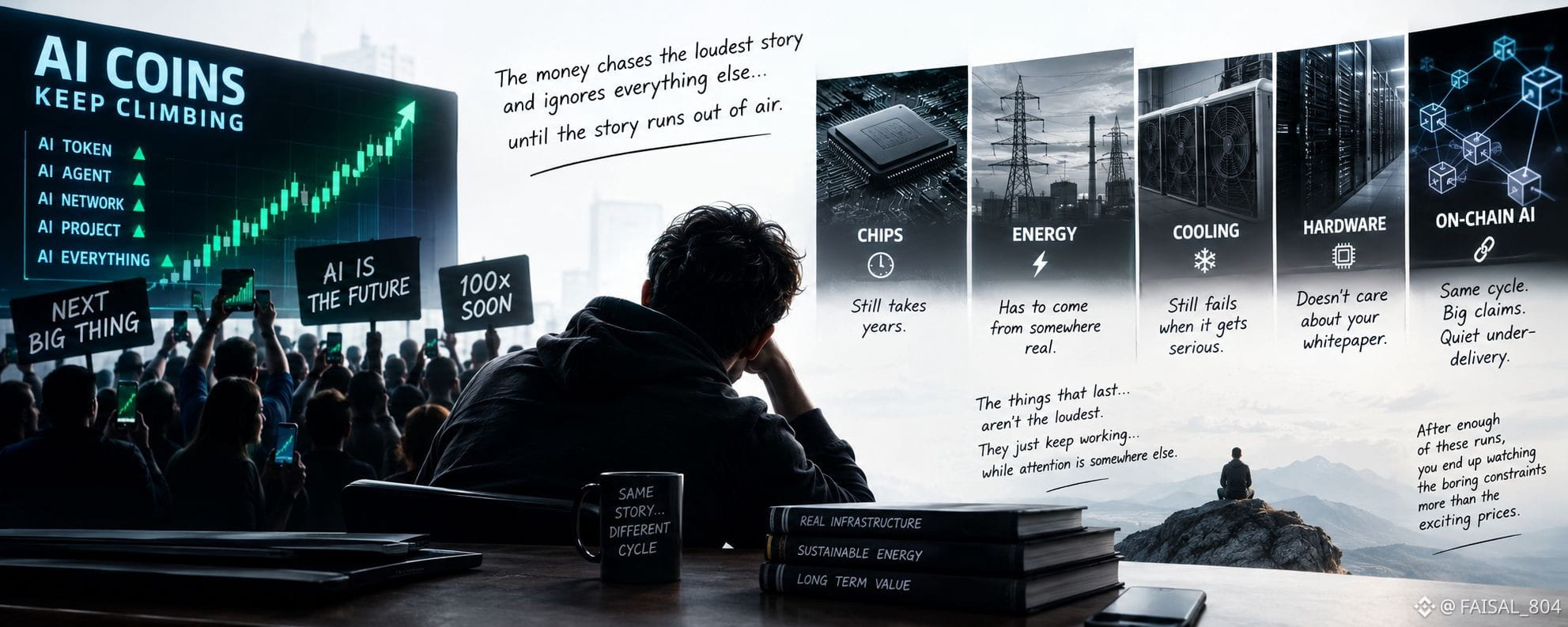
Es ist spät, und ich sitze hier und sehe zu, wie die gleichen KI-Namen weiter nach oben klettern, während der Rest des Markts einfach ignoriert wird. Ich bin im Kryptobereich lange genug dabei, dass sich dieses ganze Muster inzwischen müde anfühlt. Geld heftet sich an die lauteste Story und tut so, als gäbe es nichts anderes, bis der Story irgendwann die Luft ausgeht.
Beim letzten Mal war es genauso. Plötzlich hatte jedes Projekt einen KI-Bezug. Die meisten von ihnen kamen nie wirklich an die echten Probleme heran. Power hatte immer noch Grenzen. Kühlung schlug immer noch fehl, sobald es ernst wurde. Die Hardware hat nicht gekümmert, was in den Whitepapers stand. Ich merke immer wieder, wie schnell Leute diese Punkte vergessen, sobald die Charts anfangen gut auszusehen.
Ich bin mir nicht sicher, ob diese Phase anders ist. Die großen Aktien können noch eine Weile weiter steigen – normalerweise tun sie das auch. Aber die harten Teile verschwinden nicht einfach, nur weil die Erzählung stark ist. Chips brauchen immer noch Jahre. Energie muss immer noch aus einer echten Quelle kommen. Die meisten On-Chain-Varianten, die ich beobachtet habe, haben nur denselben Zyklus wiederholt: große Versprechen, und dann leise untererfüllte Lieferungen, sobald die Anreize ausgetrocknet waren.
Irgendetwas daran, wie still es um alles andere geworden ist, fühlt sich immer noch vertraut an. Dinge, die diese Phasen überdauern, sind meistens die, die keine frische Story alle paar Wochen brauchen. Die, die einfach weiter funktionieren, während die Aufmerksamkeit woanders ist. Dem traue ich auch nicht ganz. Nach genug solcher Läufe endet man schließlich damit, mehr die langweiligen Einschränkungen zu beobachten als die aufregenden Kurse.
#AIStocksWhatNext
$LAB
{future}(LABUSDT)
$AEON
{alpha}(560x277add739c6e0477616948357af9e79fe1ec9b80)
$人生K线
{alpha}(560x1a1e69f1e6182e2f8b9e8987e83c016ac9444444)
Es ist spät, und ich sitze hier und sehe zu, wie die gleichen KI-Namen weiter nach oben klettern, während der Rest des Markts einfach ignoriert wird. Ich bin im Kryptobereich lange genug dabei, dass sich dieses ganze Muster inzwischen müde anfühlt. Geld heftet sich an die lauteste Story und tut so, als gäbe es nichts anderes, bis der Story irgendwann die Luft ausgeht.
Beim letzten Mal war es genauso. Plötzlich hatte jedes Projekt einen KI-Bezug. Die meisten von ihnen kamen nie wirklich an die echten Probleme heran. Power hatte immer noch Grenzen. Kühlung schlug immer noch fehl, sobald es ernst wurde. Die Hardware hat nicht gekümmert, was in den Whitepapers stand. Ich merke immer wieder, wie schnell Leute diese Punkte vergessen, sobald die Charts anfangen gut auszusehen.
Ich bin mir nicht sicher, ob diese Phase anders ist. Die großen Aktien können noch eine Weile weiter steigen – normalerweise tun sie das auch. Aber die harten Teile verschwinden nicht einfach, nur weil die Erzählung stark ist. Chips brauchen immer noch Jahre. Energie muss immer noch aus einer echten Quelle kommen. Die meisten On-Chain-Varianten, die ich beobachtet habe, haben nur denselben Zyklus wiederholt: große Versprechen, und dann leise untererfüllte Lieferungen, sobald die Anreize ausgetrocknet waren.
Irgendetwas daran, wie still es um alles andere geworden ist, fühlt sich immer noch vertraut an. Dinge, die diese Phasen überdauern, sind meistens die, die keine frische Story alle paar Wochen brauchen. Die, die einfach weiter funktionieren, während die Aufmerksamkeit woanders ist. Dem traue ich auch nicht ganz. Nach genug solcher Läufe endet man schließlich damit, mehr die langweiligen Einschränkungen zu beobachten als die aufregenden Kurse.
#AIStocksWhatNext
$LAB
$AEON
$人生K线
Beim letzten Mal war es genauso. Plötzlich hatte jedes Projekt einen KI-Bezug. Die meisten von ihnen kamen nie wirklich an die echten Probleme heran. Power hatte immer noch Grenzen. Kühlung schlug immer noch fehl, sobald es ernst wurde. Die Hardware hat nicht gekümmert, was in den Whitepapers stand. Ich merke immer wieder, wie schnell Leute diese Punkte vergessen, sobald die Charts anfangen gut auszusehen.
Ich bin mir nicht sicher, ob diese Phase anders ist. Die großen Aktien können noch eine Weile weiter steigen – normalerweise tun sie das auch. Aber die harten Teile verschwinden nicht einfach, nur weil die Erzählung stark ist. Chips brauchen immer noch Jahre. Energie muss immer noch aus einer echten Quelle kommen. Die meisten On-Chain-Varianten, die ich beobachtet habe, haben nur denselben Zyklus wiederholt: große Versprechen, und dann leise untererfüllte Lieferungen, sobald die Anreize ausgetrocknet waren.
Irgendetwas daran, wie still es um alles andere geworden ist, fühlt sich immer noch vertraut an. Dinge, die diese Phasen überdauern, sind meistens die, die keine frische Story alle paar Wochen brauchen. Die, die einfach weiter funktionieren, während die Aufmerksamkeit woanders ist. Dem traue ich auch nicht ganz. Nach genug solcher Läufe endet man schließlich damit, mehr die langweiligen Einschränkungen zu beobachten als die aufregenden Kurse.
#AIStocksWhatNext
$LAB
$AEON
$人生K线
1
1.6k
·
--
$INTW kommt zur starken Marktbewegung hinzu! 📈🔥
INTWUSDT zeigt ungefähr +11,22%, wobei der angezeigte Preis bei etwa 32,03 $ liegt. Der zweistellige Kursanstieg macht INTW zu einem der stärkeren Bewegungen, die im Screenshot zu sehen sind. Die Aufmerksamkeit richtet sich nun auf die Fortsetzung des Impulses, die Handelsaktivität und ob die Käufer nach diesem starken Anstieg die Kontrolle behalten können. 🚀⚡
{future}(INTWUSDT)
$INTW kommt zur starken Marktbewegung hinzu! 📈🔥
INTWUSDT zeigt ungefähr +11,22%, wobei der angezeigte Preis bei etwa 32,03 $ liegt. Der zweistellige Kursanstieg macht INTW zu einem der stärkeren Bewegungen, die im Screenshot zu sehen sind. Die Aufmerksamkeit richtet sich nun auf die Fortsetzung des Impulses, die Handelsaktivität und ob die Käufer nach diesem starken Anstieg die Kontrolle behalten können. 🚀⚡
INTWUSDT zeigt ungefähr +11,22%, wobei der angezeigte Preis bei etwa 32,03 $ liegt. Der zweistellige Kursanstieg macht INTW zu einem der stärkeren Bewegungen, die im Screenshot zu sehen sind. Die Aufmerksamkeit richtet sich nun auf die Fortsetzung des Impulses, die Handelsaktivität und ob die Käufer nach diesem starken Anstieg die Kontrolle behalten können. 🚀⚡
315
·
--
$BSV zeigt eine starke Aufwärtsdynamik! 🚀🔥
BSVUSDT ist derzeit um etwa +11,54% im Plus und handelt nahe $19,33 im Screenshot. Die starke Tagesbewegung platziert BSV unter den bemerkenswerten Gewinnern in dieser Liste. Trader werden die Reaktion rund um die aktuellen Kursniveaus beobachten und nach Anzeichen für weiterhin vorhandenes Kaufinteresse Ausschau halten, während der Markt entscheidet, ob diese Dynamik noch mehr Potenzial hat, sich weiterzuentwickeln. 📈👀
{future}(BSVUSDT)
$BSV zeigt eine starke Aufwärtsdynamik! 🚀🔥
BSVUSDT ist derzeit um etwa +11,54% im Plus und handelt nahe $19,33 im Screenshot. Die starke Tagesbewegung platziert BSV unter den bemerkenswerten Gewinnern in dieser Liste. Trader werden die Reaktion rund um die aktuellen Kursniveaus beobachten und nach Anzeichen für weiterhin vorhandenes Kaufinteresse Ausschau halten, während der Markt entscheidet, ob diese Dynamik noch mehr Potenzial hat, sich weiterzuentwickeln. 📈👀
BSVUSDT ist derzeit um etwa +11,54% im Plus und handelt nahe $19,33 im Screenshot. Die starke Tagesbewegung platziert BSV unter den bemerkenswerten Gewinnern in dieser Liste. Trader werden die Reaktion rund um die aktuellen Kursniveaus beobachten und nach Anzeichen für weiterhin vorhandenes Kaufinteresse Ausschau halten, während der Markt entscheidet, ob diese Dynamik noch mehr Potenzial hat, sich weiterzuentwickeln. 📈👀
218
·
--
$SONIC macht einen starken Move! ⚡🚀
SONICUSDT liegt bei rund +11,65% und der Preis liegt laut Screenshot bei etwa 0,02751 $. Das Token zeigt eine bemerkenswerte Stärke zusammen mit mehreren anderen Gewinnern mit zweistelligen Zuwächsen. Diese Art von Momentum kann die Marktaufmerksamkeit schnell steigern und macht die nächste Kursbewegung entscheidend dafür, ob Käufer weiter nach oben drücken oder beginnen Gewinne mitzunehmen. 🔥👀
{future}(SONICUSDT)
$SONIC macht einen starken Move! ⚡🚀
SONICUSDT liegt bei rund +11,65% und der Preis liegt laut Screenshot bei etwa 0,02751 $. Das Token zeigt eine bemerkenswerte Stärke zusammen mit mehreren anderen Gewinnern mit zweistelligen Zuwächsen. Diese Art von Momentum kann die Marktaufmerksamkeit schnell steigern und macht die nächste Kursbewegung entscheidend dafür, ob Käufer weiter nach oben drücken oder beginnen Gewinne mitzunehmen. 🔥👀
SONICUSDT liegt bei rund +11,65% und der Preis liegt laut Screenshot bei etwa 0,02751 $. Das Token zeigt eine bemerkenswerte Stärke zusammen mit mehreren anderen Gewinnern mit zweistelligen Zuwächsen. Diese Art von Momentum kann die Marktaufmerksamkeit schnell steigern und macht die nächste Kursbewegung entscheidend dafür, ob Käufer weiter nach oben drücken oder beginnen Gewinne mitzunehmen. 🔥👀
229
·
--
$POPCAT ist zurück im Momentum-Radar! 🐱🔥
POPCATUSDT zeigt ungefähr +11,66% bei einem angezeigten Kurs nahe 0,05765 $. Der zweistellige Zuwachs hebt eine starke Bewegung im aktuellen Markt-Snapshot hervor. Trader können nun darauf achten, ob POPCAT diesen Kaufdruck aufrechterhalten und den Anstieg verlängern kann, oder ob der schnelle Anstieg kurzfristige Gewinnmitnahmen in den Markt bringt. 🚀📊
{future}(POPCATUSDT)
$POPCAT ist zurück im Momentum-Radar! 🐱🔥
POPCATUSDT zeigt ungefähr +11,66% bei einem angezeigten Kurs nahe 0,05765 $. Der zweistellige Zuwachs hebt eine starke Bewegung im aktuellen Markt-Snapshot hervor. Trader können nun darauf achten, ob POPCAT diesen Kaufdruck aufrechterhalten und den Anstieg verlängern kann, oder ob der schnelle Anstieg kurzfristige Gewinnmitnahmen in den Markt bringt. 🚀📊
POPCATUSDT zeigt ungefähr +11,66% bei einem angezeigten Kurs nahe 0,05765 $. Der zweistellige Zuwachs hebt eine starke Bewegung im aktuellen Markt-Snapshot hervor. Trader können nun darauf achten, ob POPCAT diesen Kaufdruck aufrechterhalten und den Anstieg verlängern kann, oder ob der schnelle Anstieg kurzfristige Gewinnmitnahmen in den Markt bringt. 🚀📊
98
·
--
$ARX steigt mit starkem Momentum weiter nach oben! 🚀
ARXUSDT zeigt derzeit rund +11,82% und handelt nahe $0,2147 im Screenshot. Die Bewegung platziert ARX unter den führenden Gewinnern, die in der Liste angezeigt werden. Das Momentum zieht eindeutig Aufmerksamkeit auf sich, aber Trader werden genau beobachten, ob es zu einer Fortsetzung kommt und ob die Kaufkraft stark genug bleibt, damit sich die aktuelle Bewegung weiterentwickeln kann. 👀📈
{future}(ARXUSDT)
$ARX steigt mit starkem Momentum weiter nach oben! 🚀
ARXUSDT zeigt derzeit rund +11,82% und handelt nahe $0,2147 im Screenshot. Die Bewegung platziert ARX unter den führenden Gewinnern, die in der Liste angezeigt werden. Das Momentum zieht eindeutig Aufmerksamkeit auf sich, aber Trader werden genau beobachten, ob es zu einer Fortsetzung kommt und ob die Kaufkraft stark genug bleibt, damit sich die aktuelle Bewegung weiterentwickeln kann. 👀📈
ARXUSDT zeigt derzeit rund +11,82% und handelt nahe $0,2147 im Screenshot. Die Bewegung platziert ARX unter den führenden Gewinnern, die in der Liste angezeigt werden. Das Momentum zieht eindeutig Aufmerksamkeit auf sich, aber Trader werden genau beobachten, ob es zu einer Fortsetzung kommt und ob die Kaufkraft stark genug bleibt, damit sich die aktuelle Bewegung weiterentwickeln kann. 👀📈
498
·
--
$ARM bewegt sich mit ernsthaftem Schwung! ⚡🚀
ARMUSDT zeigt ungefähr +12,00%, wobei der angezeigte Preis bei etwa 320,53 liegt. Eine Bewegung im zweistelligen Bereich wie diese bringt das Token sofort in den Fokus von Tradern, die auf Momentum setzen. Die nächste Phase könnte wichtig sein, da Käufer versuchen könnten, die Bewegung zu verteidigen, während Verkäufer nach einem so starken prozentualen Anstieg möglicherweise Gewinne mitnehmen. 📊🔥
{future}(ARMUSDT)
$ARM bewegt sich mit ernsthaftem Schwung! ⚡🚀
ARMUSDT zeigt ungefähr +12,00%, wobei der angezeigte Preis bei etwa 320,53 liegt. Eine Bewegung im zweistelligen Bereich wie diese bringt das Token sofort in den Fokus von Tradern, die auf Momentum setzen. Die nächste Phase könnte wichtig sein, da Käufer versuchen könnten, die Bewegung zu verteidigen, während Verkäufer nach einem so starken prozentualen Anstieg möglicherweise Gewinne mitnehmen. 📊🔥
ARMUSDT zeigt ungefähr +12,00%, wobei der angezeigte Preis bei etwa 320,53 liegt. Eine Bewegung im zweistelligen Bereich wie diese bringt das Token sofort in den Fokus von Tradern, die auf Momentum setzen. Die nächste Phase könnte wichtig sein, da Käufer versuchen könnten, die Bewegung zu verteidigen, während Verkäufer nach einem so starken prozentualen Anstieg möglicherweise Gewinne mitnehmen. 📊🔥
69
·
--
$ARKM zeigt heute beeindruckende Stärke! 📈🔥
ARKMUSDT ist um etwa +12,01% gestiegen, der Preis liegt laut Screenshot bei rund 0,1306 $. Der Sprung in den zweistelligen Bereich setzt ARKM klar unter die stärkeren Performer der aktuellen Session, die hier gezeigt werden. Die Aufmerksamkeit richtet sich nun auf die Fortsetzung: Können Käufer den Druck aufrechterhalten, oder werden Trader nach der schnellen Bewegung anfangen, Gewinne mitzunehmen? 👀🚀
{spot}(ARKMUSDT)
$ARKM zeigt heute beeindruckende Stärke! 📈🔥
ARKMUSDT ist um etwa +12,01% gestiegen, der Preis liegt laut Screenshot bei rund 0,1306 $. Der Sprung in den zweistelligen Bereich setzt ARKM klar unter die stärkeren Performer der aktuellen Session, die hier gezeigt werden. Die Aufmerksamkeit richtet sich nun auf die Fortsetzung: Können Käufer den Druck aufrechterhalten, oder werden Trader nach der schnellen Bewegung anfangen, Gewinne mitzunehmen? 👀🚀
ARKMUSDT ist um etwa +12,01% gestiegen, der Preis liegt laut Screenshot bei rund 0,1306 $. Der Sprung in den zweistelligen Bereich setzt ARKM klar unter die stärkeren Performer der aktuellen Session, die hier gezeigt werden. Die Aufmerksamkeit richtet sich nun auf die Fortsetzung: Können Käufer den Druck aufrechterhalten, oder werden Trader nach der schnellen Bewegung anfangen, Gewinne mitzunehmen? 👀🚀
215
·
--
$1000FLOKI tritt der Kundgebung bei! 🐕🔥
1000FLOKIUSDT zeigt rund +12,14%, wobei der angezeigte Preis nahe $0,02955 liegt. Der starke prozentuale Anstieg macht dieses Token zu einem der bemerkenswerten Gewinner im Screenshot. Momentum-Trader beobachten möglicherweise genau, ob der Kaufdruck anhält, während letztlich der Markt entscheidet, ob sich diese Stärke zu einem weiteren Anstieg entwickelt oder allmählich nachlässt. 🚀👀
{future}(1000FLOKIUSDT)
$1000FLOKI tritt der Kundgebung bei! 🐕🔥
1000FLOKIUSDT zeigt rund +12,14%, wobei der angezeigte Preis nahe $0,02955 liegt. Der starke prozentuale Anstieg macht dieses Token zu einem der bemerkenswerten Gewinner im Screenshot. Momentum-Trader beobachten möglicherweise genau, ob der Kaufdruck anhält, während letztlich der Markt entscheidet, ob sich diese Stärke zu einem weiteren Anstieg entwickelt oder allmählich nachlässt. 🚀👀
1000FLOKIUSDT zeigt rund +12,14%, wobei der angezeigte Preis nahe $0,02955 liegt. Der starke prozentuale Anstieg macht dieses Token zu einem der bemerkenswerten Gewinner im Screenshot. Momentum-Trader beobachten möglicherweise genau, ob der Kaufdruck anhält, während letztlich der Markt entscheidet, ob sich diese Stärke zu einem weiteren Anstieg entwickelt oder allmählich nachlässt. 🚀👀
123
·
--
$PENGU bewegt sich schnell! 🐧🔥
PENGUUSDT zeigt ungefähr +12,20%, wobei der Preis bei etwa 0,009102 $ liegt. Eine Bewegung dieser Größenordnung kann schnell mehr Aufmerksamkeit und Handelsaktivität auslösen. Die Bullen zeigen in diesem Snapshot klar Stärke, während die nächste Phase davon abhängt, ob Käufer die Bewegung weiterhin unterstützen oder ob kurzfristige Gewinnmitnahmen auftreten. 👀📊
{spot}(PENGUUSDT)
$PENGU bewegt sich schnell! 🐧🔥
PENGUUSDT zeigt ungefähr +12,20%, wobei der Preis bei etwa 0,009102 $ liegt. Eine Bewegung dieser Größenordnung kann schnell mehr Aufmerksamkeit und Handelsaktivität auslösen. Die Bullen zeigen in diesem Snapshot klar Stärke, während die nächste Phase davon abhängt, ob Käufer die Bewegung weiterhin unterstützen oder ob kurzfristige Gewinnmitnahmen auftreten. 👀📊
PENGUUSDT zeigt ungefähr +12,20%, wobei der Preis bei etwa 0,009102 $ liegt. Eine Bewegung dieser Größenordnung kann schnell mehr Aufmerksamkeit und Handelsaktivität auslösen. Die Bullen zeigen in diesem Snapshot klar Stärke, während die nächste Phase davon abhängt, ob Käufer die Bewegung weiterhin unterstützen oder ob kurzfristige Gewinnmitnahmen auftreten. 👀📊
173
·
--
$IOTX fängt ernsthaften Schwung ein! ⚡
IOTXUSDT ist um rund +12,29% im Plus und handelt im Screenshot nahe $0.003765. Die starke prozentuale Bewegung unterstreicht aggressives Kaufinteresse und neu entfachte Aufmerksamkeit für das Token. Die entscheidende Frage ist nun, ob dieser Schwung weiter anhalten und in eine nachhaltige Bewegung übergehen kann – oder ob Trader nach dem Rallye-Gewinn anfangen, Gewinne mitzunehmen. 🚀📈
{spot}(IOTXUSDT)
$IOTX fängt ernsthaften Schwung ein! ⚡
IOTXUSDT ist um rund +12,29% im Plus und handelt im Screenshot nahe $0.003765. Die starke prozentuale Bewegung unterstreicht aggressives Kaufinteresse und neu entfachte Aufmerksamkeit für das Token. Die entscheidende Frage ist nun, ob dieser Schwung weiter anhalten und in eine nachhaltige Bewegung übergehen kann – oder ob Trader nach dem Rallye-Gewinn anfangen, Gewinne mitzunehmen. 🚀📈
IOTXUSDT ist um rund +12,29% im Plus und handelt im Screenshot nahe $0.003765. Die starke prozentuale Bewegung unterstreicht aggressives Kaufinteresse und neu entfachte Aufmerksamkeit für das Token. Die entscheidende Frage ist nun, ob dieser Schwung weiter anhalten und in eine nachhaltige Bewegung übergehen kann – oder ob Trader nach dem Rallye-Gewinn anfangen, Gewinne mitzunehmen. 🚀📈
199
·
--
$DOGE macht heute einen starken Schritt! 🚀
DOGEUSDT zeigt derzeit einen Anstieg von etwa +12,34%, wobei der Preis nahe bei 0,10006 $ liegt. Diese Art von Momentum bringt Dogecoin wieder ins Rampenlicht und könnte frische Aufmerksamkeit im Markt anziehen. Trader werden darauf achten, ob Käufer diese Stärke aufrechterhalten können oder ob die Bewegung nach dem scharfen Push nach oben erst einmal abkühlt. 👀🔥
{spot}(DOGEUSDT)
$DOGE macht heute einen starken Schritt! 🚀
DOGEUSDT zeigt derzeit einen Anstieg von etwa +12,34%, wobei der Preis nahe bei 0,10006 $ liegt. Diese Art von Momentum bringt Dogecoin wieder ins Rampenlicht und könnte frische Aufmerksamkeit im Markt anziehen. Trader werden darauf achten, ob Käufer diese Stärke aufrechterhalten können oder ob die Bewegung nach dem scharfen Push nach oben erst einmal abkühlt. 👀🔥
DOGEUSDT zeigt derzeit einen Anstieg von etwa +12,34%, wobei der Preis nahe bei 0,10006 $ liegt. Diese Art von Momentum bringt Dogecoin wieder ins Rampenlicht und könnte frische Aufmerksamkeit im Markt anziehen. Trader werden darauf achten, ob Käufer diese Stärke aufrechterhalten können oder ob die Bewegung nach dem scharfen Push nach oben erst einmal abkühlt. 👀🔥
163
·
--
🔥 $PIE.ETF gewinnt spürbar an Fahrt!
PIEVERSEUSDT wird derzeit bei etwa 1.6267 US-Dollar (Rs451.06) gehandelt und verzeichnet einen starken Zuwachs von +38.36%. Die Bewegung zeigt, dass Käufer aktiv sind und der Token erhebliches Marktinteresse auf sich zieht. Nach einem so starken Schub werden Trader darauf achten, ob PIE in höheren Bereichen Unterstützung aufbauen kann und seine Aufwärtsdynamik im nächsten Move fortsetzt. 🚀💰
{etf_us}(PIE.ETF)
🔥 $PIE.ETF gewinnt spürbar an Fahrt!
PIEVERSEUSDT wird derzeit bei etwa 1.6267 US-Dollar (Rs451.06) gehandelt und verzeichnet einen starken Zuwachs von +38.36%. Die Bewegung zeigt, dass Käufer aktiv sind und der Token erhebliches Marktinteresse auf sich zieht. Nach einem so starken Schub werden Trader darauf achten, ob PIE in höheren Bereichen Unterstützung aufbauen kann und seine Aufwärtsdynamik im nächsten Move fortsetzt. 🚀💰
PIEVERSEUSDT wird derzeit bei etwa 1.6267 US-Dollar (Rs451.06) gehandelt und verzeichnet einen starken Zuwachs von +38.36%. Die Bewegung zeigt, dass Käufer aktiv sind und der Token erhebliches Marktinteresse auf sich zieht. Nach einem so starken Schub werden Trader darauf achten, ob PIE in höheren Bereichen Unterstützung aufbauen kann und seine Aufwärtsdynamik im nächsten Move fortsetzt. 🚀💰
PIEVERSE-2,48%
PIEETF+1,46%
1
196
·
--
🚀 $BR macht einen starken Ausbruchsschritt!
BR handelt nahe $0.92197 (Rs255.65) und ist um beeindruckende +43.61% gestiegen. Der starke prozentuale Zuwachs reiht BRU unter die bemerkenswerten Gewinner in der aktuellen Marktübersicht ein. Händler achten jetzt möglicherweise auf anhaltenden Kaufdruck, Konsolidierung und eine mögliche Fortsetzung, während der Token versucht, seine jüngste Dynamik beizubehalten. 👀📈
{future}(BRUSDT)
🚀 $BR macht einen starken Ausbruchsschritt!
BR handelt nahe $0.92197 (Rs255.65) und ist um beeindruckende +43.61% gestiegen. Der starke prozentuale Zuwachs reiht BRU unter die bemerkenswerten Gewinner in der aktuellen Marktübersicht ein. Händler achten jetzt möglicherweise auf anhaltenden Kaufdruck, Konsolidierung und eine mögliche Fortsetzung, während der Token versucht, seine jüngste Dynamik beizubehalten. 👀📈
BR handelt nahe $0.92197 (Rs255.65) und ist um beeindruckende +43.61% gestiegen. Der starke prozentuale Zuwachs reiht BRU unter die bemerkenswerten Gewinner in der aktuellen Marktübersicht ein. Händler achten jetzt möglicherweise auf anhaltenden Kaufdruck, Konsolidierung und eine mögliche Fortsetzung, während der Token versucht, seine jüngste Dynamik beizubehalten. 👀📈
204
·
--
⚡ $MYX bewegt sich aggressiv!
MYXUSDT liegt derzeit bei etwa 0,08979 $ (Rs24,89) und verzeichnet einen soliden +45,24%-Gewinn. Diese Art von täglicher Bewegung zeigt starke Marktaktivität und wachsende Aufmerksamkeit rund um den Token. Die nächste Phase könnte wichtig werden, da Trader beobachten, ob Käufer weiterhin den Schwung verteidigen oder ob der Markt nach dem schnellen Anstieg beginnt, Gewinne mitzunehmen. 📈🔥
{future}(MYXUSDT)
⚡ $MYX bewegt sich aggressiv!
MYXUSDT liegt derzeit bei etwa 0,08979 $ (Rs24,89) und verzeichnet einen soliden +45,24%-Gewinn. Diese Art von täglicher Bewegung zeigt starke Marktaktivität und wachsende Aufmerksamkeit rund um den Token. Die nächste Phase könnte wichtig werden, da Trader beobachten, ob Käufer weiterhin den Schwung verteidigen oder ob der Markt nach dem schnellen Anstieg beginnt, Gewinne mitzunehmen. 📈🔥
MYXUSDT liegt derzeit bei etwa 0,08979 $ (Rs24,89) und verzeichnet einen soliden +45,24%-Gewinn. Diese Art von täglicher Bewegung zeigt starke Marktaktivität und wachsende Aufmerksamkeit rund um den Token. Die nächste Phase könnte wichtig werden, da Trader beobachten, ob Käufer weiterhin den Schwung verteidigen oder ob der Markt nach dem schnellen Anstieg beginnt, Gewinne mitzunehmen. 📈🔥
1
327
Anmelden und weiter Inhalte entdecken
Krypto-Nutzer weltweit auf Binance Square kennenlernen
⚡️ Bleib in Sachen Krypto stets am Puls.
💬 Die weltgrößte Kryptobörse vertraut darauf.
👍 Erhalte verlässliche Einblicke von verifizierten Creators.
E-Mail-Adresse/Telefonnummer
Trendthemen
CircleMints500MUSDCOnSolana
143,446 Aufrufe
2,632 Kommentare
#circlemints500musdconsolana 🚨 500 Mio. USDC PUT SOLANA DEFI UNTER DER LUPE
Circle hat 500 Millionen Dollar in USDC auf Solana hinzugefügt. Das ist eine Zahl.. Hier ist, worauf Trader wirklich achten müssen. 👀
Ein Sprung von 500 Millionen Dollar in der USDC-Angebotsmenge bedeutet nicht automatisch 500 Millionen Dollar Kaufdruck. So funktioniert das nicht. Die eigentliche Geschichte beginnt erst danach.
🔹 Fließt das USDC in Lending-Protokolle?
🔹 Steigt die Nachfrage nach Krediten und kommt dadurch mehr Liquidität rein?
🔹 Sinken die USDC-Lending-Renditen, wenn das Angebot wächst?
🔹 Verschiebt sich diese Stablecoin-Liquidität irgendwann in SOL und andere Solana-Assets?
Circle sagt, dass das USDC im Voraus geprägt und gehalten werden kann, bevor es in das Umlaufangebot gelangt. Das bedeutet: Die Schlagzeile ist der Anfang. Der tatsächliche Geldfluss nach der Prägung ist wichtiger als die Ankündigung.
Jupiter ist bereits ein Akteur auf Solana für USDC-Lending und -Borrowing. Daher sind die Auslastungsrate und die Borrowing-Aktivität dort Metriken, die man im Blick behalten sollte.
📊 Das ist mein Hauptaugenmerk:
Zuflüsse → DeFi-Auslastung → steigende Kreditnachfrage → SOL-Liquidität.
Wird diese 500-Millionen-Dollar-Summe untätig bleiben?. Fließt sie zuerst in DeFi?. Und wird sie dann irgendwann in riskantere Assets wie SOL, JUP, KMNO wechseln?
Die nächsten Tage könnten uns viel darüber verraten, wie Solana DeFi auf diese Einspeisung reagiert.
#solana #crypto #Khan62 #USDC
$KMNO $JUP $ORCA
Khan 62
·6 Likes
·5.1k Aufrufe
PolymarketBankFailureBetsDrawFDICConcern
128,450 Aufrufe
2,145 Kommentare
BlackRockBuildsTokenizedPortfoliosForOndo
123,534 Aufrufe
1,538 Kommentare