

CryptoFrontNews
17.8k Beiträge

CryptoFrontNews
 Square Verified+
Melden
Nutzer blockieren
CryptoFrontNews (CFN) delivers the latest in cryptocurrency with real-time updates, expert analyses, and in-depth articles on digital currencies and blockchain.
4 Following
12.7K+ Follower
19.1K+ Like gegeben
Beiträge

Artikel
Übersetzung ansehen
Chainlink Price Faces Pressure Near $11.50LINK faces downside risk as descending trendlines remain intact, with traders watching $11.80 support and lower price zones.
Two possible corrective paths place November 5 on the calendar as traders assess whether LINK could fall toward lower support.
Binance leads LINK open interest and trading volume, while BingX records the highest futures trade count in the displayed figures.
Chainlink price remains under pressure after a recent decline, while technical projections suggest another corrective move could follow. Traders are watching nearby support, descending resistance, and November 5 for further direction.
LINK Chart Shows a Persistent Downtrend
Nology (@nology3000) noted that LINK’s first corrective wave appeared complete. His later chart maps two possible paths for the next corrective phase. Both scenarios retain a downward bias, with November 5 marked as an important date.
Source: X
The 4-hour chart reveals that LINK is eroding from its late September highs around $15.60. Lower highs and lower lows have since formed the price pattern. There are a number of down trendlines to support the challenge of maintaining a recovery.
LINK has been trading around USD 11.51 with a 4.68% 24-hour drop. It fell 4.98% over the past week and saw trading volumes of $201.6 million on a daily basis. These figures accompany a market structure that has yet to show a confirmed reversal.
The nearest reference area sits around 11.80–11.90, where price has recently traded. A sustained hold could support another attempt to recover lost ground. However, a break below this area would leave LINK exposed to lower support levels.
November 5 Frames Two Possible Paths
The chart uses Elliott Wave labels to map the next corrective section. The projections allow for different routes, although both feature a possible move lower. The wave count is not a definite forecast.
The first major resistance level is at $12.40. Above it, LINK faces another barrier between $13.20 and $13.50. Reclaiming these zones would weaken the current bearish structure and challenge the descending trendlines.
If support fails, the $11.20 region becomes an intermediate reference. Further weakness could bring 10.80–11.00 into focus before another possible reaction. These levels offer checkpoints rather than confirmed destinations.
The lower projection zone sits around 9.80–10.00, near a blue horizontal support band. Reaching it would require a further decline from current levels. A rebound before November 5, however, could alter the timing or invalidate the projected path.
Trading Activity Adds Context to LINK’s Move
The longer-term chart shows LINK’s earlier rallies coinciding with bursts of trading volume. One advance carried the token toward $30, while another later rise approached $25. Both moves eventually faded, followed by extended periods of weaker prices.
The recent recovery lifted LINK from its prolonged range around 7–10. Price advanced into September before retreating again, leaving the wider recovery incomplete. The historical chart also shows less activity during some quieter periods.
Exchange figures place Binance first in open interest at approximately $102.54 million. Gate follows with $95.16 million, while Bybit records $66.35 million. These totals show where futures positions are concentrated, but do not reveal traders’ overall directional bias.
Binance also leads reported LINK volume with roughly $93.36 million. MEXC follows at $47.41 million, while Bybit records $28.98 million. Binance has a total of 443,010 futures trade counts while BingX has 1.21 million.
Such rankings are based on different elements of market activity and are not interchangeable. Outstanding contracts are referred to as open interest, the traded value of contracts is known as volume and the number of contracts traded is known as trade count. None independently confirms whether LINK’s next move will be bullish or bearish.
For now, the price structure remains weak beneath descending resistance.$11.80 may permit a recovery attempt, but a failure may show lower zones. November 5 is another date in the projection, but price action will have to decide if that scenario unfolds.
Chainlink Price Faces Pressure Near $11.50
LINK faces downside risk as descending trendlines remain intact, with traders watching $11.80 support and lower price zones.
Two possible corrective paths place November 5 on the calendar as traders assess whether LINK could fall toward lower support.
Binance leads LINK open interest and trading volume, while BingX records the highest futures trade count in the displayed figures.
Chainlink price remains under pressure after a recent decline, while technical projections suggest another corrective move could follow. Traders are watching nearby support, descending resistance, and November 5 for further direction.
LINK Chart Shows a Persistent Downtrend
Nology (@nology3000) noted that LINK’s first corrective wave appeared complete. His later chart maps two possible paths for the next corrective phase. Both scenarios retain a downward bias, with November 5 marked as an important date.
Source: X
The 4-hour chart reveals that LINK is eroding from its late September highs around $15.60. Lower highs and lower lows have since formed the price pattern. There are a number of down trendlines to support the challenge of maintaining a recovery.
LINK has been trading around USD 11.51 with a 4.68% 24-hour drop. It fell 4.98% over the past week and saw trading volumes of $201.6 million on a daily basis. These figures accompany a market structure that has yet to show a confirmed reversal.
The nearest reference area sits around 11.80–11.90, where price has recently traded. A sustained hold could support another attempt to recover lost ground. However, a break below this area would leave LINK exposed to lower support levels.
November 5 Frames Two Possible Paths
The chart uses Elliott Wave labels to map the next corrective section. The projections allow for different routes, although both feature a possible move lower. The wave count is not a definite forecast.
The first major resistance level is at $12.40. Above it, LINK faces another barrier between $13.20 and $13.50. Reclaiming these zones would weaken the current bearish structure and challenge the descending trendlines.
If support fails, the $11.20 region becomes an intermediate reference. Further weakness could bring 10.80–11.00 into focus before another possible reaction. These levels offer checkpoints rather than confirmed destinations.
The lower projection zone sits around 9.80–10.00, near a blue horizontal support band. Reaching it would require a further decline from current levels. A rebound before November 5, however, could alter the timing or invalidate the projected path.
Trading Activity Adds Context to LINK’s Move
The longer-term chart shows LINK’s earlier rallies coinciding with bursts of trading volume. One advance carried the token toward $30, while another later rise approached $25. Both moves eventually faded, followed by extended periods of weaker prices.
The recent recovery lifted LINK from its prolonged range around 7–10. Price advanced into September before retreating again, leaving the wider recovery incomplete. The historical chart also shows less activity during some quieter periods.
Exchange figures place Binance first in open interest at approximately $102.54 million. Gate follows with $95.16 million, while Bybit records $66.35 million. These totals show where futures positions are concentrated, but do not reveal traders’ overall directional bias.
Binance also leads reported LINK volume with roughly $93.36 million. MEXC follows at $47.41 million, while Bybit records $28.98 million. Binance has a total of 443,010 futures trade counts while BingX has 1.21 million.
Such rankings are based on different elements of market activity and are not interchangeable. Outstanding contracts are referred to as open interest, the traded value of contracts is known as volume and the number of contracts traded is known as trade count. None independently confirms whether LINK’s next move will be bullish or bearish.
For now, the price structure remains weak beneath descending resistance.$11.80 may permit a recovery attempt, but a failure may show lower zones. November 5 is another date in the projection, but price action will have to decide if that scenario unfolds.
Two possible corrective paths place November 5 on the calendar as traders assess whether LINK could fall toward lower support.
Binance leads LINK open interest and trading volume, while BingX records the highest futures trade count in the displayed figures.
Chainlink price remains under pressure after a recent decline, while technical projections suggest another corrective move could follow. Traders are watching nearby support, descending resistance, and November 5 for further direction.
LINK Chart Shows a Persistent Downtrend
Nology (@nology3000) noted that LINK’s first corrective wave appeared complete. His later chart maps two possible paths for the next corrective phase. Both scenarios retain a downward bias, with November 5 marked as an important date.
Source: X
The 4-hour chart reveals that LINK is eroding from its late September highs around $15.60. Lower highs and lower lows have since formed the price pattern. There are a number of down trendlines to support the challenge of maintaining a recovery.
LINK has been trading around USD 11.51 with a 4.68% 24-hour drop. It fell 4.98% over the past week and saw trading volumes of $201.6 million on a daily basis. These figures accompany a market structure that has yet to show a confirmed reversal.
The nearest reference area sits around 11.80–11.90, where price has recently traded. A sustained hold could support another attempt to recover lost ground. However, a break below this area would leave LINK exposed to lower support levels.
November 5 Frames Two Possible Paths
The chart uses Elliott Wave labels to map the next corrective section. The projections allow for different routes, although both feature a possible move lower. The wave count is not a definite forecast.
The first major resistance level is at $12.40. Above it, LINK faces another barrier between $13.20 and $13.50. Reclaiming these zones would weaken the current bearish structure and challenge the descending trendlines.
If support fails, the $11.20 region becomes an intermediate reference. Further weakness could bring 10.80–11.00 into focus before another possible reaction. These levels offer checkpoints rather than confirmed destinations.
The lower projection zone sits around 9.80–10.00, near a blue horizontal support band. Reaching it would require a further decline from current levels. A rebound before November 5, however, could alter the timing or invalidate the projected path.
Trading Activity Adds Context to LINK’s Move
The longer-term chart shows LINK’s earlier rallies coinciding with bursts of trading volume. One advance carried the token toward $30, while another later rise approached $25. Both moves eventually faded, followed by extended periods of weaker prices.
The recent recovery lifted LINK from its prolonged range around 7–10. Price advanced into September before retreating again, leaving the wider recovery incomplete. The historical chart also shows less activity during some quieter periods.
Exchange figures place Binance first in open interest at approximately $102.54 million. Gate follows with $95.16 million, while Bybit records $66.35 million. These totals show where futures positions are concentrated, but do not reveal traders’ overall directional bias.
Binance also leads reported LINK volume with roughly $93.36 million. MEXC follows at $47.41 million, while Bybit records $28.98 million. Binance has a total of 443,010 futures trade counts while BingX has 1.21 million.
Such rankings are based on different elements of market activity and are not interchangeable. Outstanding contracts are referred to as open interest, the traded value of contracts is known as volume and the number of contracts traded is known as trade count. None independently confirms whether LINK’s next move will be bullish or bearish.
For now, the price structure remains weak beneath descending resistance.$11.80 may permit a recovery attempt, but a failure may show lower zones. November 5 is another date in the projection, but price action will have to decide if that scenario unfolds.
25
Artikel
Übersetzung ansehen
Israel Central Bank Rejects Netanyahu’s Crypto Plan to Evade SanctionsThe Bank of Israel said cryptocurrency cannot bypass international sanctions and urged Israel to protect economic ties with major trading partners.
More than 100 economists, including former central bank governor Jacob Frenkel, warned sanctions could hurt investment and living standards.
Gadi Eisenkot and Yair Lapid criticized Netanyahu’s proposal, warning it could weaken national security and drive companies abroad.
The Bank of Israel rejected Prime Minister Benjamin Netanyahu’s proposal to explore cryptocurrency as a way around potential international financial sanctions. In a statement on October 24, the central bank urged Israel to protect economic ties with major trading partners. Netanyahu raised the proposal during an October 23 television interview, citing possible restrictions on Israeli banks.
https://twitter.com/WuBlockchain/status/2114189273381662875?s=20
Bank Says Crypto Cannot Bypass Sanctions
According to the central bank, cryptocurrencies cannot serve as a means of circumventing sanctions imposed on Israel. It urged political leaders to focus on preventing restrictions and limiting their economic impact.
Netanyahu said he was preparing for a scenario involving broader international sanctions. He warned that restrictions on Israeli banks could require an alternative financial system. When asked about cryptocurrency, he confirmed it was among the options under consideration and also mentioned blockchain technology.
The proposal comes as Britain, France and Canada have announced plans to block imports from Israeli settlements in the occupied West Bank. Those measures target settlement policy amid growing international criticism of Israel’s government.
Economists Warn of Economic Consequences
The proposal also drew criticism from economists and political opponents. More than 100 economists, including former Bank of Israel officials, signed a letter opposing Netanyahu’s plan on Sunday.
The signatories included former central bank governor Jacob Frenkel and several Nobel laureates. They warned that sanctions could increase unemployment, reduce foreign investment and weaken Israel’s international economic standing.
The letter cited South Africa, Iran and Russia as examples of countries affected by similar sanctions. It warned that Israeli living standards could fall and the state’s ability to finance security could suffer.
Eisenkot and Lapid Criticize Netanyahu’s Proposal
Gadi Eisenkot, Netanyahu’s main rival in Tuesday’s election, called the cryptocurrency proposal “madness.” He warned that his rival’s “BibiCoin policy” could push companies abroad and undermine national security.
Opposition leader Yair Lapid also criticized Netanyahu’s remarks. He warned that Israelis could face shortages similar to those experienced in Russia and Iran. Meanwhile, Netanyahu defended his record on Sunday and urged voters to support him.
He also said he and U.S. President Donald Trump had two years left to work together against Iran’s rulers. Opinion polls pointed to a possible electoral stalemate, with neither Netanyahu’s ruling coalition nor an opposition alliance securing a parliamentary majority.
Israel Central Bank Rejects Netanyahu’s Crypto Plan to Evade Sanctions
The Bank of Israel said cryptocurrency cannot bypass international sanctions and urged Israel to protect economic ties with major trading partners.
More than 100 economists, including former central bank governor Jacob Frenkel, warned sanctions could hurt investment and living standards.
Gadi Eisenkot and Yair Lapid criticized Netanyahu’s proposal, warning it could weaken national security and drive companies abroad.
The Bank of Israel rejected Prime Minister Benjamin Netanyahu’s proposal to explore cryptocurrency as a way around potential international financial sanctions. In a statement on October 24, the central bank urged Israel to protect economic ties with major trading partners. Netanyahu raised the proposal during an October 23 television interview, citing possible restrictions on Israeli banks.
https://twitter.com/WuBlockchain/status/2114189273381662875?s=20
Bank Says Crypto Cannot Bypass Sanctions
According to the central bank, cryptocurrencies cannot serve as a means of circumventing sanctions imposed on Israel. It urged political leaders to focus on preventing restrictions and limiting their economic impact.
Netanyahu said he was preparing for a scenario involving broader international sanctions. He warned that restrictions on Israeli banks could require an alternative financial system. When asked about cryptocurrency, he confirmed it was among the options under consideration and also mentioned blockchain technology.
The proposal comes as Britain, France and Canada have announced plans to block imports from Israeli settlements in the occupied West Bank. Those measures target settlement policy amid growing international criticism of Israel’s government.
Economists Warn of Economic Consequences
The proposal also drew criticism from economists and political opponents. More than 100 economists, including former Bank of Israel officials, signed a letter opposing Netanyahu’s plan on Sunday.
The signatories included former central bank governor Jacob Frenkel and several Nobel laureates. They warned that sanctions could increase unemployment, reduce foreign investment and weaken Israel’s international economic standing.
The letter cited South Africa, Iran and Russia as examples of countries affected by similar sanctions. It warned that Israeli living standards could fall and the state’s ability to finance security could suffer.
Eisenkot and Lapid Criticize Netanyahu’s Proposal
Gadi Eisenkot, Netanyahu’s main rival in Tuesday’s election, called the cryptocurrency proposal “madness.” He warned that his rival’s “BibiCoin policy” could push companies abroad and undermine national security.
Opposition leader Yair Lapid also criticized Netanyahu’s remarks. He warned that Israelis could face shortages similar to those experienced in Russia and Iran. Meanwhile, Netanyahu defended his record on Sunday and urged voters to support him.
He also said he and U.S. President Donald Trump had two years left to work together against Iran’s rulers. Opinion polls pointed to a possible electoral stalemate, with neither Netanyahu’s ruling coalition nor an opposition alliance securing a parliamentary majority.
More than 100 economists, including former central bank governor Jacob Frenkel, warned sanctions could hurt investment and living standards.
Gadi Eisenkot and Yair Lapid criticized Netanyahu’s proposal, warning it could weaken national security and drive companies abroad.
The Bank of Israel rejected Prime Minister Benjamin Netanyahu’s proposal to explore cryptocurrency as a way around potential international financial sanctions. In a statement on October 24, the central bank urged Israel to protect economic ties with major trading partners. Netanyahu raised the proposal during an October 23 television interview, citing possible restrictions on Israeli banks.
https://twitter.com/WuBlockchain/status/2114189273381662875?s=20
Bank Says Crypto Cannot Bypass Sanctions
According to the central bank, cryptocurrencies cannot serve as a means of circumventing sanctions imposed on Israel. It urged political leaders to focus on preventing restrictions and limiting their economic impact.
Netanyahu said he was preparing for a scenario involving broader international sanctions. He warned that restrictions on Israeli banks could require an alternative financial system. When asked about cryptocurrency, he confirmed it was among the options under consideration and also mentioned blockchain technology.
The proposal comes as Britain, France and Canada have announced plans to block imports from Israeli settlements in the occupied West Bank. Those measures target settlement policy amid growing international criticism of Israel’s government.
Economists Warn of Economic Consequences
The proposal also drew criticism from economists and political opponents. More than 100 economists, including former Bank of Israel officials, signed a letter opposing Netanyahu’s plan on Sunday.
The signatories included former central bank governor Jacob Frenkel and several Nobel laureates. They warned that sanctions could increase unemployment, reduce foreign investment and weaken Israel’s international economic standing.
The letter cited South Africa, Iran and Russia as examples of countries affected by similar sanctions. It warned that Israeli living standards could fall and the state’s ability to finance security could suffer.
Eisenkot and Lapid Criticize Netanyahu’s Proposal
Gadi Eisenkot, Netanyahu’s main rival in Tuesday’s election, called the cryptocurrency proposal “madness.” He warned that his rival’s “BibiCoin policy” could push companies abroad and undermine national security.
Opposition leader Yair Lapid also criticized Netanyahu’s remarks. He warned that Israelis could face shortages similar to those experienced in Russia and Iran. Meanwhile, Netanyahu defended his record on Sunday and urged voters to support him.
He also said he and U.S. President Donald Trump had two years left to work together against Iran’s rulers. Opinion polls pointed to a possible electoral stalemate, with neither Netanyahu’s ruling coalition nor an opposition alliance securing a parliamentary majority.
63

Artikel
Ritual startet eine KI-native Layer 1 für autonome AgentenNew York, Vereinigte Staaten, 26. Oktober 2026, Chainwire
Ritual Chain macht KI-Agenten zu dauerhaften wirtschaftlichen Akteuren, die ihre eigenen Wallets, ihre On-Chain-Identität und ihren privaten Zustand kontrollieren.
Ritual, ein Labor für autonome Intelligenz, gegründet von den ehemaligen Partnern von Polychain Capital Niraj Pant und Akilesh Potti, hat Ritual Chain gestartet, eine EVM-kompatible Layer-1-Blockchain. Im Gegensatz zu herkömmlichen Blockchains, die in erster Linie für die Ausführung von Finanztransaktionen entwickelt wurden, ist Ritual Chain darauf ausgelegt, Software zu unterstützen, die selbstständig Intelligenz nutzen, Kapital kontrollieren, mit externen Diensten interagieren und ohne ständige menschliche Eingriffe weiterarbeiten kann. Das Netzwerk macht den Zugriff auf KI-Modelle, private Berechnungen und autonomes Scheduling zu nativen Funktionen für EVM-Anwendungen.
Ritual startet eine KI-native Layer 1 für autonome Agenten
New York, Vereinigte Staaten, 26. Oktober 2026, Chainwire
Ritual Chain macht KI-Agenten zu dauerhaften wirtschaftlichen Akteuren, die ihre eigenen Wallets, ihre On-Chain-Identität und ihren privaten Zustand kontrollieren.
Ritual, ein Labor für autonome Intelligenz, gegründet von den ehemaligen Partnern von Polychain Capital Niraj Pant und Akilesh Potti, hat Ritual Chain gestartet, eine EVM-kompatible Layer-1-Blockchain. Im Gegensatz zu herkömmlichen Blockchains, die in erster Linie für die Ausführung von Finanztransaktionen entwickelt wurden, ist Ritual Chain darauf ausgelegt, Software zu unterstützen, die selbstständig Intelligenz nutzen, Kapital kontrollieren, mit externen Diensten interagieren und ohne ständige menschliche Eingriffe weiterarbeiten kann. Das Netzwerk macht den Zugriff auf KI-Modelle, private Berechnungen und autonomes Scheduling zu nativen Funktionen für EVM-Anwendungen.
Ritual Chain macht KI-Agenten zu dauerhaften wirtschaftlichen Akteuren, die ihre eigenen Wallets, ihre On-Chain-Identität und ihren privaten Zustand kontrollieren.
Ritual, ein Labor für autonome Intelligenz, gegründet von den ehemaligen Partnern von Polychain Capital Niraj Pant und Akilesh Potti, hat Ritual Chain gestartet, eine EVM-kompatible Layer-1-Blockchain. Im Gegensatz zu herkömmlichen Blockchains, die in erster Linie für die Ausführung von Finanztransaktionen entwickelt wurden, ist Ritual Chain darauf ausgelegt, Software zu unterstützen, die selbstständig Intelligenz nutzen, Kapital kontrollieren, mit externen Diensten interagieren und ohne ständige menschliche Eingriffe weiterarbeiten kann. Das Netzwerk macht den Zugriff auf KI-Modelle, private Berechnungen und autonomes Scheduling zu nativen Funktionen für EVM-Anwendungen.
17
Artikel
Übersetzung ansehen
Stellar Price Eyes $0.80 as XLM Faces Two Major CeilingsXLM trades near $0.1689 after falling from September highs above $0.23, with immediate support around 0.167–0.165.
Analyst identifies $0.2254 as the first resistance, followed by a major 0.45–0.50 zone on the potential path toward $0.80.
RSI remains below 50 and MACD is slightly bearish; a break below $0.165 could extend losses, while reclaiming $0.180 may improve momentum.
Stellar’s XLM token is testing support near $0.17 as analyst Giannis Andreou outlines two resistance levels before a potential move toward $0.80. Andreou identified $0.2254 as the first hurdle, followed by macro resistance between $0.45 and $0.50. Meanwhile, the four-hour chart shows continued selling pressure after XLM’s decline from September highs above $0.23.
XLM Tests Support After Falling From September Highs
XLM traded between $0.21 and $0.23 in late September, briefly moving above $0.23 around September 29. However, momentum weakened in October, pushing the token below $0.21 and $0.20.
A rebound toward $0.205 around October 11 failed to reverse the decline. By mid-October, XLM had dropped below $0.19, while another recovery attempt near $0.187 around October 21 also faded.
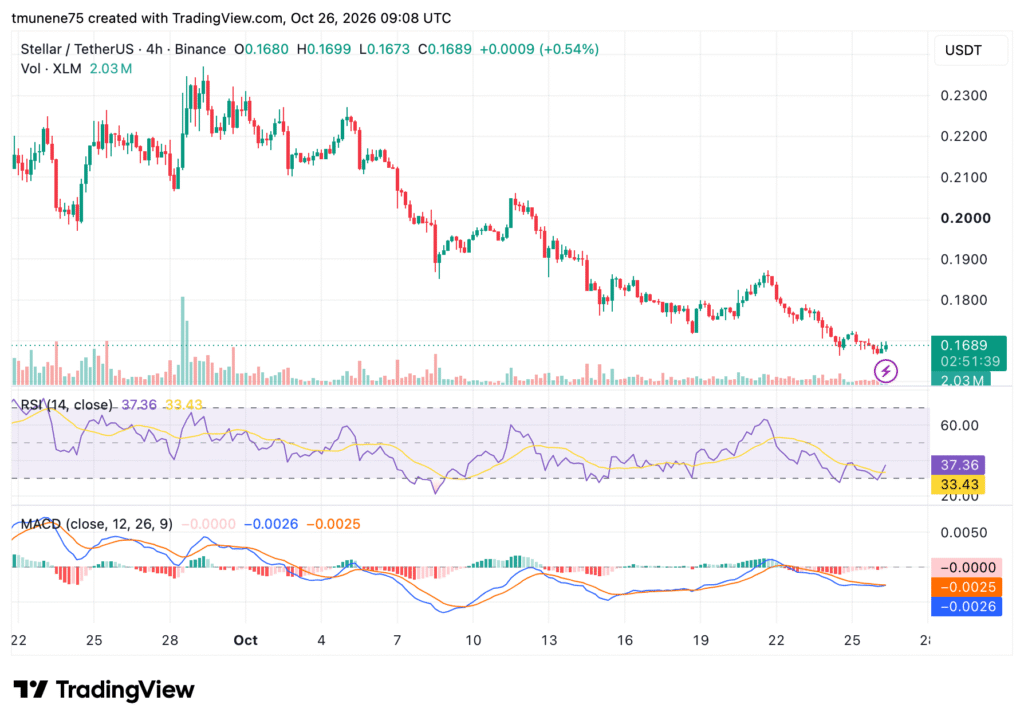
The latest four-hour Binance chart shows XLM at $0.1689, up 0.54% on the latest candle. The candle opened at $0.1680, reached $0.1699, and fell to $0.1673. Trading volume stood at 2.03 million XLM.
Source: TradingView
The Relative Strength Index is at 37.36, above its average of 33.43 but below the neutral 50 level. Meanwhile, the MACD line remains slightly below its signal line, with readings of -0.0026 and -0.0025, respectively.
Andreou Identifies $0.2254 as First Resistance
Andreou said XLM’s weekly chart is testing rising support around 0.16–0.17. The recovery would first need to reclaim $0.2254 and break above a steeper descending trendline.
A successful move could bring the 0.45–0.50 macro resistance zone into focus. Andreou’s scenario allows for an initial rejection before another breakout attempt. If XLM later turns that trendline into support, the analyst sees a possible route toward $0.80.
XLM Support Levels Could Shape the Next Move
The four-hour chart places immediate support around 0.167–0.165, followed by $0.160. A break below $0.165 could extend the decline.
However, resistance is around 0.175–0.180, with another barrier between $0.187 and $0.190. A sustained recovery above $0.180 would provide an early sign of improving price momentum. Andreou warned that losing rising support would weaken the recovery setup.
Stellar Price Eyes $0.80 as XLM Faces Two Major Ceilings
XLM trades near $0.1689 after falling from September highs above $0.23, with immediate support around 0.167–0.165.
Analyst identifies $0.2254 as the first resistance, followed by a major 0.45–0.50 zone on the potential path toward $0.80.
RSI remains below 50 and MACD is slightly bearish; a break below $0.165 could extend losses, while reclaiming $0.180 may improve momentum.
Stellar’s XLM token is testing support near $0.17 as analyst Giannis Andreou outlines two resistance levels before a potential move toward $0.80. Andreou identified $0.2254 as the first hurdle, followed by macro resistance between $0.45 and $0.50. Meanwhile, the four-hour chart shows continued selling pressure after XLM’s decline from September highs above $0.23.
XLM Tests Support After Falling From September Highs
XLM traded between $0.21 and $0.23 in late September, briefly moving above $0.23 around September 29. However, momentum weakened in October, pushing the token below $0.21 and $0.20.
A rebound toward $0.205 around October 11 failed to reverse the decline. By mid-October, XLM had dropped below $0.19, while another recovery attempt near $0.187 around October 21 also faded.
The latest four-hour Binance chart shows XLM at $0.1689, up 0.54% on the latest candle. The candle opened at $0.1680, reached $0.1699, and fell to $0.1673. Trading volume stood at 2.03 million XLM.
Source: TradingView
The Relative Strength Index is at 37.36, above its average of 33.43 but below the neutral 50 level. Meanwhile, the MACD line remains slightly below its signal line, with readings of -0.0026 and -0.0025, respectively.
Andreou Identifies $0.2254 as First Resistance
Andreou said XLM’s weekly chart is testing rising support around 0.16–0.17. The recovery would first need to reclaim $0.2254 and break above a steeper descending trendline.
A successful move could bring the 0.45–0.50 macro resistance zone into focus. Andreou’s scenario allows for an initial rejection before another breakout attempt. If XLM later turns that trendline into support, the analyst sees a possible route toward $0.80.
XLM Support Levels Could Shape the Next Move
The four-hour chart places immediate support around 0.167–0.165, followed by $0.160. A break below $0.165 could extend the decline.
However, resistance is around 0.175–0.180, with another barrier between $0.187 and $0.190. A sustained recovery above $0.180 would provide an early sign of improving price momentum. Andreou warned that losing rising support would weaken the recovery setup.
Analyst identifies $0.2254 as the first resistance, followed by a major 0.45–0.50 zone on the potential path toward $0.80.
RSI remains below 50 and MACD is slightly bearish; a break below $0.165 could extend losses, while reclaiming $0.180 may improve momentum.
Stellar’s XLM token is testing support near $0.17 as analyst Giannis Andreou outlines two resistance levels before a potential move toward $0.80. Andreou identified $0.2254 as the first hurdle, followed by macro resistance between $0.45 and $0.50. Meanwhile, the four-hour chart shows continued selling pressure after XLM’s decline from September highs above $0.23.
XLM Tests Support After Falling From September Highs
XLM traded between $0.21 and $0.23 in late September, briefly moving above $0.23 around September 29. However, momentum weakened in October, pushing the token below $0.21 and $0.20.
A rebound toward $0.205 around October 11 failed to reverse the decline. By mid-October, XLM had dropped below $0.19, while another recovery attempt near $0.187 around October 21 also faded.
The latest four-hour Binance chart shows XLM at $0.1689, up 0.54% on the latest candle. The candle opened at $0.1680, reached $0.1699, and fell to $0.1673. Trading volume stood at 2.03 million XLM.
Source: TradingView
The Relative Strength Index is at 37.36, above its average of 33.43 but below the neutral 50 level. Meanwhile, the MACD line remains slightly below its signal line, with readings of -0.0026 and -0.0025, respectively.
Andreou Identifies $0.2254 as First Resistance
Andreou said XLM’s weekly chart is testing rising support around 0.16–0.17. The recovery would first need to reclaim $0.2254 and break above a steeper descending trendline.
A successful move could bring the 0.45–0.50 macro resistance zone into focus. Andreou’s scenario allows for an initial rejection before another breakout attempt. If XLM later turns that trendline into support, the analyst sees a possible route toward $0.80.
XLM Support Levels Could Shape the Next Move
The four-hour chart places immediate support around 0.167–0.165, followed by $0.160. A break below $0.165 could extend the decline.
However, resistance is around 0.175–0.180, with another barrier between $0.187 and $0.190. A sustained recovery above $0.180 would provide an early sign of improving price momentum. Andreou warned that losing rising support would weaken the recovery setup.
85

Artikel
Tokenisierte Vermögenswerte steuern auf 40 Milliarden US-Dollar zuDie Daten im Diagramm zeigen, dass der Gesamtwert tokenisierter Vermögenswerte von 0,7 Milliarden US-Dollar im Jahr 2021 auf 38,8 Milliarden US-Dollar im bisherigen Jahresverlauf 2026 gestiegen ist.
Ondo bringt traditionelle Finanzprodukte wie US-Staatsanleihen und Aktien in den Bereich tokenisierter Vermögenswerte.
Der Marktwert allein lässt weder auf die Handelsaktivität noch auf den Zugang für Anleger oder Ondos Anteil am wachsenden Markt für tokenisierte Vermögenswerte schließen.
Der Gesamtwert tokenisierter Vermögenswerte stieg um das 500.000-Fache – von 0,7 Milliarden US-Dollar im Jahr 2021 auf 38,8 Milliarden US-Dollar im Jahr 2026.
Tokenisierte Vermögenswerte verzeichnen ein rasantes Marktwachstum
Tokenisierte Vermögenswerte steuern auf 40 Milliarden US-Dollar zu
Die Daten im Diagramm zeigen, dass der Gesamtwert tokenisierter Vermögenswerte von 0,7 Milliarden US-Dollar im Jahr 2021 auf 38,8 Milliarden US-Dollar im bisherigen Jahresverlauf 2026 gestiegen ist.
Ondo bringt traditionelle Finanzprodukte wie US-Staatsanleihen und Aktien in den Bereich tokenisierter Vermögenswerte.
Der Marktwert allein lässt weder auf die Handelsaktivität noch auf den Zugang für Anleger oder Ondos Anteil am wachsenden Markt für tokenisierte Vermögenswerte schließen.
Der Gesamtwert tokenisierter Vermögenswerte stieg um das 500.000-Fache – von 0,7 Milliarden US-Dollar im Jahr 2021 auf 38,8 Milliarden US-Dollar im Jahr 2026.
Tokenisierte Vermögenswerte verzeichnen ein rasantes Marktwachstum
Ondo bringt traditionelle Finanzprodukte wie US-Staatsanleihen und Aktien in den Bereich tokenisierter Vermögenswerte.
Der Marktwert allein lässt weder auf die Handelsaktivität noch auf den Zugang für Anleger oder Ondos Anteil am wachsenden Markt für tokenisierte Vermögenswerte schließen.
Der Gesamtwert tokenisierter Vermögenswerte stieg um das 500.000-Fache – von 0,7 Milliarden US-Dollar im Jahr 2021 auf 38,8 Milliarden US-Dollar im Jahr 2026.
Tokenisierte Vermögenswerte verzeichnen ein rasantes Marktwachstum
188
Artikel
Übersetzung ansehen
Ethena (ENA) Rebounds 8.8% as Analysts Watch $0.25 TargetENA rebounded 8.8% after Arthur Hayes sold 14 million tokens worth about $2.7 million, but the token remains below its 200-day moving average.
CryptoBullet expects a prolonged correction and identifies 0.122–0.172 as a potential buying zone before another sustained breakout.
Crypto Patel targets $0.25 initially, with longer-term levels up to $3; a break above $0.223 could strengthen the recovery outlook.
Ethena’s ENA token has rebounded 8.8% after Arthur Hayes sold 14 million tokens worth approximately $2.7 million. Analysts CryptoBullet and Crypto Patel have outlined different paths for the token, with both tracking potential gains. However, CryptoBullet expects a prolonged correction, while ENA trades near $0.211 below its 200-day moving average.
https://twitter.com/CryptoPatel/status/2112959601834426860?s=20
CryptoBullet Expects a Longer Correction Before Breakout
CryptoBullet said ENA rose fourfold between July and September, describing the rally as a sign of strength. The analyst classified the move as an aggressive five-wave impulse and expects a correction before another sustained breakout.
According to CryptoBullet, the pullback so far has not been sufficient. The analyst anticipates a prolonged flat correction and identified 0.122–0.172 as a potential buying zone. Meanwhile, ENA’s chart shows a decline from approximately 0.10–0.13 in late April toward 0.07–0.08 by mid-August.
The token then climbed above $0.10 in late August before accelerating toward $0.285 in September. However, October selling pushed it back toward 0.18–0.20 before the recent recovery.
Crypto Patel Maps ENA Targets From $0.13 to $3
Crypto Patel highlighted a possible trend reversal on the higher-timeframe chart and listed $0.13 and $0.25 as initial price targets. The analyst also identified longer-term targets at $0.50, $0.80, $1.25, and $3.
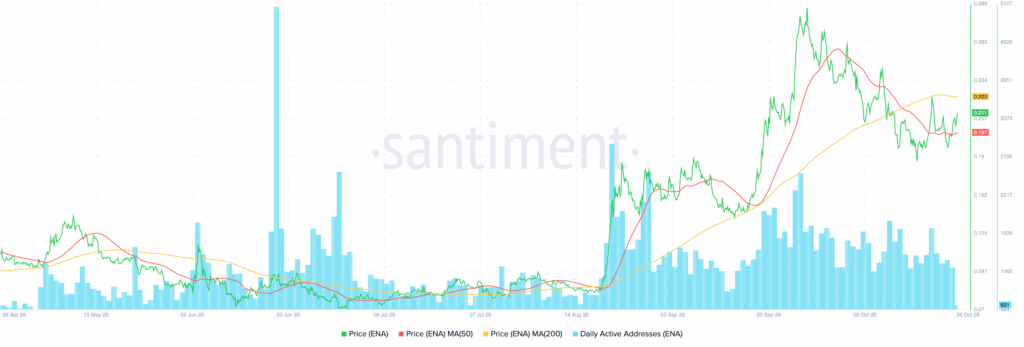
ENA currently trades around $0.211, above its 50-day moving average near $0.197 but below its 200-day average around $0.223. The latter level remains an important resistance area, while 0.197–0.200 provides near-term support.
ENA Network Activity and Resistance Levels Remain in Focus
The chart records major spikes in daily active addresses during June and the August–September rally. Network activity rose alongside the price advance, although recent readings alone cannot establish sustained adoption.
Source: Santiment
A move above $0.223 could open the way toward resistance between $0.234 and $0.250. Conversely, a break below $0.197 could expose ENA to further downside, with $0.180 representing another support level.
Ethena (ENA) Rebounds 8.8% as Analysts Watch $0.25 Target
ENA rebounded 8.8% after Arthur Hayes sold 14 million tokens worth about $2.7 million, but the token remains below its 200-day moving average.
CryptoBullet expects a prolonged correction and identifies 0.122–0.172 as a potential buying zone before another sustained breakout.
Crypto Patel targets $0.25 initially, with longer-term levels up to $3; a break above $0.223 could strengthen the recovery outlook.
Ethena’s ENA token has rebounded 8.8% after Arthur Hayes sold 14 million tokens worth approximately $2.7 million. Analysts CryptoBullet and Crypto Patel have outlined different paths for the token, with both tracking potential gains. However, CryptoBullet expects a prolonged correction, while ENA trades near $0.211 below its 200-day moving average.
https://twitter.com/CryptoPatel/status/2112959601834426860?s=20
CryptoBullet Expects a Longer Correction Before Breakout
CryptoBullet said ENA rose fourfold between July and September, describing the rally as a sign of strength. The analyst classified the move as an aggressive five-wave impulse and expects a correction before another sustained breakout.
According to CryptoBullet, the pullback so far has not been sufficient. The analyst anticipates a prolonged flat correction and identified 0.122–0.172 as a potential buying zone. Meanwhile, ENA’s chart shows a decline from approximately 0.10–0.13 in late April toward 0.07–0.08 by mid-August.
The token then climbed above $0.10 in late August before accelerating toward $0.285 in September. However, October selling pushed it back toward 0.18–0.20 before the recent recovery.
Crypto Patel Maps ENA Targets From $0.13 to $3
Crypto Patel highlighted a possible trend reversal on the higher-timeframe chart and listed $0.13 and $0.25 as initial price targets. The analyst also identified longer-term targets at $0.50, $0.80, $1.25, and $3.
ENA currently trades around $0.211, above its 50-day moving average near $0.197 but below its 200-day average around $0.223. The latter level remains an important resistance area, while 0.197–0.200 provides near-term support.
ENA Network Activity and Resistance Levels Remain in Focus
The chart records major spikes in daily active addresses during June and the August–September rally. Network activity rose alongside the price advance, although recent readings alone cannot establish sustained adoption.
Source: Santiment
A move above $0.223 could open the way toward resistance between $0.234 and $0.250. Conversely, a break below $0.197 could expose ENA to further downside, with $0.180 representing another support level.
CryptoBullet expects a prolonged correction and identifies 0.122–0.172 as a potential buying zone before another sustained breakout.
Crypto Patel targets $0.25 initially, with longer-term levels up to $3; a break above $0.223 could strengthen the recovery outlook.
Ethena’s ENA token has rebounded 8.8% after Arthur Hayes sold 14 million tokens worth approximately $2.7 million. Analysts CryptoBullet and Crypto Patel have outlined different paths for the token, with both tracking potential gains. However, CryptoBullet expects a prolonged correction, while ENA trades near $0.211 below its 200-day moving average.
https://twitter.com/CryptoPatel/status/2112959601834426860?s=20
CryptoBullet Expects a Longer Correction Before Breakout
CryptoBullet said ENA rose fourfold between July and September, describing the rally as a sign of strength. The analyst classified the move as an aggressive five-wave impulse and expects a correction before another sustained breakout.
According to CryptoBullet, the pullback so far has not been sufficient. The analyst anticipates a prolonged flat correction and identified 0.122–0.172 as a potential buying zone. Meanwhile, ENA’s chart shows a decline from approximately 0.10–0.13 in late April toward 0.07–0.08 by mid-August.
The token then climbed above $0.10 in late August before accelerating toward $0.285 in September. However, October selling pushed it back toward 0.18–0.20 before the recent recovery.
Crypto Patel Maps ENA Targets From $0.13 to $3
Crypto Patel highlighted a possible trend reversal on the higher-timeframe chart and listed $0.13 and $0.25 as initial price targets. The analyst also identified longer-term targets at $0.50, $0.80, $1.25, and $3.
ENA currently trades around $0.211, above its 50-day moving average near $0.197 but below its 200-day average around $0.223. The latter level remains an important resistance area, while 0.197–0.200 provides near-term support.
ENA Network Activity and Resistance Levels Remain in Focus
The chart records major spikes in daily active addresses during June and the August–September rally. Network activity rose alongside the price advance, although recent readings alone cannot establish sustained adoption.
Source: Santiment
A move above $0.223 could open the way toward resistance between $0.234 and $0.250. Conversely, a break below $0.197 could expose ENA to further downside, with $0.180 representing another support level.
121

Artikel
XRP könnte um 22 % fallen, wenn die Wale weiter verkaufen, warnt AnalystDie Zahl der XRP-Wallets mit 10 bis 100 Millionen Token sank von 351 auf 339, während die Guthaben auf Kryptobörsen um etwa 50 Millionen XRP stiegen.
Ali Charts warnt, dass ein Durchbruch unter 1,26 $ Kursziele bei 1,11 $ und 0,98 $ eröffnen könnte.
XRP notiert unter seinen gleitenden 50- und 200-Tage-Durchschnitten, während die Zahl aktiver Adressen trotz eines Anstiegs der Holder-Zahl auf 8,25 Millionen auf rund 23.800 gesunken ist.
XRP könnte in Richtung 0,98 $ fallen, wenn Großinvestoren weiter verkaufen und der Kurs unter 1,26 $ fällt, so Analyst Ali Charts. Der Analyst meldete einen Rückgang der Wallets mit 10 bis 100 Millionen XRP sowie steigende Guthaben auf Kryptobörsen. Unterdessen notierte XRP am 26. Oktober bei 1,276 $ und damit unter seinem gleitenden 50-Tage-Durchschnitt.
XRP könnte um 22 % fallen, wenn die Wale weiter verkaufen, warnt Analyst
Die Zahl der XRP-Wallets mit 10 bis 100 Millionen Token sank von 351 auf 339, während die Guthaben auf Kryptobörsen um etwa 50 Millionen XRP stiegen.
Ali Charts warnt, dass ein Durchbruch unter 1,26 $ Kursziele bei 1,11 $ und 0,98 $ eröffnen könnte.
XRP notiert unter seinen gleitenden 50- und 200-Tage-Durchschnitten, während die Zahl aktiver Adressen trotz eines Anstiegs der Holder-Zahl auf 8,25 Millionen auf rund 23.800 gesunken ist.
XRP könnte in Richtung 0,98 $ fallen, wenn Großinvestoren weiter verkaufen und der Kurs unter 1,26 $ fällt, so Analyst Ali Charts. Der Analyst meldete einen Rückgang der Wallets mit 10 bis 100 Millionen XRP sowie steigende Guthaben auf Kryptobörsen. Unterdessen notierte XRP am 26. Oktober bei 1,276 $ und damit unter seinem gleitenden 50-Tage-Durchschnitt.
Ali Charts warnt, dass ein Durchbruch unter 1,26 $ Kursziele bei 1,11 $ und 0,98 $ eröffnen könnte.
XRP notiert unter seinen gleitenden 50- und 200-Tage-Durchschnitten, während die Zahl aktiver Adressen trotz eines Anstiegs der Holder-Zahl auf 8,25 Millionen auf rund 23.800 gesunken ist.
XRP könnte in Richtung 0,98 $ fallen, wenn Großinvestoren weiter verkaufen und der Kurs unter 1,26 $ fällt, so Analyst Ali Charts. Der Analyst meldete einen Rückgang der Wallets mit 10 bis 100 Millionen XRP sowie steigende Guthaben auf Kryptobörsen. Unterdessen notierte XRP am 26. Oktober bei 1,276 $ und damit unter seinem gleitenden 50-Tage-Durchschnitt.
1
1.3k
Artikel
Ethereum-Marktkapitalisierung sinkt um 54 Mrd. US-Dollar, während ETH die Marke von 2.300 US-Dollar testetDie Marktkapitalisierung von Ethereum fiel innerhalb von drei Wochen um 54 Milliarden US-Dollar, während das gesamte Open Interest an den Börsen auf 11,5 Milliarden US-Dollar sank.
Das Open Interest bei Binance sank um 1,3 Milliarden US-Dollar auf 5,7 Milliarden US-Dollar, während auch Gate, HTX und Bybit erhebliche monatliche Rückgänge verzeichneten.
ETH wird nahe 2.304 US-Dollar gehandelt, bei bearishen RSI- und MACD-Werten. Ein Rückgang unter 2.300 US-Dollar könnte die Unterstützungsmarken bei 2.250 und 2.200 US-Dollar in den Fokus rücken.
Ethereum hat innerhalb von drei Wochen 54 Milliarden US-Dollar an Marktkapitalisierung verloren, da ETH um etwa 15 % fiel und Derivatehändler ihr Engagement reduzierten. Der Analyst Darkfost berichtete, dass das gesamte Ethereum-Open-Interest an den Börsen auf 11,5 Milliarden US-Dollar gesunken sei. Unterdessen wurde ETH am 26. Oktober nahe 2.304,53 US-Dollar gehandelt, während technische Indikatoren anhaltenden Verkaufsdruck signalisierten.
Ethereum-Marktkapitalisierung sinkt um 54 Mrd. US-Dollar, während ETH die Marke von 2.300 US-Dollar testet
Die Marktkapitalisierung von Ethereum fiel innerhalb von drei Wochen um 54 Milliarden US-Dollar, während das gesamte Open Interest an den Börsen auf 11,5 Milliarden US-Dollar sank.
Das Open Interest bei Binance sank um 1,3 Milliarden US-Dollar auf 5,7 Milliarden US-Dollar, während auch Gate, HTX und Bybit erhebliche monatliche Rückgänge verzeichneten.
ETH wird nahe 2.304 US-Dollar gehandelt, bei bearishen RSI- und MACD-Werten. Ein Rückgang unter 2.300 US-Dollar könnte die Unterstützungsmarken bei 2.250 und 2.200 US-Dollar in den Fokus rücken.
Ethereum hat innerhalb von drei Wochen 54 Milliarden US-Dollar an Marktkapitalisierung verloren, da ETH um etwa 15 % fiel und Derivatehändler ihr Engagement reduzierten. Der Analyst Darkfost berichtete, dass das gesamte Ethereum-Open-Interest an den Börsen auf 11,5 Milliarden US-Dollar gesunken sei. Unterdessen wurde ETH am 26. Oktober nahe 2.304,53 US-Dollar gehandelt, während technische Indikatoren anhaltenden Verkaufsdruck signalisierten.
Das Open Interest bei Binance sank um 1,3 Milliarden US-Dollar auf 5,7 Milliarden US-Dollar, während auch Gate, HTX und Bybit erhebliche monatliche Rückgänge verzeichneten.
ETH wird nahe 2.304 US-Dollar gehandelt, bei bearishen RSI- und MACD-Werten. Ein Rückgang unter 2.300 US-Dollar könnte die Unterstützungsmarken bei 2.250 und 2.200 US-Dollar in den Fokus rücken.
Ethereum hat innerhalb von drei Wochen 54 Milliarden US-Dollar an Marktkapitalisierung verloren, da ETH um etwa 15 % fiel und Derivatehändler ihr Engagement reduzierten. Der Analyst Darkfost berichtete, dass das gesamte Ethereum-Open-Interest an den Börsen auf 11,5 Milliarden US-Dollar gesunken sei. Unterdessen wurde ETH am 26. Oktober nahe 2.304,53 US-Dollar gehandelt, während technische Indikatoren anhaltenden Verkaufsdruck signalisierten.
1
99
Artikel
Bitcoin-Großinvestoren halten sich zurück, während Einzahlungen von Privatanlegern sich nahezu verdoppelnDie Bitcoin-Zuflüsse von Privatanlegern zu Binance haben sich innerhalb von 30 Tagen auf 10,75 Milliarden $ nahezu verdoppelt, während die Einzahlungen von Großinvestoren von 5,9 Milliarden $ auf 3,8 Milliarden $ zurückgingen.
Ali Charts sieht bei 82.000 $ einen Widerstand und bei einer Fortsetzung der Bitcoin-Korrektur ein mögliches Kaufniveau bei 72.500 $.
Der stärkste Rückgang von Bitcoin im aktuellen Zyklus beträgt bislang 7 %; in früheren abgeschlossenen Zyklen waren es mindestens 28 %.
Bitcoin droht eine mögliche Korrektur in Richtung 72.500 $, während der Analyst Ali Charts einen Ausbruch nach unten aus einem steigenden Kanal beobachtet. Unterdessen zeigen die Daten von Darkfost, dass die Bitcoin-Zuflüsse von Privatanlegern zu Binance ein Sechsmonatshoch erreicht haben, während die Einzahlungen von Großinvestoren weiter zurückgehen. Diese gegensätzlichen Trends zeigen sich, während BTC sich über 80.000 $ hält und Analysten die Rückgänge im aktuellen Marktzyklus bewerten.
Bitcoin-Großinvestoren halten sich zurück, während Einzahlungen von Privatanlegern sich nahezu verdoppeln
Die Bitcoin-Zuflüsse von Privatanlegern zu Binance haben sich innerhalb von 30 Tagen auf 10,75 Milliarden $ nahezu verdoppelt, während die Einzahlungen von Großinvestoren von 5,9 Milliarden $ auf 3,8 Milliarden $ zurückgingen.
Ali Charts sieht bei 82.000 $ einen Widerstand und bei einer Fortsetzung der Bitcoin-Korrektur ein mögliches Kaufniveau bei 72.500 $.
Der stärkste Rückgang von Bitcoin im aktuellen Zyklus beträgt bislang 7 %; in früheren abgeschlossenen Zyklen waren es mindestens 28 %.
Bitcoin droht eine mögliche Korrektur in Richtung 72.500 $, während der Analyst Ali Charts einen Ausbruch nach unten aus einem steigenden Kanal beobachtet. Unterdessen zeigen die Daten von Darkfost, dass die Bitcoin-Zuflüsse von Privatanlegern zu Binance ein Sechsmonatshoch erreicht haben, während die Einzahlungen von Großinvestoren weiter zurückgehen. Diese gegensätzlichen Trends zeigen sich, während BTC sich über 80.000 $ hält und Analysten die Rückgänge im aktuellen Marktzyklus bewerten.
Ali Charts sieht bei 82.000 $ einen Widerstand und bei einer Fortsetzung der Bitcoin-Korrektur ein mögliches Kaufniveau bei 72.500 $.
Der stärkste Rückgang von Bitcoin im aktuellen Zyklus beträgt bislang 7 %; in früheren abgeschlossenen Zyklen waren es mindestens 28 %.
Bitcoin droht eine mögliche Korrektur in Richtung 72.500 $, während der Analyst Ali Charts einen Ausbruch nach unten aus einem steigenden Kanal beobachtet. Unterdessen zeigen die Daten von Darkfost, dass die Bitcoin-Zuflüsse von Privatanlegern zu Binance ein Sechsmonatshoch erreicht haben, während die Einzahlungen von Großinvestoren weiter zurückgehen. Diese gegensätzlichen Trends zeigen sich, während BTC sich über 80.000 $ hält und Analysten die Rückgänge im aktuellen Marktzyklus bewerten.
1
228

Artikel
Singapur, Malaysia und Thailand treiben die Nutzung digitaler Zahlungsmittel voranDie MAS von Singapur, Bank Negara Malaysia und die Bank of Thailand werden mit der Branche bei der grenzüberschreitenden Abwicklung digitaler Zahlungsmittel zusammenarbeiten.
BLOOM wird die Akzeptanz digitaler Zahlungsmittel, grenzüberschreitende Abwicklungen, die Interoperabilität von Netzwerken und programmierbare Kontrollen wie Identitäts- und Sanktionsprüfungen behandeln.
Ripple, Visa, Mastercard und die Weltbankgruppe gehören zu den Teilnehmern, die Anwendungen in den Bereichen Zahlungsverkehr, Treasury und Handelsfinanzierung erkunden.
Singapur, Malaysia und Thailand werden mit Finanzunternehmen an der grenzüberschreitenden Abwicklung digitaler Zahlungsmittel arbeiten. Die Monetary Authority of Singapore gab BLOOM am 23. Oktober bekannt. Bank Negara Malaysia und die Bank of Thailand traten als Mitglieder auf politischer Entscheidungsebene bei. Sie werden dazu beitragen, Ansätze für regulierte Stablecoins und tokenisierte Einlagen über verschiedene Institute und Rechtsordnungen hinweg zu entwickeln.
Singapur, Malaysia und Thailand treiben die Nutzung digitaler Zahlungsmittel voran
Die MAS von Singapur, Bank Negara Malaysia und die Bank of Thailand werden mit der Branche bei der grenzüberschreitenden Abwicklung digitaler Zahlungsmittel zusammenarbeiten.
BLOOM wird die Akzeptanz digitaler Zahlungsmittel, grenzüberschreitende Abwicklungen, die Interoperabilität von Netzwerken und programmierbare Kontrollen wie Identitäts- und Sanktionsprüfungen behandeln.
Ripple, Visa, Mastercard und die Weltbankgruppe gehören zu den Teilnehmern, die Anwendungen in den Bereichen Zahlungsverkehr, Treasury und Handelsfinanzierung erkunden.
Singapur, Malaysia und Thailand werden mit Finanzunternehmen an der grenzüberschreitenden Abwicklung digitaler Zahlungsmittel arbeiten. Die Monetary Authority of Singapore gab BLOOM am 23. Oktober bekannt. Bank Negara Malaysia und die Bank of Thailand traten als Mitglieder auf politischer Entscheidungsebene bei. Sie werden dazu beitragen, Ansätze für regulierte Stablecoins und tokenisierte Einlagen über verschiedene Institute und Rechtsordnungen hinweg zu entwickeln.
BLOOM wird die Akzeptanz digitaler Zahlungsmittel, grenzüberschreitende Abwicklungen, die Interoperabilität von Netzwerken und programmierbare Kontrollen wie Identitäts- und Sanktionsprüfungen behandeln.
Ripple, Visa, Mastercard und die Weltbankgruppe gehören zu den Teilnehmern, die Anwendungen in den Bereichen Zahlungsverkehr, Treasury und Handelsfinanzierung erkunden.
Singapur, Malaysia und Thailand werden mit Finanzunternehmen an der grenzüberschreitenden Abwicklung digitaler Zahlungsmittel arbeiten. Die Monetary Authority of Singapore gab BLOOM am 23. Oktober bekannt. Bank Negara Malaysia und die Bank of Thailand traten als Mitglieder auf politischer Entscheidungsebene bei. Sie werden dazu beitragen, Ansätze für regulierte Stablecoins und tokenisierte Einlagen über verschiedene Institute und Rechtsordnungen hinweg zu entwickeln.
320

Artikel
HTX nimmt Russland nach Bitget und MEXC in die Liste der eingeschränkten Jurisdiktionen aufHTX hat Russland zu den eingeschränkten Jurisdiktionen hinzugefügt. Dadurch könnten der Kontozugang und Auszahlungen für betroffene Personen und Unternehmen eingeschränkt werden.
Bitget und MEXC schränkten im Oktober ebenfalls den Zugang zum russischen Markt ein und verwiesen dabei auf verbotene Jurisdiktionen und Bedenken hinsichtlich der Einhaltung regulatorischer Vorgaben.
Analysten verweisen auf zunehmende regulatorische Risiken und Sanktionsrisiken, es gibt jedoch keine Hinweise auf ein koordiniertes Vorgehen der Börsen.
HTX hat Russland zu den eingeschränkten Jurisdiktionen hinzugefügt. Dadurch kann die Kryptowährungsbörse ihre Dienstleistungen für russische Nutzer beschränken. Dem russischen Wirtschaftsmedium RBC zufolge gelten die Einschränkungen für Personen mit Wohnsitz in Russland oder Personen, die sich dort aufhalten, sowie für Unternehmen, die dort registriert sind oder hauptsächlich dort tätig sind. Dieser Schritt folgt auf ähnliche Entscheidungen von Bitget und MEXC im Oktober; wann die Einschränkungen bei HTX in Kraft treten, ist jedoch noch nicht bekannt.
HTX nimmt Russland nach Bitget und MEXC in die Liste der eingeschränkten Jurisdiktionen auf
HTX hat Russland zu den eingeschränkten Jurisdiktionen hinzugefügt. Dadurch könnten der Kontozugang und Auszahlungen für betroffene Personen und Unternehmen eingeschränkt werden.
Bitget und MEXC schränkten im Oktober ebenfalls den Zugang zum russischen Markt ein und verwiesen dabei auf verbotene Jurisdiktionen und Bedenken hinsichtlich der Einhaltung regulatorischer Vorgaben.
Analysten verweisen auf zunehmende regulatorische Risiken und Sanktionsrisiken, es gibt jedoch keine Hinweise auf ein koordiniertes Vorgehen der Börsen.
HTX hat Russland zu den eingeschränkten Jurisdiktionen hinzugefügt. Dadurch kann die Kryptowährungsbörse ihre Dienstleistungen für russische Nutzer beschränken. Dem russischen Wirtschaftsmedium RBC zufolge gelten die Einschränkungen für Personen mit Wohnsitz in Russland oder Personen, die sich dort aufhalten, sowie für Unternehmen, die dort registriert sind oder hauptsächlich dort tätig sind. Dieser Schritt folgt auf ähnliche Entscheidungen von Bitget und MEXC im Oktober; wann die Einschränkungen bei HTX in Kraft treten, ist jedoch noch nicht bekannt.
Bitget und MEXC schränkten im Oktober ebenfalls den Zugang zum russischen Markt ein und verwiesen dabei auf verbotene Jurisdiktionen und Bedenken hinsichtlich der Einhaltung regulatorischer Vorgaben.
Analysten verweisen auf zunehmende regulatorische Risiken und Sanktionsrisiken, es gibt jedoch keine Hinweise auf ein koordiniertes Vorgehen der Börsen.
HTX hat Russland zu den eingeschränkten Jurisdiktionen hinzugefügt. Dadurch kann die Kryptowährungsbörse ihre Dienstleistungen für russische Nutzer beschränken. Dem russischen Wirtschaftsmedium RBC zufolge gelten die Einschränkungen für Personen mit Wohnsitz in Russland oder Personen, die sich dort aufhalten, sowie für Unternehmen, die dort registriert sind oder hauptsächlich dort tätig sind. Dieser Schritt folgt auf ähnliche Entscheidungen von Bitget und MEXC im Oktober; wann die Einschränkungen bei HTX in Kraft treten, ist jedoch noch nicht bekannt.
74
Artikel
Übersetzung ansehen
PENGU Chart Shows Signs of a Possible ReversalPENGU has rebounded twice near the $0.0067–$0.0070 area, raising the possibility of a base after months of downward pressure.
PENGU recovered better from overnight losses and came out with better daily performance in the latest session as compared to FARTCOIN.
A sustained move above nearby resistance could strengthen the reversal case, while renewed selling below support would weaken the current setup.
PENGU is showing signs of a possible reversal after months of selling, with repeated support rebounds and stronger short-term performance.
Repeated Rebounds Put Support in Focus
Pure8 described the PENGU daily chart as interesting, drawing attention to a possible change in price structure. The chart shows a decline from approximately $0.011172, followed by a low near $0.005840. Since then, buyers have pushed the token higher, although the earlier downtrend remains relevant.
Source: X
Two rounded recoveries stand out around the $0.0067–$0.0070 region. Each followed a retreat, with price subsequently climbing away from the lower range. Their resemblance suggests sellers may be losing some control, but two rebounds alone cannot establish a lasting floor.
The latest market data places PENGU near $0.007850, below its previous high. This leaves a considerable distance between the current price and the earlier peak. Buyers must produce further gains before the chart can show a convincing break from its declining structure.
The support region remains important if selling returns. However, a move below around $0.006746 would break the repeated re-bounce pattern, and the more significant low of $0.005840 is lower. If these areas were kept above, the recovery could be given more space to grow.
Resistance and Momentum Will Determine the Next Move
The chart also brings up the possibility of an inverse head and shoulders. Typically three troughs, the middle being lower than the other two. The supplied chart does not set a break above the neckline to confirm.
The first zone of interest is around $0.0078 – $0.0080. The 24-hour high is $0.007961, which brings the token closer to the nearby resistance level. If it continues to move upwards from this range, it will be more convincing that buyers are able to prolong the recovery.
The MACD panel indicates that momentum lines have reached the lower end of their range and are turning up. In addition, the histogram seems to be trending upward from a series of below-average readings. The image, however, does not validate a completed Bullish Cross, so it is not an ending evidence, but rather supporting evidence.
If PENGU hits resistance again, trading will become an issue. The price spike alone is not as strong a sign of a breakout as a breakout with increased volume. On the other hand, if the token rejects close to $0.0080, the token may stall out before another support test.
PENGU Outperforms FARTCOIN in the Latest Session
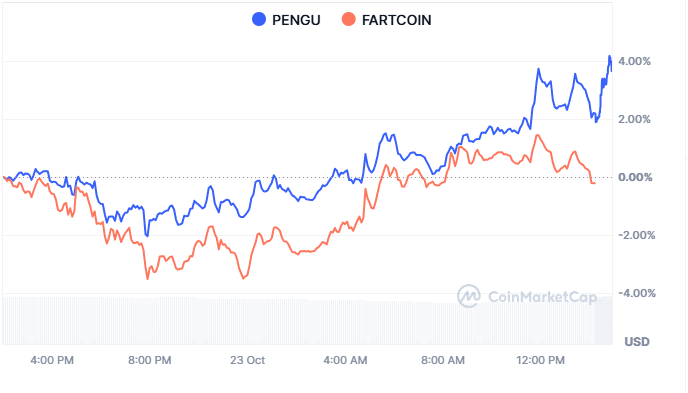
The comparison chart tracks PENGU in blue and FARTCOIN in orange across the same 24-hour period. Both assets decline during the evening, but FARTCOIN falls further, reaching below negative 3%. PENGU’s lowest reading stays closer to negative 2%, showing relative resilience during the sell-off.
Source: Coinmarketcap
Their paths begin separating more clearly during the overnight recovery. PENGU climbs into positive territory and advances through the morning, while FARTCOIN recovers more unevenly. The gap widens as the blue line rises, indicating stronger percentage performance from PENGU during this period.
PENGU briefly approaches a 4% gain before surrendering part of its advance. It finishes the displayed comparison near a 2% gain, while FARTCOIN falls back toward zero. This difference shows that PENGU retained more of its rebound despite the late pullback.
The accompanying market panel lists PENGU’s market capitalization at approximately $502.29 million. Its 24-hour trading volume stands near $95.15 million as of writing, down 2.44%. The price gain alongside lower volume means the advance did not coincide with rising turnover.
For now, PENGU has a possible reversal structure and stronger short-term performance than FARTCOIN. The next evidence must come from a sustained move above resistance, supported by continued buying. Failure near $0.0080 or a break below recent support would leave the recovery uncertain.
PENGU Chart Shows Signs of a Possible Reversal
PENGU has rebounded twice near the $0.0067–$0.0070 area, raising the possibility of a base after months of downward pressure.
PENGU recovered better from overnight losses and came out with better daily performance in the latest session as compared to FARTCOIN.
A sustained move above nearby resistance could strengthen the reversal case, while renewed selling below support would weaken the current setup.
PENGU is showing signs of a possible reversal after months of selling, with repeated support rebounds and stronger short-term performance.
Repeated Rebounds Put Support in Focus
Pure8 described the PENGU daily chart as interesting, drawing attention to a possible change in price structure. The chart shows a decline from approximately $0.011172, followed by a low near $0.005840. Since then, buyers have pushed the token higher, although the earlier downtrend remains relevant.
Source: X
Two rounded recoveries stand out around the $0.0067–$0.0070 region. Each followed a retreat, with price subsequently climbing away from the lower range. Their resemblance suggests sellers may be losing some control, but two rebounds alone cannot establish a lasting floor.
The latest market data places PENGU near $0.007850, below its previous high. This leaves a considerable distance between the current price and the earlier peak. Buyers must produce further gains before the chart can show a convincing break from its declining structure.
The support region remains important if selling returns. However, a move below around $0.006746 would break the repeated re-bounce pattern, and the more significant low of $0.005840 is lower. If these areas were kept above, the recovery could be given more space to grow.
Resistance and Momentum Will Determine the Next Move
The chart also brings up the possibility of an inverse head and shoulders. Typically three troughs, the middle being lower than the other two. The supplied chart does not set a break above the neckline to confirm.
The first zone of interest is around $0.0078 – $0.0080. The 24-hour high is $0.007961, which brings the token closer to the nearby resistance level. If it continues to move upwards from this range, it will be more convincing that buyers are able to prolong the recovery.
The MACD panel indicates that momentum lines have reached the lower end of their range and are turning up. In addition, the histogram seems to be trending upward from a series of below-average readings. The image, however, does not validate a completed Bullish Cross, so it is not an ending evidence, but rather supporting evidence.
If PENGU hits resistance again, trading will become an issue. The price spike alone is not as strong a sign of a breakout as a breakout with increased volume. On the other hand, if the token rejects close to $0.0080, the token may stall out before another support test.
PENGU Outperforms FARTCOIN in the Latest Session
The comparison chart tracks PENGU in blue and FARTCOIN in orange across the same 24-hour period. Both assets decline during the evening, but FARTCOIN falls further, reaching below negative 3%. PENGU’s lowest reading stays closer to negative 2%, showing relative resilience during the sell-off.
Source: Coinmarketcap
Their paths begin separating more clearly during the overnight recovery. PENGU climbs into positive territory and advances through the morning, while FARTCOIN recovers more unevenly. The gap widens as the blue line rises, indicating stronger percentage performance from PENGU during this period.
PENGU briefly approaches a 4% gain before surrendering part of its advance. It finishes the displayed comparison near a 2% gain, while FARTCOIN falls back toward zero. This difference shows that PENGU retained more of its rebound despite the late pullback.
The accompanying market panel lists PENGU’s market capitalization at approximately $502.29 million. Its 24-hour trading volume stands near $95.15 million as of writing, down 2.44%. The price gain alongside lower volume means the advance did not coincide with rising turnover.
For now, PENGU has a possible reversal structure and stronger short-term performance than FARTCOIN. The next evidence must come from a sustained move above resistance, supported by continued buying. Failure near $0.0080 or a break below recent support would leave the recovery uncertain.
PENGU recovered better from overnight losses and came out with better daily performance in the latest session as compared to FARTCOIN.
A sustained move above nearby resistance could strengthen the reversal case, while renewed selling below support would weaken the current setup.
PENGU is showing signs of a possible reversal after months of selling, with repeated support rebounds and stronger short-term performance.
Repeated Rebounds Put Support in Focus
Pure8 described the PENGU daily chart as interesting, drawing attention to a possible change in price structure. The chart shows a decline from approximately $0.011172, followed by a low near $0.005840. Since then, buyers have pushed the token higher, although the earlier downtrend remains relevant.
Source: X
Two rounded recoveries stand out around the $0.0067–$0.0070 region. Each followed a retreat, with price subsequently climbing away from the lower range. Their resemblance suggests sellers may be losing some control, but two rebounds alone cannot establish a lasting floor.
The latest market data places PENGU near $0.007850, below its previous high. This leaves a considerable distance between the current price and the earlier peak. Buyers must produce further gains before the chart can show a convincing break from its declining structure.
The support region remains important if selling returns. However, a move below around $0.006746 would break the repeated re-bounce pattern, and the more significant low of $0.005840 is lower. If these areas were kept above, the recovery could be given more space to grow.
Resistance and Momentum Will Determine the Next Move
The chart also brings up the possibility of an inverse head and shoulders. Typically three troughs, the middle being lower than the other two. The supplied chart does not set a break above the neckline to confirm.
The first zone of interest is around $0.0078 – $0.0080. The 24-hour high is $0.007961, which brings the token closer to the nearby resistance level. If it continues to move upwards from this range, it will be more convincing that buyers are able to prolong the recovery.
The MACD panel indicates that momentum lines have reached the lower end of their range and are turning up. In addition, the histogram seems to be trending upward from a series of below-average readings. The image, however, does not validate a completed Bullish Cross, so it is not an ending evidence, but rather supporting evidence.
If PENGU hits resistance again, trading will become an issue. The price spike alone is not as strong a sign of a breakout as a breakout with increased volume. On the other hand, if the token rejects close to $0.0080, the token may stall out before another support test.
PENGU Outperforms FARTCOIN in the Latest Session
The comparison chart tracks PENGU in blue and FARTCOIN in orange across the same 24-hour period. Both assets decline during the evening, but FARTCOIN falls further, reaching below negative 3%. PENGU’s lowest reading stays closer to negative 2%, showing relative resilience during the sell-off.
Source: Coinmarketcap
Their paths begin separating more clearly during the overnight recovery. PENGU climbs into positive territory and advances through the morning, while FARTCOIN recovers more unevenly. The gap widens as the blue line rises, indicating stronger percentage performance from PENGU during this period.
PENGU briefly approaches a 4% gain before surrendering part of its advance. It finishes the displayed comparison near a 2% gain, while FARTCOIN falls back toward zero. This difference shows that PENGU retained more of its rebound despite the late pullback.
The accompanying market panel lists PENGU’s market capitalization at approximately $502.29 million. Its 24-hour trading volume stands near $95.15 million as of writing, down 2.44%. The price gain alongside lower volume means the advance did not coincide with rising turnover.
For now, PENGU has a possible reversal structure and stronger short-term performance than FARTCOIN. The next evidence must come from a sustained move above resistance, supported by continued buying. Failure near $0.0080 or a break below recent support would leave the recovery uncertain.
482
Artikel
Ethereum steht vor einem Test der 2.300-Dollar-Marke, während Glamsterdam dem Testnet näherkommtETH wird bei etwa 2.335 US-Dollar gehandelt. Der RSI liegt bei 38,93 und das MACD-Histogramm ist negativ, während die Unterstützung im Bereich von 2.300 bis 2.330 US-Dollar liegt.
Michael van de Poppe nennt 2.320 und 2.230 US-Dollar als mögliche Einstiegsniveaus für Long-Positionen, falls Ethereum weiter nachgibt.
Crypto Patel hebt Gasgebühren von 0,004 US-Dollar hervor, während Glamsterdam einem Meilenstein im Hoodi-Testnet näherkommt. Sicherheit und Kompatibilität werden weiterhin überprüft.
Ethereum wird bei etwa 2.335 US-Dollar gehandelt, während die bärische Dynamik ETH in Richtung der Unterstützung bei 2.300 US-Dollar drückt. Analysten beobachten mögliche Einstiegsniveaus und Entwicklungen im Netzwerk. Michael van de Poppe nannte 2.320 und 2.230 US-Dollar als mögliche Einstiegsniveaus für Long-Positionen während der Marktschwäche. Unterdessen hob Crypto Patel Gasgebühren von 0,004 US-Dollar hervor, während die Entwickler einem Meilenstein im Glamsterdam-Testnet näherkommen.
Ethereum steht vor einem Test der 2.300-Dollar-Marke, während Glamsterdam dem Testnet näherkommt
ETH wird bei etwa 2.335 US-Dollar gehandelt. Der RSI liegt bei 38,93 und das MACD-Histogramm ist negativ, während die Unterstützung im Bereich von 2.300 bis 2.330 US-Dollar liegt.
Michael van de Poppe nennt 2.320 und 2.230 US-Dollar als mögliche Einstiegsniveaus für Long-Positionen, falls Ethereum weiter nachgibt.
Crypto Patel hebt Gasgebühren von 0,004 US-Dollar hervor, während Glamsterdam einem Meilenstein im Hoodi-Testnet näherkommt. Sicherheit und Kompatibilität werden weiterhin überprüft.
Ethereum wird bei etwa 2.335 US-Dollar gehandelt, während die bärische Dynamik ETH in Richtung der Unterstützung bei 2.300 US-Dollar drückt. Analysten beobachten mögliche Einstiegsniveaus und Entwicklungen im Netzwerk. Michael van de Poppe nannte 2.320 und 2.230 US-Dollar als mögliche Einstiegsniveaus für Long-Positionen während der Marktschwäche. Unterdessen hob Crypto Patel Gasgebühren von 0,004 US-Dollar hervor, während die Entwickler einem Meilenstein im Glamsterdam-Testnet näherkommen.
Michael van de Poppe nennt 2.320 und 2.230 US-Dollar als mögliche Einstiegsniveaus für Long-Positionen, falls Ethereum weiter nachgibt.
Crypto Patel hebt Gasgebühren von 0,004 US-Dollar hervor, während Glamsterdam einem Meilenstein im Hoodi-Testnet näherkommt. Sicherheit und Kompatibilität werden weiterhin überprüft.
Ethereum wird bei etwa 2.335 US-Dollar gehandelt, während die bärische Dynamik ETH in Richtung der Unterstützung bei 2.300 US-Dollar drückt. Analysten beobachten mögliche Einstiegsniveaus und Entwicklungen im Netzwerk. Michael van de Poppe nannte 2.320 und 2.230 US-Dollar als mögliche Einstiegsniveaus für Long-Positionen während der Marktschwäche. Unterdessen hob Crypto Patel Gasgebühren von 0,004 US-Dollar hervor, während die Entwickler einem Meilenstein im Glamsterdam-Testnet näherkommen.
165
Artikel
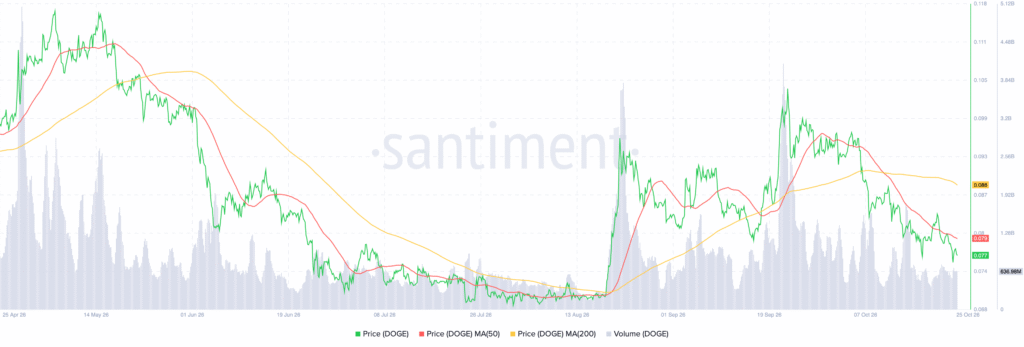
Dogecoin nimmt 0,70 $ ins Visier, während Analysten Ausbruchsmuster und wichtige Widerstände beobachtenDOGE wird bei etwa 0,077 $ gehandelt und liegt damit unter seinen gleitenden 50- und 200-Tage-Durchschnitten. Die unmittelbare Unterstützung liegt zwischen 0,075 und 0,077 $.
Giannis Andreou sieht einen möglichen Weg in Richtung 0,70 $, wenn DOGE die Marke von 0,07–0,08 $ verteidigt und aufeinanderfolgende Widerstandsniveaus durchbricht.
Trader Tardigrade vergleicht den Monatschart von Dogecoin mit der Struktur von 2015 bis 2017 und deutet einen möglichen Ausbruch an, ohne einen Zeitpunkt dafür zu nennen.
Dogecoin wird bei etwa 0,077 $ gehandelt, nachdem die Verluste im Oktober einen Großteil der Erholung im August und September zunichtegemacht haben. Analysten beobachten derweil mögliche langfristige Ausbruchsmuster. Giannis Andreou skizzierte einen möglichen Weg in Richtung 0,70 $, falls DOGE mehrere Widerstandsniveaus überwindet. Unterdessen verglich Trader Tardigrade die Monatsstruktur von Dogecoin mit dem Kursverlauf von 2015 bis 2017.
Dogecoin nimmt 0,70 $ ins Visier, während Analysten Ausbruchsmuster und wichtige Widerstände beobachten
DOGE wird bei etwa 0,077 $ gehandelt und liegt damit unter seinen gleitenden 50- und 200-Tage-Durchschnitten. Die unmittelbare Unterstützung liegt zwischen 0,075 und 0,077 $.
Giannis Andreou sieht einen möglichen Weg in Richtung 0,70 $, wenn DOGE die Marke von 0,07–0,08 $ verteidigt und aufeinanderfolgende Widerstandsniveaus durchbricht.
Trader Tardigrade vergleicht den Monatschart von Dogecoin mit der Struktur von 2015 bis 2017 und deutet einen möglichen Ausbruch an, ohne einen Zeitpunkt dafür zu nennen.
Dogecoin wird bei etwa 0,077 $ gehandelt, nachdem die Verluste im Oktober einen Großteil der Erholung im August und September zunichtegemacht haben. Analysten beobachten derweil mögliche langfristige Ausbruchsmuster. Giannis Andreou skizzierte einen möglichen Weg in Richtung 0,70 $, falls DOGE mehrere Widerstandsniveaus überwindet. Unterdessen verglich Trader Tardigrade die Monatsstruktur von Dogecoin mit dem Kursverlauf von 2015 bis 2017.
Giannis Andreou sieht einen möglichen Weg in Richtung 0,70 $, wenn DOGE die Marke von 0,07–0,08 $ verteidigt und aufeinanderfolgende Widerstandsniveaus durchbricht.
Trader Tardigrade vergleicht den Monatschart von Dogecoin mit der Struktur von 2015 bis 2017 und deutet einen möglichen Ausbruch an, ohne einen Zeitpunkt dafür zu nennen.
Dogecoin wird bei etwa 0,077 $ gehandelt, nachdem die Verluste im Oktober einen Großteil der Erholung im August und September zunichtegemacht haben. Analysten beobachten derweil mögliche langfristige Ausbruchsmuster. Giannis Andreou skizzierte einen möglichen Weg in Richtung 0,70 $, falls DOGE mehrere Widerstandsniveaus überwindet. Unterdessen verglich Trader Tardigrade die Monatsstruktur von Dogecoin mit dem Kursverlauf von 2015 bis 2017.
2
435

Artikel
Langfristige Bitcoin-Halter verkaufen, während BTC die Unterstützung bei 80.000 $ testetDer Bestand langfristiger Bitcoin-Halter ist seit August um 300.000 BTC gesunken. Die durchschnittliche Veränderung über 30 Tage liegt bei minus 195.000 BTC.
BTC notiert nahe 80.535 $, während der RSI unter 50 bleibt und der MACD weiterhin negativ ist. Das spiegelt eine schwache Dynamik und anhaltenden Verkaufsdruck wider.
Bitcoin findet Unterstützung bei 80.000 $ und 79.000 $. Eine Rückeroberung der Marke von 82.000 $ könnte eine Erholung in Richtung 83.000–84.000 $ einleiten.
Bitcoin nähert sich der Marke von 80.000 $, während langfristige Halter ihre Bestände reduzieren und damit den Verkaufsdruck in einem ohnehin schwächer werdenden Markt erhöhen. Analyst Darkfost berichtete, dass der Bestand langfristiger Halter seit August um 300.000 BTC gesunken ist. Die durchschnittliche Veränderung über 30 Tage liegt bei minus 195.000 BTC. Unterdessen zeigt Bitcoins Vier-Stunden-Chart wiederholte Abweisungen an Widerständen und eine schwache Dynamik.
Langfristige Bitcoin-Halter verkaufen, während BTC die Unterstützung bei 80.000 $ testet
Der Bestand langfristiger Bitcoin-Halter ist seit August um 300.000 BTC gesunken. Die durchschnittliche Veränderung über 30 Tage liegt bei minus 195.000 BTC.
BTC notiert nahe 80.535 $, während der RSI unter 50 bleibt und der MACD weiterhin negativ ist. Das spiegelt eine schwache Dynamik und anhaltenden Verkaufsdruck wider.
Bitcoin findet Unterstützung bei 80.000 $ und 79.000 $. Eine Rückeroberung der Marke von 82.000 $ könnte eine Erholung in Richtung 83.000–84.000 $ einleiten.
Bitcoin nähert sich der Marke von 80.000 $, während langfristige Halter ihre Bestände reduzieren und damit den Verkaufsdruck in einem ohnehin schwächer werdenden Markt erhöhen. Analyst Darkfost berichtete, dass der Bestand langfristiger Halter seit August um 300.000 BTC gesunken ist. Die durchschnittliche Veränderung über 30 Tage liegt bei minus 195.000 BTC. Unterdessen zeigt Bitcoins Vier-Stunden-Chart wiederholte Abweisungen an Widerständen und eine schwache Dynamik.
BTC notiert nahe 80.535 $, während der RSI unter 50 bleibt und der MACD weiterhin negativ ist. Das spiegelt eine schwache Dynamik und anhaltenden Verkaufsdruck wider.
Bitcoin findet Unterstützung bei 80.000 $ und 79.000 $. Eine Rückeroberung der Marke von 82.000 $ könnte eine Erholung in Richtung 83.000–84.000 $ einleiten.
Bitcoin nähert sich der Marke von 80.000 $, während langfristige Halter ihre Bestände reduzieren und damit den Verkaufsdruck in einem ohnehin schwächer werdenden Markt erhöhen. Analyst Darkfost berichtete, dass der Bestand langfristiger Halter seit August um 300.000 BTC gesunken ist. Die durchschnittliche Veränderung über 30 Tage liegt bei minus 195.000 BTC. Unterdessen zeigt Bitcoins Vier-Stunden-Chart wiederholte Abweisungen an Widerständen und eine schwache Dynamik.
582

Artikel
Cardano droht laut Analyst ein Rückgang um 20 %, nachdem ADA wichtige Unterstützung durchbrochen hatEin Analyst warnt, dass ADA um 20 % auf 0,166 $ fallen könnte, wenn der Widerstand bei 0,220 $ hält, nachdem der Kurs unter seinen steigenden Preiskanal gefallen ist.
Der RSI von Cardano liegt bei 34,77 und der MACD bleibt negativ. Das signalisiert anhaltenden Verkaufsdruck, während ADA bei etwa 0,2056 $ gehandelt wird.
Die deutsche DZ BANK bietet Cardano neben Bitcoin, Ethereum und Litecoin auf meinKrypto an. Voraussetzung ist, dass die teilnehmenden Banken sich für eine Einführung entscheiden.
Cardano droht ein möglicher Rückgang um 20 % auf 0,166 $, nachdem der Analyst Ali Charts einen Einbruch unter den steigenden Preiskanal gemeldet hat. ADA wird weiterhin bei etwa 0,20 $ gehandelt, wobei sich im Vier-Stunden-Chart eine rückläufige Dynamik abzeichnet. Unterdessen hat die deutsche DZ BANK Cardano in ihr Angebot von vier Kryptowährungen auf der Plattform meinKrypto aufgenommen.
Cardano droht laut Analyst ein Rückgang um 20 %, nachdem ADA wichtige Unterstützung durchbrochen hat
Ein Analyst warnt, dass ADA um 20 % auf 0,166 $ fallen könnte, wenn der Widerstand bei 0,220 $ hält, nachdem der Kurs unter seinen steigenden Preiskanal gefallen ist.
Der RSI von Cardano liegt bei 34,77 und der MACD bleibt negativ. Das signalisiert anhaltenden Verkaufsdruck, während ADA bei etwa 0,2056 $ gehandelt wird.
Die deutsche DZ BANK bietet Cardano neben Bitcoin, Ethereum und Litecoin auf meinKrypto an. Voraussetzung ist, dass die teilnehmenden Banken sich für eine Einführung entscheiden.
Cardano droht ein möglicher Rückgang um 20 % auf 0,166 $, nachdem der Analyst Ali Charts einen Einbruch unter den steigenden Preiskanal gemeldet hat. ADA wird weiterhin bei etwa 0,20 $ gehandelt, wobei sich im Vier-Stunden-Chart eine rückläufige Dynamik abzeichnet. Unterdessen hat die deutsche DZ BANK Cardano in ihr Angebot von vier Kryptowährungen auf der Plattform meinKrypto aufgenommen.
Der RSI von Cardano liegt bei 34,77 und der MACD bleibt negativ. Das signalisiert anhaltenden Verkaufsdruck, während ADA bei etwa 0,2056 $ gehandelt wird.
Die deutsche DZ BANK bietet Cardano neben Bitcoin, Ethereum und Litecoin auf meinKrypto an. Voraussetzung ist, dass die teilnehmenden Banken sich für eine Einführung entscheiden.
Cardano droht ein möglicher Rückgang um 20 % auf 0,166 $, nachdem der Analyst Ali Charts einen Einbruch unter den steigenden Preiskanal gemeldet hat. ADA wird weiterhin bei etwa 0,20 $ gehandelt, wobei sich im Vier-Stunden-Chart eine rückläufige Dynamik abzeichnet. Unterdessen hat die deutsche DZ BANK Cardano in ihr Angebot von vier Kryptowährungen auf der Plattform meinKrypto aufgenommen.
2
367
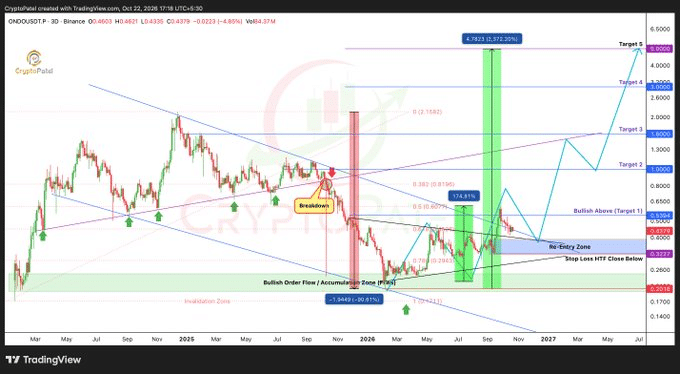
Artikel
ONDO stößt auf Widerstand, während die Erholung an Schwung verliertONDO wird nach Kursverlusten nahe 0,433 $ gehandelt. Das Niveau von 0,435 $ stellt eine kurzfristige Hürde für Käufer dar, die auf eine Erholung setzen.
Die Börsenflüsse zeigen während der jüngsten Rallyes starke Zu- und Abflüsse. Dadurch bleibt die Marktrichtung von ONDO ungewiss, während der Kurs von seinem Höchststand zurückgeht.
Die Wiedereinstiegszone bei 0,39–0,33 $ bleibt wichtig. Ein Schlusskurs auf einem höheren Zeitrahmen unter 0,32 $ würde das angegebene Setup ungültig machen.
Die Kursentwicklung von ONDO bleibt bärisch: Der Kurs prallte an einem Hoch ab und konnte sich nicht darüber halten. Die Händler orientieren sich an den nahegelegenen Unterstützungs- und Widerstandsniveaus.
ONDO stößt auf Widerstand, während die Erholung an Schwung verliert
ONDO wird nach Kursverlusten nahe 0,433 $ gehandelt. Das Niveau von 0,435 $ stellt eine kurzfristige Hürde für Käufer dar, die auf eine Erholung setzen.
Die Börsenflüsse zeigen während der jüngsten Rallyes starke Zu- und Abflüsse. Dadurch bleibt die Marktrichtung von ONDO ungewiss, während der Kurs von seinem Höchststand zurückgeht.
Die Wiedereinstiegszone bei 0,39–0,33 $ bleibt wichtig. Ein Schlusskurs auf einem höheren Zeitrahmen unter 0,32 $ würde das angegebene Setup ungültig machen.
Die Kursentwicklung von ONDO bleibt bärisch: Der Kurs prallte an einem Hoch ab und konnte sich nicht darüber halten. Die Händler orientieren sich an den nahegelegenen Unterstützungs- und Widerstandsniveaus.
Die Börsenflüsse zeigen während der jüngsten Rallyes starke Zu- und Abflüsse. Dadurch bleibt die Marktrichtung von ONDO ungewiss, während der Kurs von seinem Höchststand zurückgeht.
Die Wiedereinstiegszone bei 0,39–0,33 $ bleibt wichtig. Ein Schlusskurs auf einem höheren Zeitrahmen unter 0,32 $ würde das angegebene Setup ungültig machen.
Die Kursentwicklung von ONDO bleibt bärisch: Der Kurs prallte an einem Hoch ab und konnte sich nicht darüber halten. Die Händler orientieren sich an den nahegelegenen Unterstützungs- und Widerstandsniveaus.
400
Verifiziert
Artikel
Arf und Ripple bringen RLUSD-Abwicklungsliquidität auf XRPLArf und Ripple planen, RLUSD auf XRPL zu nutzen, um lizenzierten Unternehmen für grenzüberschreitende Zahlungen kurzfristige Abwicklungsliquidität bereitzustellen.
Arf gibt ein jährliches Abwicklungsvolumen von rund 10 Milliarden US-Dollar an. Die Liquidität wird in der Regel innerhalb von ein bis fünf Tagen zurückgezahlt.
Eine künftige Integration mit dem nativen Lending Protocol von XRPL hängt davon ab, ob die Änderungen XLS-65 und XLS-66 vor der Aktivierung des Mainnets genehmigt werden.
Arf und Ripple arbeiten zusammen, um lizenzierten Unternehmen für grenzüberschreitende Zahlungen über den XRP Ledger (XRPL) Abwicklungsliquidität bereitzustellen, die durch RLUSD gedeckt ist. Die Vereinbarung stellt kurzfristiges Betriebskapital bereit, während internationale Zahlungen abgewickelt werden, und deckt so den Finanzierungsbedarf in verschiedenen Märkten. Arf gibt ein jährliches Abwicklungsvolumen von rund 10 Milliarden US-Dollar an. Das Kapital wird monatlich viermal umgeschlagen.
Arf und Ripple bringen RLUSD-Abwicklungsliquidität auf XRPL
Arf und Ripple planen, RLUSD auf XRPL zu nutzen, um lizenzierten Unternehmen für grenzüberschreitende Zahlungen kurzfristige Abwicklungsliquidität bereitzustellen.
Arf gibt ein jährliches Abwicklungsvolumen von rund 10 Milliarden US-Dollar an. Die Liquidität wird in der Regel innerhalb von ein bis fünf Tagen zurückgezahlt.
Eine künftige Integration mit dem nativen Lending Protocol von XRPL hängt davon ab, ob die Änderungen XLS-65 und XLS-66 vor der Aktivierung des Mainnets genehmigt werden.
Arf und Ripple arbeiten zusammen, um lizenzierten Unternehmen für grenzüberschreitende Zahlungen über den XRP Ledger (XRPL) Abwicklungsliquidität bereitzustellen, die durch RLUSD gedeckt ist. Die Vereinbarung stellt kurzfristiges Betriebskapital bereit, während internationale Zahlungen abgewickelt werden, und deckt so den Finanzierungsbedarf in verschiedenen Märkten. Arf gibt ein jährliches Abwicklungsvolumen von rund 10 Milliarden US-Dollar an. Das Kapital wird monatlich viermal umgeschlagen.
Arf gibt ein jährliches Abwicklungsvolumen von rund 10 Milliarden US-Dollar an. Die Liquidität wird in der Regel innerhalb von ein bis fünf Tagen zurückgezahlt.
Eine künftige Integration mit dem nativen Lending Protocol von XRPL hängt davon ab, ob die Änderungen XLS-65 und XLS-66 vor der Aktivierung des Mainnets genehmigt werden.
Arf und Ripple arbeiten zusammen, um lizenzierten Unternehmen für grenzüberschreitende Zahlungen über den XRP Ledger (XRPL) Abwicklungsliquidität bereitzustellen, die durch RLUSD gedeckt ist. Die Vereinbarung stellt kurzfristiges Betriebskapital bereit, während internationale Zahlungen abgewickelt werden, und deckt so den Finanzierungsbedarf in verschiedenen Märkten. Arf gibt ein jährliches Abwicklungsvolumen von rund 10 Milliarden US-Dollar an. Das Kapital wird monatlich viermal umgeschlagen.
110
Teilweise korrekt

Artikel
NEAR sieht sich Datenschutzkritik von ICP-Gründer ausgesetzt, während der TVL 244 Mio. US-Dollar erreichtLaut dem Bericht beträgt der gebundene Gesamtwert (TVL) von NEAR 244 Millionen US-Dollar gegenüber 12 Millionen US-Dollar bei ICP, während auf Confidential Intents 171 Millionen US-Dollar entfallen.
ICP-Gründer Dom kritisierte NEARs Vertraulichkeitsmodell und äußerte Bedenken zu vetKeys, obwohl die Vorwürfe weiterhin umstritten sind.
NEAR fiel in Richtung Unterstützung zurück, nachdem es nicht gelungen war, die Oktober-Rallys aufrechtzuerhalten. 29 %–30 % bilden eine Unterstützungszone, während 45 %–50 % weiterhin als Widerstand gelten.
Der in der Blockchain gebundene Gesamtwert (TVL) von NEAR beträgt 244 Millionen US-Dollar, verglichen mit 12 Millionen US-Dollar bei ICP, während die Debatte über Datenschutztechnologie an Fahrt gewinnt. In unserer Sendung Crypto Talk wurde diese Diskrepanz ebenso hervorgehoben wie die Kritik von ICP-Gründer Dom, der NEARs Confidential Intents infrage stellte und Bedenken zu vetKeys äußerte. Unterdessen zeigt der NEAR-Chart nach einer Korrektur von den Oktoberhochs eine nachlassende Dynamik.
NEAR sieht sich Datenschutzkritik von ICP-Gründer ausgesetzt, während der TVL 244 Mio. US-Dollar erreicht
Laut dem Bericht beträgt der gebundene Gesamtwert (TVL) von NEAR 244 Millionen US-Dollar gegenüber 12 Millionen US-Dollar bei ICP, während auf Confidential Intents 171 Millionen US-Dollar entfallen.
ICP-Gründer Dom kritisierte NEARs Vertraulichkeitsmodell und äußerte Bedenken zu vetKeys, obwohl die Vorwürfe weiterhin umstritten sind.
NEAR fiel in Richtung Unterstützung zurück, nachdem es nicht gelungen war, die Oktober-Rallys aufrechtzuerhalten. 29 %–30 % bilden eine Unterstützungszone, während 45 %–50 % weiterhin als Widerstand gelten.
Der in der Blockchain gebundene Gesamtwert (TVL) von NEAR beträgt 244 Millionen US-Dollar, verglichen mit 12 Millionen US-Dollar bei ICP, während die Debatte über Datenschutztechnologie an Fahrt gewinnt. In unserer Sendung Crypto Talk wurde diese Diskrepanz ebenso hervorgehoben wie die Kritik von ICP-Gründer Dom, der NEARs Confidential Intents infrage stellte und Bedenken zu vetKeys äußerte. Unterdessen zeigt der NEAR-Chart nach einer Korrektur von den Oktoberhochs eine nachlassende Dynamik.
ICP-Gründer Dom kritisierte NEARs Vertraulichkeitsmodell und äußerte Bedenken zu vetKeys, obwohl die Vorwürfe weiterhin umstritten sind.
NEAR fiel in Richtung Unterstützung zurück, nachdem es nicht gelungen war, die Oktober-Rallys aufrechtzuerhalten. 29 %–30 % bilden eine Unterstützungszone, während 45 %–50 % weiterhin als Widerstand gelten.
Der in der Blockchain gebundene Gesamtwert (TVL) von NEAR beträgt 244 Millionen US-Dollar, verglichen mit 12 Millionen US-Dollar bei ICP, während die Debatte über Datenschutztechnologie an Fahrt gewinnt. In unserer Sendung Crypto Talk wurde diese Diskrepanz ebenso hervorgehoben wie die Kritik von ICP-Gründer Dom, der NEARs Confidential Intents infrage stellte und Bedenken zu vetKeys äußerte. Unterdessen zeigt der NEAR-Chart nach einer Korrektur von den Oktoberhochs eine nachlassende Dynamik.
1
913
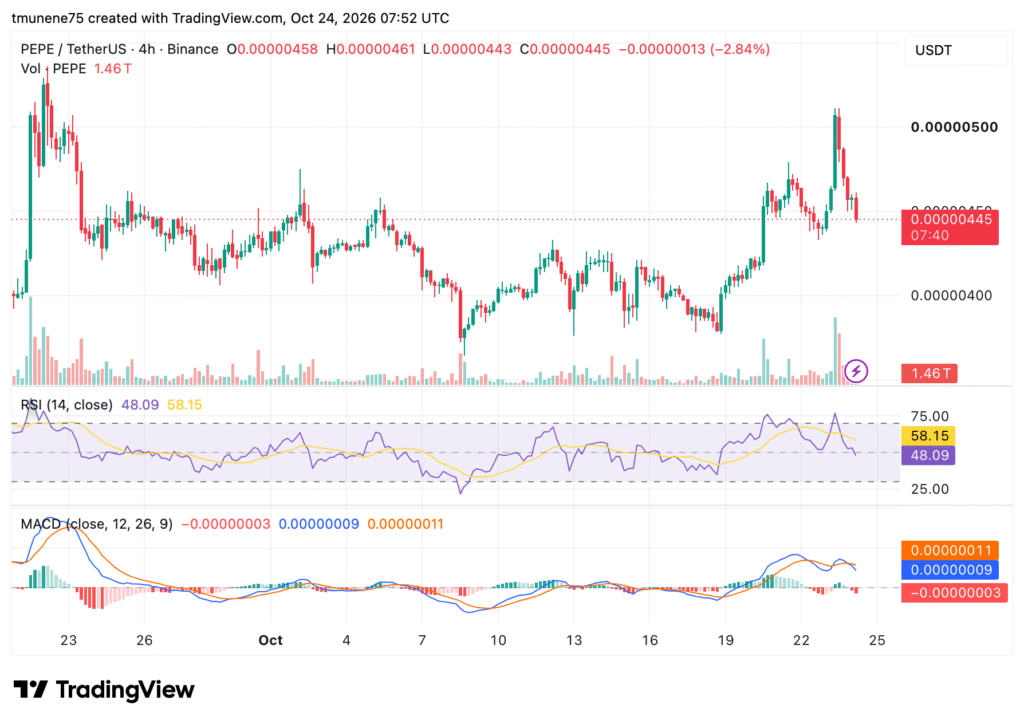
Artikel
Übersetzung ansehen
PEPE Rally Faces $0.00000440 Test as Exchange Flows ShiftPEPE rose about 13% from October 17–22, but exchanges regained 2.11 trillion tokens, reversing over 40% of October 16 withdrawals.
PEPE retreated from $0.00000510 to $0.00000445 as RSI fell to 48.09 and MACD turned negative, signaling weaker momentum.
Analyst Giannis Andreou sees $0.00000500 as a breakout level, with $0.00000727 possible if resistance breaks and holds on a retest.
PEPE gained about 13% between October 17 and 22, but renewed exchange inflows and weakening technical momentum now challenge the rally. Santiment Intelligence reported that exchanges recovered more than 40% of the 4.77 trillion tokens withdrawn on October 16. Meanwhile, analyst Giannis Andreou identified a symmetrical triangle, as PEPE retreated from $0.00000510 toward immediate support.
Exchange Inflows Reverse Part of PEPE’s Supply Decline
Santiment reported that PEPE’s exchange supply fell by 4.77 trillion tokens on October 16, a 6% decline and its largest daily drop since at least October 2. The same day recorded 15 transfers exceeding $1 million and approximately $20 million in net exchange outflows.
Those outflows ran about eight times the October 11–15 average. Subsequently, PEPE rose around 13% from its October 17 close to its October 22 close, while Bitcoin and Ethereum finished roughly flat.
However, exchange supply increased by 2.11 trillion PEPE between October 19 and 22. Net inflows occurred on October 20, 21 and 22, reversing more than 40% of October 16’s withdrawals.
PEPE Price Rejection Weakens Short-Term Momentum
PEPE recently climbed from around 0.00000380–0.00000400, briefly breaking above $0.00000500 before facing resistance near $0.00000510. The four-hour chart shows a pullback to $0.00000445, with the latest candle declining 2.84%.
Source: TradingView
Trading volume reached 1.46 trillion PEPE amid elevated activity during the rally and subsequent sell-off. Immediate support sits at 0.00000440–0.00000445, followed by $0.00000420 and $0.00000400. Buyers would need to reclaim 0.00000460–0.00000470 to challenge the recent peak.
The Relative Strength Index is at 48.09, below its 58.15 moving average and the neutral 50 threshold. Meanwhile, the MACD line at 0.00000009 remains below its 0.00000011 signal line, with a negative histogram of -0.00000003.
Analyst Maps Triangle Breakout Levels
Andreou said PEPE is consolidating between falling resistance and rising support. A pullback toward $0.00000410 could precede a breakout attempt.
https://twitter.com/gandreou007/status/2113654178576728267?s=20
A daily close above descending resistance would put $0.00000500 in focus. If PEPE holds that trendline during a retest, $0.00000727 becomes the next target. However, a daily breakdown below rising support followed by a failed reclaim would weaken the setup.
PEPE Rally Faces $0.00000440 Test as Exchange Flows Shift
PEPE rose about 13% from October 17–22, but exchanges regained 2.11 trillion tokens, reversing over 40% of October 16 withdrawals.
PEPE retreated from $0.00000510 to $0.00000445 as RSI fell to 48.09 and MACD turned negative, signaling weaker momentum.
Analyst Giannis Andreou sees $0.00000500 as a breakout level, with $0.00000727 possible if resistance breaks and holds on a retest.
PEPE gained about 13% between October 17 and 22, but renewed exchange inflows and weakening technical momentum now challenge the rally. Santiment Intelligence reported that exchanges recovered more than 40% of the 4.77 trillion tokens withdrawn on October 16. Meanwhile, analyst Giannis Andreou identified a symmetrical triangle, as PEPE retreated from $0.00000510 toward immediate support.
Exchange Inflows Reverse Part of PEPE’s Supply Decline
Santiment reported that PEPE’s exchange supply fell by 4.77 trillion tokens on October 16, a 6% decline and its largest daily drop since at least October 2. The same day recorded 15 transfers exceeding $1 million and approximately $20 million in net exchange outflows.
Those outflows ran about eight times the October 11–15 average. Subsequently, PEPE rose around 13% from its October 17 close to its October 22 close, while Bitcoin and Ethereum finished roughly flat.
However, exchange supply increased by 2.11 trillion PEPE between October 19 and 22. Net inflows occurred on October 20, 21 and 22, reversing more than 40% of October 16’s withdrawals.
PEPE Price Rejection Weakens Short-Term Momentum
PEPE recently climbed from around 0.00000380–0.00000400, briefly breaking above $0.00000500 before facing resistance near $0.00000510. The four-hour chart shows a pullback to $0.00000445, with the latest candle declining 2.84%.
Source: TradingView
Trading volume reached 1.46 trillion PEPE amid elevated activity during the rally and subsequent sell-off. Immediate support sits at 0.00000440–0.00000445, followed by $0.00000420 and $0.00000400. Buyers would need to reclaim 0.00000460–0.00000470 to challenge the recent peak.
The Relative Strength Index is at 48.09, below its 58.15 moving average and the neutral 50 threshold. Meanwhile, the MACD line at 0.00000009 remains below its 0.00000011 signal line, with a negative histogram of -0.00000003.
Analyst Maps Triangle Breakout Levels
Andreou said PEPE is consolidating between falling resistance and rising support. A pullback toward $0.00000410 could precede a breakout attempt.
https://twitter.com/gandreou007/status/2113654178576728267?s=20
A daily close above descending resistance would put $0.00000500 in focus. If PEPE holds that trendline during a retest, $0.00000727 becomes the next target. However, a daily breakdown below rising support followed by a failed reclaim would weaken the setup.
PEPE retreated from $0.00000510 to $0.00000445 as RSI fell to 48.09 and MACD turned negative, signaling weaker momentum.
Analyst Giannis Andreou sees $0.00000500 as a breakout level, with $0.00000727 possible if resistance breaks and holds on a retest.
PEPE gained about 13% between October 17 and 22, but renewed exchange inflows and weakening technical momentum now challenge the rally. Santiment Intelligence reported that exchanges recovered more than 40% of the 4.77 trillion tokens withdrawn on October 16. Meanwhile, analyst Giannis Andreou identified a symmetrical triangle, as PEPE retreated from $0.00000510 toward immediate support.
Exchange Inflows Reverse Part of PEPE’s Supply Decline
Santiment reported that PEPE’s exchange supply fell by 4.77 trillion tokens on October 16, a 6% decline and its largest daily drop since at least October 2. The same day recorded 15 transfers exceeding $1 million and approximately $20 million in net exchange outflows.
Those outflows ran about eight times the October 11–15 average. Subsequently, PEPE rose around 13% from its October 17 close to its October 22 close, while Bitcoin and Ethereum finished roughly flat.
However, exchange supply increased by 2.11 trillion PEPE between October 19 and 22. Net inflows occurred on October 20, 21 and 22, reversing more than 40% of October 16’s withdrawals.
PEPE Price Rejection Weakens Short-Term Momentum
PEPE recently climbed from around 0.00000380–0.00000400, briefly breaking above $0.00000500 before facing resistance near $0.00000510. The four-hour chart shows a pullback to $0.00000445, with the latest candle declining 2.84%.
Source: TradingView
Trading volume reached 1.46 trillion PEPE amid elevated activity during the rally and subsequent sell-off. Immediate support sits at 0.00000440–0.00000445, followed by $0.00000420 and $0.00000400. Buyers would need to reclaim 0.00000460–0.00000470 to challenge the recent peak.
The Relative Strength Index is at 48.09, below its 58.15 moving average and the neutral 50 threshold. Meanwhile, the MACD line at 0.00000009 remains below its 0.00000011 signal line, with a negative histogram of -0.00000003.
Analyst Maps Triangle Breakout Levels
Andreou said PEPE is consolidating between falling resistance and rising support. A pullback toward $0.00000410 could precede a breakout attempt.
https://twitter.com/gandreou007/status/2113654178576728267?s=20
A daily close above descending resistance would put $0.00000500 in focus. If PEPE holds that trendline during a retest, $0.00000727 becomes the next target. However, a daily breakdown below rising support followed by a failed reclaim would weaken the setup.
299
Anmelden und weiter Inhalte entdecken
Krypto-Nutzer weltweit auf Binance Square kennenlernen
⚡️ Bleib in Sachen Krypto stets am Puls.
💬 Die weltgrößte Kryptobörse vertraut darauf.
👍 Erhalte verlässliche Einblicke von verifizierten Creators.
E-Mail-Adresse/Telefonnummer
Trendthemen
BinancePick
3M Aufrufe
152,488 Kommentare
Mach bei #Gewinnsaison mit: Prognostiziere Unternehmensergebnisse auf Binance Pick und teile deine Meinung auf Binance Square!
Binance Square Official
·409 Likes
·342.9k Aufrufe
EarningsSeason
5.3M Aufrufe
25,926 Kommentare
AnthropicTTMRevenueGrewAbout1200%
26,659 Aufrufe
387 Kommentare