

Banks are moving onto blockchain infrastructure, but there's a question I think deserves more attention:
Who actually holds the keys?
When a traditional bank adopts blockchain technology, it doesn't automatically become decentralized. The technology may change how transactions are processed, recorded and verified, but control can still remain with banks and network operators.
I investigated Keybank involvement in several blockchain-based banking initiatives. As part of my research through @DAO Labs , I wanted to understand what's being built, what is confirmed, and where important questions remain.
KeyBank's blockchain involvement
KeyBank is a US financial institution with roots dating back to 1825. Its blockchain involvement isn't primarily about launching a retail cryptocurrency. The initiatives I found focus on tokenized deposits, institutional settlement and blockchain-based financial infrastructure.
1. Cari Network
KeyBank is one of Cari Network's six original design partner banks, alongside First Horizon, Huntington, M&T, Old National and SouthState.
On September 2, 2026, Cari announced $32.5 million in initial funding backed entirely by banks. Its goal is to build blockchain infrastructure for financial institutions.
Cari uses ZKsync's Prividium technology, designed to support private and permissioned blockchain environments.
Cari's development progress is worth following, but it's important to distinguish its development milestones from a fully operational, widely deployed banking network.
2. FIS Project Keystone
On April 30, 2026, FIS announced Project Keystone, a collaboration with financial institutions, including KeyBank, to develop a bank-owned and administered network for digital forms of regulated deposits.
The initiative explores how regulated institutions can use tokenized money while maintaining the banking framework surrounding those deposits.
3. The Clearing House On-Chain Money Initiative
On September 24, 2026, The Clearing House announced Quant as its technology partner for an initiative exploring tokenized deposits.
KeyBank is among the participating institutions, and the network is expected to become available in the first half of 2027.
These developments suggest that traditional financial institutions are actively exploring blockchain-based money and settlement infrastructure.
But an announcement, development project, pilot and production system are four different things. I don't think we should treat them as interchangeable.
How does Prividium work?
Cari's use of ZKsync Prividium is particularly interesting because it highlights the balance between private financial activity and public cryptographic verification.
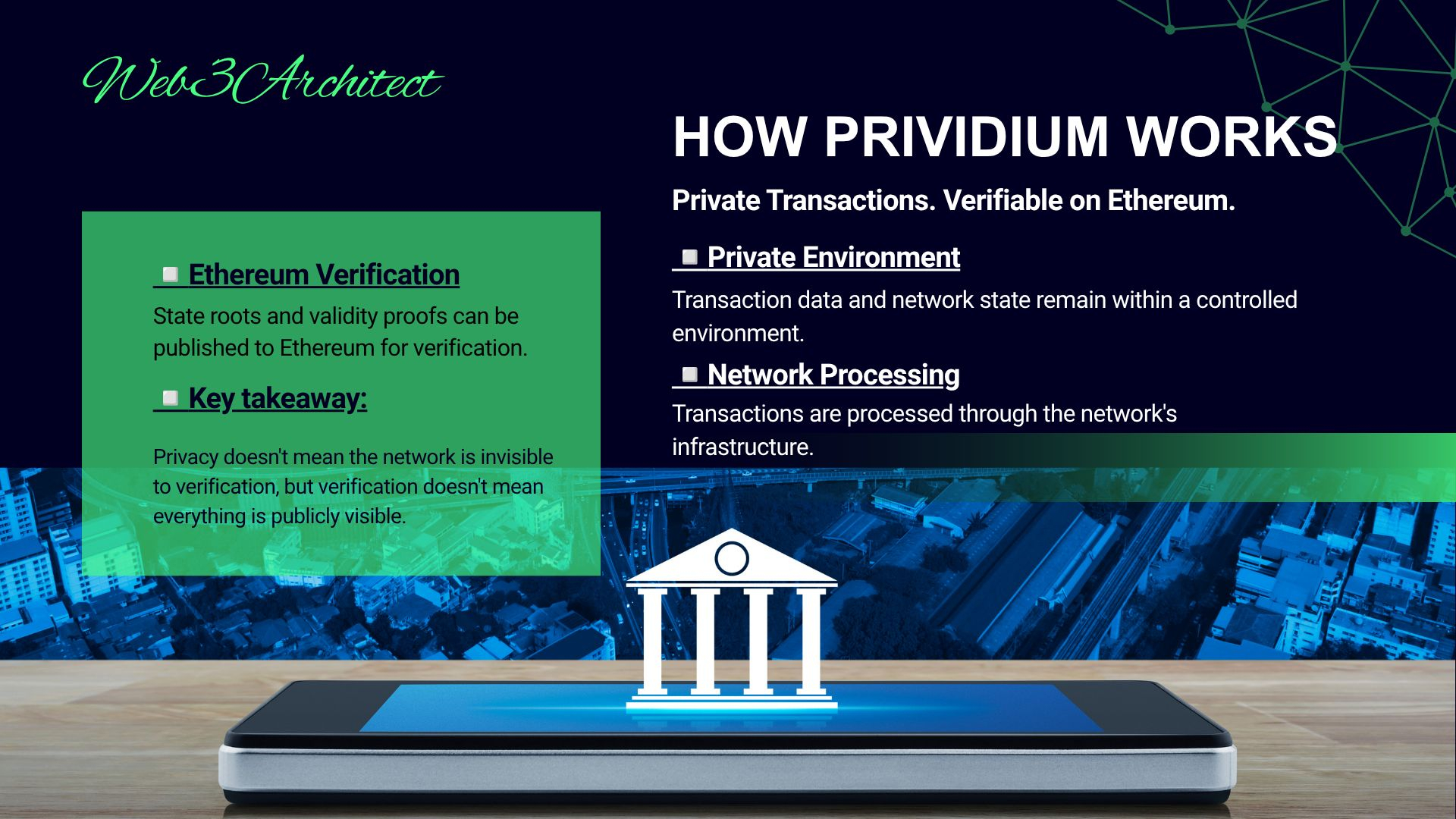
Prividium is designed to operate in a private, permissioned environment while using Ethereum for verification.
In simplified terms, the architecture works like this:
The private environment: Transaction data and network state remain within an operator-controlled environment rather than being fully exposed on a public blockchain.
The network layer: Transactions are processed through the network's infrastructure, including its sequencer.
The Ethereum layer: State roots and cryptographic validity proofs can be published to Ethereum, allowing aspects of the system's correctness to be verified.
This architecture is intended to give institutions privacy and controlled participation while retaining cryptographic verification.
But here's an important distinction:
Ethereum verifying a cryptographic proof does not mean Ethereum can see every private transaction.
It also doesn't mean anyone can freely join the network, inspect its complete ledger or transact without permission.
Verification and transparency are related, but they are not the same thing.
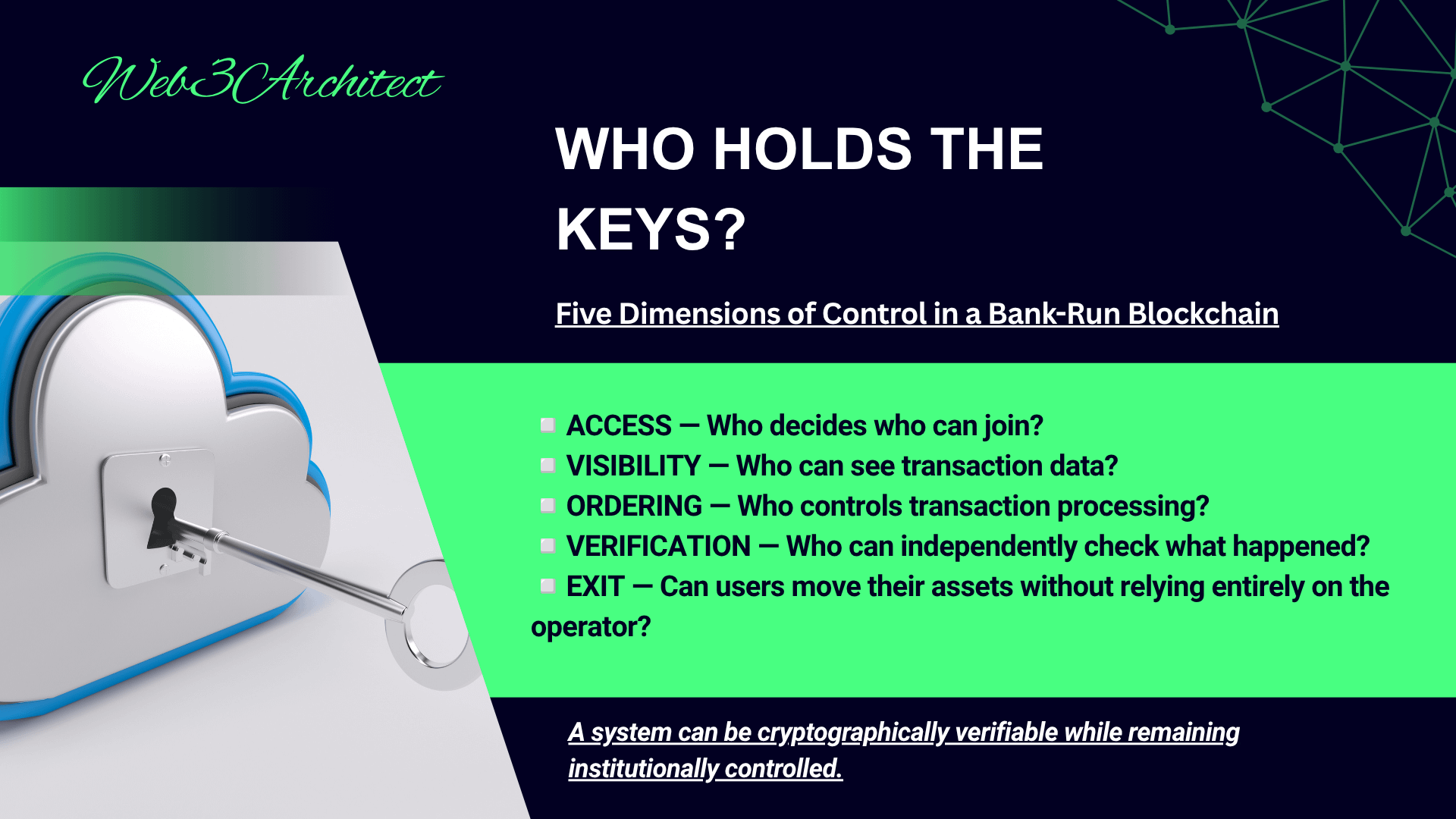
Who holds the keys? My five-axis assessment
Rather than judging the system simply by whether it uses blockchain, I think we should examine where control sits.
I looked at five dimensions.
Access — Who can join?
On a permissioned network, participation isn't open in the same way as public Ethereum.
Banks, network operators and administrators manage permissions and determine which participants can access the environment.
This makes institutional compliance and controlled participation easier, but it also means access isn't universal.
Visibility — Who can see the data?
Private transaction data is managed within the controlled environment.
The operator, banks and authorized auditors may have different levels of access, depending on their roles and permissions.
A public blockchain allows outsiders to inspect publicly available transaction data. A private banking network doesn't necessarily offer the same visibility to customers or independent observers.
Ordering — Who decides which transactions are processed?
The network's sequencer handles transaction ordering.
This helps coordinate transactions, but it also introduces an important point of control. Depending on the architecture and permissions, operators may have the ability to restrict or filter transactions.
This is one of the trade-offs that deserves attention when evaluating institutional blockchain infrastructure.
Verification — Who can check that things happened correctly?
Cryptographic validity proofs can allow verification of aspects of transaction processing without revealing all private transaction data.
Ethereum can verify published proofs, while authorized auditors may be able to examine private records according to their permissions.
However, verifying a proof isn't equivalent to independently inspecting the entire underlying ledger.
Exit — Can customers move their assets away?
This is probably the dimension I find most important.
If the operator becomes unavailable, restricts access or experiences an operational failure, can customers independently retrieve their assets and records?
The answer depends on the network's withdrawal arrangements, data availability, recovery mechanisms and the roles of the bank and operator.
This is my analytical assessment of a Prividium-style architecture, not a confirmed breakdown of KeyBank's actual administrative key allocations.
Verifiable doesn't automatically mean decentralized
This is where I think institutional blockchain discussions can become misleading.
A system can use cryptographic proofs, connect to Ethereum and provide verifiable transaction processing while still having significant institutional control over participation, visibility, transaction ordering and exit.
That doesn't automatically make the architecture bad.
Banks have regulatory obligations, privacy requirements and responsibilities to customers. They may not want or be able to operate on a completely open network.
But those requirements don't eliminate the need to examine governance.
The question is not simply:
Is blockchain being used?
It's also:
- Who controls access?
- Who can restrict transactions?
- Who manages the underlying data?
- What can customers independently verify?
- What happens if the operator becomes unavailable?
These questions matter because the technology itself doesn't answer all of them.
KeyBank isn't the only institution exploring this
This isn't limited to KeyBank.
Deutsche Bank's Project DAMA 2 also explores institutional digital asset servicing and tokenization using ZKsync-based technology.
The broader financial industry is experimenting with different approaches to tokenized deposits, digital settlement and institutional blockchain infrastructure.
But I wouldn't conclude that one architecture has already become the industry standard.
Different projects have different goals, participants, technologies and stages of development.
Three questions I'd ask KeyBank
If I could ask keybank three questions about these initiatives, they would be:
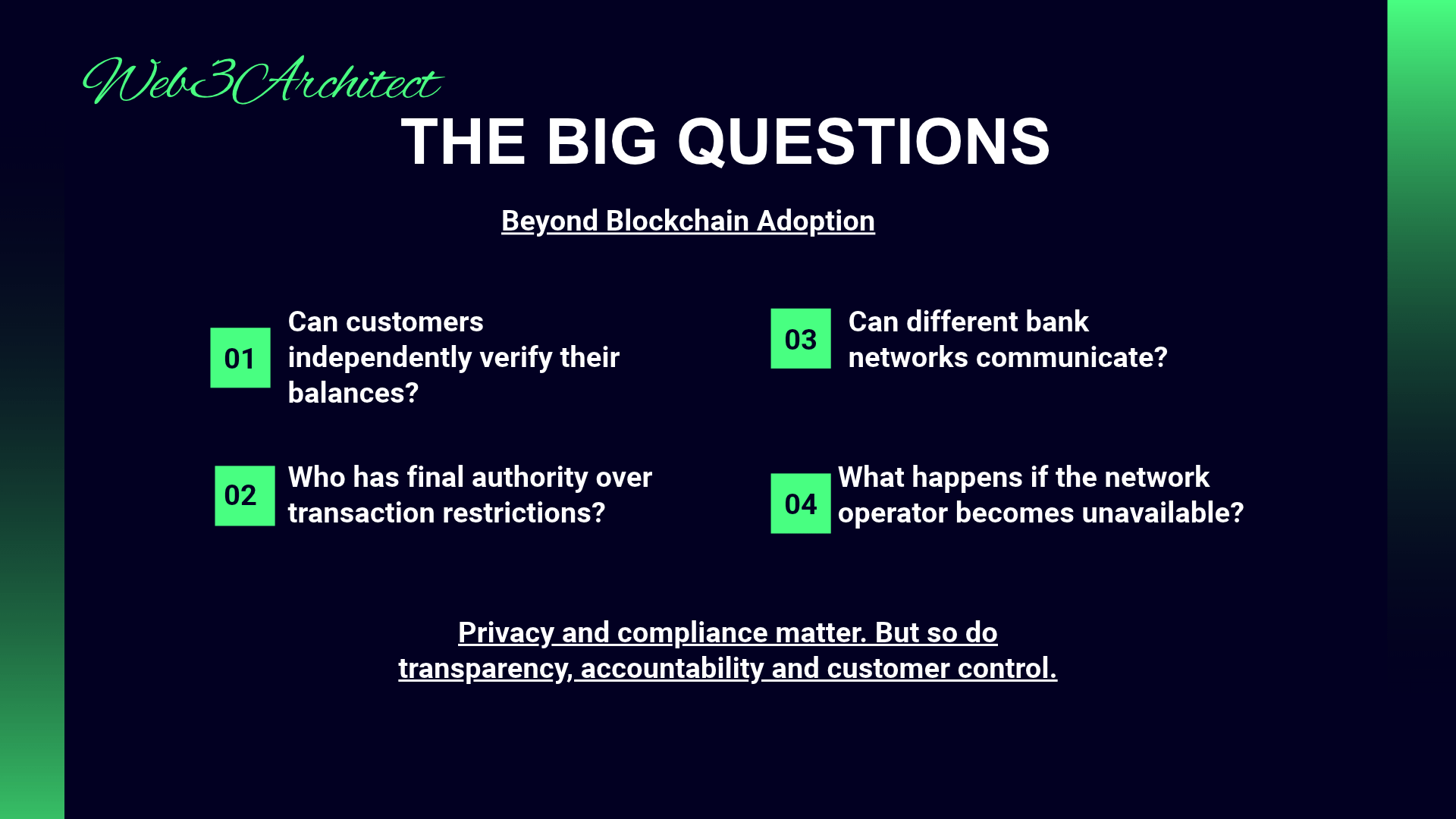
1. Can customers independently verify their tokenized deposit balances?
Not just through a bank interface, but through meaningful verification mechanisms that give customers confidence in the information they're receiving.
2. Who has final authority over transaction restrictions?
What are the governance rules, who can intervene, and how are those decisions managed?
3. What happens if the network operator becomes unavailable?
Can customers retrieve their assets and records? Are there reliable recovery and exit mechanisms that don't depend entirely on the operator's continued availability?
I'd be more optimistic about these systems with transparent governance, meaningful verification tools, interoperability and reliable exit mechanisms.
My conclusion
I think blockchain-based banking infrastructure is worth paying attention to.
Tokenized deposits and private blockchain networks may improve settlement, coordination and the way financial institutions interact. Cryptographic verification can also provide valuable assurances without requiring every transaction to be publicly visible.
But I don't think institutional blockchain adoption should automatically be labelled decentralization.
A system can be private, efficient and cryptographically verifiable while remaining institutionally controlled.
For me, the important question is whether these systems can combine the benefits of privacy and compliance with meaningful transparency, accountability and customer control.
Because ultimately, the question isn't just whether transactions happen on-chain. It's who holds the keys, who controls the system, and what options users have when that control matters.
Independent research based on public sources. Not affiliated with any organization mentioned