
When I look at the blockchain industry, one question keeps coming to mind: What happens when blockchain technology stops being something people simply invest in and starts becoming something they actually use in everyday life?
That's where Celo caught my attention.
Many blockchain projects compete over transaction speed, scalability, and new technologies. Celo is taking a slightly different direction. Its focus is on making digital money easier to access, transfer, and use, particularly through mobile devices and stablecoins.
But there is much more happening with Celo than its original mobile-first vision. Its transition to Ethereum Layer 2, growing stablecoin ecosystem, MiniPay expansion, and new infrastructure for AI-powered payments make it an interesting project to understand.
Let's explore what is changing and why it matters.
1. What Exactly Is Celo?
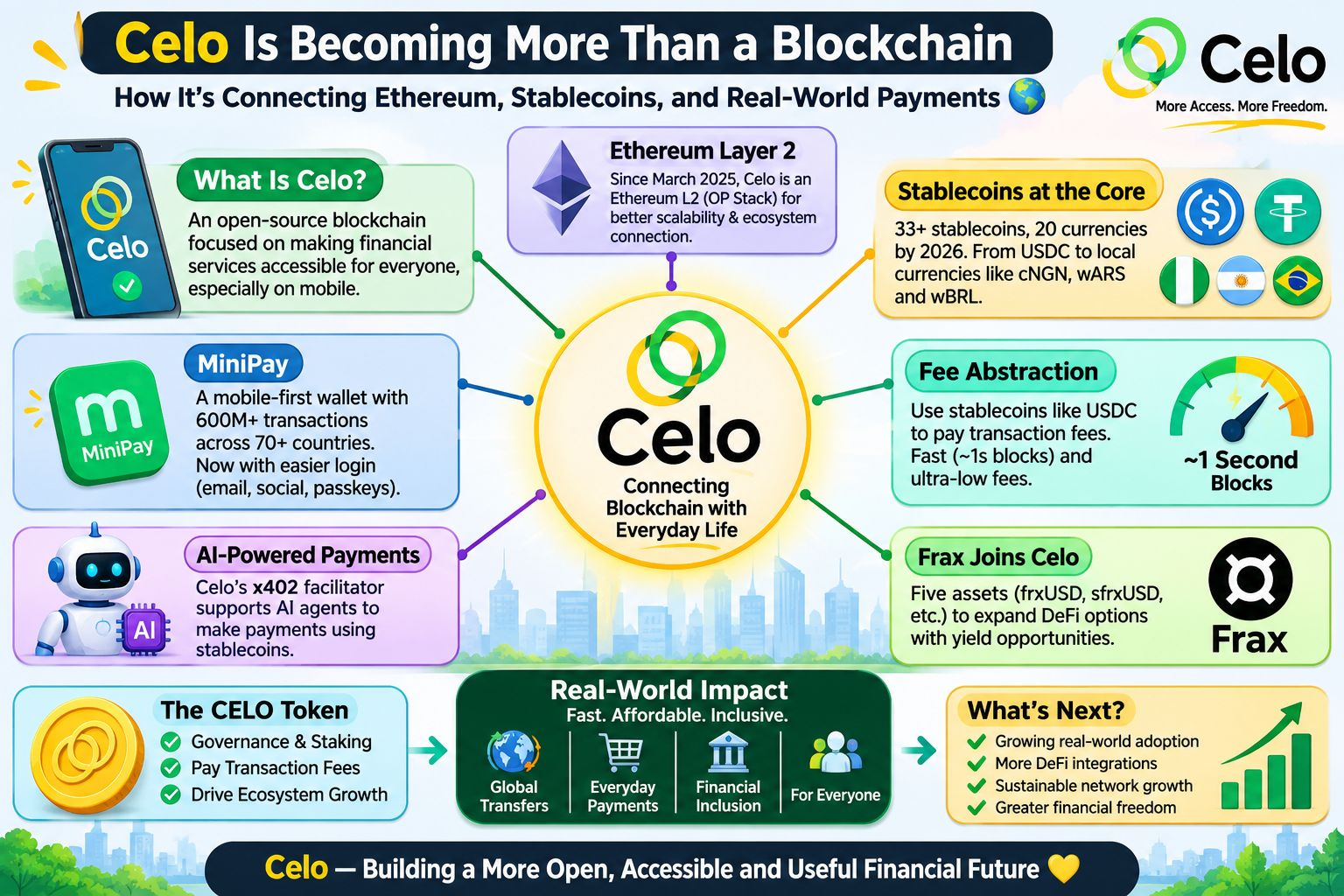
Celo is an open-source blockchain ecosystem designed to make financial services more accessible.
Its original vision was simple: people should be able to send, receive, and use digital money without needing complicated financial infrastructure.
Think about someone who wants to send money to family in another country. Traditional financial services can involve multiple intermediaries, delays, and expensive fees.
Celo aims to make these transactions faster and more affordable through blockchain technology.
It supports smart contracts, decentralized applications, stablecoins, and financial services while maintaining a strong focus on mobile accessibility.
One important thing to understand is that Celo is not just a payment application. It is the underlying infrastructure on which developers can build financial products.
2. The Biggest Change: Celo Became an Ethereum Layer 2
This is one of the most important developments in Celo's history.
On March 26, 2025, Celo officially transitioned from an independent Layer 1 blockchain to an Ethereum Layer 2 built using the OP Stack.
Why does this matter?
A Layer 1 blockchain operates with its own consensus and security infrastructure. A Layer 2 processes transactions separately while connecting to an underlying blockchain such as Ethereum.
By becoming an Ethereum L2, Celo gained a closer connection to Ethereum's ecosystem, including its developer infrastructure, interoperability, and settlement framework.
The migration also preserved Celo's existing network history and ecosystem.
But Celo did not simply copy another Layer 2.
It continued developing features that make its network different, especially around mobile payments, stablecoin transactions, and low transaction costs.
Its architecture also uses EigenDA for data availability and OP Succinct Lite for proof-based dispute resolution.
In simple terms, Celo is trying to combine Ethereum compatibility with infrastructure designed for everyday financial activity.
3. Stablecoins Are at the Center of Celo's Strategy
This is where I think Celo becomes particularly interesting.
Stablecoins are digital assets designed to maintain a relatively stable value, often by tracking a currency such as the US dollar.
Unlike Bitcoin or many other cryptocurrencies, stablecoins are not primarily designed around price appreciation.
Their usefulness comes from transferring and holding value.
Celo has been expanding its stablecoin ecosystem beyond dollar-based assets.
By September 2026, its ecosystem reported 33 live stablecoins representing 20 currencies.
That includes assets connected to different local markets, such as:
- USDC and USD₮ for dollar-based transactions.
- cNGN for the Nigerian naira.
- wARS for the Argentine peso.
- wBRL for the Brazilian real.
- IDRX for the Indonesian rupiah.
Why is this important?
Imagine a person in Nigeria receiving digital money in a currency relevant to their local economy, while another person in Brazil uses a Brazilian real-based stablecoin.
This creates opportunities for local payments and onchain currency exchange without forcing every transaction into the same financial system.
The bigger idea is to connect global digital money with local financial needs.
4. MiniPay: Bringing Blockchain Closer to Everyday Users
Technology becomes meaningful when people can actually use it.
That's why MiniPay deserves attention in the Celo ecosystem.
MiniPay is a self-custodial stablecoin wallet developed by Opera and built on Celo. It was designed to make sending and receiving digital dollars easier through a mobile-friendly experience.
In November 2026, MiniPay announced an important upgrade: its 20 million-plus activated wallets are moving to Privy, the wallet infrastructure company owned by Stripe.
What makes this development interesting?
Users will be able to access their wallets using familiar options such as email, social accounts, and passkeys instead of having to manage a traditional seed phrase.
Importantly, MiniPay remains self-custodial, meaning users retain control of their funds and can export their keys.
The announcement also reported more than 600 million transactions across over 70 countries and 77 Mini Apps.
This is an important distinction: blockchain adoption does not always begin with someone understanding smart contracts or gas fees. Sometimes it begins with a simple wallet that makes sending digital money easier.
5. Celo Is Making Transactions Easier Through Fee Abstraction
Here is another feature that deserves more attention.
On many blockchains, users need the network's native token to pay transaction fees.
For newcomers, this can create an unnecessary complication.
Imagine holding USDC but needing to purchase another cryptocurrency just to send it.
Celo addresses this problem through fee abstraction.
It allows supported ERC-20 tokens, including stablecoins, to be used for transaction fees.
This means users can interact with applications without always needing to maintain a separate balance of CELO for gas.
Celo also offers approximately one-second block times and sub-cent average transaction fees according to its current network information.
For payment applications, these details matter because users generally care more about completing a transaction smoothly than understanding the technical process behind it.
6. A New Direction: Celo and AI-Powered Payments
One of the newer developments I find particularly interesting is Celo's work around autonomous AI agents.
AI agents are software systems that can perform tasks and interact with other services.
In the future, some agents may need to purchase data, access APIs, pay for computing resources, or exchange services without requiring a human to approve every individual transaction.
But how would these agents make payments?
This is where payment infrastructure such as x402 becomes relevant.
Celo has developed a native x402 facilitator that supports stablecoin-based payments for agents.
In October 2026, Celo expanded this infrastructure to support 10 stablecoins across eight currencies, including US dollars, Nigerian naira, and several Latin American currencies.
This opens an interesting possibility: AI agents could potentially transact using digital currencies that better match the local markets they serve.
It is still an emerging area, but it shows that Celo is exploring use cases beyond traditional human-to-human payments.
7. A Fresh Development: Frax Joins the Celo Ecosystem
There is another recent development worth highlighting.
On November 24, 2026, Frax brought five assets to Celo:
- frxUSD
- sfrxUSD
- WFRAX
- frxETH
- sfrxETH
One particularly interesting asset is sfrxUSD, a yield-bearing stablecoin designed to provide a savings option within DeFi.
Celo Core Co. also announced an allocation of up to $9 million of reserve collateral into sfrxUSD, while Frax committed to buying and holding native CELO.
Why does this matter?
A healthy financial ecosystem needs more than payment infrastructure. It also needs ways to save, borrow, provide liquidity, and use assets across different applications.
Integrations like this can expand the financial products available to users and developers.
Of course, yield-bearing assets also come with smart-contract, liquidity, and market risks that users should understand.
8. What Is the Role of the CELO Token?
Understanding the network without understanding its native token would leave an important part of the picture missing.
CELO is the native token of the Celo ecosystem.
It has several roles, including:
- Participating in network governance.
- Supporting staking and network security.
- Paying transaction fees.
- Participating in the ecosystem's economic structure.
Celo's 2026 CELOccelerate tokenomics initiative also introduced changes aimed at connecting network usage with token economics.
According to Celo's September 2026 ecosystem update, net sequencer revenue is being converted into CELO through programmatic buybacks and directed to the Community Fund.
This creates an important question for anyone studying the project:
Can increasing network usage translate into sustainable economic value for the ecosystem and its token holders?
That is something worth following over time rather than assuming that more transactions automatically mean a higher token price.
9. What Should We Watch Next?
I believe Celo's next chapter should be judged by actual adoption, not just announcements.
There are several things worth watching:
Real stablecoin usage: Are people consistently using these assets for payments, savings, and transfers?
MiniPay growth: Can its growing wallet base translate into regular active users and meaningful financial activity?
Developer adoption: Are more applications choosing Celo because its infrastructure solves real problems?
AI payment activity: Can autonomous agents develop sustainable economic activity rather than generating temporary transaction numbers?
Network economics: Can the growing use of Celo create lasting value for its ecosystem and CELO token?
These questions will tell us much more about the project's long-term direction than promotional headlines alone.
Final Thoughts
What makes Celo interesting to me is that its story is gradually expanding.
It started with a vision of making financial services accessible through mobile phones. Today, it is building around Ethereum Layer 2 infrastructure, local-currency stablecoins, self-custodial wallets, DeFi integrations, and payments for AI agents.
The most important part is not how many technical features a blockchain can introduce. It is whether those features solve problems that people and businesses actually face.
Celo still has challenges to overcome, particularly around sustainable adoption, infrastructure security, and converting network activity into long-term economic value.
But its direction raises an important question for the wider industry:
What if the next major blockchain breakthrough isn't another complicated financial product, but making digital money so easy to use that people no longer need to think about the blockchain behind it?
That is the kind of evolution I will be watching from Celo.