


Researchers recommend Keccak-256 for Ethereum post-quantum hash-based cryptography. Doubling down on Keccak-256 avoids adding a third general-purpose hash alongside SHA2-256, drawing on nearly two decades of cryptanalysis and a large security margin. The design relies on symmetric primitives derived from the Keccak-f permutation, including Keccak-256 for standard hashing, Keccak-duplex for Fiat-Shamir transformations, and SHAKE256 for pseudorandom bit generation.
For years, zkVM proving throughput served as the primary engineering bottleneck. The previous working assumption held that post-quantum signatures would require algebraic, zero-knowledge friendly hashes like Poseidon to achieve acceptable proving speed at the expense of well-studied security. That historical tradeoff has disappeared because binary-field proof systems and GKR-based provers now prove standard hash functions at or well above the network performance threshold.
In the target post-quantum design, signature verification, blob handling, and recursive aggregation run inside leanVM. Proving costs must remain low enough to prevent aggregation bottlenecks, requiring roughly 500,000 hashes per second. This benchmark maps to roughly 1,000 attestations per second to cover a consensus layer committee on EIP-7870 equivalent hardware. LeanVM achieves over 500,000 Keccak-f permutations per second on such hardware, satisfying required throughput.

Researchers reviewed five candidate hashes before narrowing the field. Algebraic candidates Poseidon and Poseidon2 face ongoing cryptanalysis on round-reduced instances, removing the rationale to deploy them now that standard hashes prove fast enough. High-speed candidate BLAKE3 reaches 2.2 million compressions per second on 16-vCPU hardware, but reduces rounds to seven, lacks a mode-of-operation security proof, and has a sparse cryptanalytic record compared to older hashes.
The evaluation narrowed to protocol incumbents SHA2-256 and Keccak-256. SHA2-256 is fast natively and used in consensus SSZ structures, but practical collisions reach 35 of 64 rounds and best attacks reach 38 rounds. Its Merkle-Damgard structure allows length extension, preventing direct treatment as a random oracle without extra constructions like HMAC. In contrast, Keccak-256 uses a sponge construction provably indifferentiable from a random oracle under ideal permutation assumptions.
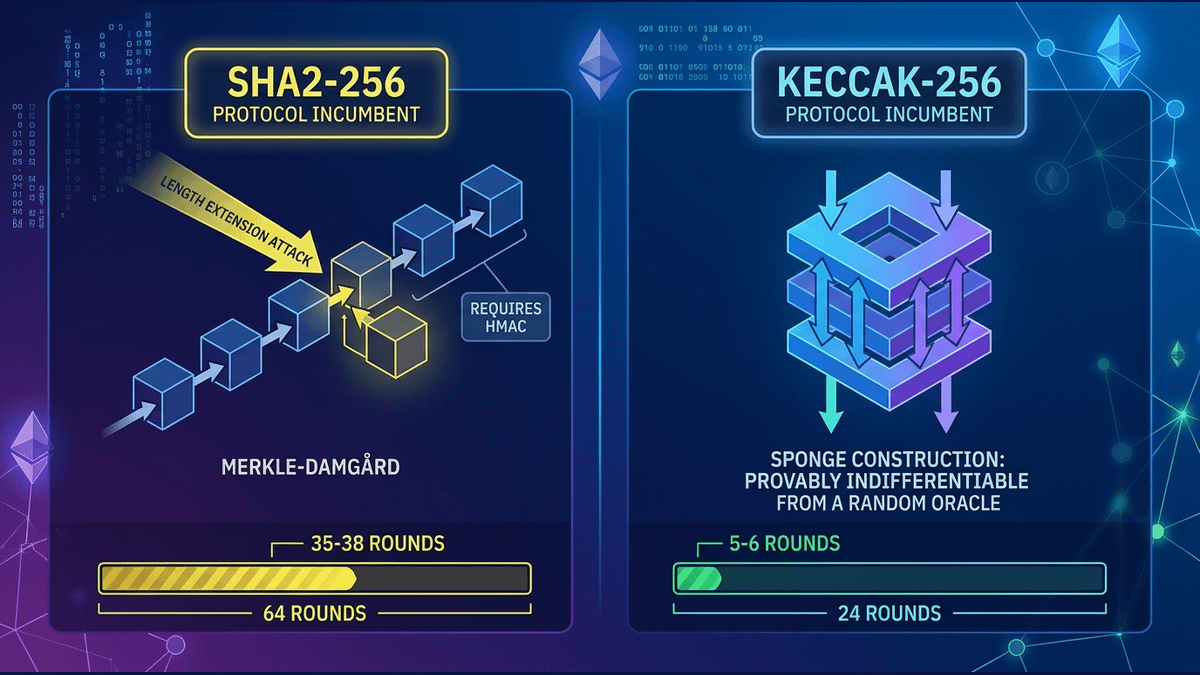
Keccak-256 maintains a wider defensive margin, with practical collision attacks reaching five of 24 rounds and theoretical attacks reaching six on the underlying permutation. While Keccak-256 is natively slower than SHA2-256 and slower to prove than BLAKE3, researchers accepted that relative cost for superior cryptanalytic security. Ethereum already features a native KECCAK256 opcode, and using it avoids redundant code paths required by near-identical standards like SHA3-256.
