
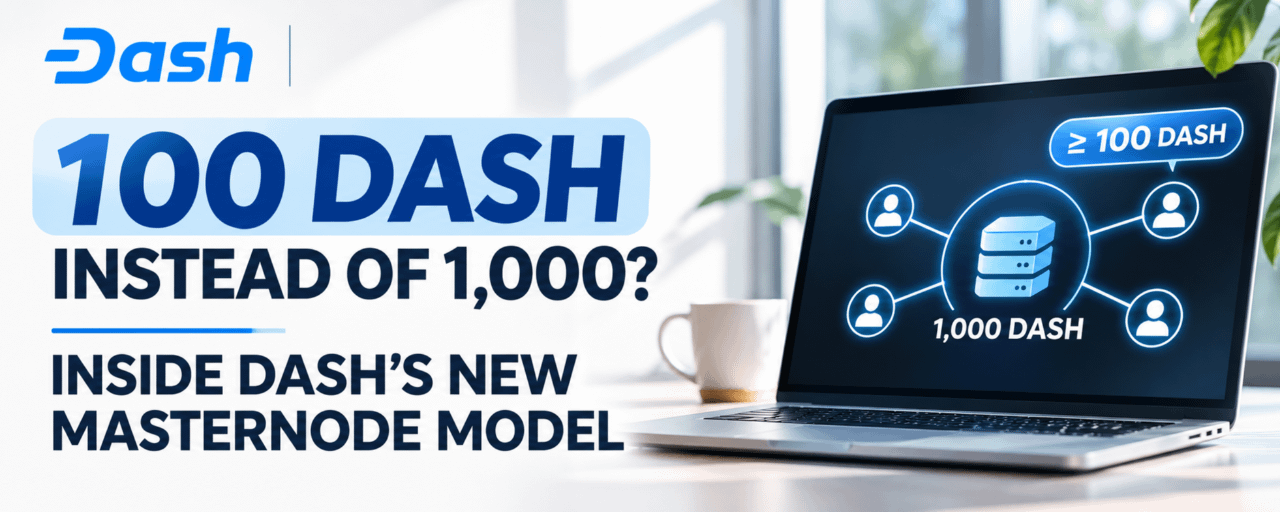


Dash Core v24 introduces a way for holders to participate in masternode ownership with as little as 100 DASH, compared with the traditional individual collateral requirement of 1,000 DASH.
The software arrived in November 2026, although the network upgrade still awaits activation. For smaller holders, the change could make earning native masternode rewards considerably more accessible.
How does shared ownership work?
According to Dash's official documentation, accessed on November 27, between two and eight participants can collectively fund a regular masternode.
Each participant must contribute at least 100 DASH, while the combined collateral must equal exactly 1,000 DASH.
Consider a masternode funded by four holders contributing 400, 300, 200 and 100 DASH respectively. The protocol distributes the owner's portion of masternode rewards according to those contributions.
Someone providing 100 DASH would receive 10% of that portion, without relying on another participant to manually distribute the payments.
The blockchain also records each participant's designated refund address. This reduces the custody risk associated with conventional pooling arrangements where one party controls the entire collateral.
What happens when someone wants to leave?
This is where the design gets interesting.
DIP-0035 allows any individual participant to dissolve the entire shared masternode, regardless of how much collateral they contributed.
A holder providing just 100 DASH could therefore initiate the dissolution of a node containing 1,000 DASH.
Participants can agree on an early-exit penalty when establishing the node. If someone dissolves it independently during that period, the protocol deducts the agreed penalty from their share and distributes it among the remaining participants.
Everyone receives their respective collateral back, subject to the applicable penalty and transaction fee.
The arrangement reduces dependence on a central custodian, although participants remain financially dependent on each other's willingness to maintain the node.
Will this increase demand for DASH?
The new minimum contribution represents a 90% reduction in the individual capital barrier.
However, every regular masternode still requires the same total collateral of 1,000 DASH. If existing masternode owners simply reorganize their holdings into shared arrangements, the amount of collateral across the network may barely change.
Additional demand would come from holders committing coins that previously remained outside the masternode system.
Evolution masternodes, which require 4,000 DASH and receive fees from Dash Platform, will need a separate network activation before supporting shared ownership.
The rollout has also experienced delays. A community report covering the November 24 Dash Core Group development update indicates that v24 could activate around December 15, rather than the earliest November 28 date mentioned in the original release announcement.
That revised schedule remains conditional on network readiness.
For DASH holders, the useful measurement after activation will be the net change in collateral committed to active masternodes. A growing number of shared registrations alone would reveal little about additional demand if those registrations merely replace existing nodes.
Would you commit 100 DASH to a shared masternode knowing another participant could dissolve it?
