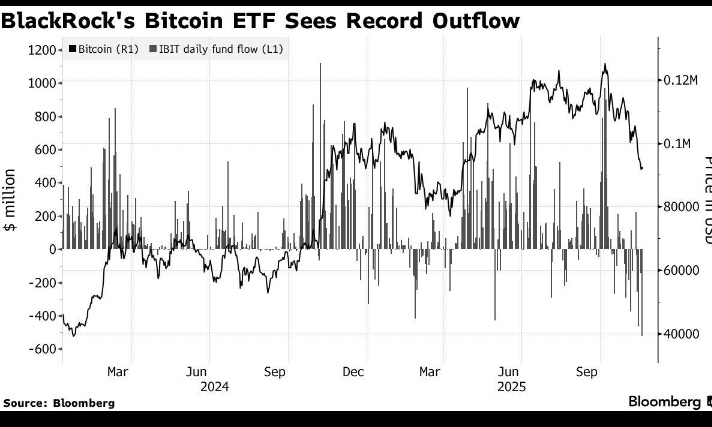

LI have been watching Bitcoin's recent price Bitcoin's Biggest Problem Isn't Price. It's Institutional Money Leaving.movements, but one thing concerns me more than the correction itself: institutional money is moving out of the market.
According to data compiled from Farside Investors, US spot Bitcoin ETFs recorded approximately $3.59 billion in net outflows between November 2 and November 20, 2026.
The weekly figures are quite concerning.
November 2–6: $1.282 billion in outflows.
November 9–13: $1.065 billion in outflows.
November 16–20: $1.245 billion in outflows.
And the pressure did not stop there. Preliminary reporting for November 23–25 showed another approximately $1.25 billion in net outflows over three trading sessions.
This is not just a small change in investor sentiment. It shows that demand through one of Bitcoin's most important institutional investment channels has weakened considerably.
What is happening with institutional investors?
Spot Bitcoin ETFs allow traditional investors to gain exposure to Bitcoin without directly holding cryptocurrency. BlackRock's IBIT and Fidelity's FBTC are important examples.
When ETF investors redeem their shares, the funds can sell underlying Bitcoin to meet those redemptions. That can create additional selling pressure, although ETF outflows do not automatically mean every institutional investor is selling Bitcoin.
BlackRock's IBIT has been particularly important in November's outflow figures. Morgan Stanley's MSBT, meanwhile, has continued to attract some capital. So the picture is not identical across every fund.
Ethereum is facing a similar problem.
US spot Ethereum ETFs recorded approximately $985.8 million in cumulative net outflows over the same three-week period.
This suggests that institutional demand weakness is not limited to Bitcoin. It is affecting the broader crypto investment environment.
But here is the question I find more interesting.
If billions of dollars are leaving Bitcoin ETFs, who is absorbing the available supply?
Are long-term holders accumulating? Are whales buying the correction? Or is retail demand simply not strong enough to replace institutional selling?
We should also remember that ETF flows are only one part of the market. Exchange activity, derivatives positioning, stablecoin liquidity and on-chain accumulation all matter.
For me, a sustainable recovery needs more than a green candle. I would want to see ETF flows stabilizing, consistent net inflows returning, stronger spot buyingvolume and Bitcoin reclaiming important technical resistance levels.
Institutional outflows do not guarantee that Bitcoin will fall further. But ignoring them while calling every dip a buying opportunity is equally dangerous.
I want to hear your opinion:
Are institutions temporarily reducing their Bitcoin exposure, or are we witnessing a bigger shift in institutional demand?
Would you accumulate Bitcoin during this correction, or wait until ETF inflows turn positive again?
#BTC走势分析 #ETHETFsApproved #Whale.Alert