
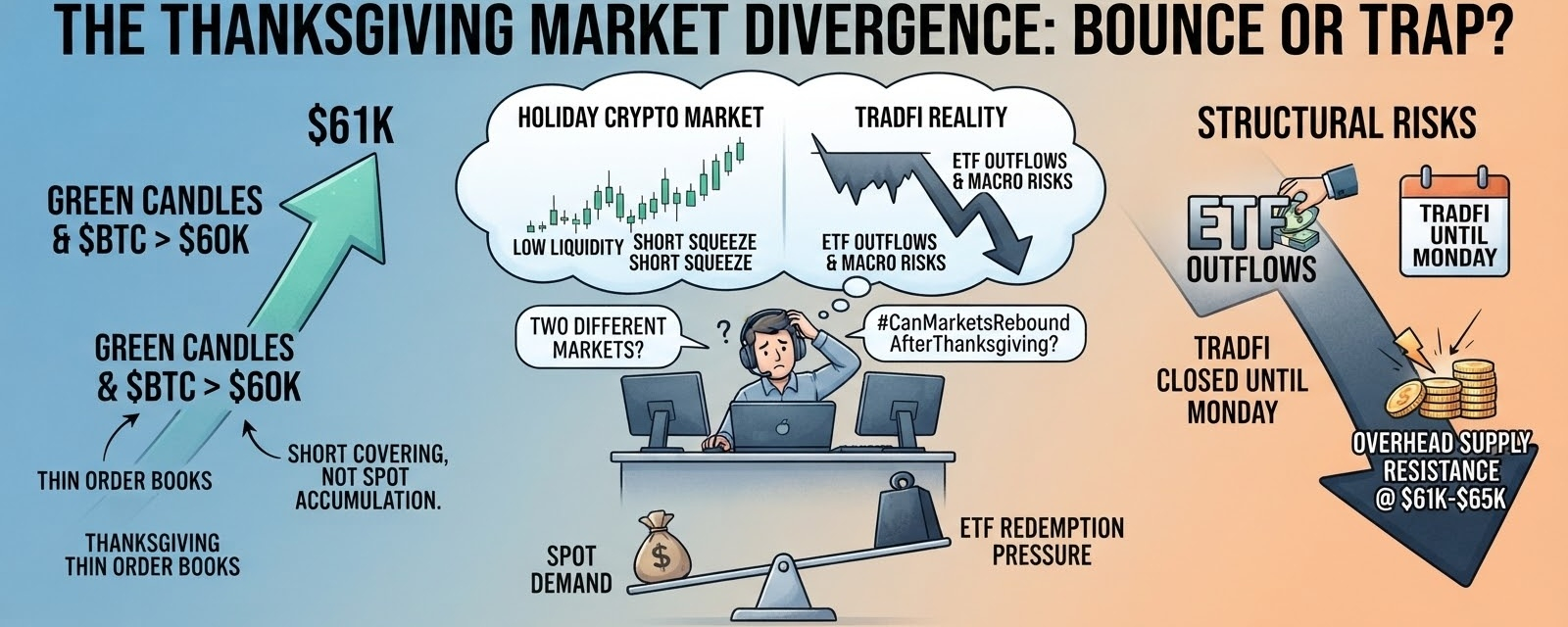

I spent the last 48 hours staring at order books, funding rates, and ETF flow trackers, and the more I watch this bounce, the more I feel like I'm watching two completely different markets at the same time 💡.
Today is Thanksgiving in the U.S., and $BTC just climbed back over $60,000 toward the $61,000 mark after dipping near $55,300 earlier in the week. On the surface, seeing green candles while traditional Wall Street desks are offline feels like a relief.
Yet when I look at how the plumbing underneath is actually moving, I keep coming back to one question: #CanMarketsReboundAfterThanksgiving? 🤔
Here's what's throwing me off. Holiday weekends in crypto have thin order books—trading desks are understaffed, market makers widen their spreads, and even modest buy orders can push a chart higher than it deserves.
Looking at recent desk breakdowns like Talos, most of this push back above $60,000 isn't fresh spot accumulation. It's short covering and futures positioning unwinding into a thin book—traders closing downside bets, which forces price up even when real spot buyers aren't chasing it.
Actually, scratch that—let me be fair to the bulls for a second. Even if a bounce starts as a short squeeze, squeezes can force sidelined capital back in if momentum holds.
The problem is what happens across the rest of the board. While $BTC reclaimed $60,000,$ETH and higher-beta DeFi names still feel heavy every time equity futures wobble.
And then there's the institutional side, which honestly makes me second-guess the whole move. November has seen massive net outflows across U.S. spot Bitcoin ETFs—surpassing prior monthly records—alongside steady withdrawals from spot Ethereum funds.
Even with a few bright spots like Morgan Stanley's fund bucking the broader outflow trend this month, the net flow picture is still draining structural bid.
Look at the derivatives tape too. On-chain and options data show rolling downside volatility running more than double upside volatility, with traders still paying up for puts. At first I read that as pure panic, though the more I think about it, it might just be desks refusing to walk into a four-day liquidity gap unhedged.
What really complicates things is that crypto isn't trading in its own bubble anymore. Between hot inflation prints, tariff headlines, Treasury yield pressure, and the constant volatility around AI heavyweights like Nvidia and Anthropic's market debut, digital assets are tethered straight to tech risk appetite.
With U.S. equities closed today and running a half-day Friday, we're sitting inside a weird structural air pocket 📉. Crypto trades 24/7, while ETF creation, redemption, and full institutional liquidity are frozen until Monday morning.
Here is the hard constraint this rally has to survive: for this bounce to hold next week, organic spot demand and fresh stablecoin inflows have to absorb overhead supply faster than ETF redemptions and realized-loss selling drain it.
If spot absorption doesn't show up by Monday's open, thin-book short covering turns right back into exit liquidity.
But Here's What Worries Me...
The catch is that oversold does not mean bottomed. Thin holiday books cut both ways—a single stop-hunt over the weekend can wipe out late, over-leveraged longs just as violently as it squeezed shorts on Wednesday.
I'm also watching long-term holder behavior. When older coins move at a loss during sharp sell-offs, that trapped supply tends to sit right overhead around familiar resistance like $61,000–$65,000, waiting to sell into strength.
I'm keeping an eye on $BNB and major alts to see if anything shows genuine relative strength on spot volume, because right now, celebrating a Thursday afternoon candle feels premature.
The weirdest part is that both things can be true at once: $BTC can look structurally healthier after flushing leverage while still getting dragged down Monday morning by one TradFi rebalancing desk—so how are you supposed to trust a chart when the holiday liquidity and the real-world plumbing disagree? 🧵
#CanMarketsReboundAfterThanksgiving #Bitcoin #CryptoMarket #Write2Earn
Not financial advice. Always DYOR.