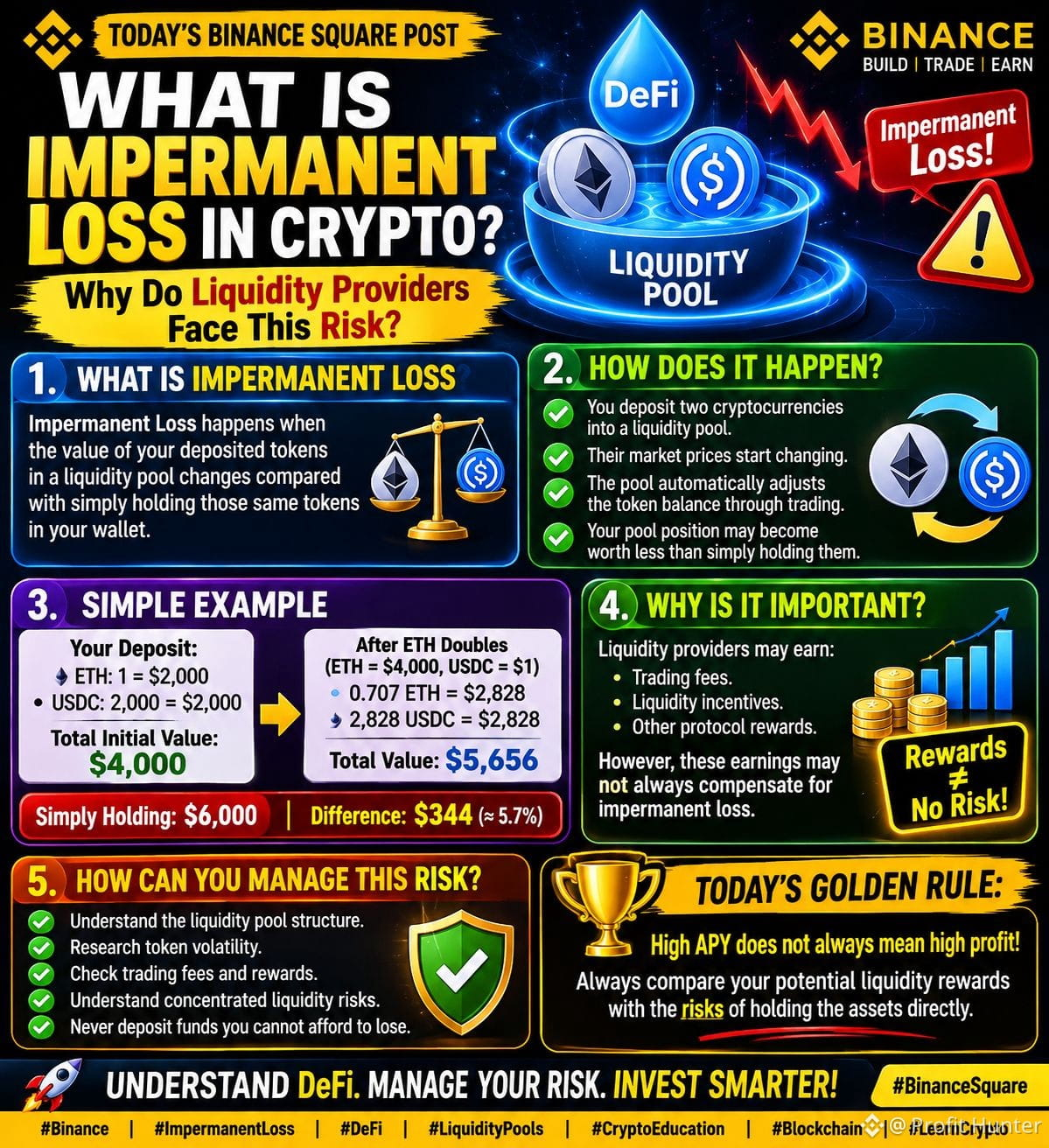
💧 WHAT IS IMPERMANENT LOSS IN CRYPTO? WHY DO LIQUIDITY PROVIDERS FACE THIS RISK?
Have you ever deposited your crypto into a liquidity pool to earn rewards?
There is something important you should understand before doing it: IMPERMANENT LOSS! ⚠️
Let's break it down. 👇
🔥 1. WHAT IS IMPERMANENT LOSS?
Impermanent Loss happens when the value of your deposited tokens in a liquidity pool changes compared with simply holding those same tokens in your wallet.
⚙️ 2. HOW DOES IT HAPPEN?
🔹 You deposit two cryptocurrencies into a liquidity pool.
🔹 Their market prices start changing.
🔹 The pool automatically adjusts the token balance through trading.
🔹 Your pool position may become worth less than simply holding the original tokens.
📊 3. SIMPLE EXAMPLE
Imagine you deposit:
- 1 ETH = $2,000
- 2,000 USDC = $2,000
Total initial value = $4,000
Now imagine $ETH doubles to $4,000 while USDC stays at $1.
In a simplified 50/50 constant-product pool, your position could become approximately:
- 0.707 ETH = $2,828
- 2,828 USDC = $2,828
Total value = $5,656
But simply holding your original assets would be worth $6,000.
That difference is approximately $344, or 5.7%.
This is impermanent loss before considering trading fees and rewards.
💡 4. WHY IS IT IMPORTANT?
Liquidity providers may earn:
- Trading fees.
- Liquidity incentives.
- Other protocol rewards.
However, these earnings may not always compensate for impermanent loss.
⚠️ 5. HOW CAN YOU MANAGE THIS RISK?
✅ Understand the liquidity pool structure.
✅ Research token volatility.
✅ Check trading fees and rewards.
✅ Understand concentrated liquidity risks.
✅ Never deposit funds you cannot afford to lose.
🏆 TODAY'S GOLDEN RULE:
High APY does not always mean high profit!
Always compare your potential liquidity rewards with the risks of holding the assets directly.
🚀 UNDERSTAND DeFi. MANAGE YOUR RISK. INVEST SMARTER!
#Impermanentloss #DeFi: #LiquidityPools #CryptoRisks #Blockchain