
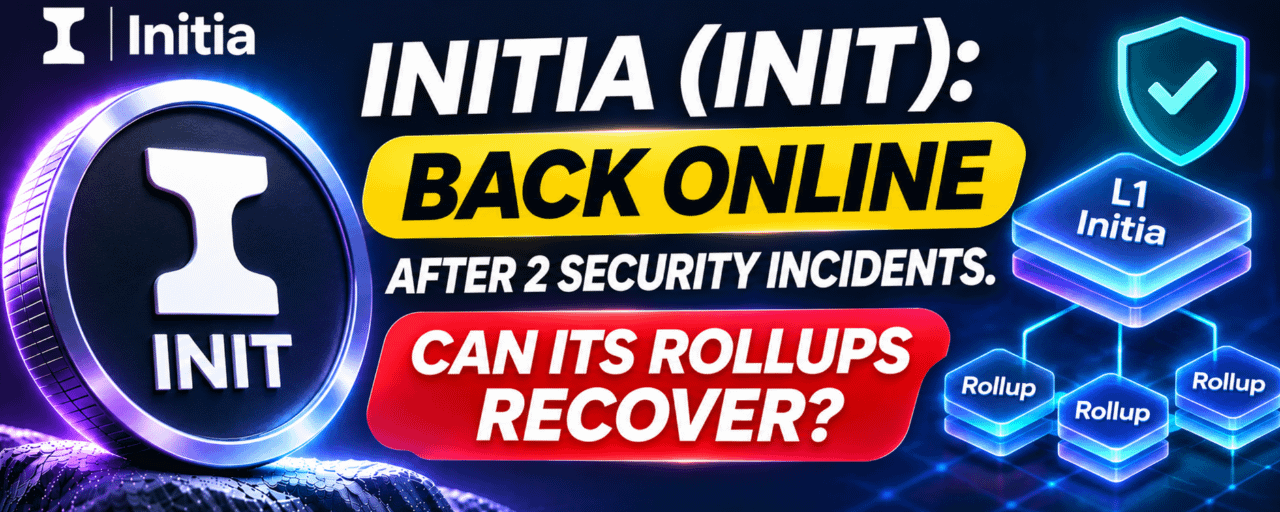


Initia has brought its Layer 1 and connected rollups back online after suffering two security incidents in less than three weeks. On November 20, the team confirmed that operations had resumed and that the Foundation had covered verified shortfalls affecting assets held in bridge escrow.
That announcement brings some relief to users who had been waiting for access to their funds. But after reviewing what happened, I'm more interested in whether Initia can rebuild confidence in the infrastructure that connects its application-specific blockchains.
The project faces that challenge while most of its INIT supply is still outside circulation.
What Happened to Initia in October and November?
The first incident occurred on October 23. An attacker exploited a vulnerability in Initia's MoveVM script caching, allowing unauthorized balances of assets including WETH and stablecoins to appear on the network. Around $2.7 million was transferred out before the chain was halted.
Initia patched the vulnerability, restored the affected reserves with Foundation support and restarted its Layer 1 and rollups on November 2.
One week later, another problem emerged.
According to Initia's November 10 investigation, an attacker used compromised Google Cloud credentials and a command-injection vulnerability to gain access to infrastructure used for provisioning private nodes. The attacker eventually reached Anvil, the service responsible for hosting rollups, and used that access to forge IBC withdrawals involving five rollups.
Approximately $3.27 million in assets moved to an attacker-controlled address on Initia L1. At the time of the investigation, about $2.16 million remained on the halted network, while other assets had already been transferred out.
The team said no native INIT was withdrawn from the network by the attacker.
On November 20, the Initia Foundation approved using up to 3.67 million INIT from its existing holdings and $330,000 in other assets to cover verified bridge shortfalls. It also stated that no INIT would be sold to fund the recovery.
I think the distinction is important. Using treasury assets to restore reserves doesn't mean the stolen funds have all been recovered from the attacker. It means the Foundation has committed resources to make the affected balances whole.
The network is operating again, although some withdrawal routes still have additional confirmation periods or rate limits.
The Technology Still Has a Clear Purpose
Initia was designed to connect specialized rollups through a shared Layer 1. Developers can build applications using different execution environments, including EVM, MoveVM and WasmVM, while relying on Initia for routing, liquidity and coordination.
INIT supports that structure through transaction fees, staking and governance.
One feature I find interesting is Enshrined Liquidity. Instead of requiring all participants to stake individual INIT tokens, the system can also allow approved liquidity positions containing INIT to participate in network security.
Initia also uses the Vested Interest Program, or VIP, to reward rollups and users who meet activity requirements. The idea is to encourage developers to attract people who continue using their applications.
However, those rewards come from token allocations established at launch.
Of INIT's one-billion-token supply, 25% was allocated to staking and Enshrined Liquidity rewards, with another 25% reserved for VIP incentives.
That's half the supply dedicated to encouraging participation.
The economic question is whether those incentives eventually create activity that continues without generous token distributions.
Current DeFi figures suggest there is considerable work ahead.
On November 25, DeFiLlama recorded approximately $1.73 million in DeFi TVL on Initia L1. Its separate rollup tracking showed around $343,000 across the covered Initia chains.
InitiaDEX generated roughly $11,000 in trading fees during the preceding 30 days, with zero protocol revenue retained under DeFiLlama's methodology.
These figures don't capture every game, transaction or application running on Initia. They do, however, provide a limited picture of how much DeFi activity is currently visible.
The 2027 Unlock Is Another Important Test
INIT has a fixed supply of one billion tokens, with approximately 219.8 million circulating as of November 25.
The release schedule changed this year.
Investors and contributors agreed to extend their initial vesting cliff from April 2026 to April 2027. According to Tokenomist's updated schedule, approximately 82.94 million INIT are due to unlock on April 24, 2027, across investor, contributor and other allocations.
That's equivalent to nearly 38% of the current circulating supply.
Meanwhile, staking and VIP reward distributions continue between major unlocks. DeFiLlama estimates these releases at approximately 575,000 INIT each week.
None of those figures guarantee immediate selling. But they make sustained demand for INIT especially important.
For me, the next phase of Initia's development is about proving that the repaired infrastructure can attract and retain users. I'd watch rollup activity, assets returning after the restart, the performance of bridges under the new security controls and the amount of INIT distributed through incentives.
The November recovery resolved an immediate operational problem. Rebuilding trust with developers and liquidity providers will require a longer record of reliable operation.
