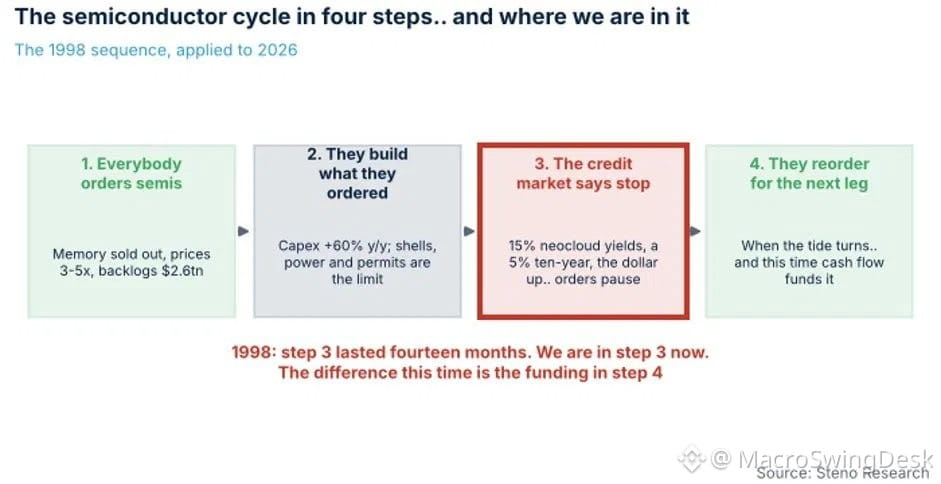
Everyone ordered chips. They built what they ordered. Then the credit market said stop.
That's where we are now: step three. In 1998, this phase lasted 14 months. Then semis went 7x.
Here's my view for 2030: The world won't have too much compute. It will have too little. The backlog is signed, data centers are full on day one, and this time the next leg gets funded by cash flow—not the bond market.
Step four is when fortunes get made.
⚠️ If you're positioning for the next semiconductor supercycle, this is the setup. Credit tightening killed the build-out. But demand didn't disappear—it's deferred. When liquidity returns and capex resumes, semis could rip. History says the bottoming process takes time, but the snapback is violent.
🔑 Watch for: credit spreads tightening, hyperscaler capex guidance turning positive, and semiconductor inventory clearing. The turn won't be obvious until it's already happening.