

I read the headline twice.
Not because it was complicated. Because I was sure I had it backwards. NVIDIA reinstates Jensen Huang. Puts him back. After all of it.
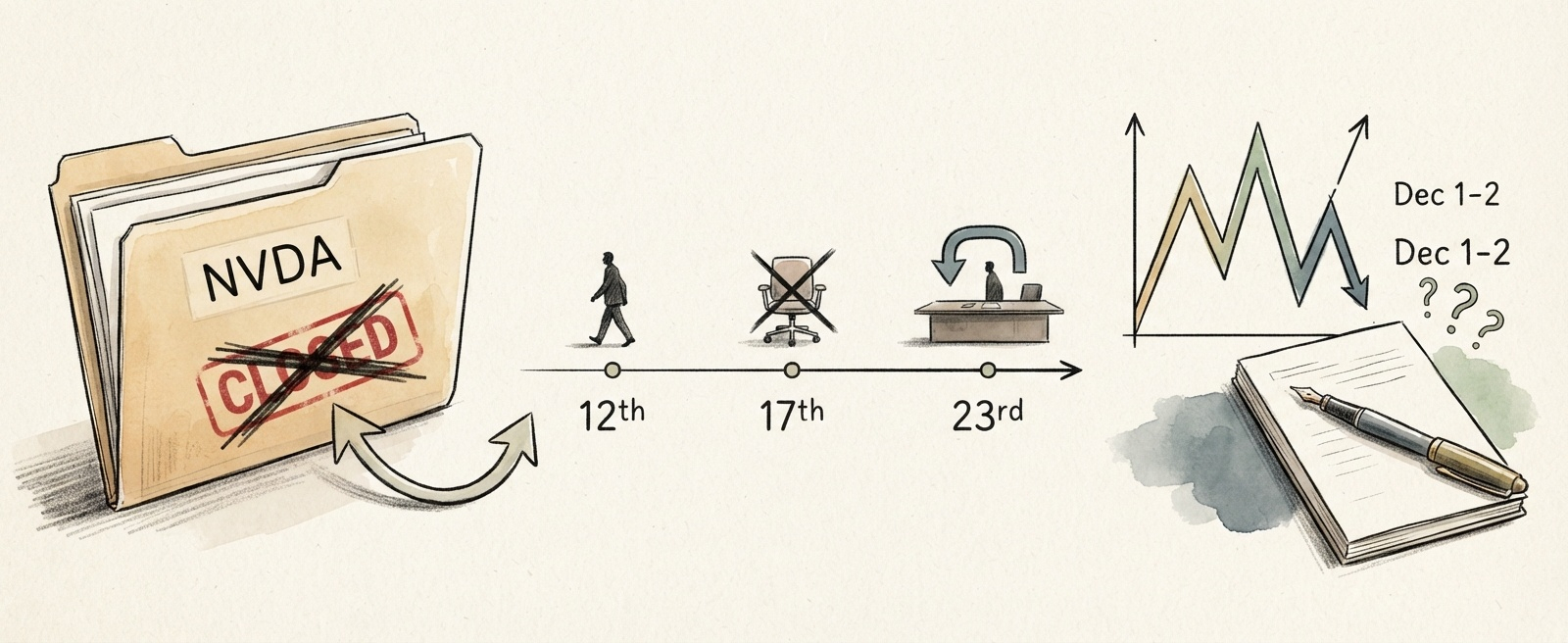
I had filed this one away, and that's the part I keep turning over. Resigned on the 12th. Board says no on the 17th. Somewhere in my head the folder was closed. Next chapter: who replaces him, what the search firm comes up with.
Then the 23rd.
Let me separate what I know from what I'm just feeling, because I don't trust my first reaction.
What I know: the board voted unanimously to bring him back. The CFO goes back to being just the CFO. The release says the board talked to him, got comfortable on candor, and took input from senior levels of the US government before deciding it wasn't a national security issue.
What I don't know: what changed in six days. The release doesn't say. Nobody I've read says. And there's an investigation that isn't finished.
And honestly, what I feel is whiplash. Which is not analysis.
But something about it is bugging me, and I think it's this.
A big part of how I explain the AI trade to people runs through one company. Not just me. Think about how the AI narrative in this market gets built. A headline about the flagship moves sentiment. Sentiment moves attention. Attention moves flows into anything tagged "AI", including tokens that have no direct link to the company at all. And then the flows make the next headline louder.
That's my working theory of the loop. I haven't verified any link in that chain. I haven't looked at how AI tokens behaved over these eleven days, and I'd rather say that than pretend. My guess is the reaction was noisy and mostly about the headline, not the substance. But that's a guess.
Here's the constraint I can't stop seeing, though.
That loop only works while the anchor stays credible. The whole narrative is borrowed from one company. So its stability depends on the anchor's story staying put for longer than the trade you're making on it lasts. If the anchor's story can flip in six days, the borrowed narrative has a shorter shelf life than most people are sizing for.
I keep wondering if that's the real risk. Not a bad headline. A good headline that arrives too late to be useful.
And it makes me think about rotation. When one corner of AI gets noisy, does attention drift to infrastructure plays that feel steadier? Does it drift toward consumer apps? Or does it just go back to BTC and wait? I genuinely don't know. I have a feeling the answer depends on who's looking, and that's not an answer.
I also caught myself doing something strange. For about two weeks I had started writing sentences about him in the past tense. That's the kind of thing you only notice after the story turns over.
Part of me says this is just a public company cleaning up a messy situation fast, because stakes this large force fast decisions. That's a fine reading. I might even believe it.
Another part snags on the pace. It moved faster than the story had any right to. I can't tell if that means a board that decided quickly, or one that had decided long before it said so. I can't tell the difference from here.
The lesson I keep landing on is smaller than "the board was wrong" or "the market was wrong." If you'd asked me on the 18th whether he'd be back as CEO within a week, I'd have said no, and I'd have said it confidently. The confident version of a story has a short half-life. Mine ran out.
The investigation continues. House committees are set to question him behind closed doors on December 1 and 2. Whatever I think I understand today may not survive that.
So I'm stuck between two readings that don't fit together. If the story can reverse this quickly, then a narrative built on it is fragile. But if it reversed because the company is that central, then the narrative is exactly as strong as it looked.
Which one are you actually trading on, and how would you know before the next headline tells you?
$NVDA #AI