

Ethena has already built a multibillion-dollar synthetic dollar business.
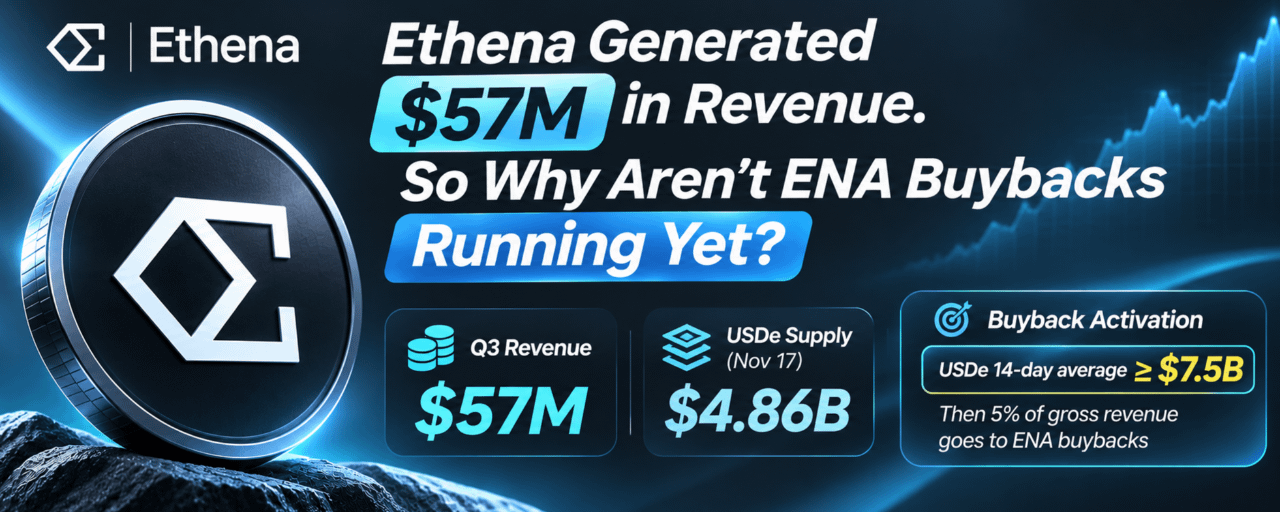
USDe is being used across DeFi, and the protocol generated approximately $57 million in gross revenue during Q3 2026.
That's a real business producing measurable income.
But there's something I find more interesting than the revenue figure.
Ethena approved a mechanism to use part of its revenue to buy ENA from the market.
And those buybacks haven't reached their activation threshold.
Here's why.
In September, ENA holders approved a fee switch designed to connect protocol revenue with token demand.
The mechanism starts when USDe's circulating supply reaches a 14-day average of $7.5 billion.
At that level, 5% of eligible gross protocol revenue would be allocated toward the buyback structure.
As USDe supply reaches higher milestones, the share increases.
Under the approved framework, 95% of the resulting net revenue received by the Ethena Foundation would go toward purchasing ENA.
It's an interesting design.
But USDe hasn't returned to the required scale.
According to Ethena's November 17 governance report, USDe supply stood around $4.86 billion.
That leaves a considerable distance to the first buyback threshold.
So ENA holders currently have a potential revenue-linked mechanism whose activation depends on future growth.
And I think that difference deserves attention.
Ethena's business works differently from most DeFi lending platforms.
USDe is a synthetic dollar backed through a combination of collateral arrangements, hedged positions, stablecoins, and other approved assets.
Historically, an important source of yield has come from holding crypto assets while using short perpetual futures positions to reduce directional price exposure.
When funding rates are favorable, the strategy can generate income.
But funding rates aren't permanently positive.
And the composition of USDe backing has become more diverse.
At the end of October, Ethena reported approximately $2.23 billion allocated across DeFi and institutional lending, representing nearly half of its backing.
Crypto basis positions accounted for another $658 million.
That means the risk profile now extends beyond perpetual funding rates alone.
Lending counterparties, collateral liquidity, redemption conditions, and operational controls all matter.
There's also a question about who receives the revenue.
USDe users can stake their holdings to receive sUSDe, which earns a variable yield.
The protocol also uses revenue for partner incentives and other activities.
Diverting some of that income toward ENA purchases creates a tradeoff.
More value could reach ENA holders through token demand, while less may remain available for other reward programs.
If those incentives become less competitive, USDe growth could slow.
That's why I wouldn't assume the highest possible buyback percentage is automatically the best outcome.
Ethena also has to manage risk.
Its September governance report recorded a Reserve Fund of approximately $62.57 million.
The fund provides an additional buffer against specified losses and market stresses, although it cannot guarantee protection under every scenario.
During October, Ethena disclosed approximately $8.8 million in unrealized PnL exposure associated with a Binance-related incident. The project stated that collateral remained with external custodians and that the affected positions were covered.
The distinction between temporary exposure and a realized loss matters here.
I would also watch ENA supply.
A November SEC filing from StablecoinX reported an ENA treasury of roughly 3 billion tokens, around 20% of total supply, with associated contractual lockups removed.
That doesn't mean those tokens were immediately sold.
But it adds another variable when evaluating future market supply.
For me, the investment thesis now depends on a fairly specific sequence.
USDe needs to regain scale. Ethena needs to maintain attractive risk-adjusted returns. And enough revenue must remain after other obligations to support meaningful ENA purchases.
Until then, I wouldn't value ENA as though the buyback program were already operating at full capacity.
The question I'd keep watching is how quickly USDe can return to $7.5 billion without sacrificing the economics that made people use it in the first place.