
Trust is not restored through promises alone. It is built through actions that users can verify.
When a cryptocurrency platform experiences a serious security incident, the immediate response is only the beginning.
Users want to know what happened, whether their assets are protected, what the company is doing to prevent similar incidents, and whether its commitments are actually being delivered.
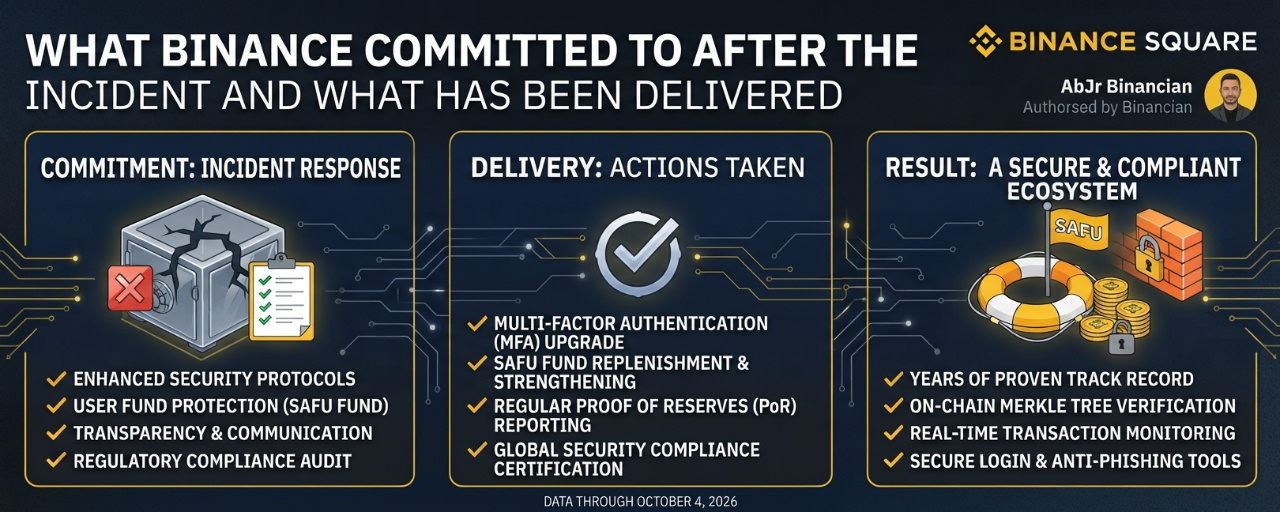
Following the October 2026 security incident, Binance announced a series of response measures covering asset protection, infrastructure security, reserve transparency and financial recovery.
Rather than simply repeating those announcements, let's examine the commitments and the progress reported by Binance.
1. Covering the Financial Impact
One of the most important questions following a security incident is who bears the financial loss.
Binance committed to covering the assets affected by the October incident rather than passing the financial impact on to affected customers.
In its November 19 announcement, Binance confirmed that it had completed coverage of the affected assets.
This is an important milestone because it addresses one of the most immediate concerns users have following a platform security incident: the status of their funds.
However, covering the affected assets and preventing future incidents are two different responsibilities.
Both matter.
2. Replenishing the SAFU Fund
Binance's Secure Asset Fund for Users (SAFU) is an emergency protection mechanism designed to provide an additional financial safeguard in certain extreme circumstances.
Following the incident, Binance committed to replenishing SAFU to approximately US$1 billion.
The purpose is to maintain a substantial emergency reserve that can support the platform's broader user-protection framework.
SAFU should not be confused with universal insurance.
Its use is subject to the fund's purpose and Binance's decisions, and it does not guarantee compensation for every possible loss.
Nevertheless, maintaining an adequately funded emergency reserve is an important part of a broader risk-management strategy.
3. Strengthening Security Infrastructure
A financial response is important, but the long-term objective must be reducing the likelihood and impact of similar incidents.
Binance has outlined additional security measures following its investigation.
These include:
Strengthening transaction authorization and wallet-service controls.
Reviewing access permissions and affected infrastructure.
Improving monitoring for suspicious behaviour.
Expanding AI-based behavioural anomaly detection.
Enhancing operational security and risk controls.
These measures are intended to improve the ability to detect unusual activity and prevent unauthorized transactions.
It is important to distinguish announced improvements from independently audited proof of effectiveness.
Security infrastructure must be tested continuously, not judged only by the existence of a new feature or control.
4. Restoring Services Safely
Another important part of incident recovery is restoring normal platform operations.
Following the incident, Binance implemented temporary restrictions while security reviews and recovery measures were underway.
Its subsequent updates described the gradual reopening of withdrawals across supported networks.
The phased approach is important because restoring services should not come at the expense of additional security risks.
Users should always consult the latest official service announcements before initiating withdrawals, particularly when dealing with specific assets or blockchain networks.
5. Improving Transparency Through Proof of Reserves
Binance also published an updated Proof of Reserves snapshot.
The November 12 snapshot covered 198 tokens, with the corresponding zero-knowledge proof generated on November 14.
This allows users to independently verify whether their eligible balances are included in the published reserves.
Proof of Reserves does not establish that every aspect of an exchange's financial position is risk-free, but it gives users an additional verification mechanism rather than requiring them to rely solely on public statements.
6. Commitment Tracker: What Has Been Reported?
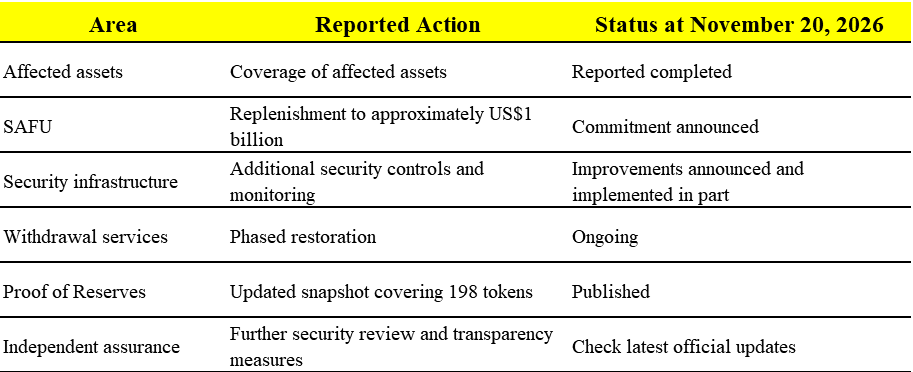
The distinction between completed actions, announced commitments and ongoing work is important.
Users should not treat an announced initiative as completed until there is evidence confirming its delivery.
7. What Should Users Monitor Going Forward?
The next stage of accountability should focus on measurable progress.
Users and industry observers should pay attention to:
Confirmation of SAFU replenishment.
Further technical security disclosures.
Independent security assessments and their scope.
Withdrawal availability across supported networks.
Continued Proof of Reserves updates.
Improvements to incident detection and response.
These indicators provide a practical way to assess whether commitments are translating into lasting improvements.
Final Thoughts: Accountability Is an Ongoing Process
The October incident was a serious reminder that even major cryptocurrency platforms face evolving security threats.
Binance's reported completion of affected-asset coverage, updated Proof of Reserves and additional security measures represent important steps in its response.
But restoring confidence is not a one-time event.
It requires continuous improvements, transparent communication and evidence that commitments are being fulfilled.
The strongest measure of an exchange's response is not what it promises immediately after an incident, but what it can demonstrate over time.
Official announcement and updates:
https://www.binance.com/en/support/announcement/detail/0729ad59cde74700b4eaa96c33441e71
https://www.binance.com/en/proof-of-reserves
#Binance #SAFU🙏 #CryptoSecurity #transparency #UserProtection