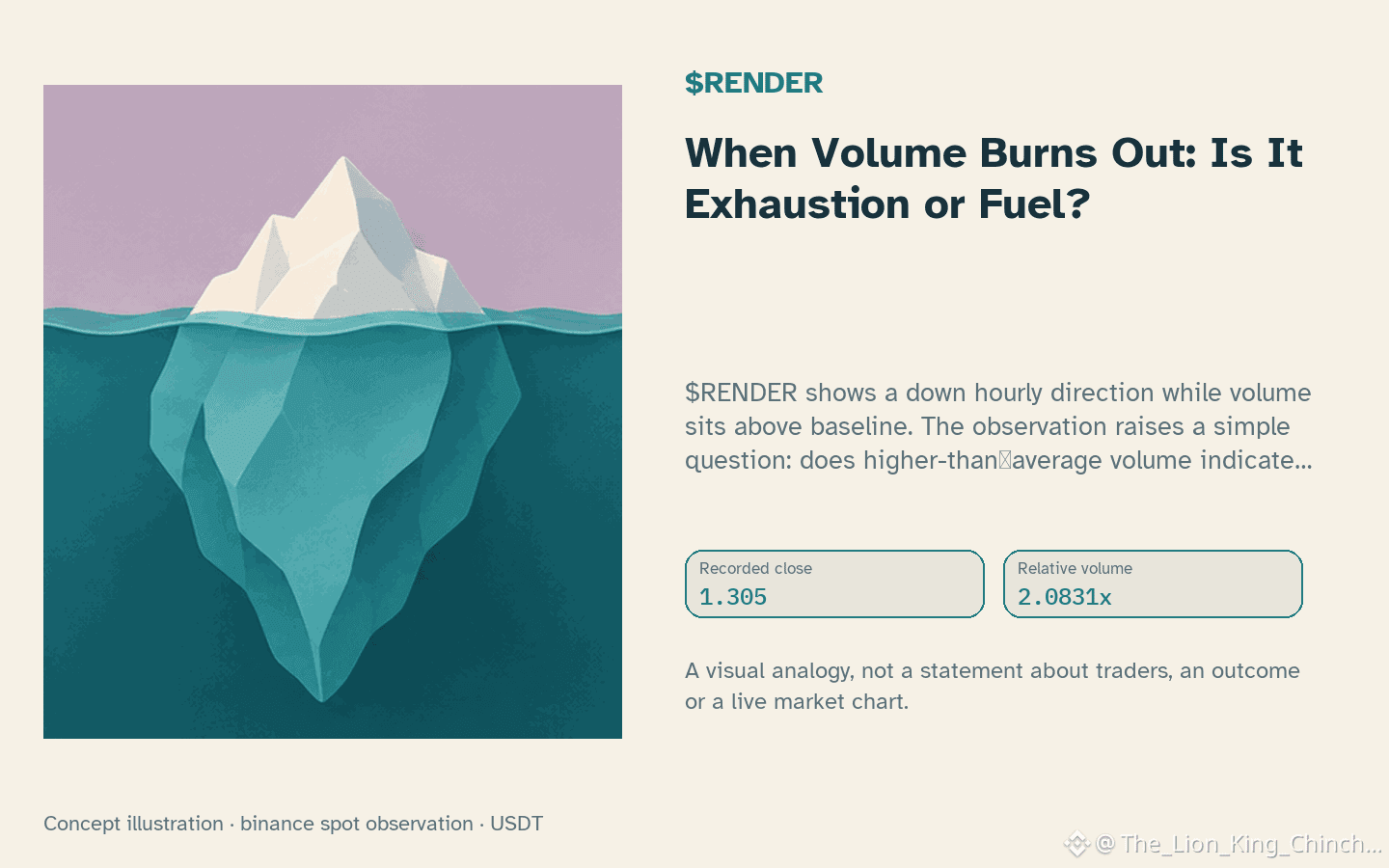
$RENDER: When Volume Burns Out: Is It Exhaustion or Fuel?
$RENDER shows a down hourly direction while volume sits above baseline. The observation raises a simple question: does higher-than‑average volume indicate that traders are draining momentum (exhaustion) or that the market is being steadily fed with new orders (steady fuel)?
### A hypothetical decision
Imagine a campfire. Adding a handful of dry sticks at once makes the flames flare, but the fire may soon sputter if the wood runs out. Conversely, feeding the fire a steady stream of small twigs keeps the heat consistent. In market terms, a spike in relative volume 2.08x can be likened to the sudden handful of sticks – a burst that might precede a short‑term pullback. A modest but continuous volume level, even if above baseline, resembles the slow twig feed, suggesting ongoing participation.
### Where the analogy helps
The analogy clarifies why two identical volume readings can lead to opposite outcomes. If the price is already trending down, a sudden volume surge may reflect sellers closing positions, creating a “fuel‑run‑out” scenario. If price is stable, the same volume could simply be new liquidity entering the order book, supporting the current level.
### Where the analogy fails
A fire does not consider wind; a market does not ignore price gaps, order‑type mix, or external news. The observation does not tell us whether the volume came from market or limit orders, nor does it reveal hidden order‑book depth.
### Counterexample and self‑check
Suppose the next hourly candle closes with a small upward move and the same relative volume 2.08x persists. That would weaken the exhaustion hypothesis and favor the steady‑fuel view. Monitoring the hourly change -0.533537% alongside the RSI 48.0 can provide a quick sanity check without over‑interpreting a single volume spike.
Probabilistic market research, not a recommendation or guaranteed return.
#RENDER #CryptoEducation #CryptoLearning