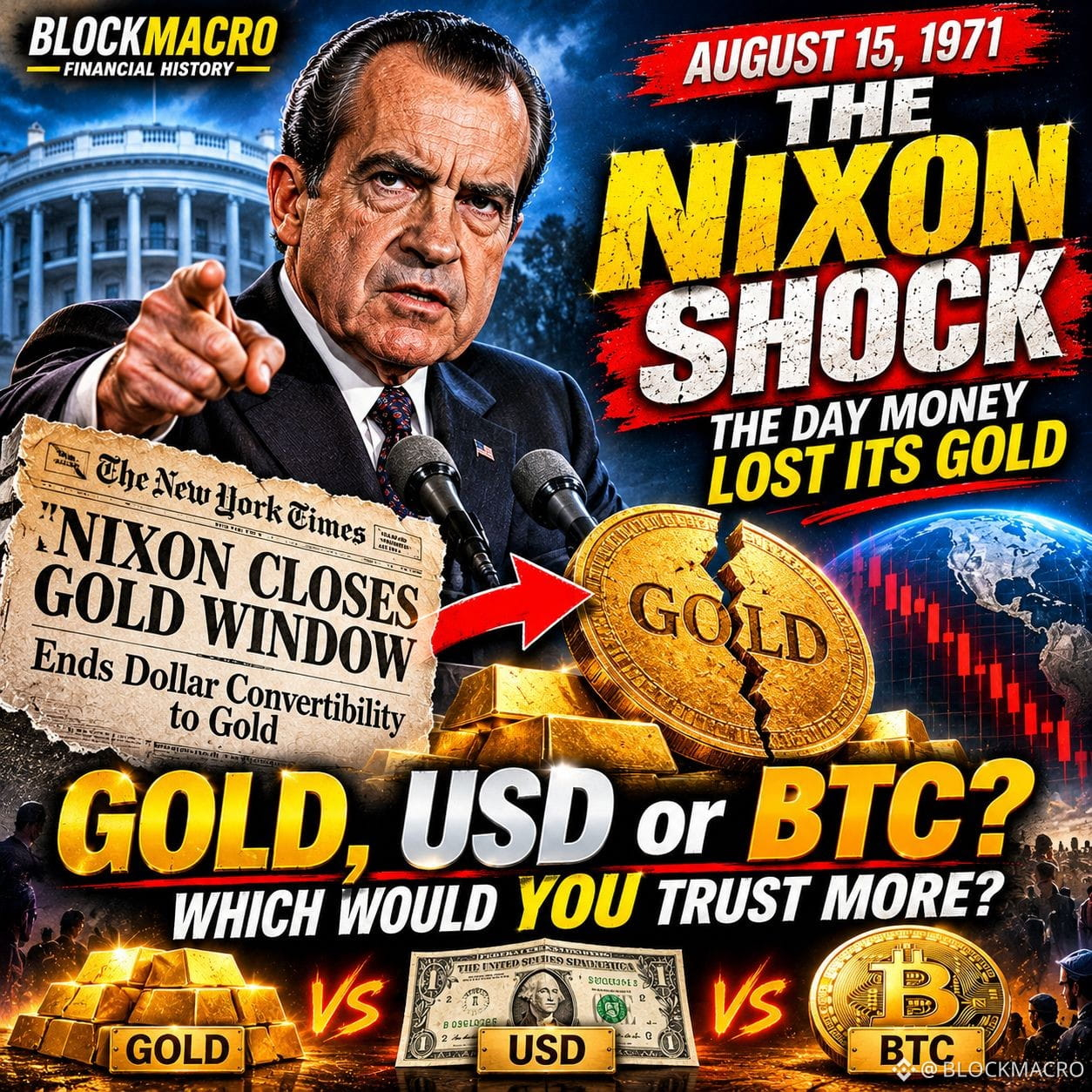
FINANCIAL HISTORY: THE DAY MONEY LOST ITS GOLD
August 15, 1971 — One Decision Changed the World's Financial System Forever.
Imagine a world where the US dollar was linked to gold.
Under the Bretton Woods system, foreign governments could exchange their dollars for gold at $35 per ounce.
But there was a problem: America had issued far more dollars than its gold reserves could comfortably support.
Confidence was fading. Countries were demanding gold.
Then President Richard Nixon made a historic announcement.
He closed the "Gold Window."
Foreign governments could no longer convert their US dollar reserves into gold.
The decision became known as THE NIXON SHOCK.
It marked the beginning of the end of the Bretton Woods system and the transition toward today's fiat-money world.
WHY DOES THIS MATTER TO CRYPTO?
Bitcoin was created decades later, in a world where government-issued currencies were no longer redeemable for gold.
Its supporters see Bitcoin's fixed supply of 21 million coins as an alternative to a monetary system based on trust in governments and central banks.
But here's the controversial question:
If money no longer needs gold backing, what should give it value — government trust, economic power, or mathematical scarcity?
History changed in 1971.
Could Bitcoin change the next chapter?
— BLOCKMACRO
$BTC $ETH #FinancialHistory #bitcoin #GOLD #FederalReserve