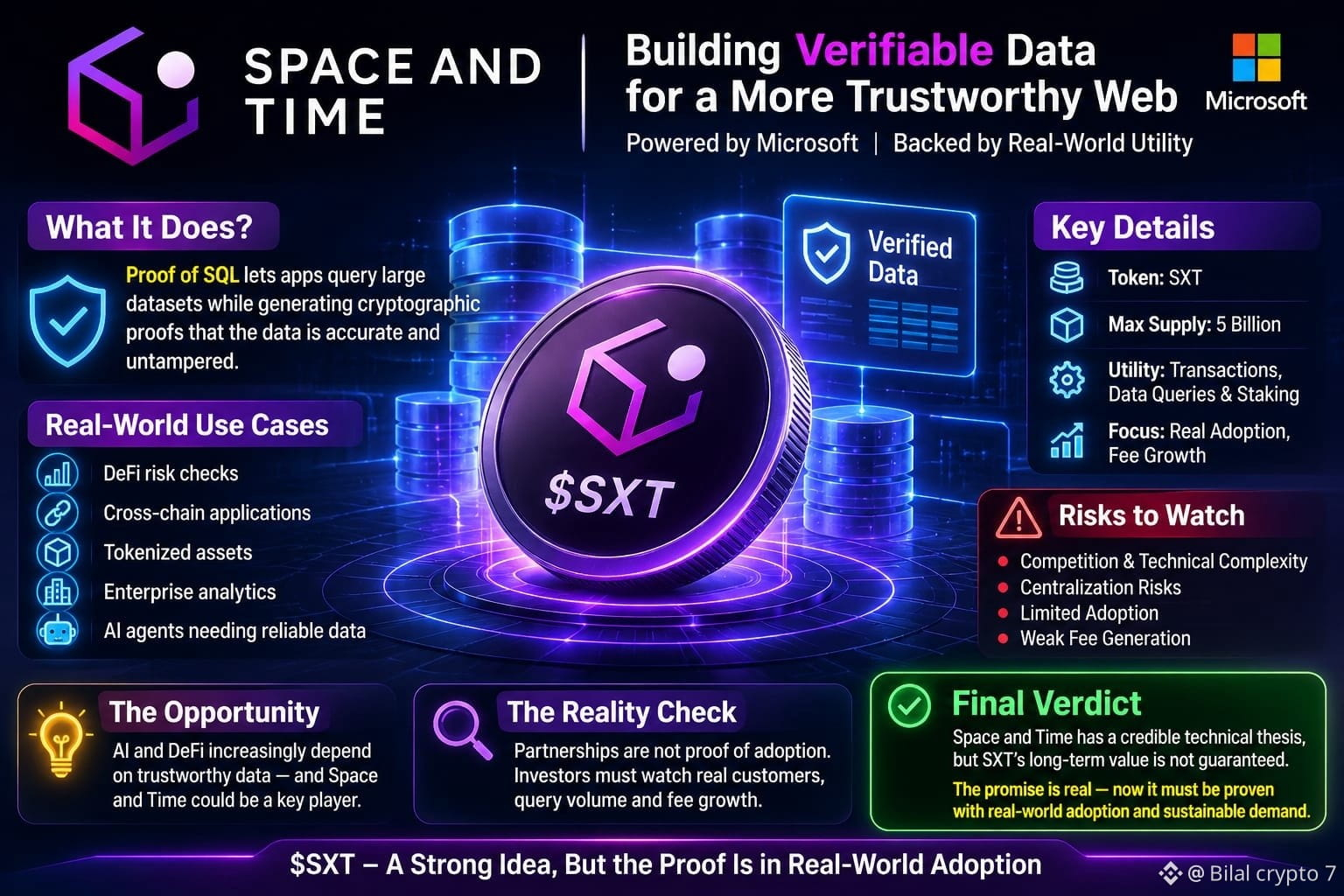
Space and Time is building data infrastructure designed to make information verifiable, not merely accessible. Its technology, Proof of SQL, lets applications and smart contracts query large datasets while generating cryptographic proofs that data was not altered and computation was correct. This could support DeFi risk checks, cross-chain applications, tokenized assets, enterprise analytics, and AI agents needing reliable data.
Microsoft’s backing adds credibility, but partnerships and investor names are not proof of paying customers or adoption. The real test is whether developers and businesses use the network repeatedly and pay meaningful fees.
SXT has utility: it powers network transactions, data queries, and staking to help secure the system. However, utility does not automatically create token value. Demand must grow faster than emissions and unlock-related selling pressure. Maximum supply is 5 billion tokens, allocated across team, investors, community, and ecosystem development. Investors should monitor circulating supply, vesting schedules, staking, and fee demand.
The opportunity is significant because AI and DeFi increasingly depend on trustworthy data. Yet competition, technical complexity, centralization risks, limited adoption, and weak fee generation remain concerns. Dashboards show fees and revenue, but these figures must be judged against operating costs and demand.
My view: Space and Time has a credible technical thesis and applications, but SXT’s long-term value is not guaranteed. Watch real customers, query volume, fee growth, decentralization, and token unlocks—not headlines. The fundamental promise is real; durable token value still needs to be proven.
#sxt $SXT @SpaceandTime