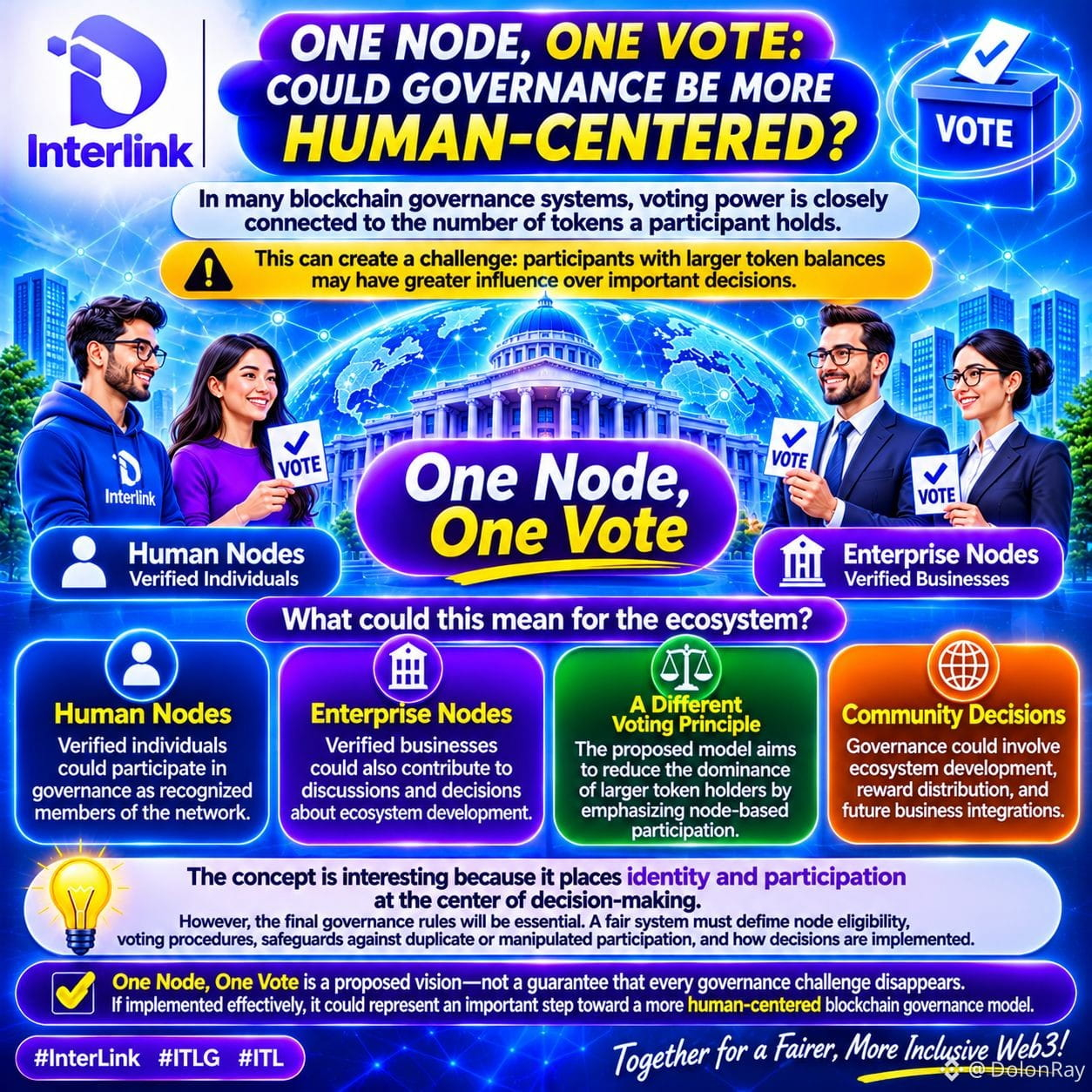
🗳️ 𝗢𝗡𝗘 𝗡𝗢𝗗𝗘, 𝗢𝗡𝗘 𝗩𝗢𝗧𝗘: 𝗖𝗢𝗨𝗟𝗗 𝗚𝗢𝗩𝗘𝗥𝗡𝗔𝗡𝗖𝗘 𝗕𝗘 𝗠𝗢𝗥𝗘 𝗛𝗨𝗠𝗔𝗡-𝗖𝗘𝗡𝗧𝗘𝗥𝗘𝗗? 🌐
In many blockchain governance systems, voting power is closely connected to the number of tokens a participant holds.
This can create a challenge: participants with larger token balances may have greater influence over important decisions.
InterLink's proposed Staking Vault introduces a different governance vision:
One Node, One Vote.
The idea is to connect governance participation with verified nodes rather than allowing voting power to depend only on token ownership.
What could this mean for the ecosystem?
👤 Human Nodes: Verified individuals could participate in governance as recognized members of the network.
🏢 Enterprise Nodes: Verified businesses could also contribute to discussions and decisions about ecosystem development.
⚖️ A Different Voting Principle: The proposed model aims to reduce the dominance of larger token holders by emphasizing node-based participation.
🌍 Community Decisions: Governance could involve ecosystem development, reward distribution, and future business integrations.
The concept is interesting because it places identity and participation at the center of decision-making.
However, the final governance rules will be essential. A fair system must define node eligibility, voting procedures, safeguards against duplicate or manipulated participation, and how decisions are implemented.
One Node, One Vote is a proposed vision—not a guarantee that every governance challenge disappears.
If implemented effectively, it could represent an important step toward a more human-centered blockchain governance model.
#InterLink #ITLG #ITL