
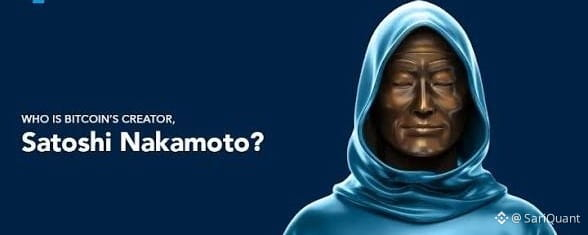

In 2008, a stranger dropped a 9-page PDF onto a cryptography mailing list, launched a peer-to-peer financial revolution, mined roughly 1.1 million $BTC, and then vanished into thin air.
No interviews. No leaked selfies. No voice recordings. Just one final email in April 2011 saying they had "moved on to other things."
Seventeen years later, governments, intelligence agencies, investigative journalists, and AI forensics teams still haven’t proven who Satoshi Nakamoto is.
Here is the real story behind why Satoshi stayed faceless—and why that mystery is the strongest shield $BTC has ever had:
1. A Founder Is a Vulnerability
Every traditional tech network has a throat to choke. If regulators want to shut down a platform, they subpoena the CEO, freeze their accounts, or force a backdoor into the code. Satoshi understood that if Bitcoin had a public face, it wouldn’t survive its infancy. By erasing themselves from the equation, Satoshi turned $BTC from a startup into a leaderless protocol that nobody can sue or arrest.
2. The Heaviest Fortune on Earth
On-chain analysts have tracked the early "Patoshi pattern" blocks roughly 22,000 wallets holding ~1.1 million $BTC that have sat completely untouched since 2009.
Think about the psychological weight of holding private keys worth tens of billions of dollars. Going public wouldn’t bring fame it would bring state-level surveillance, extortion, and permanent danger. Staying anonymous wasn’t paranoia; it was basic survival.
3. Masterclass in Digital Ghosting
Long before modern privacy tools became mainstream, Satoshi practiced flawless operational security:
Communicated strictly through encrypted emails and pseudonymous forum accounts.
Used British spelling conventions alongside American time-zone posting windows deliberately or naturally muddying their geographic trail.
Never slipped up once across hundreds of forum posts and code commits.
4. The Suspects And the Ultimate Cryptographic Test
Over the years, crypto detectives have narrowed the hunt down to legendary cypherpunks—Hal Finney (who received the very first $BTC transaction), Nick Szabo (creator of bit gold), Adam Back (inventor of Hashcash), and Len Sassaman (whose tragic passing in 2011 lines up eerily with Satoshi’s final exit).
Yet every living suspect has denied it and in 2024, a UK High Court officially dismantled Craig Wright’s claims after years of forged documents.
The beauty of cryptography is that proof doesn't require a face. Anyone claiming to be Satoshi only needs to sign a single message using the private keys from Block 1 or Block 9. Until that happens, every theory remains just a story.
5. Why the Silence Matters to Your Portfolio
As long as Satoshi’s 1.1 million $BTC stays dormant, the market treats those coins as permanently locked effectively shrinking Bitcoin’s real circulating supply. Satoshi didn’t cash out at $1, $1,000, or $100,000. Leaving behind a generational fortune without taking a single satoshi is the ultimate proof that $BTC wasn’t built as an exit scam.
In Budapest, there’s a bronze statue of Satoshi wearing a hoodie and its face is a polished mirror. When you look at it, you see yourself. That was the whole point.
💬 Over to you:
Do you think Satoshi was one person or a secret team?
If a single satoshi ever moved from those 2009 wallets tomorrow, how hard would $BTC dump?
Drop your theories below 👇