


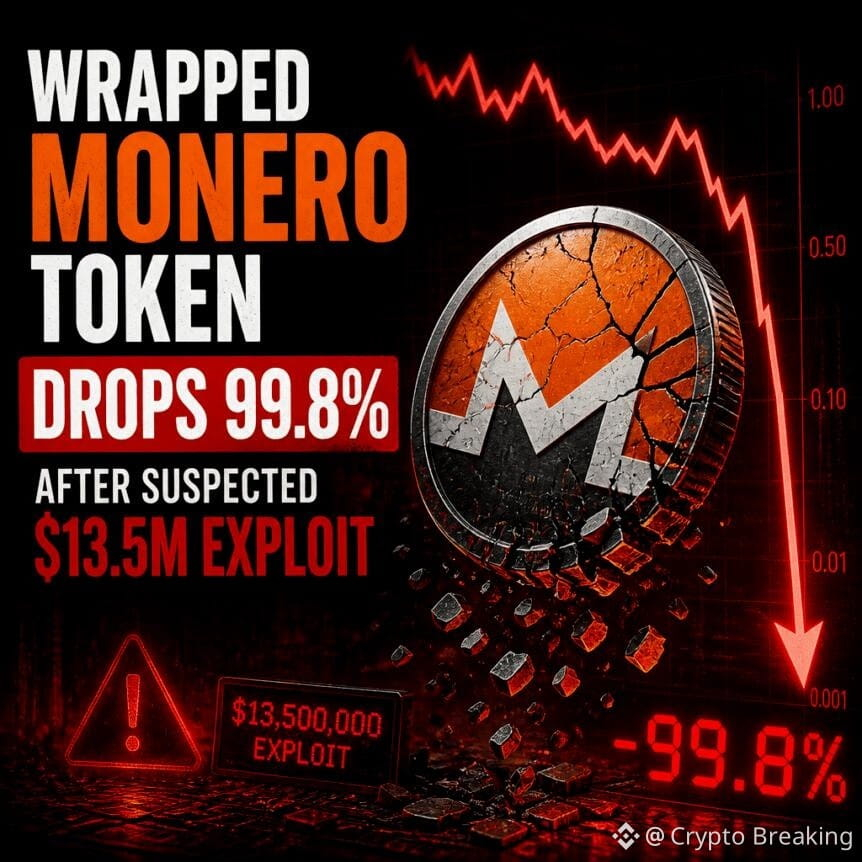
A wrapped token representing Monero collapsed on Hyperliquid on Friday after blockchain analytics firm Bitquery traced a rapid sale by a wallet that had received funds from the token’s deployer account. The token, called XMR1 and issued via Wagyu, dropped from roughly $500 to about $1 in approximately 30 minutes—an almost total wipeout of value—before stabilizing at a far lower level.
Bitquery’s investigation suggests the crash was driven by liquidation activity rather than any impact on Monero’s native network. In Bitquery’s view, the deployer-side compromise remains unconfirmed, and the broader question for traders is whether the incident represents an isolated custody failure or something more systemic in the token’s operational setup.
Key takeaways
Bitquery links XMR1’s near-total collapse to a wallet that received XMR1 tokens from the deployer account and sold around $13.5 million worth on Friday.
The $13.28 million USDC flow appears to have moved through Arbitrum, then converted into 7,467 ETH via CoW Protocol, with much of the ETH later bridged to Ethereum.
Bitquery found earlier November hack proceeds were used to buy XMR1, but it found no on-chain proof connecting those hacks to Friday’s suspected exploit.
Wagyu operator PerpetualCow attributed the failure to an alleged hosting-provider breach, while acknowledging uncertainty over who controlled the deployer key.
Wrapped Monero token sees rapid liquidation
According to Bitquery’s on-chain analysis of XMR1 on Hyperliquid, the event began with a transfer of 5.2 million XMR1 tokens from the deployer account to a separate wallet. That wallet then sold roughly $13.5 million worth of XMR1 on Friday, triggering the token’s collapse.
Bitquery reported that XMR1 fell from about $500 to $1 within around 30 minutes, representing a 99.8% decline. Because XMR1 is a wrapped representation of Monero meant to be traded on non-native environments, the collapse affected the wrapped token and its liquidity rather than changing Monero’s core asset or protocol performance.
How the funds moved after the sale
Bitquery traced the proceeds from the reported XMR1 liquidation to stablecoin and then to major-chain liquidity routes. Specifically, the firm said it tracked $13.28 million in USDC transferred to Arbitrum. On Arbitrum, $13.22 million was exchanged for 7,467 ETH through CoW Protocol.
Bitquery added that most of the ETH was subsequently bridged to Ethereum. For market participants, this matters because it shows the liquidation did not merely dissipate within one venue—it likely converted into assets that can be deployed more broadly, increasing the odds of continued sell pressure elsewhere if other markets are connected.
Earlier hack funds used to buy XMR1—possible incentive, unclear causality
Bitquery also examined whether Friday’s collapse could have been driven by previously compromised sources. The firm said it identified proceeds from four hacks earlier in November—connected to Across Protocol, Kava, Lighter, and Safe—that were used to purchase approximately $6.6 million worth of XMR1.
However, Bitquery cautioned that it found no on-chain evidence linking those earlier incidents to the specific wallet activity that occurred on Friday. In other words, the analytics point to a pattern of funds seeking exposure to XMR1 at some point in the past, but they do not establish that those funds directly caused the deployer-side breach or liquidation that day.
That distinction is important for traders and builders: an on-chain correlation can suggest where liquidity or demand for wrapped assets came from, yet it doesn’t automatically explain the immediate cause of a sudden, catastrophic price drop.
Wagyu operator blames hosting-provider breach; key custody remains uncertain
While Bitquery’s analysis could connect the sell-off to deployer-linked transfers, it said it could not determine how the deployer account’s private key was obtained or who controlled it during the transfers—leaving the underlying compromise scenario unresolved.
Separately, PerpetualCow—the pseudonymous operator of Wagyu, the service behind XMR1—offered an explanation that focused on operational and infrastructure security. In a statement shared publicly, PerpetualCow blamed an alleged breach of hosting provider 1984. The operator claimed that customer data and internal server files had been exposed.
PerpetualCow said the XMR1 deployer key had been stored on a server that was later deleted, but that the hosting provider allegedly retained logs and files associated with it. The operator also pledged personal reimbursement to affected traders and said Wagyu would relaunch at a later date, though no timetable was provided.
Cointelegraph reported that it contacted the operator for additional details regarding the breach and reimbursement plans but had not received a response by publication. The combination of Bitquery’s inability to confirm key control and Wagyu’s hosting-focused allegation leaves a clear gap: readers can follow the fund-flow evidence, but they cannot yet independently verify the full chain of custody behind the deployer-side transfers.
For users of wrapped-token infrastructure, this episode underscores how quickly trust can unravel when key material, hosting security, or deployer access is called into question. Even when the underlying asset (here, Monero) remains unaffected, the wrapper’s credibility can become the single point of failure.
Going forward, traders should watch for whether Wagyu provides a verifiable remediation plan for deployer key management, how any relaunch is structured, and whether any further on-chain investigation identifies additional linked wallets beyond the immediate $13.5 million sell-off. Until those details are confirmed, XMR1’s collapse stands as a reminder that wrapped assets carry distinct operational risk even when the native chain behind them does not move.
This article was originally published as Wrapped Monero Token Drops 99.8% After Suspected $13.5M Exploit on Crypto Breaking News – your trusted source for crypto news, Bitcoin news, and blockchain updates.