


#CanBTCReboundAfterFallingBelow60K? #globalstocksfacelongestlosingstreaksince2023 🌍 #PositiveMindsGlobalResults
BINANCE SQUARE | INVEST • LEARN • GROW • TOGETHER
NOVEMBER 21, 2026 | GLOBAL STOCK MARKETS • ECONOMY • AI • WALL STREET • CRYPTO • FINANCIAL RISKS
Global financial markets are approaching another critical resistance point. After repeated cycles of inflation fears, higher interest rates, geopolitical tensions, AI-driven valuations, government debt concerns, and economic uncertainty, investors are facing another question:
Is the global economy strong enough to absorb another major financial shock—or are markets approaching a breaking point?
This is no longer just about whether stock prices rise or fall. The next market test could affect equities, bonds, currencies, commodities, corporate valuations, banking liquidity, investment capital and the cryptocurrency market simultaneously.
The potential exposure is measured not in billions—but in trillions of dollars.
1. The $9 Trillion Warning: What Has Already Happened?
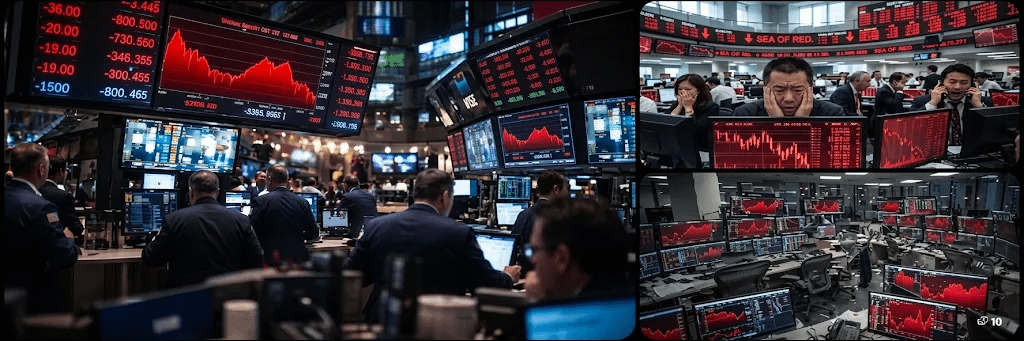
This time, the warning is no longer hypothetical. Global financial markets have already experienced a significant correction.
According to a Reuters report published November 20, approximately $9 trillion in global stock market value has been erased since August, as investors reassess AI valuations, technology-sector expectations, interest rates and the economic outlook.
The sell-off has affected technology stocks, Asian markets and broader investor sentiment. Taiwan's stock market reportedly suffered its steepest weekly decline since the early 1990s, while volatility increased and the US dollar strengthened.
Approximately $9 TRILLION IN GLOBAL EQUITY VALUE ERASED
That number is already enormous—but the critical question is whether this correction represents a temporary adjustment or the beginning of a deeper global repricing.
2. Why Global Markets Are Facing Another Resistance

Five major pressures are converging:
AI valuation pressure: Investors are questioning whether massive AI infrastructure investments can deliver sufficient profits to justify the valuations.
Interest-rate risk: Persistent inflation could force central banks to maintain restrictive policy or consider additional rate increases.
Government debt: Rising borrowing costs are increasing the pressure on governments with large deficits and refinancing requirements.
Geopolitical instability: Conflict, energy disruption, trade tensions and political uncertainty could increase inflation and weaken economic growth.
Corporate earnings expectations: Companies may face increasing pressure if revenue growth, profit margins and AI spending returns fall below market expectations.
The European Central Bank has also warned that AI-related exposures, sovereign debt risks and geopolitical tensions could trigger abrupt repricing across financial markets.
3. How Many Trillions Could Be at Risk?
Illustrative market-stress scenarios — not forecasts or confirmed losses.
$9 TRILLION
Already erased in the reported sell-off
Reported global equity-value losses since August.
$20T+
Extreme global repricing scenario
A hypothetical severe bear-market event involving multiple asset classes, not a prediction that this amount will be lost.
These figures are hypothetical stress scenarios for the scale of potential market damage. The $9 trillion figure is the reported loss; the $10 trillion, $15 trillion and $20 trillion-plus figures are not official estimates, nor are they targets or probabilities published by financial institutions.
A broader financial crisis could also involve bond-market losses, property valuations, private credit, leveraged positions and currencies—but those exposures cannot simply be added together because they overlap and represent different types of financial risk.
5. Who Could Be Most Vulnerable?

Market Main risk
🇺🇸 US stocks AI valuations, earnings expectations, interest rates
🇹🇼 Taiwan & 🇰🇷 South Korea Semiconductor concentration and technology sell-off
🇪🇺 Europe Economic weakness, debt and energy costs
🇨🇳 China Weak domestic demand, property and trade pressure
🌏 Emerging markets Dollar strength, capital outflows and currency pressure
🏦 Bonds Rising yields, refinancing costs and government debt
🛢️ Energy Geopolitical shocks and inflation
₿ Crypto Liquidity withdrawal, leverage and risk-off selling
The greatest vulnerability may lie in markets that have become heavily dependent on a narrow group of technology companies, aggressive growth expectations or cheap financing.
6. What Happens to Bitcoin and Crypto If Global Markets Fall Again?
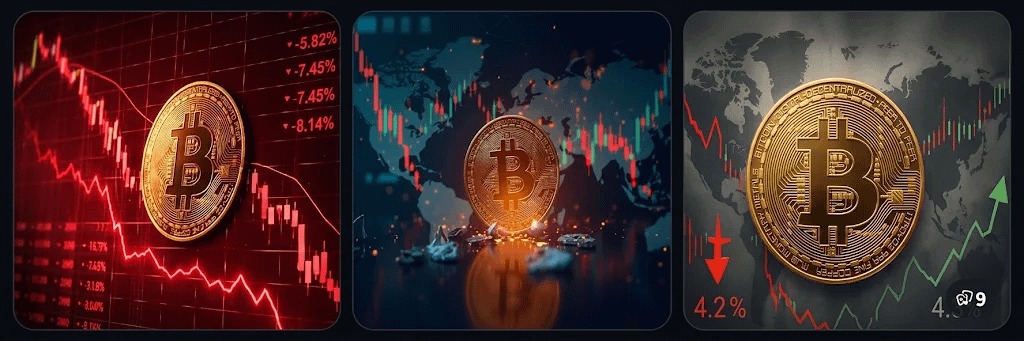
Bitcoin is not automatically protected when global markets experience financial stress.
In a sudden liquidity crisis, investors may sell Bitcoin, Ethereum and other digital assets to raise cash, reduce leverage or cover losses elsewhere. A stronger US dollar and tighter financial conditions could create additional pressure on crypto.
However, if the market eventually shifts toward expectations of monetary easing, liquidity support or lower interest rates, digital assets could experience a powerful recovery.
The critical signals to watch:
Bitcoin's ability to maintain major support levels.
Ethereum's strength relative to Bitcoin.
Stablecoin liquidity and capital flows.
ETF inflows and outflows.
US dollar strength.
Treasury yields and central-bank policy.
Forced liquidations and derivatives leverage.
Crypto could either amplify the global sell-off or become one of the strongest recovery assets once confidence and liquidity return.
7. The Next 30–90 Days: What Could Decide the Market?
Bullish scenario 🟢
Inflation cools, central banks avoid aggressive tightening, AI companies deliver strong earnings, geopolitical tensions ease and investors regain confidence. The correction could become a healthy reset rather than a major crisis.
Bearish scenario 🔴
Inflation remains stubborn, interest rates stay higher for longer, AI spending fails to deliver expected returns, corporate earnings weaken and global markets continue falling. A deeper correction could then spread into credit, employment, consumption and investment.
Extreme scenario ⚠️
A combination of geopolitical escalation, an AI valuation collapse, sovereign debt stress, credit deterioration and liquidity problems could create a synchronized global sell-off—potentially turning an equity correction into a broader financial crisis.
🌍 FINAL VERDICT: ANOTHER RESISTANCE—OR THE BEGINNING OF A MUCH BIGGER RESET?
The global economy is not necessarily heading toward a recession or financial collapse. But the risks are becoming increasingly interconnected, and the latest market sell-off shows how quickly confidence can change.
Nearly $9 trillion has reportedly already disappeared from global equity valuations. The next major test is whether investors can stabilize the market—or whether another wave of selling pushes losses substantially deeper.
The next $1 trillion in losses could be a warning. Another $5 trillion could change investor psychology. A much larger global repricing could reshape technology valuations, government financing, investment strategies and the future direction of crypto markets.
The question is no longer simply how high markets can rise. It is how much risk the global financial system can absorb before confidence breaks.
Stay alert. Protect capital. Watch liquidity. Never confuse a market rebound with the end of risk.
Disclaimer: This article is for informational and educational purposes only. Market scenarios are hypothetical, not predictions or guaranteed outcomes. This is not financial advice. Always conduct your own research and manage risk responsibly.
#GlobalMarkets #StockMarket #GlobalEconomy #FinancialCrisis #MarketCrash #AI #FederalReserve #Inflation #Bitcoin #Crypto #Investing #Macroeconomics #PositiveMindsGlobalResults


