
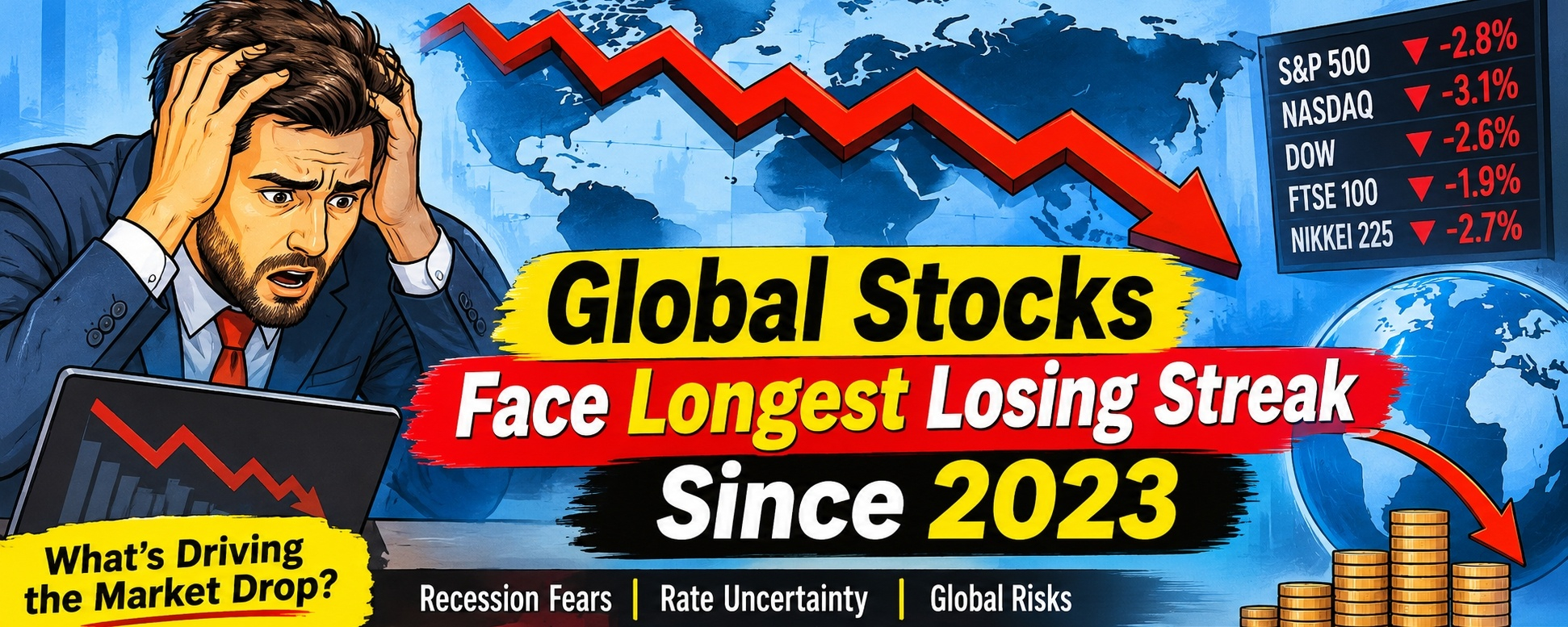

Global Stocks Just Recorded Their Longest Losing Streak Since 2023. Something Is Changing.
Seven consecutive losing sessions.
That's where the MSCI All Country World Index stands, marking its longest losing streak since September 2023.
But honestly, the number itself isn't what interests me most.
It's what might be happening behind it.
For months, investors were willing to pay a premium for almost anything connected to artificial intelligence. Chips, data centers, computing infrastructure and AI software all benefited from expectations of enormous future growth.
And the excitement wasn't entirely unreasonable. AI is changing how businesses operate.
But there's a difference between believing in a technology and believing every investment connected to it is worth its current price.
I think that's where the market is starting to get uncomfortable.
The question is no longer just how big AI can become. It's how much money companies can actually make from it.
1. AI is growing, but the economics still have to work
Here's the part I think deserves more attention.
Building AI infrastructure requires enormous investment. Companies need computing capacity, energy, data centers, specialized hardware and ongoing development.
All of that costs money before the expected returns fully arrive.
The economic equation is relatively simple:
More investment → higher capital requirements → pressure to generate revenue → the need for sustainable profits.
If spending keeps increasing faster than the cash flows it eventually produces, investors have a reason to reconsider valuations.
And that's an important distinction.
AI adoption could continue accelerating while some AI-related stocks lose value.
Both things can happen at the same time.
The technology doesn't have to fail for investors to question whether they paid too much for the companies building it.
2. Anthropic's debut tells an interesting story
Anthropic's stock-market debut attracted considerable attention, but its strong opening performance didn't reverse the broader market weakness.
That contrast is worth looking at.
On November 19, the S&P 500 dropped 2%, extending its losing streak to six sessions. More than 90% of its constituent stocks finished lower.
Meanwhile, an individual AI-related listing could still attract buyers.
So what does that tell us?
Investors can remain interested in individual opportunities while becoming increasingly cautious about the broader market.
A successful company debut doesn't automatically mean confidence in the entire AI sector is returning.
I'd be careful about confusing enthusiasm for one company with strength across an entire investment narrative.
3. Why I'm paying attention from a crypto perspective
This is where traditional markets become relevant to cryptocurrency.
Bitcoin isn't a technology stock. Its market structure, supply dynamics and investment drivers are different.
Still, it doesn't exist in isolation from the global financial system.
When investors become less comfortable taking risks, that change in sentiment can reach multiple asset classes.
Liquidity, interest-rate expectations and institutional positioning can all influence how much exposure investors are willing to maintain.
But there's an important distinction here: Bitcoin doesn't have to follow the S&P 500.
A stock-market correction doesn't automatically invalidate a Bitcoin rally.
What matters is whether digital-asset demand remains strong enough to support its own market.
For me, that's a much more useful question than simply asking whether stocks and crypto will move in the same direction.
4. Is this just a correction, or are expectations changing?
I'm not convinced that seven consecutive losing sessions are enough to declare a structural bear market.
That would be jumping too far ahead.
There are different explanations for what we're seeing:
- Investors may simply be correcting valuations that became too optimistic.
- Companies may be struggling to convert heavy investment into sustainable earnings.
- Broader financial conditions may be making investors less willing to hold risky assets.
These possibilities can look similar on a price chart.
But they mean very different things for the months ahead.
A temporary valuation reset could create a different opportunity from a prolonged deterioration in business fundamentals.
That's why I would rather understand the reason behind the decline than rush to label the market.
5. Three things I'm watching now
There are three signals I think deserve attention.
First, market participation.
Does selling continue spreading beyond AI-related companies, or does weakness begin to narrow?
Second, AI profitability.
Are investors starting to demand actual financial returns instead of rewarding every new investment announcement?
Third, global liquidity.
Are financial conditions becoming more supportive or less supportive of risk-taking across equities and cryptocurrency?
None of these signals can tell us exactly where prices go next.
But together, they can help us understand whether the current weakness is mainly about valuation or something deeper.
My final thought
Here's what I find most interesting about this market.
AI could become one of the most important technologies of our generation, and investors could still lose confidence in the prices they're paying for AI companies today.
Those two ideas aren't contradictory.
The same principle applies to cryptocurrency: a promising long-term narrative doesn't automatically guarantee attractive valuations or uninterrupted market growth.
Perhaps the next phase won't be decided by who tells the most convincing story.
It may be decided by who can actually deliver the economic results behind it.
So I'm curious about your perspective:
If global markets are entering a more selective investment environment, what will drive the next major recovery?
A return of confidence in AI profitability, or stronger global liquidity that brings risk appetite back across financial markets?
#GlobalMarkets #Bitcoin #AI #CryptoMarket #MarketAnalysis