


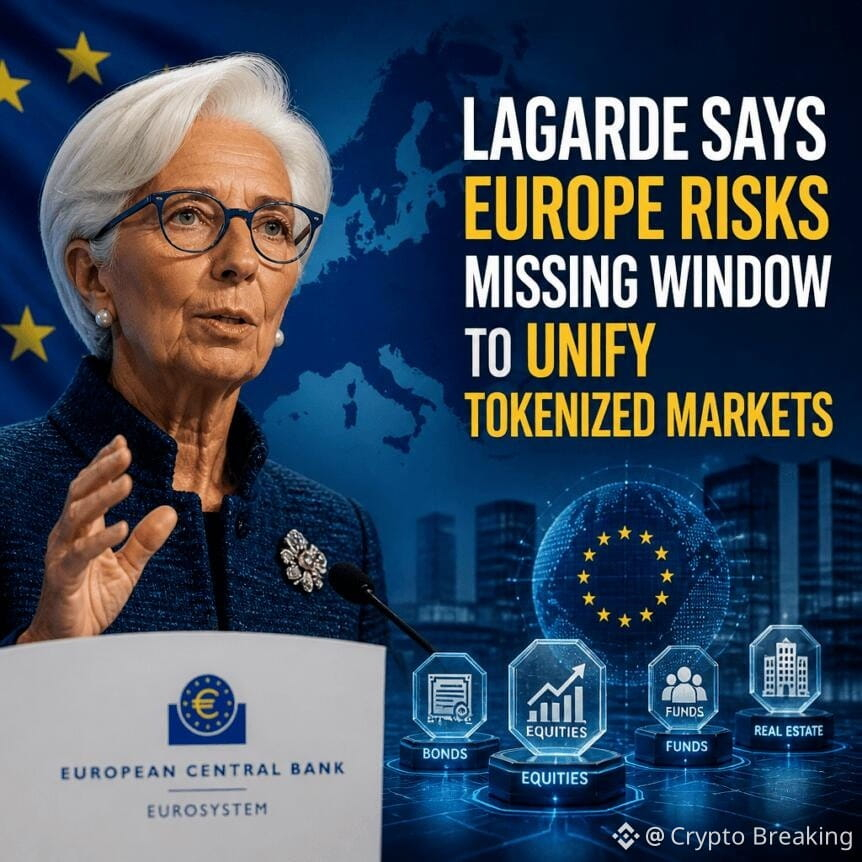
European Central Bank (ECB) President Christine Lagarde has warned that tokenized securities in Europe could stall if the region fails to agree on shared rules before different platforms build incompatible standards.
Speaking at the Frankfurt European Banking Congress on Friday, Lagarde said blockchain can streamline how firms issue, trade, and settle securities by using the same underlying infrastructure. But she argued that the benefits will depend on coordination at the regulatory level, not just on technology.
Key takeaways
Lagarde cautioned that tokenized securities may become fragmented if trading platforms adopt incompatible rule sets.
She linked the need for standardization to legislators, saying common rules are required beyond what the ECB can provide.
Lagarde cited rapid growth in tokenized asset markets, describing a fivefold increase year-on-year to around 23 billion euros in March.
The ECB and Eurosystem are advancing initiatives such as Pontes for settling tokenized securities in central bank money and Appia to develop standards.
The Eurosystem plans to publish a blueprint on tokenized securities standards in 2028.
Lagarde pushes for common rules as tokenization accelerates
In her remarks, Lagarde emphasized that tokenization—where financial instruments are represented digitally on distributed ledgers—has matured to the point where it can change core market plumbing. She noted that blockchain technology allows institutions to issue, trade, and settle securities on a single platform, which could reduce friction and shorten settlement cycles.
Still, the ECB president said the most immediate risk is not technical failure, but regulatory and standards mismatch. As tokenized markets expand, she warned that firms may deploy different rules across different venues, making it harder—or impossible—for trades to be settled seamlessly across platforms.
“Common rules will be needed too, and those lie with legislators,” Lagarde said.
Her message reframes tokenization as an interoperability problem as much as a financial innovation. For investors and market participants, compatibility is critical: fragmented standards can force operational workarounds, increase settlement risk, or limit who can participate in a given ecosystem.
Growth in tokenized assets raises the stakes
Lagarde pointed to the momentum behind tokenized finance to underline why Europe needs to act sooner rather than later. According to her, the global market for tokenized assets was worth about 23 billion euros in March, roughly five times its size a year earlier.
That kind of growth rate tends to attract both institutional and technology-driven entrants, which can accelerate adoption—but it can also multiply competing technical and legal approaches. Lagarde’s warning suggests that if Europe does not coordinate standards early, the region could end up with a patchwork of tokenized markets that do not communicate efficiently.
Eurosystem’s Pontes and Appia: central bank money and shared standards
Lagarde’s comments align with steps already underway within the Eurosystem to ensure tokenized securities settlement can connect to established central bank infrastructure.
She referenced Pontes, which the Eurosystem launched in September. Pontes is designed to provide a way for financial institutions to settle trades involving tokenized securities using central bank money—an important consideration for liquidity, settlement finality, and overall market integrity.
Earlier in November, the European Stability Mechanism used Pontes to settle a 1 billion euro digital bond, according to the remarks. While the figure in this context is described as a settlement amount rather than a broader adoption milestone, it illustrates that tokenized settlement against central bank money is moving from concept toward practical use.
On the standards side, Lagarde also pointed to Appia, a second Eurosystem project focused on working with market participants on common standards for tokenized securities. The initiative aims to publish a blueprint in 2028, signaling that standardization efforts are being planned on a multi-year timeline.
What remains uncertain—and what investors should watch
Even with operational projects such as Pontes and longer-horizon work through Appia, Lagarde’s core point is that success will hinge on how quickly lawmakers align rules across the EU. Technology may enable tokenized trading, but interoperability requires legal and technical convergence—covering everything from how settlement instructions are interpreted to how rights and obligations are recognized across venues.
Investors and market participants should therefore pay close attention to two areas as this develops. First, whether regulators move to define the “common rules” Lagarde referenced in a way that supports cross-platform settlement rather than platform-specific silos. Second, how the 2028 standards blueprint translates into enforceable expectations for market infrastructure and participants.
Lagarde’s warning also raises a broader question for Europe’s financial competitiveness: whether the region can shape tokenization standards early enough to avoid locking itself into fragmented frameworks driven by individual ecosystems.
For now, the key watchpoint is progress on shared standards—both the Eurosystem’s technical blueprint work and the legislative decisions Lagarde said must follow—because that is what will determine whether tokenized securities in Europe can scale as a true integrated market.
This article was originally published as Lagarde Says Europe Risks Missing Window to Unify Tokenized Markets on Crypto Breaking News – your trusted source for crypto news, Bitcoin news, and blockchain updates.