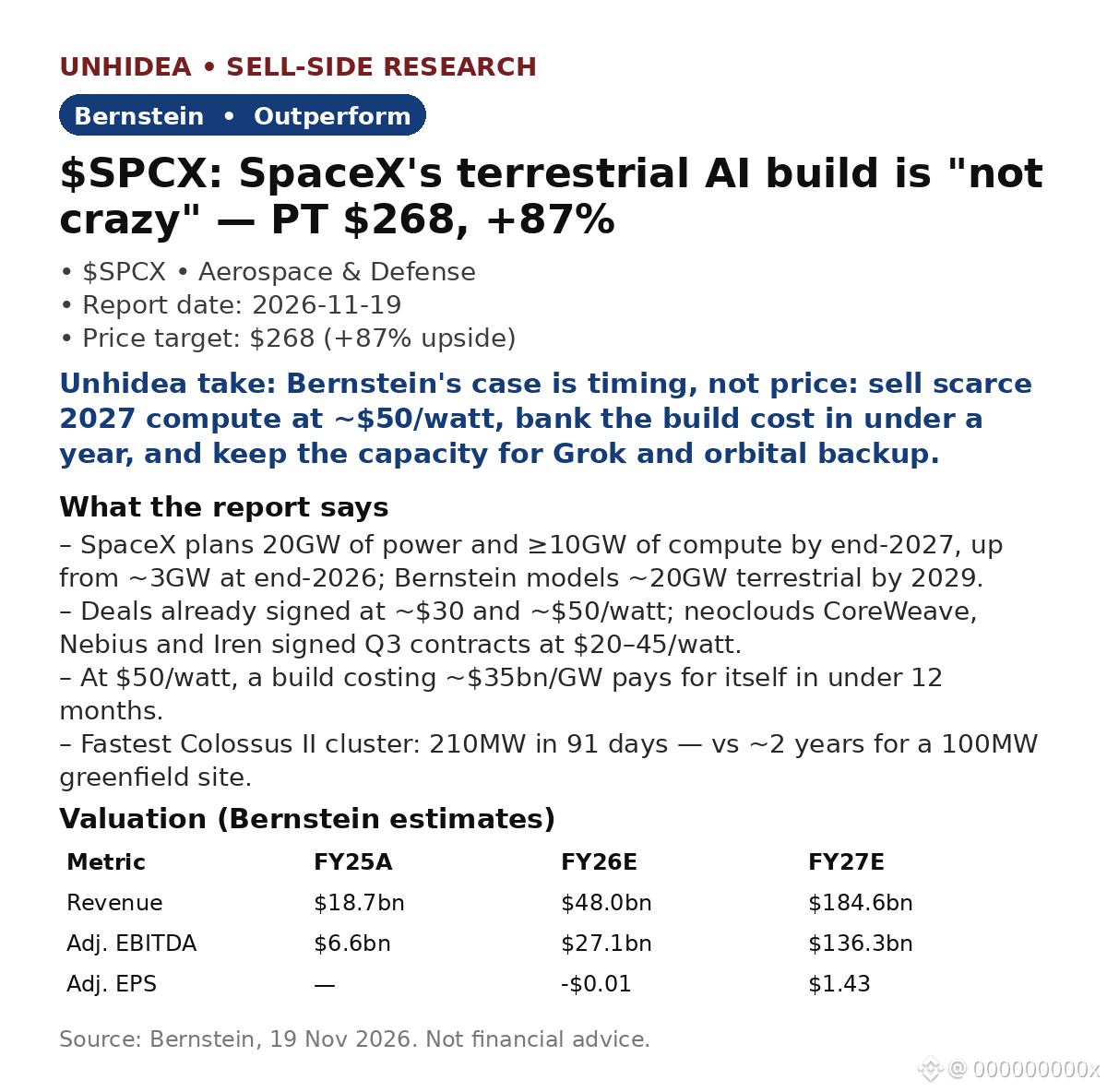
$SPCX: Bernstein says SpaceX's "crazy" terrestrial AI build is a game plan — Outperform, $268 target, +87% vs the $143.50 close on 18 Nov.
- The plan: 20GW of power and at least 10GW of compute by end-2027, up from ~3GW planned at end-2026. Bernstein models ~20GW of terrestrial capacity by 2029.
- The pricing fight: skeptics point to neoclouds running below $15/watt. But SpaceX has already signed deals at ~$30 and ~$50/watt, and CoreWeave, Nebius and Iren signed Q3 contracts at $20–45/watt.
- The math: at $50/watt, a build costing ~$35bn/GW pays for itself in under 12 months. Bernstein assumes pricing fades to $13–15/watt by 2030–31 — and says the capacity is still worth having.
- The clock: SpaceX built its fastest Colossus II cluster (210MW) in 91 days; the industry benchmark is ~2 years for a 100MW greenfield site. Delay into mid-2028 meets a ~75GW hyperscaler pipeline.
- The numbers: revenue $18.7bn (FY25A) → $48.0bn (FY26E) → $184.6bn (FY27E); adj. EBITDA $6.6bn → $27.1bn → $136.3bn. PT $268 held on a 17x terminal forward EV/EBITDA for AI.
Unhidea take: this is a timing arbitrage, not a price bet — SpaceX is selling scarcity in 2027 before the pipeline lands in 2028. The question isn't whether $50/watt lasts; it's whether SpaceX can build fast enough to bank it.
Unhidea take: the real prize is the option stack — 20GW that trains Grok, backs up orbital data centers (Starship Flight 15's second-stage catch raised Bernstein's confidence), and still has resale value if pricing craters. Orbital racks are worth zero at end of life.
Risks: build delays; pricing falls by mid-2028 as ~55–75GW of capacity comes online; turbine-blade bottleneck before 2028.
Source: Bernstein, 19 Nov 2026. Not financial advice.
- The plan: 20GW of power and at least 10GW of compute by end-2027, up from ~3GW planned at end-2026. Bernstein models ~20GW of terrestrial capacity by 2029.
- The pricing fight: skeptics point to neoclouds running below $15/watt. But SpaceX has already signed deals at ~$30 and ~$50/watt, and CoreWeave, Nebius and Iren signed Q3 contracts at $20–45/watt.
- The math: at $50/watt, a build costing ~$35bn/GW pays for itself in under 12 months. Bernstein assumes pricing fades to $13–15/watt by 2030–31 — and says the capacity is still worth having.
- The clock: SpaceX built its fastest Colossus II cluster (210MW) in 91 days; the industry benchmark is ~2 years for a 100MW greenfield site. Delay into mid-2028 meets a ~75GW hyperscaler pipeline.
- The numbers: revenue $18.7bn (FY25A) → $48.0bn (FY26E) → $184.6bn (FY27E); adj. EBITDA $6.6bn → $27.1bn → $136.3bn. PT $268 held on a 17x terminal forward EV/EBITDA for AI.
Unhidea take: this is a timing arbitrage, not a price bet — SpaceX is selling scarcity in 2027 before the pipeline lands in 2028. The question isn't whether $50/watt lasts; it's whether SpaceX can build fast enough to bank it.
Unhidea take: the real prize is the option stack — 20GW that trains Grok, backs up orbital data centers (Starship Flight 15's second-stage catch raised Bernstein's confidence), and still has resale value if pricing craters. Orbital racks are worth zero at end of life.
Risks: build delays; pricing falls by mid-2028 as ~55–75GW of capacity comes online; turbine-blade bottleneck before 2028.
Source: Bernstein, 19 Nov 2026. Not financial advice.