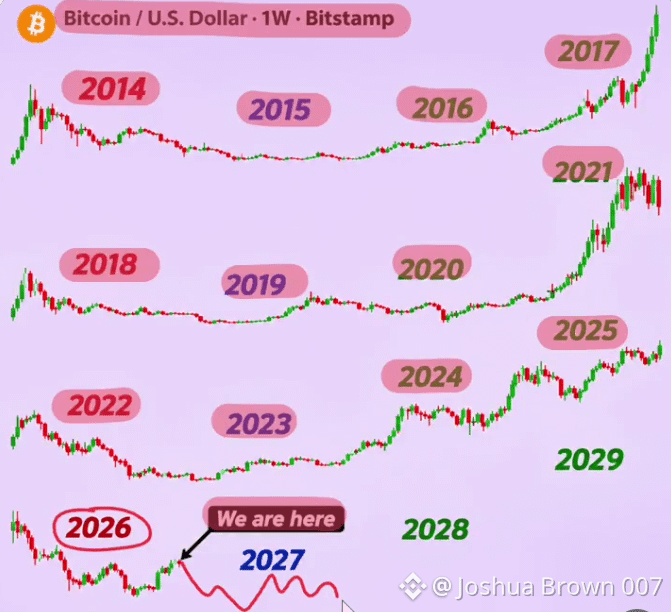
Is Bitcoin preparing for another four-year cycle, or are we assuming history will repeat itself?
I have been looking at Bitcoin’s historical cycle structure, and one pattern deserves serious attention.
2014–2017: Bear Market → Recovery → Bull Run → Cycle Peak
2018–2021: Bear Market → Recovery → Bull Run → Cycle Peak
2022–2025: Bear Market → Recovery → Bull Run → Cycle Peak
Now look at the possible next sequence:
2026: Bear Market?
2027: Recovery and Accumulation?
2028: New Bull Phase?
2029: Potential Cycle Peak?
There are three interesting historical observations:
Previous bear-market years overlapped with US midterm election years.
Recovery phases followed those election years.
The last three major cycle peaks occurred approximately 526, 548 and 534 days after Bitcoin halvings.
But this cycle is behaving differently.
Bitcoin's decline from approximately $126K to $58.6K represents around 53%, considerably less than the 77–85% drawdowns seen in earlier cycles.
The correction also happened faster, reaching that low roughly 268 days after the peak.
So, is $58,600 the actual cycle bottom, or are we still waiting for another capitulation?
I don't want to blindly assume that the four-year cycle will repeat. Institutional participation, ETF flows, liquidity conditions, monetary policy and global macroeconomic developments have changed the market.
My approach is to watch both scenarios rather than build a position around one prediction.
If the historical structure survives, 2027 could become an important accumulation window ahead of the expected April 2028 halving.
History doesn't promise the future, but ignoring historical patterns is equally dangerous.
Save this analysis. Let's revisit it in 2027 and see which scenario played out.
#Bitcoin #CryptoMarket #BitcoinHalving #CryptoAnalysis