Was Lighter hacked? The exchange says no. So how did $10.4M walk out the door? 👀
On Nov 16, an attacker drained 10,393,057 USDC from Lighter, a decentralized perps exchange, using a leaked trading API key belonging to a single trader (Bitquery). Lighter froze all withdrawals and pool creation for about 7 hours, then reopened them after recovering roughly $5M. Its contracts were never touched.
🔍 THE TWIST: the key alone should not have been enough. Lighter's own rules block a key from withdrawing to a stranger's wallet. The attacker got around it by opening a public liquidity pool with a 0% fee, buying 99.99% of its shares for about $10K, then moving the victim's USDC into the pool in ~$1M batches and redeeming the shares. The funds were swapped for ~5,750 $ETH within minutes.
⚠️ A leaked API key ≠ a protocol hack. That distinction matters, and it cuts both ways. Lighter is right that its smart contracts held. But the episode shows a leaked credential plus a pool-creation loophole can move eight figures without breaking a single contract.
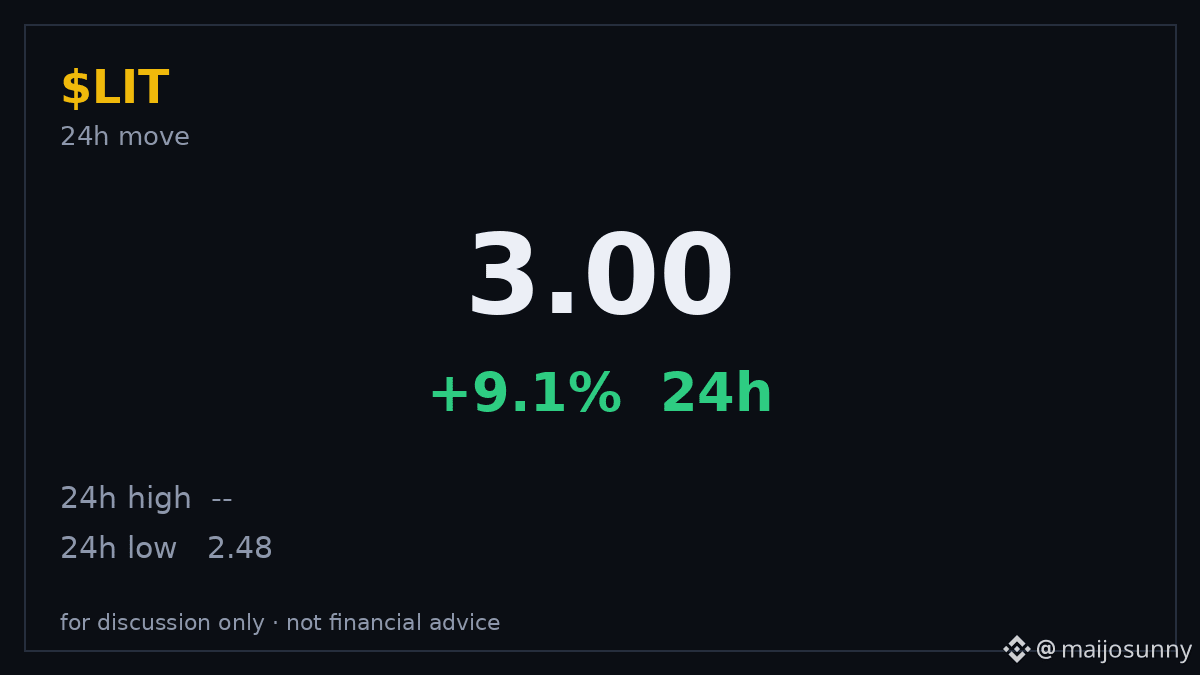
📊 Why it matters: $LIT fell more than 10% to under $2.48 on the news, then bounced back to $3.00, up 9% in 24h (CoinGecko). The market priced this as a one-trader incident, not a protocol failure. The open question is whether other perps venues have the same pool loophole. Some researchers put the total at $15.5M across two market-maker accounts. Lighter has not confirmed that figure, so treat it as an estimate.
👀 What to watch: how the key leaked, whether the affected trader is made whole, and whether the unrecovered ~$5M moves again.
Bottom line: the contracts held, the guardrails around them did not. Is this a one-off key leak, or a warning for every DEX that lets users create pools? 👇
Educational content only. Not financial advice. DYOR.
#crypto #DeFi #Lighter
On Nov 16, an attacker drained 10,393,057 USDC from Lighter, a decentralized perps exchange, using a leaked trading API key belonging to a single trader (Bitquery). Lighter froze all withdrawals and pool creation for about 7 hours, then reopened them after recovering roughly $5M. Its contracts were never touched.
🔍 THE TWIST: the key alone should not have been enough. Lighter's own rules block a key from withdrawing to a stranger's wallet. The attacker got around it by opening a public liquidity pool with a 0% fee, buying 99.99% of its shares for about $10K, then moving the victim's USDC into the pool in ~$1M batches and redeeming the shares. The funds were swapped for ~5,750 $ETH within minutes.
⚠️ A leaked API key ≠ a protocol hack. That distinction matters, and it cuts both ways. Lighter is right that its smart contracts held. But the episode shows a leaked credential plus a pool-creation loophole can move eight figures without breaking a single contract.
📊 Why it matters: $LIT fell more than 10% to under $2.48 on the news, then bounced back to $3.00, up 9% in 24h (CoinGecko). The market priced this as a one-trader incident, not a protocol failure. The open question is whether other perps venues have the same pool loophole. Some researchers put the total at $15.5M across two market-maker accounts. Lighter has not confirmed that figure, so treat it as an estimate.
👀 What to watch: how the key leaked, whether the affected trader is made whole, and whether the unrecovered ~$5M moves again.
Bottom line: the contracts held, the guardrails around them did not. Is this a one-off key leak, or a warning for every DEX that lets users create pools? 👇
Educational content only. Not financial advice. DYOR.
#crypto #DeFi #Lighter