
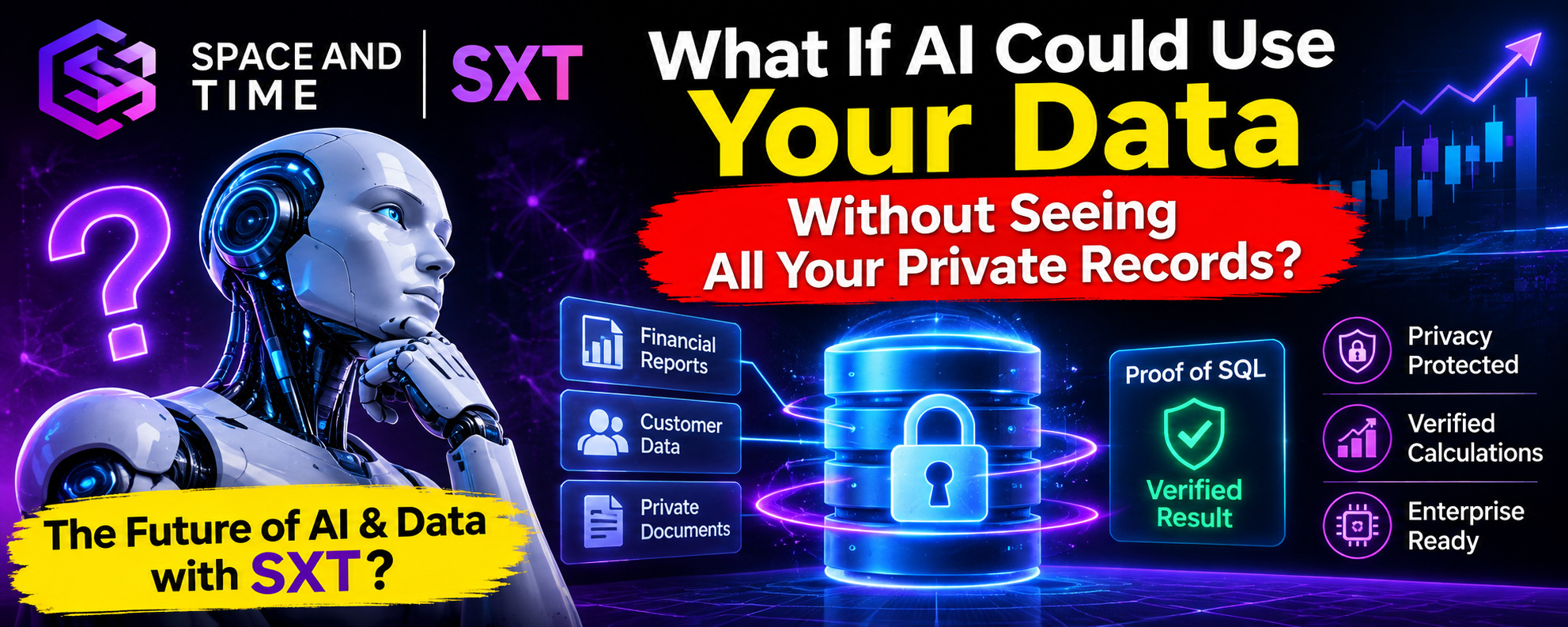


I was thinking about how much information we give to technology every day.
A business has thousands of records. Financial reports, customer details, private documents and internal numbers. Now imagine that the same business wants an AI agent to analyse all this information and make decisions.
There is an obvious problem.
How much access should that AI actually have?
Giving an AI system access to an entire database just to answer one question does not always make sense. Some information is private, some is sensitive, and not every calculation requires seeing every record.
This is where the recent move by Space and Time caught my attention.
On November 9, the project introduced Space and Time Enterprise, a platform designed to let businesses verify calculations made using private data without exposing the underlying records.
The technology behind it is Proof of SQL.
Here is what makes the idea interesting.
A business can run a database query, receive an answer and generate cryptographic proof showing that the calculation was performed correctly. An AI application or an auditor can check that proof without needing direct access to the private database.
I think this is a practical problem worth solving.
We are giving AI more responsibilities, but we are still figuring out how to control what information it can access.
However, I would not call this a complete solution to data security.
A proof can show that a calculation was performed correctly on particular records. It cannot guarantee that those records were accurate or complete from the beginning. Businesses still need proper data controls.
There is another detail I found interesting.
Space and Time Enterprise can run on a company's own servers without requiring it to operate a blockchain.
That could make the technology easier for traditional businesses to explore. But it also raises a question about the relationship between enterprise adoption and SXT token demand.
If a company uses the enterprise product without interacting with SXT Chain, how much value actually reaches the token ecosystem?
I think that question deserves more attention than another partnership announcement.
The launch included Maple Finance, Indomobil, Trenez and The Data Foundation. That gives us some real names to follow, but the important part will be seeing how these relationships develop into regular usage.
For me, the interesting story is not simply that Space and Time has launched another product.
It is trying to address a difficult balance between privacy, access and verification.
And I keep coming back to one question:
If AI can prove that it calculated an answer correctly without seeing all the private information behind it, could this become a normal requirement for businesses in the future?
Or will companies continue to prefer the simpler systems they already understand?
I think the answer will depend less on announcements and more on what businesses actually use when the technology becomes part of their daily operations.
