
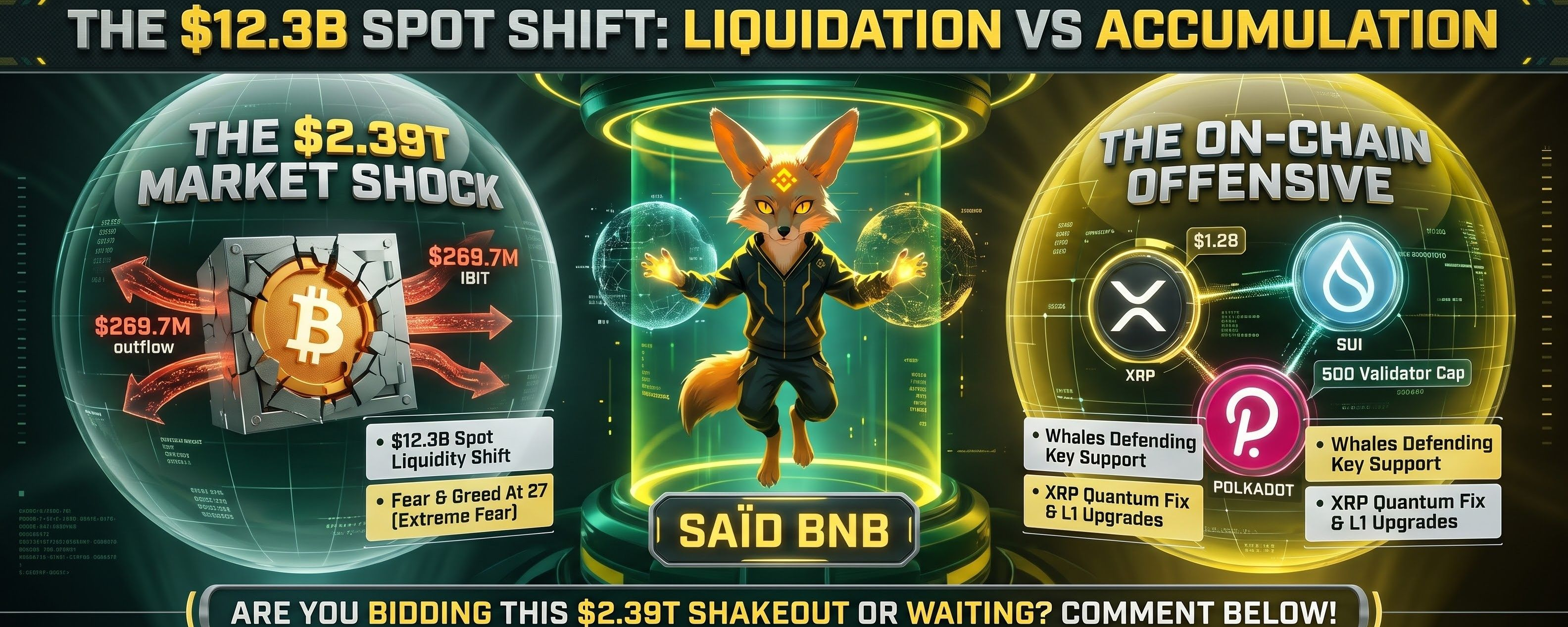


I didn't sleep much last night. I was watching on-chain ledger visualizers at 3:30 AM while a sudden $12.3 billion shift in spot market liquidity swept through the order books.
If you have been in the trenches with me, you know that exact feeling when the screen starts flashing red and the entire timeline begins to panic-post. As Bitcoin dominance tightly controls 56.6% of the $2.39 trillion global crypto market cap, a wave of liquidations and ETF outflows—triggered by broader macro headwinds, post-election shifts, and tech sector volatility—has pushed the Fear & Greed Index to a chilly 27 (Extreme Fear).
But while retail is panicking on social media, the on-chain story is telling an entirely different tale: institutional giants and massive whales are positioning themselves for the next big phase of this cycle.
Let's look at the first side of the board: the post-election and policy fallout. Many traders were blindsided by a sudden wave of US spot Bitcoin ETF outflows, with BlackRock's IBIT alone logging $269.7 million in single-day redemptions. The pressure intensified following reports of the FBI naming North Korea in connection with specific wallet addresses and new Congressional focus on digital assets.
When macro variables change on the fly, traders who don't follow the capital get squeezed. Right now, $BTC is testing key support ranges, but on-chain data shows whales have moved massive quantities of capital back onto exchange books to defend these key levels.
If you understand market structure, you know these tests are designed to gather liquidity before a trend can establish itself.
Now, look at the second world of utility: the relentless narrative of Real-World Assets (RWAs) and scaling upgrades.
Even in a downturn, some projects are refusing to play by the "fear" rulebook.
Take XRP, which is battling at a $1.28 technical threshold while dealing with news of Binance hackers parking 233 million XRP in inactive wallets and Ripple unveiling a quantum security update.
Despite the drama, 33 out of 35 validators backed a crucial ledger fix, showing true structural resilience.
Meanwhile, Sui ($SUI ) is navigating a test after its recent drop, as Suiet Wallet announced it is shutting down, forcing SUI holders to move assets by November 14.
Further out, the fight for L1 efficiency continues with Polkadot cutting its validator count to only 500, removing millions of DOT from active staking.
What does this tell us? The era of empty, unbacked momentum is over; the market is aggressively separating the actual networks from the background noise.
So, where am is my focus for the rest of November as Solana’s $SOL Breakpoint conference Approaches in London? I am ignoring the noise and watching where actual on-chain utility is consolidating.
When the market flashes Extreme Fear, it's the exact moment you need a cool head to inspect where the long-term foundations are being built—whether it's post-upgrade privacy features or high-volume DeFi protocols.
The capital rotations we are seeing today aren’t the end of the run; they’re the high-stakes sorting process of a maturing market.
I want to hear from you in the comments below: Are you actively bidding this $2.39T shakeout, or are you waiting for more macro clarity before deploying capital? Drop your top token or setup below, hit that follow button, and let’s navigate this volatility together! 🔥👇