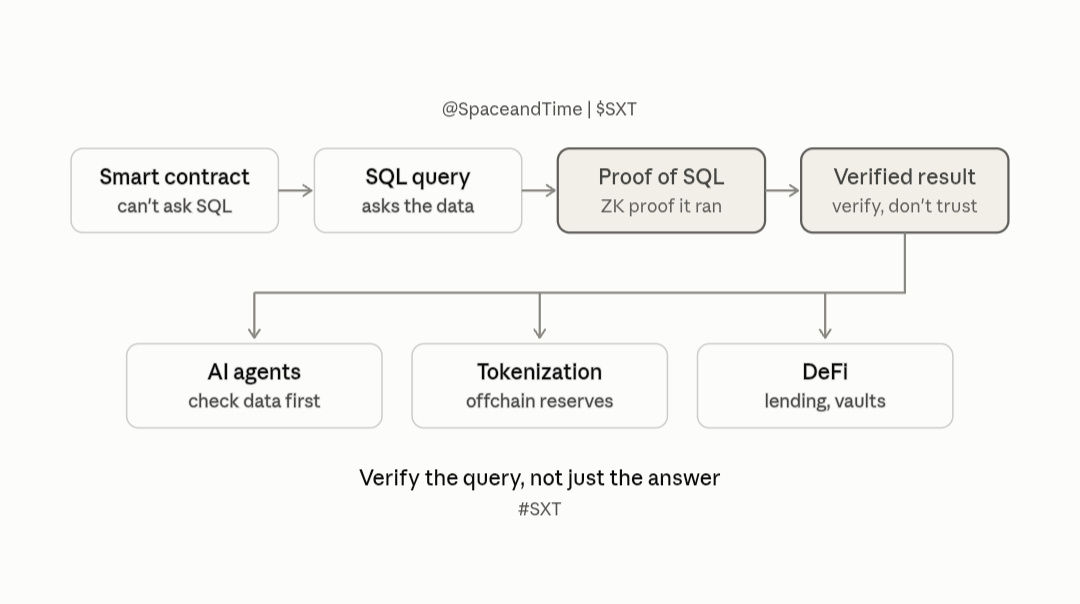
Looked at @SpaceandTime expecting another "onchain data" indexer. What stuck with me was something simpler: smart contracts can't query data on their own, because there's no query language onchain.
Space and Time lets them ask SQL questions, and Proof of SQL returns a ZK proof that the query ran correctly over tamper-proof data. So the answer can be verified instead of trusted.
I can see it mattering in three places: AI agents checking verified data before they act, tokenization anchoring offchain data like reserves, and DeFi lending or vault decisions that depend on the numbers being right.
The tension is that a proof shows the query ran correctly, not that the underlying data is good. Real usage also still looks small next to the token's market size.
For context only, $SXT is trading around $0.01 across the trackers I checked.
If the proof only covers the computation, who ends up accountable when the input data itself is wrong?
#sxt