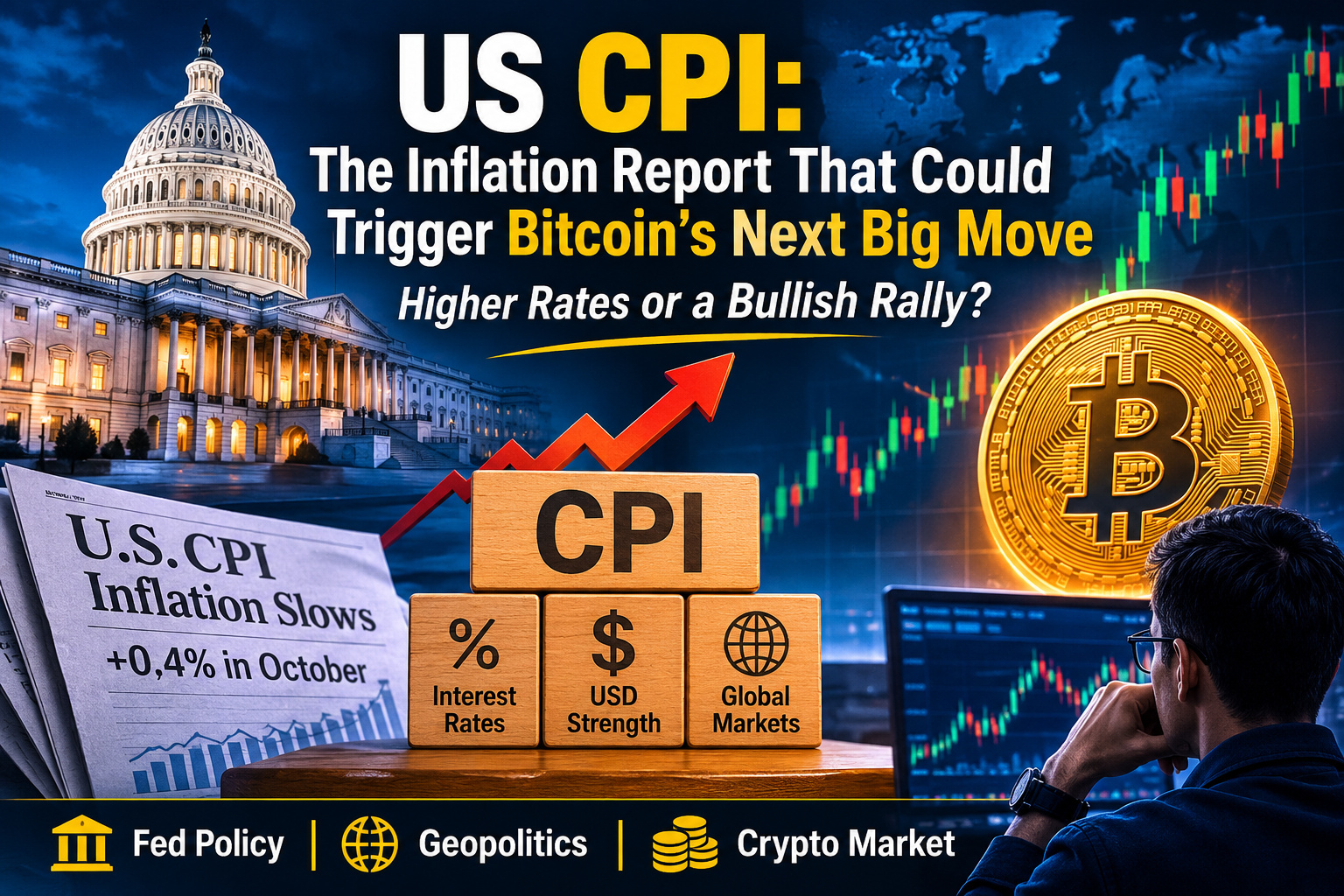

One inflation report can change the Fed’s rate outlook, redirect billions in institutional capital and shake the entire crypto market. But will the next CPI surprise send Bitcoin higher or trigger another wave of selling?
Every US CPI release puts financial markets on alert. Traders look beyond the inflation numbers and try to understand what they mean for the Federal Reserve’s next move.
For crypto investors, this matters more than many realize.
Bitcoin is not isolated from traditional financial markets. US interest rates, Treasury yields, dollar strength and global liquidity all influence how investors value risk assets.
That makes CPI one of the most important economic indicators for anyone trading Bitcoin and altcoins.
The real opportunity, however, is not simply guessing whether inflation will rise or fall. It is understanding how the numbers could change monetary policy and where institutional capital might move next.
1. Why CPI Matters to the Crypto Market
The Consumer Price Index (CPI) measures changes in the prices consumers pay for goods and services. It is an important indicator of inflation and one of the economic reports closely monitored by the Federal Reserve.
Traders generally focus on two figures:
Headline CPI: Includes food, energy and other consumer expenses.
Core CPI: Excludes food and energy to provide a clearer picture of underlying inflation.
Why does this distinction matter?
Oil prices can push headline inflation higher or lower in a relatively short period. Core inflation helps investors assess whether broader price pressures are becoming persistent.
The Fed also monitors other indicators, particularly the Personal Consumption Expenditures (PCE) price index, which is its preferred inflation measure.
Its long-term inflation target is 2%.
If inflation remains stubbornly high, policymakers may have little reason to reduce interest rates quickly. That can tighten financial conditions and put pressure on assets such as Bitcoin, technology stocks and other speculative investments.
2. What History Tells Us About Inflation and Bitcoin
The relationship between monetary policy and Bitcoin became particularly clear after the COVID-19 pandemic.
In 2020 and 2021, massive fiscal support, monetary expansion and supply-chain disruptions helped fuel inflation.
At the same time, exceptionally low interest rates and abundant liquidity supported demand for risk assets. Bitcoin benefited from that environment.
Then came 2022.
As US inflation reached a four-decade high, the Federal Reserve began an aggressive interest-rate tightening cycle.
Borrowing became more expensive. Treasury yields increased, liquidity conditions tightened and investors became less willing to hold speculative assets.
Bitcoin experienced a substantial decline alongside other risk-sensitive investments.
There is an important lesson here.
Bitcoin may have a long-term investment case as an alternative monetary asset, but in the short term, its price remains sensitive to global liquidity.
That is why traders pay so much attention to the relationship between CPI, interest rates and the dollar.
3. The Federal Reserve: How US Monetary Policy Shapes Global Markets
The Federal Reserve makes decisions for the US economy, but the consequences reach far beyond American borders.
When US interest rates remain high, dollar-denominated investments become relatively attractive.
International investors may shift capital towards US Treasury securities rather than holding riskier assets in emerging markets.
This can create pressure on foreign currencies, increase borrowing costs for countries with dollar-denominated debt and reduce liquidity available for speculative investments.
Crypto is particularly sensitive to this process.
When investors become more cautious, capital can move away from Bitcoin and altcoins towards cash, Treasury securities or other relatively defensive assets.
Geopolitics adds another layer.
Trade restrictions, Middle Eastern tensions, sanctions and shipping disruptions can increase energy and production costs.
If these developments push inflation higher, the Fed may have less room to cut interest rates.
For crypto investors, a political decision made thousands of miles away can eventually affect the value of their portfolio.
4. What the Latest US CPI Data Tells Investors
The October 2026 US CPI report was released on November 10.
Three figures deserve attention:
Indicator October 2026 September 2026
Headline CPI, monthly +0.4% +0.6%
Core CPI, monthly +0.3% +0.3%
Food prices, monthly +0.5% —
Energy prices, monthly +0.7% —
Source: US Bureau of Labor Statistics, October 2026 CPI report.
The numbers offer a mixed picture.
Headline inflation slowed from 0.6% to 0.4%. That is an improvement, but it does not mean inflation has been defeated.
Core CPI remained unchanged at 0.3%. Persistent underlying price increases remain a concern for policymakers.
Food prices increased by 0.5%, while energy prices rose by 0.7%.
There is also an important data limitation. Because October 2025 survey data were unavailable during the US government funding lapse, the BLS could not calculate the usual 12-month headline and core CPI changes for October 2026.
Investors should keep this limitation in mind rather than treating the monthly figures as a complete picture of inflation.
One more distinction matters: disinflation means prices are rising more slowly. It does not mean prices are falling.
5. How CPI Moves Bitcoin: Understanding the Transmission Mechanism
The connection between inflation and Bitcoin is easier to understand when we follow the flow of capital.
When inflation comes in higher than expected:
Markets may anticipate a more restrictive Federal Reserve.
Treasury yields may increase.
The US dollar may strengthen.
Holding non-yielding assets becomes relatively less attractive.
Investors may reduce exposure to Bitcoin and altcoins.
When inflation comes in lower than expected:
Expectations of future rate cuts may increase.
Treasury yields may decline.
The dollar may weaken.
Risk appetite may improve.
Bitcoin and other risk assets may attract fresh demand.
But there is a catch.
Markets do not react to the headline number alone. They react to the difference between actual data and what investors had already expected.
If traders are expecting high inflation, a slightly elevated CPI reading may not cause much damage.
On the other hand, even a lower reading can disappoint if the market was expecting a much sharper decline.
That is why the consensus forecast matters just as much as the actual CPI figure.
6. Institutional Capital: Who Is Really Moving the Market?
Retail traders often focus on Bitcoin's price chart. Institutional investors look at a much wider set of indicators.
Three groups are particularly important.
Asset managers and hedge funds
These investors constantly compare the potential returns of bonds, equities, gold and Bitcoin.
When Treasury yields become more attractive, some capital may move away from speculative investments.
Market makers and leveraged traders
These participants respond quickly to changes in volatility, liquidity and positioning.
A sudden move in yields or the dollar can trigger liquidations in leveraged crypto positions, making an ordinary price correction much sharper.
Spot Bitcoin ETF investors
Spot Bitcoin ETFs provide traditional investors with a regulated way to gain exposure to Bitcoin.
Sustained ETF inflows can indicate stronger institutional demand. Persistent outflows may suggest that investors are reducing exposure.
However, one day's ETF flow does not establish a long-term trend.
The better approach is to monitor ETF flows alongside spot volume, Treasury yields, dollar strength and derivatives positioning.
7. Geopolitics: The Inflation Risk Crypto Traders Cannot Ignore
Inflation is not driven by domestic consumer demand alone.
International political decisions can influence the cost of energy, imports and transportation.
Three developments deserve particular attention:
Middle East and energy security: Military tensions or shipping disruptions can push oil prices higher. This can increase transportation and production costs.
US-China trade relations: Tariffs and export restrictions can raise import prices and disrupt manufacturing supply chains.
Global supply-chain disruptions: Sanctions, shipping delays and commodity restrictions can make production more expensive.
These developments can put the Federal Reserve in a difficult position.
If inflation rises while economic growth slows, policymakers face a difficult choice. Cutting rates could support growth but risk prolonging inflation. Keeping rates high could control demand but put more pressure on employment and investment.
This is why a single positive CPI report does not guarantee a sustained Bitcoin rally.
Geopolitical developments can quickly change the inflation outlook.
8. The Fed's Position: Why the Next Decision Matters
On October 28, 2026, the Federal Reserve maintained its federal funds target range at 3.75%–4.00%.
The decision was not unanimous. Two policymakers preferred a 25-basis-point rate increase.
This disagreement is important because it shows that policymakers do not have identical views about the inflation outlook.
For financial markets, the next question is whether incoming economic data will strengthen the case for holding rates, cutting them or keeping monetary policy restrictive for longer.
The next US CPI report is scheduled for December 10, 2026.
Until then, investors will continue monitoring inflation-related indicators, employment data and the Fed's policy signals.
9. From Geopolitical Decisions to Your Crypto Portfolio
Understanding the connection between politics and financial markets can help investors avoid reacting too late.
Here is the chain worth following:
Geopolitical decisions
Tariffs, sanctions, energy disruptions and trade restrictions.
↓
Commodity and import prices
Changes in oil, transportation and production costs.
↓
US inflation
Headline CPI, core CPI and inflation expectations.
↓
Federal Reserve policy
Interest-rate decisions and expectations of future monetary easing or tightening.
↓
Global financial conditions
Treasury yields, dollar strength and institutional capital flows.
↓
Portfolio impact
Bitcoin, altcoins, equities, gold, cash and bonds.
This is how an international political development can eventually affect an ordinary investor's portfolio.
The important point is to identify where the risk originates rather than simply reacting when Bitcoin starts moving.
10. Three CPI Scenarios Every Crypto Investor Should Prepare For
CPI outcome Potential market reaction Investment approach
Inflation falls more than expected Lower yield expectations; potentially bullish for $BTC Look for sustained spot demand
Inflation remains sticky Higher-for-longer rate expectations; potential selling pressure Reduce leverage and protect capital
Inflation rises unexpectedly Stronger dollar and yields may pressure risk assets Avoid chasing rebounds; preserve liquidity
There is another scenario worth considering.
Inflation could decline while economic growth weakens sharply.
Initially, markets might welcome the possibility of rate cuts. But if recession fears increase, investors could sell risk assets across the board.
Bitcoin would not necessarily escape that pressure.
The reason behind a monetary-policy shift matters just as much as the direction of interest rates.
11. A Practical Trading Strategy Before and After CPI
For Bitcoin and major altcoin investors, I would focus on five indicators:
1. US 2-Year Treasury Yield
This helps reveal changing expectations about Federal Reserve policy.
2. US Dollar Index (DXY)
A stronger dollar can create additional pressure on risk-sensitive assets.
3. Bitcoin Spot ETF Flows
Look for sustained institutional demand rather than reacting to one day's figures.
4. Open Interest and Funding Rates
These indicators help identify excessive leverage and the possibility of liquidation-driven volatility.
5. Bitcoin Market Structure
Watch important support and resistance levels, trading volume and daily candle closes.
My preferred approach is simple: avoid opening an aggressive leveraged position immediately before CPI.
Wait for the announcement. Let the initial volatility settle, then look for confirmation through spot volume and Bitcoin's market structure.
A sudden price spike does not automatically signal a new trend.
For longer-term investors, gradual entries, cash reserves and sensible position sizing offer more flexibility than trying to catch the exact bottom.
12. The Bigger Investment Picture
Bitcoin is becoming increasingly connected to traditional financial markets.
Institutional participation, spot ETF investment channels, Treasury yields and global liquidity all influence its short-term valuation.
But Bitcoin does not simply follow the Federal Reserve.
Its supply structure, network adoption, regulatory developments and independent demand also matter. These factors can sometimes offset broader macroeconomic pressure.
That is why investors should monitor both sides of the market: Bitcoin's internal fundamentals and the external financial environment.
My investment takeaway: Don't trade the CPI headline. Focus on how the data changes expectations for Federal Reserve policy. Confirm that shift through Treasury yields and the dollar, then look for confirmation in Bitcoin's spot-market structure.
Investors who manage risk around macroeconomic events are often in a stronger position than those who try to predict every market move.
---
What's your view? Will falling US inflation give Bitcoin the momentum for its next major rally, or will persistent price pressures force the Federal Reserve to keep interest rates higher for longer? Share your analysis in the comments.
Disclaimer: This article is for educational and informational purposes only. It is not financial advice. Cryptocurrency markets are volatile. Always conduct your own research (DYOR) and manage risk before investing.