

The cryptocurrency industry has made enormous progress over the years, but recent security incidents have reminded us of one important reality: No cryptocurrency exchange is completely immune to hacking.
From Binance and Bybit to Bitget, WazirX, and DMM Bitcoin, several major platforms have experienced serious security breaches involving hundreds of millions or even billions of dollars.
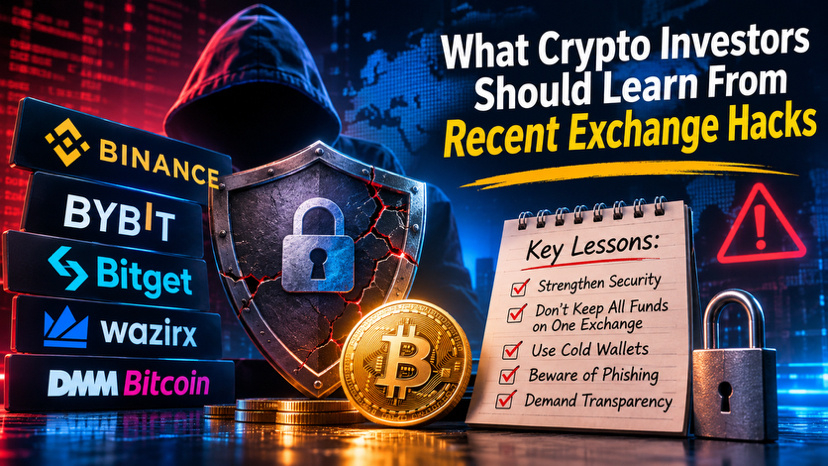
These incidents raise important questions about exchange security, user protection, and the risks of keeping digital assets on centralized platforms.
More importantly, they teach us that protecting cryptocurrency is not just about securing private keys. It also involves protecting employees, internal systems, transaction approvals, and the infrastructure behind exchanges.
Let’s look at what happened and what the entire crypto community should learn from these incidents.
1. Recent Exchange Hacks: What Happened?
Binance :- October 2026
On October 29, Binance experienced a major security incident involving approximately $6.34 billion in affected digital assets.
According to Binance’s initial investigation, attackers compromised internal wallet transaction-signing infrastructure and used unauthorized access to initiate transfers across multiple blockchain networks.
The incident involved sophisticated attacks targeting internal systems and authorization processes.
Binance stated that it would absorb the financial impact rather than pass the losses to users. Its November 3 update reported that 98% of affected token assets had been replenished, while approximately $2.85 billion in assets had been frozen or intercepted.
This incident demonstrated that even exchanges with extensive security resources can face serious infrastructure vulnerabilities.
Bybit :- February 2025
Bybit suffered one of the largest cryptocurrency thefts in history, losing approximately $1.5 billion.
The attackers manipulated the transaction interface used by wallet signers, making malicious transactions appear legitimate.
This was particularly concerning because the targeted wallet was a cold wallet, which many users consider highly secure.
The FBI attributed the attack to North Korea’s TraderTraitor hacking operation.
The biggest lesson was that cold storage and multiple transaction approvals are not enough if the signing process itself can be manipulated.
Bitget :- September 2026
Bitget also experienced a significant security breach involving approximately $387.5 million in digital assets.
According to the exchange, attackers compromised backend infrastructure connected to its wallet operations and manipulated transaction information during the authorization process.
Bitget stated that its cold wallets remained unaffected and that its protection fund would cover the losses.
This incident highlighted how vulnerabilities in internal systems can put exchange assets at risk even without directly stealing private keys.
WazirX and DMM Bitcoin :- 2024
These incidents also deserve attention.
WazirX suffered a security breach involving more than $230 million from a multisignature wallet in July 2024.
DMM Bitcoin lost approximately $305 million in Bitcoin following a security incident in May 2024.
Together, these cases demonstrate that exchange security has been a major challenge for the industry for years.
2. What Do These Attacks Have in Common?
Although the attacks involved different techniques, several important patterns emerge.
First, hackers are targeting people, not just technology.
Social engineering, compromised employee devices, fake recruitment opportunities, and malicious software can provide attackers with access to systems that would otherwise be difficult to penetrate.
Second, private keys are not the only security concern.
Even if private keys remain protected, compromised transaction interfaces, backend services, or authorization systems can create opportunities for unauthorized transfers.
Third, sophisticated attacks are becoming harder to detect.
Attackers may spend months preparing an operation, studying internal systems, and identifying weaknesses before moving any funds.
Finally, recovering stolen cryptocurrency is extremely difficult.
Blockchain transactions are generally irreversible. Although exchanges, blockchain investigators, and stablecoin issuers can sometimes freeze or trace assets, recovering everything is not guaranteed.
3. What Should Cryptocurrency Exchanges Improve?
These incidents should encourage every exchange to strengthen its security infrastructure.
Here are some important improvements the industry needs:
Stronger transaction verification: Every large transaction should undergo independent verification before approval.
Better employee security: Hardware security keys, device monitoring, strict access permissions, and cybersecurity training should be standard.
Withdrawal protection: Unusual or unusually large transfers should automatically trigger additional security checks.
Independent security audits: Exchanges should regularly test their wallets, backend systems, internal APIs, and transaction-signing infrastructure.
Better monitoring: Suspicious login activity, unexpected permission changes, and abnormal withdrawal patterns should be detected immediately.
Transparent incident reporting: Exchanges should communicate honestly about security failures, recovery efforts, and customer protection.
Security should never be treated as a one-time achievement. It requires continuous investment and improvement.
4. What Should Ordinary Crypto Investors Learn?
This is probably the most important part for everyday users.
We cannot control how an exchange manages its internal infrastructure, but we can take steps to reduce our own exposure.
Don’t keep all your assets on one exchange.
Centralized exchanges are useful for trading, but keeping your entire portfolio on a single platform creates concentration risk.
Consider keeping only the funds you need for active trading on exchanges. For long-term holdings, learn about self-custody and reputable hardware wallets.
Understand hot wallets and cold wallets.
Hot wallets are connected to online infrastructure and are generally used for faster transactions.
Cold wallets keep private keys offline and are generally better suited for long-term storage.
Both have advantages and limitations. Self-custody also means you are responsible for protecting your recovery phrase and private keys.
Enable stronger account protection.
Use two-factor authentication, passkeys or hardware security keys where supported, withdrawal address whitelisting, anti-phishing codes, and unique passwords.
Never share your seed phrase.
No legitimate exchange employee, support agent, or project representative needs your wallet recovery phrase.
Anyone asking for it should be treated as a potential scammer.
Be careful with suspicious links and downloads.
Fake job opportunities, malicious applications, browser extensions, and phishing websites can compromise your devices and accounts.
The Binance incident is a reminder that even seemingly legitimate professional opportunities can be used as attack vectors.
Understand Proof of Reserves.
Proof of Reserves can help users verify certain exchange-held assets, depending on the methodology.
However, it does not guarantee that an exchange cannot be hacked or that its internal security systems are flawless.
Financial transparency and cybersecurity are two different things.
5. Does This Mean Centralized Exchanges Are Unsafe?
Not necessarily.
Centralized exchanges remain an essential part of the cryptocurrency ecosystem. They provide liquidity, trading infrastructure, fiat deposits and withdrawals, derivatives markets, and access to thousands of digital assets.
However, users should understand that a large reputation does not automatically mean zero risk.
Even exchanges with substantial financial reserves can experience security failures.
At the same time, self-custody is not completely risk-free. Losing a recovery phrase or signing a malicious transaction can also result in permanent losses.
The goal should not be to blindly trust exchanges or completely avoid them.
It should be to understand the risks and manage them intelligently.
Conclusion: Protecting Capital Matters More Than Ever
The Binance, Bybit, Bitget, WazirX, and DMM Bitcoin incidents should change how we think about cryptocurrency security.
For years, many investors have focused primarily on price movements, trading volume, market capitalization, leverage, and potential returns.
But the security of the platform holding those assets deserves just as much attention.
A profitable trade means nothing if the infrastructure protecting your funds fails.
The biggest lessons are simple:
Never assume that a major exchange is impossible to hack.
Avoid keeping all your investments in one place.
Learn about self-custody and wallet security.
Protect your devices, passwords, and recovery phrases.
Demand transparency and accountability from exchanges.
Remember that protecting capital is just as important as growing it.
Crypto was built around financial independence, but financial independence also requires personal responsibility.
The future of this industry will not depend only on faster blockchains, better trading platforms, or wider adoption. It will also depend on whether users can trust the systems protecting their money.
Because in crypto, protecting your capital is just as important as making profits.