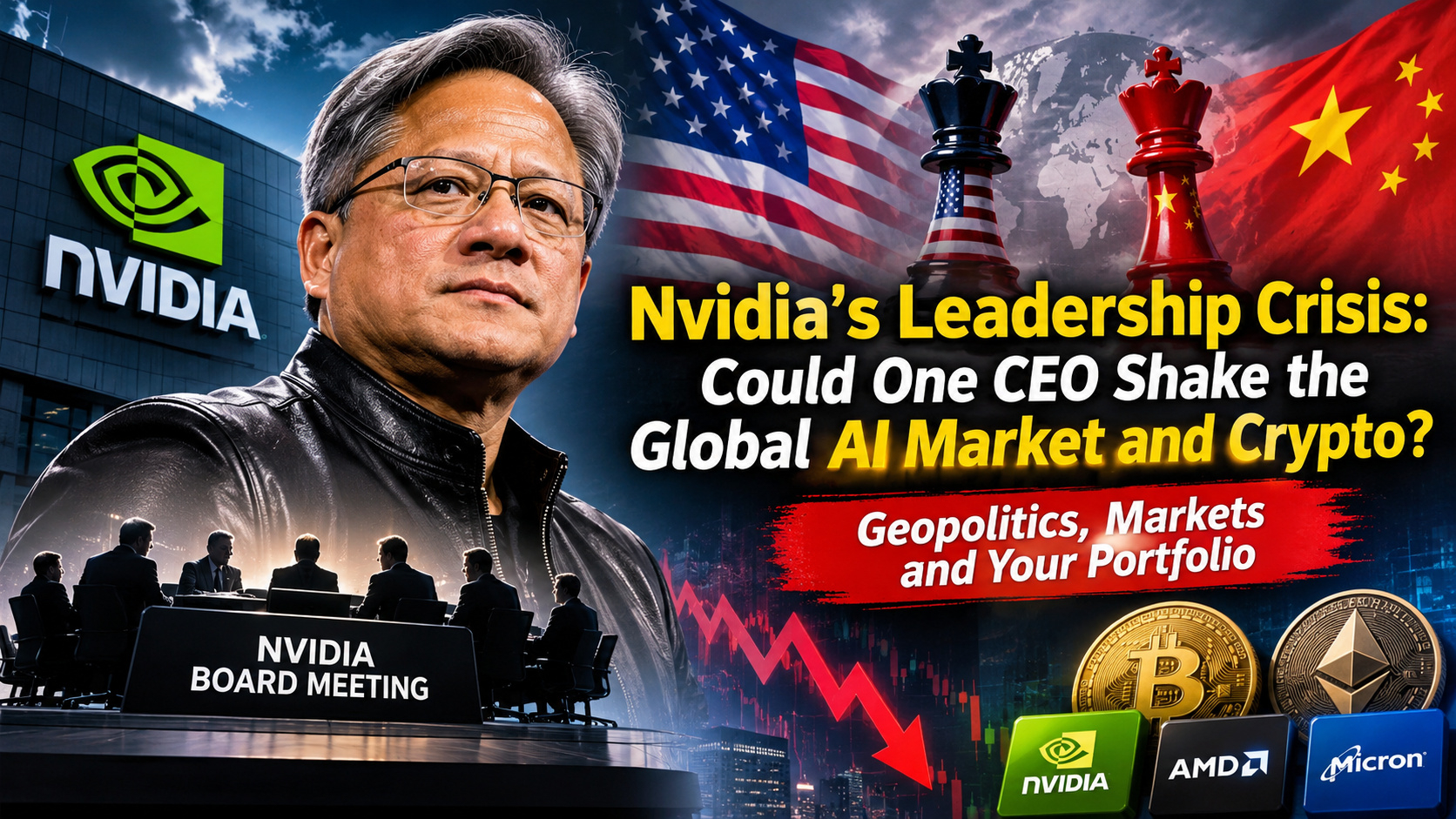

What happens when the man behind the world's most powerful AI chip company becomes the center of a corporate crisis? The consequences could reach far beyond Nvidia's stock price — potentially reshaping institutional capital flows, the semiconductor industry and even crypto market sentiment.
Nvidia is facing a moment that could test both its corporate leadership and its position in the global AI economy.
On November 11, Reuters reported that Nvidia's board had met to consider Jensen Huang's future as CEO, following reports about two alleged extramarital affairs. The Wall Street Journal had earlier reported that the company was preparing to remove him.
Nvidia shares reportedly dropped more than 8% in extended trading after the initial report. The potential market-value impact was estimated at approximately $600 billion if those losses persisted.
However, a reported board discussion should not be confused with a confirmed decision to remove Huang.
For investors, the bigger question is this: Can Nvidia maintain its dominance if uncertainty emerges around the leadership of the company that has become central to the global AI industry?
1. Nvidia Is No Longer Just a Semiconductor Company
Nvidia's transformation is one of the most important developments in modern technology markets.
For years, semiconductor companies competed primarily through chip performance, manufacturing efficiency and pricing. But the AI boom has changed the equation.
Nvidia now supplies critical computing infrastructure for AI models, cloud providers and data centers. Its GPUs, networking technology and CUDA software ecosystem have created a competitive advantage that is difficult to replicate.
This has also made Nvidia strategically important to the United States.
Washington increasingly views advanced semiconductors as national-security assets. Access to high-performance computing technology can influence economic competitiveness, military research and technological independence.
That is why Nvidia's business decisions are no longer determined by commercial demand alone.
US export controls, China's technological ambitions and international security considerations all influence the company's future.
2. The US–China Rivalry Adds Another Layer of Risk
The semiconductor industry sits at the center of the technological competition between Washington and Beijing.
The United States wants to maintain its advantage in advanced AI computing. China, meanwhile, is working to reduce its dependence on American technology.
This creates three important risks for Nvidia.
US export restrictions: Additional controls could limit Nvidia's access to Chinese customers and reduce potential revenue opportunities.
China's domestic chip industry: Chinese companies have incentives to develop alternatives, potentially increasing competition over time.
National-security investigations: Greater scrutiny can increase regulatory uncertainty and compliance costs.
There is also a distinction investors should understand.
Reports of foreign-intelligence interest involving a corporate executive do not automatically establish that confidential company information has been compromised.
The important issue is whether any investigation eventually produces evidence of operational, legal or security-related problems.
Until then, investors should separate confirmed developments from speculation.
3. Corporate Governance: Nvidia's Biggest Leadership Question
Jensen Huang has led Nvidia for decades. His influence extends beyond executive management.
He has shaped the company's product strategy, business relationships and long-term position in the AI industry.
That creates what institutional investors call key-person risk.
When a company becomes closely associated with one individual, uncertainty about that person's future can affect investor confidence even if the underlying business remains strong.
Nvidia's board has the authority to remove its CEO under the company's bylaws, according to Reuters.
But the decision would involve difficult trade-offs.
Keeping Huang could preserve strategic continuity.
Removing him could demonstrate board independence but introduce succession uncertainty.
Appointing an interim leader could provide stability, although investors would still demand a credible long-term plan.
The market is not necessarily questioning Nvidia's technology.
It is questioning whether the company's leadership structure can remain stable during a period of heightened scrutiny.
4. Institutional Capital Flows: Where Could the Money Go?
This is where the story becomes particularly important for investors.
Large institutional funds do not always sell a company because its business has deteriorated. Sometimes they reduce exposure because the risk attached to future earnings has increased.
That distinction matters.
Nvidia's AI business remains supported by demand for advanced computing infrastructure. But investors must now consider leadership risk alongside earnings growth and valuation.
Three stocks deserve attention.
NVIDIA ($NVDA )
Nvidia remains the central company in this crisis. Its future performance will depend on leadership stability, AI infrastructure demand, export policy and its ability to maintain technological advantages.
Advanced Micro Devices (AMD)
AMD could attract investors looking for alternative exposure to AI computing. If major customers diversify their chip suppliers, AMD may benefit.
However, capital rotation does not automatically translate into market-share gains. Actual product competitiveness and customer adoption will matter.
Micron Technology ($MU )
Micron offers a different angle on the AI investment cycle through memory products, particularly high-bandwidth memory.
AI infrastructure requires more than GPUs. Memory, networking and data-center capacity are also essential.
That makes Micron an important company to monitor, although its performance remains sensitive to memory prices, supply conditions and capital expenditure.
The key distinction is that AMD represents a potential competitive alternative to Nvidia, while Micron provides exposure to another critical part of the AI supply chain.
5. History Shows How Geopolitics Can Redirect Capital
The current semiconductor competition has historical roots.
During the Cold War, advanced computing and semiconductor technology became important instruments of economic and military power.
Later, Japan, South Korea and Taiwan emerged as major forces in the global semiconductor supply chain.
The competition has now entered a new phase, with artificial intelligence at its center.
US restrictions introduced from 2022 onward changed how semiconductor companies approached the Chinese market.
Companies had to reconsider product availability, manufacturing partnerships and international expansion strategies.
This illustrates an important lesson from financial history:
When governments identify an industry as strategically important, capital allocation becomes increasingly influenced by political decisions.
The same dynamic is now visible across AI, semiconductors, energy and defence.
For investors, profitability alone is no longer enough. Political exposure and regulatory risk also deserve attention.
6. How Could Nvidia's Crisis Affect Bitcoin and Crypto?
At first glance, a leadership dispute at Nvidia has little to do with Bitcoin.
But global financial markets are connected through liquidity, institutional positioning and risk appetite.
When large investors reduce exposure to high-valuation technology stocks, they may also reconsider positions in other volatile assets.
That creates three possible transmission channels.
First: Institutional risk reduction.
If investors move away from technology stocks, pressure could spread to Bitcoin, Ethereum and speculative altcoins through broader portfolio adjustments.
Second: AI investment sentiment.
Nvidia is a major symbol of the AI investment boom.
A prolonged leadership crisis could weaken sentiment toward AI-related equities and crypto projects connected to AI infrastructure.
Third: Dollar liquidity and interest rates.
If geopolitical uncertainty coincides with tighter financial conditions or stronger demand for dollar liquidity, speculative assets could face additional pressure.
However, Bitcoin does not depend on Jensen Huang's leadership.
Its long-term investment case is driven by different factors, including monetary conditions, adoption, regulation and institutional demand.
The connection is mainly through short-term market sentiment and liquidity.
7. The Portfolio Impact Map
Investors should understand how a corporate or political decision can travel through the financial system.
US–China tensions and national-security concerns
↓
Nvidia leadership and governance uncertainty
↓
Institutional investors reassess risk exposure
↓
Capital rotation across semiconductor stocks
↓
Changes in technology-sector sentiment and liquidity
↓
Potential impact on Bitcoin, Ethereum and AI-related altcoins
This is a possible transmission mechanism, not a guaranteed sequence.
The actual outcome will depend on the board's decision, company fundamentals and broader macroeconomic conditions.
8. Three Market Scenarios Investors Should Prepare For
Bullish scenario
Huang remains CEO, or Nvidia announces an orderly leadership transition. Uncertainty declines, and investors return their attention to earnings growth and AI demand.
This could support a recovery in Nvidia shares and improve sentiment across the semiconductor sector.
Neutral scenario
The investigation continues without an immediate leadership change. Nvidia remains volatile while investors monitor developments and consider alternative semiconductor investments.
AMD and other AI-related companies could attract additional attention.
Bearish scenario
Huang is removed without a credible succession plan, or new developments create further regulatory and operational uncertainty.
In that situation, Nvidia's valuation could face additional pressure. Broader AI-sector sentiment could weaken, potentially affecting other technology stocks and risk-sensitive crypto assets.
The next earnings report and management guidance will also be important in determining whether the underlying AI business remains strong.
9. What Should Investors Watch Now?
Instead of reacting to every headline, investors should focus on five developments:
Board decision: Does Huang remain CEO, or does Nvidia announce a leadership change?
Succession planning: Does the company have a credible alternative leadership structure?
US–China policy: Are new semiconductor export restrictions introduced?
Capital rotation: Are institutional investors moving into AMD and other semiconductor companies, or reducing exposure to the entire AI sector?
Crypto market structure: Are Bitcoin and Ethereum maintaining important support levels despite broader technology-market volatility?
For Nvidia investors, buying aggressively during headline-driven volatility without understanding the leadership situation could increase risk.
For AMD and Micron investors, competitive opportunities should be evaluated against earnings, valuation and actual demand.
For crypto investors, liquidity, Bitcoin's market structure and broader institutional risk appetite deserve more attention than short-term AI narratives.
10. The Bigger Picture: Technology Is Now a Geopolitical Asset
Nvidia's crisis highlights a major change in global finance.
Technology companies are no longer evaluated only through revenue, innovation and market share.
Their relationships with governments, exposure to export controls, international business access and corporate governance can also influence their valuations.
This is especially true for companies operating at the intersection of AI, semiconductors and national security.
Jensen Huang's future is therefore more than a corporate leadership question. It is a test of how a strategically important technology company manages institutional confidence during a period of geopolitical competition.
My investment view: Nvidia's long-term competitive position should be assessed separately from its immediate leadership risk. $AMD could benefit from competitive diversification, while Micron remains exposed to the broader AI memory cycle. Bitcoin and Ethereum could face indirect pressure if institutional investors reduce risk across financial markets.
The important thing is to distinguish temporary headline-driven volatility from a genuine deterioration in business fundamentals.
The next phase of the AI market may be shaped not only by who builds the best chips, but also by who controls the technology, supply chains and capital behind them.
What do you think: If Jensen Huang leaves Nvidia, will AMD become the biggest beneficiary, or could the entire AI and crypto market face a wider confidence shock? Share your analysis in the comments.
---
Risk Disclaimer: This article is for educational and informational purposes only. Reported allegations and board discussions should not be treated as established legal findings or confirmation of a CEO removal. Market scenarios are possibilities, not guaranteed outcomes. Always conduct your own research (DYOR). Not Financial Advice (NFA).
#NVIDIA #MU #HuangRisksOusterOverReportedAffairWithSubordinate #Geopolitics #CryptoMarket