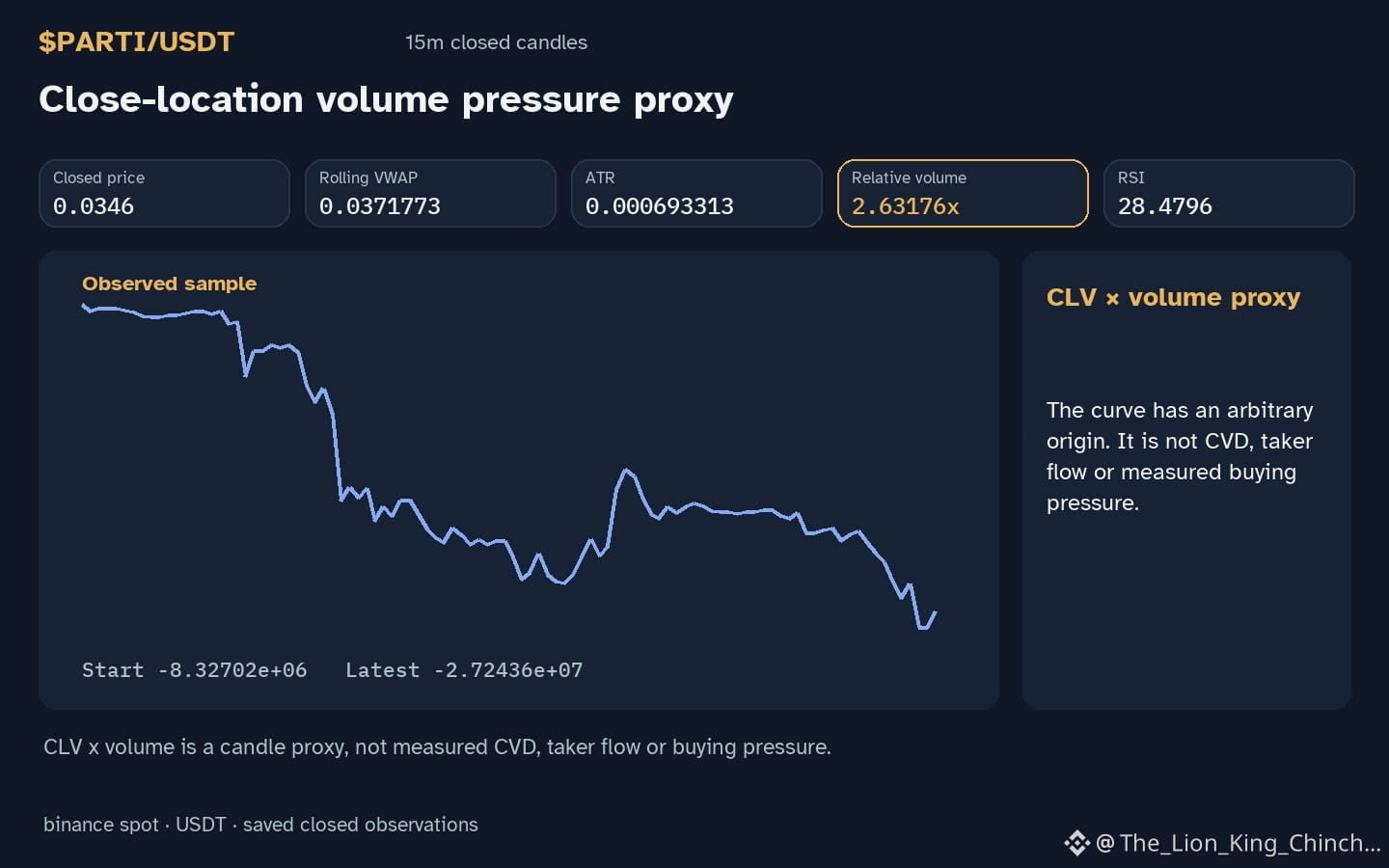
$PARTI: PARTI: Rethinking Tape Reading With Asymmetric Volume
What does it mean when $PARTI shows a down hourly direction while volume stays above baseline? The observation invites a tape‑reading thought experiment across a short window of bars.
A hypothetical decision could be that the most recent up‑bars carry heavier volume than the down‑bars. If this asymmetry reflects genuine buying pressure, a trader might expect a short‑term bounce. The clue is the contrast between volume on up moves and volume on down moves within the last 20 bars.
An alternative reading is that the volume differential simply mirrors random fluctuations. In a volatile market, occasional spikes on up‑bars do not guarantee a reversal; they may be noise. The weakness of the first interpretation grows if the up‑bar volume is not consistently higher across the window or if the down‑bars show similar volume in later segments.
A counterexample would be a sequence where the down‑bars actually dominate volume despite the overall above‑baseline level. That would undermine the idea that volume asymmetry predicts a bounce.
To reassess, one could track the ratio of volume on up‑bars versus down‑bars over the next 18000 seconds and compare it to the current pattern. If the ratio reverses, the original reading loses strength. This approach keeps the analysis grounded in observable tape behavior while acknowledging the limits of inference.
Probabilistic market research, not a recommendation or guaranteed return.
What would weaken this reading?
#PARTI #MarketAnalysis #CryptoLearning