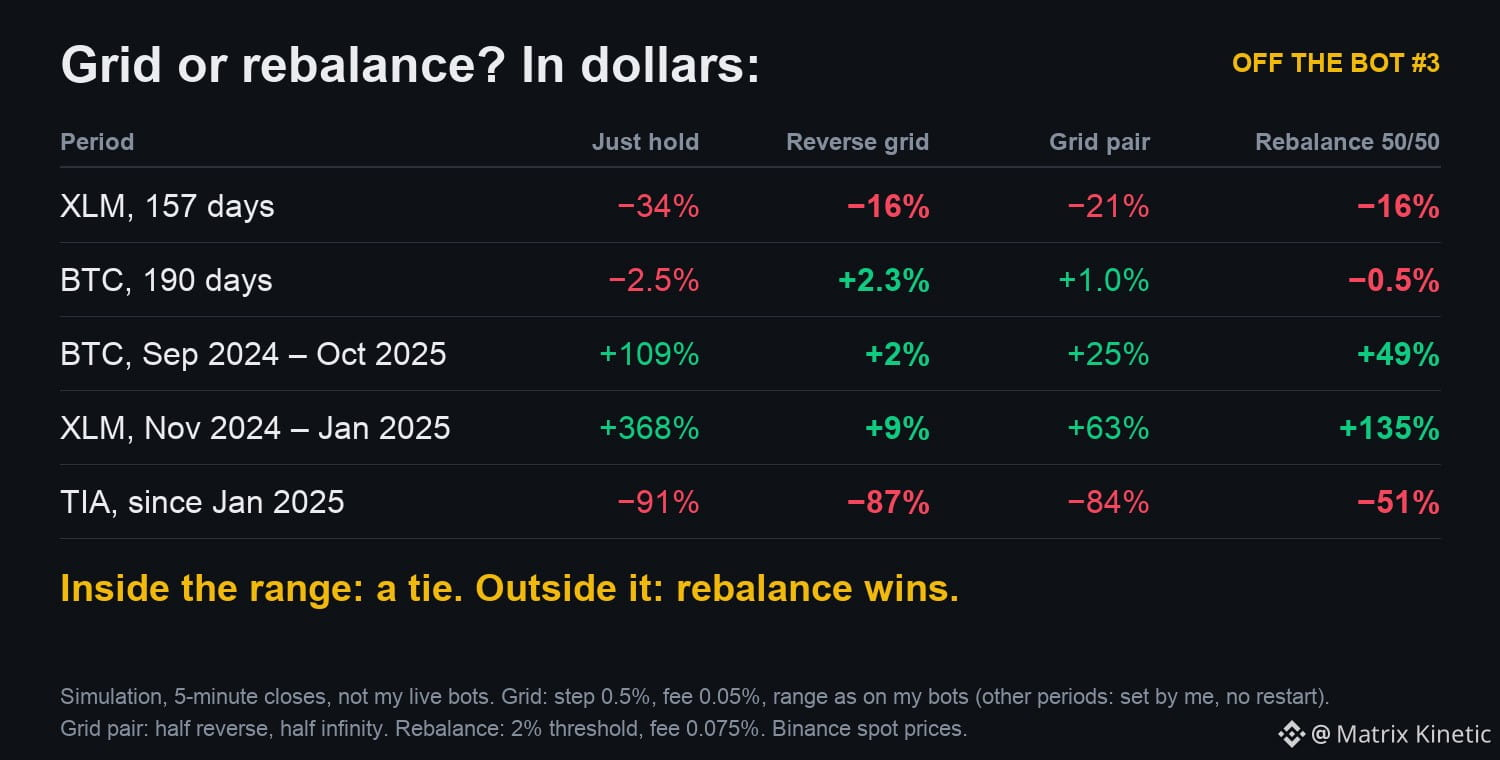
Off the bot #3. Grid or rebalance? On BTC +109%: +2% vs +49%.
Last time I swapped staking for a reverse grid. There's a simpler tool: a 50/50 rebalancing bot. Coin and stablecoin, back to equal halves whenever one drifts. Binance has one built in (minimum 200 USDC).
No floor, no ceiling.
It's really a grid without borders: the threshold sets the step, and trade size shrinks with the portfolio, so the cash never runs out.
I simulated both on 5-minute prices. In coins the model lands within a point of my live BTC and TRX grids, and 5 below on XLM.
Inside the range it's a tie. $XLM −34%: grid −16%, rebalance −16%.
Outside it, the range decides. $BTC +109%: the reverse grid sold everything near its ceiling and sat in cash, +2%. Rebalance +49%. $TIA −91%: grid −87%, rebalance −51%. Still −51%.
Two things I expected to matter didn't. Threshold: from 0.25% to 10% the result barely moved on my coins. Fees: 0.05% or 0.075%, same. And a finer grid step was worse: 0.1% lost to 1% every time.
So why do I keep grids? I count in BTC. Over 190 days the reverse grid added +4.9% in coins, the rebalance +2.0%. A rebalance splits its harvest across both sides, and you only see both grow if price comes back.
But a rebalance is easier to live with. Set BTC/BNB/TRX/USDT at 25% each and forget it. Some bots let you add funds, withdraw or change settings without stopping them. I run one too.
Not advice. What would you run instead of staking?
#trading #RiskManagement #bitcoin #Binance