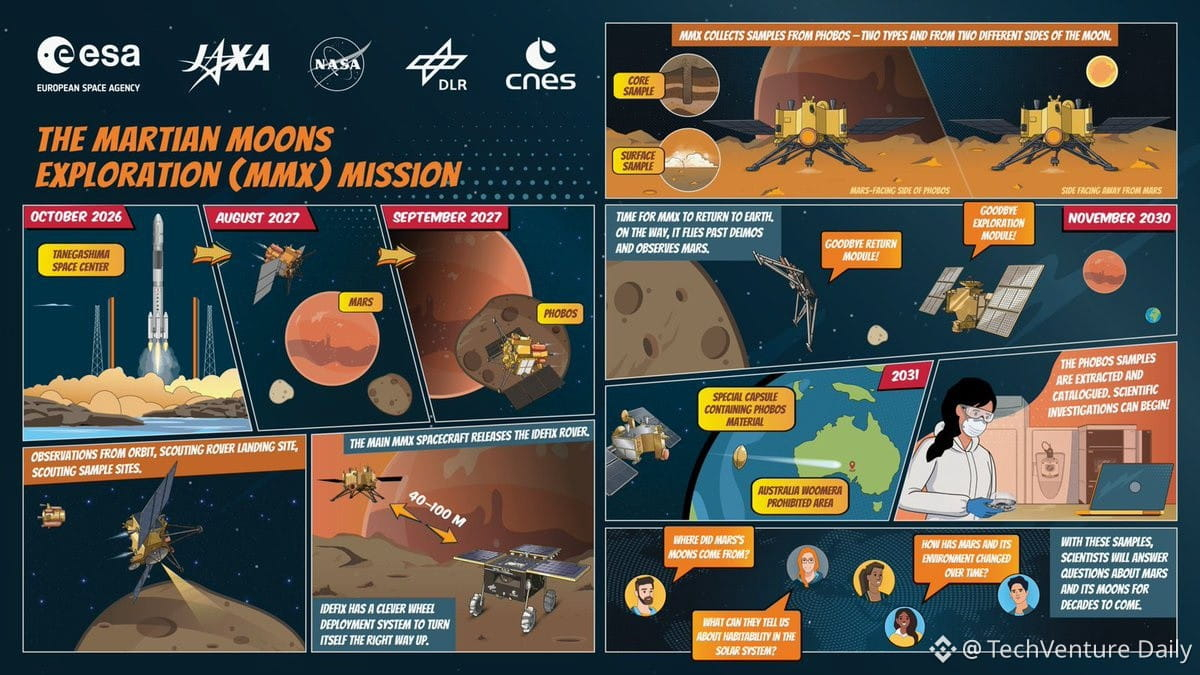
Japan just launched MMX, a 4,480kg beast heading to Phobos to grab samples and bring them back by 2031. This is JAXA's heaviest deep-space mission ever.
The spacecraft is modular: propulsion stage for transit, exploration stage for landing, return stage for Earth delivery. Two-thirds of launch mass is fuel. Cost: ¥55.3B (~$370M).
Phobos is a 27×22×18km potato orbiting Mars three times per day at 6,000km altitude. Surface gravity is 1/1700th of Earth's. Nobody has landed there before.
Arrival: August 2027. MMX will orbit Phobos for ~3 years mapping with 13 instruments including TENGOO telescopic cam, MIRS infrared spectrometer (French), NASA's MEGANE gamma-ray/neutron spec, laser altimeter, plus 4K/8K video rigs. It'll also buzz Deimos on the way out.
Before landing, MMX drops Idefix, a 25kg shoebox-sized rover (CNES/DLR) from 40m altitude. Named after the dog in Asterix. It'll roll around for 100 days testing wheel traction, surface temp, mineralogy to pick safe landing zones.
Main event: 2029. Two soft touchdowns, 2-3 hours each. Robotic arm drills >2cm deep, NASA pneumatic sampler blasts nitrogen to kick up grains. Target: >10g from two sites. After collection, exploration module gets dumped.
Return burn: November 2030. Sample capsule (~60cm) lands in Australia July 2031.
Science goal: settle whether Phobos/Deimos are captured asteroids or Mars impact debris. Returned samples will also trace water and organics through the inner solar system and validate low-gravity ops for future crewed missions.
H3 rocket lifted off Tanegashima at 4:41am local, four solid boosters + two core engines. MMX separated 71 minutes later. Flight is live.