
Learn how cognitive biases quietly influence your decisions and how to reduce their impact
Cognitive Psychology: The human brain developed for survival, not for making probability-based decisions.
Here is Chapter 12 from my book: How to Trade Like a Scientist: Use the Principles of Science to Build, Test, and Continuously Improve a Profitable Trading System.
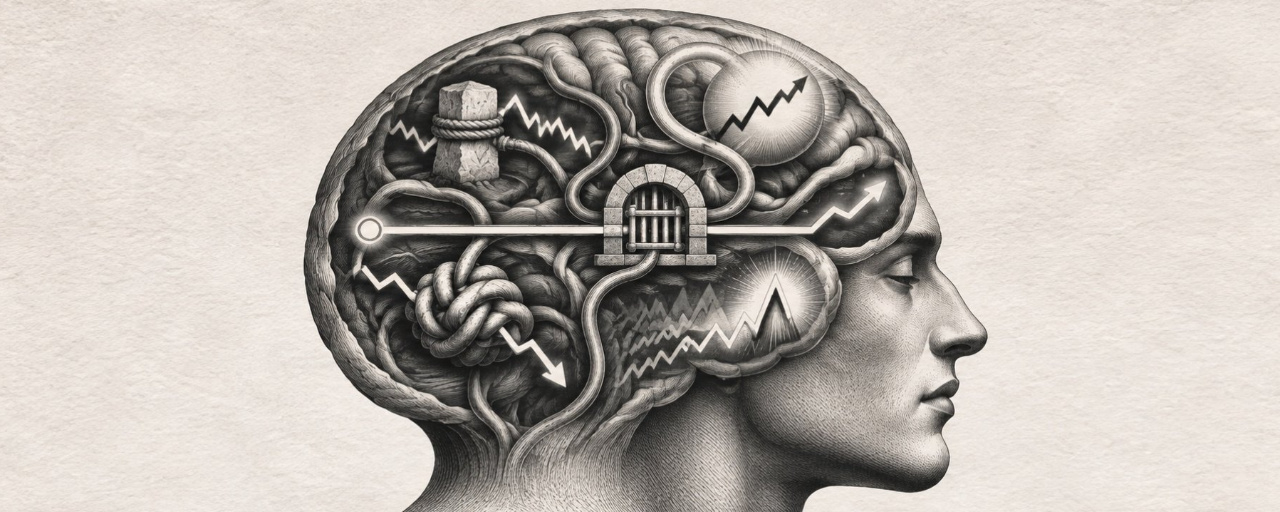
The human brain developed to survive uncertainty, not to manage probability. For hundreds of thousands of years, staying alive meant making fast decisions with limited information. The brain learned to spot danger quickly, remember painful experiences vividly, and stick close to the safety of the group. Those instincts kept people alive on the savanna. Financial markets reward almost the opposite set of behaviors.
Successful trading calls for patience rather than urgency, accepting small losses rather than avoiding them, independent thinking rather than following the crowd, and decisions built on probabilities rather than raw instinct. That mismatch between the wiring people carry and the behavior markets actually reward is the subject of this chapter. The mental shortcuts responsible for it are well-documented and, more usefully, predictable. Once a trader can name a bias, they can build a specific defense against it rather than fighting a vague feeling of being pulled off course.
Anchoring Keeps You Focused on the Wrong Number
The brain naturally latches onto the first piece of information it receives and continues to treat it as important, even after it has stopped being useful. Psychologists call this anchoring.
In trading, the anchor is often your purchase price, a recent high or low, or a price you believe an asset should reach. Those numbers may feel important, but they have no influence on what the market does next. The market only trades at the current price. The market does not care what your entry price was.
Imagine you buy a stock at $50, and it falls to $45. Many traders become emotionally attached to the original purchase price and refuse to sell because they want to "get back to even." But the market doesn't know you paid $50. From today's price of $45, the only question that matters is whether you would buy the stock today based on your trading system.
If the answer is yes, it remains in a buy zone; continue holding it. If the answer is no, your original purchase price shouldn't prevent you from selling and cutting your loss after your entry signal has been proven wrong. The $50 price is part of history. It doesn't change the probability of what the stock is likely to do next. Your trading plan likely told you to cut your loss before you got to this point.
The lesson is simple: don't decide based on where you entered the trade. Decide based on where the market is now and what your trading plan tells you to do next.
Why Losses Hurt More Than Gains Feel Good
Psychologists Daniel Kahneman and Amos Tversky discovered that people feel the pain of a loss much more strongly than the pleasure of an equal gain. Losing $100 usually feels worse than gaining $100 feels good.
This made sense throughout human history. Losing food, shelter, or protection could threaten survival, so our brains evolved to avoid losses. In trading, however, this instinct often works against us.
Many traders hold losing positions too long because taking the loss feels painful. They sell winning positions too quickly because they don't want to risk giving back a profit. Both habits reduce long-term performance. Both are based on loss aversion, trying to avoid the pain of feeling a loss.
Imagine your trading plan calls for risking $100 to make $200. If you consistently let your losses grow to $200 while still taking profits at $200, your reward-to-risk ratio changes from 2-to-1 to 1-to-1. Even if your win rate stays exactly the same, your trading edge becomes much smaller.
The market doesn't care how you feel about a loss. It only rewards disciplined execution. The lesson is simple: don't let the fear of taking a loss or the desire to protect a small gain override your trading plan. A small, planned loss is often the price of achieving much larger gains over the long run. Much of your success as a trader will come down to your skill of keeping losses small and accepting them fast.
Recent Results Feel More Important Than They Are
The human brain naturally gives more importance to recent events than to older ones. Psychologists call this recency bias. After several winning trades, it's easy to feel you've figured out the market. After several losing trades, it's just as easy to believe your trading strategy has stopped working. Neither conclusion is correct.
Imagine you've followed the same trading strategy for 200 trades. The last five trades represent only 2.5 percent of everything you've learned about that strategy. Yet those five trades are often the ones you remember most clearly, making them seem much more important than they really are.
The larger sample tells the real story. A handful of recent trades rarely provides enough evidence to conclude that a trading strategy has changed. Winning and losing streaks are a normal part of trading.
The lesson is simple: don't let your last few trades outweigh the evidence from your entire trading history. Judge your strategy over a large sample of trades, not by the emotions created by your most recent results.
Memorable Events Distort Your Judgment
The brain remembers dramatic events much better than ordinary ones. A market crash, a spectacular bull market rally, or a major news event stays in your memory because it was unusual and emotional. As a result, those events often feel more likely to happen again than they really are. Psychologists call this the availability bias.
For example, after living through a major market crash, many investors expect another crash even when the market is behaving normally. Likewise, after a powerful bull market, it becomes easy to believe prices will continue rising indefinitely.
The problem is that memorable events are not always the most common events. Markets spend most of their time making relatively ordinary moves, but our brains naturally focus on the exceptions rather than the rule. Before making an important trading decision, ask yourself whether you are reacting to current market conditions or simply recalling a dramatic past event.
The lesson is simple: don't mistake what is easiest to remember for what is most likely to happen. Base your decisions on evidence, not on the events that stand out most in your memory. Over the long term, the stock market will most of the time exhibit normal price action and revert to its historical average. Don't get stuck mentally on the fear of market crashes or on nonstop parabolic bull markets, as neither is normal.
Success Can Create Overconfidence
A winning streak can lead traders to believe they are more skilled than they really are. This false confidence often leads to taking bigger risks, becoming less selective, and paying less attention to the rules that created the success.
Imagine a trader who normally risks 1 percent of their account on each trade. After several wins in a row, they become confident and increase their risk to 3 percent per trade. Nothing about the trading strategy has changed. The only change is the trader's confidence.
If the next few trades are losses, those losses are now three times as large as they would have been under the original position-sizing parameters. A small losing streak that would have been easy to recover from can quickly become a much larger setback. Winning streaks do not prove that a trading strategy has become better. They are a normal part of any profitable system.
The lesson is simple: success is not a reason to abandon discipline. Continue following the same position-sizing and risk-management rules that produced the winning streak.
Looking Back Makes the Future Seem Obvious
After a market move has already happened, it often feels like it was easy to predict. Psychologists call this hindsight bias. Once we know the outcome, our brains quietly rewrite the past, making us believe the warning signs were obvious all along. In reality, they usually weren't.
Imagine reviewing a trade that ended in a loss. Looking back, you may think, "I should have known this would happen." But before the trade, you didn't have the benefit of knowing the outcome. You only had the information available at that moment, and the future was still uncertain.
The same thing happens after successful trades. A winning trade can make you believe the opportunity was obvious and you should have increased your position sizing, even though it may have looked far less certain before you entered.
The lesson is simple: judge your decisions based on the information you had at the time, not on what became obvious afterward. Good traders don't expect to predict the future perfectly. They focus on making the best possible decision with the information available. Hindsight can be a parasite on a trader's mind, making you second-guess yourself through the illusion of present knowledge. If you followed your trading signals in real time, you did the right thing under the uncertainty of that moment.
Don't Let the Past Control Today's Decisions
One of the strongest biases in human psychology is the sunk-cost fallacy. It is our tendency to continue investing in something simply because we have already invested so much time, research, effort, or money in it.
This instinct is easy to understand. Nobody enjoys admitting that their time, effort, or money has been wasted. Once we commit to a decision, our brains naturally want to justify that commitment. Walking away feels like accepting failure, even when it is clearly the better choice. The problem is that the market doesn't care how much you've already invested or lost.
Imagine buying a stock at $60 and watching it fall to $50. At that point, the $10 loss has already happened. Holding the position can't erase it, and neither can buying more shares. Yet many traders continue holding because selling would force them to admit the original decision didn't work out. Others invest even more money because they feel they have "too much invested to quit now." Both reactions are driven by the past instead of the future.
The money already invested is gone, whether you hold, sell, or buy more. It has become a sunk cost. The only question that matters now is which decision gives you the best chance of success from now on.
This bias appears everywhere in life. People stay in failing businesses because they've already invested years building them. They remain in unhappy relationships because they've spent too much time to leave. They finish books they no longer enjoy simply because they're halfway through. In every case, past investments influence decisions that should depend only on future benefits and future costs.
The lesson is simple: yesterday's investment or trade is history. Today's decision should be based only on what gives you the best outcome from this point forward, regardless of how much time, effort, or money you've already committed.
The Way Information Is Presented Changes Decisions
People often make different decisions based on how the same information is presented, even when the facts are identical. Psychologists call this the framing effect.
For example, imagine two trading strategies.
The first is described as winning 70 percent of its trades.
The second is described as losing 30 percent of its trades.
Most people naturally prefer the first description, even though both strategies are identical. The wording changed. The facts did not.
The same thing happens in the financial markets. Headlines, analyst reports, and market commentary often present information in ways that create excitement or fear without changing the underlying facts. Successful traders learn to look past the presentation and focus on the information itself. Before reacting to any new information, ask yourself whether the facts have actually changed or only the way they were presented.
The lesson is simple: don't let the presentation of information influence your decisions more than the information itself.
Too Much Information Can Lead to Worse Decisions
Many people believe that having more information automatically leads to better decisions. In reality, the brain can only process a limited amount of information at one time. As more information competes for your attention, it becomes harder to identify what actually matters.
Imagine trying to decide whether to buy a stock. One indicator suggests buying. Another suggests waiting. A third signals selling. Meanwhile, financial news, social media, television commentators, and online forums all offer different opinions. Instead of making decisions easier, the extra information often creates confusion. This is known as cognitive overload.
When the brain becomes overloaded, people often hesitate, second-guess themselves, or focus on whatever information confirms what they already wanted to do. Successful traders avoid this trap by simplifying their decision-making process. They identify the information that consistently helps them make better decisions and ignore everything else.
The lesson is simple: more information does not always produce better decisions. Often, a smaller amount of relevant information leads to clearer thinking and more consistent execution. Your job as a trader is to create a trading system that filters out the complexity and makes trading profitably simpler by focusing on what signals matter the most to you in your own timeframe.
Why These Biases Matter
Every trader experiences these cognitive biases because they are part of normal human psychology. They aren't signs of a lack of intelligence, experience, or discipline. They are shortcuts the brain developed to help our ancestors survive in an uncertain world.
The problem is that what helped people survive thousands of years ago doesn't always help them make good decisions in today's financial markets. Our instincts often encourage us to avoid losses, follow the crowd, remember dramatic events, and rely on recent experiences. Successful trading often requires doing the opposite.
The goal isn't to eliminate these biases completely. That's impossible. The goal is to recognize when they are influencing your thinking before they influence your decisions.
The more aware you become of these mental shortcuts, the less control they have over your trading. Every time you ask, "Am I reacting to the facts or to one of my biases?" You give yourself the opportunity to make a more objective decision.
Trading like a scientist means studying more than the markets. It also means understanding the strengths and weaknesses of your mind when making trading decisions. The better you understand both, the more consistently you can make rational decisions in an uncertain market.
Build Defenses Against Your Own Cognitive Biases
Base every trading decision on the current evidence, not on the price at which you entered the trade.
Don't let the fear of taking a loss or the excitement of making a profit cause you to ignore your trading plan.
Judge your trading strategy over a large sample of trades instead of reacting to recent wins or losses.
Before acting on a strong feeling about the market, ask whether it is supported by evidence or simply influenced by a memorable past event.
Stay disciplined after winning streaks. Success is not a reason to increase risk or abandon good trading rules.
Evaluate your decisions based on the information available at the time, not on what became obvious after the outcome was known.
Don't let money, research, time, or effort already invested influence your next decision. Focus only on what gives you the best opportunity in the future.
Look beyond headlines and opinions by focusing on the facts rather than the way information is presented.
Keep your trading process simple. Too much information can make good decisions harder, not easier.
Recognize when cognitive biases are influencing your thinking, and rely on your tested trading process rather than your instincts.
You can pick up a copy of How to Trade Like a Scientist: Use the Principles of Science to Build, Test, and Continuously Improve a Profitable Trading System on Amazon worldwide if you want to read the rest of this book.
#BinanceReopensWithdrawalsForMoreAssets #BTCRebounds80K #Binance98PercentReplenished #USMidterms-WhatAreMarketsExpecting? #ADPUSPrivateEmployersAdd86000JobsInOctober