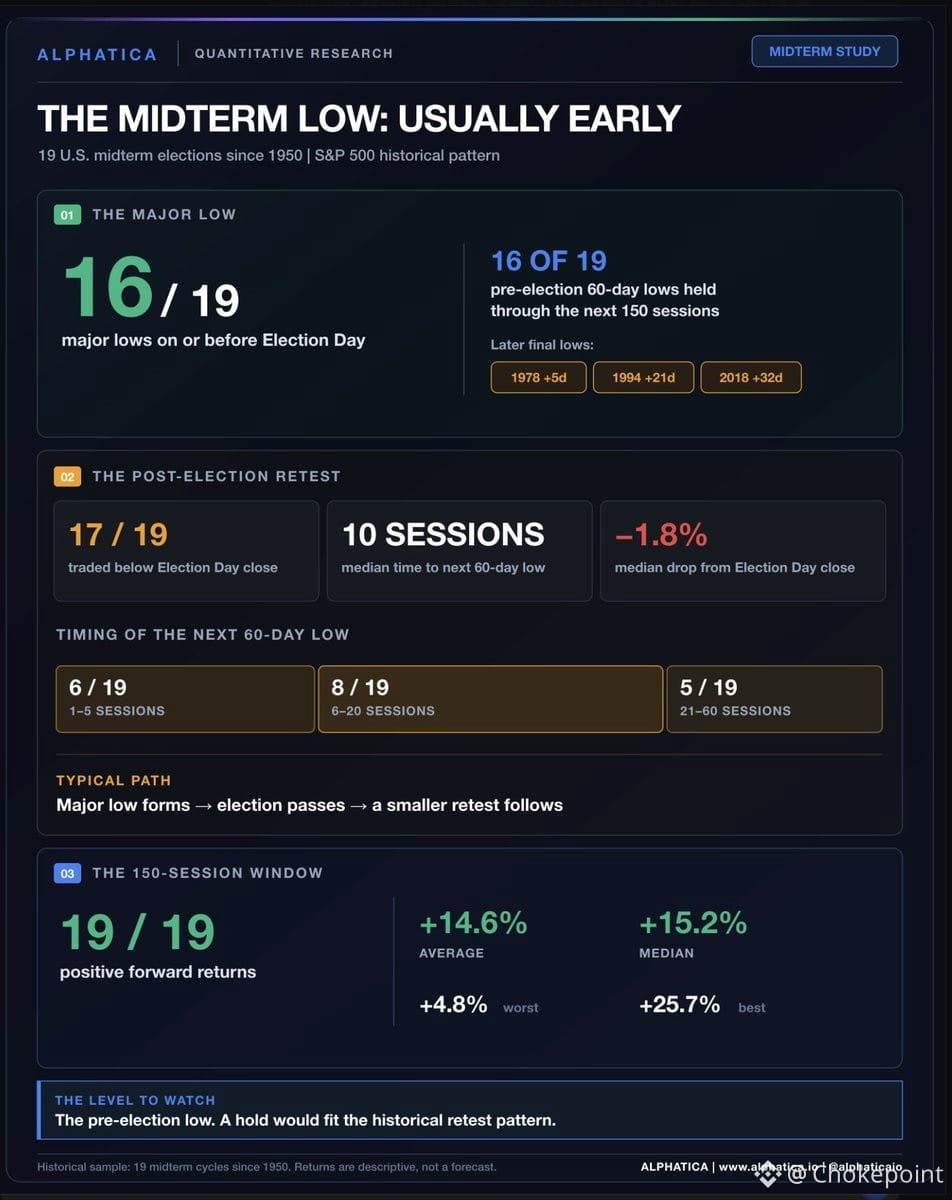
The major low is most likely in — but that doesn't mean we rip straight up.
We ran 19 midterm cycles back to 1950. In 16 of them, the market's final low came on or before Election Day. Only three cycles bottomed after: 1978 (5 sessions later), 1994 (21 sessions), 2018 (32 sessions).
The pre-election 60-day low survived the next 150 sessions in 16 of 19 cases. That's the structural relief.
But here's the part people miss: the market usually retests after the election.
The next 60-day low hit:
• Within 1–5 sessions: 6 times
• Within 6–20 sessions: 8 times
• Within 21–60 sessions: 5 times
Median timing: 10 sessions post-election.
Median decline from Election Day close: -1.8%.
Only two cycles avoided trading below the Election Day close in the following 60 sessions.
So the pattern isn't "election ends, moon." It's: major low before the election, followed by a smaller retest over the next few weeks. Then the longer window opens.
The 150-session forward return was positive after all 19 elections:
• Average: +14.6%
• Median: +15.2%
• Worst: +4.8%
• Best: +25.7%
This lines up with our breadth data: we're likely inside a bottoming zone or have already bottomed. The level that matters is the pre-election low.
If that holds, history says post-election weakness is more likely a retest than the start of a new bear market.